Combination LEXUS LS430 2003 Factory Manual PDF
[x] Cancel search | Manufacturer: LEXUS, Model Year: 2003, Model line: LS430, Model: LEXUS LS430 2003Pages: 4500, PDF Size: 87.45 MB
Page 1835 of 4500
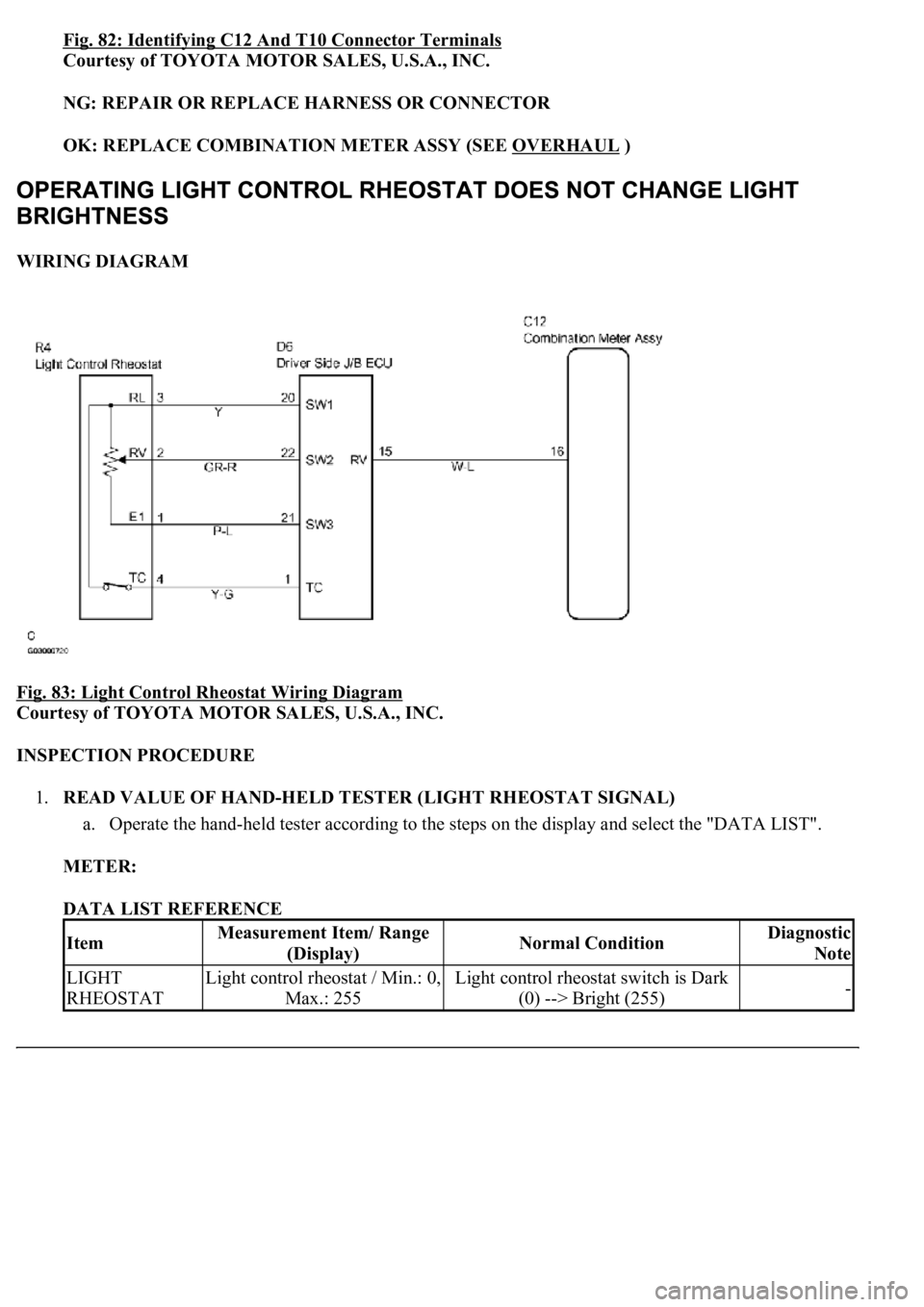
Fig. 82: Identifying C12 And T10 Connector Terminals
Courtesy of TOYOTA MOTOR SALES, U.S.A., INC.
NG: REPAIR OR REPLACE HARNESS OR CONNECTOR
OK: REPLACE COMBINATION METER ASSY (SEE OVERHAUL
)
WIRING DIAGRAM
Fig. 83: Light Control Rheostat Wiring Diagram
Courtesy of TOYOTA MOTOR SALES, U.S.A., INC.
INSPECTION PROCEDURE
1.READ VALUE OF HAND-HELD TESTER (LIGHT RHEOSTAT SIGNAL)
a. Operate the hand-held tester according to the steps on the display and select the "DATA LIST".
METER:
DATA LIST REFERENCE
ItemMeasurement Item/ Range
(Display)Normal ConditionDiagnostic
Note
LIGHT
RHEOSTATLight control rheostat / Min.: 0,
Max.: 255Light control rheostat switch is Dark
(0) --> Bright (255)-
Page 1836 of 4500
OK:
Light control can be changed within the specified range by actual operation.
NG: Go to step 2
OK: REPLACE COMBINATION METER ASSY (SEE OVERHAUL
)
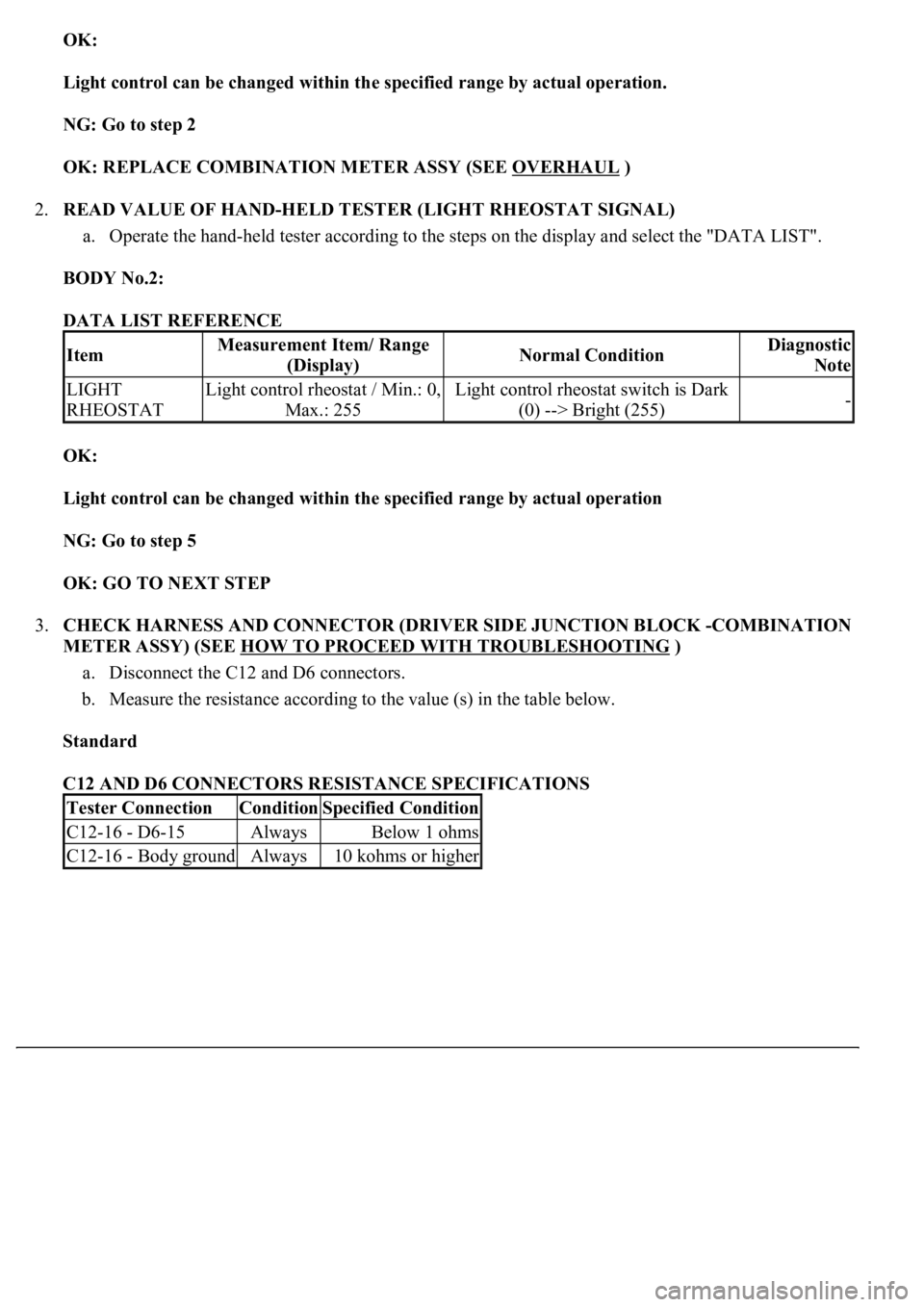
2.READ VALUE OF HAND-HELD TESTER (LIGHT RHEOSTAT SIGNAL)
a. Operate the hand-held tester according to the steps on the display and select the "DATA LIST".
BODY No.2:
DATA LIST REFERENCE
OK:
Light control can be changed within the specified range by actual operation
NG: Go to step 5
OK: GO TO NEXT STEP
3.CHECK HARNESS AND CONNECTOR (DRIVER SIDE JUNCTION BLOCK -COMBINATION
METER ASSY) (SEE HOW TO PROCEED WITH TROUBLESHOOTING
)
a. Disconnect the C12 and D6 connectors.
b. Measure the resistance according to the value (s) in the table below.
Standard
C12 AND D6 CONNECTORS RESISTANCE SPECIFICATIONS
ItemMeasurement Item/ Range
(Display)Normal ConditionDiagnostic
Note
LIGHT
RHEOSTATLight control rheostat / Min.: 0,
Max.: 255Light control rheostat switch is Dark
(0) --> Bright (255)-
Tester ConnectionConditionSpecified Condition
C12-16 - D6-15AlwaysBelow 1 ohms
C12-16 - Body groundAlways10 kohms or higher
Page 1838 of 4500
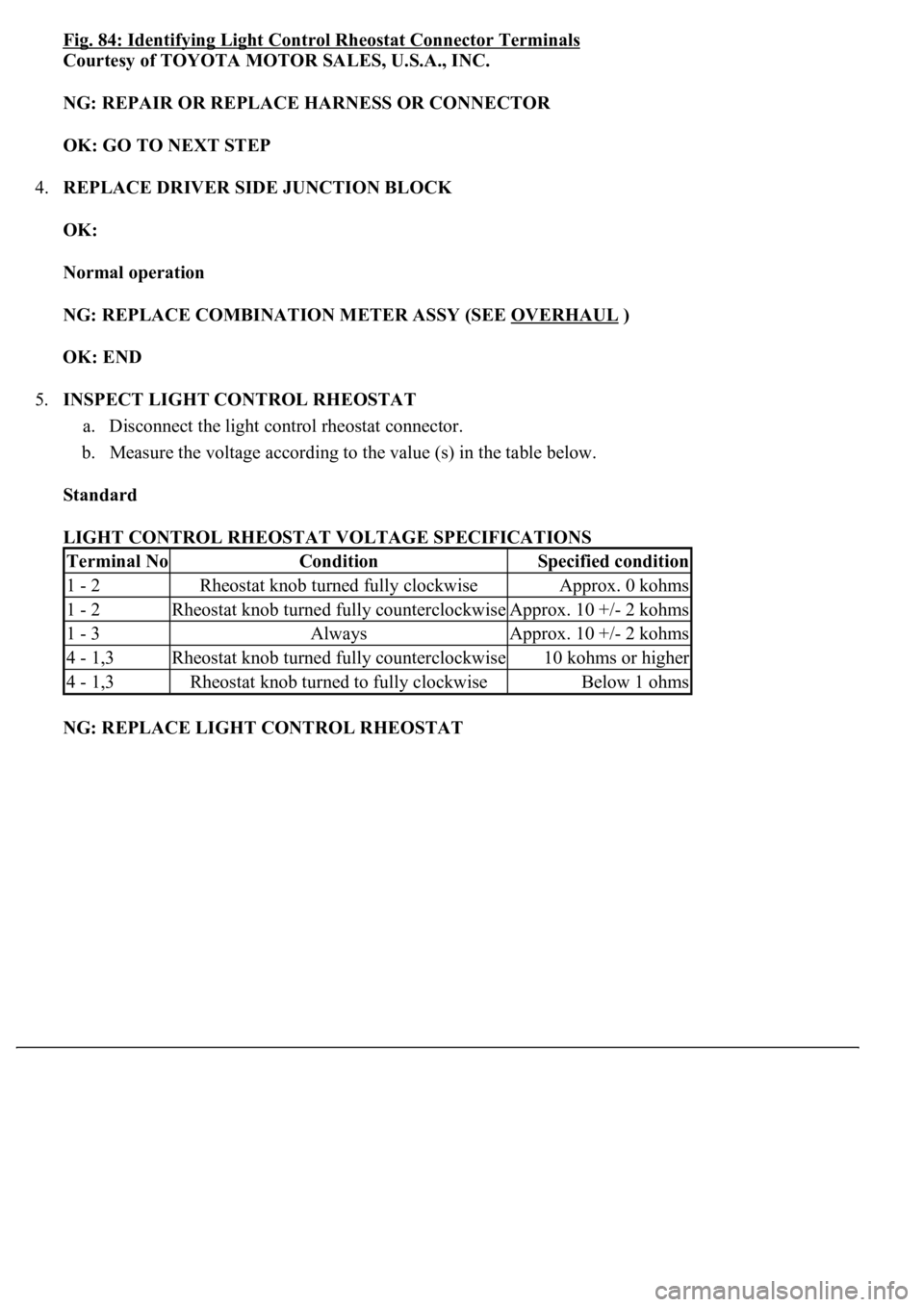
Fig. 84: Identifying Light Control Rheostat Connector Terminals
Courtesy of TOYOTA MOTOR SALES, U.S.A., INC.
NG: REPAIR OR REPLACE HARNESS OR CONNECTOR
OK: GO TO NEXT STEP
4.REPLACE DRIVER SIDE JUNCTION BLOCK
OK:
Normal operation
NG: REPLACE COMBINATION METER ASSY (SEE OVERHAUL
)
OK: END
5.INSPECT LIGHT CONTROL RHEOSTAT
a. Disconnect the light control rheostat connector.
b. Measure the voltage according to the value (s) in the table below.
Standard
LIGHT CONTROL RHEOSTAT VOLTAGE SPECIFICATIONS
NG: REPLACE LIGHT CONTROL RHEOSTAT
Terminal NoConditionSpecified condition
1 - 2Rheostat knob turned fully clockwiseApprox. 0 kohms
1 - 2Rheostat knob turned fully counterclockwiseApprox. 10 +/- 2 kohms
1 - 3AlwaysApprox. 10 +/- 2 kohms
4 - 1,3Rheostat knob turned fully counterclockwise10 kohms or higher
4 - 1,3Rheostat knob turned to fully clockwiseBelow 1 ohms
Page 1842 of 4500
7.REPLACE DRIVER SIDE JUNCTION BLOCK
OK:
Normal operation
NG: REPLACE COMBINATION METER ASSY (SEE OVERHAUL
)
OK: END
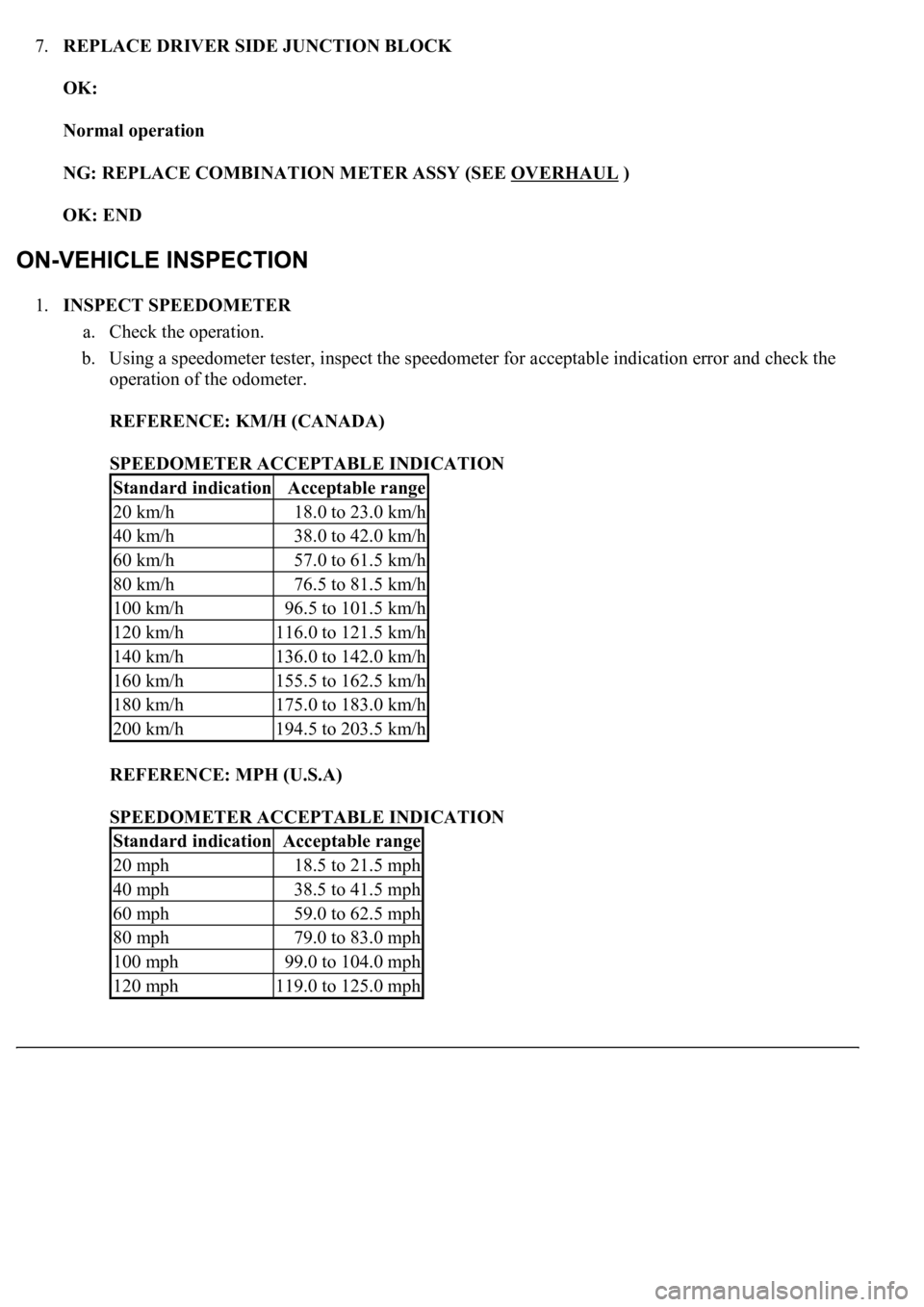
1.INSPECT SPEEDOMETER
a. Check the operation.
b. Using a speedometer tester, inspect the speedometer for acceptable indication error and check the
operation of the odometer.
REFERENCE: KM/H (CANADA)
SPEEDOMETER ACCEPTABLE INDICATION
REFERENCE: MPH (U.S.A)
SPEEDOMETER ACCEPTABLE INDICATION
Standard indicationAcceptable range
20 km/h18.0 to 23.0 km/h
40 km/h38.0 to 42.0 km/h
60 km/h57.0 to 61.5 km/h
80 km/h76.5 to 81.5 km/h
100 km/h96.5 to 101.5 km/h
120 km/h116.0 to 121.5 km/h
140 km/h136.0 to 142.0 km/h
160 km/h155.5 to 162.5 km/h
180 km/h175.0 to 183.0 km/h
200 km/h194.5 to 203.5 km/h
Standard indicationAcceptable range
20 mph18.5 to 21.5 mph
40 mph38.5 to 41.5 mph
60 mph59.0 to 62.5 mph
80 mph79.0 to 83.0 mph
100 mph99.0 to 104.0 mph
120 mph119.0 to 125.0 mph
Page 1843 of 4500
c. Check the deflection width of the speedometer indicator.
Reference: Below 0.5 km/h (0.3 mph)
2.INSPECT OUTPUT OF VEHICLE SPEED
a. Check the output signal waveform.
1. Remove the combination meter assy.
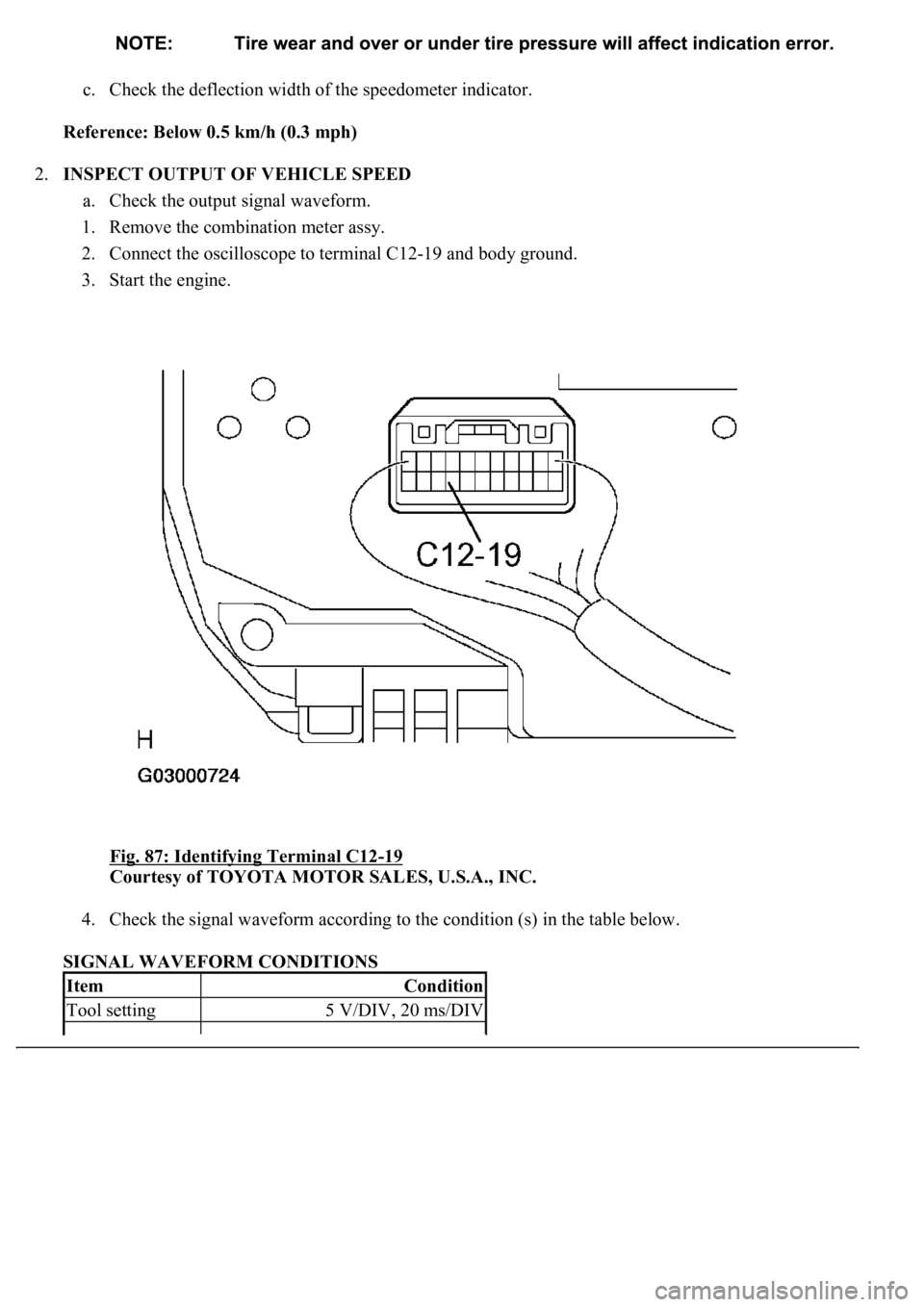
2. Connect the oscilloscope to terminal C12-19 and body ground.
3. Start the engine.
Fig. 87: Identifying Terminal C12
-19
Courtesy of TOYOTA MOTOR SALES, U.S.A., INC.
4. Check the signal waveform according to the condition (s) in the table below.
SIGNAL WAVEFORM CONDITIONS
ItemCondition
Tool setting5 V/DIV, 20 ms/DIV
Page 1904 of 4500

The computer which controls the cruise control system is combined with the ECM, and the actuator uses
the throttle position sensor and motor. A microcomputer is built into the ECM to control functions
including: ON-OFF, SET/COAST, RESUME/ACCEL, CANCEL, vehicle speed operation, motor output
control, and overdrive control.
The ECM compares the driving vehicle speed from the speed sensor with the stored vehicle speed
set through the cruise control main switch assy. The ECM instructs the throttle valve motor of the
throttle position sensor and motor to close the valve when the driving vehicle speed is greater than
the stored vehicle speed, and instructs it to open the valve when the driving speed is less than the
stored speed.
The ECM receives signals such as ON-OFF, SET/COAST, RESUME/ACCEL, and CANCEL from
the cruise control main switch assy and executes them.
The ECM turns on the indicator in the combination meter based upon the ON signal from the cruise
control main switch assy.
The ECM cancels the cruise control system when it detects that the brake pedal is depressed, based
on the stop lamp switch signal.
The ECM cancels the cruise control system when it detects that the shift position is changed from
D (6th, 5th or 4th gear) to N (3rd, 2nd or 1st gear), based on the park/neutral position switch assy
signal.
2.LIMIT CONTROL
a. Low speed limit
The lowest possible limit of the speed setting range is set at approximately 40 km/h (25 mph). The
cruise control system cannot be set when the driving vehicle speed is below the low speed limit.
Cruise control operation will be automatically canceled and the stored vehicle speed will be erased
when the vehicle speed goes below the low speed limit while the cruise control is in operation.
b. High speed limit
The highest possible limit of the speed setting range is set at approximately 200 km/h (125 mph).
The cruise control system cannot be set when the driving vehicle speed is over the high speed limit.
Speed up using RESUME/ACCEL with the cruise control main switch assy also cannot be set
beyond the high speed limit.
3.OPERATION OF CRUISE CONTROL
The cruise control main switch operates seven functions: SET, COAST, TAP-DOWN, RESUME,
ACCEL, TAP-UP, and CANCEL. The SET, TAP-DOWN and COAST functions, and the RESUME,
TAP-UP and ACCEL functions are operated with the same switch. The cruise control main switch assy is
an automatic return type switch which turns on only while operating it in each arrow direction and turns
off after releasing it.
a. SET CONTROL
Vehicle speed is stored and constant speed control is maintained when pushing the switch to SET/
COAST while drivin
g with the cruise control main switch ON-OFF button on (the CRUISE main
Page 1915 of 4500
1.DESCRIPTION
The ECU controls the cruise control system of the vehicle. The data and DTCs relating to the cruise
<004600520051005700550052004f00030056005c00560057004800500003004600440051000300450048000300550048004400470003004900550052005000030057004b004800030027002f0026001600030052004900030057004b004800030059004800
4b004c0046004f004800110003002c004900030048004c0057[her DTC or CRUISE OK is not displayed
in the multi-information display on the combination meter when checking for DTCs, there may be a
problem with the combination meter or the CAN communication and multiplex communication system.
Use the hand-held tester to check and solve the problem.
2.CHECK THE DLC3
a. The vehicle's ECM uses ISO 9141-2 for communication. The terminal arrangement of the DLC3
complies with SAE J1962 and matches the ISO 9141-2 format.
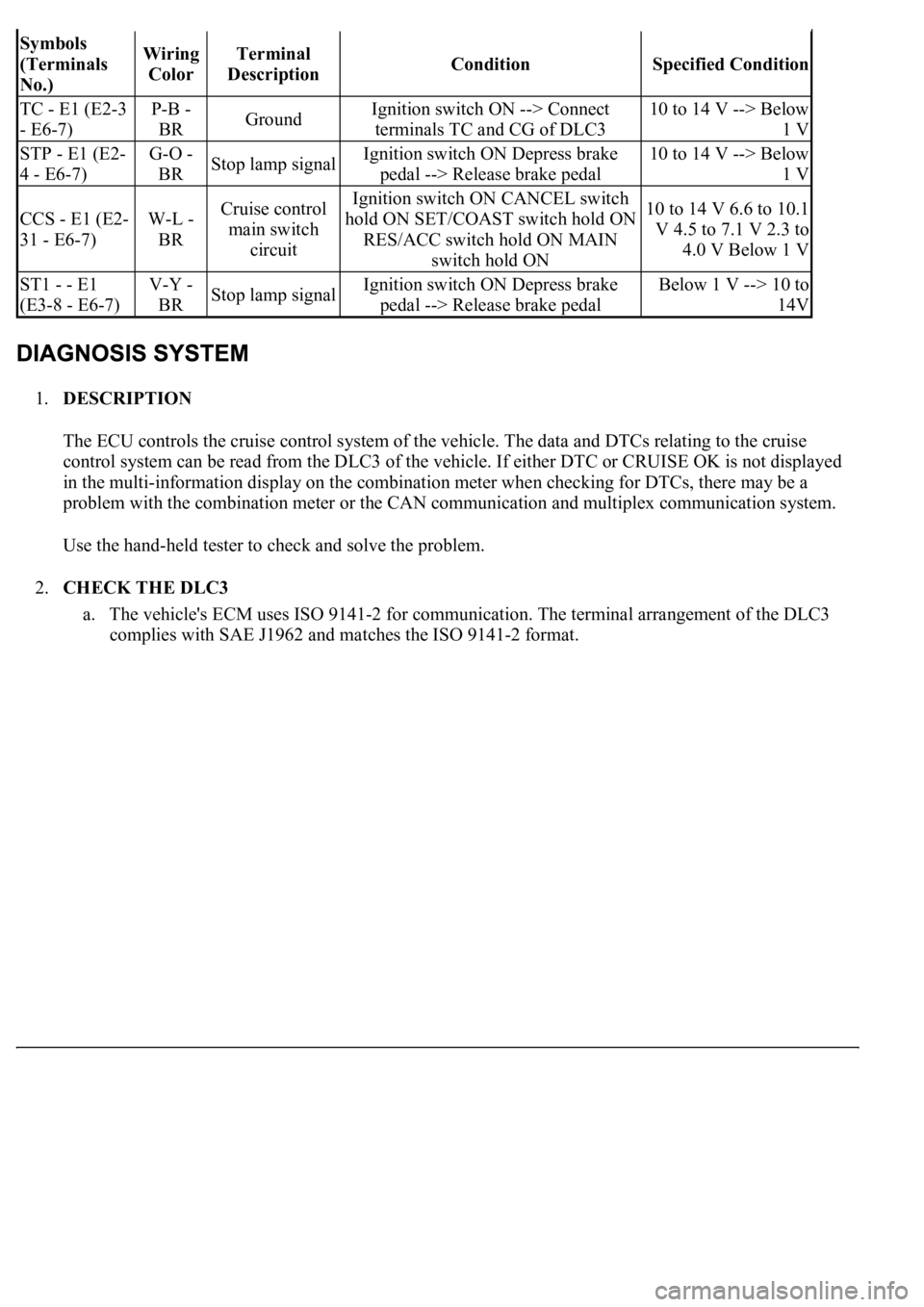
Symbols
(Terminals
No.)Wiring
ColorTerminal
DescriptionConditionSpecified Condition
TC - E1 (E2-3
- E6-7)P-B -
BRGroundIgnition switch ON --> Connect
terminals TC and CG of DLC310 to 14 V --> Below
1 V
STP - E1 (E2-
4 - E6-7)G-O -
BRStop lamp signalIgnition switch ON Depress brake
pedal --> Release brake pedal10 to 14 V --> Below
1 V
CCS - E1 (E2-
31 - E6-7)W-L -
BRCruise control
main switch
circuitIgnition switch ON CANCEL switch
hold ON SET/COAST switch hold ON
RES/ACC switch hold ON MAIN
switch hold ON10 to 14 V 6.6 to 10.1
V 4.5 to 7.1 V 2.3 to
4.0 V Below 1 V
ST1 - - E1
(E3-8 - E6-7)V-Y -
BRStop lamp signalIgnition switch ON Depress brake
pedal --> Release brake pedalBelow 1 V --> 10 to
14V
Page 1922 of 4500
The ignition switch must be turned to the ON position to proceed ACTIVE TEST using the hand-held
tester.
ACTIVE TEST DETAIL (COMBINATION METER ASSY)
HINT:
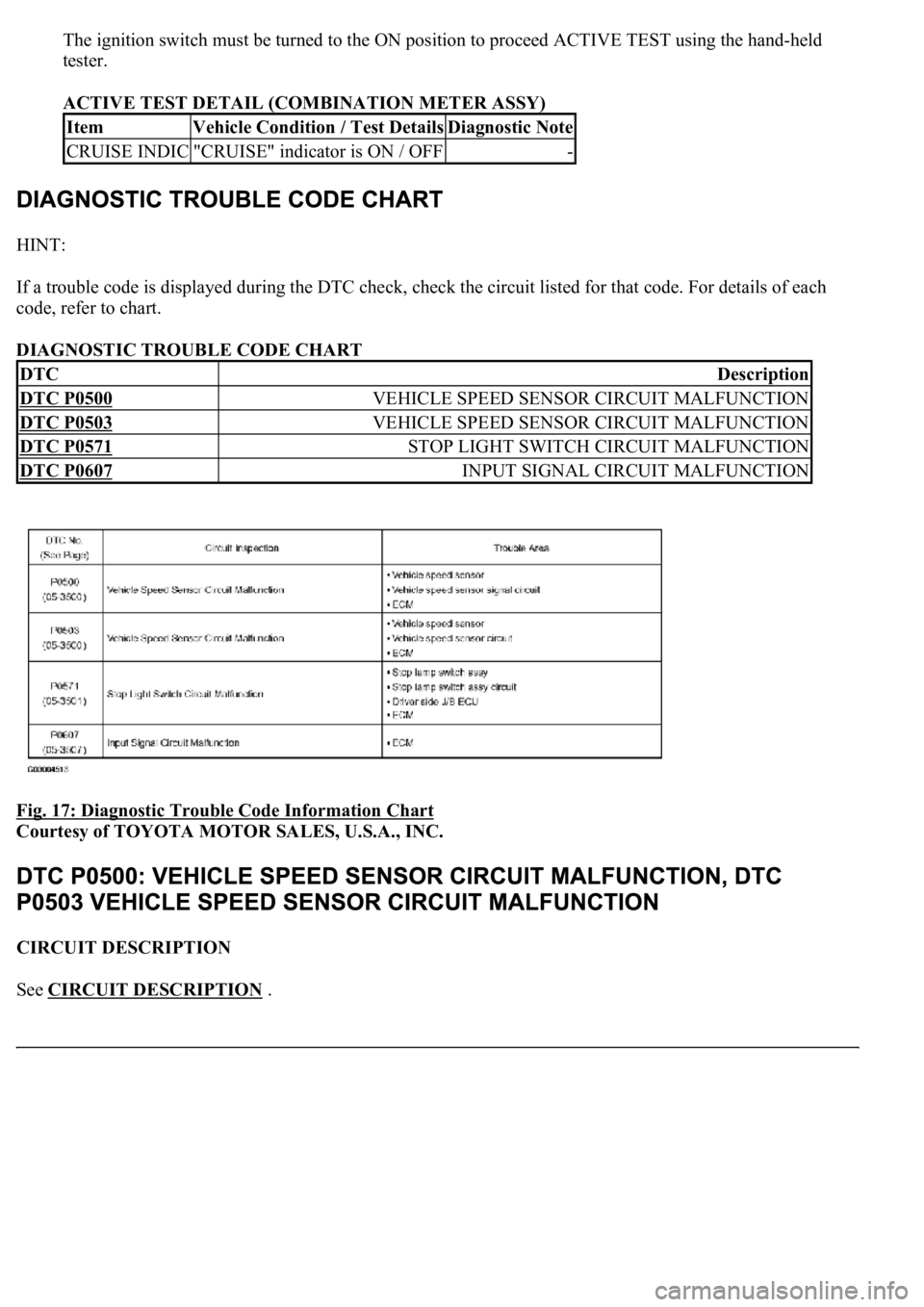
If a trouble code is displayed during the DTC check, check the circuit listed for that code. For details of each
code, refer to chart.
DIAGNOSTIC TROUBLE CODE CHART
Fig. 17: Diagnostic Trouble Code Information Chart
Courtesy of TOYOTA MOTOR SALES, U.S.A., INC.
CIRCUIT DESCRIPTION
See CIRCUIT DESCRIPTION
.
ItemVehicle Condition / Test DetailsDiagnostic Note
CRUISE INDIC"CRUISE" indicator is ON / OFF-
DTCDescription
DTC P0500 VEHICLE SPEED SENSOR CIRCUIT MALFUNCTION
DTC P0503 VEHICLE SPEED SENSOR CIRCUIT MALFUNCTION
DTC P0571 STOP LIGHT SWITCH CIRCUIT MALFUNCTION
DTC P0607 INPUT SIGNAL CIRCUIT MALFUNCTION
Page 1940 of 4500
![LEXUS LS430 2003 Factory Manual PDF Fig. 31: [Disconnecting ECM Connector]
Courtesy of TOYOTA MOTOR SALES, U.S.A., INC.
NG: REPAIR OR REPLACE HARNESS OR CONNECTOR
OK: REPLACE ECM (SEE REPLACEMENT
)
CIRCUIT DESCRIPTION
The ECM det](/img/36/57050/w960_57050-1939.png "LEXUS LS430 2003 Factory Manual PDF Fig. 31: [Disconnecting ECM Connector]
Courtesy of TOYOTA MOTOR SALES, U.S.A., INC.
NG: REPAIR OR REPLACE HARNESS OR CONNECTOR
OK: REPLACE ECM (SEE REPLACEMENT
)
CIRCUIT DESCRIPTION
The ECM det")
Fig. 31: [Disconnecting ECM Connector]
Courtesy of TOYOTA MOTOR SALES, U.S.A., INC.
NG: REPAIR OR REPLACE HARNESS OR CONNECTOR
OK: REPLACE ECM (SEE REPLACEMENT
)
CIRCUIT DESCRIPTION
The ECM detects a cruise control switch signal and sends it to the combination meter via CAN and
BEAN. Then the CRUISE main indicator light comes on.
The CRUISE main indicator light circuit uses CAN and BEAN for communication. If there are any
malfunctions in this circuit, check for DTCs in the CAN communication system and multiplex
communication system.
INSPECTION PROCEDURE
1.PERFORM ACTIVE TEST BY HAND-HELD TESTER
a. Connect the hand-held tester to the DLC3.
b. Check the CRUISE main indicator light by using ACTIVE TEST.
ACTIVE TEST DETAIL (COMBINATION METER ASSY)
OK: Indicator light comes on/goes off.
NG: GO TO COMBINATION METER SYSTEM (SEE HOW TO PROCEED WITH
TROUBLESHOOTING )
OK: Go to next step
2.READ VALUE ON HAND-HELD TESTER
a. Connect the hand-held tester to the DLC3.
b. Turn the ignition switch to the ON position and turn the hand-held tester main switch on.
c. Select the item below in the "DATA LIST", and read the display on the hand-held tester.
DATA LIST (CC (ECM))
ItemVehicle Condition / Test DetailsDiagnostic Note
CRUISE INDIC"CRUISE" indicator is ON / OFF-
ItemMeasurement Item / Display
(Range)Normal ConditionDiagnostic
Note
CCS INDICATOR
MCruise indicator signal (Main
CPU) /ON or OFFON: "CCS READY" ON OFF:
"CCS READY" OFF-
Page 1962 of 4500
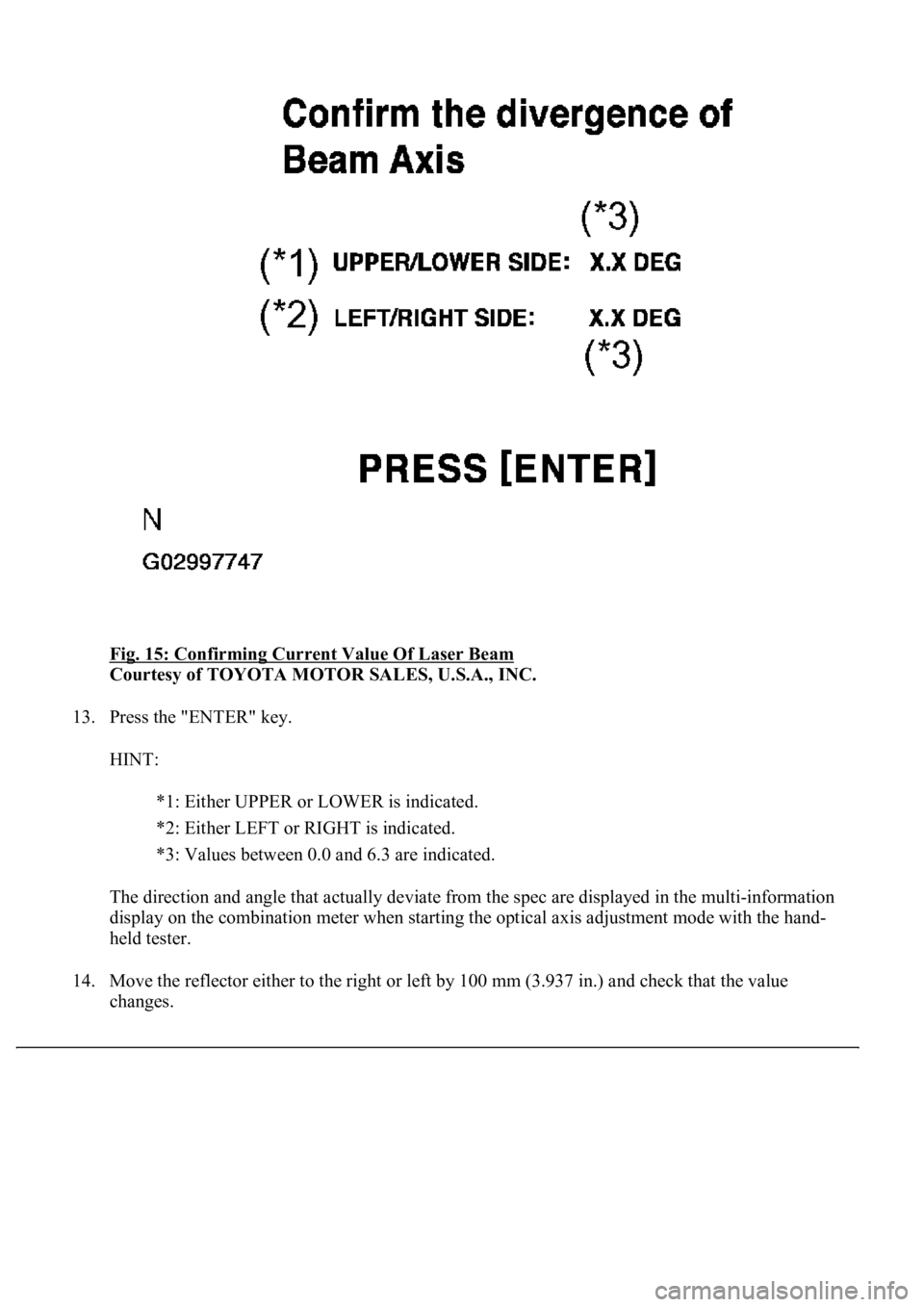
Fig. 15: Confirming Current Value Of Laser Beam
Courtesy of TOYOTA MOTOR SALES, U.S.A., INC.
13. Press the "ENTER" key.
HINT:
*1: Either UPPER or LOWER is indicated.
*2: Either LEFT or RIGHT is indicated.
*3: Values between 0.0 and 6.3 are indicated.
The direction and angle that actually deviate from the spec are displayed in the multi-information
display on the combination meter when starting the optical axis adjustment mode with the hand-
held tester.
14. Move the reflector either to the right or left by 100 mm (3.937 in.) and check that the value
changes.