wheel LEXUS LS430 2006 User Guide
[x] Cancel search | Manufacturer: LEXUS, Model Year: 2006, Model line: LS430, Model: LEXUS LS430 2006Pages: 419, PDF Size: 11.19 MB
Page 85 of 419
69
1-7. Safety information
1
Before driving
CAUTION
■SRS airbag precautions
●Improperly seated and/or restrained infants and children can be killed or seri-
ously injured by the deploying airbags. An infant or child who is too small to use a
sea
t belt should be properly secured using a child restraint system. Lexus strongly
recommends that all infants and children be placed in the rear seats of the vehicle
and properly restrained. The rear seats are the safest for infants and children.
( P.73 )
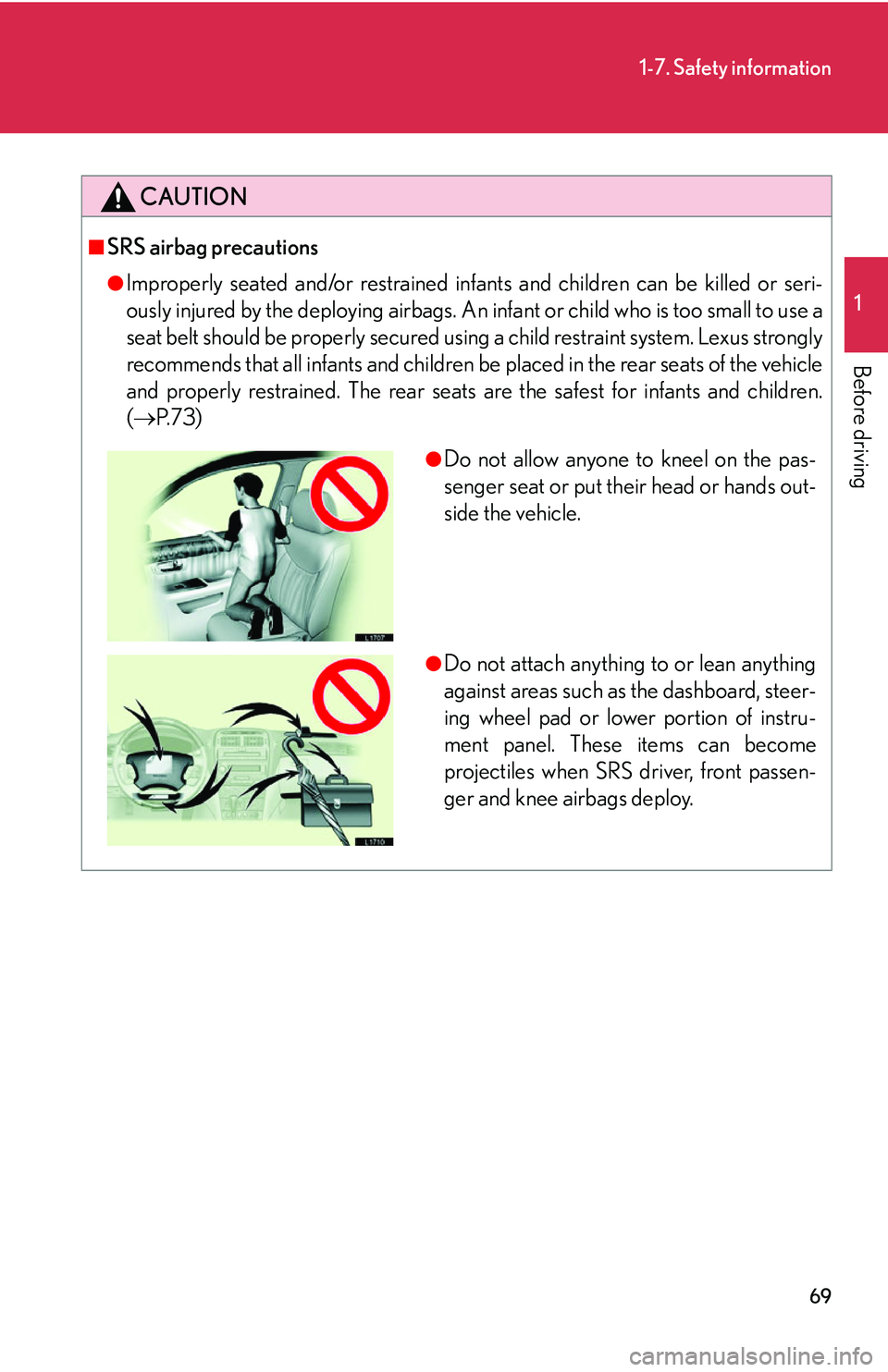
●Do not allow anyone to kneel on the pas-
senger seat or put their head or hands out-
side the vehicle.
●Do not attach anything to or lean anything
against areas such as the dashboard, steer-
ing wheel pad or lower portion of instru-
ment panel. These items can become
projectiles when SRS driver, front passen-
ger and knee airbags deploy.
Page 87 of 419
71
1-7. Safety information
1
Before driving
CAUTION
■SRS airbag precautions
●If the vinyl cover is put on the area where the SRS knee airbag will deploy, be sure
to remove it.
●Do not use seat accessories which cover the parts where the SRS side airbags
inflate as this may interfere with inflation of these airbags.
●Do not strike or apply significant levels of force to the area of the SRS airbag
components shown on P. 61. Doing so could cause a SRS airbag to malfunction.
●Do not touch any of the component parts immediately after the SRS airbag has
deployed (inflated) as they become hot.
●If breathing becomes difficult, open a d oor or window to allow fresh air in, or
leave the vehicle if it is safe to do so. Wash off any residue as soon as possible to
prevent skin irritation.
●If the areas where the SRS airbags are stored, such as the steering wheel pad and
front pillar garnish, are damaged or cracked, have them replaced by your Lexus
dealer.
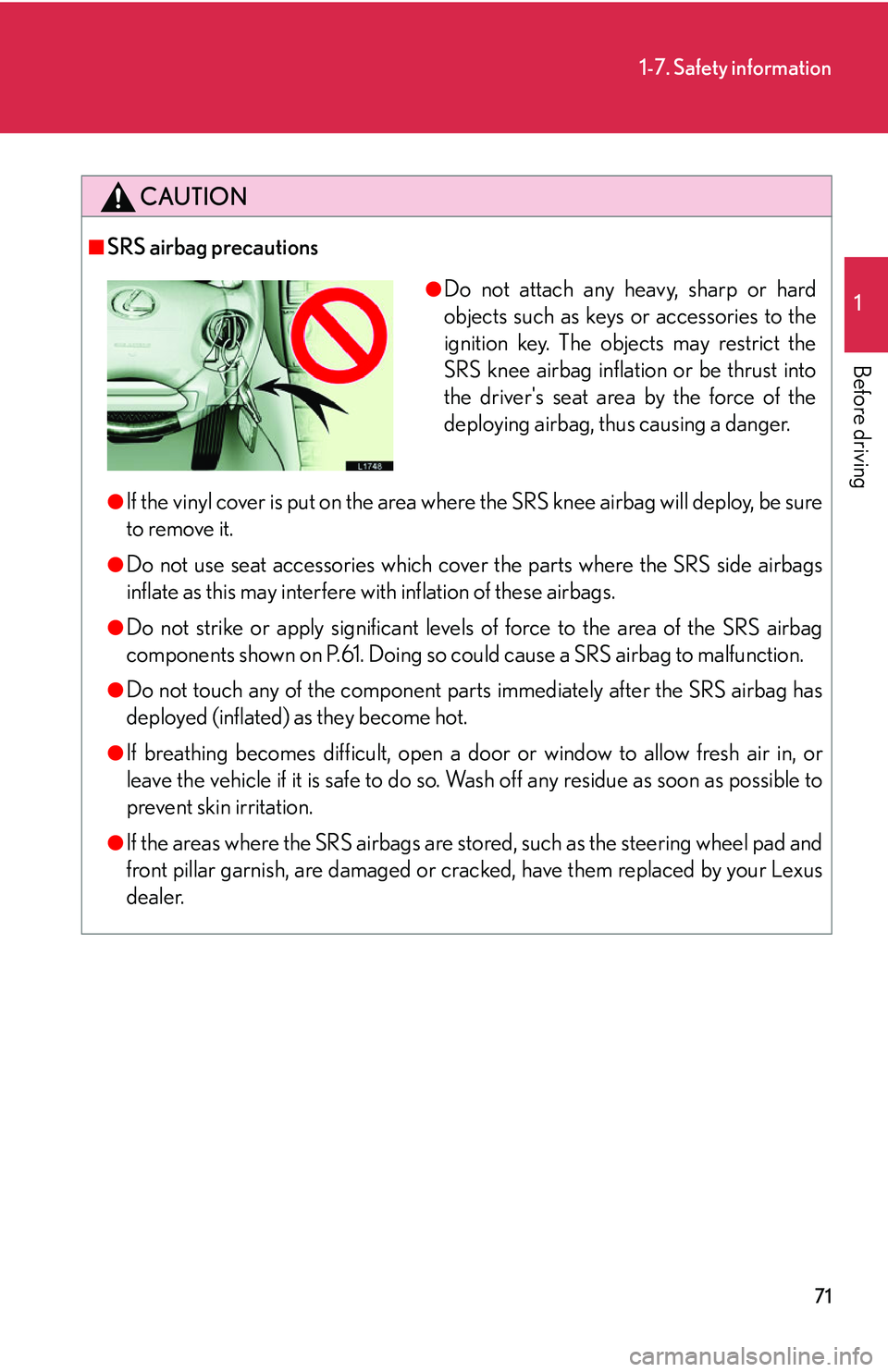
●Do not attach any heavy, sharp or hard
objects such as keys or accessories to the
ignition key. The obje cts may restrict the
SRS knee airbag inflation or be thrust into
the driver's seat area by the force of the
deploying airbag, thus causing a danger.
Page 88 of 419
72
1-7. Safety information
CAUTION
■Modifications and disposal of SRS airbag system components
Do not perform any of the following modifications to o
r dispose of the vehicle with -
out consulting your Lexus dealer. The SRS airb
ag may malfunction and may deploy
(inflate) accidentally, causing death or serious injury.
• Installation, removal, disassembl y and r
epair of the SRS airbags.
• Repairs, modifications, removal or replacement of the steering wheel, instru -
ment panel, dashboard, seats or seat upholste
ry, front, side and rear pillars or
roof side rail.
• Repair or modification of the front fender , fr
ont bumper or side of the occupant
compartment.
• Installation of snow plows, winches, etc. to the front grille (bull bars, kangaroo ba
r, etc.).
• Modifications to the vehi cle
’s suspension system.
• Installation of electronic devices such as a mobile two-way radio, cassette tape pl
ayer or CD player.
Page 106 of 419
90
2-1. Driving procedures
CAUTION
■While driving the vehicle
●Be careful when driving on slippery surfaces, as the vehicle may skid or spin when
downshifting, rapidly accelerating, braking or turning.
●Do not adjust the position of the steering wheel, seat, or mirror while driving.
Doing so may result in losing control of th
e vehicle and cause an accident, which
may cause death or serious injury.
●Always check that passengers’ arms, heads or other parts of their bodies are not
outside the vehicle, as this may result in death or serious injury.
■When shifting the selector lever
Use caution if accelerating while shifting.
This may lead to unexpected rapid acceleration of the vehicle that may cause an
ac
cident.
■When the vehicle is stopped
●Do not race the engine.
If the vehicle is in any gear other than P or N the
vehicle may accelerate suddenly
and unexpectedly, and may cause an accident.
●Do not leave the vehicle with the engine running for a long time.
If such a situation cannot be avoided, park the vehicle in an open space and
che
ck that exhaust fumes do no t enter the vehicle interior.
●Always keep a foot on the brake pedal while the engine is running to prevent an
accident caused by the vehicle moving.
Page 109 of 419
93
2-1. Driving procedures
2
When driving
NOTICE
■Avoiding damage to vehicle parts
●Do not turn the steering wheel fully in either direction and hold it there for a long
time. Doing so may damage the power steering pump.
●When driving over bumps in the road, drive as slowly as possible to avoid damag-
ing the wheels, underside of the vehicle, etc.
■If you hear a squealing or scraping no ise (brake pad wear limit indicators)
Have your Lexus dealer check and replace the brake pads as soon as possible.
Exp
ensive rotor damage can result if the pads are not replaced when needed.
■If a malfunction is detected while driving
A flat or damaged tire may c
ause the following situations. Hold the steering wheel
firmly and gradually press the brak e pedal to slow down the vehicle.
• It may be difficult to control your vehicle.
• The vehicle will make abnormal sounds.
• The vehicle will behave abnormally.
Replace a flat tire with a new one. ( P.
3 4 7 )
Page 111 of 419
95
2-1. Driving procedures
2
When driving
■If the engine does not start
Check whether the other keys will start the engine.
If they work, your key may be broken. Have the key checked at your Lexus dealer.
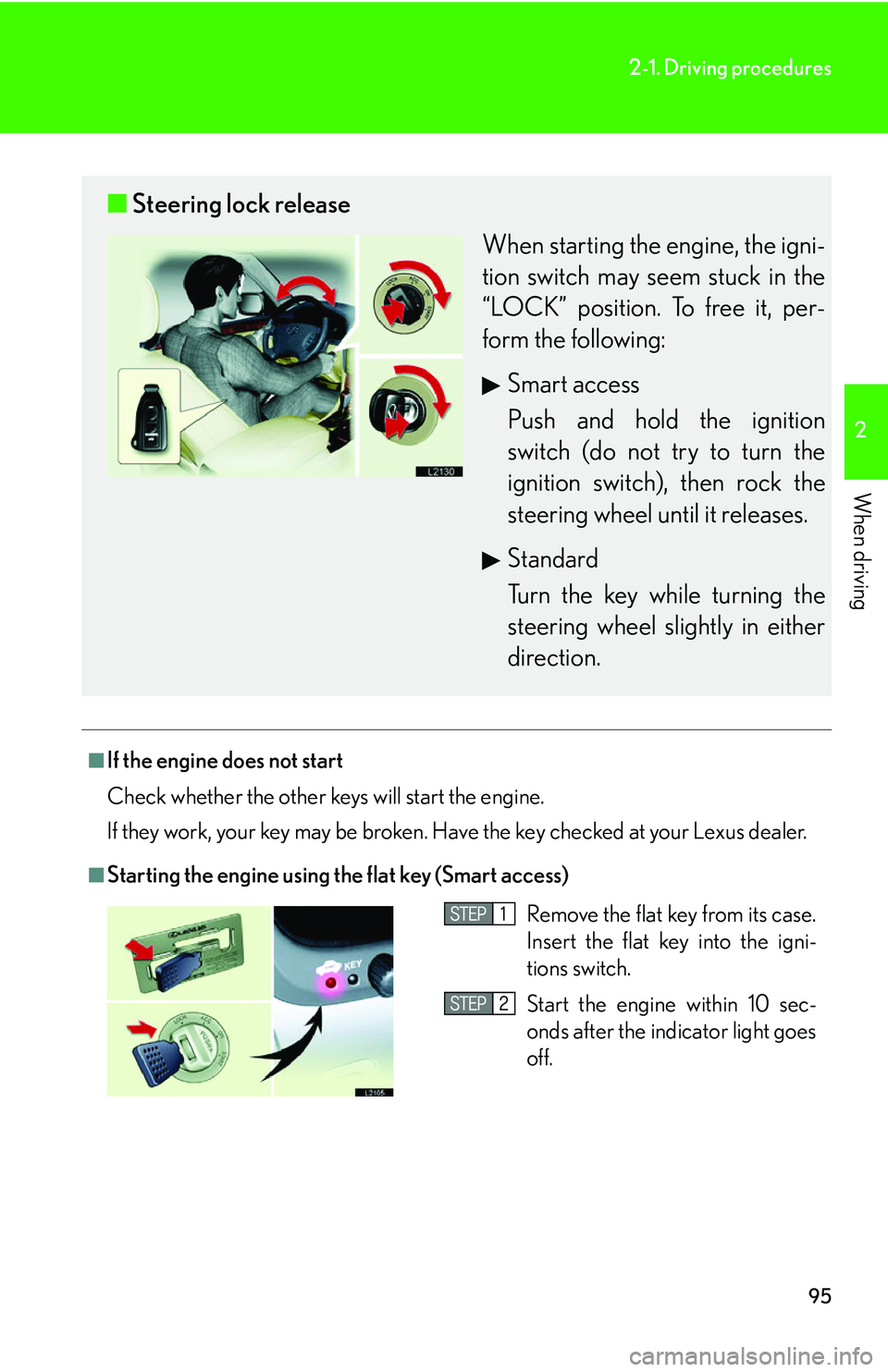
■Starting the engine using the flat key (Smart access)
■ Steering lock release
When starting the engine, the igni -
tion switch may seem stuck in the
“L
OCK” position. To free it, per -
form the following:
Smart access
Push and hold the ignition
s
witch (do not try to turn the
ignition switch), then rock the
steering wheel until it releases.
Standard
Turn the key while turning the
steering wheel slightly in either
dir
ection.
Remove the flat key from its case.
Insert the flat key into the igni-
tions switch.
Start the engine within 10 sec-
onds after the indicator light goes
off.
Page 156 of 419

140
2-4. Using other driving systems
Driver assist systems
When VSC or TRAC is operating
If the vehicle is in danger of slip-
ping or the rear wheels spin, the
slip indicator ligh t flash to indicate
that the s
ystems have been
engaged.
A buzzer (intermittent) sounds
when VSC is operating.
To help enhance improve vehicle safety, the following systems operate auto-
matically in certain driving conditions.
■ ABS (Anti-lock Braking System)
Help ensure steering performance in th e event of sudden braking or driving
on slippery road surfaces.
■ BA (Brake Assist)
Generates an increased level of braking force after the brake pedal is
pushed, when the system detects a panic stop situation.
■VSC (Vehicle Stability Control)
Helps the driver to control skidding wh en swerving suddenly or turning on
slippery road surfaces.
■ TRAC (Traction Control)
Helps maintain drive power and prevents spinning the rear wheels when
starting the vehicle or accelerating on slippery roads.
■Pre-collision system (if equipped)
( P. 1 4 3 )
Page 157 of 419

141
2-4. Using other driving systems
2
When driving
To disable VSC and TRAC
If the vehicle gets stuck in fresh snow or mud, VSC and TRAC may
reduce power from the engine to the wheels. You may need to turn VSC
and TRAC off to enable you to rock the vehicle in order to free the vehi-
cle.
Push the button to turn off VSC
and TRAC.
The TRAC OFF indicator light
turns on.
Push the button again to turn the
sy
stem back on.
1
■Operating sounds and vibrations caus ed by the ABS, VSC & TRAC systems
●A sound may be heard from the engine compartment when the engine is
started or just after the vehicle begins to move. This sound does not indicate that
a malfunction has occurred in any of these systems.
●Any of the following conditions may occur when the ABS, VSC and TRAC sys -
tems are operating. None of these indicates that a malfunction has occurred.
• A sound may be heard.
• Vibrations may be felt through the vehicle body and steering.
• A motor sound may be heard after the vehicle comes to a stop.
• The brake pedal may pulsate slightly while the ABS is activated.
• The brake pedal may move forward slightly after the ABS is activated.
■Failure warning for VSC or TRAC system
If an error in the VSC or TRAC systems is
detected, the master warning light and
TRAC OFF indicator light comes on, a warning tone sounds. (P.334 )
Page 158 of 419
142
2-4. Using other driving systems
CAUTION
Any of the following conditions may result in-an accident which could cause death
or serious injury:
■The ABS may not operate effectively when:
●The limits of tire gripping performance have been exceeded.
●If the vehicle hydroplanes while driving at high speed while the road is wet or
slick.
■Stopping distance when the ABS is activated will exceed that of normal condi -
tions
The ABS is not designed to shorten the v
ehicle’s stopping distance. Always main -
tain a safe distance between you and the vehicle in front of you, particularly in the
fo
llowing situations.
• When driving on dirt, gravel or snow-covered roads
• When driving with tire chains
• When driving over bumps in the road
• When driving over roads with potholes or uneven roads
• When towing a trailer
■TRAC may not operate effectively when:
Directional control and power may not be ac hi
evable while driving on slippery road
surfaces, even if the TRAC system is operating.
Do not drive the vehicle in conditions where control and power may be lost.
■When the slip indicator flashe s and a warning buzzer sounds
This situation occurs immediately before VSC is activated. Always drive carefully.
R
eckless driving may cause an at the recommended level.
Exercise particular care when an indicator light flashes and a buzzer sounds.
■Replacing tires
Ensure that all tires are the same size an d
brand, have the same tread pattern, and
that the level of tire pressure is at the recommended level.
The ABS and VSC systems may not operate no rmal
ly if different tires are installed
to the vehicle.
Contact your Lexus dealer for further info rmati
on when replacing tires or wheels.
Page 165 of 419
149
2-5. Driving information
2
When driving
Winter driving tips
Carry out the necessary preparations and inspections before driving the
vehicle in winter. Always drive the vehicle in a manner appropriate for the
prevailing weather and roadway conditions.
■ Pre-winter preparations
●Use fluids appropriate to the p revailing outside temperatures.
• Engine oil
• Engine coolant
• Washer fluid
●Inspect the level and specific gravity of battery electrolyte.
●Have the vehicle fitted with four sno w tires or purchase a set of tire
chains for the rear tires.
Ensure that all tires are the same si
ze and brand, and that chains
match the size of the tires.
■ Befor
e driving the vehicle
Perform the following steps acco r
ding to the driving conditions.
●Do not forcibly try to open a window or move a wiper that has fro-
zen. Pour some warm water over the frozen area to melt the ice.
Wipe away the water immediately to pr
event it from freezing.
●To ensure proper operation of the climate control system fan,
remove any snow that has accumulated on the air inlet vents in front
of the windshield.
●Remove any ice that has accumulated on the vehicle chassis.
●Periodically check for and remove any excess ice or snow that may
accumulate in the wheel well or brakes.