wheel LEXUS LS430 2006 Owner's Manual
[x] Cancel search | Manufacturer: LEXUS, Model Year: 2006, Model line: LS430, Model: LEXUS LS430 2006Pages: 419, PDF Size: 11.19 MB
Page 167 of 419
151
2-5. Driving information
2
When driving
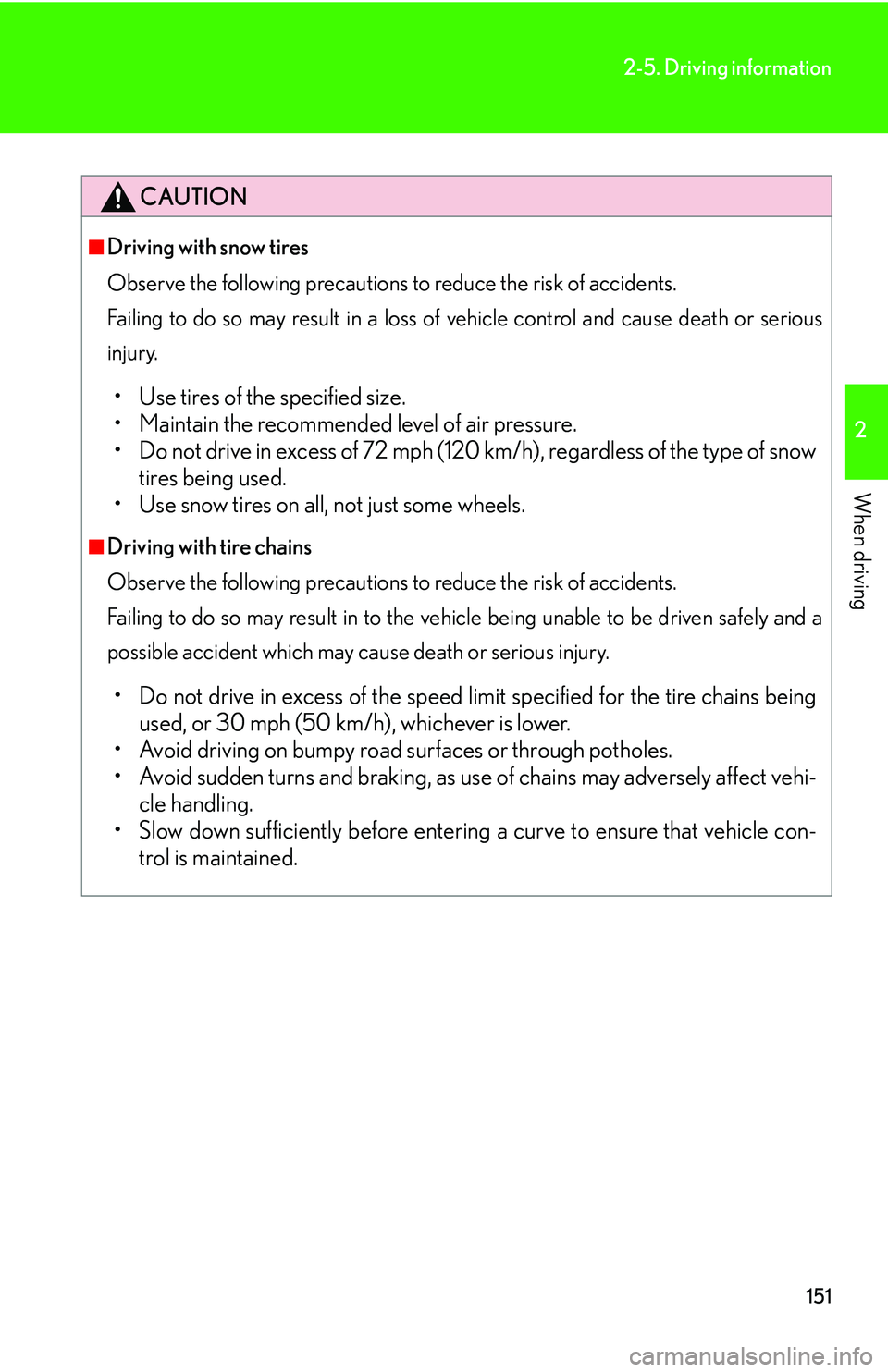
CAUTION
■Driving with snow tires
Observe the following precautions to reduce the risk of accidents.
Failing to do so may result in a loss of vehicle control and cause death or serious
injur
y.
• Use tires of the specified size.
• Maintain the recommended level of air pressure.
• Do not drive in excess of 72 mph (120 km/h), regardless of the type of snow tir
es being used.
• Use snow tires on all, not just some wheels.
■Driving with tire chains
Observe the following precautions to reduce the risk of accidents.
Failing to do so may result in to the vehicle being unable to be driven safely and a
p
ossible accident which may cause death or serious injury.
• Do not drive in excess of the speed limit specified for the tire chains being
used, or 30 mph (50 km/h), whichever is lower.
• Avoid driving on bumpy road s
urfaces or through potholes.
• Avoid sudden turns and braking, as us e of chains may a
dversely affect vehi-
cle handling.
• Slow down sufficiently before entering a curve to ensure that vehicle con -
trol is maintained.
Page 170 of 419
154
2-5. Driving information
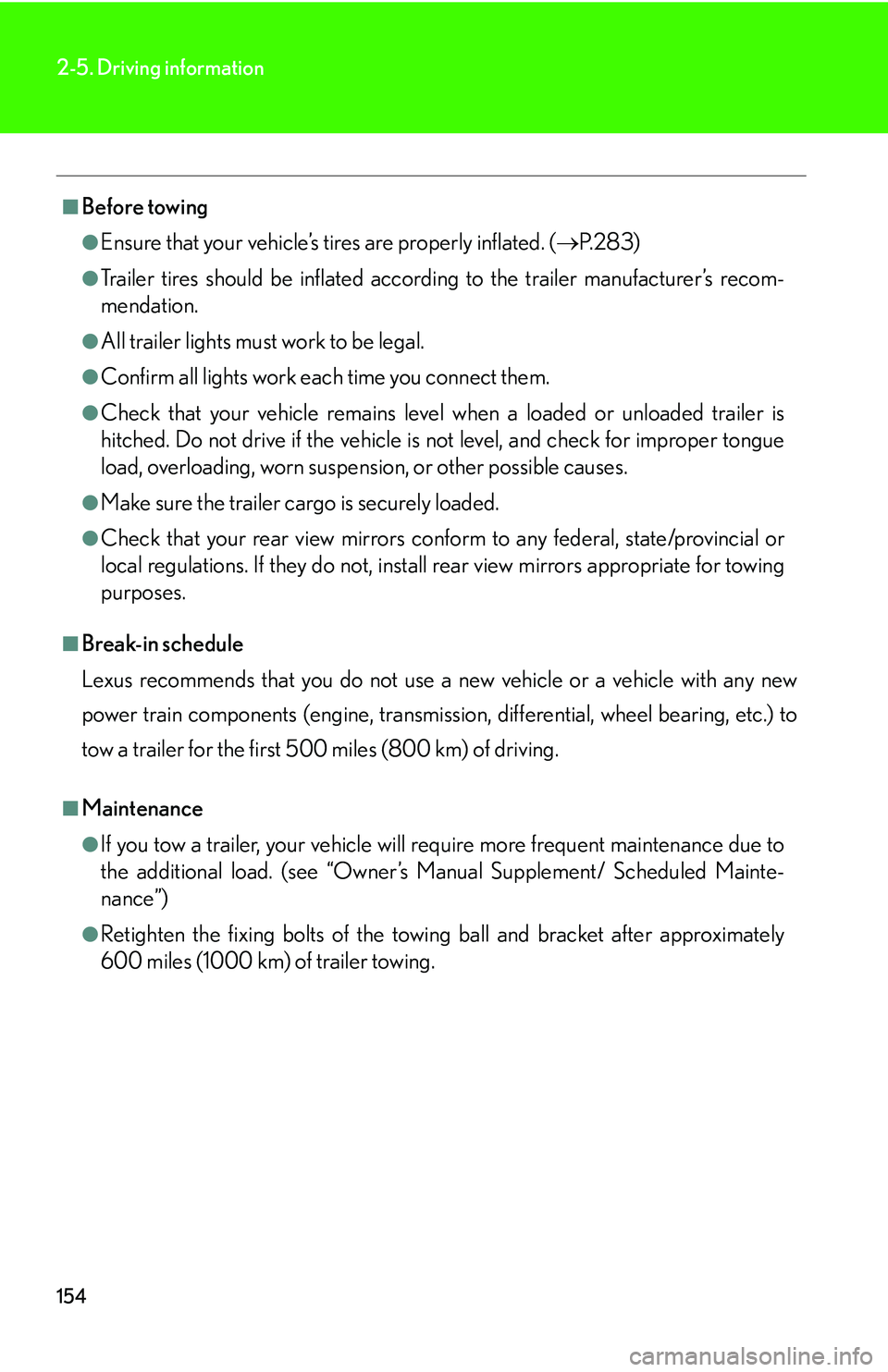
■Before towing
●Ensure that your vehicle’s tires are properly inflated. (P.283 )
●Trailer tires should be inflated according to the trailer manufacturer’s recom -
mendation.
●All trailer lights must work to be legal.
●Confirm all lights work each time you connect them.
●Check that your vehicle remains level when a loaded or unloaded trailer is
hitched. Do not drive if the vehicle is not level, and check for improper tongue
load, overloading, worn suspension, or other possible causes.
●Make sure the trailer cargo is securely loaded.
●Check that your rear view mirrors conform to any federal, state/provincial or
local regulations. If they do not, instal l rear view mirrors appropriate for towing
purposes.
■Break-in schedule
Lexus recommends that you do not use a new vehicle or a vehicle with any new
p
ower train components (engine, transmissi on, differential, wheel bearing, etc.) to
tow a trailer for the first 500 miles (800 km) of driving.
■Maintenance
●If you tow a trailer, your vehicle will require more frequent maintenance due to
the additional load. (see “Owner’s Manual Supplement/ Scheduled Mainte -
nance”)
●Retighten the fixing bolts of the towing ball and bracket after approximately
600 miles (1000 km) of trailer towing.
Page 172 of 419
156
2-5. Driving information
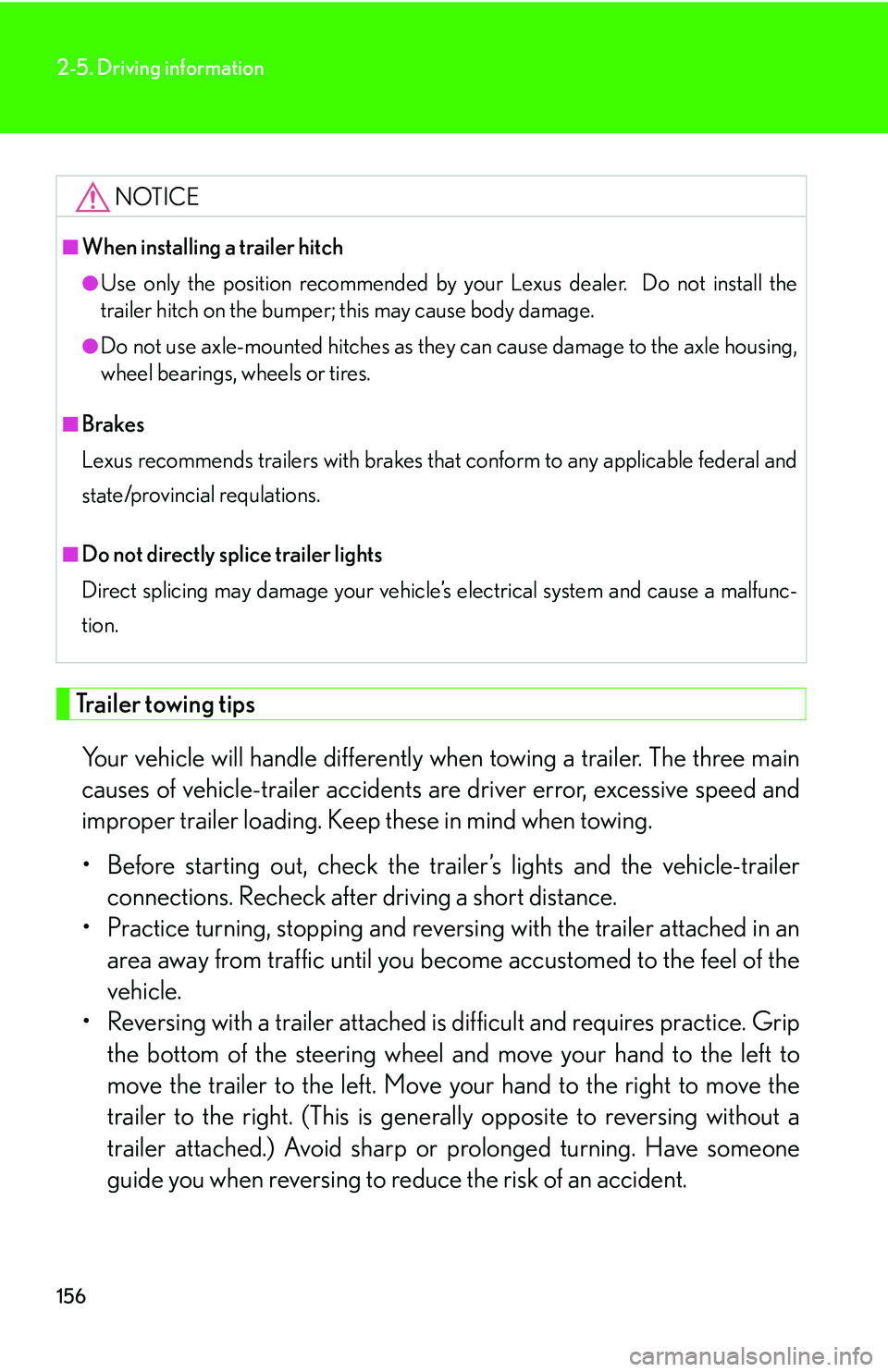
Trailer towing tips
Your vehicle will handle differently when towing a trailer. The three main
causes of vehicle-trailer accidents are driver error, excessive speed and
improper trailer loading. Keep these in mind when towing.
• Before starting out, check the tra iler
’s lights and the vehicle-trailer
connections. Recheck after driving a short distance.
• Practice turning, stopping and reversi ng with the tr
ailer attached in an
area away from traffic until you be come accustomed to the feel of the
vehicle.
• Reversing with a trailer attached is dif
ficult and requires practice. Grip
the bottom of the steering wheel and move your hand to the left to
move the trailer to the left. Move yo ur hand to the right to move the
trailer to the right. (This is gene rally opposite to reversing without a
trailer attached.) Avoid sharp or prolonged turning. Have someone
guide you when reversing to redu ce the risk of an accident.
NOTICE
■When installing a trailer hitch
●Use only the position recommended by your Lexus dealer. Do not install the
trailer hitch on the bumper; this may cause body damage.
●Do not use axle-mounted hitches as they can cause damage to the axle housing,
wheel bearings, wheels or tires.
■Brakes
Lexus recommends trailers with brakes that conform to any applicable federal and
sta
te/provincial requlations.
■Do not directly splice trailer lights
Direct splicing may damage your vehicle’s electrical system and cause a malfunc -
tion.
Page 173 of 419
157
2-5. Driving information
2
When driving
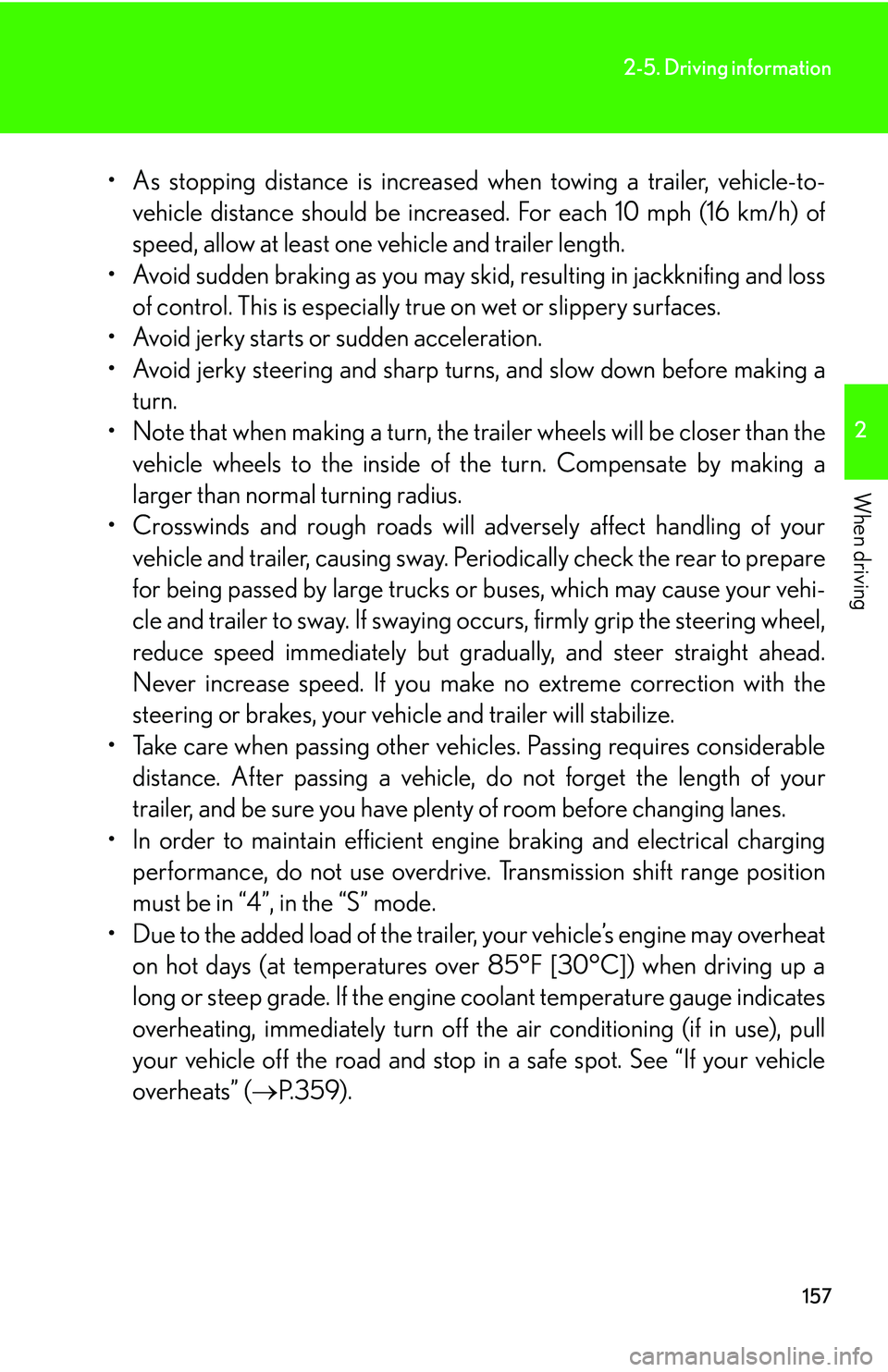
• As stopping distance is increased when towing a trailer, vehicle-to-
vehicle distance should be increas ed. For each 10 mph (16 km/h) of
speed, allow at least one vehicle and trailer length.
• Avoid sudden braking as you may sk id, r
esulting in jackknifing and loss
of control. This is especially true on wet or slippery surfaces.
• Avoid jerky starts or sudden acceleration.
• Avoid jerky steering and sharp turn s, and slo
w down before making a
turn.
• Note that when making a turn, the tr ailer wheels will be closer than the
v
ehicle wheels to the inside of th e turn. Compensate by making a
larger than normal turning radius.
• Crosswinds and rough roads will ad v
ersely affect handling of your
vehicle and trailer, causing sway. Peri odically check the rear to prepare
for being passed by large trucks or buses, which may cause your vehi-
cle and trailer to sway. If s
waying occurs, firmly grip the steering wheel,
reduce speed immediately but gradually, and steer straight ahead.
Never increase speed. If you make no extreme correction with the
steering or brakes, your vehi cle and trailer will stabilize.
• Take care when passing other vehicl es. P
assing requires considerable
distance. After passing a vehicle, do not forget the length of your
trailer, and be sure you have plenty of room before changing lanes.
• In order to maintain efficient engine br
aking and electrical charging
performance, do not use overdrive. Transmission shift range position
must be in “4”, in the “S” mode.
• Due to the added load of the traile r
, your vehicle’s engine may overheat
on hot days (at temperatures over 85°F [30°C]) when driving up a
long or steep grade. If the engine coolant temperature gauge indicates
overheating, immediately turn off the air conditioning (if in use), pull
your vehicle off the road and stop in a safe spot. See “If your vehicle
overheats” ( P.359 ).
Page 174 of 419
158
2-5. Driving information
• Always place wheel blocks under both the vehicle and the trailer
wheels when parking. Apply the pa rking brake firmly, and put the
transmission in “P”. Avoi d parking on a slope, but if unavoidable, do so
only after performing the following:
Apply the brakes and keep them applied.
Have someone place wheel blocks under both the v
ehicle and
trailer wheels.
When the wheel blocks are in pl ace, r
elease the brakes slowly
until the blocks absorb the load.
Apply the parking brake firmly.
Shift into “P” and turn off the engine.
• When restarting after parking on a slope:
With the transmission in the “P” position, star
t the engine. Be sure
to keep the brake pedal pressed.
Shift into “3”, “2”, “1”, or the “R” position (if r
eversing).
Release the parking brake and br ak
e pedal, and slowly pull or
back away from the wheel blocks.
Stop and apply the brakes.
Have someone retrieve the blocks.
Page 176 of 419
160
2-5. Driving information
Dinghy towing
NOTICE
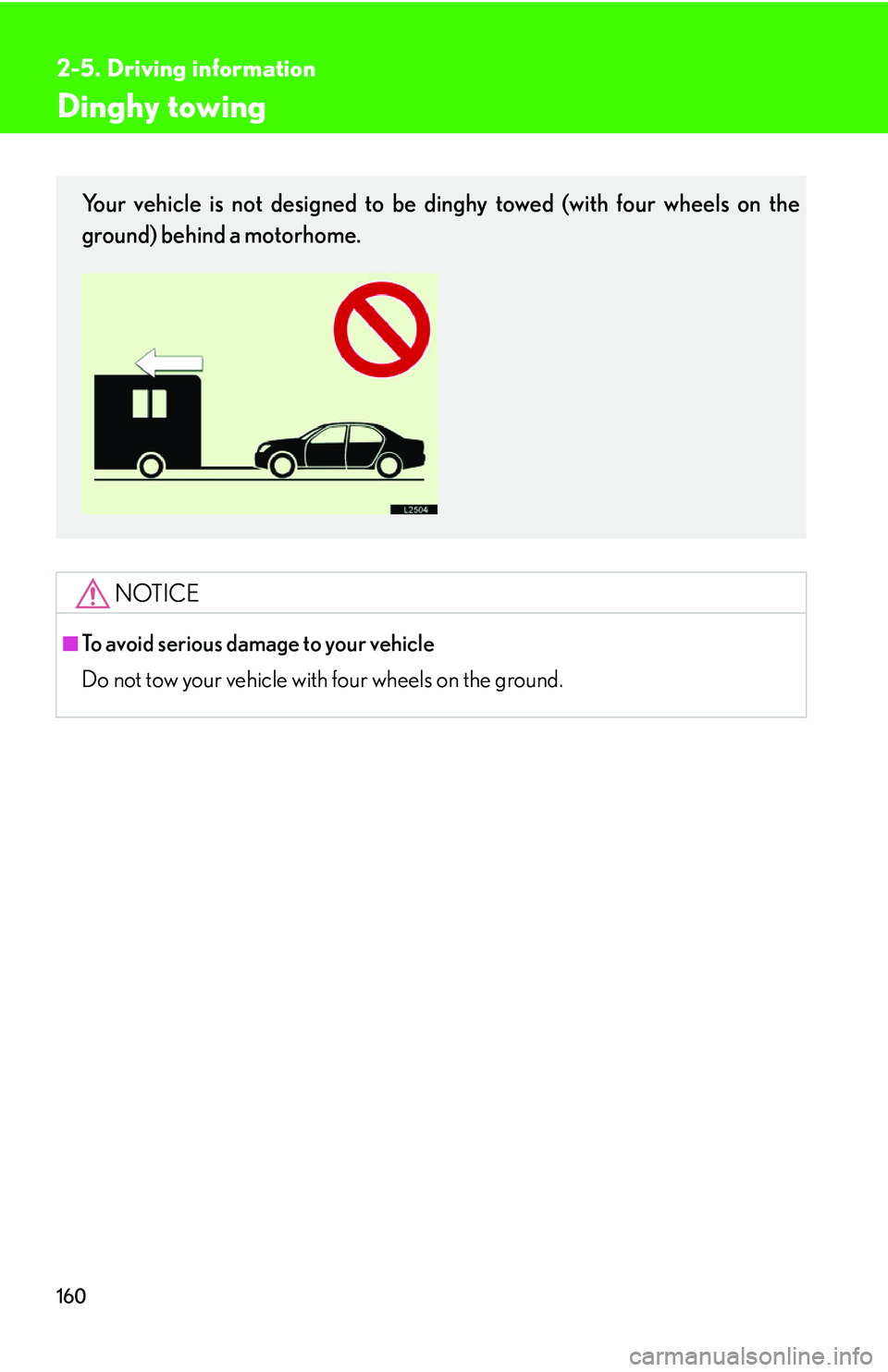
■To avoid serious damage to your vehicle
Do not tow your vehicle with four wheels on the ground.
Your vehicle is not designed to be dinghy towed (with four wheels on the
ground) behind a motorhome.
Page 211 of 419
195
3-2. Using the audio system
3
Interior features
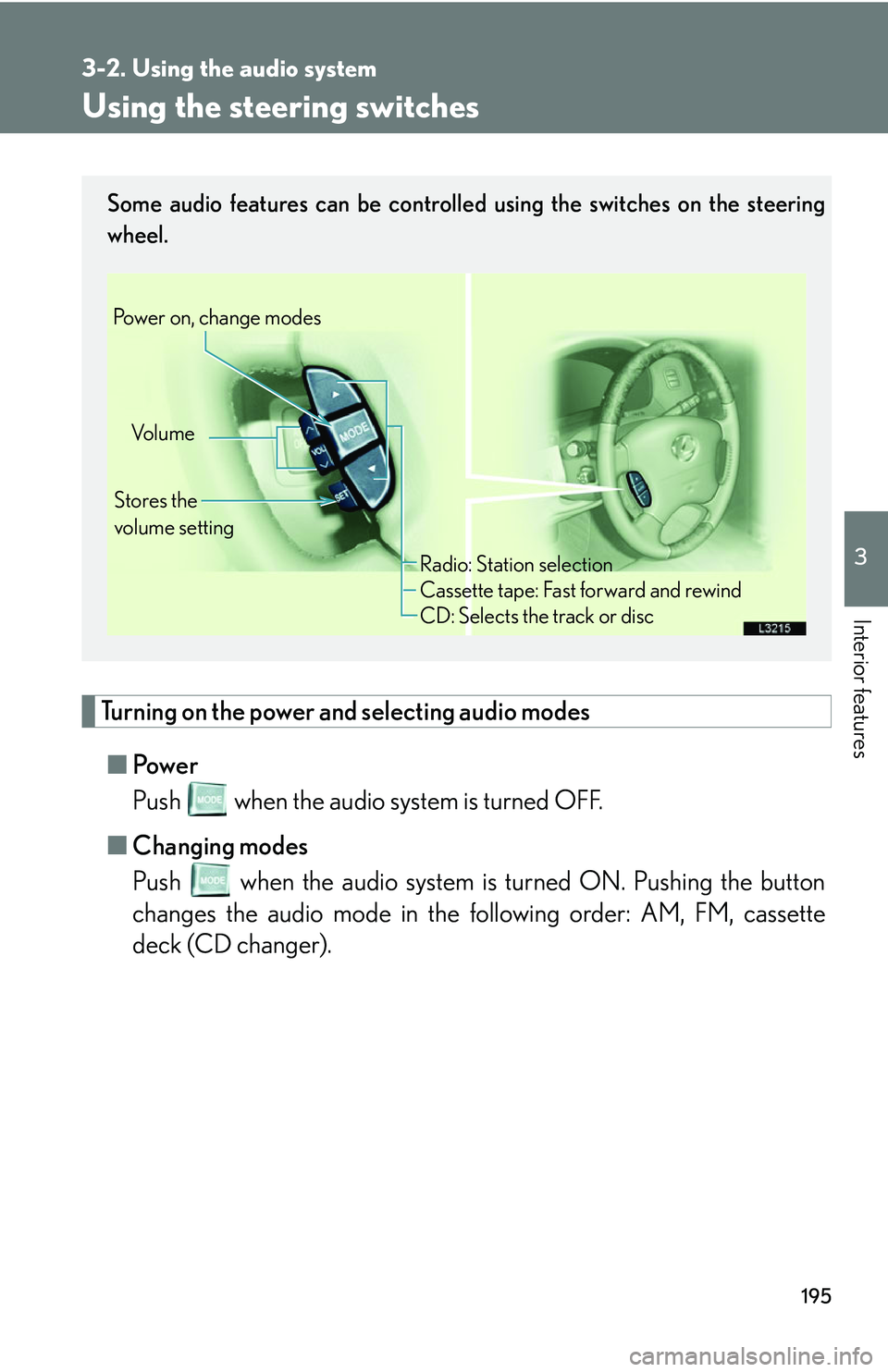
Using the steering switches
Turning on the power and selecting audio modes
■Pow e r
Push when the audio system is turned OFF.
■ Cha
nging modes
Push when the audio system is turned ON. Pushing the button
changes the audio mode in the following order: AM, FM, cassette
deck (CD changer).
Some audio features can be controlled using the switches on the steering
wheel.
Vo l u m e
Stores the
volume setting
Power on, change modes
Radio: Station selection
Cassette tape: Fast forward and rewind
CD: Selects the track or disc
Page 213 of 419
197
3-2. Using the audio system
3
Interior features
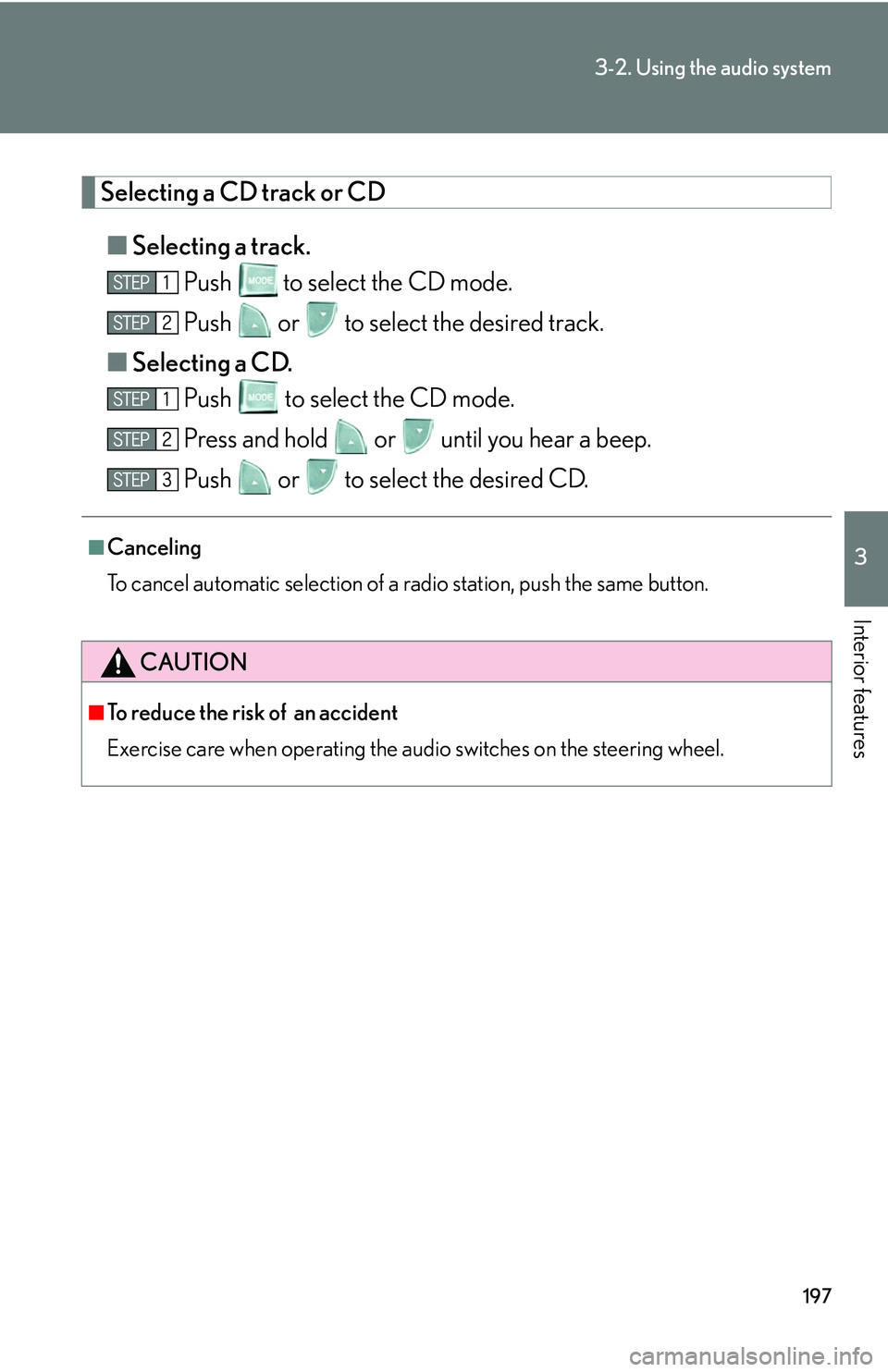
Selecting a CD track or CD
■Selecting a track.
Push
to select the CD mode.
Push or to select the desired track.
■ Selecting a CD
.
Push to select the CD mode.
Press and hold or until you hear a beep.
Push or to select the desired CD.
■Canceling
To cancel automatic selection of a radio station, push the same button.
CAUTION
■To reduce the risk of an accident
Exercise care when operating the audio switches on the steering wheel.
Page 259 of 419
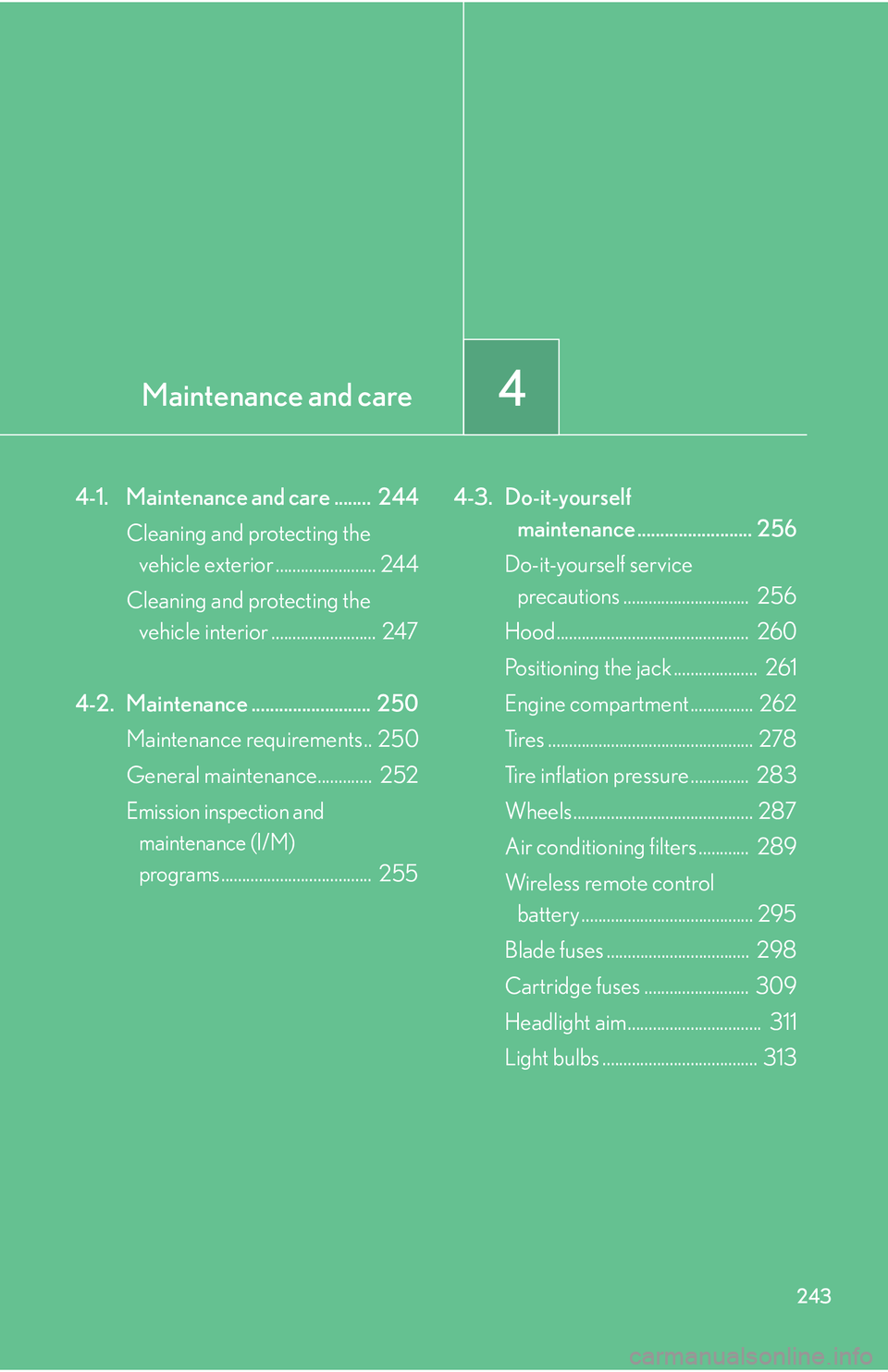
4Maintenance and care
243
4-1. Maintenance and care ........ 244
Cleaning and protecting the vehicle exterior ........................ 244
Cleaning and protecting the vehicle interior ......................... 247
4-2. Maintenance .......................... 250 Maintenance requirements.. 250
General maintenance............. 252
Emission inspection and
maintenance (I/M)
programs.................................... 255 4-3. Do-it-yourself
maintenance ......................... 256
Do-it-yourself service
precautions .............................. 256
Hood.............................................. 260
Positioning the jack .................... 261
Engine compartment ............... 262
Tires ................................................. 278
Tire inflation pressure .............. 283
Wheels ........................................... 287
Air conditioning filters
............ 289
Wireless remote control battery ......................................... 295
Blade fuses .................................. 298
Cartridge fuses ......................... 309
Headlight aim................................ 311
Light bulbs ..................................... 313
Page 260 of 419
244
4-1. Maintenance and care
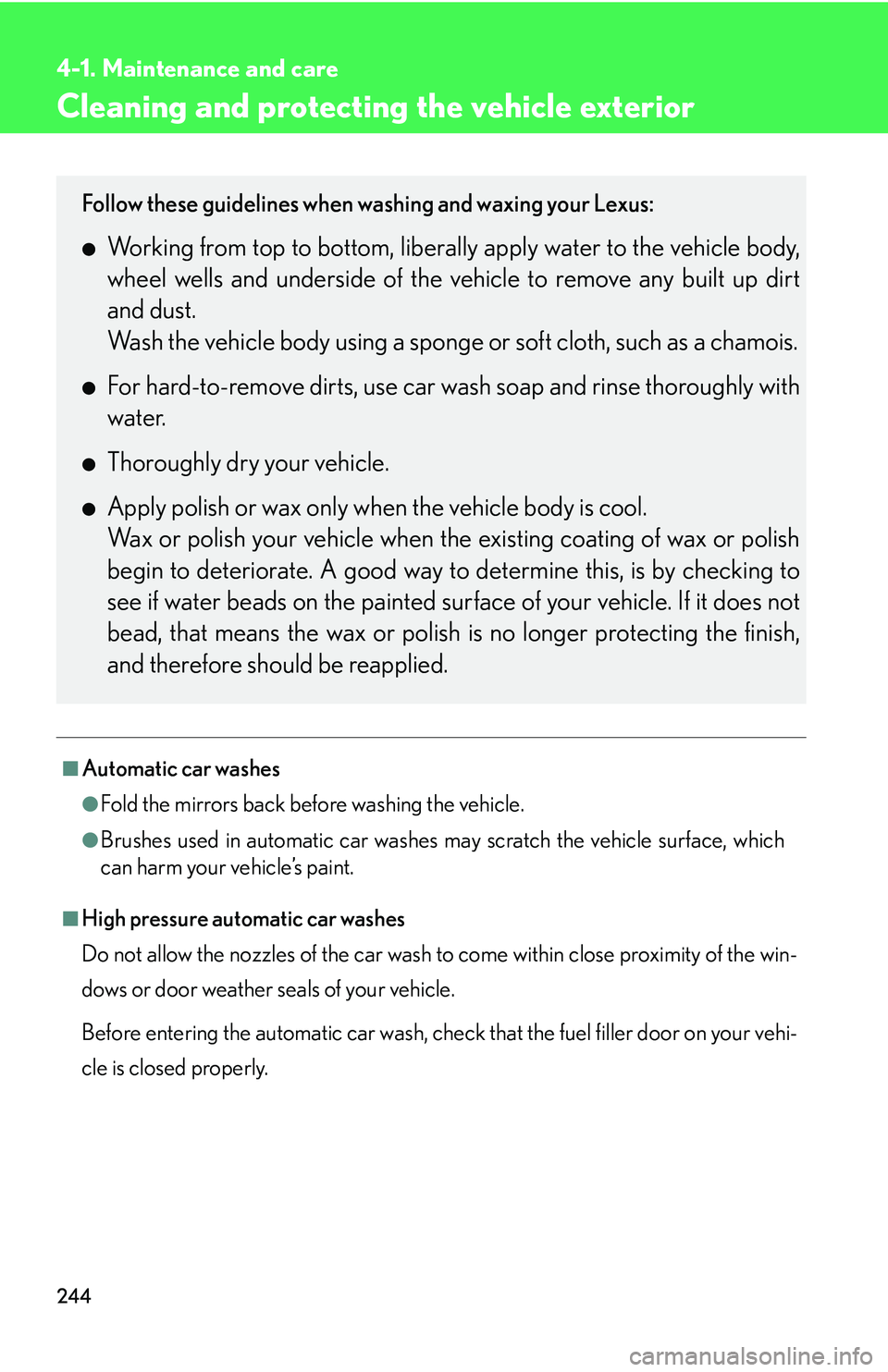
Cleaning and protecting the vehicle exterior
■Automatic car washes
●Fold the mirrors back before washing the vehicle.
●Brushes used in automatic car washes may scratch the vehicle surface, which
can harm your vehicle’s paint.
■High pressure automatic car washes
Do not allow the nozzles of the car wash to come within close proximity of the win-
dows or door weather seals of your vehicle.
Before entering the automatic car wash, check that the fuel filler door on your vehi -
cle is closed properly.
Follow these guidelines when washing and waxing your Lexus:
●Working from top to bottom, libera lly apply water to the vehicle body,
wheel wells and underside of the vehi cle to remove any built up dirt
and dust.
Wash the vehicle body using a sponge or sof
t cloth, such as a chamois.
●For hard-to-remove dirts, use car wash soap and rinse thoroughly with
water.
●Thoroughly dry your vehicle.
●Apply polish or wax only when the vehicle body is cool.
Wax or polish your vehicle when the e
xisting coating of wax or polish
begin to deteriorate. A good way to determine this, is by checking to
see if water beads on the painted surfac e of your vehicle. If it does not
bead, that means the wax or polish is no longer protecting the finish,
and therefore should be reapplied.