wheel LEXUS LS430 2006 Service Manual
[x] Cancel search | Manufacturer: LEXUS, Model Year: 2006, Model line: LS430, Model: LEXUS LS430 2006Pages: 419, PDF Size: 11.19 MB
Page 337 of 419
5
When trouble arises
321
5-1. Essential information
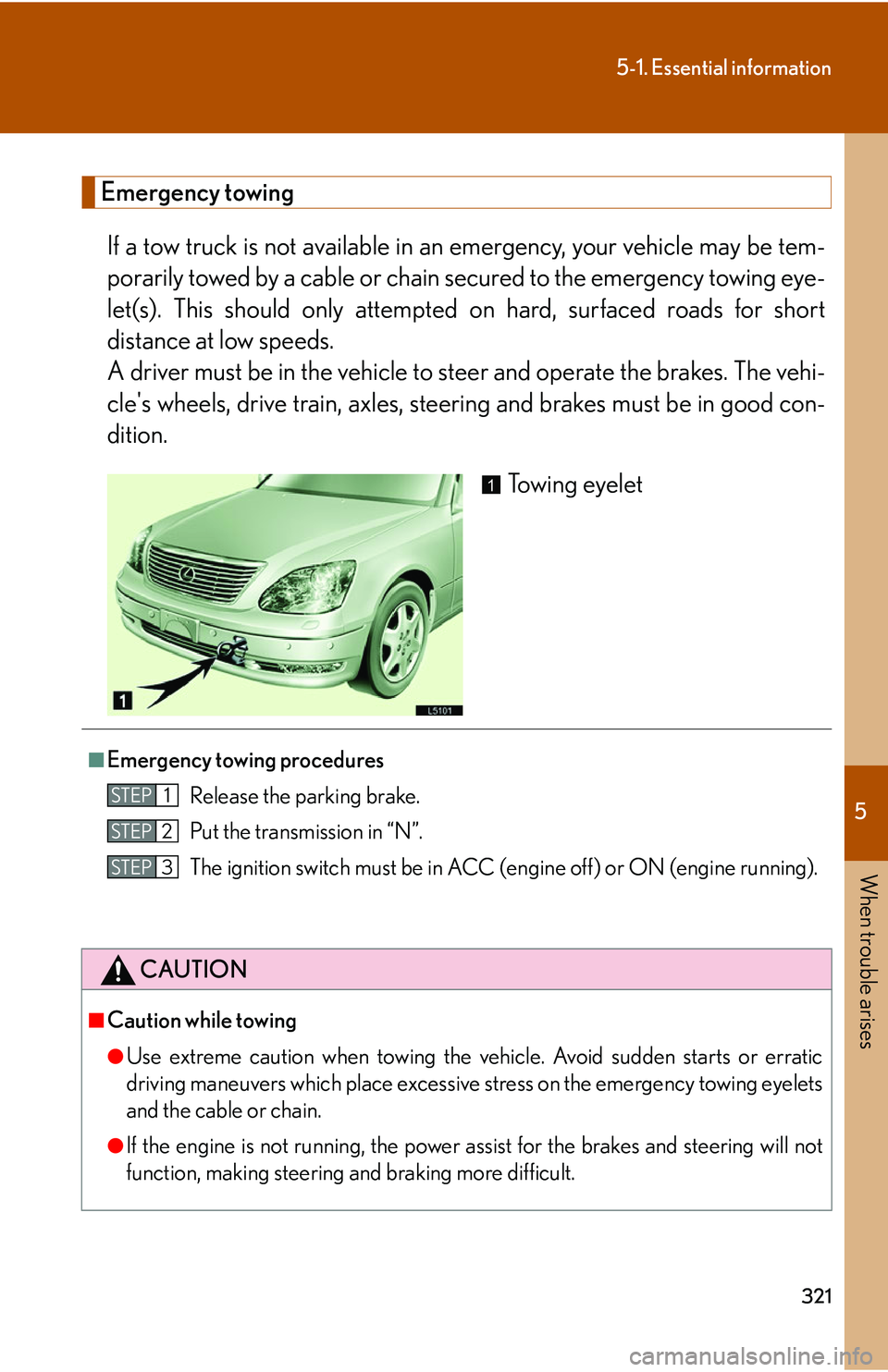
Emergency towing
If a tow truck is not available in an emergency, your vehicle may be tem-
porarily towed by a cable or chain secur
ed to the emergency towing eye-
let(s). This should only attempted on har
d, surfaced roads for short
distance at low speeds.
A driver must be in the vehicle to steer and oper
ate the brakes. The vehi-
cle's wheels, drive train, axles, steer ing and br
akes must be in good con-
dition.
Towing eyelet
1
■Emergency towing proceduresRelease the parking brake.
Put the transmission in “N”.
The ignition switch must be in ACC (eng
ine off) or ON (engine running).
CAUTION
■Caution while towing
●Use extreme caution when towing the vehi cle. Avoid sudden starts or erratic
driving maneuvers which place excessive stress on the emergency towing eyelets
and the cable or chain.
●If the engine is not running, the power assi st for the brakes and steering will not
function, making steering and braking more difficult.
STEP1
STEP2
STEP3
Page 338 of 419
322
5-1. Essential information
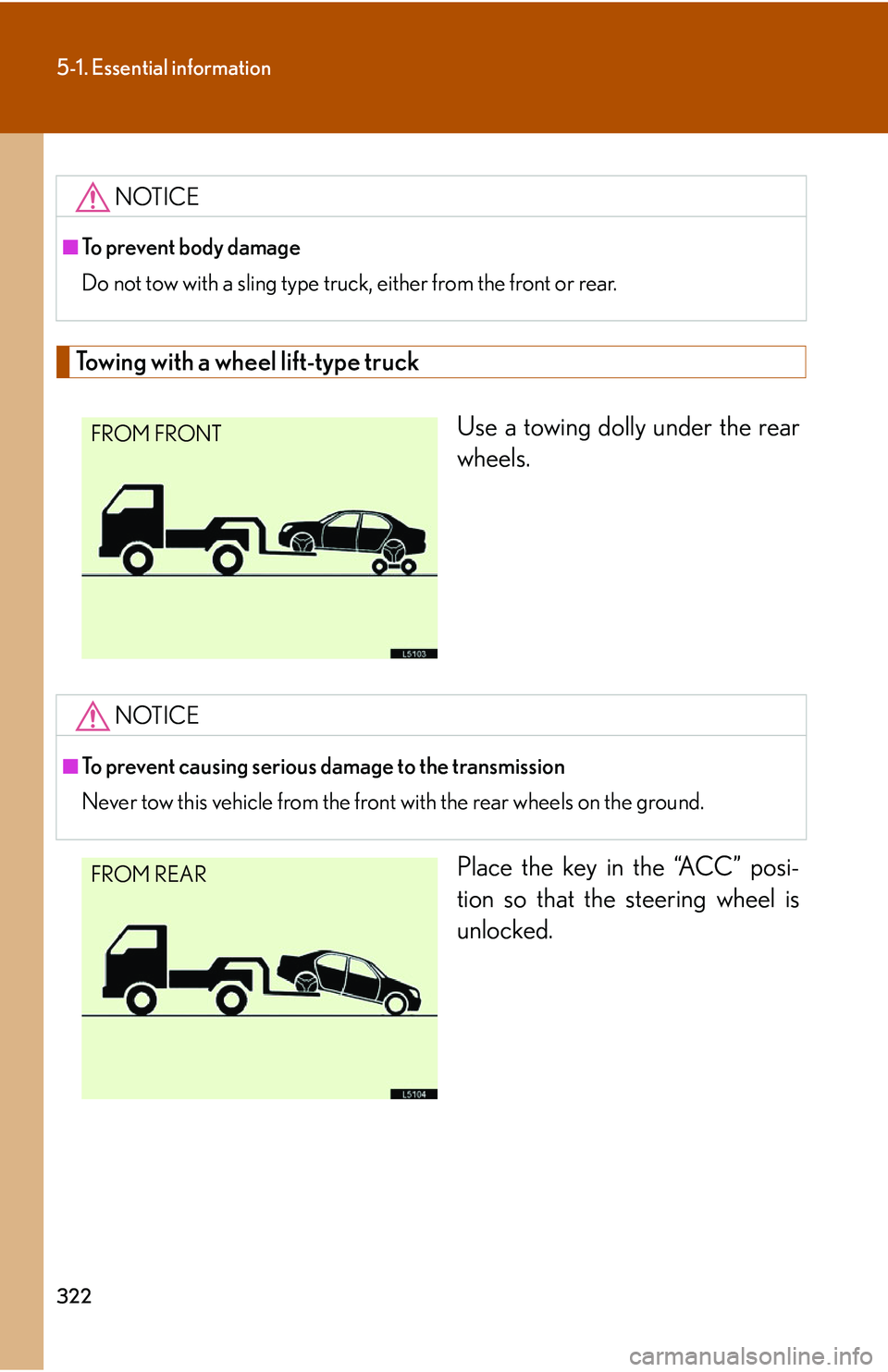
Towing with a wheel lift-type truck
Use a towing dolly under the rear
wheels.
Place the key in the “ACC” posi-
tion so that the steering wheel is
unlock
ed.
NOTICE
■To prevent body damage
Do not tow with a sling type truck, either from the front or rear.
FROM FRONT
NOTICE
■To prevent causing serious damage to the transmission
Never tow this vehicle from the front with the rear wheels on the ground.
FROM REAR
Page 339 of 419
5
When trouble arises
323
5-1. Essential information
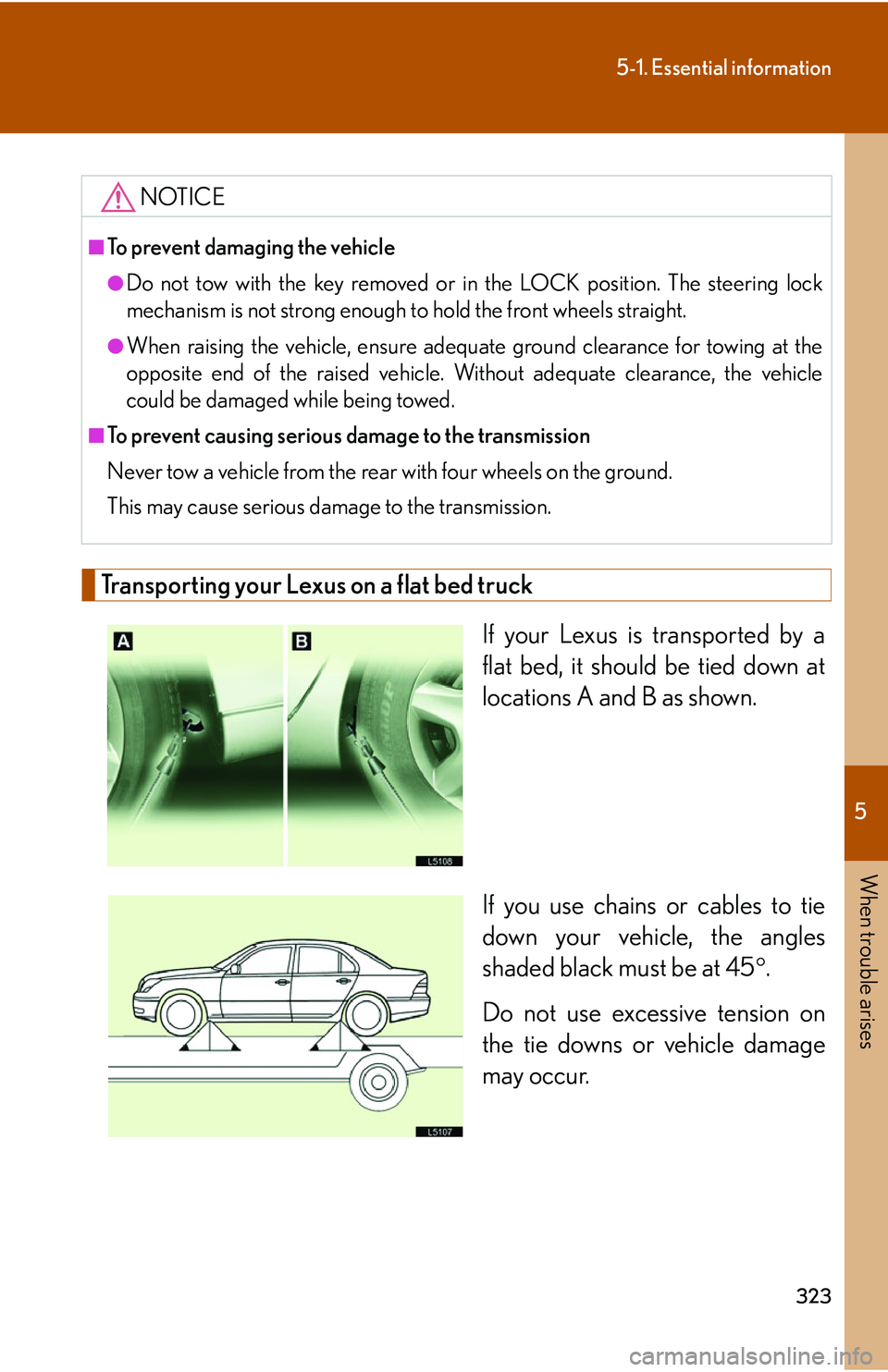
Transporting your Lexus on a flat bed truck
If your Lexus is transported by a
flat bed, it should be tied down at
locations A and B as shown.
If you use chains or cables to tie
do
wn your vehicle, the angles
shaded black must be at 45 .
Do not use excessive tension on
the tie do
wns or vehicle damage
may occur.
NOTICE
■To prevent damaging the vehicle
●Do not tow with the key removed or in the LOCK position. The steering lock
mechanism is not strong enough to hold the front wheels straight.
●When raising the vehicle, ensure adequate ground clearance for towing at the
opposite end of the raised vehicle. Wi thout adequate clearance, the vehicle
could be damaged while being towed.
■To prevent causing serious damage to the transmission
Never tow a vehicle from the rear with four wheels on the ground.
This may cause serious dama g
e to the transmission.
Page 355 of 419
5
When trouble arises
339
5-2. Steps to take in an emergency
Warning message and lightDetailsCorrection procedures
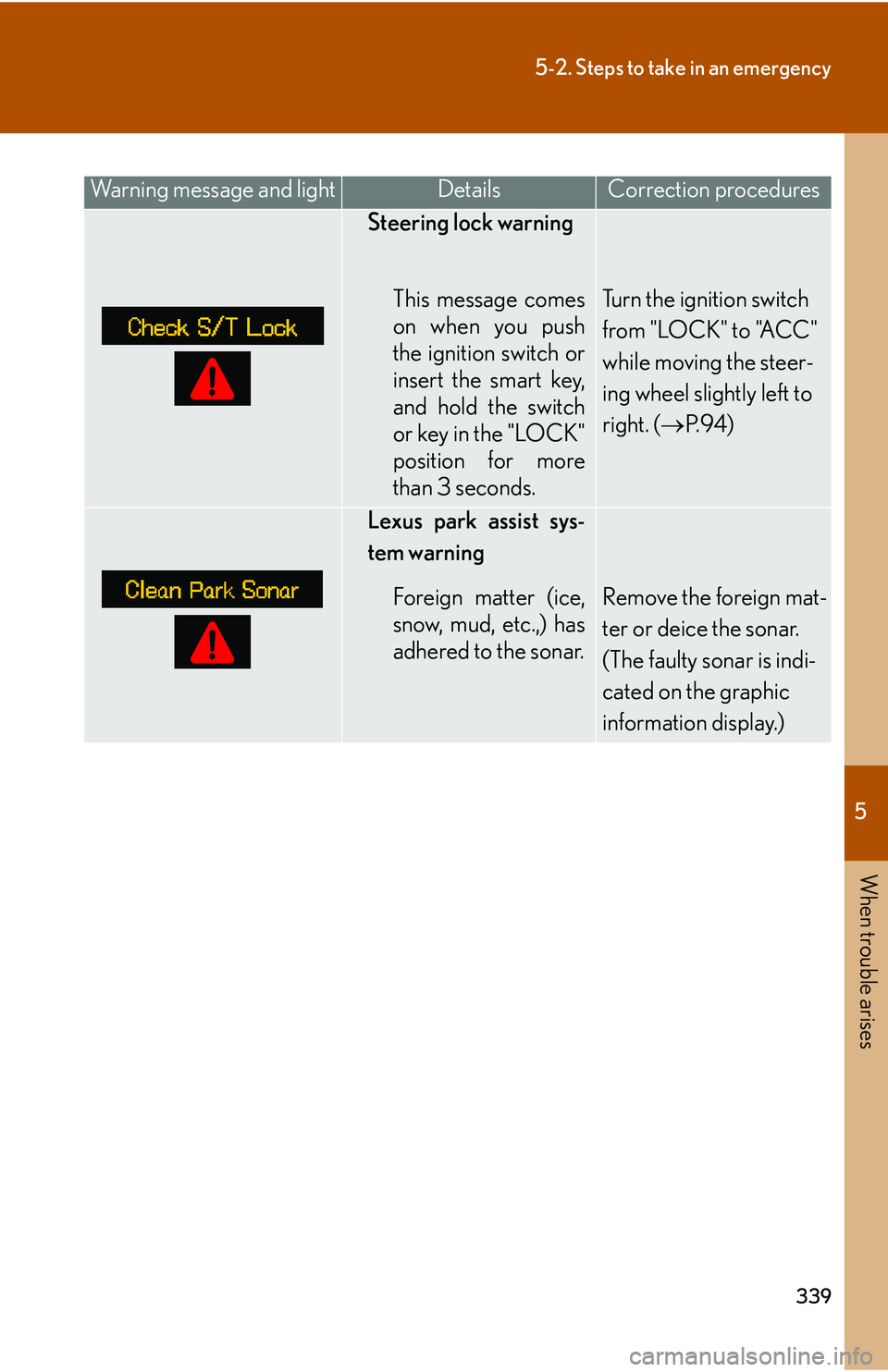
Steering lock warning
This message comes
on when you push
the ignition switch or
insert the smart key,
and hold the switch
or key in the "LOCK"
position for more
than 3 seconds.Turn the ignition switch
from "LOCK" to "ACC"
while moving the steer-
ing wheel slightly left to
rig
ht. ( P.94
)
Lexus park assist sys-
tem warning
Foreign matter (ice,
snow, mud, etc.,) has
adhered to the sonar.Remove the foreign mat -
ter or deice the sonar.
(The faulty sonar is indi -
cated on the graphic
information display
.)
Page 358 of 419
342
5-2. Steps to take in an emergency
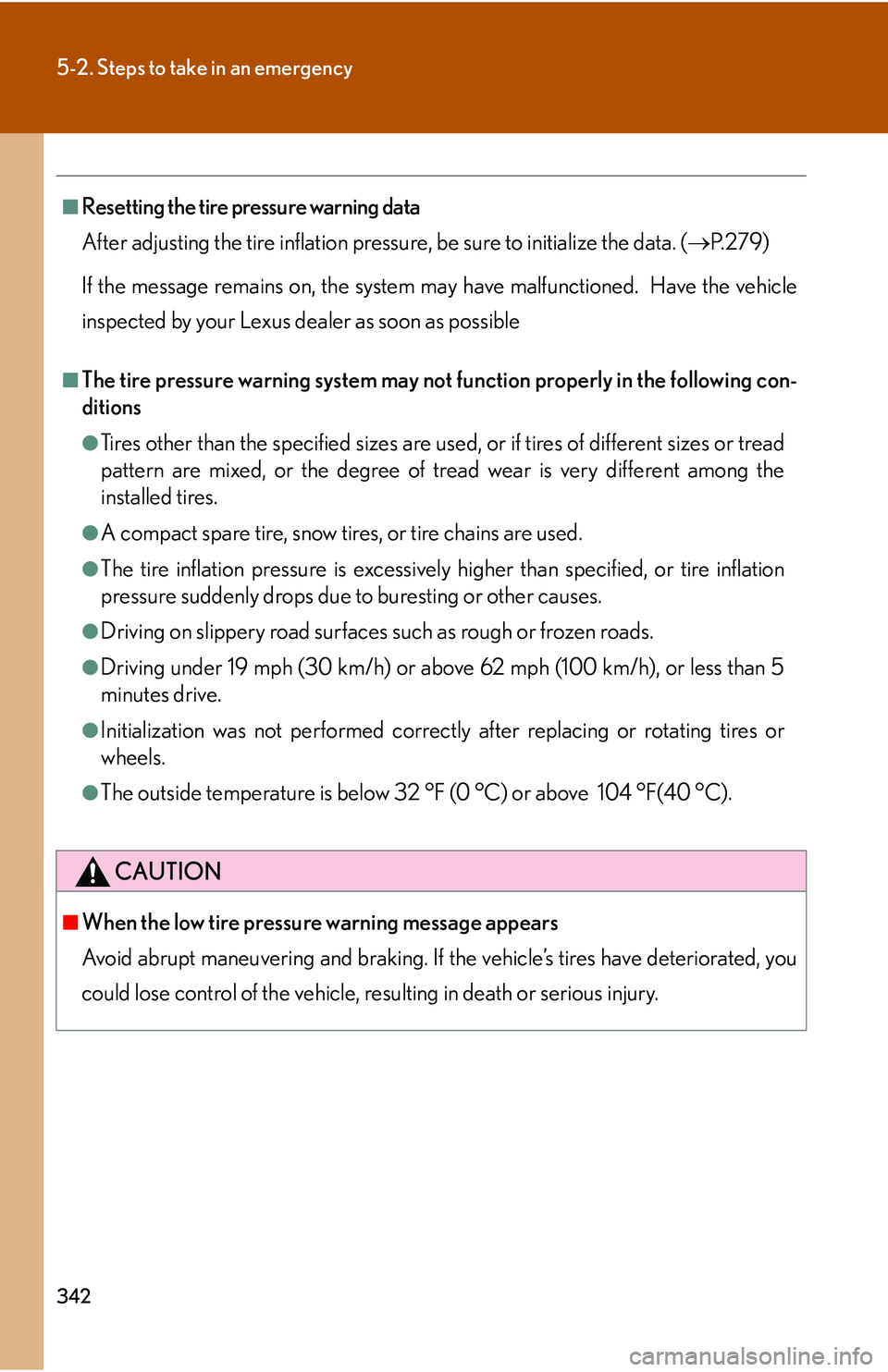
■Resetting the tire pressure warning data
After adjusting the tire inflation pressur
e, be sure to initialize the data. (P. 2 7 9 )
If the message remains on, the system may have malfunctioned. Have the vehicle
inspected b
y your Lexus dealer as soon as possible
■The tire pressure warning system may not function properly in the following con -
ditions
●Tires other than the sp ecified sizes are used, or if tires of different sizes or tread
pattern are mixed, or the degree of tread wear is very different among the
installed tires.
●A compact spare tire, snow tires, or tire chains are used.
●The tire inflation pressure is excessively higher than specified, or tire inflation
pressure suddenly drops due to buresting or other causes.
●Driving on slippery road surfaces such as rough or frozen roads.
●Driving under 19 mph (30 km/h) or above 62 mph (100 km/h), or less than 5
minutes drive.
●Initialization was not performed correctly after replacing or rotating tires or
wheels.
●The outside temperature is below 32 °F (0 °C) or above 104 °F(40 °C).
CAUTION
■When the low tire pressure warning message appears
Avoid abrupt maneuvering and braking. If th
e vehicle’s tires have deteriorated, you
could lose control of the vehicle, resulting in death or serious injury.
Page 364 of 419
348
5-2. Steps to take in an emergency
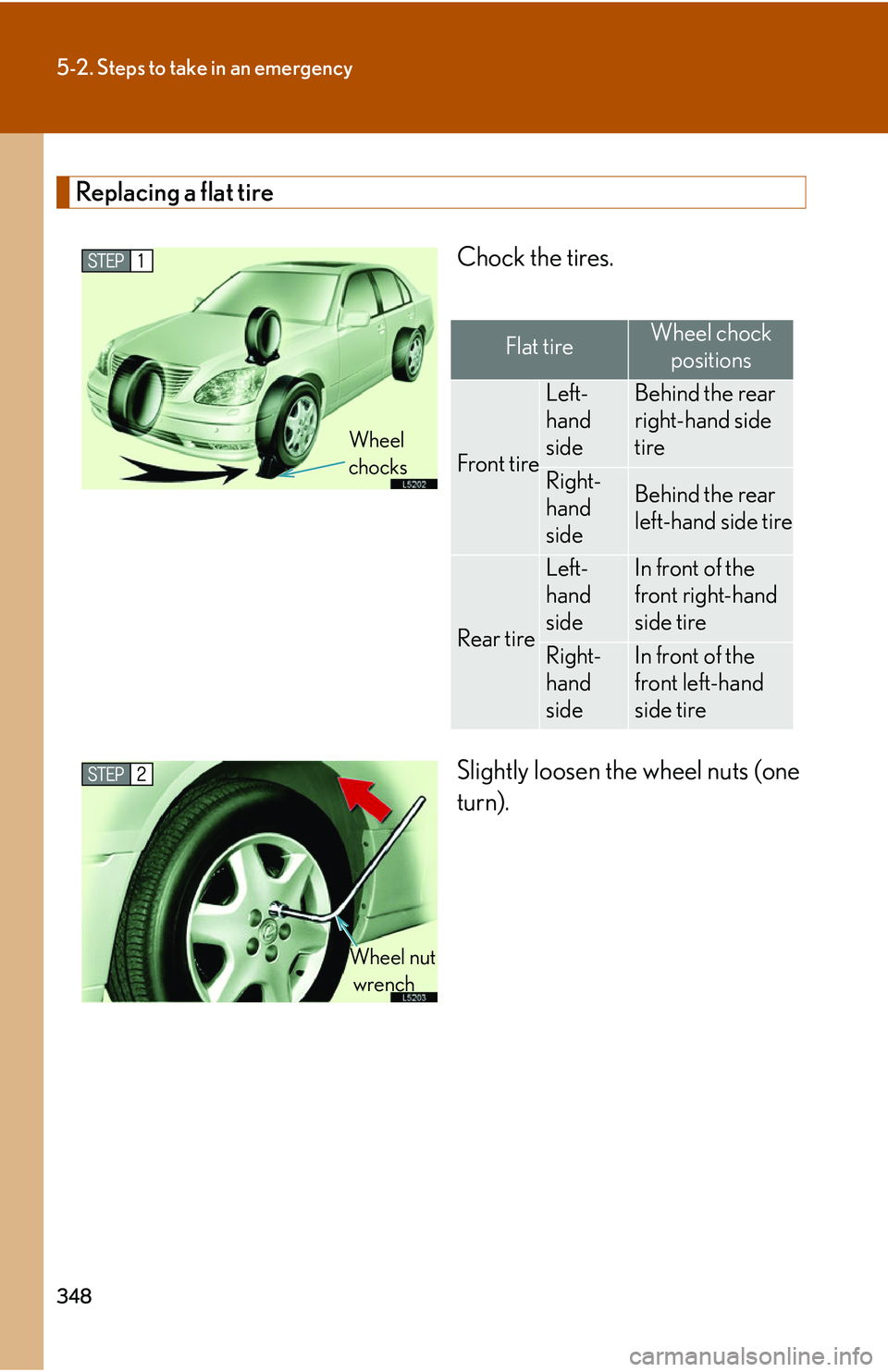
Replacing a flat tire
Chock the tires.
Slightly loosen the wheel nuts (one
turn).
Wheel
chocks
Flat tireWheel chock positions
Front tire
Left-
hand
sideBehind the rear
right-hand side
tire
Right-
hand
sideBehind the rear
left-hand side tire
Rear tire
Left-
hand
sideIn front of the
front right-hand
side tire
Right-
hand
sideIn front of the
front left-hand
side tire
Wheel nut
wrench
Page 365 of 419
5
When trouble arises
349
5-2. Steps to take in an emergency
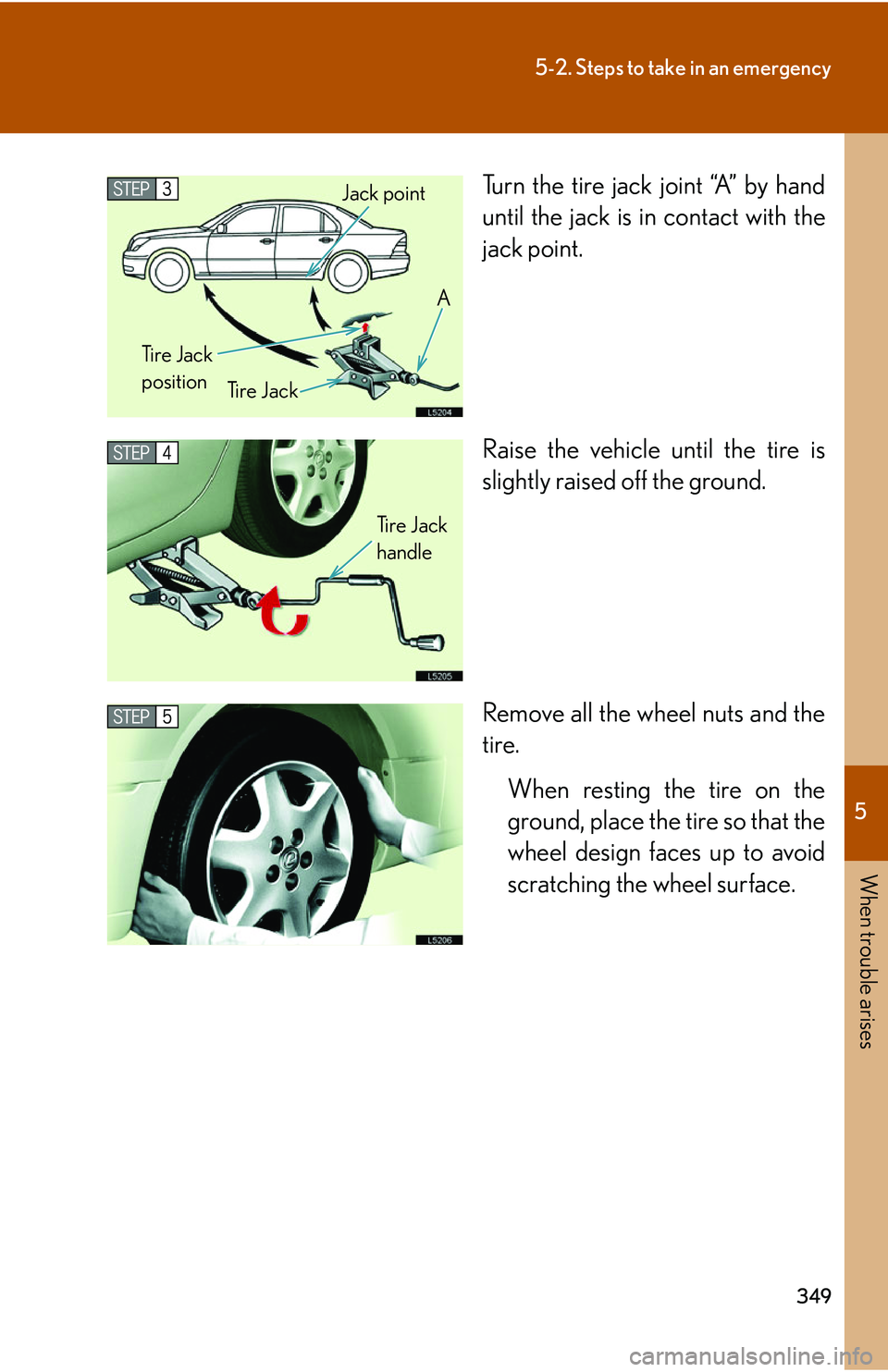
Turn the tire jack joint “A” by hand
until the jack is in contact with the
jack point.
Raise the vehicle until the tire is
slightly r
aised off the ground.
Remove all the wheel nuts and the
tir
e.
When resting the tire on the
gr
ound, place the tire so that the
wheel design faces up to avoid
scratching the wheel surface.
A
Tire Jack
Ti r e J a c k
position
Jack point
Ti r e J a c k
handle
Page 366 of 419
350
5-2. Steps to take in an emergency
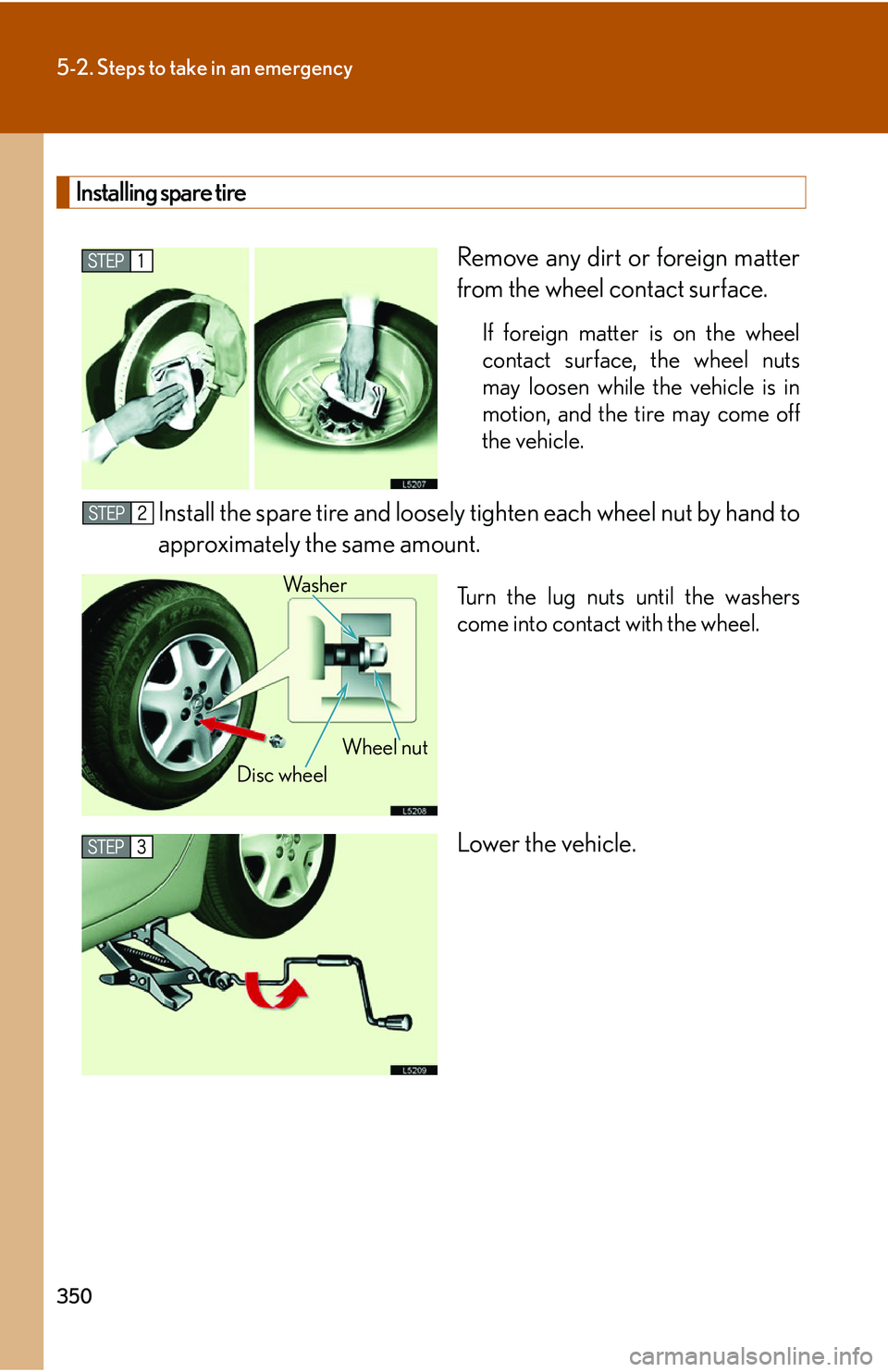
Installing spare tire
Remove any dirt or foreign matter
from the wheel contact surface.
If foreign matter is on the wheel
contact surface, the wheel nuts
may loosen while the vehicle is in
motion, and the tire may come off
the vehicle.
Install the spare tire and loosely tighten each wheel nut by hand to
approximately the same amount.
Turn the lug nuts until the washers
come into contact with the wheel.
Lower the vehicle.
Wheel nut
Wa s h e r
Disc wheel
Page 368 of 419
352
5-2. Steps to take in an emergency
CAUTION
■Using the tire jack
Improper use of the tire jack may lead to death or injuries due to the vehicle sud-
denly falling off the jack.
Observe the following precautions to prevent accidents.
• Do not use the tire jack for any purpose other than replacing tires or installing and
removing tire chains.
• Only use the tire jack that comes with this vehicle for replacing a flat tire.
Do not use this tire jack on other vehicl
es, and do not use other tire jacks for
replacing tires on this vehicle.
• Always check that the tire jack is securely set to the jack point.
• Do not raise the vehicle while someone is in it.
• When raising the vehicle, do not put an object on or under the jack.
• Do not raise the vehicle to a height greate r than
that required to replace the tire.
• Do not put any part of your body under the vehicle supported by a jack.
• Do not start or run the engine while your vehicle is supported by the jack.
• Use a jack stand if it is necessary to get under the vehicle.
• Take particular care when lowering the vehicle to ensure that no one working on or
near the vehicle may be injured.
■Replacing a flat tire
Observe the following precautions to reduce
the risk of death or serious injury.
• Never use oil or grease on the wheel bolts or wheel nuts.
The oil or grease can cause the wheel nuts to loosen, causing a serious accident.
R
emove any oil or grease on the wheel bolts or wheel nuts.
• Have the wheel nuts tightene d with a tor
que wrench to 76 f t•lbf (105 N•m, 10.5
kgf
•m) as soon as possible after changing wheels.
Failure to follow these pre-cautions could cause, the wheel nuts to loosen and the
w
heels may fall off, which could lead to an accident causing death or serious injury.
NOTICE
■Do not drive the vehicle with a flat tire.
Do not continue driving with a flat tire.
Driving even a short distance can damage a tire and wheel beyond repair.
Page 377 of 419
5
When trouble arises
361
5-2. Steps to take in an emergency
If the vehicle becomes stuck
CAUTION
■When removing the stuck vehicle
If you choose to rock the vehicle back and forth to free it, make sure the surround-
ing area is clear, to avoid striking other vehicles, objects or persons. The vehicle
may
also lunge forward or lunge back suddenly as it becomes free, use extreme
caution.
NOTICE
■To avoid damaging the transmission and other components
●Do not operate the selector lever while depressing the accelerator pedal.
●Avoid spinning the wheels and do not rev the engine.
●If the vehicle remains stuck after trying these procedures the vehicle may require
towing to be freed.
Carry out the following procedures if the tires spin or the vehicle becomes
stuck in mud, dirt, or snow to the extent that it cannot move.
• Stop the engine. Set the parking brake and put the transmission
selector lever in “P”.
• Remove the mud, snow, or sand from around the stuck tire.
• Place wood, stones or some other ma terial to help pr
ovide traction
under the tires.
• Restart the engine.
• Turn off the traction control system. ( P.141)
• Carefully apply the accelerator to free the vehicle.