light LEXUS LS430 2006 Owner's Manual
[x] Cancel search | Manufacturer: LEXUS, Model Year: 2006, Model line: LS430, Model: LEXUS LS430 2006Pages: 419, PDF Size: 11.19 MB
Page 70 of 419
54
1-6. Theft deterrent system
Engine immobilizer system
■Conditions that may cause the system to malfunction
●If the grip portion of the key is in contact with a metallic object.
●If the key is in close proximity to or touching a key to the security system (key
with a built-in transponder chip) of another vehicle.
NOTICE
■To prevent damage to the key
The key may be damaged if it is:
•Bent
• Subjected to a strong impact
• Left in direct sunlight
•Wet
• Left in close proximity to objects emitting magnetic fields
• In close proximity to an object that inter
feres with the electromagnetic wave
that is emitted
Keep all keys in a safe place.
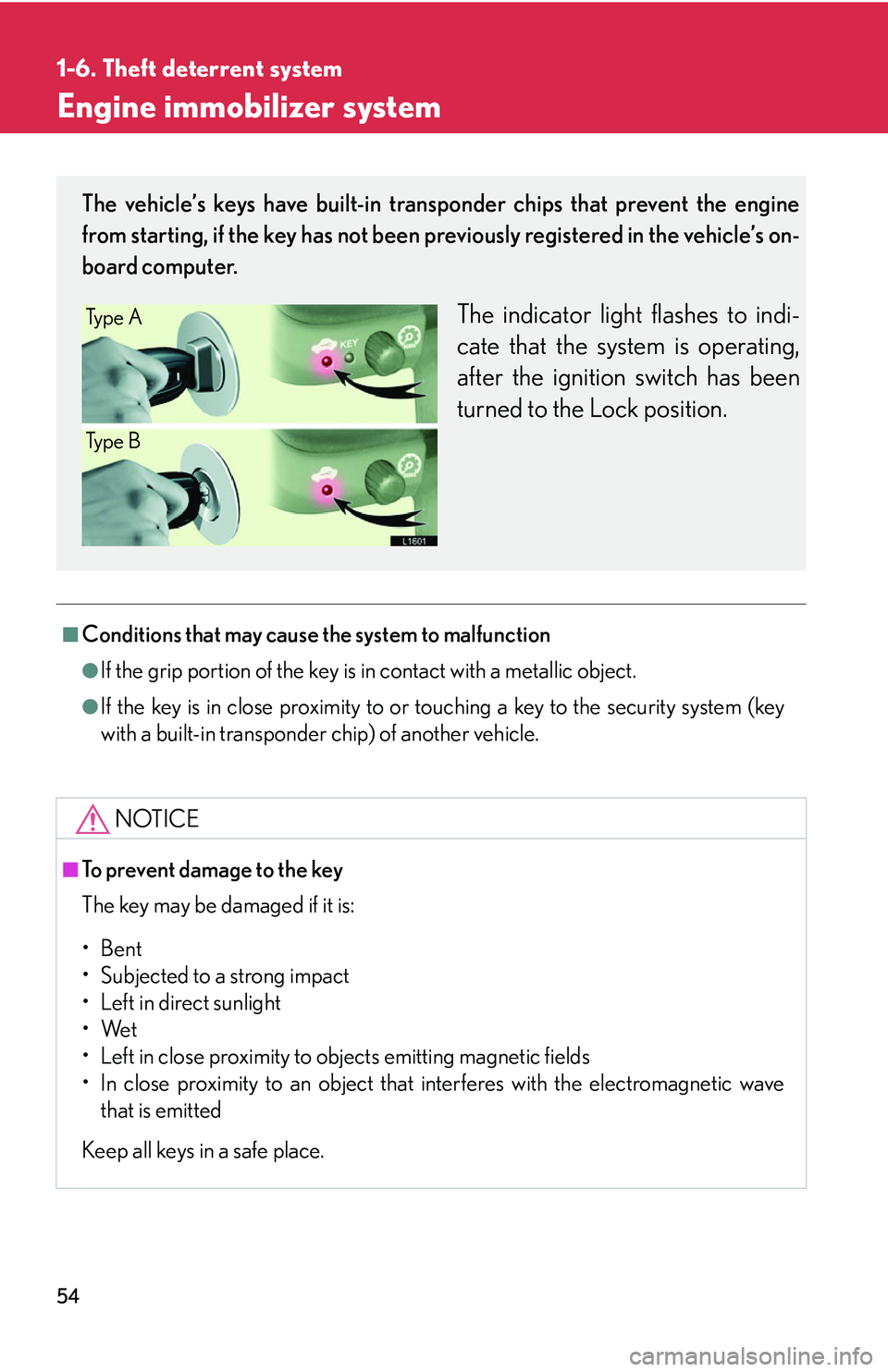
The vehicle’s keys have built-in transponder chips that prevent the engine
from starting, if the key has not been previously registered in the vehicle’s on-
board computer.
The indicator light flashes to indi -
cate that the system is operating,
af
ter the ignition switch has been
turned to the Lock position.
Ty p e A
Ty p e B
Page 71 of 419
55
1
1-6. Theft deterrent system
Before driving
Alarm
Deactivating or stopping the alarm
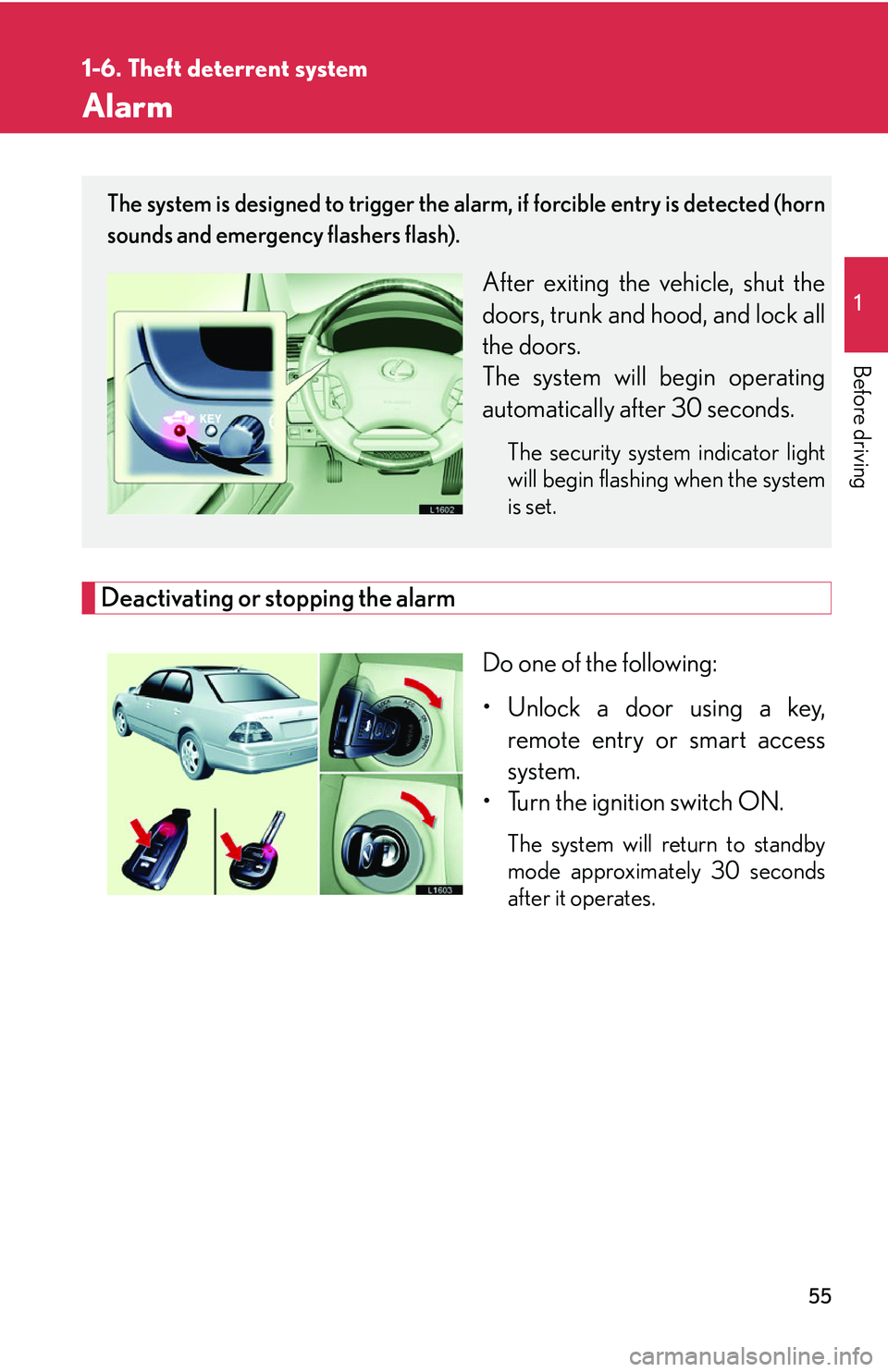
Do one of the following:
• Unlock a door using a key, r
emote entry or smart access
system.
• Turn the ignition switch ON.
The system will return to standby
mode approximately 30 seconds
after it operates.
The system is designed to trigger the alarm, if forcible entry is detected (horn
sounds and emergency flashers flash).
After exiting the vehicle, shut the
doors, trunk and hood, and lock all
the doors.
The system will begin operating
automatically af
ter 30 seconds.
The security system indicator light
will begin flashing when the system
is set.
Page 77 of 419
61
1-7. Safety information
1
Before driving
Airbag system components
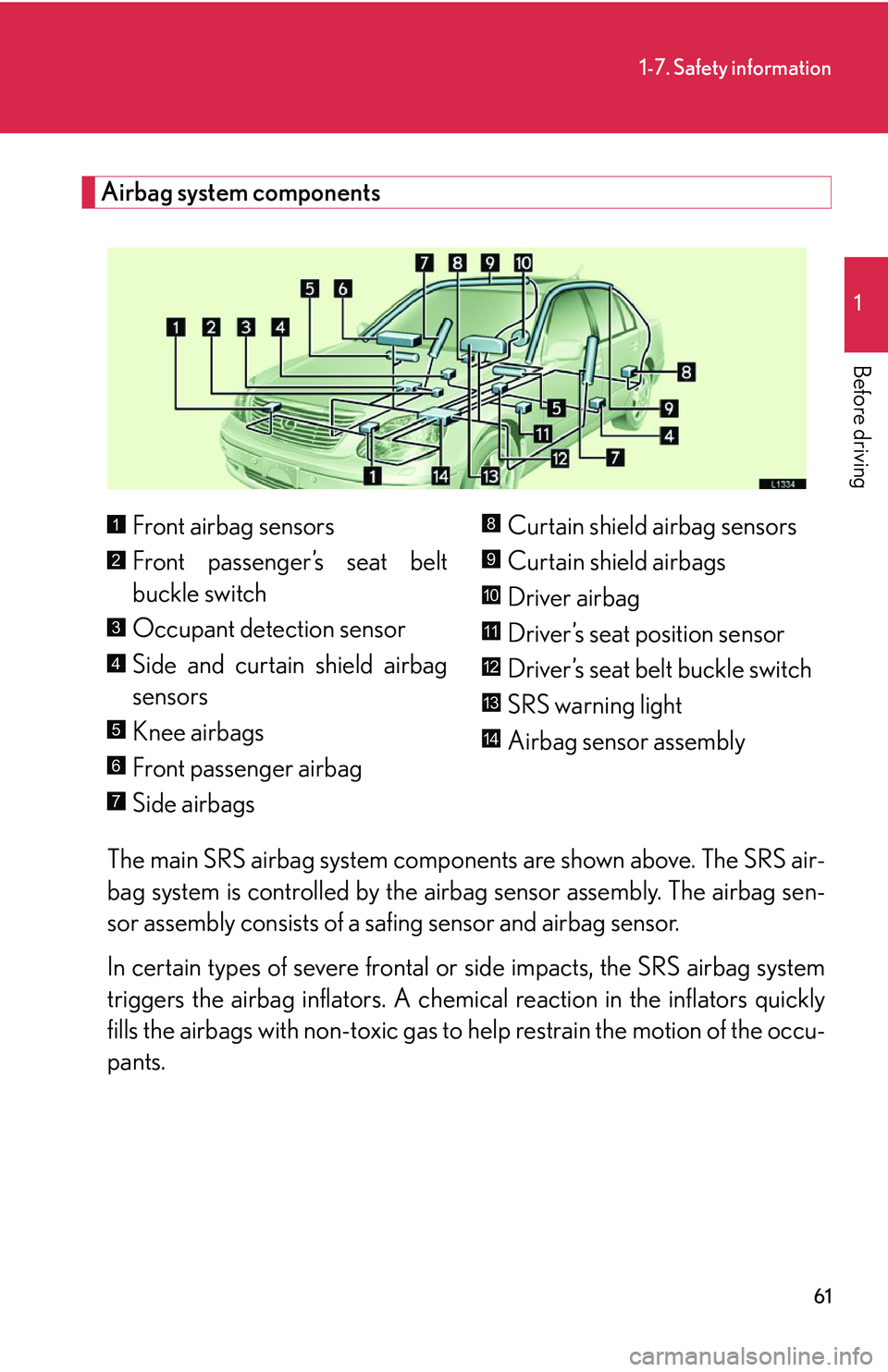
The main SRS airbag system components are shown above. The SRS air-
bag system is controlled by the airb ag sensor as
sembly. The airbag sen-
sor assembly consists of a safing sensor and airbag sensor.
In certain types of severe frontal or side impacts, the SRS airbag s
ystem
triggers the airbag inflators. A chemica l reaction in the inflators quickly
fills the airbags with non-toxic gas to help restrain the motion of the occu -
pants. Front airbag sensors
Front passenger’s seat belt
buckle switch
Occupant detection sensor
Side and curtain shield airbag
sensors
Knee airbags
Front passenger airbag
Side airbags
Curtain shield airbag sensors
Curtain shield airbags
Driver airbag
Driver’s seat position sensor
Driver’s seat belt buckle switch
SRS warning light
Airbag sensor assembly
1
2
3
4
5
6
7
8
9
10
11
12
13
14
Page 78 of 419
62
1-7. Safety information
■If the SRS airbags deploy (inflate)
●Bruising and slight abrasions may result from contact with a deploying (inflating)
SRS airbag.
●A loud noise and white powder will be emitted.
●Parts of the airbag module (steering whee l hub, airbag cover and inflator), as
well as the front seats, apart from the front pillar and roof side rail may be hot for
several minutes, and the airbags themselves will be hot.
●The front windshield may crack.
■Operating conditions (front airbags)
●The SRS front airbags will deploy if the severity of the frontal impact is above the
designed threshold level, comparable to an approximate 15 mph (25 km/h) col -
lision, when the vehicle imp acts
straight into a fixed barrier that does not move
or deform.
However, this threshold velocity will be considerably higher, if the vehicle strikes
a
n object, such as a parked vehicle or sign pole, which can move or deform on
impact, or if the vehicle is involved in an underride collision (e.g., a collision in
which the front of the vehicle “underrides”, or goes under, the bed of a truck, etc.).
●It is possible that in some collisions where the forward deceleration of the vehi -
cle is very close to the designed thresh ol
d level, the SRS front airbags and the
seat belt pretensioners ma y not activate together.
●The SRS front passenger airbag will not activate, if there is no passenger sitting
in the front passenger seat. However, th e front passenger airbag may deploy, if
luggage is put in the seat or the seat belt is buckled up, regardless of the pres -
ence of an occupant in the seat.
■Operating conditions (side and curtain shield airbags)
●The SRS side airbags and curtain shield airbags are designed to inflate, when
the passenger compartment is subjected to a severe impact from the side.
●The SRS side airbag on the passenger seat will not activate, if there is no passen -
ger sitting in the front passenger seat. Ho
wever, the side airbag on the passen-
ger seat may deploy, if luggage is put in the seat or the seat belt is buckled up,
r
egardless of the presence of the occupant in the seat.
Page 82 of 419
66
1-7. Safety information
CAUTION
■SRS airbag precautions
Observe the following precautions regarding the airbags. Failure to do so may
ca
use death or serious injury:
●The driver and all passengers in the vehicle must wear their seat belts properly.
The SRS airbags are supplemental devices to be used with seat belts.
●The SRS driver airbag deploys by a cons iderable force and can cause death or
serious injury especially, if the driver is very close to the airbag. The National
Highway Traffic Safety Administration (“NHTSA”) advises:
Since the risk zone for driver airbag is th e fi
rst 2 - 3 in. (50 - 75 mm) of inflation,
placing yourself 10 in. (250 mm) from your driver airbag provides you with a
clear margin of safety. This distance is measured from the center of the steering
wheel to your breastbone. If you sit less than 10 in. (250 mm) away now, you can
change your driving position in several ways:
• Move your seat to the rear as far as you can while still reaching the pedals
co
mfortably.
• Slightly recline the back of the seat. Alt
hough vehicle designs vary, many driv-
ers can achieve the 10 in. (250 mm) distance, even with the driver seat all the
w
ay forward, simply by reclining the back of the seat somewhat. If reclining
the back of your seat makes it hard to see the road, raise yourself by using a
firm, non-slippery cushion or raise the seat if your vehicle has that feature.
• If your steering wheel is adjustable, ti lt it do
wnward. This points the airbag
toward your chest instead of your head and neck.
Page 94 of 419
78
1-7. Safety information
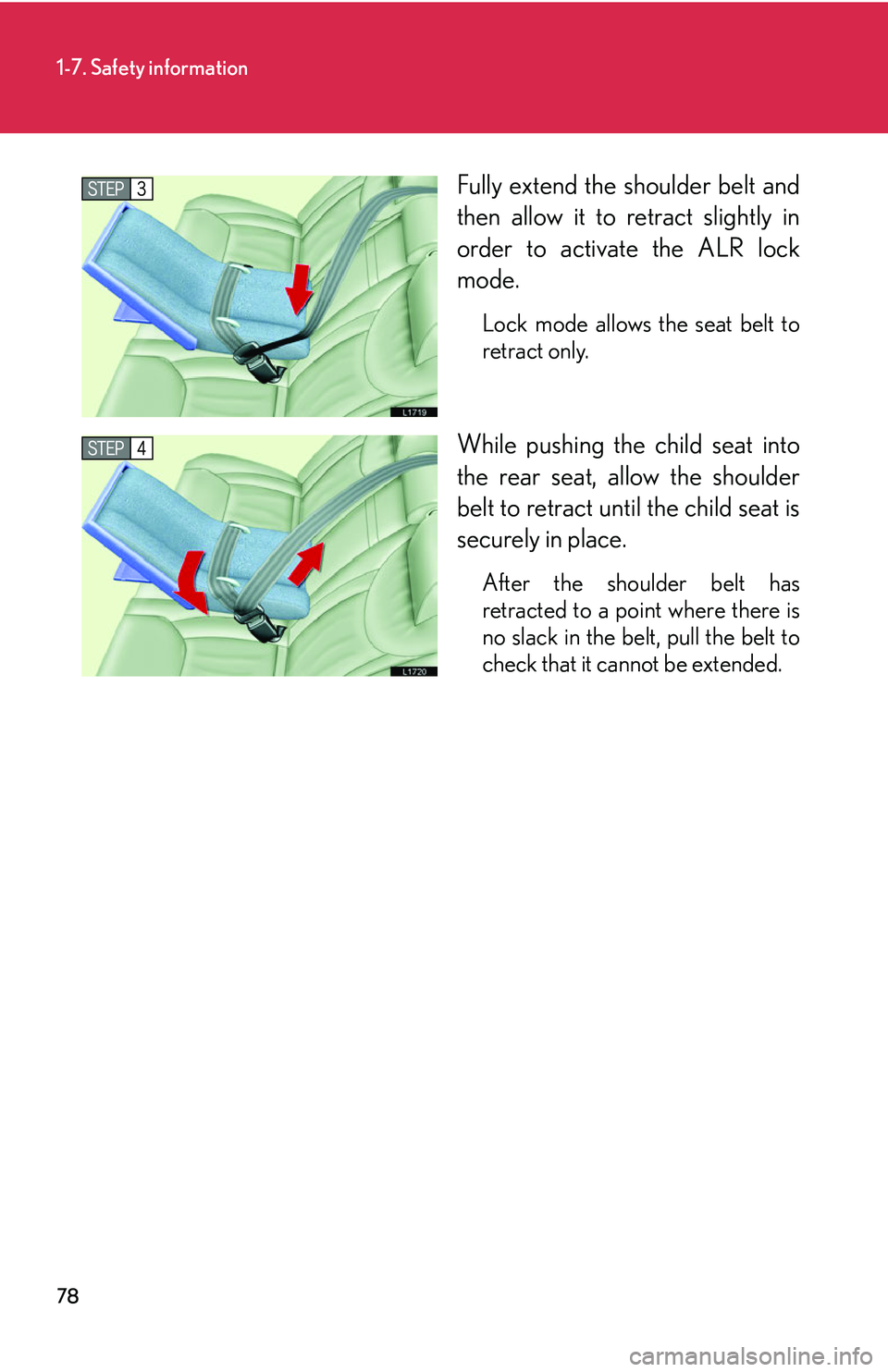
Fully extend the shoulder belt and
then allow it to retract slightly in
order to activate the ALR lock
mode.
Lock mode allows the seat belt to
retract only.
While pushing the child seat into
the rear seat, allow the shoulder
belt to retract until the child seat is
securely in place.
After the shoulder belt has
retracted to a point where there is
no slack in the belt, pull the belt to
check that it cannot be extended.
Page 95 of 419
79
1-7. Safety information
1
Before driving
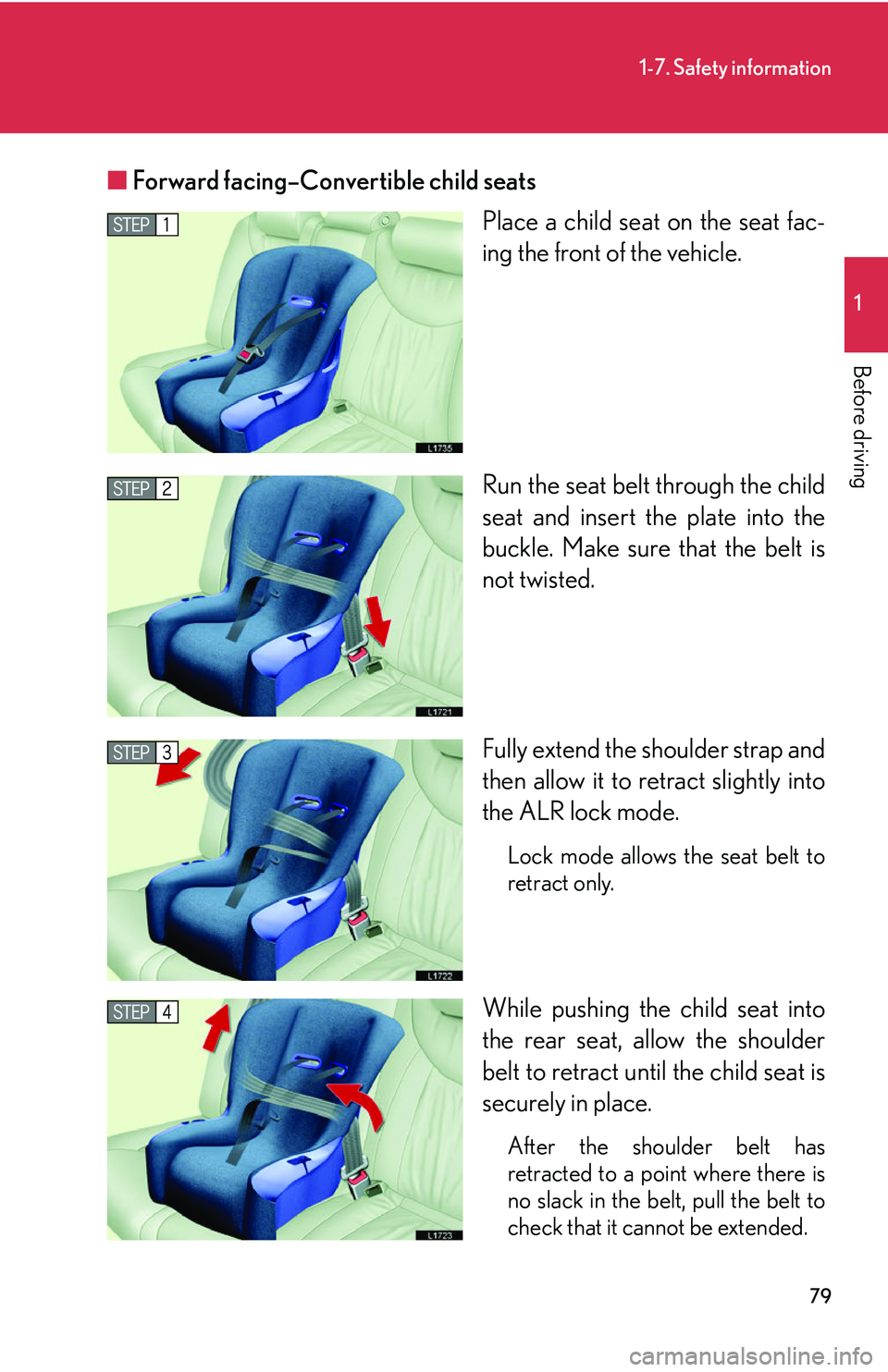
■Forward facing–Convertible child seats
Place a child seat on the seat fac-
ing the front of the vehicle.
Run the seat belt through the child
seat and inser
t the plate into the
buckle. Make sure that the belt is
not twisted.
Fully extend the shoulder strap and
then allo
w it to retract slightly into
the ALR lock mode.
Lock mode allows the seat belt to
retract only.
While pushing the child seat into
the rear seat, allow the shoulder
belt to retract until the child seat is
securely in place.
After the shoulder belt has
retracted to a point where there is
no slack in the belt, pull the belt to
check that it cannot be extended.
Page 99 of 419
83
1-7. Safety information
1
Before driving
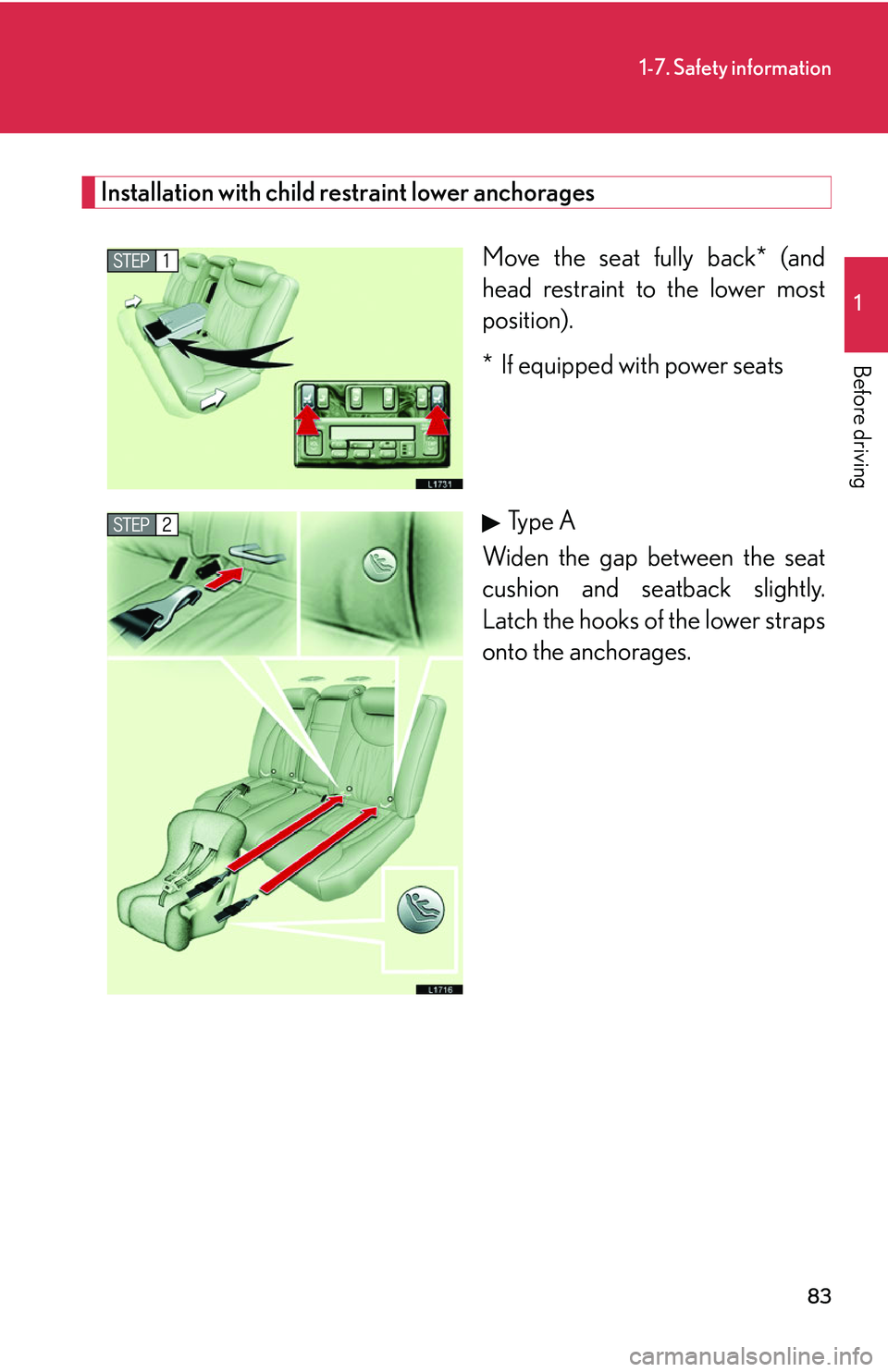
Installation with child restraint lower anchorages
Move the seat fully back* (and
head restraint to the lower most
position).
* If equipped with power seats
Ty p e A
Widen the gap between the seat
cushion and seatback slightly
.
Latch the hooks of the lower straps
onto the anchorages.
Page 100 of 419
84
1-7. Safety information
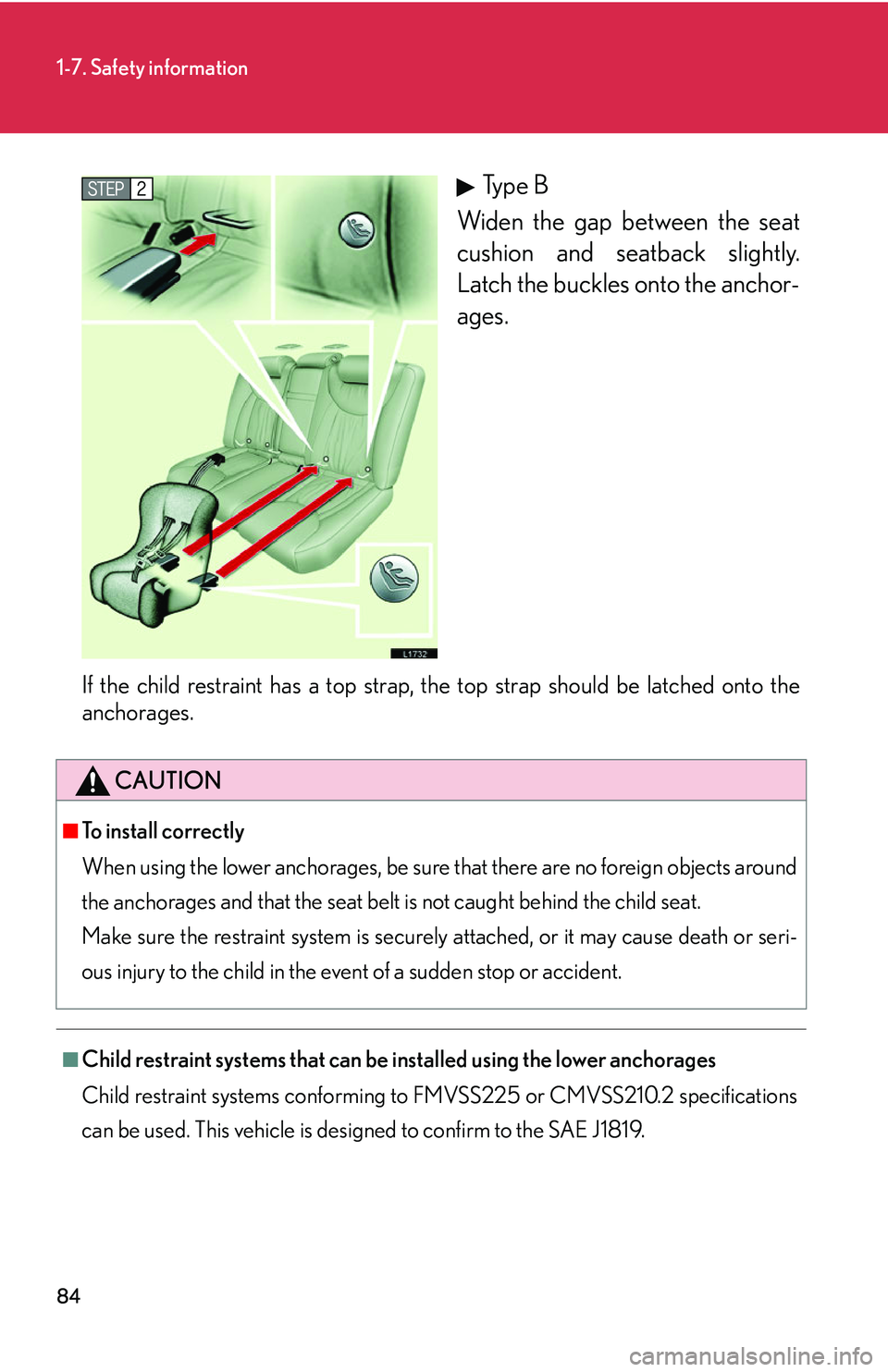
Type B
Widen the gap between the seat
cushion and seatback slightly
.
Latch the buckles onto the anchor-
ages.
If the child restraint has a top strap, the top strap should be latched onto the
anchorages.
CAUTION
■To install correctly
When using the lower anchorages, be sure that there are no foreign objects around
the ancho
rages and that the seat belt is not caught behind the child seat.
Make sure the restraint system is securely
attached, or it may cause death or seri-
ous injury to the child in the even t of
a sudden stop or accident.
■Child restraint systems that can be installed using the lower anchorages
Child restraint systems conforming to FM V
SS225 or CMVSS210.2 specifications
can be used. This vehicle is designed to confirm to the SAE J1819.
Page 101 of 419
2When driving
85
2-1. Driving procedures ................. 86Driving the vehicle ...................... 86
Starting the engine ...................... 94
Automatic transmission ............ 98
Turn signal lever ............................ 101
Parking brake .............................. 102
2-2. Instrument cluster .................. 103 Gauges and meters .................. 103
Indicators and warning
lights ............................................. 105
Multi-information display ........ 107
2-3. Operating the headlight and
windshield wipers .................. 110
Headlight switch .......................... 110
Fog light switch ............................. 113
Windshield wipers and
washer ........................................... 114
Headlight cleaner switch.......... 117 2-4. Using other driving
systems ..................................... 118
Lexus park assist system ........... 118
Rear view monitor system....... 123
Cruise control .............................. 126
Dynamic radar/ laser cruise
control .......................................... 129
Electronically modulated air
suspension.................................. 138
Driver assist systems ................. 140
Pre-collision system
(if equipped) .............................. 143
2-5. Driving information ................ 145 Cargo & luggage ....................... 145
Vehicle load limits....................... 148
Winter driving tips...................... 149
Trailer Towing ............................... 152
Dinghy towing.............................. 160