tire LEXUS LS430 2006 Service Manual
[x] Cancel search | Manufacturer: LEXUS, Model Year: 2006, Model line: LS430, Model: LEXUS LS430 2006Pages: 419, PDF Size: 11.19 MB
Page 379 of 419
6Vehicle specification
363
6-1. Specifications.......................... 364Maintenance data .................... 364
Fuel information ......................... 373
Tire information .......................... 376
6-2. Owner’s customize .............. 384 Customizable features ........... 384
Initializing your Lexus .............. 387
Page 386 of 419
370
6-1. Specifications
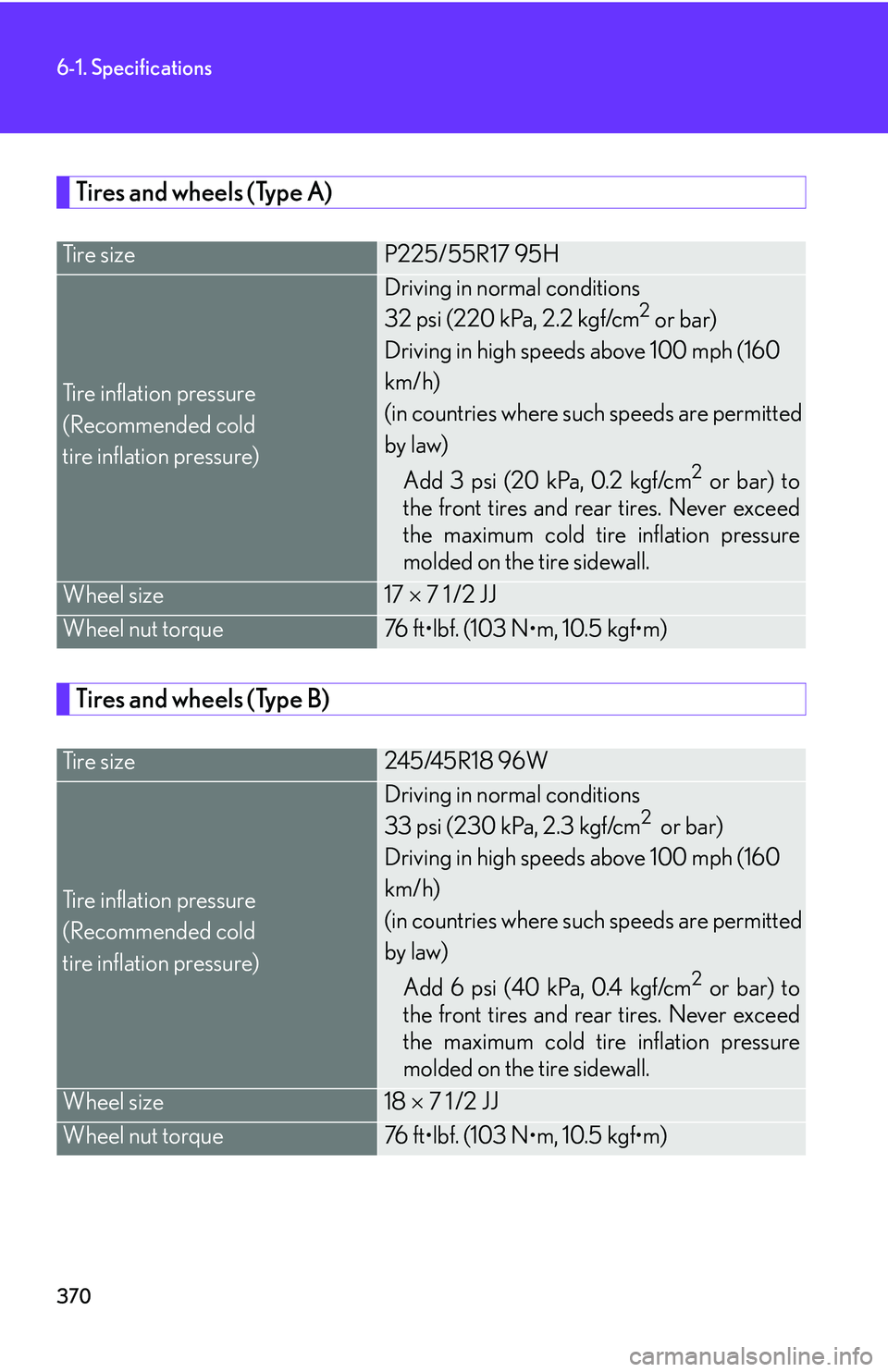
Tires and wheels (Type A)
Tires and wheels (Type B)
Ti r e s i z eP225/55R17 95H
Tire inflation pressure
(Recommended cold
tire inflation pressure)
Driving in normal conditions
32 psi (220 kPa, 2.2 kgf/cm2 or bar)
Driving in high speeds above 100 mph (160
km/
h)
(in countries where such speeds are permitted
b
y law)
Add 3 psi (20 kPa, 0.2 kgf/cm
2 or bar) to
the front tires and rear tires. Never exceed
the maximum cold tire inflation pressure
molded on the tire sidewall.
Wheel size17 7 1 /2 JJ
Wheel nut torque76 f t•lbf. (103 N•m, 10.5 kgf•m)
Ti r e s i z e245/45R18 96W
Tire inflation pressure
(Recommended cold
tire inflation pressure)
Driving in normal conditions
33 psi (230 kPa, 2.3 kgf/cm2 or bar)
Driving in high speeds above 100 mph (160
km/
h)
(in countries where such speeds are permitted
b
y law)
Add 6 psi (40 kPa, 0.4 kgf/cm
2 or bar) to
the front tires and rear tires. Never exceed
the maximum cold tire inflation pressure
molded on the tire sidewall.
Wheel size18 7 1 /2 JJ
Wheel nut torque76 f t•lbf. (103 N•m, 10.5 kgf•m)
Page 387 of 419
371
6-1. Specifications
6
Vehicle specifications
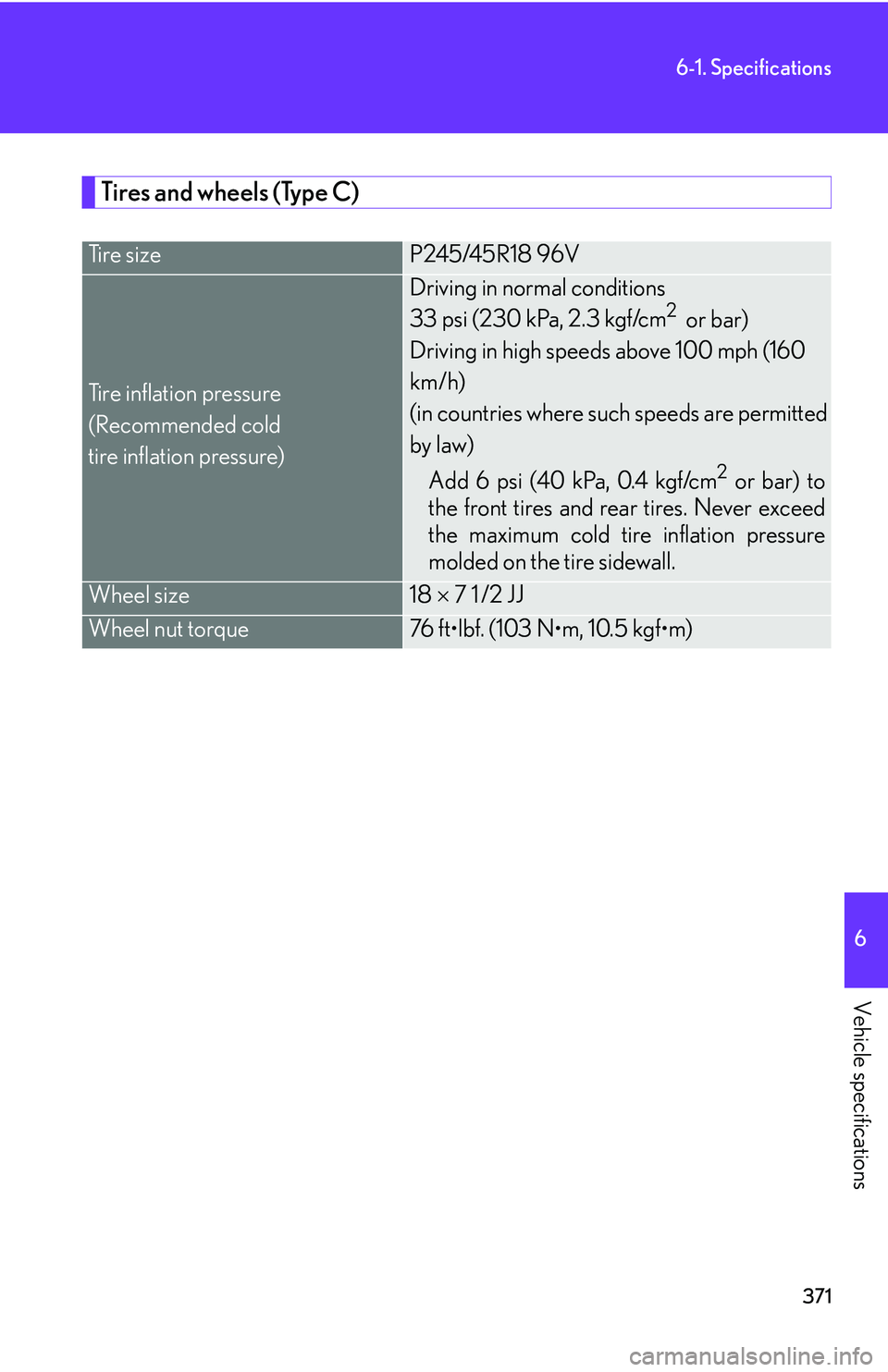
Tires and wheels (Type C)
Ti r e s i z eP245/45R18 96V
Tire inflation pressure
(Recommended cold
tire inflation pressure)
Driving in normal conditions
33 psi (230 kPa, 2.3 kgf/cm2 or bar)
Driving in high speeds above 100 mph (160
km/
h)
(in countries where such speeds are permitted
b
y law)
Add 6 psi (40 kPa, 0.4 kgf/cm
2 or bar) to
the front tires and rear tires. Never exceed
the maximum cold tire inflation pressure
molded on the tire sidewall.
Wheel size18 7 1 /2 JJ
Wheel nut torque76 f t•lbf. (103 N•m, 10.5 kgf•m)
Page 392 of 419
376
6-1. Specifications
Tire information
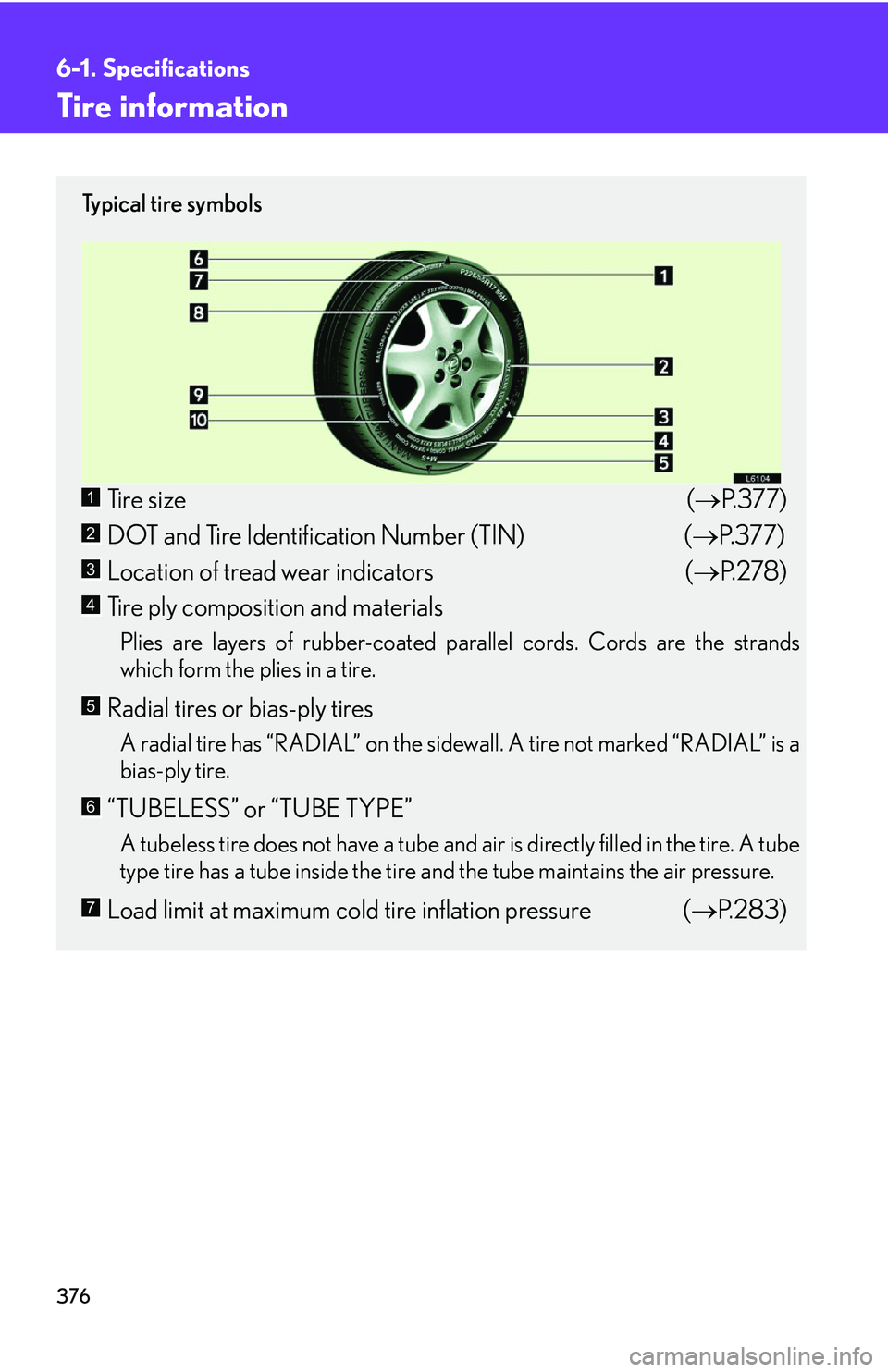
Ty p i c a l t i r e s y m b o l s
Tire size(P.377 )
DOT and Tire Identification Number (TIN) ( P.377 )
Location of tread wear indicators ( P.278 )
Tire ply composition and materials
Plies are layers of rubber-coated parallel cords. Cords are the strands
which form the plies in a tire.
Radial tires or bias-ply tires
A radial tire has “RADIAL” on the sidewall. A tire not marked “RADIAL” is a
bias-ply tire.
“TUBELESS” or “TUBE TYPE”
A tubeless tire does not have a tube and air is directly filled in the tire. A tube
type tire has a tube inside the tire and the tube maintains the air pressure.
Load limit at maximum cold tire inflation pressure ( P.283 )
1
2
3
4
5
6
7
Page 393 of 419
377
6-1. Specifications
6
Vehicle specifications
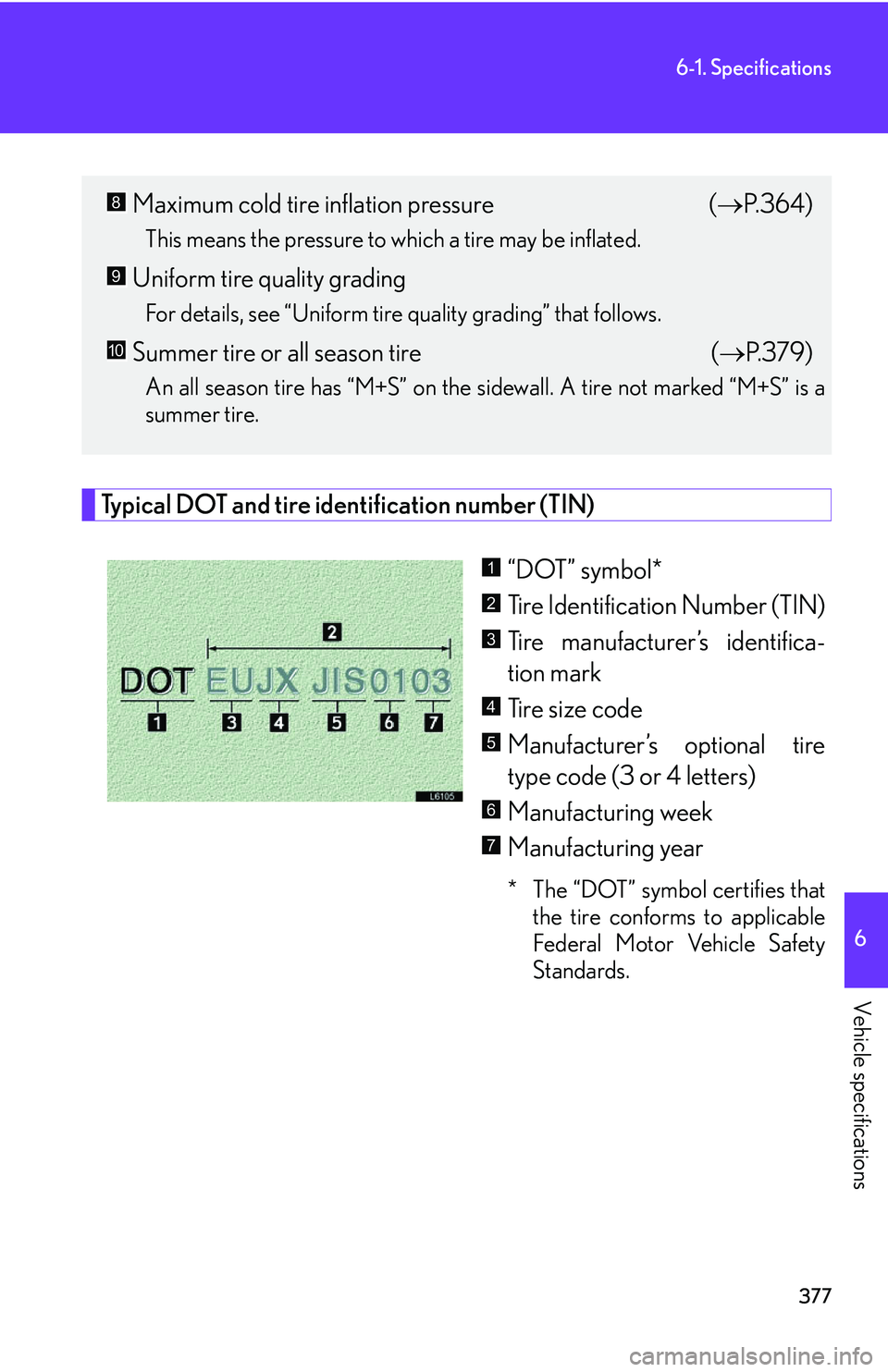
Typical DOT and tire identification number (TIN)
“DOT” symbol*
Tire Identification Number (TIN)
Tire manufacturer’s identifica -
tion mark
Tire size code
Manufacturer’s optional tire
type code (3 or 4 letters)
Manufacturing week
Manufacturing year
* The “DOT” symbol certifies that the tire conforms to applicable
Federal Motor Vehicle Safety
Standards.
Maximum cold tire inflation pressure ( P.364 )
This means the pressure to which a tire may be inflated.
Uniform tire quality grading
For details, see “Uniform tire quality grading” that follows.
Summer tire or all season tire (P.379 )
An all season tire has “M+S” on the sidewall. A tire not marked “M+S” is a
summer tire.
8
9
10
1
2
3
4
5
6
7
Page 394 of 419
378
6-1. Specifications
Tire size
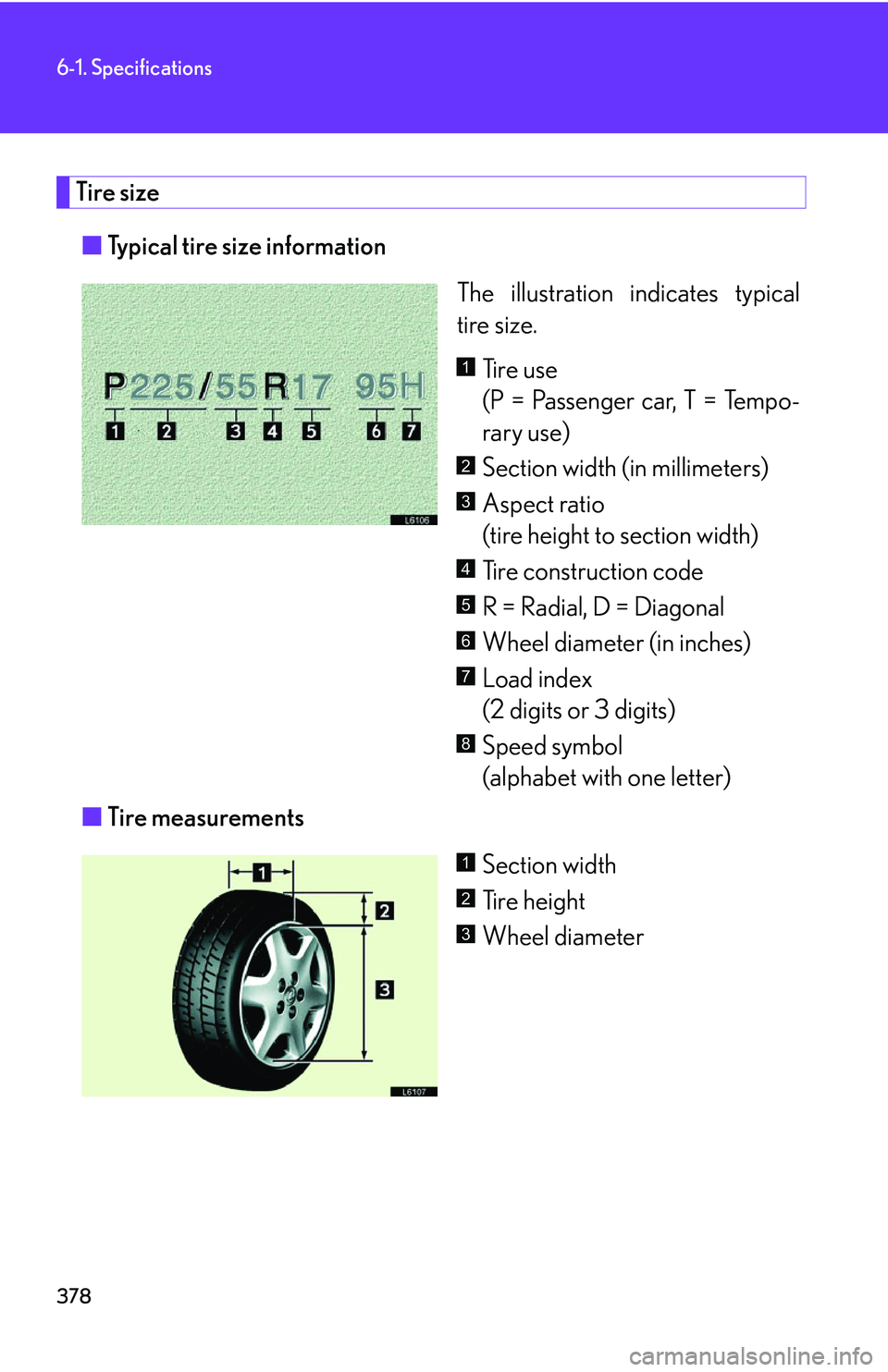
■Typical tire size information
The illustration indicates typical
tir
e size.
Tire use
(P = Passenger car, T = Tempo -
rary use)
Section width (in millimeters)
Aspect ratio
(tire height to section width)
Tire construction code
R = Radial, D = Diagonal
Wheel diameter (in inches)
Load index
(2 digits or 3 digits)
Speed symbol
(alphabet with one letter)
■ T
ire measurements
Section width
Ti r e h e i g h t
Wheel diameter
1
2
3
4
5
6
7
8
1
2
3
Page 395 of 419
379
6-1. Specifications
6
Vehicle specifications
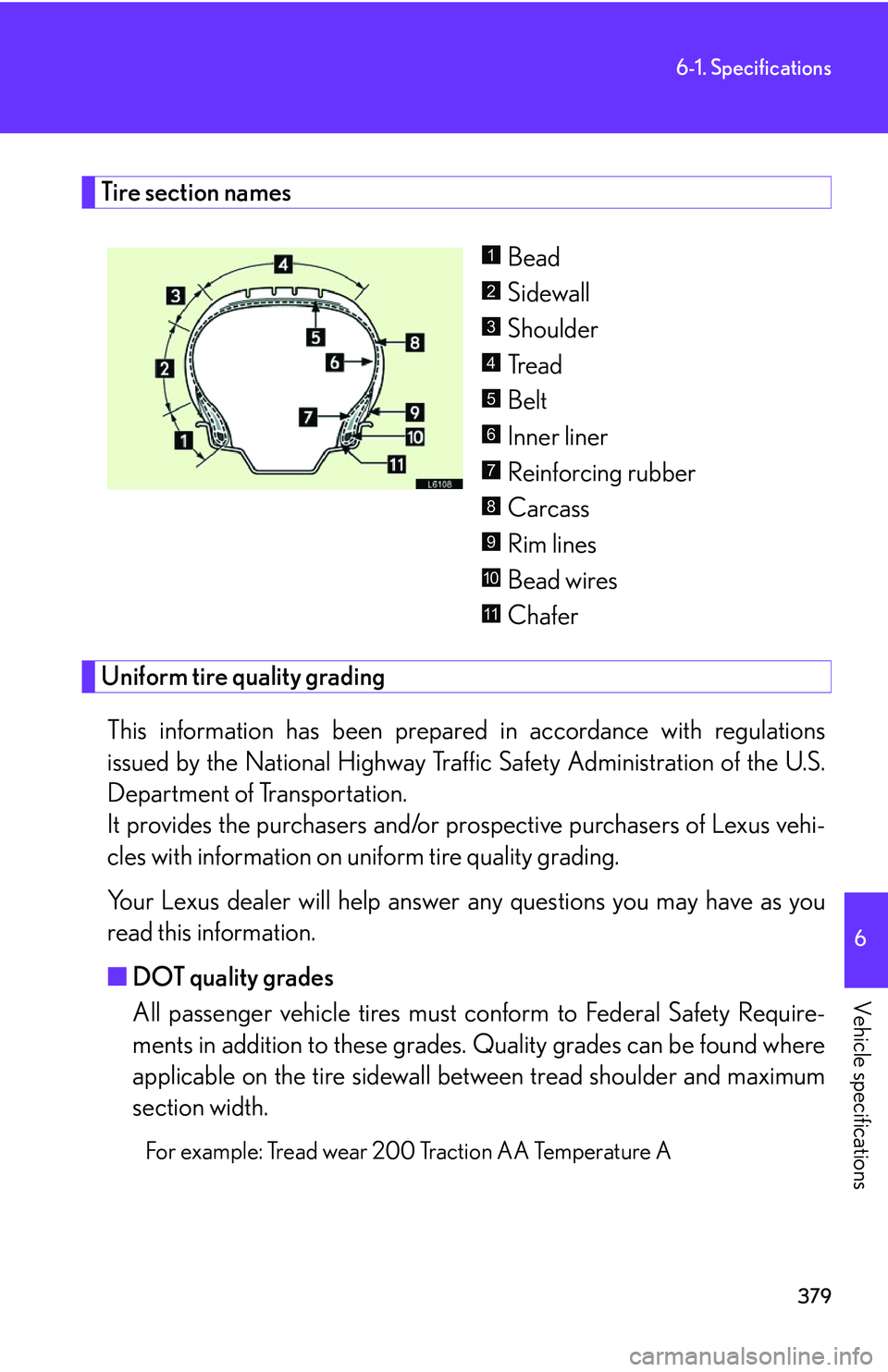
Tire section names
Bead
Sidewall
Shoulder
Tread
Belt
Inner liner
Reinforcing rubber
Carcass
Rim lines
Bead wires
Chafer
Uniform tire quality grading
This information has been prepared in accordance with regulations
issued by the National Highway Traffic Safety Ad ministration of the U.S.
Department of Transportation.
It provides the purchasers and/or prospective purchasers of Lexus vehi -
cles with information on uniform tir
e quality grading.
Your Lexus dealer will help answer any que
stions you may have as you
read this information.
■ DO
T quality grades
All passenger vehicle tires must co nform to F
ederal Safety Require -
ments in addition to these grades. Quality gr
ades can be found where
applicable on the tire sidewall between tread shoulder and maximum
section width.
For example: Tread wear 200 Traction AA Temperature A
1
2
3
4
5
6
7
8
9
10
11
Page 396 of 419
380
6-1. Specifications
■Tread wear
The tread wear grade is a comparative rating based on the wear rate of
the tir
e when tested under controll ed conditions on a specified gov -
ernment test course.
For example, a tire graded 150 would wear one and a half (1 - 1 /2) times as
well on the government course as a tire graded 100.
The relative performance of tires de pends upon the actual conditions of
their
use, however, and may depart significantly from the norm due to varia -
tions in driving habits, service practices
and differences in road characteris-
tics and climate.
■ Traction AA, A, B, C
The traction grades, from highest to lo
west, are AA, A, B and C, and
they represent the tire’s ability to stop on wet pavement as measured
under controlled condit ions on specified government test surfaces of
asphalt and concrete.
A tire marked C may have poor traction performance.
Warning: The traction grade assigned to this tir
e is based on braking
(straight ahead) traction tests and does not include cornering (turning) trac-
tion.
Page 397 of 419
381
6-1. Specifications
6
Vehicle specifications
■Temperature A, B, C
The temperature grades are A (the hi ghest), B
, and C, representing
the tire’s resistance to the generation of heat and its ability to dissipate
heat when tested under controlled conditions on a specified indoor
laboratory test wheel.
Sustained high temperature can cause the material of the tire to degenerate
and reduce tire life, and excessive temperature can lead to sudden tire fail -
ure.
The grade C corresponds to a level of performance which all passenger car
tir
es must meet under the Federal Moto r Vehicle Safety Standard No. 109.
Grades B and A represent higher levels of performance on the laboratory
test wheel than the minimum r
equired by law.
Warning: The temperature grades for this tire are established for a tire that
is pr
operly inflated and not overloaded.
Excessive speed, under inflation, or ex ces
sive loading, either separately or
in combination, can cause heat buildup and possible tire failure.
Page 398 of 419
382
6-1. Specifications
Glossary of tire terminology
Tire related termDefinition
Accessory weight
The combined weight (in excess of those standard items
which may be replaced) of automatic transmission,
power steering, power brakes, power windows, power
seats, radio and heater, to the extent that these items are
available as factory-installed equipment (whether
installed or not)
Cold tire inflation
pressure
Tire pressure when the vehicle has been parked for three
hours or more, or has not been driven more than 1 mile or
1.5 km under that condition
Curb weight
The weight of a motor vehicl e with standard equipment,
including the maximum capacity of fuel, oil and coolant,
and if so equipped, air conditioning and additional weight
optional engine
Maximum inflation
pressure
The maximum cold inflated pressure to which a tire may
be inflated, shown on the sidewall of the tire
Maximum loaded
vehicle weight
The sum of:
(a) Curb weight
(b) Accessory weight
(c) Vehicle capacity weight
(d) Production options weight
Normal occupant weight150 lb. (68 kg) times the numb er of occupants specified
in the second column of Table 1 that follows
Production options weight
The combined weight of installed regular production
options weighing over 5 lb. (2.3 kg) in excess of the stan -
dard items which they replace, not previously considered
in curb weight or accessory weight, including heavy duty
brakes, ride levelers, roof rack, heavy duty battery, and
special trim
Vehicle capacity weight
(Total load capacity)The rated cargo and luggage load plus 150 lb. (68 kg)
times the vehicle’s designated seating capacity