headlight LEXUS LS500 2018 Owner's Manual
[x] Cancel search | Manufacturer: LEXUS, Model Year: 2018, Model line: LS500, Model: LEXUS LS500 2018Pages: 514, PDF Size: 10.62 MB
Page 233 of 514
2334-5. Using the driving support systems
LS500_OM_OM50F54U_(U) 4
Driving
Press the LKA switch to turn the LKA
system on.WARNING■
Before using LKA system
Do not rely solely upon the LKA system.
The LKA system does not automatically
drive the vehicle or reduce the amount of
attention that must be paid to the area in
front of the vehicle. The driver must
always assume full responsibility for driv-
ing safely by paying careful attention to
the surrounding conditions and operat-
ing the steering wheel to correct the path
of the vehicle. Also, the driver must take
adequate breaks when fatigued, such as
from driving for a long period of time.
Failure to perform appropriate driving
operations and pay careful attention may
lead to an accident, resulting in death or
serious injury. ■
To avoid operating LKA system by
mistake
When not using the LKA system, use the
LKA switch to turn the system off. ■
Situations unsuitab le for LKA system
Do not use the LKA system in the follow-
ing situations.
The system may not operate properly
and lead to an accident, resulting in
death or serious injury.
●
A spare tire, tire chains, etc. are
equipped.
●
When the tires have been excessively
worn, or when the tire inflation pres-
sure is low.
●
Tires which differ by structure, manu-
facturer, brand or tread pattern are
used.
●
Objects or patterns that could be mis-
taken for white (yellow) lines are pres-
ent on the side of th e road (guardrails,
curbs, reflective poles, etc.).
●
Vehicle is driven on a snow-covered
road.
●
White (yellow) lines are difficult to see
due to rain, snow, fog, dust, etc. ●
Asphalt repair marks, white (yellow)
line marks, etc. are present due to road
repair. ●
Vehicle is driven in a temporary lane or
restricted lane due to construction
work. ●
Vehicle is driven on a road surface
which is slippery due to rainy weather,
fallen snow, freezing, etc. ●
Vehicle is driven in traffic lanes other
than on highways and freeways. ●
Vehicle is driven in a construction
zone. ■
Preventing LKA system malfunctions
and operations performed by mistake ●
Do not modify the headlights or place
stickers, etc. on the surface of the
lights. ●
Do not modify the suspension etc. If
the suspension etc. needs to be
replaced, contact your Lexus dealer. ●
Do not install or place anything on the
hood or grille. Also, do not install a
grille guard (bull bars, kangaroo bar,
etc.). ●
If your windshield needs repairs, con-
tact your Lexus dealer.
Turning LKA system on
Page 236 of 514
236 4-5. Using the driving support systems
LS500_OM_OM50F54U_(U) function is automatically restored.
( → P.235)■
Steering assist function/lane centering
function
Depending on the vehicle speed, lane
departure situation, ro ad conditions, etc.,
the driver may not feel the function is oper-
ating or the function may not operate at all.■
Lane departure alert function
The warning buzzer may be difficult to hear
due to external noise, audio playback, etc.
Also, it may be difficult to feel steering
wheel vibrations due to the road conditions,
etc. ■
Hands off steering wheel alert
When the system determines that the driver
has removed the hands from the steering
wheel while the steering assist function or
lane centering function is operating, a warn-
ing message is displaye d on the multi-infor-
mation display. If the driver continues to
keep the hands off of the steering wheel, a
warning message is displayed and the func-
tion is temporarily canceled. This alert also
operates in the same way when the driver
continuously operates the steering wheel
only a small amount. However, depending
on the road conditions , etc., the function
may not cancel. ■
White (yellow) lines ar e only on one side
of road
The LKA system will not operate for the
side on which white (yellow) lines could not
be recognized. ■
Conditions in whic h functions may not
operate properly
In the following situations, the camera sen-
sor may not detect white (yellow) lines and
various functions may not operate normally.
●
There are shadows on the road that run
parallel with, or cover, the white (yellow)
lines.
●
The vehicle is driven in an area without
white (yellow) lines, such as in front of a
tollgate or checkpoint, or at an intersec-
tion, etc.
●
The white (yellow) lines are cracked,
“Botts’ dots”, “Raised pavement marker” or stones are present. ●
The white (yellow) lines cannot be seen
or are difficult to see due to sand, etc. ●
The vehicle is driven on a road surface
that is wet due to rain, puddles, etc. ●
The traffic lines are yellow (which may be
more difficult to reco gnize than lines that
are white). ●
The white (yellow) lines cross over a curb,
etc. ●
The vehicle is driven on a bright surface,
such as concrete. ●
The vehicle is driven on a surface that is
bright due to reflected light, etc. ●
The vehicle is driven in an area where the
brightness changes sudd enly, such as at
the entrances and exits of tunnels, etc. ●
Light from the headlights of an oncoming
vehicle, the sun, etc. enters the camera. ●
The vehicle is driven where the road
diverges, merges, etc. ●
The vehicle is driven on a slope. ●
The vehicle is driven on a road which tilts
left or right, or a winding road. ●
The vehicle is driven on an unpaved or
rough road. ●
The vehicle is driven around a sharp
curve. ●
The traffic lane is excessively narrow or
wide. ●
The vehicle is extremely tilted due to car-
rying heavy luggage or having improper
tire pressure. ●
The distance to the preceding vehicle is
extremely short.
●
The vehicle is moving up and down a
large amount due to road conditions
during driving (poor roads or road
seams).
●
The headlight lenses are dirty and emit a
faint amount of light at night, or the beam
axis has deviated.
●
The vehicle is struck by a crosswind.
●
The vehicle has just changed lanes or
crossed an intersection.
●
Snow tires, etc. are equipped.
Page 270 of 514

270 4-5. Using the driving support systems
LS500_OM_OM50F54U_(U) • Pedestrians who are bending forward or
squatting
• Pedestrians who are lying down
• Pedestrians who are running
• Pedestrians who suddenly enter the
detection area
• Pedestrians riding a bicycle, skateboard,
or other light vehicle
• Pedestrians wearing oversized clothing
such as a rain coat, long skirt, etc., making
their silhouette obscure
• Pedestrians whose body is partially hid-
den by an object, such as a cart or
umbrella
• Pedestrians which are obscured by dark-
ness, such as at night●
In some situations, such as the following,
pedestrians may not be detected by the
rear camera detection function, prevent-
ing the function from operating properly:
• When backing up in inclement weather
(rain, snow, fog, etc.)
• When the rear camera is obscured (dirt,
snow, ice, etc. are attached) or scratched
• When a very bright light, such as the sun,
or the headlights of another vehicle,
shines directly into the rear camera
• When backing up in a place where the
surrounding brightness changes sud-
denly, such as at the entrance or exit of a
garage or underground parking lot
• When backing up in a dim environment
such as during dusk or in an underground
parking lot●
Even though there are no pedestrians in
the detection area, some objects, such as
the following, may be detected, possibly
causing the rear camera detection func-
tion to operate.
• Three dimensional objects, such as a
pole, traffic cone, fence, or parked vehi-
cle
• Moving objects, such as a car or motor-
cycle
• Objects moving toward your vehicle
when backing up, such as flags or pud-
dles (or airborne matter, such as smoke,
steam, rain, or snow)
• Cobblestone or gravel roads, tram rails,
road repairs, white lines, pedestrian
crossings or fallen leaves on the road
• Metal covers (gratings), such as those
used for drainage ditches • Objects reflected in a puddle or on a wet
road surface
• The roadside or bumps on the road
•Shadows on the road ●
In some situations, such as the following,
the rear camera detection function may
operate even though there are no pedes-
trians in the detection area.
• When backing up toward the roadside or
a bump on the road
• If the vehicle is signif icantly tilted, such as
when carrying a heavy load
• When backing up toward an
incline/decline
• If the suspension has been modified or
tires of a size othe r than specified are
installed
• If the rear of the vehicle is raised or low-
ered due to the carried load
• If an electronic component, such as a
backlit license plate or rear fog light, is
installed near the rear camera
• If a bumper protector, such as an addi-
tional trim strip, is installed to the rear
bumper
• If the orientation of the rear camera has
been changed due to a collision or other
impact, or removal and installation
• If a towing eyelet is in stalled to the rear of
the vehicle
• When water is flowing over the rear cam-
era lens
• When the rear camera is obscured (dirt,
snow, ice, etc. are at tached) or scratched
• If there is a flashing light in the detection
area, such as the emergency flashers of
another vehicle ●
Situations in which the rear camera
detection function may be difficult to
notice
• If buzzer may be difficult to hear if the
surrounding area is noisy, the volume of
the audio system volume is high, the air
conditioning system is being used, etc.
• If the temperature in the cabin is
extremely high or low, the audio system
screen may not operate correctly.
Page 287 of 514
2874-5. Using the driving support systems
LS500_OM_OM50F54U_(U) 4
Driving ■
Parking Support Brake function (rear
pedestrians) will operate when
The function will oper ate when the PKSB
OFF indicator is not illuminated or flashing
( → P.65, 66) and all of the following condi-
tions are met: ●
Engine output restriction control
• The Parking Support Brake is enabled.
• The vehicle speed is 10 mph (15 km/h) or
less.
• The shift position is in R.
• The rear camera sensor detects a pedes-
trian behind the vehicle while backing up
and the system determines that the possi-
bility of colliding with the detected
pedestrian is high.●
Brake control
• Engine output restriction control is oper-
ating
• The Parking Support Brake determines
that an emergency brake operation is
necessary to avoid a collision with a
pedestrians.■
The Parking Support Brake function
(rear pedestrians) will stop operating
when
The function will stop operating if any of the
following conditions are met:
●
Engine output restriction control
• The Parking Support Brake is disabled.
• The collision becomes avoidable with
normal brake operation.
• The pedestrian is no longer detected
behind your vehicle.
●
Brake control
• The Parking Support Brake is disabled.
• Approximately 2 seconds have elapsed
since the vehicle was stopped by brake control.
• The brake pedal is depressed after the
vehicle is stopped by brake control.
• The pedestrian is no longer detected
behind your vehicle. ■
Detection area of the Parking Support
Brake function (rear pedestrians)
The detection area of the Parking Support
Brake function (rear pedestrians) differs
from the detection area of the RCD func-
tion ( → P.269). Therefore, even if the RCD
function detects a vehicle and provides an
alert, the Parking Support Brake function
(rear-crossing vehicles) may not start oper-
ating. ■
Situations in which the system may not
operate properly ●
Some pedestrians, such as the following,
may not be detected by the Parking Sup-
port Brake function (rear pedestrians),
preventing the function from operating
properly:
• Pedestrians who are bending forward or
squatting
• Pedestrians who are lying down
• Pedestrians who are running
• Pedestrians who suddenly enter the
detection area
• Pedestrians riding a bicycle, skateboard,
or other light vehicle
• Pedestrians wearing oversized clothing
such as a rain coat, long skirt, etc., making
their silhouette obscure
• Pedestrians whose body is partially hid-
den by an object, such as a cart or
umbrella
• Pedestrians which are obscured by dark-
ness, such as at night ●
In some situations, such as the following,
pedestrians may not be detected by the
Parking Support Brake function (rear
pedestrians), preventing the function
from operating properly:
• When backing up in inclement weather
(rain, snow, fog, etc.)
• When the rear camera is obscured (dirt,
snow, ice, etc. are at tached) or scratched
• When a very bright light, such as the sun,
or the headlights of another vehicle,
shines directly into the rear camera
• When backing up in a place where the
surrounding brightness changes sud-WARNING■
If the Parking Support Brake function
(rear pedestrians) operates unneces-
sarily
Depress the brake pedal immediately
after the Parking Support Brake function
(rear pedestrians) operates. (Operation
of the function is canceled by depressing
the brake pedal.)
Page 408 of 514
408 6-3. Do-it-yourself maintenance
LS500_OM_OM50F54U_(U) ■
LED Lights
The lights consist of a number of LEDs. If
any of the LEDs burn out, take your vehicle
to your Lexus dealer to have the light
replaced. ■
Condensation build-up on the inside of
the lens
Temporary condensation build-up on the
inside of the headlight lens does not indi-
cate a malfunction. Contact your Lexus
dealer for more information in the following
situations: ●
Large drops of water ha ve built up on the
inside of the lens.●
Water has built up inside the headlight.Light bulbs If any lights burn out, have it
replaced by your Lexus dealer.
Page 430 of 514
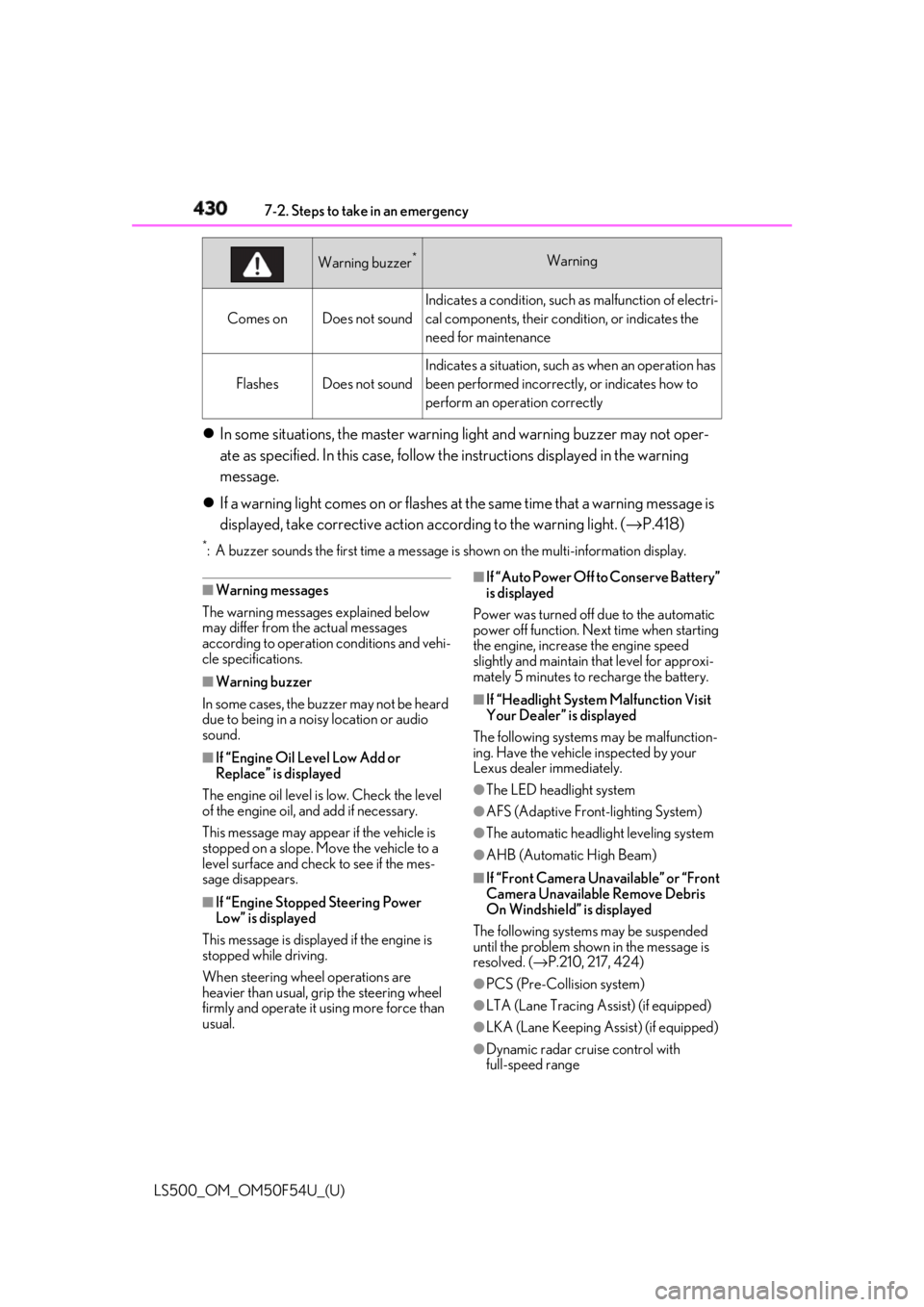
430 7-2. Steps to take in an emergency
LS500_OM_OM50F54U_(U) In some situations, the master warning light and warning buzzer may not oper-
ate as specified. In this case, follow the instructions displayed in the warning
message.
If a warning light comes on or flashes at the same time that a warning message is
displayed, take corrective actio n according to the warning light. ( → P.418)*
: A buzzer sounds the first time a message is shown on the multi-information display.
■
Warning messages
The warning messages explained below
may differ from the actual messages
according to operation conditions and vehi-
cle specifications. ■
Warning buzzer
In some cases, the bu zzer may not be heard
due to being in a noisy location or audio
sound. ■
If “Engine Oil Level Low Add or
Replace” is displayed
The engine oil level is low. Check the level
of the engine oil, and add if necessary.
This message may appear if the vehicle is
stopped on a slope. Move the vehicle to a
level surface and check to see if the mes-
sage disappears.
■
If “Engine Stoppe d Steering Power
Low” is displayed
This message is displa yed if the engine is
stopped while driving.
When steering wheel operations are
heavier than usual, grip the steering wheel
firmly and operate it using more force than
usual. ■
If “Auto Power Off to Conserve Battery”
is displayed
Power was turned off due to the automatic
power off function. Next time when starting
the engine, increase the engine speed
slightly and maintain that level for approxi-
mately 5 minutes to recharge the battery. ■
If “Headlight System Malfunction Visit
Your Dealer” is displayed
The following systems may be malfunction-
ing. Have the vehicle inspected by your
Lexus dealer immediately. ●
The LED headlight system ●
AFS (Adaptive Front-lighting System) ●
The automatic headlight leveling system ●
AHB (Automatic High Beam)
■
If “Front Camera Unav ailable” or “Front
Camera Unavailable Remove Debris
On Windshield” is displayed
The following systems may be suspended
until the problem shown in the message is
resolved. ( → P.210, 217, 424)
●
PCS (Pre-Collision system)
●
LTA (Lane Tracing Assist) (if equipped)
●
LKA (Lane Keeping Assist) (if equipped)
●
Dynamic radar cruise control with
full-speed rangeComes on Does not sound Indicates a condition, such as malfunction of electri-
cal components, their cond ition, or indicates the
need for maintenance
Flashes Does not sound Indicates a situation, such as when an operation has
been performed incorrectly, or indicates how to
perform an operation correctlyWarning buzzer *
Warning
Page 433 of 514
4337-2. Steps to take in an emergency
LS500_OM_OM50F54U_(U) 7
When trouble arises One of the following may be the cause
of the problem:
There may not be sufficient fuel in
the vehicle’s tank.
Refuel the vehicle.
The engine may be flooded.
Try to restart the engine again fol-
lowing correct starting procedures.
( → P.160)
There may be a malfunction in the
engine immobilizer system.
( → P.58)
There may be a malfunction in the
shift control system. *
( → P.163, 431) *
: It may not be possible to shift the shift
position from P.
One of the following may be the cause
of the problem:
The battery may be discharged. NOTICE■
When replacing the tires
When removing or fitting the wheels,
tires or the tire pressure warning valve
and transmitter, contact your Lexus
dealer as the tire pr essure warning valve
and transmitter may be damaged if not
handled correctly. ■
When driving over bumps
If a vehicle has a flat tire, the vehicle
height will be lower than usual. Ensure
that nothing strikes the bottom of the
vehicle. ■
To avoid damage to the tire pressure
warning valves and transmitters
When a tire is repaired with liquid seal-
ants, the tire pressu re warning valve and
transmitter may not operate properly. If a
liquid sealant is used , contact your Lexus
dealer or other qualified service shop as
soon as possible. Make sure to replace
the tire pressure warning valve and trans-
mitter when replacing the tire. ( → P.392) If the engine will not start If the engine will not start even
though correct starting procedures
are being followed ( → P.160), con-
sider each of the following points:
The engine will not start even
though the starter motor oper-
ates normally.
The starter motor turns over
slowly, the interior lights and
headlights are dim, or the horn
does not sound or sounds at a low
volume.
Page 440 of 514
440 7-2. Steps to take in an emergency
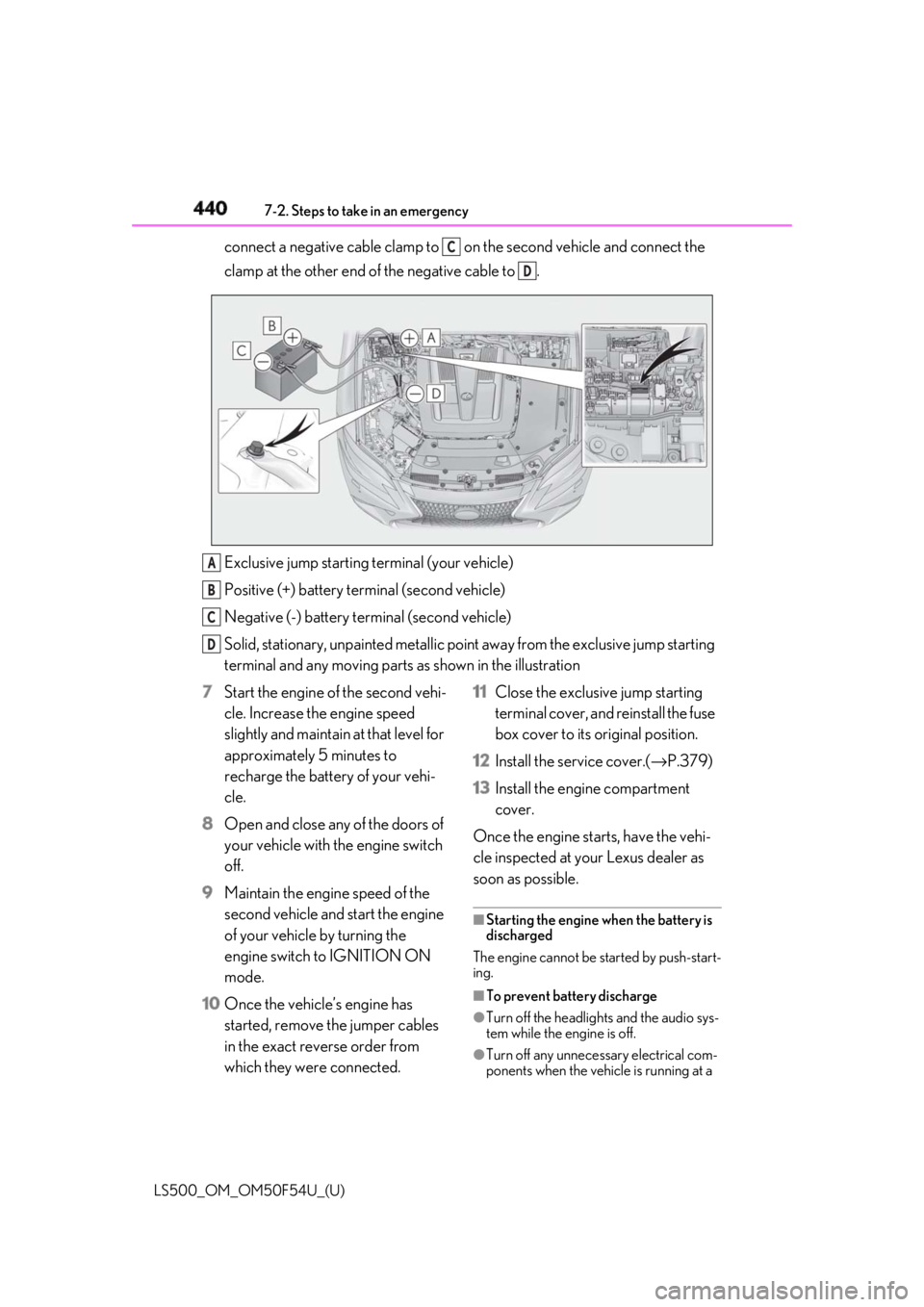
LS500_OM_OM50F54U_(U) connect a negative cable clamp to on the second vehicle and connect the
clamp at the other end of the negative cable to .
Exclusive jump starting terminal (your vehicle)
Positive (+) battery terminal (second vehicle)
Negative (-) battery terminal (second vehicle)
Solid, stationary, unpainted metallic point away from the exclusive jump starting
terminal and any mo ving parts as shown in the illustration
7 Start the engine of the second vehi-
cle. Increase the engine speed
slightly and maintain at that level for
approximately 5 minutes to
recharge the battery of your vehi-
cle.
8 Open and close any of the doors of
your vehicle with the engine switch
off.
9 Maintain the engine speed of the
second vehicle and start the engine
of your vehicle by turning the
engine switch to IGNITION ON
mode.
10 Once the vehicle’s engine has
started, remove the jumper cables
in the exact reverse order from
which they were connected. 11 Close the exclusive jump starting
terminal cover, and reinstall the fuse
box cover to its original position.
12 Install the service cover.( → P.379)
13 Install the engine compartment
cover.
Once the engine starts, have the vehi-
cle inspected at your Lexus dealer as
soon as possible. ■
Starting the engine when the battery is
discharged
The engine cannot be started by push-start-
ing.
■
To prevent battery discharge
●
Turn off the headlights and the audio sys-
tem while the engine is off.
●
Turn off any unnecessary electrical com-
ponents when the vehicle is running at a C
D
A
B
C
D
Page 477 of 514
4758-2. Customization
LS500_OM_OM50F54U_(U) 8
Vehicle specifications ■
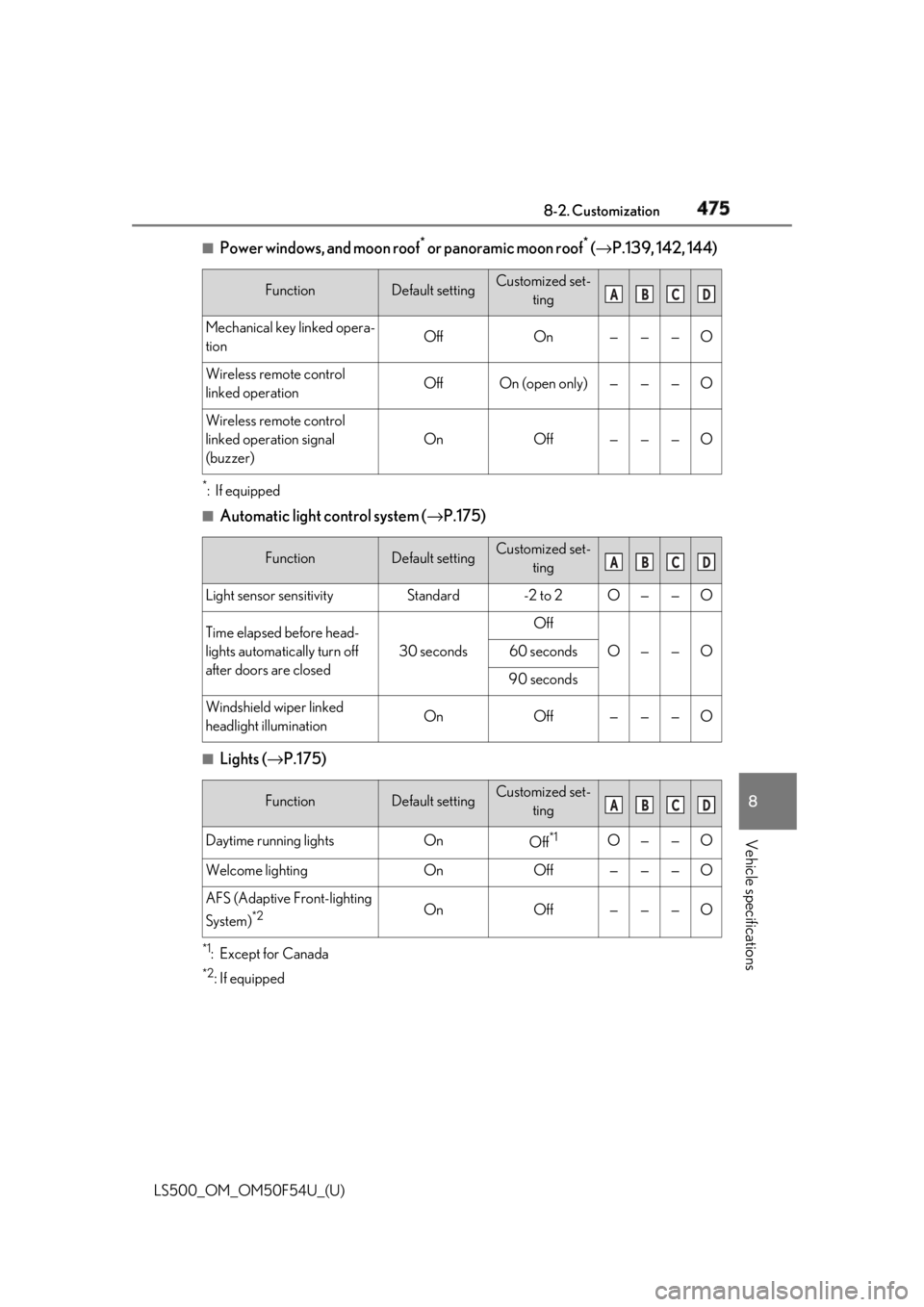
Power windows, and moon roof *
or panoramic moon roof *
( → P.139, 142, 144)*
:If equipped ■
Automatic light control system ( → P.175)
■
Lights ( → P.175)
*1
:Except for Canada *2
: If equipped Function Default setting Customized set-
ting
Mechanical key linked opera-
tion Off On — — — O
Wireless remote control
linked operation Off On (open only) — — — O
Wireless remote control
linked operation signal
(buzzer) On Off — — — O
Function Default setting Customized set-
ting
Light sensor sensitivity Standard -2 to 2 O — — O
Time elapsed before head-
lights automatically turn off
after doors are closed 30 seconds Off
O — — O60 seconds
90 seconds
Windshield wiper linked
headlight illumination On Off — — — O
Function Default setting Customized set-
ting
Daytime running lights On
Off *1
O — — O
Welcome lighting On Off — — — O
AFS (Adaptive Front-lighting
System) *2
On Off — — — O A B C D
A B C D
A B C D
Page 499 of 514

4971-1. What to do if... (Troubleshooting)
LS500_OM_OM50F54U_(U) 497Alphabetical Index
Alphabetical Index A
A/C
Air conditioning filter ............................... 402
Front automatic air conditioning system
...........................................................................313
Micro dust and pollen filter.....................319
Rear air conditioning system ............... 323
ABS (Anti-lock Brake System).............. 294
Warning light ............................................... 420
Active stabilizer suspension system .... 294
Adaptive Front-lighting System (AFS) . 177
Adaptive Variable Suspension System295
AFS (Adaptive Front-lighting System) . 177
Air conditioning filter ................................. 402
Air conditioning system
Air conditioning filter ............................... 402
Front automatic air conditioning system
...........................................................................313
Micro dust and pollen filter.....................319
Rear air conditioning system ............... 323
Airbags
Airbag operating conditions..................... 31
Airbag precautions for your child ........ 34
Correct driving posture .............................23
Curtain shield airbag operating condi-
tions .................................................................... 31
Curtain shield airbag precautions ....... 34
Front passenger occupa nt classification
system ............................................................. 40
General airbag precautions ................... 34
Locations of airbags.................................... 29
Modification and disposal of airbags ..37
Side airbag operating conditions ........... 31
Side airbag precautions ............................ 34
Side and curtain shield airbags operating
conditions........................................................ 31
Side and curtain shield airbags precau-
tions .................................................................. 34
SRS airbags ..................................................... 29
SRS warning light ........................................419 Alarm
Alarm...................................................................60
Warning buzzer .......................................... 418
Anchor brackets ..................................... 46, 55
Antennas (smart acc ess system with
push-button start).......................................107
Anti-lock Brake System (ABS).............. 294
Warning light ...............................................420
Approach warning.......................................247
Armrest............................................................ 343
Assist grips ..................................................... 343
Audio system-linked display ........................81
Automatic headlight leveling system .... 176
Automatic High Beam ................................178
Automatic light control system................ 175
Automatic transmission ..............................163
M mode ........................................................... 168
Paddle shift switches .......................167, 168
Snow mode.....................................................167
Auxiliary boxes ................................. 338, 340
Average fuel economy................................. 78
Average vehicle speed ................................ 78
B
Back-up lights
Replacing light bulbs ............................... 408
Battery
Battery checking ....................................... 384
If the battery is discharged ................... 438
Preparing and checking before winter
..........................................................................299
Warning light ................................................ 419
Blind Spot Monitor (BSM).........................251
Boost gauge.......................................................79
Brake
Brake hold .......................................................173
Fluid...................................................................453
Parking brake ............................................... 170
Warning light ................................................ 418
Brake assist .................................................... 294
Break-in tips...................................................... 151