tire pressure LEXUS LS500 2018 Owner's Guide
[x] Cancel search | Manufacturer: LEXUS, Model Year: 2018, Model line: LS500, Model: LEXUS LS500 2018Pages: 514, PDF Size: 10.62 MB
Page 426 of 514

426 7-2. Steps to take in an emergency
LS500_OM_OM50F54U_(U) If it is, tighten it securely.
The light will go off after several driving
trips.
If the light does not go off even after several
trips, contact your Lexus dealer as soon as
possible. ■
Electric power steering system warning
light (warning buzzer)
When the battery charge becomes insuffi-
cient or the voltage temporarily drops, the
electric power steeri ng system warning
light may come on and the warning buzzer
may sound. ■
When the tire pressure warning light
comes on
Inspect the tires to check if a tire is punc-
tured.
If a tire is punctured: → P.432
If none of the tires are punctured:
Turn the engine switch off then turn it to
IGNITION ON mode. Check if the tire
pressure warning light comes on or blinks.
If the tire pressure wa rning light blinks for
approximately 1 minute then stays on
There may be a malfunction in the tire
pressure warning syst em. Have the vehicle
inspected by your Lexus dealer immedi-
ately.
If the tire pressure warning light comes
on
1 After the temperature of the tires has
lowered sufficiently, check the inflation
pressure of each tire and adjust them to
the specified level.
2 If the warning light does not turn off
even after several minutes have
elapsed, check that the inflation pres-
sure of each tire is at the specified level
and perform initialization. ( → P.392)
■
The tire pressure warning light may
come on due to natural causes
The tire pressure wa rning light may come
on due to natural causes such as natural air
leaks and tire inflation pressure changes
caused by temperature. In this case, adjust-
ing the tire inflation pressure will turn off the
warning light (after a few minutes). ■
Conditions that the tire pressure warn-
ing system may not function properly
→ P.389
WARNING■
If both the ABS and the brake system
warning lights remain on
Stop your vehicle in a safe place immedi-
ately and contact your Lexus dealer.
The vehicle will become extremely
unstable during br aking, and the ABS
system may fail, which could cause an
accident resulting in death or serious
injury. ■
When the electric power steering
system warning light comes on
When the light comes on yellow, the
assist to the power st eering is restricted.
When the light comes on red, the assist
to the power steering is lost and handling
operations of the steering wheel become
extremely heavy.
When steering wheel operations are
heavier than usual, grip the steering
wheel firmly and operate it using more
force than usual. ■
If the tire pressure warning light
comes on
Be sure to observe the following precau-
tions.
Failure to do so could cause a loss of
vehicle control and result in death or
serious injury.
●
Decelerate to the lowest appropriate
speed as soon as possible. Do not
drive over 50 mph (80 km/h).
●
Check and adjust the tire inflation
pressure immediately.
●
If the tire pressure warning light comes
on even after tire inflation pressure
adjustment, it is prob able that you have
a flat tire. Have the flat tire replaced by
the nearest Lexus dealer.
Page 427 of 514
4277-2. Steps to take in an emergency
LS500_OM_OM50F54U_(U) 7
When trouble arises WARNING●
Avoid abrupt maneuvering and brak-
ing.
If the vehicle tires deteriorate, you
could lose control of the steering
wheel or the brakes.■
If a blowout or sudden air leakage
should occur
The tire pressure warning system may
not activate immediately. ■
Maintenance of the tires
Each tire, including the spare (if pro-
vided), should be checked monthly when
cold and inflated to the inflation pressure
recommended by the vehicle manufac-
turer on the vehicle placard or tire infla-
tion pressure label (tire and load
information label). (I f your vehicle has
tires of a different size than the size indi-
cated on the vehicle placard or tire infla-
tion pressure label [tire and load
information label], yo u should determine
the proper tire infl ation pressure for
those tires.)
As an added safety feature, your vehicle
has been equipped with a tire pressure
monitoring system (TPMS-tire pressure
warning system) that illuminates a low
tire pressure telltale (tire pressure warn-
ing light) when one or more of your tires
is significantly under-inflated. Accord-
ingly, when the low tire pressure telltale
(tire pressure warnin g light) illuminates,
you should stop and check your tires as
soon as possible, and inflate them to the
proper pressure. Driving on a signifi-
cantly under-inflated tire causes the tire
to overheat and can lead to tire failure.
Under-inflation also reduces fuel effi-
ciency and tire tread life, and may affect
the vehicle’s handling and stopping abil-
ity. Please note that the TPMS (tire pressure
warning system) is not a substitute for
proper tire maintenance, and it is the
driver’s responsibility to maintain correct
tire pressure, even if under-inflation has
not reached the level to trigger illumina-
tion of the TPMS low tire pressure telltale
(tire pressure warning light).
Your vehicle has also been equipped with
a TPMS (tire pressure warning system)
malfunction indicator to indicate when
the system is not operating properly. The
TPMS (tire pressure warning system)
malfunction indicator is combined with
the low tire pressure telltale (tire pres-
sure warning light) . When the system
detects a malfunction, the telltale will
flash for approximately one minute and
then remain continuously illuminated.
This sequence will continue upon subse-
quent vehicle start-ups as long as the
malfunction exists. When the malfunction
indicator is illuminated, the system may
not be able to detect or signal low tire
pressure as intended.
TPMS (tire pressure warning system)
malfunctions may occur for a variety of
reasons, including the installation of
replacement or alternate tires or wheels
on the vehicle that prevent the TPMS
(tire pressure warning system) from func-
tioning properly. Always check the
TPMS (tire pressure warning system)
malfunction telltale after replacing one
or more tires or wheels on your vehicle to
ensure that the replacement or alternate
tires and wheels allow the TPMS (tire
pressure warning system) to continue to
function properly.
NOTICE
■
To ensure the tire pressure warning
system operates properly
Do not install tires with different specifi-
cations or makers, as the tire pressure
warning system may not operate prop-
erly.
Page 432 of 514
432 7-2. Steps to take in an emergency
LS500_OM_OM50F54U_(U) Take your vehicle to the nearest Lexus
dealer or authorized tire dealer as
soon as possible if any tire goes flat. The vehicle can be driven for a maximum
of 100 miles (160 km) at a speed below 50
mph (80 km/h) after the tire pressure
warning light comes on. ( → P.422)
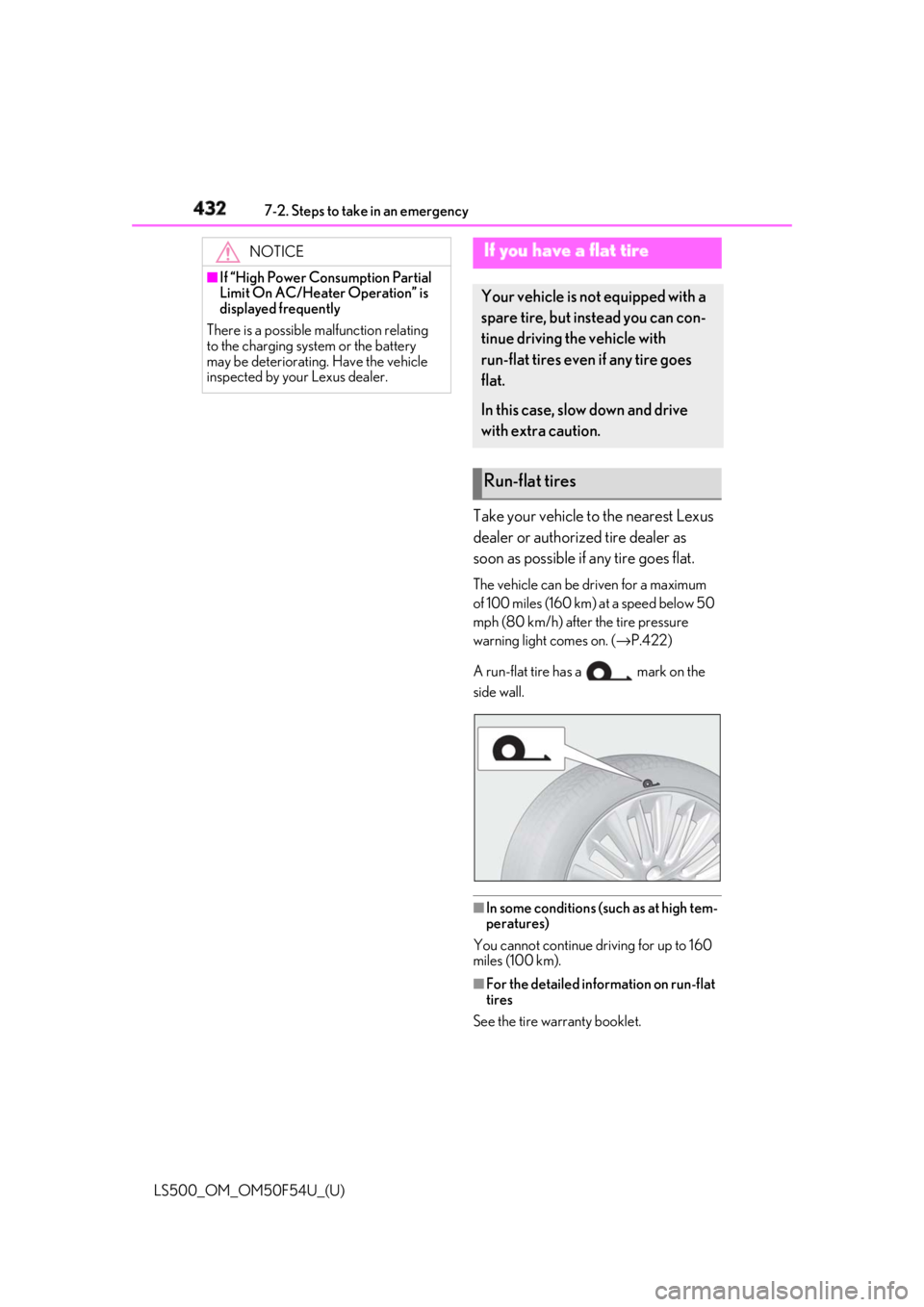
A run-flat tire has a mark on the
side wall.
■
In some conditions (s uch as at high tem-
peratures)
You cannot continue driving for up to 160
miles (100 km).
■
For the detailed information on run-flat
tires
See the tire warranty booklet.NOTICE■
If “High Power Consumption Partial
Limit On AC/Heater Operation” is
displayed frequently
There is a possible malfunction relating
to the charging system or the battery
may be deteriorating. Have the vehicle
inspected by your Lexus dealer.
If you have a flat tire Your vehicle is not equipped with a
spare tire, but instead you can con-
tinue driving the vehicle with
run-flat tires even if any tire goes
flat.
In this case, slow down and drive
with extra caution.
Run-flat tires
Page 433 of 514
4337-2. Steps to take in an emergency
LS500_OM_OM50F54U_(U) 7
When trouble arises One of the following may be the cause
of the problem:
There may not be sufficient fuel in
the vehicle’s tank.
Refuel the vehicle.
The engine may be flooded.
Try to restart the engine again fol-
lowing correct starting procedures.
( → P.160)
There may be a malfunction in the
engine immobilizer system.
( → P.58)
There may be a malfunction in the
shift control system. *
( → P.163, 431) *
: It may not be possible to shift the shift
position from P.
One of the following may be the cause
of the problem:
The battery may be discharged. NOTICE■
When replacing the tires
When removing or fitting the wheels,
tires or the tire pressure warning valve
and transmitter, contact your Lexus
dealer as the tire pr essure warning valve
and transmitter may be damaged if not
handled correctly. ■
When driving over bumps
If a vehicle has a flat tire, the vehicle
height will be lower than usual. Ensure
that nothing strikes the bottom of the
vehicle. ■
To avoid damage to the tire pressure
warning valves and transmitters
When a tire is repaired with liquid seal-
ants, the tire pressu re warning valve and
transmitter may not operate properly. If a
liquid sealant is used , contact your Lexus
dealer or other qualified service shop as
soon as possible. Make sure to replace
the tire pressure warning valve and trans-
mitter when replacing the tire. ( → P.392) If the engine will not start If the engine will not start even
though correct starting procedures
are being followed ( → P.160), con-
sider each of the following points:
The engine will not start even
though the starter motor oper-
ates normally.
The starter motor turns over
slowly, the interior lights and
headlights are dim, or the horn
does not sound or sounds at a low
volume.
Page 456 of 514
454 8-1. Specifications
LS500_OM_OM50F54U_(U) warning light is illuminated, refer to P.418.) *2
: Make sure to confirm that the brake warning light (yellow) does not illuminate. (If the
brake warning light illuminates, refer to P.418.) *3
: Vehicles without Lexus Safety System+A *4
: Vehicles with Lexus Safety System+A
19-inch tires (type A)
19-inch tires (type B)Steering Free play Less than 1.2 in. (30 mm)
Tires and wheels Tire size 245/50RF19 101W
Tire inflation pressure
(Recommended cold tire
inflation pressure) Driving under normal conditions
Front: 36 psi (250 kPa, 2.5 kgf/cm 2
or bar)
Rear: 36 psi (250 kPa, 2.5 kgf/cm 2
or bar)
Driving at high speeds above 118 mph (190 km/h) (in coun-
tries where such speeds are permitted by law)
Add 9 psi (60 kPa, 0.6 kgf/cm 2
or bar) to the front tires and
rear tires. Never exceed the maximum cold tire inflation
pressure indicated on the tire sidewall.
Wheel size 19 × 8J
Wheel nut torque 103 ft•lbf (140 N•m, 14.3 kgf•m)
Tire size 245/50RF19 101V
Tire inflation pressure
(Recommended cold tire
inflation pressure) Driving under normal conditions
Front: 36 psi (250 kPa, 2.5 kgf/cm 2
or bar)
Rear: 36 psi (250 kPa, 2.5 kgf/cm 2
or bar)
Driving at high speeds above 100 mph (160 km/h) (in
countries where such speeds are permitted by law)
Add 9 psi (60 kPa, 0.6 kgf/cm 2
or bar) to the front tires and
rear tires. Never exceed the maximum cold tire inflation
pressure indicated on the tire sidewall.
Page 457 of 514
4558-1. Specifications
LS500_OM_OM50F54U_(U) 8
Vehicle specifications
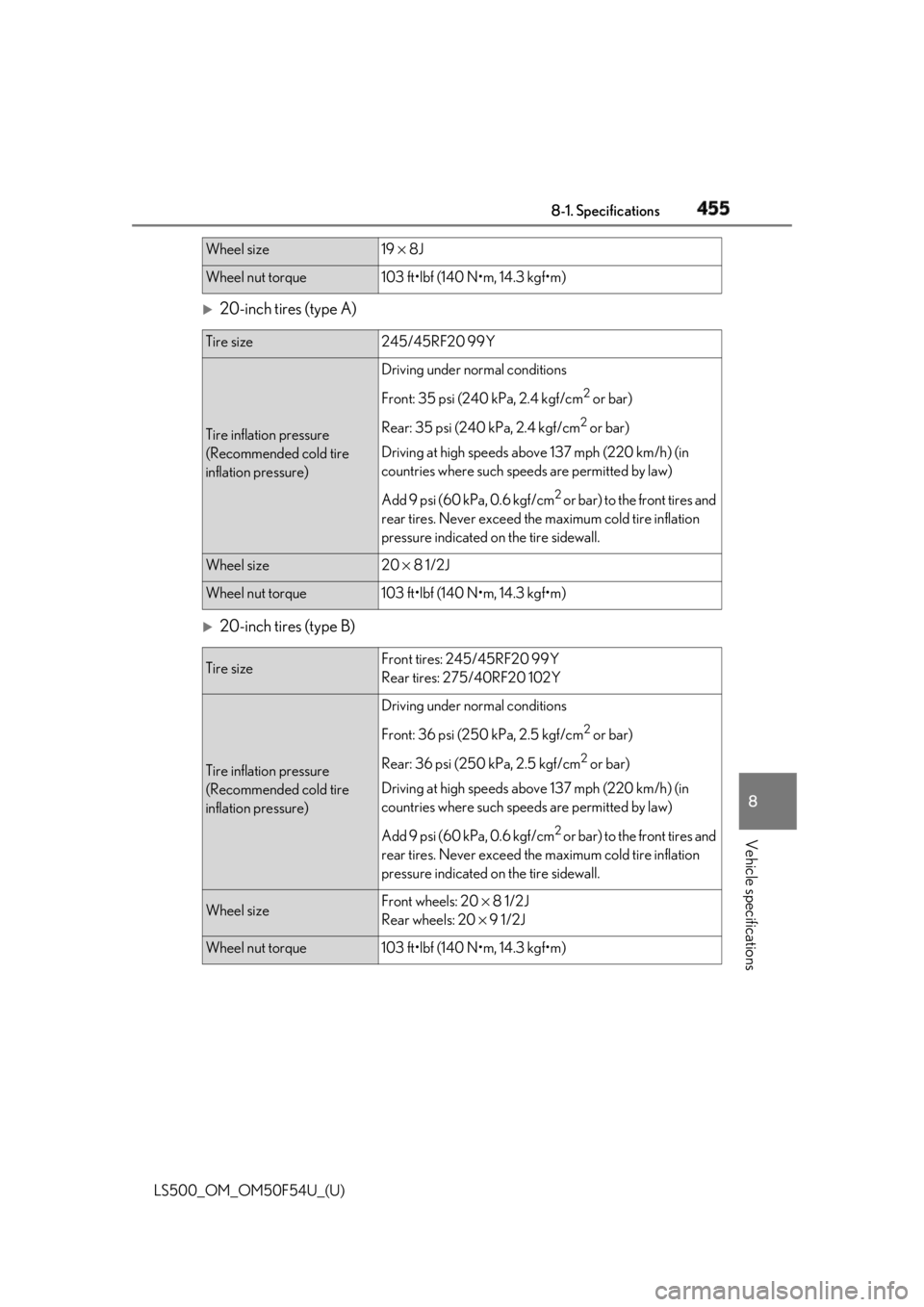
20-inch tires (type A)
20-inch tires (type B) Wheel size 19 × 8J
Wheel nut torque 103 ft•lbf (140 N•m, 14.3 kgf•m)
Tire size 245/45RF20 99Y
Tire inflation pressure
(Recommended cold tire
inflation pressure) Driving under normal conditions
Front: 35 psi (240 kPa, 2.4 kgf/cm 2
or bar)
Rear: 35 psi (240 kPa, 2.4 kgf/cm 2
or bar)
Driving at high speeds above 137 mph (220 km/h) (in
countries where such speeds are permitted by law)
Add 9 psi (60 kPa, 0.6 kgf/cm 2
or bar) to the front tires and
rear tires. Never exceed the maximum cold tire inflation
pressure indicated on the tire sidewall.
Wheel size 20 × 8 1/2J
Wheel nut torque 103 ft•lbf (140 N•m, 14.3 kgf•m)
Tire size Front tires: 245/45RF20 99Y
Rear tires: 275/40RF20 102Y
Tire inflation pressure
(Recommended cold tire
inflation pressure) Driving under normal conditions
Front: 36 psi (250 kPa, 2.5 kgf/cm 2
or bar)
Rear: 36 psi (250 kPa, 2.5 kgf/cm 2
or bar)
Driving at high speeds above 137 mph (220 km/h) (in
countries where such speeds are permitted by law)
Add 9 psi (60 kPa, 0.6 kgf/cm 2
or bar) to the front tires and
rear tires. Never exceed the maximum cold tire inflation
pressure indicated on the tire sidewall.
Wheel size Front wheels: 20 × 8 1/2J
Rear wheels: 20 × 9 1/2J
Wheel nut torque 103 ft•lbf (140 N•m, 14.3 kgf•m)
Page 458 of 514
456 8-1. Specifications
LS500_OM_OM50F54U_(U)
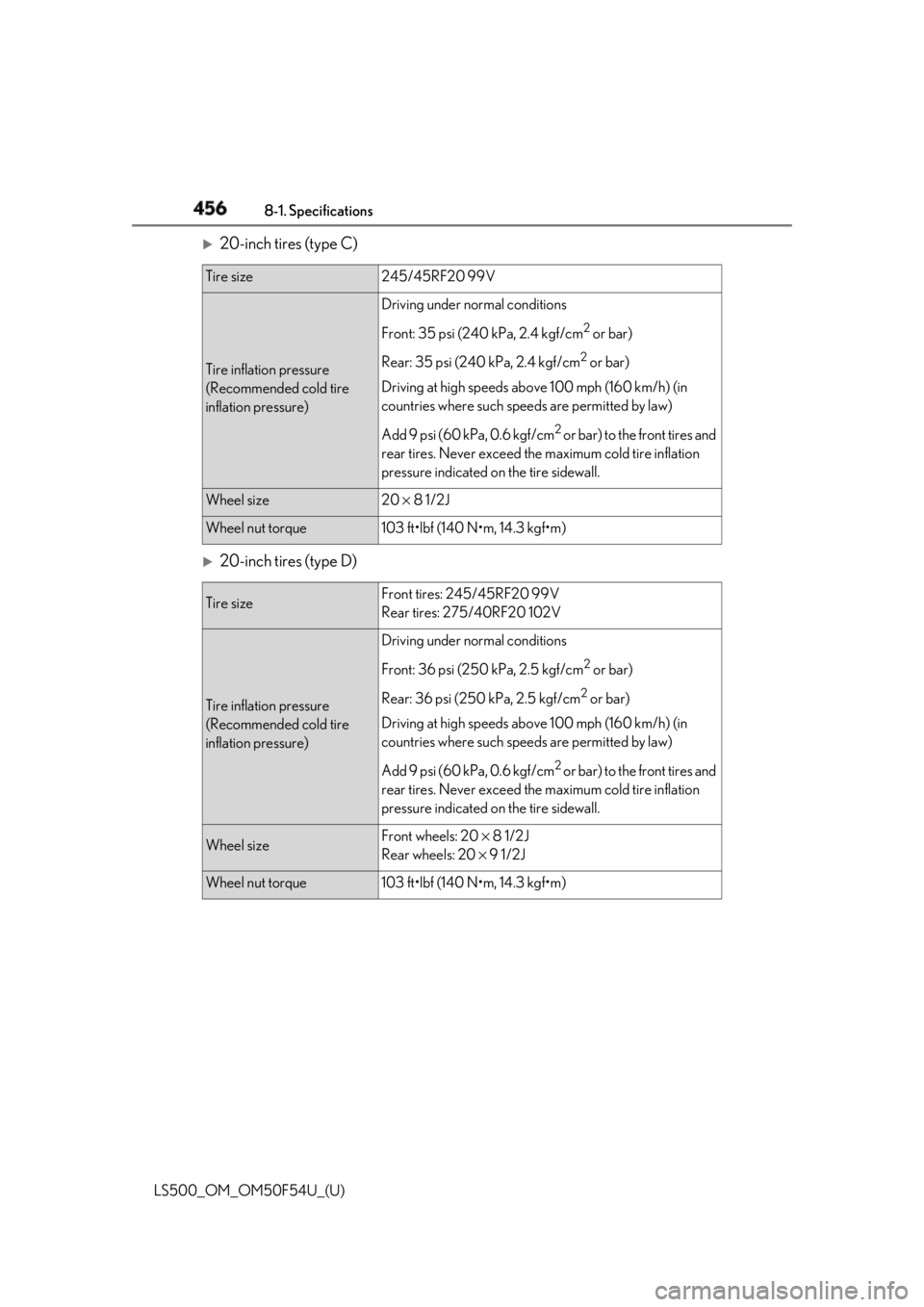
20-inch tires (type C)
20-inch tires (type D) Tire size 245/45RF20 99V
Tire inflation pressure
(Recommended cold tire
inflation pressure) Driving under normal conditions
Front: 35 psi (240 kPa, 2.4 kgf/cm 2
or bar)
Rear: 35 psi (240 kPa, 2.4 kgf/cm 2
or bar)
Driving at high speeds above 100 mph (160 km/h) (in
countries where such speeds are permitted by law)
Add 9 psi (60 kPa, 0.6 kgf/cm 2
or bar) to the front tires and
rear tires. Never exceed the maximum cold tire inflation
pressure indicated on the tire sidewall.
Wheel size 20 × 8 1/2J
Wheel nut torque 103 ft•lbf (140 N•m, 14.3 kgf•m)
Tire size Front tires: 245/45RF20 99V
Rear tires: 275/40RF20 102V
Tire inflation pressure
(Recommended cold tire
inflation pressure) Driving under normal conditions
Front: 36 psi (250 kPa, 2.5 kgf/cm 2
or bar)
Rear: 36 psi (250 kPa, 2.5 kgf/cm 2
or bar)
Driving at high speeds above 100 mph (160 km/h) (in
countries where such speeds are permitted by law)
Add 9 psi (60 kPa, 0.6 kgf/cm 2
or bar) to the front tires and
rear tires. Never exceed the maximum cold tire inflation
pressure indicated on the tire sidewall.
Wheel size Front wheels: 20 × 8 1/2J
Rear wheels: 20 × 9 1/2J
Wheel nut torque 103 ft•lbf (140 N•m, 14.3 kgf•m)
Page 461 of 514
4598-1. Specifications
LS500_OM_OM50F54U_(U) 8
Vehicle specifications
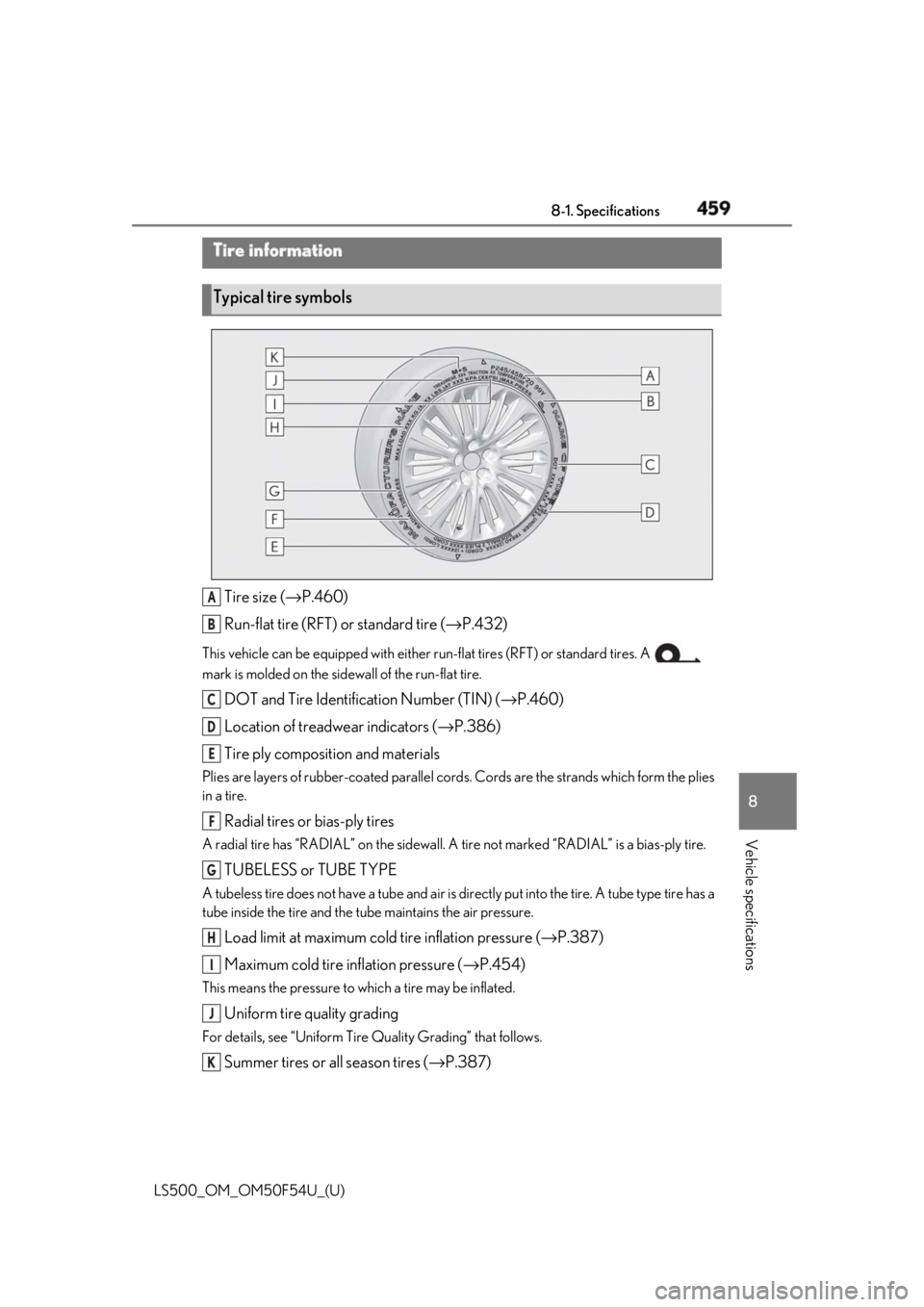
Tire size ( → P.460)
Run-flat tire (RFT) or standard tire ( → P.432)This vehicle can be equipped with either run-flat tires (RFT) or standard tires. A
mark is molded on the side wall of the run-flat tire.
DOT and Tire Identification Number (TIN) ( → P.460)
Location of treadwear indicators ( → P.386)
Tire ply composition and materialsPlies are layers of rubber-coa ted parallel cords. Cords are the strands which form the plies
in a tire.
Radial tires or bias-ply tiresA radial tire has “RADIAL” on the sidewall. A tire not marked “RADIAL” is a bias-ply tire.
TUBELESS or TUBE TYPEA tubeless tire does not have a tube and air is directly put into the tire. A tube type tire has a
tube inside the tire and the tube maintains the air pressure.
Load limit at maximum cold tire inflation pressure ( → P.387)
Maximum cold tire inflation pressure ( → P.454)This means the pressure to which a tire may be inflated.
Uniform tire quality gradingFor details, see “Uniform Tire Quality Grading” that follows.
Summer tires or all season tires ( → P.387)Tire information
Typical tire symbols
A
B
C
D
E
F
G
H
I
J
K
Page 464 of 514
462 8-1. Specifications
LS500_OM_OM50F54U_(U) ■
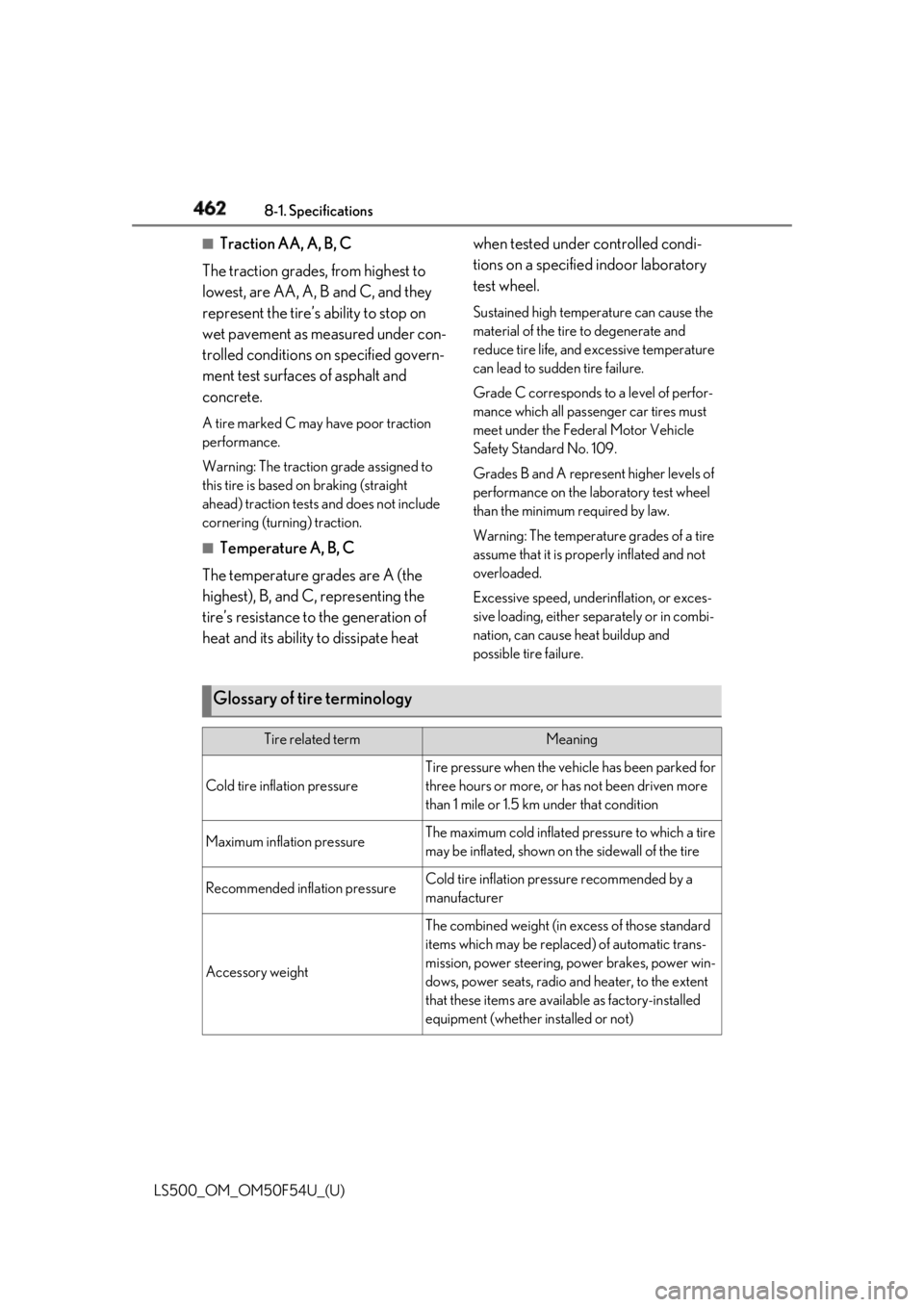
Traction AA, A, B, C
The traction grades, from highest to
lowest, are AA, A, B and C, and they
represent the tire’s ability to stop on
wet pavement as measured under con-
trolled conditions on specified govern-
ment test surfaces of asphalt and
concrete. A tire marked C may have poor traction
performance.
Warning: The traction grade assigned to
this tire is based on braking (straight
ahead) traction tests and does not include
cornering (turning) traction. ■
Temperature A, B, C
The temperature grades are A (the
highest), B, and C, representing the
tire’s resistance to the generation of
heat and its ability to dissipate heat when tested under controlled condi-
tions on a specified indoor laboratory
test wheel. Sustained high temperature can cause the
material of the tire to degenerate and
reduce tire life, and excessive temperature
can lead to sudd en tire failure.
Grade C corresponds to a level of perfor-
mance which all passenger car tires must
meet under the Fede ral Motor Vehicle
Safety Standard No. 109.
Grades B and A represent higher levels of
performance on the laboratory test wheel
than the minimum required by law.
Warning: The temperature grades of a tire
assume that it is prop erly inflated and not
overloaded.
Excessive speed, unde rinflation, or exces-
sive loading, either separately or in combi-
nation, can cause heat buildup and
possible tire failure.
Glossary of tire terminology Tire related term Meaning
Cold tire inflation pressure Tire pressure when the vehicle has been parked for
three hours or more, or has not been driven more
than 1 mile or 1.5 km under that condition
Maximum inflation pressure The maximum cold inflated pressure to which a tire
may be inflated, shown on the sidewall of the tire
Recommended inflation pressure Cold tire inflation pressure recommended by a
manufacturer
Accessory weight The combined weight (in excess of those standard
items which may be replaced) of automatic trans-
mission, power steering, power brakes, power win-
dows, power seats, radio and heater, to the extent
that these items are available as factory-installed
equipment (whether installed or not)
Page 466 of 514
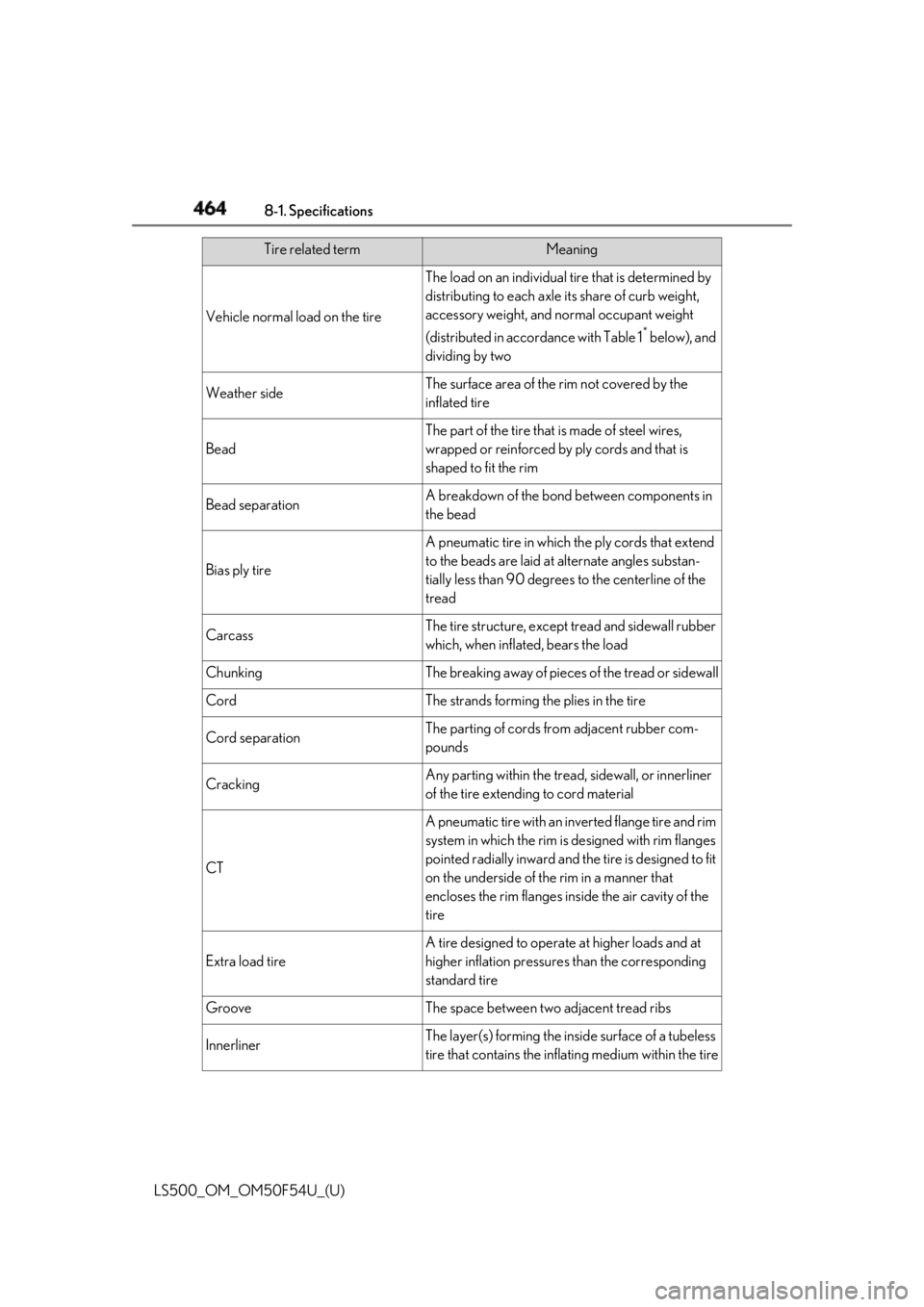
464 8-1. Specifications
LS500_OM_OM50F54U_(U) Vehicle normal load on the tire The load on an individual ti re that is determined by
distributing to each axle its share of curb weight,
accessory weight, and normal occupant weight
(distributed in accor dance with Table 1 *
below), and
dividing by two
Weather side The surface area of the rim not covered by the
inflated tire
Bead The part of the tire that is made of steel wires,
wrapped or reinforced by ply cords and that is
shaped to fit the rim
Bead separation A breakdown of the bond between components in
the bead
Bias ply tire A pneumatic tire in which the ply cords that extend
to the beads are laid at alternate angles substan-
tially less than 90 degrees to the centerline of the
tread
Carcass The tire structure, except tread and sidewall rubber
which, when inflated, bears the load
Chunking The breaking away of pieces of the tread or sidewall
Cord The strands forming the plies in the tire
Cord separation The parting of cords from adjacent rubber com-
pounds
Cracking Any parting within the tread, sidewall, or innerliner
of the tire extending to cord material
CT A pneumatic tire with an inverted flange tire and rim
system in which the rim is designed with rim flanges
pointed radially inward and the tire is designed to fit
on the underside of the rim in a manner that
encloses the rim flanges inside the air cavity of the
tire
Extra load tire A tire designed to operat e at higher loads and at
higher inflation pressures than the corresponding
standard tire
Groove The space between two adjacent tread ribs
Innerliner The layer(s) forming the in side surface of a tubeless
tire that contains the inflating medium within the tireTire related term Meaning