high LEXUS LS500 2019 Owners Manual
[x] Cancel search | Manufacturer: LEXUS, Model Year: 2019, Model line: LS500, Model: LEXUS LS500 2019Pages: 512, PDF Size: 9.71 MB
Page 449 of 512

4498-1. Specifications
LS500_OM_(U)_1810 8
Vehicle specifications containers to help you select the oil you
should use.
Cooling system Capacity
Engine
2WD models: 11.2 qt. (10.6 L, 9.3 Imp. qt.)
AWD models: 11.1 qt. (10.5 L, 9.2 Imp. qt.)
Intercooler
4.5 qt. (4.3 L, 3.8 Imp. qt.)
Coolant type Use either of the following:
“Toyota Super Long Life Coolant”
Similar high-quality ethylene glycol-based non-silicate,
non-amine, non-nitrite, and non-borate coolant with
long-life hybrid orga nic acid technology
Do not use plain water alone.
Ignition system (spark plug) Make DENSO EC22HPR-D7
Gap 0.028 in. (0.7 mm)
NOTICE
■
Iridium-tipped spark plugs
Use only iridium-tipped spark plugs. Do not adjust the spark plug gap.
Page 450 of 512
450 8-1. Specifications
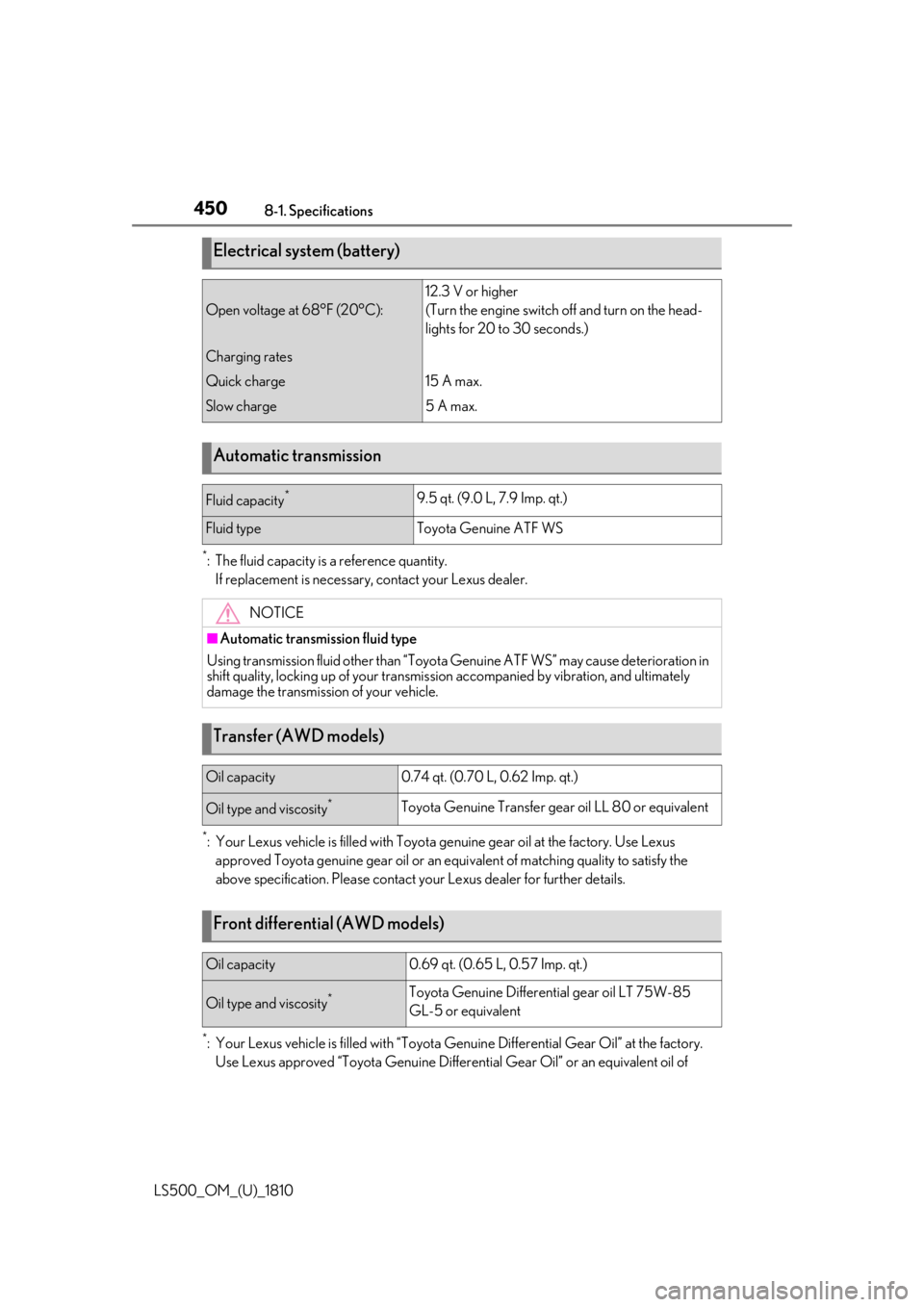
LS500_OM_(U)_1810 *
: The fluid capacity is a reference quantity.
If replacement is necessary, contact your Lexus dealer.
*
: Your Lexus vehicle is filled with Toyota ge nuine gear oil at the factory. Use Lexus
approved Toyota genuine gear oil or an equi valent of matching qu ality to satisfy the
above specification. Plea se contact your Lexus dealer for further details.
*
: Your Lexus vehicle is filled with “Toyota Genu ine Differential Gear Oil” at the factory.
Use Lexus approved “Toyota Ge nuine Differential Gear Oil” or an equivalent oil of Electrical system (battery) Open voltage at 68°F (20°C): 12.3 V or higher
(Turn the engine switch off and turn on the head-
lights for 20 to 30 seconds.)
Charging rates
Quick charge
Slow charge 15 A max.
5 A max.
Automatic transmission Fluid capacity *
9.5 qt. (9.0 L, 7.9 Imp. qt.)
Fluid type Toyota Genuine ATF WS
NOTICE■
Automatic transmission fluid type
Using transmission fluid other than “Toyota Genuine ATF WS” may ca use deterioration in
shift quality, locking up of your transmission accompanied by vibration, and ultimately
damage the transmission of your vehicle.
Transfer (AWD models) Oil capacity 0.74 qt. (0.70 L, 0.62 Imp. qt.)
Oil type and viscosity *
Toyota Genuine Transfer gear oil LL 80 or equivalent
Front differential (AWD models) Oil capacity 0.69 qt. (0.65 L, 0.57 Imp. qt.)
Oil type and viscosity *
Toyota Genuine Differential gear oil LT 75W-85
GL-5 or equivalent
Page 452 of 512
452 8-1. Specifications
LS500_OM_(U)_1810 warning light is illumin ated, refer to P.415.)*2
: Make sure to confirm that the brake warning light (yellow) does not illuminate. (If the
brake warning light illuminates, refer to P.415.) *3
: Vehicles without Lexus Safety System + A *4
: Vehicles with Lexus Safety System + A
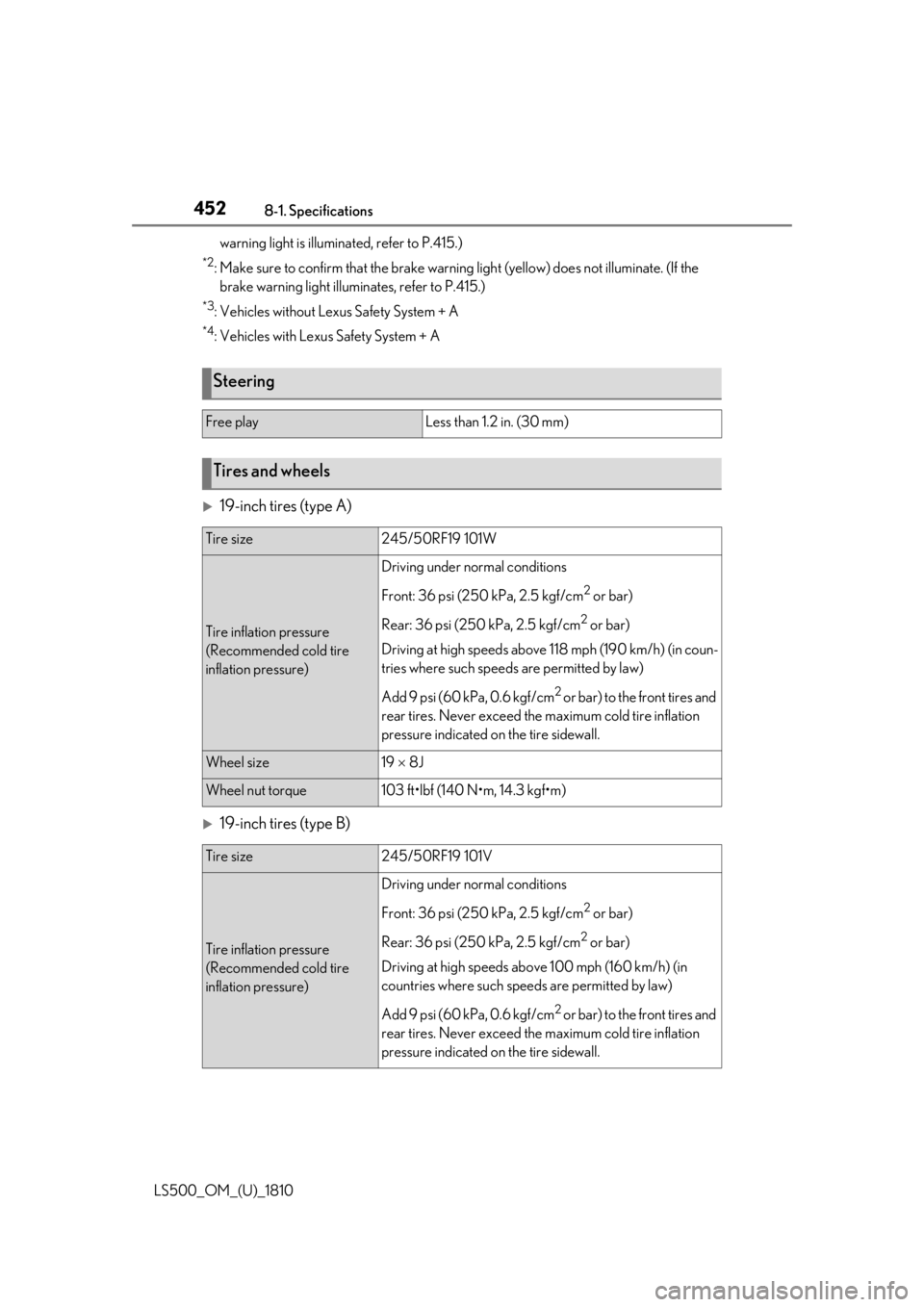
19-inch tires (type A)
19-inch tires (type B)Steering Free play Less than 1.2 in. (30 mm)
Tires and wheels Tire size 245/50RF19 101W
Tire inflation pressure
(Recommended cold tire
inflation pressure) Driving under normal conditions
Front: 36 psi (250 kPa, 2.5 kgf/cm 2
or bar)
Rear: 36 psi (250 kPa, 2.5 kgf/cm 2
or bar)
Driving at high speeds above 118 mph (190 km/h) (in coun-
tries where such speeds are permitted by law)
Add 9 psi (60 kPa, 0.6 kgf/cm 2
or bar) to the front tires and
rear tires. Never exceed the maximum cold tire inflation
pressure indicated on the tire sidewall.
Wheel size 19 8J
Wheel nut torque 103 ft•lbf (140 N•m, 14.3 kgf•m)
Tire size 245/50RF19 101V
Tire inflation pressure
(Recommended cold tire
inflation pressure) Driving under normal conditions
Front: 36 psi (250 kPa, 2.5 kgf/cm 2
or bar)
Rear: 36 psi (250 kPa, 2.5 kgf/cm 2
or bar)
Driving at high speeds above 100 mph (160 km/h) (in
countries where such speeds are permitted by law)
Add 9 psi (60 kPa, 0.6 kgf/cm 2
or bar) to the front tires and
rear tires. Never exceed the maximum cold tire inflation
pressure indicated on the tire sidewall.
Page 453 of 512
4538-1. Specifications
LS500_OM_(U)_1810 8
Vehicle specifications
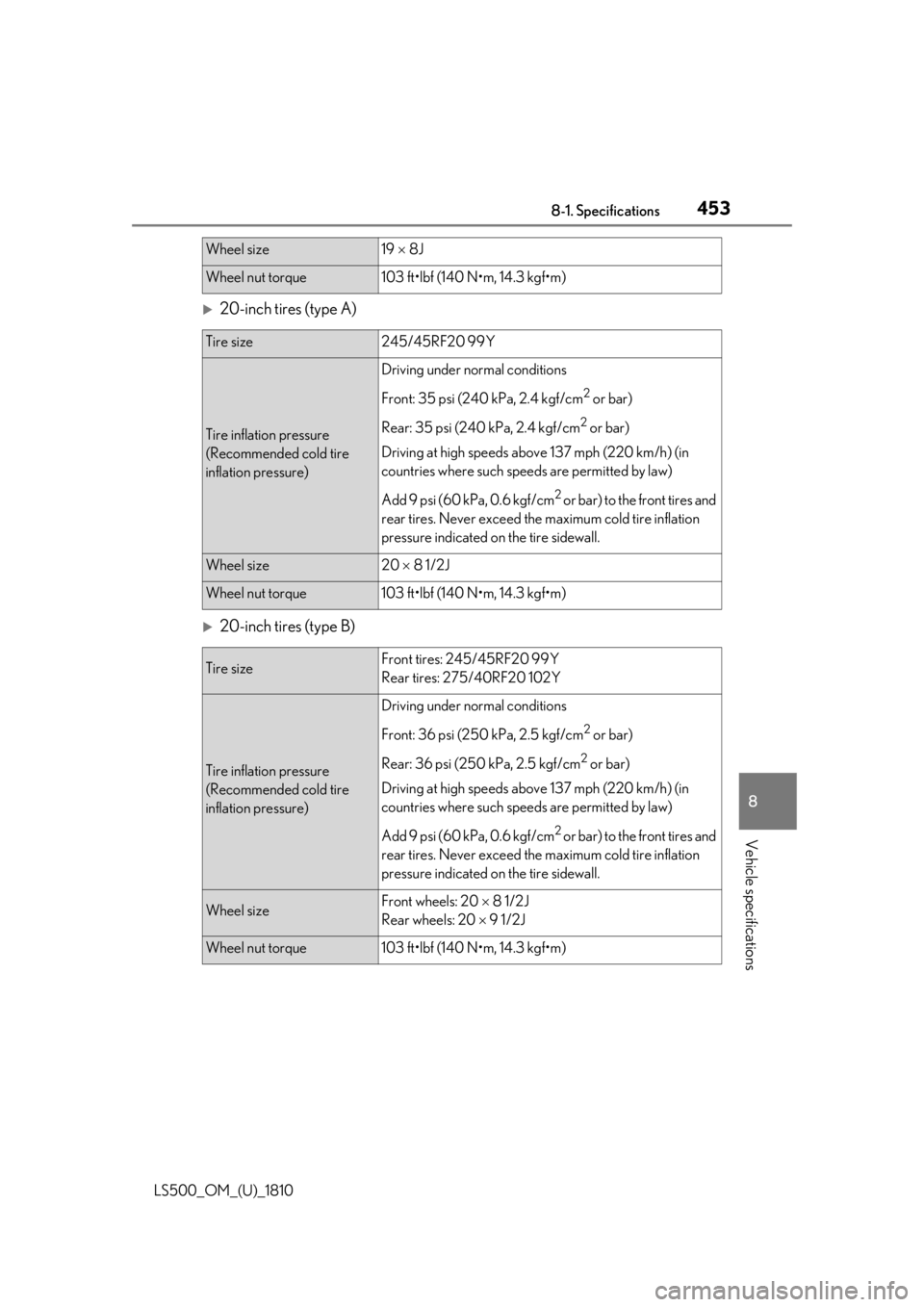
20-inch tires (type A)
20-inch tires (type B) Wheel size 19 8J
Wheel nut torque 103 ft•lbf (140 N•m, 14.3 kgf•m)
Tire size 245/45RF20 99Y
Tire inflation pressure
(Recommended cold tire
inflation pressure) Driving under normal conditions
Front: 35 psi (240 kPa, 2.4 kgf/cm 2
or bar)
Rear: 35 psi (240 kPa, 2.4 kgf/cm 2
or bar)
Driving at high speeds above 137 mph (220 km/h) (in
countries where such speeds are permitted by law)
Add 9 psi (60 kPa, 0.6 kgf/cm 2
or bar) to the front tires and
rear tires. Never exceed the maximum cold tire inflation
pressure indicated on the tire sidewall.
Wheel size 20 8 1/2J
Wheel nut torque 103 ft•lbf (140 N•m, 14.3 kgf•m)
Tire size Front tires: 245/45RF20 99Y
Rear tires: 275/40RF20 102Y
Tire inflation pressure
(Recommended cold tire
inflation pressure) Driving under normal conditions
Front: 36 psi (250 kPa, 2.5 kgf/cm 2
or bar)
Rear: 36 psi (250 kPa, 2.5 kgf/cm 2
or bar)
Driving at high speeds above 137 mph (220 km/h) (in
countries where such speeds are permitted by law)
Add 9 psi (60 kPa, 0.6 kgf/cm 2
or bar) to the front tires and
rear tires. Never exceed the maximum cold tire inflation
pressure indicated on the tire sidewall.
Wheel size Front wheels: 20 8 1/2J
Rear wheels: 20 9 1/2J
Wheel nut torque 103 ft•lbf (140 N•m, 14.3 kgf•m)
Page 454 of 512
454 8-1. Specifications
LS500_OM_(U)_1810
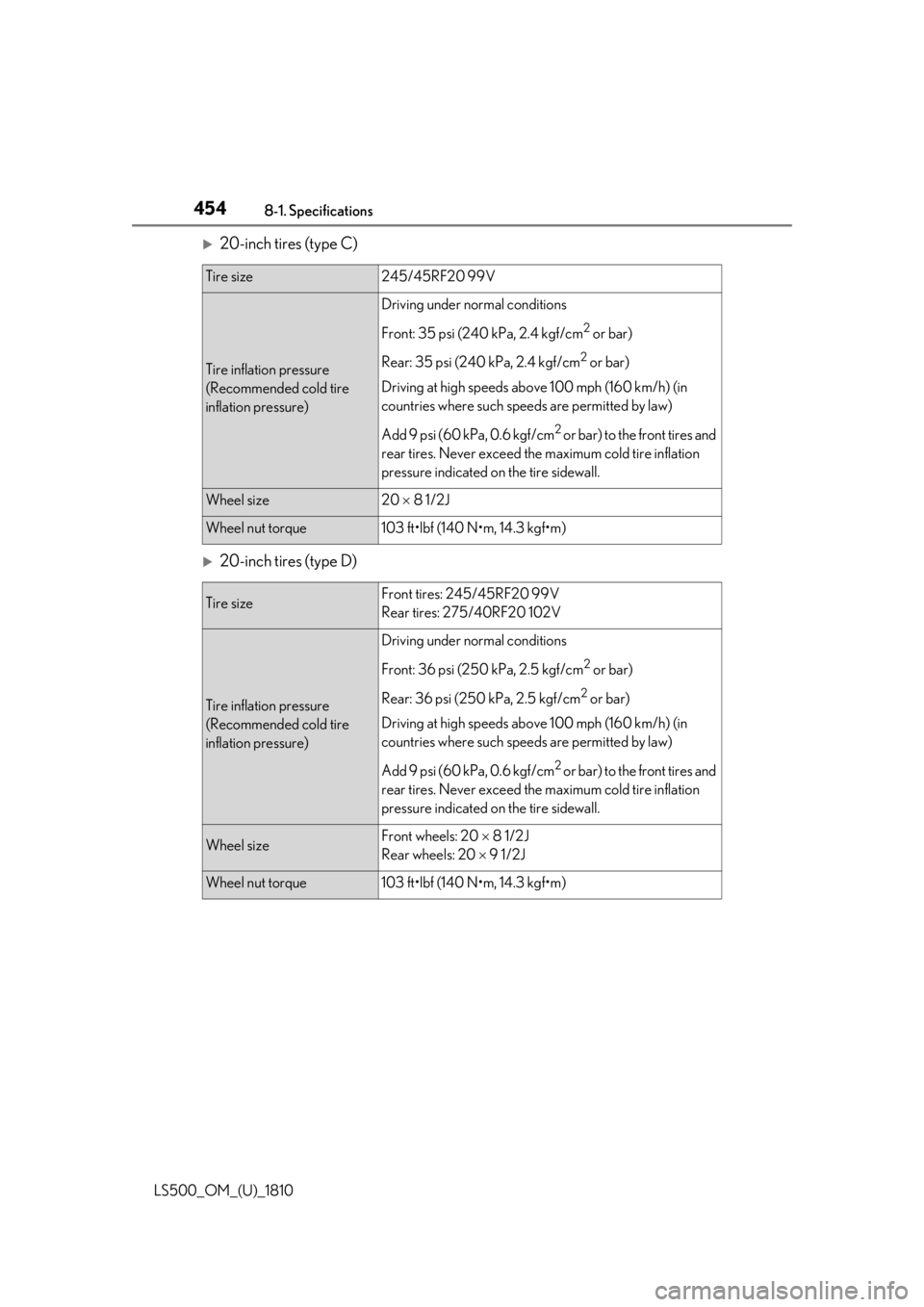
20-inch tires (type C)
20-inch tires (type D) Tire size 245/45RF20 99V
Tire inflation pressure
(Recommended cold tire
inflation pressure) Driving under normal conditions
Front: 35 psi (240 kPa, 2.4 kgf/cm 2
or bar)
Rear: 35 psi (240 kPa, 2.4 kgf/cm 2
or bar)
Driving at high speeds above 100 mph (160 km/h) (in
countries where such speeds are permitted by law)
Add 9 psi (60 kPa, 0.6 kgf/cm 2
or bar) to the front tires and
rear tires. Never exceed the maximum cold tire inflation
pressure indicated on the tire sidewall.
Wheel size 20 8 1/2J
Wheel nut torque 103 ft•lbf (140 N•m, 14.3 kgf•m)
Tire size Front tires: 245/45RF20 99V
Rear tires: 275/40RF20 102V
Tire inflation pressure
(Recommended cold tire
inflation pressure) Driving under normal conditions
Front: 36 psi (250 kPa, 2.5 kgf/cm 2
or bar)
Rear: 36 psi (250 kPa, 2.5 kgf/cm 2
or bar)
Driving at high speeds above 100 mph (160 km/h) (in
countries where such speeds are permitted by law)
Add 9 psi (60 kPa, 0.6 kgf/cm 2
or bar) to the front tires and
rear tires. Never exceed the maximum cold tire inflation
pressure indicated on the tire sidewall.
Wheel size Front wheels: 20 8 1/2J
Rear wheels: 20 9 1/2J
Wheel nut torque 103 ft•lbf (140 N•m, 14.3 kgf•m)
Page 455 of 512

4558-1. Specifications
LS500_OM_(U)_1810 8
Vehicle specifications ■
Gasoline quality
In very few cases, driveability problems may
be caused by the brand of gasoline you are
using. If driveability problems persist, try
changing the brand of gasoline. If this does
not correct the problem, consult your Lexus
dealer. ■
Recommendation of the use of gasoline
containing detergent additives●
Lexus recommends the use of gasoline
that contains detergent additives to avoid
the build-up of engine deposits.●
All gasoline sold in the U.S.A. contains
minimum detergent additives to clean
and/or keep clean intake systems, per
EPA’s lowest additive s concentration pro-
gram.
●
Lexus strongly recommends the use of
Top Tier Detergent Gasoline. For more
information on Top Tier Detergent Gaso-
line and a list of marketers, please go to
the official websit e www.toptiergas.com.
■
Recommendation of the use of low
emissions gasoline
Gasolines containing oxygenates such as
ethers and ethanol, as well as reformulated gasolines, are available in some cities.
These fuels are typically acceptable for use,
providing they meet other fuel require-
ments.
Lexus recommends these fuels, since the
formulations allow for reduced vehicle
emissions. ■
Non-recommendation of the use of
blended gasoline ●
Use only gasoline containing up to 15%
ethanol.
DO NOT use any flex-fuel or gasoline
that could contain more than 15% etha-
nol, including from any pump labeled
E30 (30% ethanol [ ]), E50 (50%
ethanol [ ]), E85 (85% ethanol [ ])
(which are only some examples of fuel
containing more than 15% ethanol).
●
If you use gasohol in your vehicle, be sure
that it has an octane rating no lower than
91. ●
Lexus does not recommend the use of
gasoline containing methanol. ■
Non-recommendation of the use of gas-
oline containing MMT
Some gasoline contains an octane enhanc-
ing additive called MMT (Methylcyclopen-
tadienyl Manganese Tricarbonyl).
Lexus does not recommend the use of gas-
oline that contains MMT. If fuel containing
MMT is used, your emission control system
may be adversely affected.
The malfunction indicator lamp on the
instrument cluster may come on. If this hap-
pens, contact your Lexus dealer for service.
■
If your engine knocks
●
Consult your Lexus dealer.
●
You may occasionally notice light knock-
ing for a short time wh ile accelerating or Fuel information You must only use unleaded gaso-
line.
Select premium unleaded gasoline
with an octane rating of 91
(Research Octane Number 96) or
higher required for optimum
engine performance and fuel econ-
omy.
If the octane rating is less than 91,
damage to the engine may occur
and may void the vehicle warranty.
At minimum, the gasoline you use
should meet the specifications of
ASTM D4814 in the U.S.A. A
B C
Page 459 of 512

4598-1. Specifications
LS500_OM_(U)_1810 8
Vehicle specifications letter) ■
Tire dimensions
Section width
Tire height
Wheel diameter
Bead
Sidewall
Shoulder
Tread
Belt
Inner liner
Reinforcing rubber
Carcass
Rim lines
Bead wires
Chafer This information has been prepared in
accordance with regulations issued by
the National Highway Traffic Safety
Administration of the U.S. Department
of Transportation.
It provides the purchasers and/or pro-
spective purchasers of Lexus vehicles
with information on uniform tire quality
grading. Your Lexus dealer will help answer any
questions you may have as you read this
information. ■
DOT quality grades
All passenger vehicle tires must con-
form to Federal Safety Requirements in
addition to these grades. Quality
grades can be found where applicable
on the tire sidewall between tread
shoulder and maximum section width. For example: Treadwear 200 Traction AA
Temperature A ■
Treadwear
The treadwear grade is a comparative
rating based on the wear rate of the tire
when tested under controlled condi-
tions on a specified government test
course. For example, a tire graded 150 would wear
one and a half (1 - 1/2) times as well on the
government course as a tire graded 100.
The relative performa nce of tires depends
upon the actual conditions of their use.
Performance may differ significantly from
the norm due to variatio ns in driving habits,
service practices and differences in road
characteristics and climate.Tire section names A
B
C
A
B
C
D
E
F
G
H
I
J
K Uniform Tire Quality Grading
Page 460 of 512
460 8-1. Specifications
LS500_OM_(U)_1810 ■
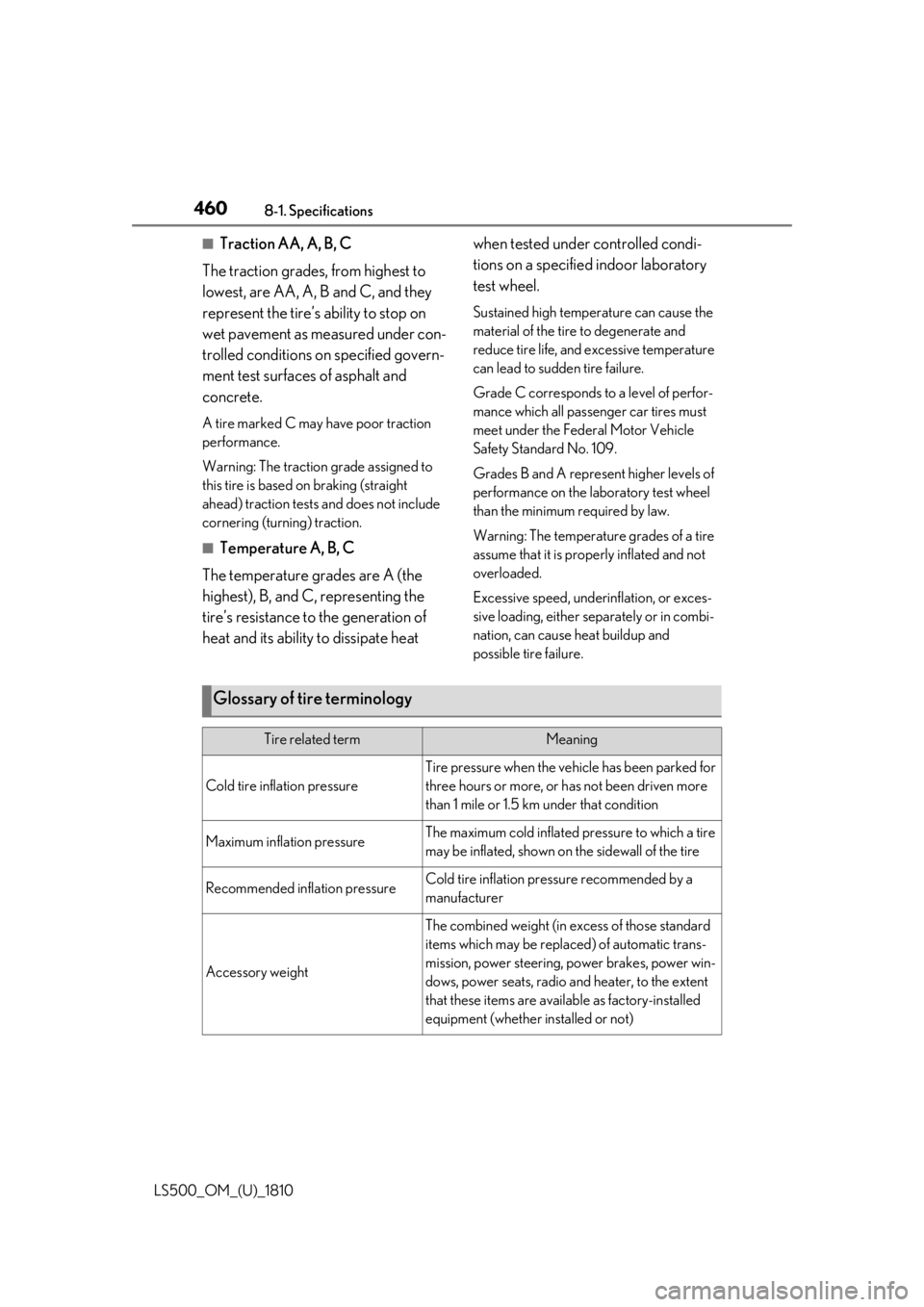
Traction AA, A, B, C
The traction grades, from highest to
lowest, are AA, A, B and C, and they
represent the tire’s ability to stop on
wet pavement as measured under con-
trolled conditions on specified govern-
ment test surfaces of asphalt and
concrete. A tire marked C may have poor traction
performance.
Warning: The traction grade assigned to
this tire is based on braking (straight
ahead) traction tests and does not include
cornering (turning) traction. ■
Temperature A, B, C
The temperature grades are A (the
highest), B, and C, representing the
tire’s resistance to the generation of
heat and its ability to dissipate heat when tested under controlled condi-
tions on a specified indoor laboratory
test wheel. Sustained high temperature can cause the
material of the tire to degenerate and
reduce tire life, and excessive temperature
can lead to sudd en tire failure.
Grade C corresponds to a level of perfor-
mance which all passenger car tires must
meet under the Fede ral Motor Vehicle
Safety Standard No. 109.
Grades B and A represent higher levels of
performance on the laboratory test wheel
than the minimum required by law.
Warning: The temperature grades of a tire
assume that it is prop erly inflated and not
overloaded.
Excessive speed, unde rinflation, or exces-
sive loading, either separately or in combi-
nation, can cause heat buildup and
possible tire failure.
Glossary of tire terminology Tire related term Meaning
Cold tire inflation pressure Tire pressure when the vehicle has been parked for
three hours or more, or has not been driven more
than 1 mile or 1.5 km under that condition
Maximum inflation pressure The maximum cold inflated pressure to which a tire
may be inflated, shown on the sidewall of the tire
Recommended inflation pressure Cold tire inflation pressure recommended by a
manufacturer
Accessory weight The combined weight (in excess of those standard
items which may be replaced) of automatic trans-
mission, power steering, power brakes, power win-
dows, power seats, radio and heater, to the extent
that these items are available as factory-installed
equipment (whether installed or not)
Page 462 of 512
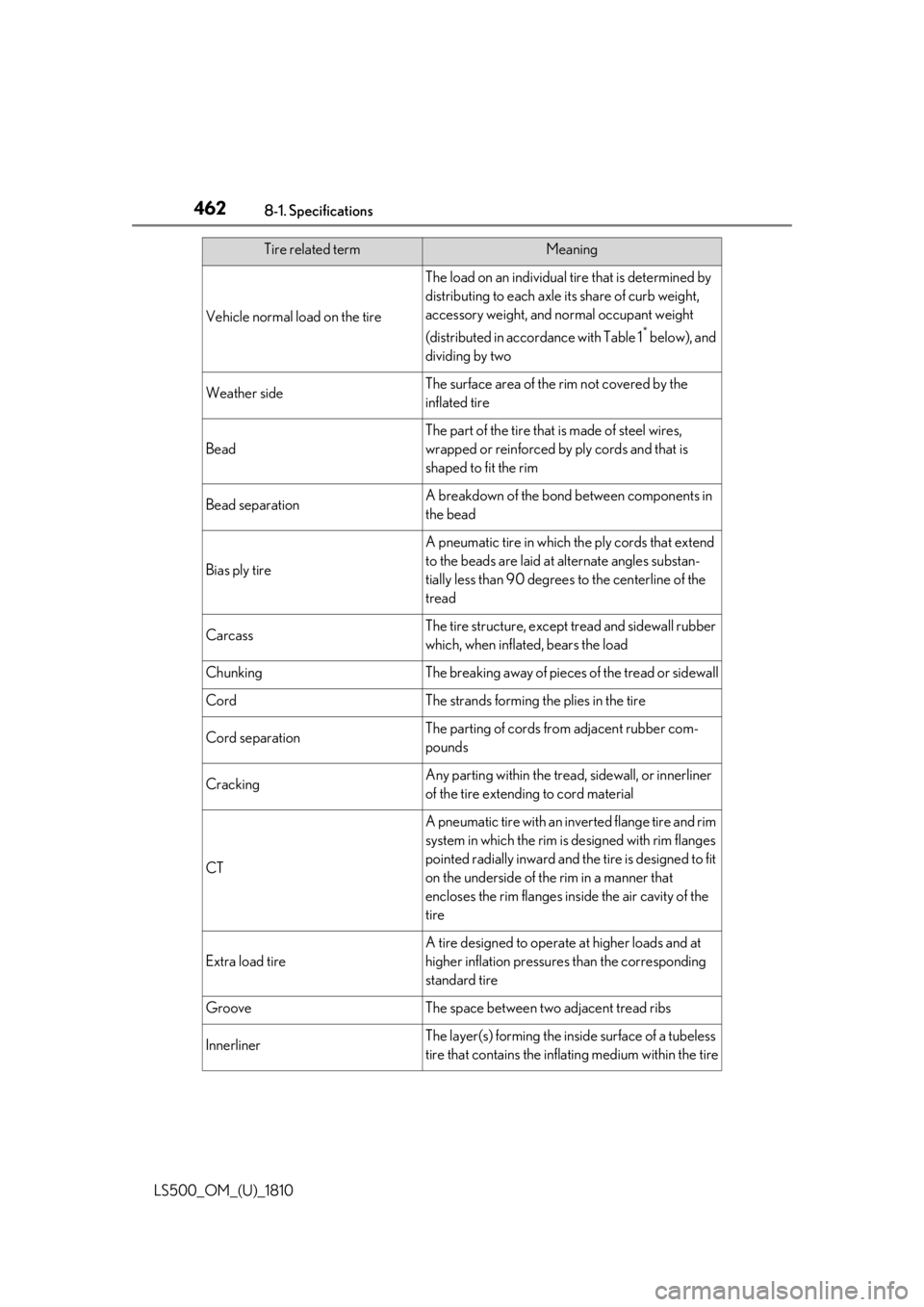
462 8-1. Specifications
LS500_OM_(U)_1810 Vehicle normal load on the tire The load on an individual ti re that is determined by
distributing to each axle its share of curb weight,
accessory weight, and normal occupant weight
(distributed in accor dance with Table 1 *
below), and
dividing by two
Weather side The surface area of the rim not covered by the
inflated tire
Bead The part of the tire that is made of steel wires,
wrapped or reinforced by ply cords and that is
shaped to fit the rim
Bead separation A breakdown of the bond between components in
the bead
Bias ply tire A pneumatic tire in which the ply cords that extend
to the beads are laid at alternate angles substan-
tially less than 90 degrees to the centerline of the
tread
Carcass The tire structure, except tread and sidewall rubber
which, when inflated, bears the load
Chunking The breaking away of pieces of the tread or sidewall
Cord The strands forming the plies in the tire
Cord separation The parting of cords from adjacent rubber com-
pounds
Cracking Any parting within the tread, sidewall, or innerliner
of the tire extending to cord material
CT A pneumatic tire with an inverted flange tire and rim
system in which the rim is designed with rim flanges
pointed radially inward and the tire is designed to fit
on the underside of the rim in a manner that
encloses the rim flanges inside the air cavity of the
tire
Extra load tire A tire designed to operat e at higher loads and at
higher inflation pressures than the corresponding
standard tire
Groove The space between two adjacent tread ribs
Innerliner The layer(s) forming the in side surface of a tubeless
tire that contains the inflating medium within the tireTire related term Meaning
Page 463 of 512
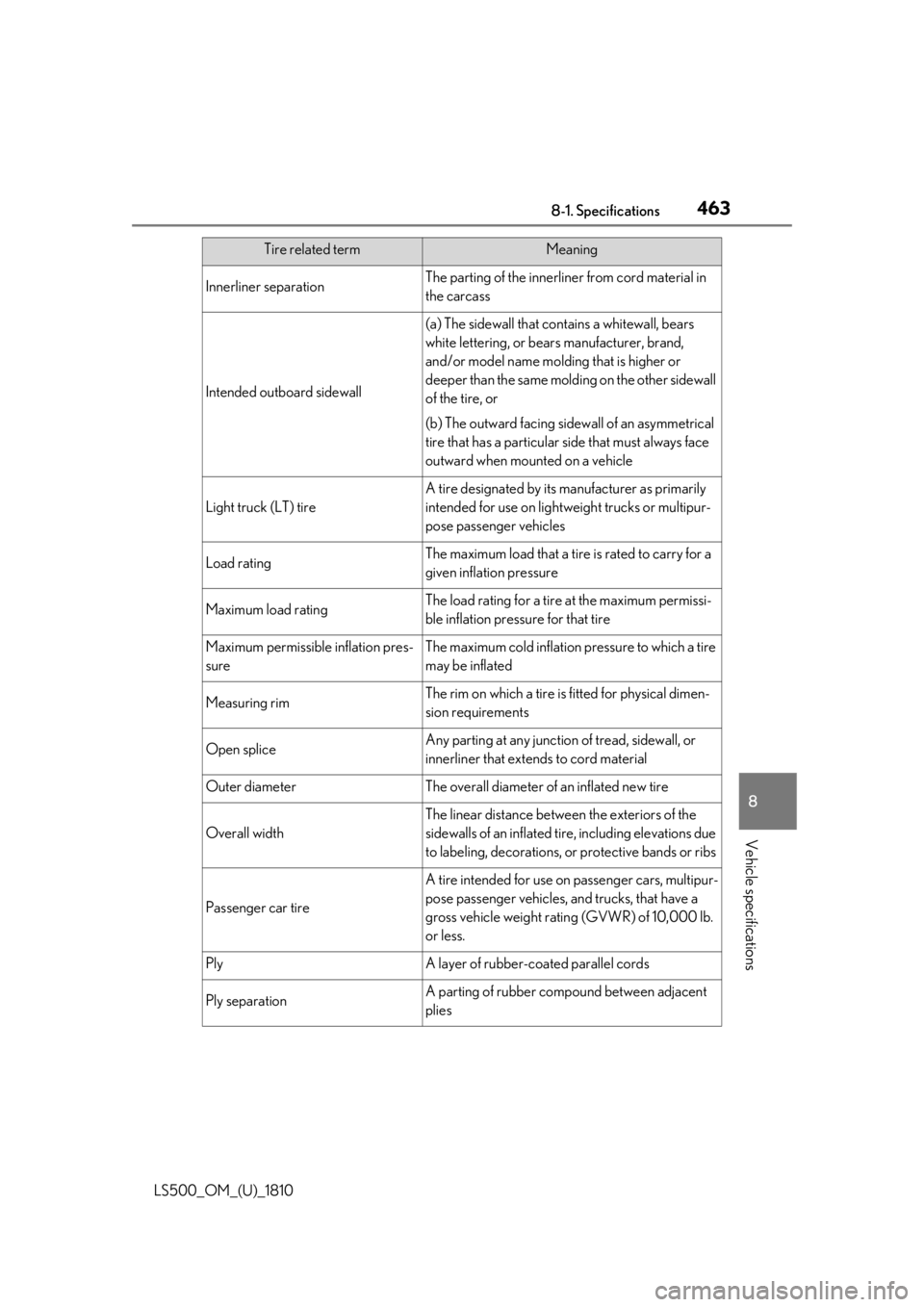
4638-1. Specifications
LS500_OM_(U)_1810 8
Vehicle specifications Innerliner separation The parting of the innerliner from cord material in
the carcass
Intended outboard sidewall (a) The sidewall that contains a whitewall, bears
white lettering, or bear s manufacturer, brand,
and/or model name molding that is higher or
deeper than the same molding on the other sidewall
of the tire, or
(b) The outward facing side wall of an asymmetrical
tire that has a particular side that must always face
outward when mounted on a vehicle
Light truck (LT) tire A tire designated by its manufacturer as primarily
intended for use on lightwe ight trucks or multipur-
pose passenger vehicles
Load rating The maximum load that a tire is rated to carry for a
given inflation pressure
Maximum load rating The load rating for a tire at the maximum permissi-
ble inflation pressure for that tire
Maximum permissible inflation pres-
sure The maximum cold inflation pressure to which a tire
may be inflated
Measuring rim The rim on which a tire is fitted for physical dimen-
sion requirements
Open splice Any parting at any junction of tread, sidewall, or
innerliner that extends to cord material
Outer diameter The overall diameter of an inflated new tire
Overall width The linear distance between the exteriors of the
sidewalls of an inflated tire, including elevations due
to labeling, decorations, or protective bands or ribs
Passenger car tire A tire intended for use on passenger cars, multipur-
pose passenger vehicles, and trucks, that have a
gross vehicle weight rating (GVWR) of 10,000 lb.
or less.
Ply A layer of rubber-c oated parallel cords
Ply separation A parting of rubber compound between adjacent
pliesTire related term Meaning