service LEXUS LS500 2021 Owner's Manual
[x] Cancel search | Manufacturer: LEXUS, Model Year: 2021, Model line: LS500, Model: LEXUS LS500 2021Pages: 520, PDF Size: 9.81 MB
Page 408 of 520
4086-3. Do-it-yourself maintenance
Use only Lexus wheel nuts and
wheel nut wrenches designed for
use with your aluminum wheels.
When rotating, repairing or chang-
ing your tires, check that the wheel
nuts are still tight after driving 1000
miles (1600 km).
Be careful not to damage the alumi-
num wheels when using tire chains.
Use only Lexus genuine balance
weights or equivalent and a plastic or rubber hammer when balancing
your wheels.
WARNING
●Never use an inner tube in a leaking
wheel which is designed for a tubeless
tire.
Doing so may result in an accident,
causing death or serious injury.
■Use of defective wheels prohibited
Do not use cracked or deformed wheels.
Doing so could cause the tire to leak air
during driving, possibly causing an acci-
dent.
NOTICE
■Replacing tire pressure warning
valves and transmitters
●Because tire repair or replacement
may affect the tire pressure warning
valves and transmitters, make sure to
have tires serviced by your Lexus
dealer or other qualified service shop.
In addition, make sure to purchase
your tire pressure warning valves and
transmitters at your Lexus dealer.
●Ensure that only ge nuine Lexus wheels
are used on your vehicle.
Tire pressure warning valves and trans-
mitters may not work properly with
non-genuine wheels.
Aluminum wheel precautions
Page 412 of 520
4126-3. Do-it-yourself maintenance
1Turn the engine switch off.
2 Open the fuse box cover.
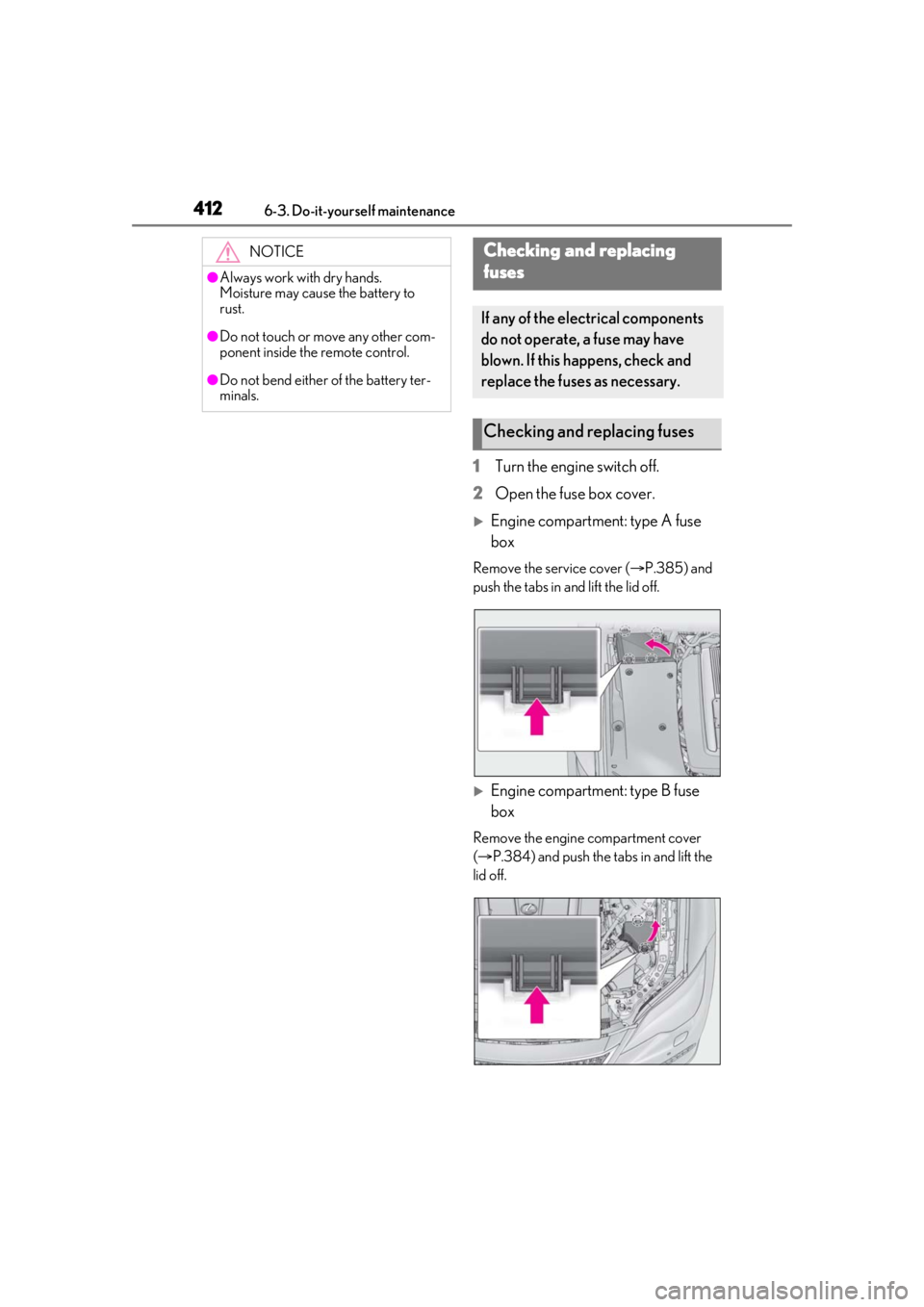
Engine compartment: type A fuse
box
Remove the service cover ( P.385) and
push the tabs in an d lift the lid off.
Engine compartment: type B fuse
box
Remove the engine compartment cover
( P.384) and push the ta bs in and lift the
lid off.
NOTICE
●Always work with dry hands.
Moisture may cause the battery to
rust.
●Do not touch or move any other com-
ponent inside the remote control.
●Do not bend either of the battery ter-
minals.
Checking and replacing
fuses
If any of the electrical components
do not operate, a fuse may have
blown. If this happens, check and
replace the fuses as necessary.
Checking and replacing fuses
Page 421 of 520
4217-2. Steps to take in an emergency
7
When trouble arises
7-2.Steps to take in an emergency
If your vehicle needs to be
towed
If towing is necessary, we recom-
mend having your vehicle towed by
your Lexus dealer or commercial
towing service, using a wheel-lift
type truck or flatbed truck.
Use a safety chain system for all
towing, and abide by all state/pro-
vincial and local laws.
If towing your vehicle with a
wheel-lift type truck from the front,
the vehicle’s rear wheels and axles
must be in good conditions.
( P.423, 421) If they are dam-
aged, use a towing dolly or flatbed
truck.
For AWD models: If towing your
vehicle with a wheel-lift type truck,
use a towing dolly. ( P.423, 421)
WARNING
Observe the following precautions.
Failure to do so may result in death or
serious injury.
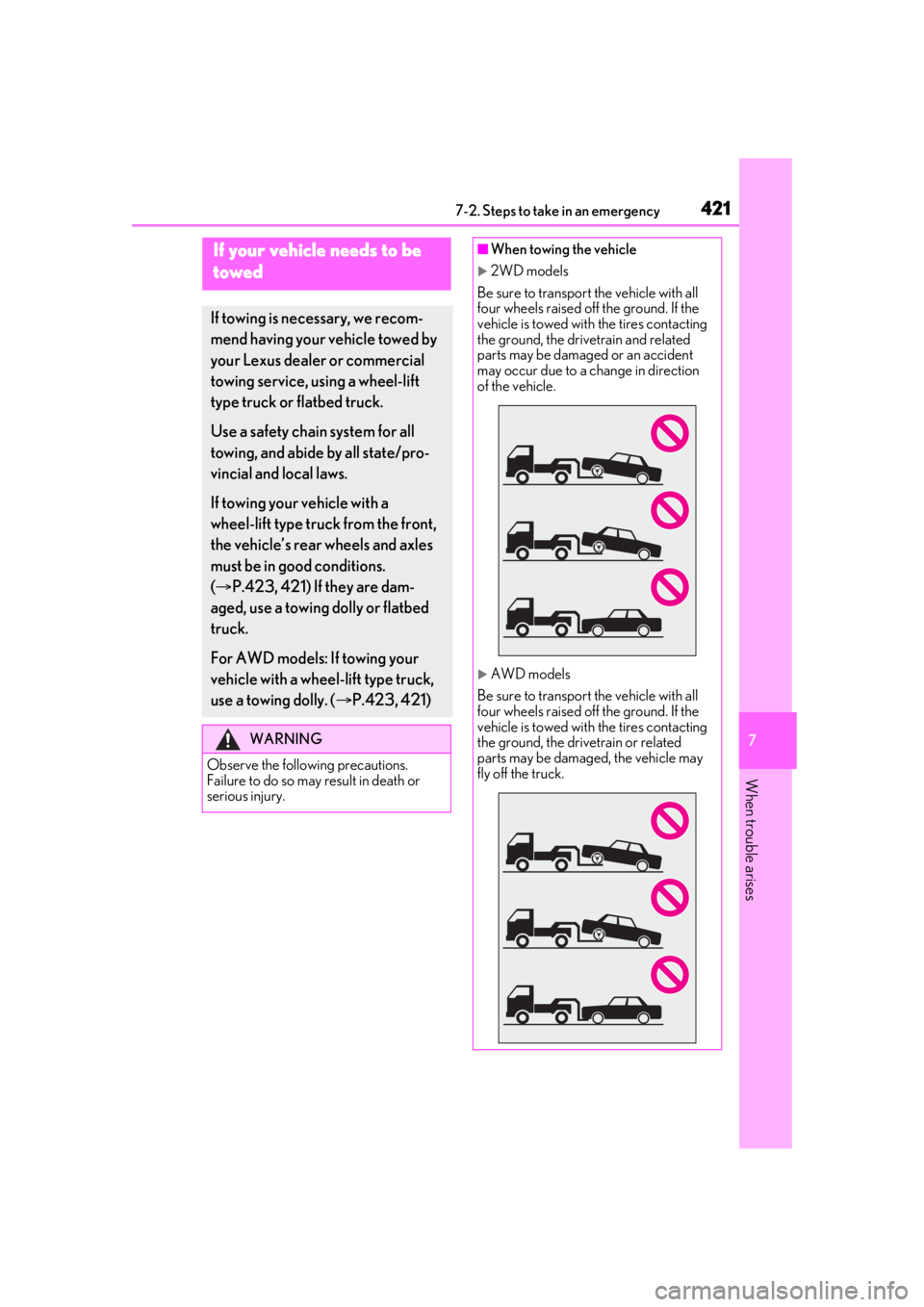
■When towing the vehicle
2WD models
Be sure to transport the vehicle with all
four wheels raised off the ground. If the
vehicle is towed with the tires contacting
the ground, the drivetrain and related
parts may be damaged or an accident
may occur due to a change in direction
of the vehicle.
AWD models
Be sure to transport the vehicle with all
four wheels raised off the ground. If the
vehicle is towed with the tires contacting
the ground, the driv etrain or related
parts may be damaged, the vehicle may
fly off the truck.
Page 422 of 520
4227-2. Steps to take in an emergency
In the following situations, it is not pos-
sible to be towed by another vehicle
using cables or chains, as the rear
wheels may be locked due to the park-
ing lock. Contact your Lexus dealer or
commercial towing service.
There is a malfunction in the P posi-
tion control system. ( P.177, 436)
There is a malfunction in the engine
immobilizer system. ( P.64)
There is a malfunction in the smart
access system with push-button
start. ( P.442)
The battery is discharged.
( P.444)
WARNING
■While towing
●When towing using cables or chains,
avoid sudden starts, etc. which place
excessive stress on the towing eyelets,
cables or chains. The towing eyelets,
cables or chains may become dam-
aged, broken debris may hit people,
and cause serious damage.
●Make sure to disable all functions of
the vehicle height control of the elec-
tronically modulate d air suspension.
Otherwise, the vehicle height may
change and part of your body may be
caught under the vehicle, possibly
causing injury. (
P.303)
●Do not turn the engine switch off.
This may lead to an accident as the
rear wheels will be locked by the park-
ing lock.
■Installing towing eyelets to the vehi-
cle
Make sure that towing eyelets are
installed securely.
If not securely installed, towing eyelets
may come loose during towing.
NOTICE
■To prevent damage to the vehicle
when towing using a wheel-lift type
truck
●Do not tow the vehicle from the rear
when the engine switch is off. The
steering lock mechanism is not strong
enough to hold the front wheels
straight.
●When raising the vehicle, ensure ade-
quate ground clearance for towing at
the opposite end of the raised vehicle.
Without adequate clearance, the vehi-
cle could be damaged while being
towed.
■To prevent damage to the vehicle
when towing with a sling-type truck
Do not tow with a sling-type truck, either
from the front or rear.
■To prevent damage to the vehicle
during emergency towing
Do not secure cables or chains to the
suspension components.
■Recreational towing (behind motor
home, etc.) (AWD models)
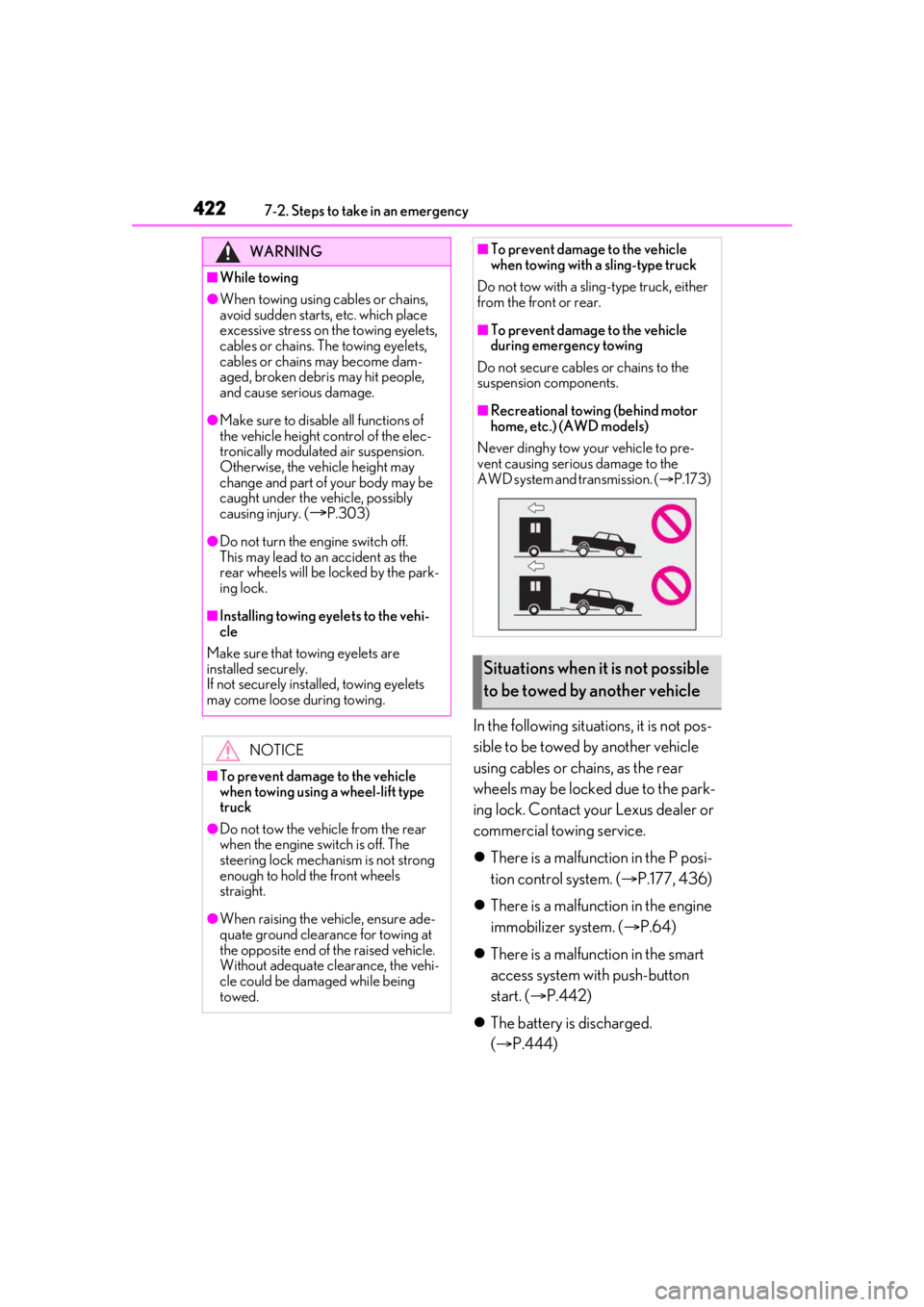
Never dinghy tow your vehicle to pre-
vent causing serious damage to the
AWD system and transmission. ( P.173)
Situations when it is not possible
to be towed by another vehicle
Page 423 of 520
4237-2. Steps to take in an emergency
7
When trouble arises
The following may indicate a problem
with your transmission. Contact your
Lexus dealer or commercial towing
service before towing.
The engine is running but the vehi-
cle does not move.
The vehicle makes an abnormal
sound.
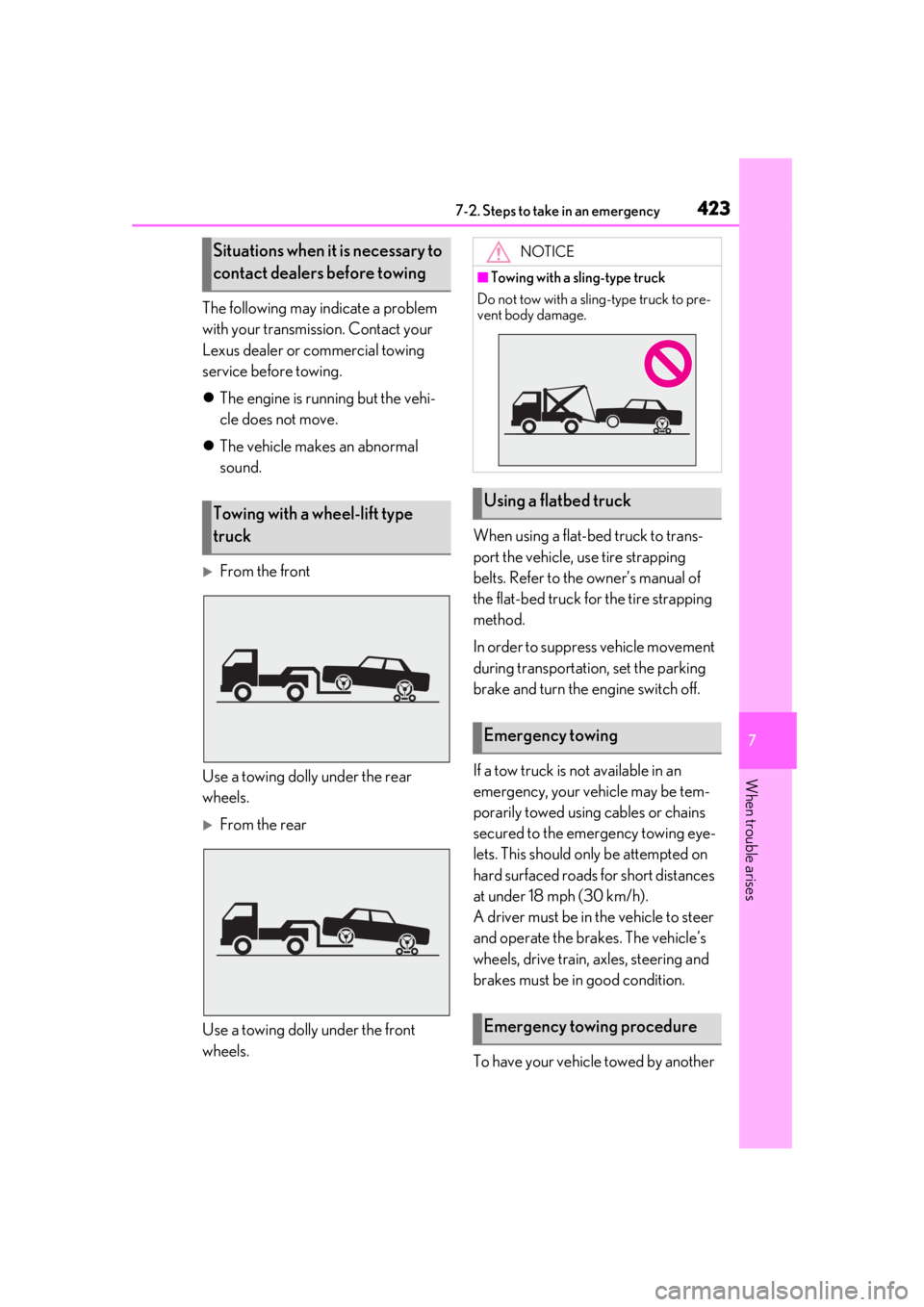
From the front
Use a towing dolly under the rear
wheels.
From the rear
Use a towing dolly under the front
wheels. When using a flat-bed truck to trans-
port the vehicle, use tire strapping
belts. Refer to the owner’s manual of
the flat-bed truck for the tire strapping
method.
In order to suppress vehicle movement
during transportation, set the parking
brake and turn the engine switch off.
If a tow truck is not available in an
emergency, your vehicle may be tem-
porarily towed using cables or chains
secured to the emergency towing eye-
lets. This should only be attempted on
hard surfaced roads for short distances
at under 18 mph (30 km/h).
A driver must be in the vehicle to steer
and operate the brakes. The vehicle’s
wheels, drive train, axles, steering and
brakes must be in good condition.
To have your vehicle towed by another
Situations when it is necessary to
contact dealers before towing
Towing with a wheel-lift type
truck
NOTICE
■Towing with a sling-type truck
Do not tow with a sling-type truck to pre-
vent body damage.
Using a flatbed truck
Emergency towing
Emergency towing procedure
Page 439 of 520
4397-2. Steps to take in an emergency
7
When trouble arises
■In some conditions (such as at high tem-
peratures)
For XXX/XXRXX size tires: You cannot
continue driving for up to 80 miles (50
km).
For XXX/XXRFXX size tires: You cannot
continue driving for up to 160 miles (100
km).
■For the detailed information on run-flat
tires
See the tire warranty booklet.
One of the following may be the cause
of the problem:
There may not be sufficient fuel in
the vehicle’s tank.
Refuel the vehicle.
The engine may be flooded.
Try to restart the engine again fol-
lowing correct starting procedures.
( P.174)
There may be a malfunction in the
engine immobilizer system.
( P.64)
There may be a malfunction in the
shift control system.
* ( P.177, 437)
*: It may not be possible to shift the shift
position from P.
One of the following may be the cause
of the problem:
The battery may be discharged.
NOTICE
■When replacing the tires
When removing or fitting the wheels,
tires or the tire pressure warning valve
and transmitter, contact your Lexus
dealer as the tire pr essure warning valve
and transmitter may be damaged if not
handled correctly.
■When driving over bumps
If a vehicle has a flat tire, the vehicle
height will be lower than usual. Ensure
that nothing strikes the bottom of the
vehicle.
■To avoid damage to the tire pressure
warning valves and transmitters
When a tire is repaired with liquid seal-
ants, the tire pressu re warning valve and
transmitter may not operate properly. If a
liquid sealant is used , contact your Lexus
dealer or other qualified service shop as
soon as possible. Make sure to replace
the tire pressure warning valve and trans-
mitter when replacing the tire. ( P.398)
If the engine will not start
If the engine will not start even
though correct starting procedures
are being followed (P.174), con-
sider each of the following points:
The engine will not start even
though the starter motor oper-
ates normally.
The starter motor turns over
slowly, the interior lights and
headlights are dim, or the horn
does not sound or sounds at a low
volume.
Page 441 of 520
4417-2. Steps to take in an emergency
7
When trouble arises
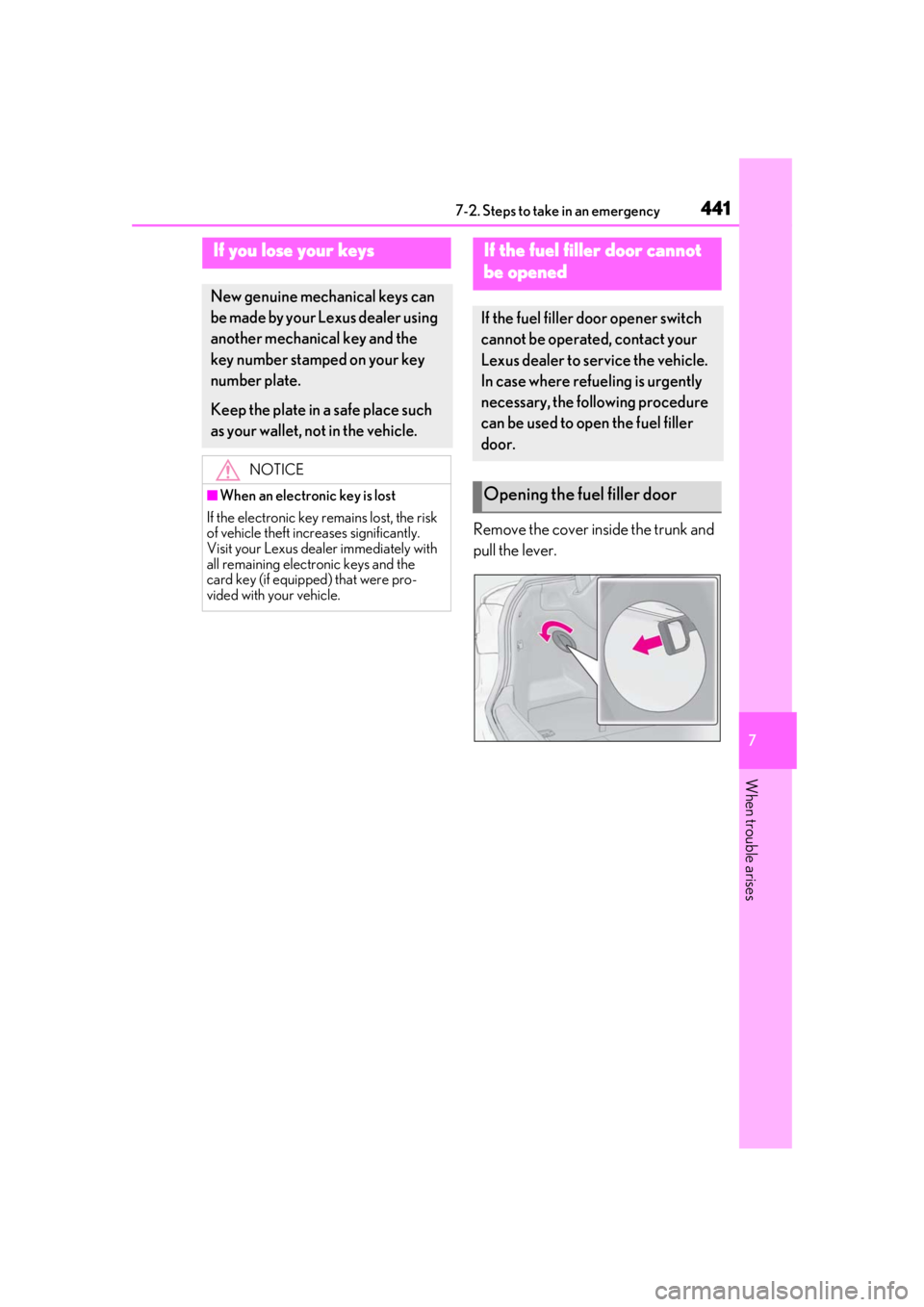
Remove the cover inside the trunk and
pull the lever.
If you lose your keys
New genuine mechanical keys can
be made by your Lexus dealer using
another mechanical key and the
key number stamped on your key
number plate.
Keep the plate in a safe place such
as your wallet, not in the vehicle.
NOTICE
■When an electronic key is lost
If the electronic key remains lost, the risk
of vehicle theft increases significantly.
Visit your Lexus deal er immediately with
all remaining electronic keys and the
card key (if equipped) that were pro-
vided with your vehicle.
If the fuel filler door cannot
be opened
If the fuel filler door opener switch
cannot be operated, contact your
Lexus dealer to service the vehicle.
In case where refueling is urgently
necessary, the following procedure
can be used to open the fuel filler
door.
Opening the fuel filler door
Page 447 of 520
4477-2. Steps to take in an emergency
7
When trouble arises
8Open and close any of the doors of
your vehicle with the engine switch
off.
9 Maintain the engine speed of the
second vehicle and start the engine
of your vehicle by turning the
engine switch to IGNITION ON
mode.
10 Once the vehicle’s engine has
started, remove the jumper cables
in the exact reverse order from
which they were connected.
11 Close the exclusive jump starting
terminal cover, and reinstall the fuse
box cover to its original position.
12 Install the service cover. ( P.385)
13 Install the engine cover. ( P.385)
Once the engine starts, have the vehi-
cle inspected at your Lexus dealer as
soon as possible.
■Starting the engine when the battery is
discharged
The engine cannot be started by push-start-
ing.
■To prevent battery discharge
●Turn off the headlights and the audio sys-
tem while the engine is off.
●Turn off any unnecessary electrical com-
ponents when the vehicle is running at a
low speed for an extended period, such
as in heavy traffic.
■When the battery is removed or dis-
charged
●Information stored in the ECU is cleared.
When the battery is depleted, have the
vehicle inspected at your Lexus dealer.
●Some systems may require initialization.
( P.490)
■When removing the battery terminals
When the battery terminals are removed,
the information stored in the ECU is
cleared. Before removi ng the battery termi-
nals, contact your Lexus dealer.
■Charging the battery
The electricity stored in the battery will dis-
charge gradually even when the vehicle is
not in use, due to natural discharge and the
draining effects of certain electrical appli-
ances. If the vehicle is left for a long time,
the battery may discharge, and the engine
may be unable to start. (The battery
recharges automatically during driving.)
■When recharging or replacing the bat-
tery
●In some cases, it may not be possible to
unlock the doors using the smart access
system with push-button start when the
battery is discharged. Use the wireless
remote control or the mechanical key to
lock or unlock the doors.
●The engine may not start on the first
attempt after the battery has recharged
but will start normally after the second
attempt. This is not a malfunction.
●The engine switch mode is memorized by
the vehicle. When the battery is recon-
nected, the system will return to the
mode it was in before the battery was dis-
charged. Before disconnecting the bat-
tery, turn the engine switch off.
If you are unsure wh at mode the engine
switch was in before the battery dis-
charged, be especially careful when
reconnecting the battery.
■When replacing the battery
●Use a Central Degassing type battery
(European Regulations).
●Use a battery with the same case size as
the previous battery and an equivalent
20 hour rate capacity (20HR) or greater.
• If the sizes differ, the battery cannot be properly secured.
• If the 20 hour rate capacity is low, even if
the time period where the vehicle is not
used is a short time, the battery may dis-
charge and the engine may not be able to
start.
Page 465 of 520
4658-1. Specifications
8
Vehicle specifications
■Gasoline quality
In very few cases, driveability problems may
be caused by the brand of gasoline you are
using. If driveability problems persist, try
changing the brand of gasoline. If this does
not correct the problem, consult your Lexus
dealer.
■Recommendation of the use of gasoline
containing detergent additives
●Lexus recommends the use of gasoline
that contains detergent additives to avoid
the build-up of engine deposits.
●All gasoline sold in the U.S.A. contains
minimum detergent additives to clean
and/or keep clean intake systems, per
EPA’s lowest additive s concentration pro-
gram.
●Lexus strongly recommends the use of
Top Tier Detergent Gasoline. For more
information on Top Tier Detergent Gaso-
line and a list of marketers, please go to
the official websit e www.toptiergas.com.
■Recommendation of the use of low
emissions gasoline
Gasolines containing oxygenates such as
ethers and ethanol, as well as reformulated gasolines, are available in some cities.
These fuels are typically acceptable for use,
providing they meet other fuel require-
ments.
Lexus recommends these fuels, since the
formulations allow for reduced vehicle
emissions.
■Non-recommendation of the use of
blended gasoline
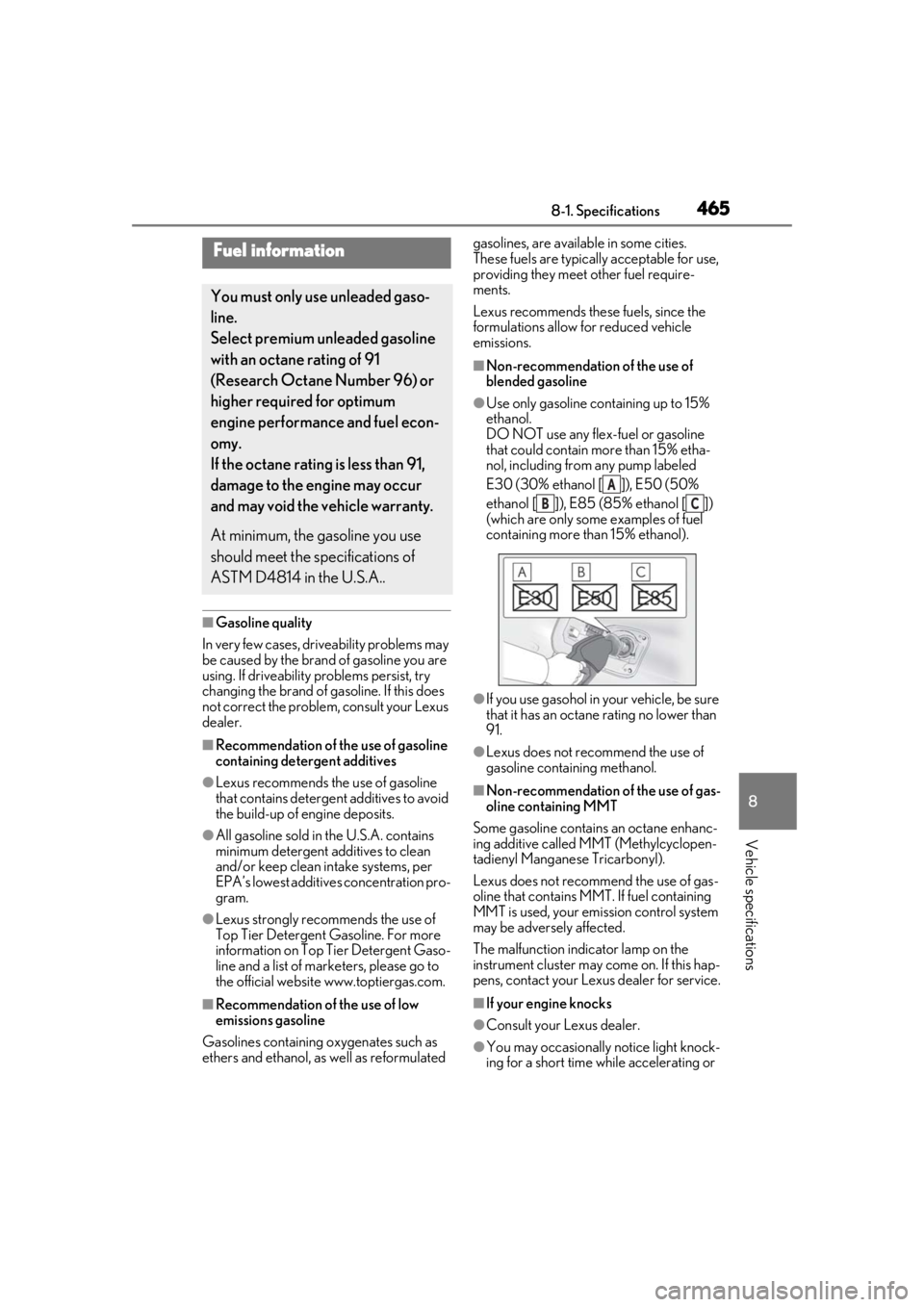
●Use only gasoline containing up to 15%
ethanol.
DO NOT use any flex-fuel or gasoline
that could contain more than 15% etha-
nol, including from
any pump labeled
E30 (30% ethanol [ ]), E50 (50%
ethanol [ ]), E85 (85% ethanol [ ])
(which are only some examples of fuel
containing more than 15% ethanol).
●If you use gasohol in your vehicle, be sure
that it has an octane rating no lower than
91.
●Lexus does not recommend the use of
gasoline containing methanol.
■Non-recommendation of the use of gas-
oline containing MMT
Some gasoline contains an octane enhanc-
ing additive called MMT (Methylcyclopen-
tadienyl Manganese Tricarbonyl).
Lexus does not recommend the use of gas-
oline that contains MMT. If fuel containing
MMT is used, your emission control system
may be adversely affected.
The malfunction indicator lamp on the
instrument cluster may come on. If this hap-
pens, contact your Lexus dealer for service.
■If your engine knocks
●Consult your Lexus dealer.
●You may occasionally notice light knock-
ing for a short time wh ile accelerating or
Fuel information
You must only use unleaded gaso-
line.
Select premium unleaded gasoline
with an octane rating of 91
(Research Octane Number 96) or
higher required for optimum
engine performance and fuel econ-
omy.
If the octane rating is less than 91,
damage to the engine may occur
and may void the vehicle warranty.
At minimum, the gasoline you use
should meet the specifications of
ASTM D4814 in the U.S.A..
A
BC
Page 469 of 520
4698-1. Specifications
8
Vehicle specifications
letter)
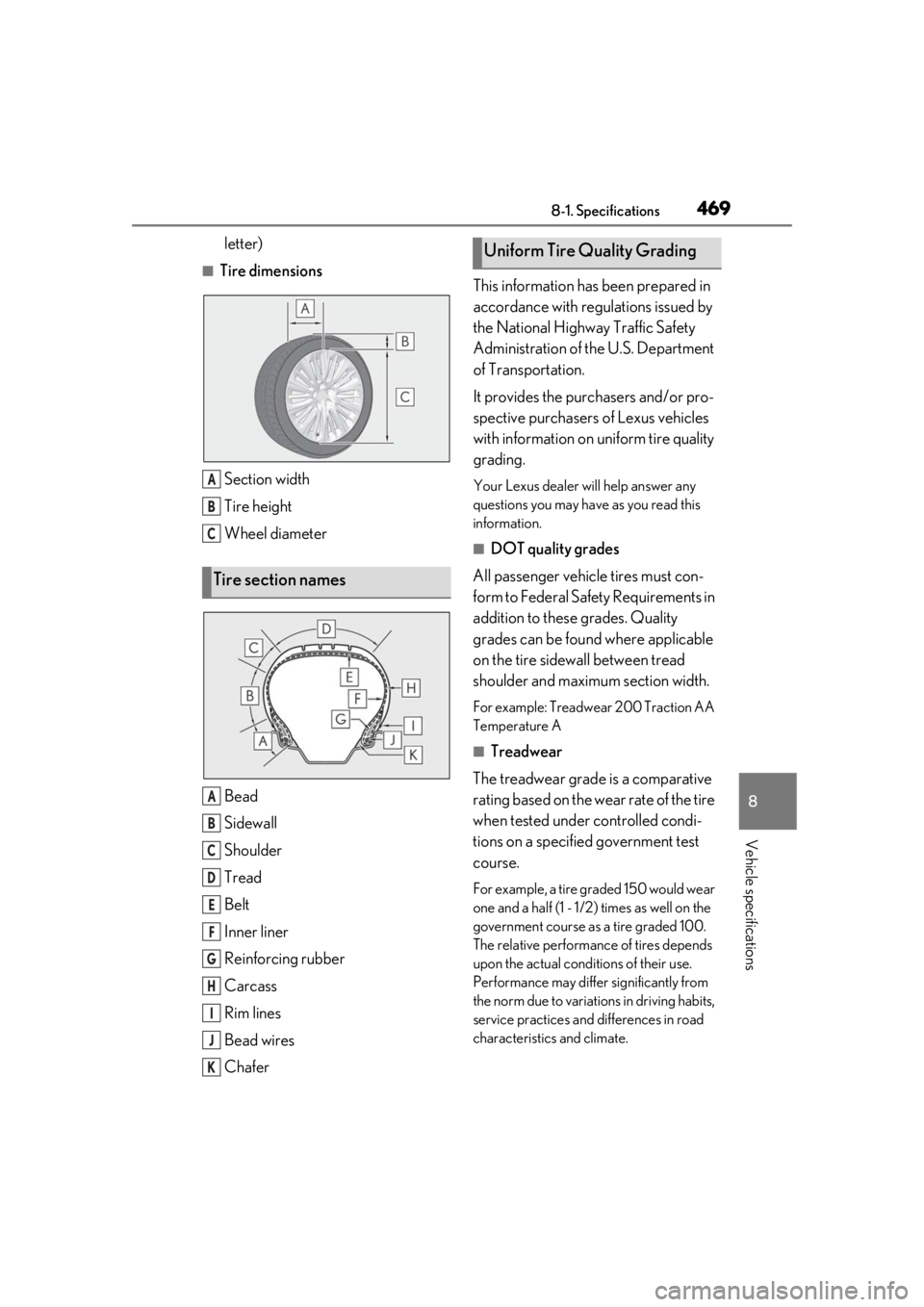
■Tire dimensionsSection width
Tire height
Wheel diameter
Bead
Sidewall
Shoulder
Tread
Belt
Inner liner
Reinforcing rubber
Carcass
Rim lines
Bead wires
Chafer This information has been prepared in
accordance with regulations issued by
the National Highway Traffic Safety
Administration of the U.S. Department
of Transportation.
It provides the purchasers and/or pro-
spective purchasers of Lexus vehicles
with information on uniform tire quality
grading.
Your Lexus dealer will help answer any
questions you may have as you read this
information.
■DOT quality grades
All passenger vehicle tires must con-
form to Federal Safety Requirements in
addition to these grades. Quality
grades can be found where applicable
on the tire sidewall between tread
shoulder and maximum section width.
For example: Treadwear 200 Traction AA
Temperature A
■Treadwear
The treadwear grade is a comparative
rating based on the wear rate of the tire
when tested under controlled condi-
tions on a specified government test
course.
For example, a tire graded 150 would wear
one and a half (1 - 1/2) times as well on the
government course as a tire graded 100.
The relative performance of tires depends
upon the actual conditions of their use.
Performance may differ significantly from
the norm due to variatio ns in driving habits,
service practices and differences in road
characteristics and climate.
Tire section names
A
B
C
A
B
C
D
E
F
G
H
I
J
K
Uniform Tire Quality Grading