ESP LEXUS LS500H 2019 Repair Manual
[x] Cancel search | Manufacturer: LEXUS, Model Year: 2019, Model line: LS500H, Model: LEXUS LS500H 2019Pages: 523, PDF Size: 15.79 MB
Page 433 of 523
4337-2. Steps to take in an emergency
LS500h_OM_(U)_1809
7
When trouble arises
WARNING
●Avoid abrupt maneuvering and brak-
ing.
If the vehicle tires deteriorate, you
could lose control of the steering
wheel or the brakes.
■If a blowout or sudden air leakage
should occur
The tire pressure warning system may
not activate immediately.
■Maintenance of the tires
Each tire, including the spare (if pro-
vided), should be checked monthly when
cold and inflated to the inflation pressure
recommended by the vehicle manufac-
turer on the vehicle placard or tire infla-
tion pressure label (tire and load
information label). (I f your vehicle has
tires of a different size than the size indi-
cated on the vehicle placard or tire infla-
tion pressure label [tire and load
information label], yo u should determine
the proper tire infl ation pressure for
those tires.)
As an added safety feature, your vehicle
has been equipped with a tire pressure
monitoring system (TPMS-tire pressure
warning system) that illuminates a low
tire pressure telltale (tire pressure warn-
ing light) when one or more of your tires
is significantly under-inflated. Accord-
ingly, when the low tire pressure telltale
(tire pressure warnin g light) illuminates,
you should stop and check your tires as
soon as possible, and inflate them to the
proper pressure. Driving on a signifi-
cantly under-inflated tire causes the tire
to overheat and can lead to tire failure.
Under-inflation also reduces fuel effi-
ciency and tire tread life, and may affect
the vehicle’s handling and stopping abil-
ity.
Please note that the TPMS (tire pressure
warning system) is not a substitute for
proper tire maintenance, and it is the
driver’s responsibility to maintain correct
tire pressure, even if under-inflation has
not reached the level to trigger illumina-
tion of the TPMS low tire pressure telltale
(tire pressure warning light).
Your vehicle has also been equipped with
a TPMS (tire pressure warning system)
malfunction indicator to indicate when
the system is not operating properly. The
TPMS (tire pressure warning system)
malfunction indicator is combined with
the low tire pressure telltale (tire pres-
sure warning light) . When the system
detects a malfunction, the telltale will
flash for approximately one minute and
then remain continuously illuminated.
This sequence will continue upon subse-
quent vehicle start-ups as long as the
malfunction exists. When the malfunction
indicator is illuminated, the system may
not be able to detect or signal low tire
pressure as intended.
TPMS (tire pressure warning system)
malfunctions may occur for a variety of
reasons, including the installation of
replacement or alternate tires or wheels
on the vehicle that prevent the TPMS
(tire pressure warning system) from func-
tioning properly. Always check the
TPMS (tire pressure warning system)
malfunction telltale after replacing one
or more tires or wheels on your vehicle to
ensure that the replacement or alternate
tires and wheels allow the TPMS (tire
pressure warning system) to continue to
function properly.
NOTICE
■To ensure the tire pressure warning
system operates properly
Do not install tires with different specifi-
cations or makers, as the tire pressure
warning system may not operate prop-
erly.
Page 437 of 523

4377-2. Steps to take in an emergency
LS500h_OM_(U)_1809
7
When trouble arises
■If “Traction Battery Needs to be Pro-
tected Shift into P to Restart” is dis-
played
This message is displayed when the hybrid
battery (traction battery) charge has
become extremely low because the vehicle
has been left with the N shift position
selected for a certain amount of time.
When operating the vehicle, shift to P and
restart the hybrid system.
■If “Shift Is in N Release Accelerator
Before Shifting” is displayed
The accelerator pedal has been depressed
when the shift position is in N.
Release the accelerator pedal and shift the
shift position to D or R.
■If “Depress Brake When Vehicle Is
Stopped Hybrid Syst em May Overheat”
is displayed
The message may be displayed when the
accelerator pedal is depressed to hold the
vehicle while the vehicle is stopped on an
incline, etc. The hybrid system may over-
heat. Release the accelerator pedal and
depress the brake pedal.
■If “Auto Power Off to Conserve Bat-
tery” is displayed
Power was turned off due to the automatic
power off function. Next time when starting
the hybrid system, operate the hybrid sys-
tem for approximately 5 minutes to
recharge the 12-volt battery.
■If “Headlight System Malfunction Visit
Your Dealer” is displayed
The following systems may be malfunction-
ing. Have the vehicle inspected by your
Lexus dealer immediately.
●The LED headlight system
●AFS (Adaptive Front-lighting System)
●The automatic headlight leveling system
●AHB (Automatic High Beam)
■If “Radar Cruise Control Unavailable
See Owner's Manual” is displayed
The dynamic radar cruise control with
full-speed range system is suspended tem-
porarily or until the problem shown in the
message is resolved. (causes and coping methods:
P.204, 210)
■If “Radar Cruise Control Unavailable” is
displayed
The dynamic radar cruise control with
full-speed range system cannot be used
temporarily. Use the system when it
becomes available again.
■If “Front Camera Unav ailable” or “Front
Camera Unavailable See Owner's
Manual” is displayed
The following systems may be suspended
until the problem shown in the message is
resolved. ( P.204, 210, 430)
●PCS (Pre-Collision system)
●LTA (Lane Tracing Assist)
●Dynamic radar cruise control with
full-speed range
●RSA (Road Sign Assist) (if equipped)
●AHB (Automatic High Beam)
■If “Maintenance Required Soon” is dis-
played
Indicates that all maintenance according to
the driven distance on the maintenance
schedule
* should be performed soon.
Comes on approximately 4500 miles
(7200 km) after the message has been
reset. If necessary, perform maintenance.
Please reset the message after the mainte-
nance is performed. ( P.375)
*: Refer to the separate “Scheduled Main-
tenance” or “Owner’s Manual Supple-
ment” for the main tenance interval
applicable to your vehicle.
■If “Maintenance Required Visit Your
Dealer” is displayed
Indicates that all mainte nance is required to
correspond to the driven distance on the
maintenance schedule
*.
Comes on approximately 5000 miles
(8000 km) after the message has been
reset. (The indicator will not work properly
unless the message ha s been reset.) Per-
form the necessary maintenance. Please
reset the message after the maintenance is
performed. ( P.375)
Page 448 of 523
4487-2. Steps to take in an emergency
LS500h_OM_(U)_1809
●Turn off any unnecessary electrical com-
ponents when the vehicle is running at a
low speed for an extended period, such
as in heavy traffic.
■When the 12-volt battery is removed or
discharged
●Information stored in the ECU is cleared.
When the 12-volt battery is depleted,
have the vehicle inspected at your Lexus
dealer.
●Some systems may require initialization.
( P.494)
■When removing the 12-volt battery ter-
minals
When the 12-volt battery terminals are
removed, the information stored in the
ECU is cleared. Before removing the
12-volt battery terminals, contact your
Lexus dealer.
■Charging the 12-volt battery
The electricity stored in the 12-volt battery
will discharge gradually even when the
vehicle is not in use, due to natural dis-
charge and the draining effects of certain
electrical appliances. If the vehicle is left for
a long time, the 12-volt battery may dis-
charge, and the hybrid system may be
unable to start. (The 12-volt battery
recharges automatically while the hybrid
system is operating.)
■When recharging or replacing the
12-volt battery
●In some cases, it may not be possible to
unlock the doors using the smart access
system with push-button start when the
12-volt battery is discharged. Use the
wireless remote control or the mechani-
cal key to lock or unlock the doors.
●The hybrid system may not start on the
first attempt after the 12-volt battery has
recharged but will start normally after the
second attempt. This is not a malfunction.
●The power switch mode is memorized by
the vehicle. When the 12-volt battery is
reconnected, the system will return to the
mode it was in before the 12-volt battery
was discharged. Before disconnecting
the 12-volt battery, turn the power switch
off. If you are unsure what mode the power
switch was in before
the 12-volt battery
discharged, be especially careful when
reconnecting the 12-volt battery.
■When replacing the 12-volt battery
●Use a Central Degassing type 12-volt
battery (European Regulations).
●Use a 12-volt battery with the same case
size as the previous 12-volt battery and an
equivalent 20 hour rate capacity (20HR)
or greater.
• If the sizes differ, the 12-volt battery can- not be properly secured.
• If the 20 hour rate capacity is low, even if
the time period where the vehicle is not
used is a short time, the 12-volt battery
may discharge and the hybrid system
may not be able to start.
●Use a 12-volt battery with a handle. If a
12-volt battery without a handle is used,
removal is more difficult.
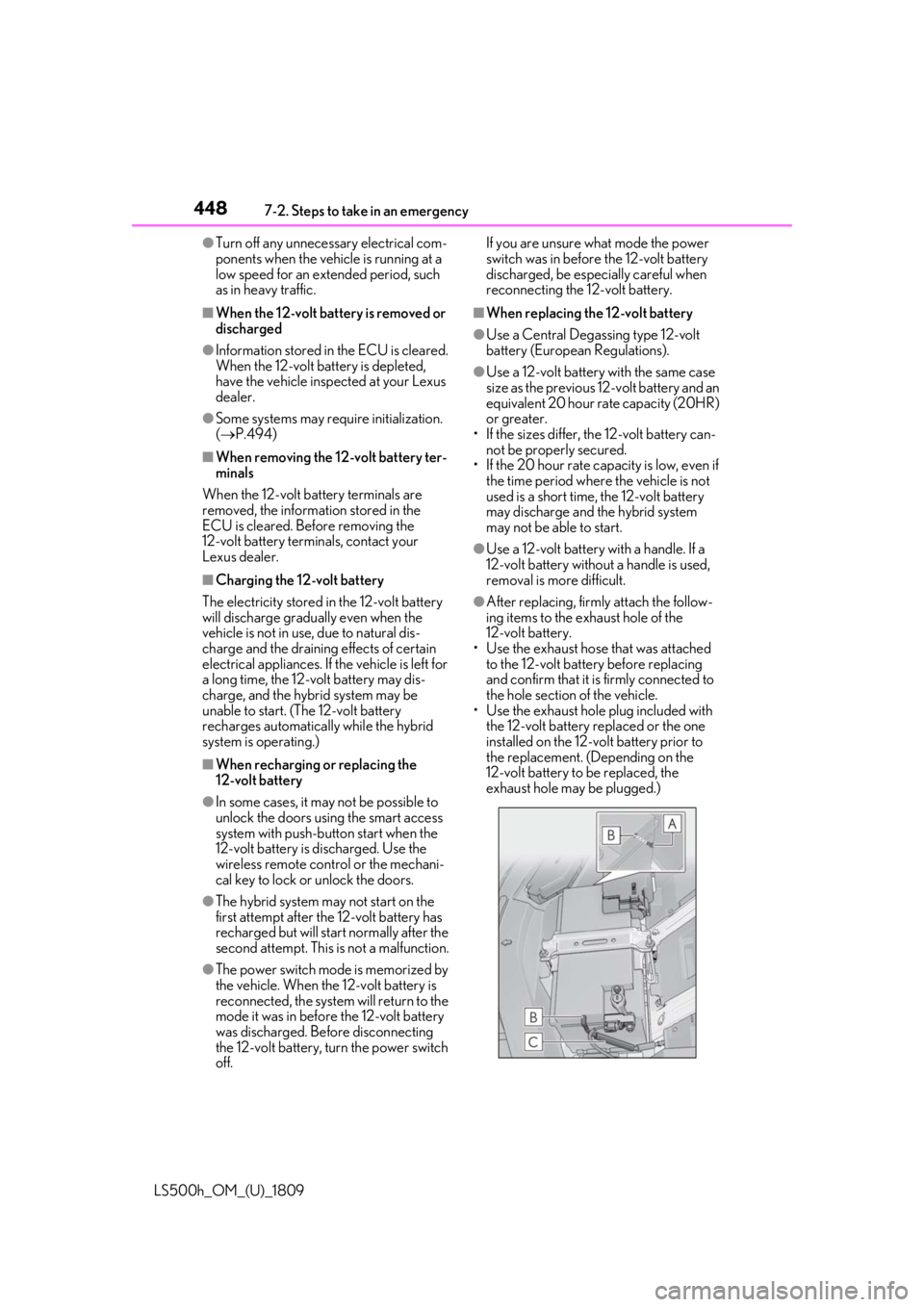
●After replacing, firm ly attach the follow-
ing items to the exhaust hole of the
12-volt battery.
• Use the exhaust hose that was attached to the 12-volt battery before replacing
and confirm that it is firmly connected to
the hole section of the vehicle.
• Use the exhaust hole plug included with the 12-volt battery re placed or the one
installed on the 12-volt battery prior to
the replacement. (Depending on the
12-volt battery to be replaced, the
exhaust hole may be plugged.)
Page 453 of 523

4537-2. Steps to take in an emergency
LS500h_OM_(U)_1809
7
When trouble arises
1 Remove the engine compartment
cover.
2 Push the tab in and open the engine
compartment cover.
3 Remove the engine cover.
4 Remove the caps and . 5
Add coolant through the inlet of the cap
up to the “F” line , and then
replace the cap .
6 Add coolant through the inlet of the cap
until it is full, and then replace the
cap .
AB
WARNING
■When inspecting under the hood of
your vehicle
Observe the following precautions.
Failure to do so may result in serious
injury such as burns.
●If steam is seen coming from under the
hood, do not open the hood until the
steam has subsided. The engine com-
partment may be very hot.
●After the hybrid system has been
turned off, check that the “READY”
indicator off.
When the hybrid system is operating,
the gasoline engine may automatically
start, or the cooling fan may suddenly
operate even if the gasoline engine
stops. Do not touch or approach rotat-
ing parts such as the fan, which may
lead to fingers or clothing (especially a
tie, a scarf or a muffler) getting caught,
resulting in serious injury.
●Do not loosen the coolant inlet cap or
the coolant reservoir cap while the
hybrid system and radiator are hot.
High temperature steam or coolant
could spray out.
NOTICE
■When adding engine/power control
unit coolant
Add coolant slowly after the hybrid sys-
tem has cooled down sufficiently. Adding
cool coolant to a hot hybrid system too
quickly can cause dama ge to the hybrid
system.
AC
A
B
B
Page 473 of 523

4738-1. Specifications
LS500h_OM_(U)_1809
8
Vehicle specifications
■Traction AA, A, B, C
The traction grades, from highest to
lowest, are AA, A, B and C, and they
represent the tire’s ability to stop on
wet pavement as measured under con-
trolled conditions on specified govern-
ment test surfaces of asphalt and
concrete.
A tire marked C may have poor traction
performance.
Warning: The traction grade assigned to
this tire is based on braking (straight
ahead) traction tests and does not include
cornering (turning) traction.
■Temperature A, B, C
The temperature grades are A (the
highest), B, and C, representing the
tire’s resistance to the generation of
heat and its ability to dissipate heat when tested under controlled condi-
tions on a specified indoor laboratory
test wheel.
Sustained high temperature can cause the
material of the tire to degenerate and
reduce tire life, and excessive temperature
can lead to sudd
en tire failure.
Grade C corresponds to a level of perfor-
mance which all passenger car tires must
meet under the Fede ral Motor Vehicle
Safety Standard No. 109.
Grades B and A represent higher levels of
performance on the laboratory test wheel
than the minimum required by law.
Warning: The temperature grades of a tire
assume that it is properly inflated and not
overloaded.
Excessive speed, unde rinflation, or exces-
sive loading, either separately or in combi-
nation, can cause heat buildup and
possible tire failure.
Glossary of tire terminology
Tire related termMeaning
Cold tire inflation pressure
Tire pressure when the vehicle has been parked for
three hours or more, or has not been driven more
than 1 mile or 1.5 km under that condition
Maximum inflation pressureThe maximum cold inflated pressure to which a tire
may be inflated, shown on the sidewall of the tire
Recommended inflation pressureCold tire inflation pressure recommended by a
manufacturer
Accessory weight
The combined weight (in excess of those standard
items which may be replaced) of hybrid transmis-
sion, power steering, power brakes, power win-
dows, power seats, radio and heater, to the extent
that these items are available as factory-installed
equipment (whether installed or not)
Page 475 of 523
4758-1. Specifications
LS500h_OM_(U)_1809
8
Vehicle specifications
Vehicle normal load on the tire
The load on an individual ti re that is determined by
distributing to each axle its share of curb weight,
accessory weight, and normal occupant weight
(distributed in accor dance with Table 1
* below), and
dividing by two
Weather sideThe surface area of the rim not covered by the
inflated tire
Bead
The part of the tire that is made of steel wires,
wrapped or reinforced by ply cords and that is
shaped to fit the rim
Bead separationA breakdown of the bond between components in
the bead
Bias ply tire
A pneumatic tire in which the ply cords that extend
to the beads are laid at alternate angles substan-
tially less than 90 degrees to the centerline of the
tread
CarcassThe tire structure, except tread and sidewall rubber
which, when inflated, bears the load
ChunkingThe breaking away of pieces of the tread or sidewall
CordThe strands forming the plies in the tire
Cord separationThe parting of cords from adjacent rubber com-
pounds
CrackingAny parting within the tread, sidewall, or innerliner
of the tire extending to cord material
CT
A pneumatic tire with an inverted flange tire and rim
system in which the rim is designed with rim flanges
pointed radially inward and the tire is designed to fit
on the underside of the rim in a manner that
encloses the rim flanges inside the air cavity of the
tire
Extra load tire
A tire designed to operat e at higher loads and at
higher inflation pressures than the corresponding
standard tire
GrooveThe space between two adjacent tread ribs
InnerlinerThe layer(s) forming the in side surface of a tubeless
tire that contains the inflating medium within the tire
Tire related termMeaning
Page 477 of 523
4778-1. Specifications
LS500h_OM_(U)_1809
8
Vehicle specifications
Pneumatic tire
A mechanical device made of rubber, chemicals,
fabric and steel or other materials, that, when
mounted on an automotive wheel, provides the
traction and contains the gas or fluid that sustains
the load
Radial ply tire
A pneumatic tire in which the ply cords that extend
to the beads are laid at su bstantially 90 degrees to
the centerline of the tread
Reinforced tire
A tire designed to operat e at higher loads and at
higher inflation pressures than the corresponding
standard tire
Section width
The linear distance between the exteriors of the
sidewalls of an inflated tire, excluding elevations
due to labeling, decoration, or protective bands
SidewallThat portion of a tire between the tread and bead
Sidewall separationThe parting of the rubber compound from the cord
material in the sidewall
Snow tire
A tire that attains a traction index equal to or
greater than 110, compared to the ASTM E-1136
Standard Referenc e Test Tire, when using the snow
traction test as described in ASTM F-1805-00,
Standard Test Method fo r Single Wheel Driving
Traction in a Straight Line on Snow-and Ice-Cov-
ered Surfaces, and which is marked with an Alpine
Symbol ( ) on at least one sidewall
Test rimThe rim on which a tire is fitted for testing, and may
be any rim listed as appropriate for use with that tire
TreadThat portion of a tire that comes into contact with
the road
Tread ribA tread section running ci rcumferentially around a
tire
Tread separationPulling away of the tread from the tire carcass
Tire related termMeaning
Page 480 of 523

4808-2. Customization
LS500h_OM_(U)_1809
tomized. Contact your Lexus dealer for further details.
Settings that can be changed using the Remote Touch
Settings that can be changed using the meter control switches
Settings that can be changed using the Rear Multi Operation Panel (if
equipped)
Settings that can be changed by your Lexus dealer
Definition of symbols: O = Available, — = Not available
■Seat belts ( P.24)
*1: If equipped
*2: Vehicles with pre-collision se at belts with comfort function
■Vehicle proximity notification system ( P.65)
■Gauges, meters and multi-information display ( P.76, 81, 85, 90)
FunctionDefault settingCustomized set-
ting
Easy Access Buckle*1OnOff———O
Retraction of front seat belts
when vehicle speed reaches
approximately 12 mph (20
km/h)
*2
OnOff———O
Retraction of front seat belt
when corresponding front
door is opened or seat belt is
released
*2
OnOff———O
FunctionDefault settingCustomized set-ting
The volume of vehicle prox-
imity notification system
sound
Level1
Level2
———OLevel3
Function*1Default settingCustomized set-ting
LanguageEnglishFrenchOO——Spanish
A
B
C
D
ABCD
ABCD
ABCD
Page 500 of 523

5009-1. For owners
LS500h_OM_(U)_1809
Capteurs d'impact latéral (arrière)
Capteur de position du siège conducteur
Contact de boucle de ceinture de sécurité conducteur
Ensemble de capteurs de coussins gonflables
Capteurs d'impact avant
Ensemble informatique du capot actif
Votre véhicule est équipé de CO USSINS GONFLABLES INTELLIGENTS
conçus selon les normes de sécurité américaines applicables aux véhicules à
moteur (FMVSS208). L'ensemble de cap teurs de coussins gonflables (ECU)
régule le déploiement des coussins gonfla bles sur la base des informations qu'il
reçoit des capteurs, etc., indiqués ci-dessus dans le schéma illustrant les com-
posants du système. Parmi ces informations figurent la gravité du choc et l'occupa-
tion du véhicule par les passagers. Le déploiement rapide des coussins gonflables
est obtenu au moyen d'une réaction chimique dans les dispositifs pyrotechniques,
qui produit un gaz inoffensif permettant d'amortir le mouvement des occupants.O
P
Q
R
S
T
ATTENTION
■Précautions relatives aux coussins
gonflables SRS
Respectez les précautions suivantes
concernant les coussins gonflables SRS.
Le non-respect de ces précautions peut
occasionner des blessures graves, voire
mortelles.
●Le conducteur et tous les passagers du
véhicule doivent porter correctement
leur ceinture de sécurité.
Les coussins gonflables SRS sont des
dispositifs supplémentaires à utiliser
avec les ceinture s de sécurité.
●Le coussin gonflable conducteur SRS
se déploie avec une force con-
sidérable, pouvant occasionner des
blessures graves, voire mortelles, si le
conducteur se trouve très près du
coussin gonflable.
L'autorité fédérale ch argée de la sécurité
routière aux États-Unis (NHTSA) con-
seille: La zone à risque du coussin gon-
flable conducteur se situant dans les
premiers 2 à 3 in. (50 à 75 mm) de
déploiement, vous placer à 10 in. (250
mm) de votre coussin gonflable conduc-
teur vous garantit une marge de sécurité
suffisante. Cette distance est à mesurer
entre le centre du vola nt et le sternum. Si
vous êtes assis à moins de 10 in. (250
mm), vous pouvez changer votre posi-
tion de conduite de plusieurs façons:
• Reculez votre siège le plus possible, de manière à pouvoir encore atteindre
confortablement les pédales.
Page 503 of 523
5039-1. For owners
LS500h_OM_(U)_1809
9
For owners
ATTENTION
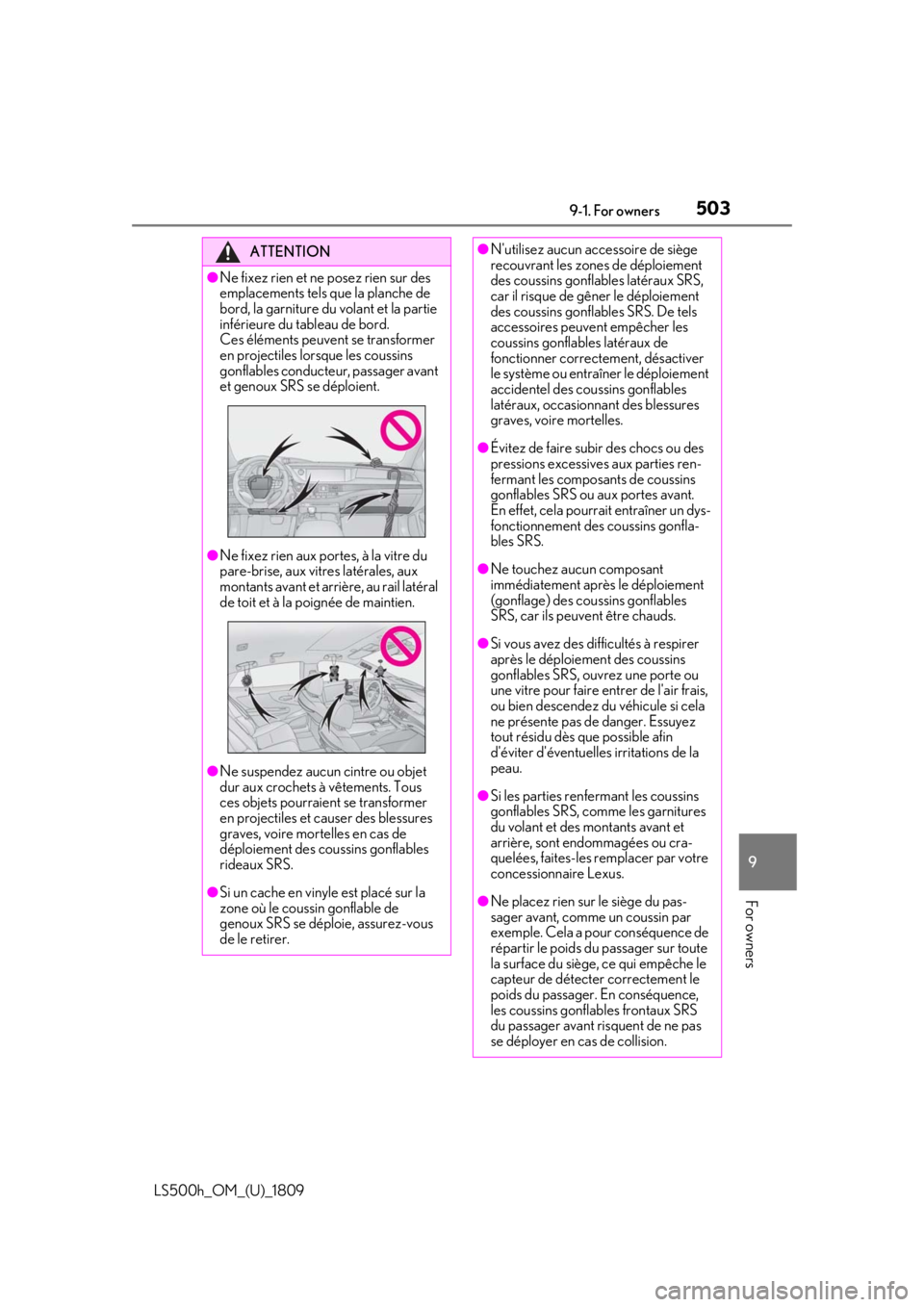
●Ne fixez rien et ne posez rien sur des
emplacements tels que la planche de
bord, la garniture du volant et la partie
inférieure du tableau de bord.
Ces éléments peuvent se transformer
en projectiles lorsque les coussins
gonflables conducteur, passager avant
et genoux SRS se déploient.
●Ne fixez rien aux portes, à la vitre du
pare-brise, aux vitres latérales, aux
montants avant et arrière, au rail latéral
de toit et à la po ignée de maintien.
●Ne suspendez aucun cintre ou objet
dur aux crochets à vêtements. Tous
ces objets pourraient se transformer
en projectiles et causer des blessures
graves, voire mortelles en cas de
déploiement des coussins gonflables
rideaux SRS.
●Si un cache en vinyle est placé sur la
zone où le coussin gonflable de
genoux SRS se déploie, assurez-vous
de le retirer.
●N'utilisez aucun accessoire de siège
recouvrant les zones de déploiement
des coussins gonflables latéraux SRS,
car il risque de gêner le déploiement
des coussins gonflables SRS. De tels
accessoires peuvent empêcher les
coussins gonflables latéraux de
fonctionner correctement, désactiver
le système ou entraîner le déploiement
accidentel des coussins gonflables
latéraux, occasionna nt des blessures
graves, voire mortelles.
●Évitez de faire subir des chocs ou des
pressions excessives aux parties ren-
fermant les composants de coussins
gonflables SRS ou aux portes avant.
En effet, cela pourra it entraîner un dys-
fonctionnement des coussins gonfla-
bles SRS.
●Ne touchez aucun composant
immédiatement après le déploiement
(gonflage) des coussins gonflables
SRS, car ils peuvent être chauds.
●Si vous avez des di fficultés à respirer
après le déploiement des coussins
gonflables SRS, ouvrez une porte ou
une vitre pour faire entrer de l'air frais,
ou bien descendez du véhicule si cela
ne présente pas de danger. Essuyez
tout résidu dès que possible afin
d'éviter d'éventuelle s irritations de la
peau.
●Si les partie s renfermant les coussins
gonflables SRS, comme les garnitures
du volant et des montants avant et
arrière, sont endommagées ou cra-
quelées, faites-les remplacer par votre
concessionnaire Lexus.
●Ne placez rien sur le siège du pas-
sager avant, comme un coussin par
exemple. Cela a pour conséquence de
répartir le poids du passager sur toute
la surface du siège, ce qui empêche le
capteur de détecter correctement le
poids du passager. En conséquence,
les coussins gonflables frontaux SRS
du passager avant risquent de ne pas
se déployer en cas de collision.