brake LEXUS NX300h 2015 Owner's Manual
[x] Cancel search | Manufacturer: LEXUS, Model Year: 2015, Model line: NX300h, Model: LEXUS NX300h 2015Pages: 681, PDF Size: 9.14 MB
Page 177 of 681

1774-1. Before driving
4
Driving
NX300h_U_OM78007U WA R N I N G
Observe the following precautions.
Failure to do so may result in death or serious injury. ■
When driving the vehicle ●
During normal driving, do not turn off the hybrid system. Turning the hybrid system off
while driving will not cause loss of steering or braking control, however, power assist
to the steering will be lost. This will make it more difficult to steer smoothly, so you
should pull over and stop the vehicle as soon as it is safe to do so.
In the event of an emergency, such as if it becomes impossible to stop the vehicle in
the normal way: P. 5 5 7●
Use engine braking (downshift) to maintain a safe speed when driving down a steep
hill.
Using the brakes continuously may cause th e brakes to overheat and lose effective-
ness. ( P. 2 0 8 )●
Do not adjust the positions of the steering wh eel, the seat, or the inside or outside rear
view mirrors while driving.
Doing so may result in a loss of vehicle control. ●
Always check that all passengers’ arms, heads or other parts of their body are not
outside the vehicle. ●
AWD models: Do not drive the vehicle off-road.
This is not an AWD vehicle designed for of f-road driving. Proceed with all due cau-
tion if it becomes unavoidable to drive off-road. ●
Do not drive across a river or through other bodies of water.
This may cause electric/electronic components to short circuit, damage the hybrid
system or cause other serious damage to the vehicle. ●
Do not drive in excess of the speed limit. Ev en if the legal speed lim it permits it, do not
drive over 85 mph (140 km/h) unless your vehicle has high-speed capability tires.
Driving over 85 mph (140 km/h) may result in tire failure, loss of control and possible
injury. Be sure to consult a tire dealer to determine whether the tires on your vehicle
are high-speed capability tires or not before driving at such speeds.
Page 178 of 681

178 4-1. Before driving
NX300h_U_OM78007U WA R N I N G
Observe the following precautions.
Failure to do so may result in death or serious injury. ■
When driving on slippery road surfaces ●
Sudden braking, acceleration and steering may cause tire slippage and reduce your
ability to control the vehicle. ●
Sudden acceleration, engine braking due to shifting, or changes in engine speed
could cause the vehicle to skid. ●
After driving through a puddle , lightly depress the brake pe dal to make sure that the
brakes are functioning properly. Wet brake pads may prevent the brakes from func-
tioning properly. If the brakes on only on e side are wet and not functioning properly,
steering control may be affected. ■
When shifting the shift lever ●
Do not let the vehicle roll backward while the shift lever is in a driving position, or roll
forward while the shift lever is in R.
Doing so may result in an acci dent or damage to the vehicle.●
Do not shift the shift lever to P while the vehicle is moving.
Doing so can damage the transmission and may result in a loss of vehicle control.●
Do not shift the shift lever to R wh ile the vehicle is moving forward.
Doing so can damage the transmission and may result in a loss of vehicle control.●
Do not shift the shift lever to D while the vehicle is moving backward.
Doing so can damage the transmission and may result in a loss of vehicle control.●
Shifting the shift lever to N while the vehicl e is moving will disengage the hybrid sys-
tem. Engine braking is not available when N is selected. ●
Be careful not to shift the shift lever with the accelerator pedal depressed.
Shifting the shift lever to any position other than P or N may lead to unexpected rapid
acceleration of the vehicle that may cause an accident and result in death or serious
injury.
Page 179 of 681

1794-1. Before driving
4
Driving
NX300h_U_OM78007U WA R N I N G
Observe the following precautions.
Failure to do so may result in death or serious injury. ■
If you hear a squealing or scraping noise (brake pad wear limit indicators)
Have the brake pads checked and replaced by your Lexus dealer as soon as possible.
Rotor damage may result if the pads are not replaced when needed.
It is dangerous to drive the vehicle when the wear limits of the brake pads and/or those
of the brake discs are exceeded. ■
When the vehicle is stopped ●
Do not depress the accelerator pedal unnecessarily.
If the shift lever is in any position other than P or N, the vehicle may accelerate sud-
denly and unexpectedly, causing an accident. ●
In order to prevent accidents due to the vehicle rolling away, always keep depressing
the brake pedal while stopped with the “R EADY” indicator is illuminated, and apply
the parking brake as necessary. ●
If the vehicle is stopped on an incline, in order to prevent accidents caused by the
vehicle rolling forward or backward, always depress the brake pedal and securely
apply the parking brake as needed. ●
Avoid revving or racing the engine.
Running the engine at high speed while the vehicle is stopped may cause the exhaust
system to overheat, which could result in a fire if combustible material is nearby. ■
When the vehicle is parked ●
Do not leave glasses, cigarette lighters, sp ray cans, or soft drink cans in the vehicle
when it is in the sun.
Doing so may result in the following:
• Gas may leak from a cigarette lighter or spray can, and may lead to a fire.
• The temperature inside the vehicle may cause the plastic lenses and plastic mate-
rial of glasses to deform or crack.
• Soft drink cans may fracture, causing the contents to spray over the interior of the
vehicle, and may also cause a short circuit in the vehicle’s electrical components. ●
Do not leave cigarette lighters in the vehicle. If a cigarette lighter is in a place such as
the glove box or on the floor, it may be lit accidentally when luggage is loaded or the
seat is adjusted, causing a fire. ●
Do not attach adhesive discs to the windsh ield or windows. Do not place containers
such as air fresheners on the instrument panel or dashboard. Adhesive discs or con-
tainers may act as lenses, causing a fire in the vehicle. ●
Do not leave a door or window open if th e curved glass is coated with a metallized
film such as a silver-colored one. Reflected sunlight may cause the glass to act as a
lens, causing a fire. ●
Always shift the shift lever to P, apply the parking brake, stop the hybrid system and
lock the vehicle.
Do not leave the vehicle unattended wh ile the “READY” indicator is illuminated.●
Do not touch the exhaust pipes while the “R EADY” indicator is illuminated or imme-
diately after turning the hybrid system off.
Doing so may cause burns.
Page 180 of 681

180 4-1. Before driving
NX300h_U_OM78007U WA R N I N G
Observe the following precautions.
Failure to do so may result in death or serious injury. ■
When taking a nap in the vehicle
Always turn the hybrid system off. Otherwise, if you accidentally move the shift lever or
depress the accelerator pedal, this could caus e an accident or fire due to hybrid system
overheating. Additionally, if the vehicle is parked in a poorly ventilated area, exhaust
gases may collect and enter the vehicle, lead ing to death or a serious health hazard.■
When braking ●
When the brakes are wet, drive more cautiously.
Braking distance increases when the brakes are wet, and this may cause one side of
the vehicle to brake differently than the other side. Also, the parking brake may not
securely hold the vehicle. ●
If the electronically controlled brake function does not operate, do not follow other
vehicles closely and avoid hills or sharp turns that require braking.
In this case, braking is st ill possible, but the brake pedal should be depressed more
firmly than usual. Also, the braking distan ce will increase. Have your brakes fixed
immediately. ●
The brake system consists of 2 or more indi vidual hydraulic systems; if one of the sys-
tems fails, the other(s) wi ll still operate. In this case, the brake pedal should be
depressed more firmly than usual and the braking distance will increase. Have your
brakes fixed immediately. ■
If the vehicle becomes stuck (AWD models)
Do not spin the wheels excessively when any of the tires is up in the air, or the vehicle is
stuck in sand, mud, etc. This may damage th e driveline components or propel the vehi-
cle forward or backward, causing an accident.
Page 181 of 681

1814-1. Before driving
4
Driving
NX300h_U_OM78007U NOTICE ■
When driving the vehicle ●
Do not depress the accelerator and brake pedals at the same time during driving, the
hybrid system output may be restrained. ●
Do not use the accelerator pedal or depress the accelerator and brake pedals at the
same time to hold the vehicle on a hill. ■
When parking the vehicle
Always shift the shift lever to P, set the parking brake. Failure to do so may cause the
vehicle to move or the vehicle may accelerate suddenly if the acce lerator pedal is acci-
dentally depressed. ■
Avoiding damage to vehicle parts ●
Do not turn the steering wheel fully in either direction and hold it there for an
extended period of time.
Doing so may damage the power steering motor. ●
When driving over bumps in the road, drive as slowly as possible to avoid damaging
the wheels, underside of the vehicle, etc. ■
If you get a flat tire while driving
A flat or damaged tire may cause the follo wing situations. Hold the steering wheel
firmly and gradually depress the brake pedal to slow down the vehicle. ●
It may be difficult to control your vehicle. ●
The vehicle will make abnormal sounds or vibrations. ●
The vehicle will lean abnormally.
Information on what to do in case of a flat tire ( P. 5 7 5 )■
When encountering flooded roads
Do not drive on a road that has flooded after heavy rain, etc. Doing so may cause the
following serious damage to the vehicle: ●
Engine stalling ●
Short in electrical components ●
Engine damage caused by water immersion
In the event that you drive on a flooded road and the vehicle is flooded, be sure to have
your Lexus dealer check the following: ●
Brake function ●
Changes in quantity and quality of oil and fluid used for the engine, hybrid transmis-
sion, etc. ●
Lubricant condition for the bearings and susp ension joints (where possible), and the
function of all joints, bearings, etc.
Page 187 of 681
1874-1. Before driving
4
Driving
NX300h_U_OM78007UTrailer towing (vehicles with towing package)
Contact your Lexus dealer for further in formation about additional requirements
such as a towing kit, etc.Your vehicle is designed primarily as a passenger-and-load-carrying vehicle.
Towing a trailer can have an adverse impact on handling, performance, brak-
ing, durability, and fuel consumption. Fo r your safety and the safety of others,
you must not overload your vehicle or trailer. You must also ensure that you
are using appropriate towing equipment, that the towing equipment has been
installed correctly and used properly, and that you employ the requisite driv-
ing habits.
Vehicle-trailer stability and braking pe rformance are affected by trailer sta-
bility, brake performance and setting, tr ailer brakes, the hitch and hitch sys-
tems (if equipped).
To tow a trailer safely, use extreme ca re and drive the vehicle in accordance
with your trailer’s characteristics and operating conditions.
Lexus warranties do not apply to damage or malfunction caused by towing a
trailer for commer cial purposes.
Page 189 of 681
1894-1. Before driving
4
Driving
NX300h_U_OM78007U ■
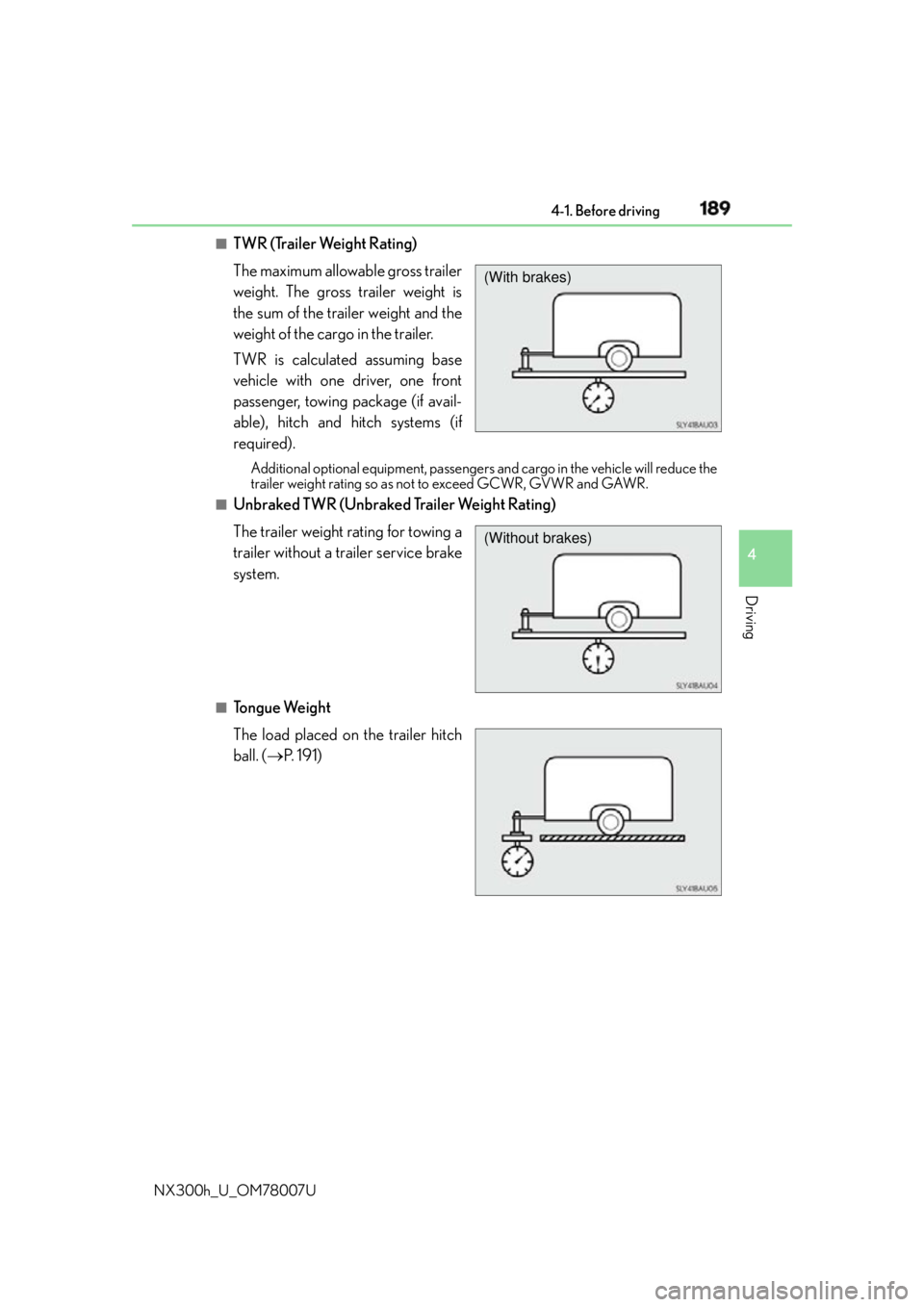
TWR (Trailer Weight Rating)
The maximum allowable gross trailer
weight. The gross trailer weight is
the sum of the trailer weight and the
weight of the cargo in the trailer.
TWR is calculated assuming base
vehicle with one driver, one front
passenger, towing package (if avail-
able), hitch and hitch systems (if
required). Additional optional equipment, passengers and cargo in the vehicle will reduce the
trailer weight rating so as not to exceed GCWR, GVWR and GAWR.■
Unbraked TWR (Unbraked Trailer Weight Rating)
The trailer weight rating for towing a
trailer without a trailer service brake
system.
■
To n g u e We i g h t
The load placed on the trailer hitch
ball. ( P. 1 9 1 ) (With brakes)
(Without brakes)
Page 190 of 681
190 4-1. Before driving
NX300h_U_OM78007U ●
The gross trailer weight must never exceed 1500 lb. (680 kg). ●
The gross combination weight must never exceed 6835 lb. (3100 kg). ●
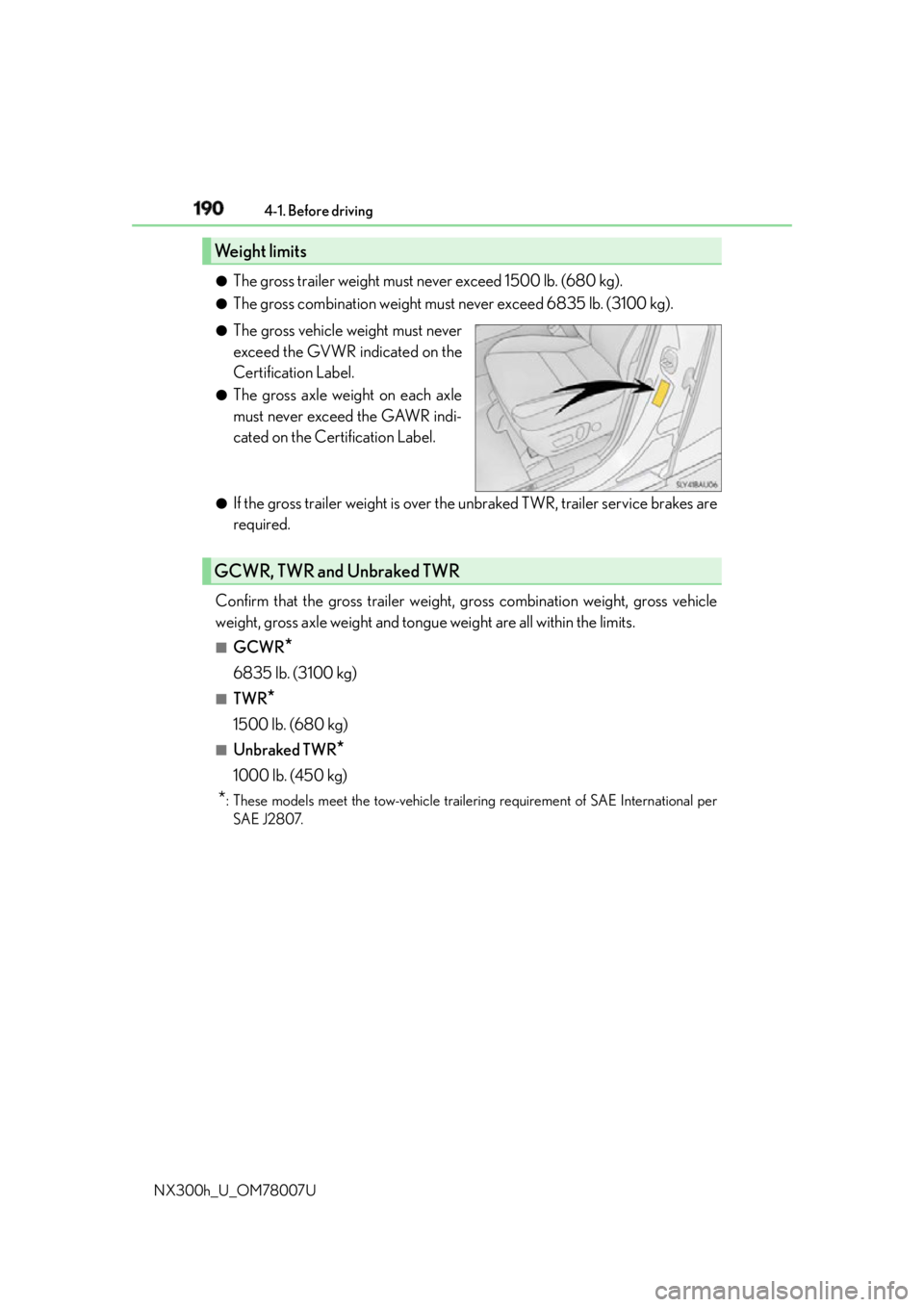
The gross vehicle weight must never
exceed the GVWR indicated on the
Certification Label. ●
The gross axle weight on each axle
must never exceed the GAWR indi-
cated on the Certification Label. ●
If the gross trailer weight is over the unbraked TWR, trailer service brakes are
required.
Confirm that the gross trailer weight, gross combination weight, gross vehicle
weight, gross axle weight and tongue weight are all within the limits.■
GCWR
*6835 lb. (3100 kg) ■
TWR
* 1500 lb. (680 kg) ■
Unbraked TWR
*1000 lb. (450 kg)
* : These models meet the tow-vehicle traile ring requirement of SAE International per
SAE J2807.Weight limits
GCWR, TWR and Unbraked TWR
Page 193 of 681

1934-1. Before driving
4
Driving
NX300h_U_OM78007U ●
Reversing with a trailer attached is di fficult and requires practice. Grip the
bottom of the steering wheel and move your hand to the left to move the
trailer to the left. Move your hand to the right to move the trailer to right. (This
is generally opposite to reversing without a trailer attached.) Avoid sharp or
prolonged turning. Have someone guid e you when reversing to reduce the
risk of an accident. ●
As stopping distance is increased when towing a trailer, vehicle-to vehicle dis-
tance should be increased. For each 10 mph (16 km/h) of speed, allow at least
one vehicle and trailer length. ●
Avoid sudden braking as you may skid, re sulting in the traile r jackknifing and a
loss of vehicle control. This is especially true on wet or slippery surfaces. ●
Avoid jerky starts or sudden acceleration. ●
Avoid jerky steering and sharp turns, and slow down before making turn. ●
Note that when making a turn, the traile r wheels will be closer than the vehicle
wheels to the inside of the turn. Comp ensate by making a wider than normal
turning radius. ●
Slow down before making a turn, in cross winds, on wet or slippery surfaces,
etc.
Increasing vehicle speed can destabilize the trailer. ●
Take care when passing other vehicles. Passing requires considerable dis-
tance. After passing a vehicle, do not forget the length of your trailer, and be
sure you have plenty of room before changing lanes. ●
To maintain engine braking efficiency and charging system performance
when using engine braking, do no t put the transmission in D. ( P. 2 0 8 )●
Instability happens more frequently when descending steep or long downhill
grades. Before descending, slow down and downshift. Do not make sudden
downshifts while descending steep or long downhill grades. ●
Avoid holding the brake pedal down too long or applying the brakes too fre-
quently. This could cause the brakes to overheat and result in reduced braking
efficiency. ●
Due to the added load of the trailer, yo ur vehicle’s engine may overheat on hot
days (at temperatures over 85 F [30 C]) when driving up a long or steep
grade. If the engine coolant temperat ure gauge indicates overheating, imme-
diately turn off the air cond itioning (if in use), pull your vehicle off the road and
stop in a safe spot. ( P. 600)
Page 194 of 681

194 4-1. Before driving
NX300h_U_OM78007U ●
Always place wheel blocks under both the vehicle’s and the trailer’s wheels
when parking. Put the transmission in P and apply the parking brake. Avoid
parking on a slope, but if unavoidable, do so only after performing the follow-
ing:
Apply the brakes and keep them applied.
Have someone place wheel blocks under both the vehicle’s and trailer’s
wheels.
When the wheel blocks are in place, release the brakes slowly until the
blocks absorb the load.
Shift into P and apply the parking brake.
Turn off the hybrid system.●
When restarting after parking on a slope:
With the transmission in P, start the hybrid system. Be sure to keep the
brake pedal depressed.
Shift into a forward gear. If reversing, shift into R.
If the parking brake is in manual mode, release the parking brake.
( P. 2 1 4 )
Release the brake pedal, and slowly pull or back away from the wheel
blocks. Stop and apply the brakes.
Have someone retrieve the blocks. 1
2
3
4
5
1
2
3
4
5