brake LEXUS NX300h 2015 Manual PDF
[x] Cancel search | Manufacturer: LEXUS, Model Year: 2015, Model line: NX300h, Model: LEXUS NX300h 2015Pages: 681, PDF Size: 9.14 MB
Page 326 of 681
326 4-6. Driving tips
NX300h_U_OM78007UWinter driving tips ●
Use fluids that are appropriate to the prevailing outside temperatures.
•Engine oil
• Engine/power control unit coolant
• Washer fluid ●
Have a service technician inspect the condition of the 12-volt battery. ●
Have the vehicle fitted with four snow tires or purchase a set of tire chains for
the front tires
* . Ensure that all tires are the same size and br and, and that chains match the size of the
tires.
* : Tire chains cannot be mounted on the 225/60R18 tires.
Perform the following according to the driving conditions: ●
Do not try to forcibly open a window or move a wiper that is frozen. Pour
warm water over the frozen area to melt the ice. Wipe away the water imme-
diately to prevent it from freezing. ●
To ensure proper operation of the climate control system fan, remove any
snow that has accumulated on the air inlet vents in front of the windshield. ●
Check for and remove any excess ice or snow that may have accumulated on
the exterior lights, vehicle’s roof, chassis, around the tires or on the brakes. ●
Remove any snow or mud from the bottom of your shoes before getting in the
vehicle.Carry out the necessary preparations and inspections before driving the vehi-
cle in winter. Always drive the vehicle in a manner appropriate to the prevail-
ing weather conditions.
Pre-winter preparations
Before driving the vehicle
Page 327 of 681
3274-6. Driving tips
4
Driving
NX300h_U_OM78007U Accelerate the vehicle slowly, keep a safe distance between you and the vehicle
ahead, and drive at a reduced speed suitable to road conditions.●
Park the vehicle and move the shift lever to P and block the wheel under the
vehicle without setting the parking brake. The parking brake may freeze up,
preventing it from being released. When the parking brake is in automatic mode, release the parking brake after shifting
the shift lever to P. ( P. 2 1 3 )●
If the vehicle is left parked with the br akes damp in cold temperatures, there is
a possibility of the brakes freezing.
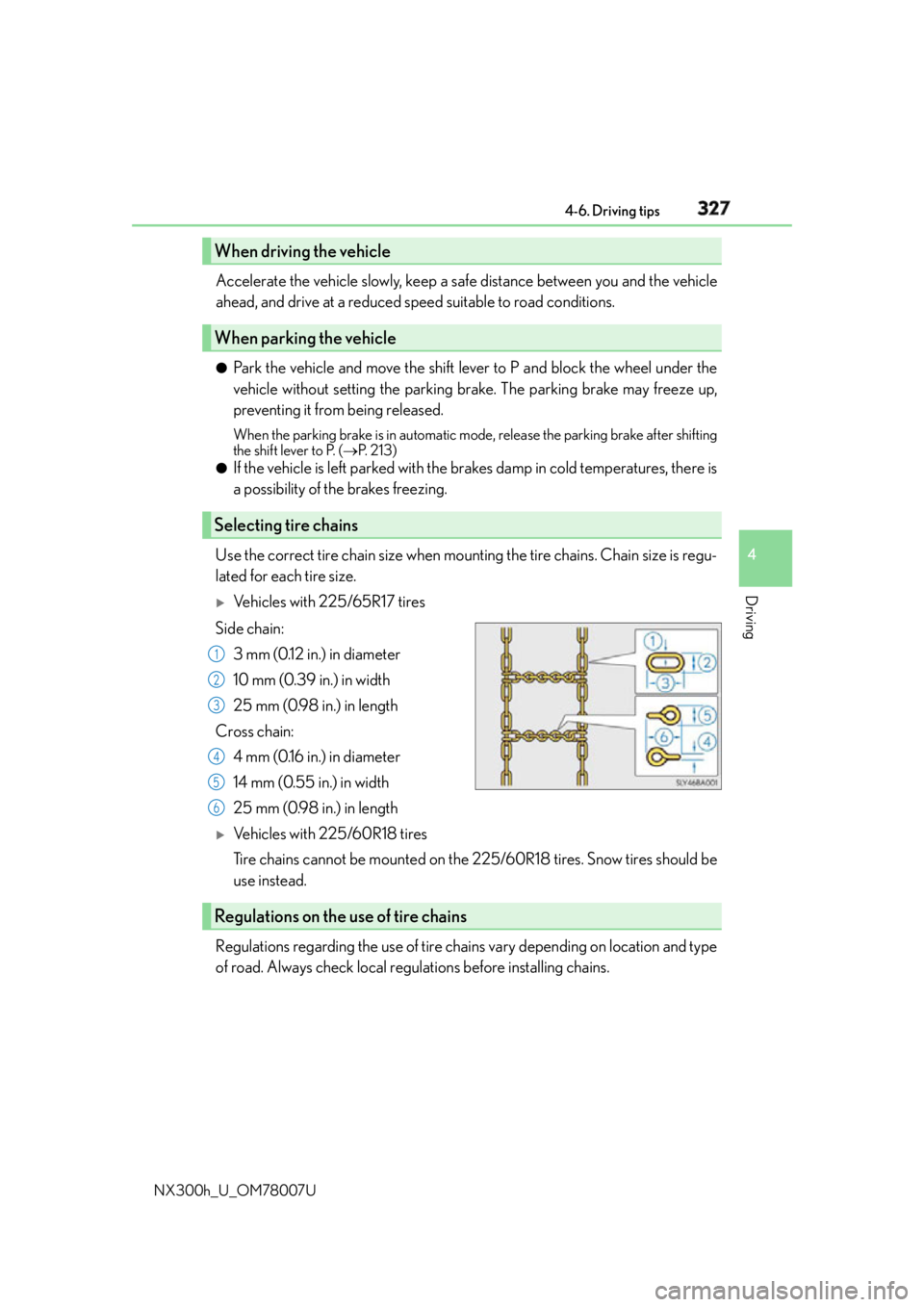
Use the correct tire chain size when mounting the tire chains. Chain size is regu-
lated for each tire size.
Vehicles with 225/65R17 tires
Side chain:
3 mm (0.12 in.) in diameter
10 mm (0.39 in.) in width
25 mm (0.98 in.) in length
Cross chain:
4 mm (0.16 in.) in diameter
14 mm (0.55 in.) in width
25 mm (0.98 in.) in length
Vehicles with 225/60R18 tires
Tire chains cannot be mounted on the 225/60R18 tires. Snow tires should be
use instead.
Regulations regarding the use of tire chains vary depending on location and type
of road. Always check local regulations before installing chains.When driving the vehicle
When parking the vehicle
Selecting tire chains 1
2
3
4
5
6
Regulations on the use of tire chains
Page 328 of 681

328 4-6. Driving tips
NX300h_U_OM78007U ■
Tire chain installation
Observe the following precautions wh en installing and removing chains:●
Install and remove tire chains in a safe location. ●
Install tire chains on the front tires only. Do not install tire chains on the rear tires. ●
Install tire chains on front tires as tightl y as possible. Retighten chains after driving
1/4 -1/2 mile (0.5 - 1.0 km). ●
Install tire chains following the instru ctions provided with the tire chains.
WA R N I N G ■
Driving with snow tires
Observe the following precautions to reduce the risk of accidents.
Failure to do so may result in a loss of ve hicle control and cause death or serious injury.●
Use tires of the specified size. ●
Maintain the recommended level of air pressure. ●
Do not drive in excess of 75 mph (120 km/h), regardless of the type of snow tires
being used. ●
Use snow tires on all, not just some wheels.■
Driving with tire chains
Observe the following precautions to reduce the risk of accidents.
Failure to do so may result in the vehicle being unable to be driven safely, and may
cause death or serious injury. ●
Do not drive in excess of the speed limit specified for the tire chains being used, or
30 mph (50 km/h), whichever is lower. ●
Avoid driving on bumpy road surfaces or over potholes. ●
Avoid sudden acceleration, ab rupt steering, sudden bra king and shifting operations
that cause sudden engine braking. ●
Slow down sufficiently before entering a cu rve to ensure that vehicle control is main-
tained. ●
Do not use LDA (Lane Departure Alert with steering control) (if equipped). ■
When parking the vehicle
When parking the vehicle without applying the parking brake, make sure to chock the
wheels. If you do not chock the wheels, the vehicle may move unexpectedly, possibly
resulting in an accident.
Page 332 of 681

332 4-6. Driving tips
NX300h_U_OM78007U WA R N I N G ■
Off-road driving precautions
Always observe the following precautions to minimize the risk of death or serious
injury or damage to your vehicle: ●
Drive carefully when off the road. Do not ta ke unnecessary risks by driving in danger-
ous places. ●
Do not grip the steering wheel spokes when driving off-road. A bad bump could jerk
the wheel and injure your hands. Keep both hands and especially your thumbs on the
outside of the rim. ●
Always check your brakes for effectivenes s immediately after driving in sand, mud,
water or snow. ●
After driving through tall grass, mud, rock, sand, water, etc., check that there is no
grass, bush, paper, rags, stone, sand, et c. adhering or trap ped to the underbody.
Clear off any such matter from the underbody. If the vehicle is used with these materi-
als trapped or adhering to the underb ody, a breakdown or fire could occur.●
When driving off-road or in rugged terrai n, do not drive at excessive speeds, jump,
make sharp turns, strike objects, etc. This may cause loss of control or vehicle rollover
causing death or serious injury. You are also risking expensive damage to your vehi-
cle’s suspension and chassis.
NOTICE ■
To prevent water damage
Take all necessary safety measures to ensure that water damage to the hybrid battery
(traction battery), hybrid system or other components does not occur. ●
Water entering the engine compartment may cause severe damage to the hybrid
system. Water entering the interior may cause the hybrid battery stowed under the
rear seats to short circuit. ●
Water entering the hybrid transmission and rear electric motor (traction motor) will
cause deterioration in transmission qualit y. The malfunction indicator may come on,
and the vehicle may not be drivable. ●
Water can wash the grease from wheel be arings, causing rusting and premature fail-
ure, and may also enter the hybrid transmission case, reducing the gear oil’s lubricat-
ing qualities. ■
When you drive through water
If driving through water, such as when crossing shallow streams, first check the depth of
the water and the bottom of the riverbed for firmness. Drive slowly and avoid deep
water. ■
Inspection after off-road driving ●
Sand and mud that has accumulated around brake discs may affect braking efficiency
and may damage brake system components. ●
Always perform a maintenance inspection after each day of off-road driving that has
taken you through rough terr ain, sand, mud, or water. For scheduled maintenance
information, refer to the “Warranty and Services Guide/Owner’s Manual Supple-
ment/Scheduled Maintenance”.
Page 487 of 681
4877-1. Maintenance and care
7
Maintenance and care
NX300h_U_OM78007U NOTICE ■
To prevent paint deterioration and corrosio n on the body and components (aluminum
wheels etc.) ●
Wash the vehicle immediately in the following cases:
• After driving near the sea coast
• After driving on salted roads
• If coal tar or tree sap is present on the paint surface
• If dead insects, insect droppings or bird droppings are present on the paint surface
• After driving in an area contaminated wi th soot, oily smoke, mine dust, iron pow-
der or chemical substances
• If the vehicle becomes heavily soiled with dust or mud
• If liquids such as benzene and gaso line are spilled on the paint surface●
If the paint is chipped or scratche d, have it repaired immediately.●
To prevent the wheels from corroding, remo ve any dirt and store in a place with low
humidity when storing the wheels. ■
Cleaning the exterior lights ●
Wash carefully. Do not use organic substances or scrub with a hard brush.
This may damage the su rfaces of the lights.●
Do not apply wax to the surfaces of the lights.
Wax may cause damage to the lenses. ■
To prevent damage to the windshield wiper arms
When lifting the wiper arms away from the windshield, pull the dr iver side wiper arm
upward first, and repeat for the passenger side. When returning the wipers to their
original position, do so from the passenger side first. ■
When using an automatic car wash (vehicle s with rain-sensing windshield wipers)
Set the wiper switch to the off position.
If the wiper switch is in “AUTO”, the wipers may operate and the wiper blades may be
damaged. ■
When using a high pressure car wash ●
When washing the vehicle, do not let water of the high pressure washer hit directly or
the vicinity of the camera. Due to the shock fr om the high pressure water, it is possible
the device may not operate as normal. ●
Do not bring the nozzle tip close to followi ng parts and boots (Rubber or resin manu-
factured cover), or connectors. Parts may be damages if they come into contact with
high pressure water.
• Traction battery related parts
• Steering parts
• Suspension parts
•Brake parts
Page 494 of 681
494 7-2. Maintenance
NX300h_U_OM78007UGeneral maintenance Listed below are the general maintenance items that should be performed at
the intervals specified in the “Warranty and Service Guide” or “Owner’s
Manual Supplement”. It is recommende d that any problem you notice should
be brought to the attention of your Lexu s dealer or qualifie d service shop for
advice.
Engine compartment Items Check points
Brake fluid Is the brake fluid at the correct level? ( P. 5 1 0 )
Engine/power control unit
coolant Is the engine coolant at the correct level? ( P. 5 0 8 )
Engine oil Is the engine oil at the correct level? ( P. 5 0 4 )
Exhaust system There should not be any fumes or strange sounds.
Radiator/condenser The radiator and condenser should be free from
foreign objects. ( P. 5 0 9 )
Wa s h e r f l u i d Is there sufficient washer fluid? ( P. 511)
Luggage compartment Items Check points
12-volt battery Check the connections. ( P. 5 1 2 )
Page 495 of 681
4957-2. Maintenance
7
Maintenance and care
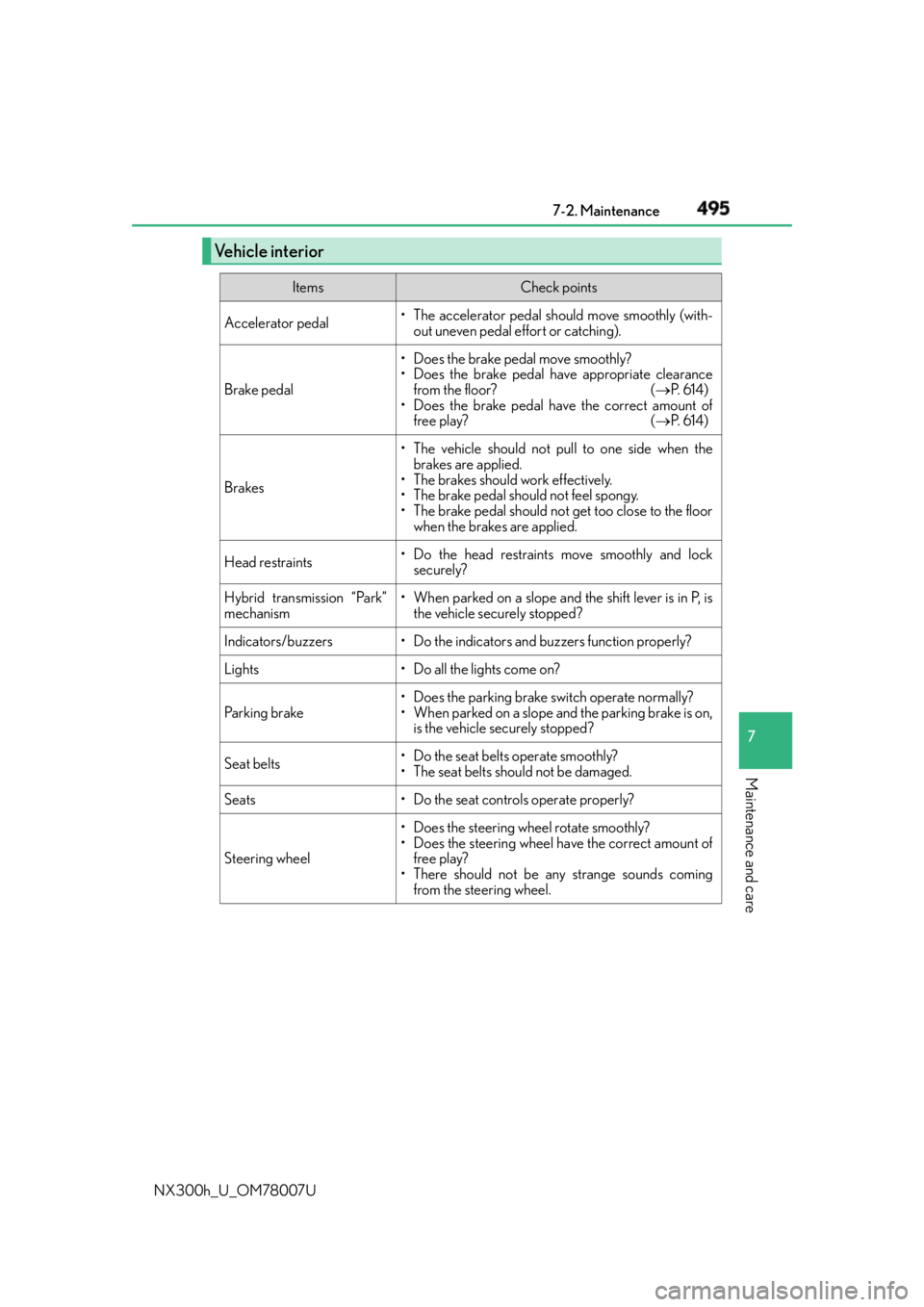
NX300h_U_OM78007U Vehicle interior Items Check points
Accelerator pedal • The accelerator pedal should move smoothly (with-
out uneven pedal effort or catching).
Brake pedal • Does the brake pedal move smoothly?
• Does the brake pedal have appropriate clearance
from the floor? ( P. 6 1 4 )
• Does the brake pedal have the correct amount of
free play? ( P. 6 1 4 )
Brakes • The vehicle should not pull to one side when the
brakes are applied.
• The brakes should work effectively.
• The brake pedal should not feel spongy.
• The brake pedal should not get too close to the floor
when the brakes are applied.
Head restraints • Do the head restraints move smoothly and lock
securely?
Hybrid transmission “Park”
mechanism • When parked on a slope and the shift lever is in P, is
the vehicle securely stopped?
Indicators/buzzers • Do the indicators and buzzers function properly?
Lights • Do all the lights come on?
Parking brake • Does the parking brake switch operate normally?
• When parked on a slope and the parking brake is on,
is the vehicle securely stopped?
Seat belts •Do the seat belt s operate smoothly?
• The seat belts should not be damaged.
Seats • Do the seat controls operate properly?
Steering wheel • Does the steering wheel rotate smoothly?
• Does the steering wheel have the correct amount of
free play?
• There should not be an y strange sounds coming
from the steering wheel.
Page 498 of 681
498 7-3. Do-it-yourself maintenance
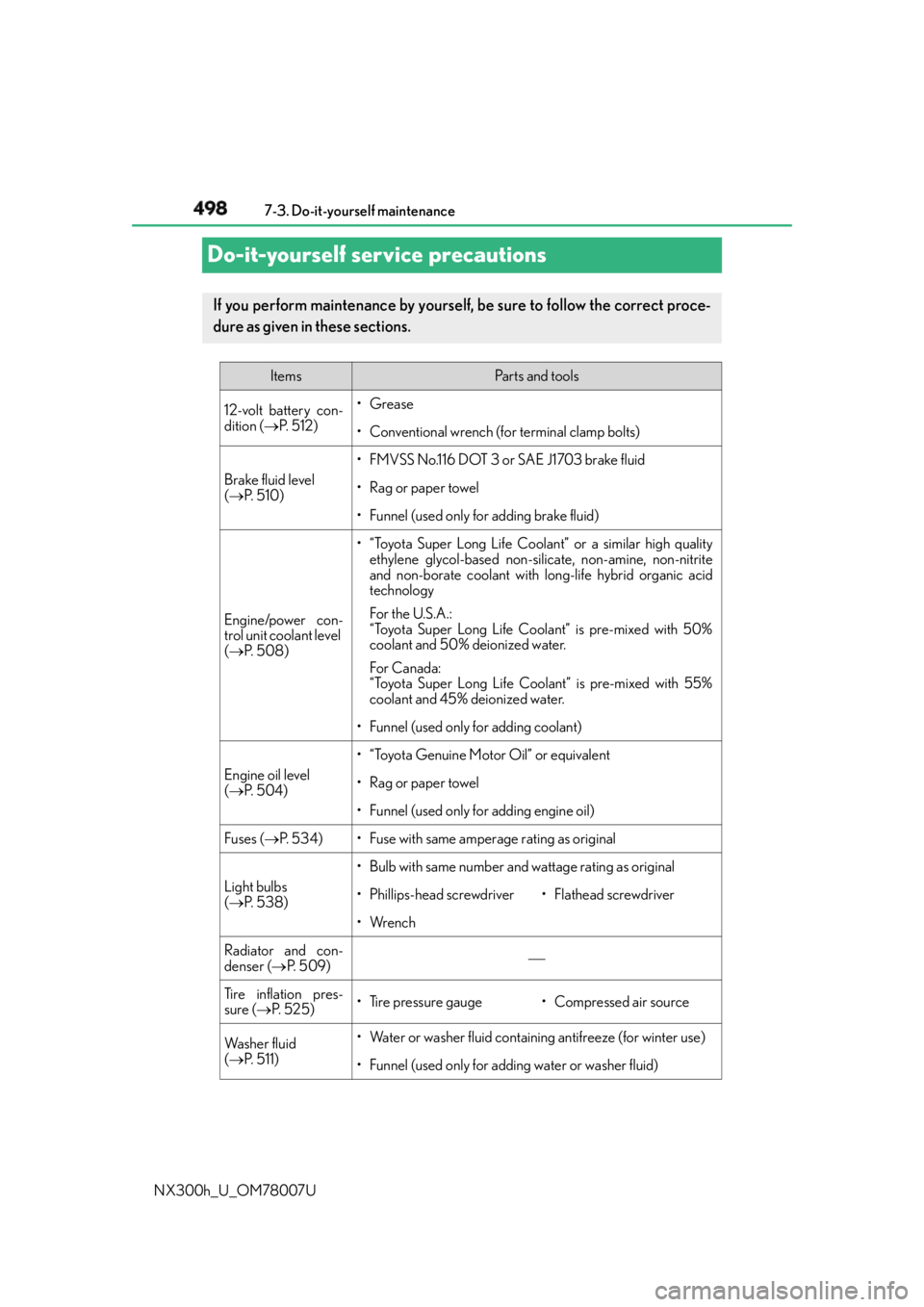
NX300h_U_OM78007UDo-it-yourself service precautions If you perform maintenance by yourself, be sure to follow the correct proce-
dure as given in these sections. Items Pa r t s a n d t o o l s
12-volt battery con-
dition ( P. 5 1 2 ) •Grease
• Conventional wrench (for terminal clamp bolts)
Brake fluid level
( P. 5 1 0 ) • FMVSS No.116 DOT 3 or SAE J1703 brake fluid
•Rag or paper towel
• Funnel (used only for adding brake fluid)
Engine/power con-
trol unit coolant level
( P. 5 0 8 ) • “Toyota Super Long Life Coolant” or a similar high quality
ethylene glycol-based non-silicate, non-amine, non-nitrite
and non-borate coolant with long-life hybrid organic acid
technology
For the U.S.A.:
“Toyota Super Long Life Coolant” is pre-mixed with 50%
coolant and 50% deionized water.
For Canada:
“Toyota Super Long Life Coolant” is pre-mixed with 55%
coolant and 45% deionized water.
• Funnel (used only for adding coolant)
Engine oil level
( P. 5 0 4 ) • “Toyota Genuine Motor Oil” or equivalent
•Rag or paper towel
• Funnel (used only for adding engine oil)
Fuses ( P. 5 3 4 ) • Fuse with same amperage rating as original
Light bulbs
( P. 5 3 8 ) • Bulb with same number and wattage rating as original
• Phillips-head screwdriver •Flathead screwdriver
•Wrench
Radiator and con-
denser ( P. 5 0 9 )
Tire inflation pres-
sure ( P. 5 2 5 ) •Tire pressure gauge • Compressed air source
Wa s h e r f l u i d
( P. 511) • Water or washer fluid containi ng antifreeze (for winter use)
• Funnel (used only for adding water or washer fluid)
Page 502 of 681
502 7-3. Do-it-yourself maintenance
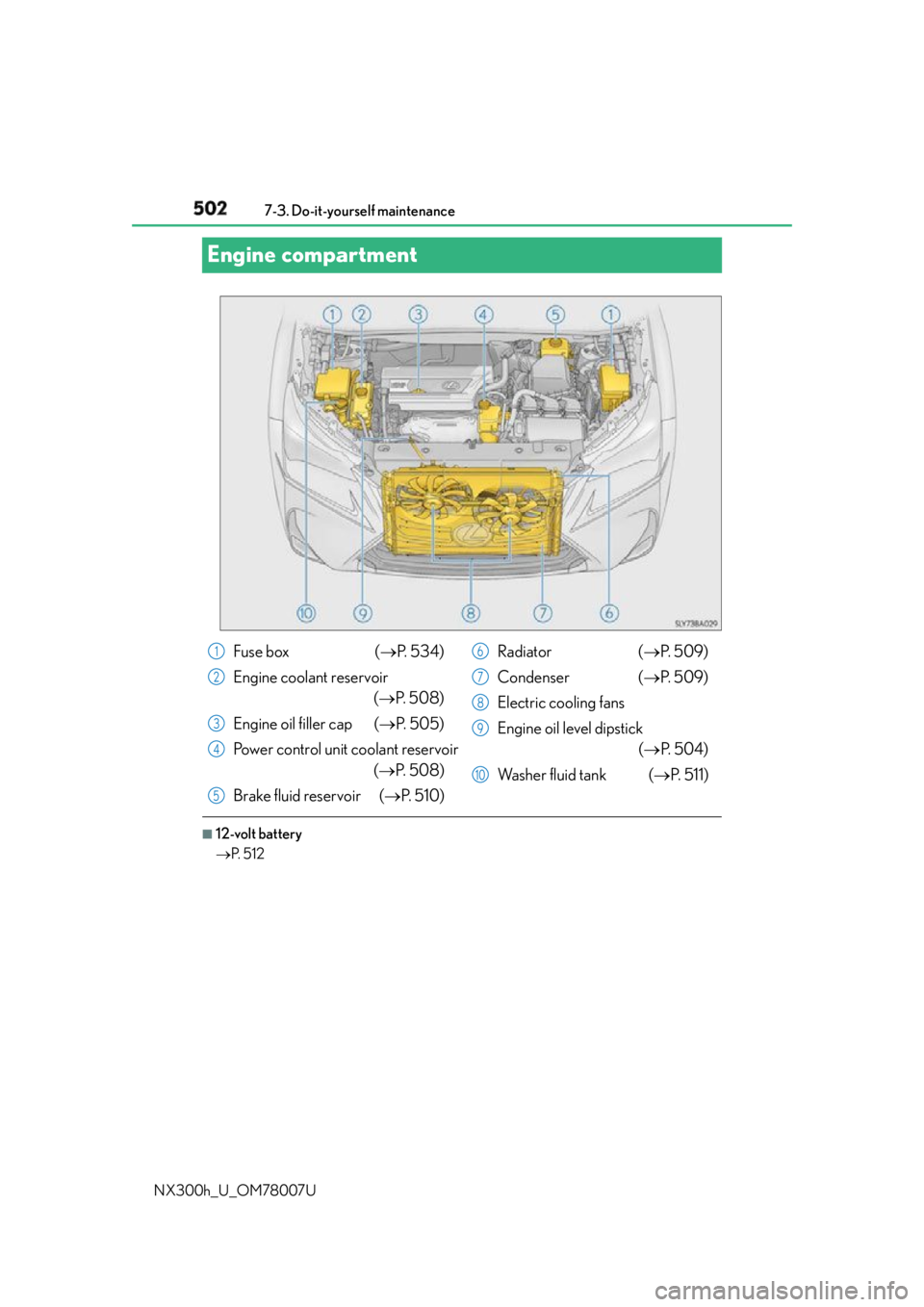
NX300h_U_OM78007UEngine compartment
■
12-volt battery
P. 5 1 2Fuse box ( P. 5 3 4 )
Engine coolant reservoir
( P. 5 0 8 )
Engine oil filler cap ( P. 505)
Power control unit coolant reservoir
( P. 5 0 8 )
Brake fluid reservoir ( P. 5 1 0 ) Radiator ( P. 5 0 9 )
Condenser ( P. 5 0 9 )
Electric cooling fans
Engine oil level dipstick
( P. 5 0 4 )
Wa s h e r f l u i d t a n k ( P. 5 1 1 )1
2
3
4
5 6
7
8
9
10
Page 510 of 681
510 7-3. Do-it-yourself maintenance
NX300h_U_OM78007U ■
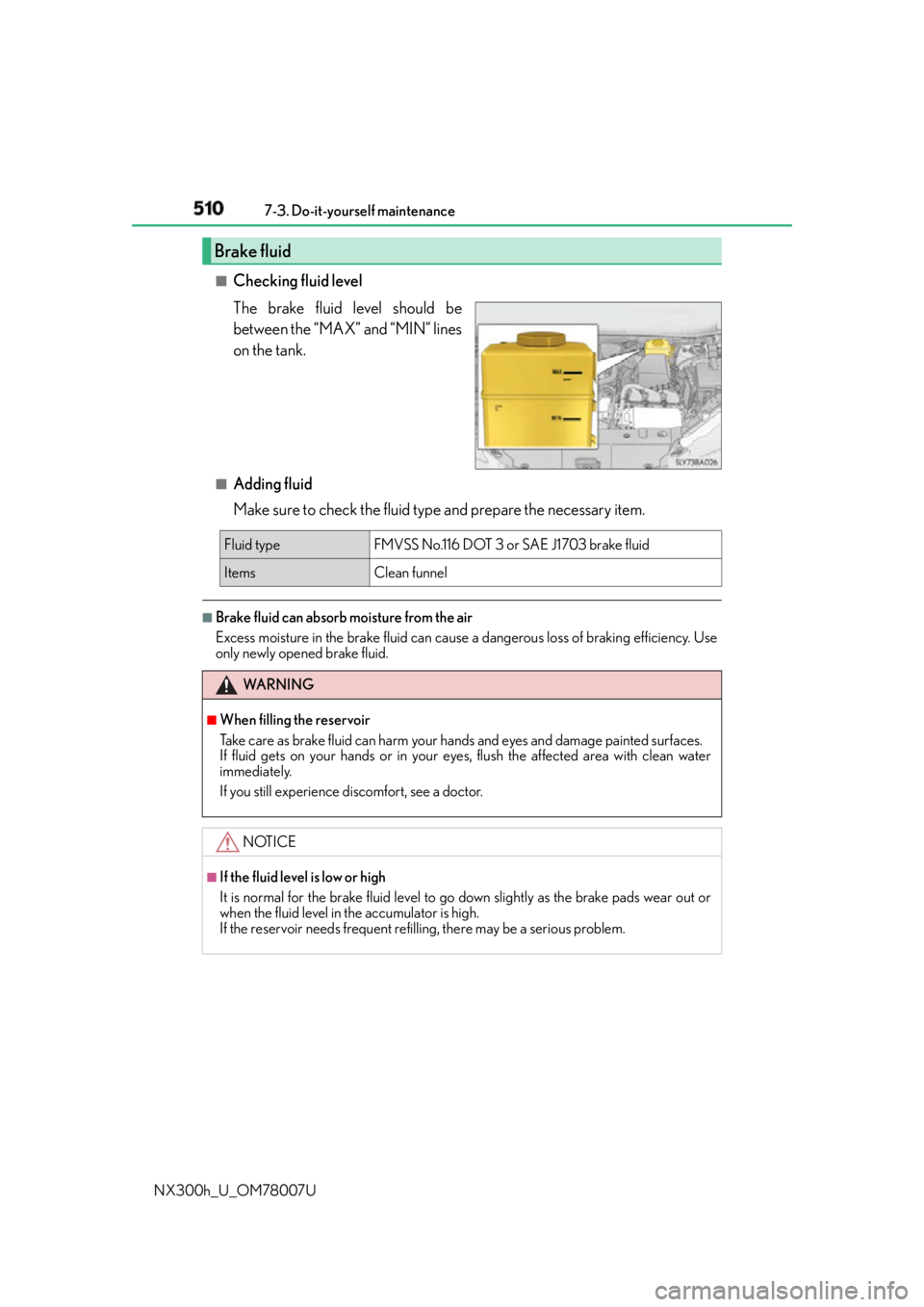
Checking fluid level
The brake fluid level should be
between the “MAX” and “MIN” lines
on the tank.
■
Adding fluid
Make sure to check the fluid type and prepare the necessary item. ■
Brake fluid can absorb moisture from the air
Excess moisture in the brake fluid can cause a dangerous loss of braking efficiency. Use
only newly opened brake fluid.Brake fluid
Fluid type FMVSS No.116 DOT 3 or SAE J1703 brake fluid
Items Clean funnel
WA R N I N G ■
When filling the reservoir
Take care as brake fluid can harm your hands and eyes and damage painted surfaces.
If fluid gets on your hands or in your eyes, flush the affected area with clean water
immediately.
If you still experience discomfort, see a doctor.
NOTICE ■
If the fluid level is low or high
It is normal for the brake fluid level to go down slightly as the brake pads wear out or
when the fluid level in the accumulator is high.
If the reservoir needs frequent refil ling, there may be a serious problem.