brake LEXUS RC200T 2017 Workshop Manual
[x] Cancel search | Manufacturer: LEXUS, Model Year: 2017, Model line: RC200T, Model: LEXUS RC200T 2017Pages: 724, PDF Size: 42.04 MB
Page 358 of 724
3584-5. Using the driving support systems
RC200t_RC F_EE(OM24728E)
■The pre-crash safety system is operational when
The pre-crash safety system is enable d and the following conditions are met:
●Pre-crash warning:
• Vehicle speed is greater than about 15 km/h (10 mph).
• The speed at which your vehicle is approaching the obstacle or the vehicle running ahead of you is greater than about 15 km/h (10 mph).
●Pre-crash brake assist:
• The VSC system is not disabled. • Vehicle speed is greater than about 30 km/h (19 mph).
• The speed at which your vehicle is approaching the obstacle or the vehicle running ahead of you is greater than about 30 km/h (19 mph).• The brake pedal is depressed.
●Pre-crash braking:
• The VSC system is not disabled.
• Vehicle speed is greater than about 15 km/h (10 mph). • The speed at which your vehicle is approaching the obstacle or the vehicle runningahead of you is greater than about 15 km/h (10 mph).
●Suspension control:
• Vehicle speed is greater than about 5 km/h (4 mph).
• The speed at which your vehicle is approaching the obstacle or the vehicle running ahead of you is greater than about 30 km/h (19 mph).
■Conditions that may trigger the system even if there is no danger of a collision
In any of the following situations where the frontal area of the radar sensor is interrupted, the radar sensor may detect possibility of a frontal collision and the system may be acti- vated.
●When passing by an oncoming vehicle in a curve or a turn to the right or the left
●When rapidly approaching an obstacle ahead (e.g. preceding vehicle, toll gate barrier, etc.)
●When there is a structural object (billboard, low ceiling, fluorescent light, etc.) above the uphill road ahead
●When driving on a narrow road or throug h under a low overhead structure (bridge,
tunnel, fly-under, etc.)
●When driving on an uneven road surface
●When there is a metal object, bump, or protrusion on the road surface
●When vehicle’s front part is raised or lowered depending on loading conditions
●When the direction of radar sensor is misaligned by strong impact applied on an area
around the radar sensor, etc.
●When there is an obstacle (guard rail, etc.) by the roadside at the entrance to a curve
●When the front of your vehicle is pointing upwards (caused by putting a heavy load in
the trunk etc.)
When the system is activated in the situations described above, there is also a possibility that the brakes may be applied with a force greater than normal.
Page 362 of 724
3624-5. Using the driving support systems
RC200t_RC F_EE(OM24728E)
WARNING
■Limitations of the pre-crash safety system
●The driver is solely responsible for safe driving. Always drive safely, taking care to observe your surroundings.
Do not use the pre-crash safety system in stead of normal braking operations under any circumstances. This system will not pr event collisions or lessen damage or inju- ries in all cases. Do not overly rely on this system. Failure to do so may cause an acci-
dent, resulting in death or serious injury.
●This system has been designed to help avoid and reduce the impact of collisions. However, the system operates differently depending on the situation ( P. 358,
358). As a result, the same level of perf ormance may not be expected in all cases. Also, the pre-crash safety brakes may not oper ate if the driver is depressing the brake pedal or turning the steering wheel, as th e system will determine such conditions as
collision avoidance operations.
●As the pre-crash safety system is designed to assist the driver in safe driving, it may operate under sporty driving conditions, which may cause an accident. For this rea-
son under sporty driving conditions, it is recommended that this system be disabled by using the PCS OFF switch.
■Handling the radar sensor
Observe the following to ensure the pre-crash safety system can function effectively. Otherwise, the system may not function correctly and could result in an accident.
●Keep the sensor and grille cover clean at all times.
Clean the sensor and grille cover with a soft cloth so you do not mark or damage them.
●Do not subject the sensor or surrounding area to a strong impact.
If the sensor moves even slightly off po sition, the system may become inaccurate or malfunction. If the sensor or surrounding area is subject to a strong impact, alwayshave the area inspected and adjusted by an y authorized Lexus dealer or repairer, or
another duly qualified an d equipped professional.
●Do not disassemble the sensor.
●Do not attach accessories or stickers to the sensor, grille cover or surrounding area.
●Do not modify or paint the sensor and grille cover.
●If the radar sensor needs to be replaced, contact any authorized Lexus dealer or repairer, or another duly qualified and equipped professional.
Page 363 of 724
3634-5. Using the driving support systems
4
Driving
RC200t_RC F_EE(OM24728E)
WARNING
■Cautions regarding the assist contents of the system
By means of alarms and brake control, the pr e-crash safety system is intended to assist the driver in avoiding collisions throug h the process of LOOK-JUDGE-ACT. There are
limits to the degree of assistance the system can provide, so please keep in mind the following important points.
●Assisting the driver in watching the road
The pre-crash safety system is only able to detect obstacles directly in front of the vehicle, and only within a limited range. It is not a mechanism that allows careless or inattentive driving, and it is not a system that can assist the driver in low-visibility con-
ditions. It is still necessary for the driver to pay close attention to the vehicle’s surroundings.
●Assisting the driver in making correct judgment
When attempting to estimate the possibility of a collision, the only data available to the pre-crash safety system is that from obstacles it has detected directly in front ofthe vehicle. Therefore, it is absolutely necessary for the driver to remain vigilant and
to determine whether or not there is a po ssibility of collision in any given situation.
●Assisting the driver in taking action The pre-crash brake assist function of the pre-crash safety system is designed to help
reduce the severity of a collision, and will only operate when the system determines that a collision is unavoidable. This system is not capable of automatically avoiding a collision or bringing the vehicle to a stop safely without appropriate operations per-
formed by the driver. For this reason, wh en encountering a dangerous situation the driver must take direct and immediate acti on in order to ensure the safety of all involved.
Page 385 of 724
3854-6. Driving tips
4
Driving
RC200t_RC F_EE(OM24728E)
Perform the following according to the driving conditions:
●Do not try to forcibly open a window or move a wiper that is frozen. Pour
warm water over the frozen area to melt the ice. Wipe away the water imme-
diately to prevent it from freezing.
●To ensure proper operation of the climate control system fan, remove any
snow that has accumulated on the air inlet vents in front of the windshield.
●Check for and remove any excess ice or snow that may have accumulated on
the exterior lights, vehicle’s roof, chassi s, around the tires or on the brakes.
●Remove any snow or mud from the bottom of your shoes before getting in the
vehicle.
Accelerate the vehicle slowly, keep a safe distance between you and the vehicle
ahead, and drive at a reduced speed suitable to road conditions.
●Park the vehicle and move the shift lever to P without setting the parking
brake. The parking brake may freeze up, preventing it from being released.If
the vehicle is parked without setting the parking brake, make sure to block the
wheels.
Failure to do so may be dangerous because it may cause the vehicle to move
unexpectedly, possibly leading to an accident.
●If the vehicle is parked without setting the parking brake, confirm that the shift
lever cannot be moved out of P*.
*: The shift lever will be locked if it is atte mpted to be shifted from P to any other position
without depressing the brake pedal. If the shift lever can be shifted from P, there may
be a problem with the shift lock system. Ha ve the vehicle inspected by any authorized
Lexus retailer or Lexus authorized re pairer, or any reliable repairer.
Before driving the vehicle
When driving the vehicle
When parking the vehicle
Page 507 of 724
5077-1. Maintenance and care
7
Maintenance and care
RC200t_RC F_EE(OM24728E)
■Automatic car washes (vehicles with CFRP parts)
Do not use automatic car washes as they may scratch the CFRP parts and damage the paint.
■High pressure car washes
●Do not allow the nozzles of the car wash to come within close proximity of the windows.
●Before using the car wash, check that the fuel filler door on your vehicle is closed prop-
erly.
■When using a car wash
If the door handle becomes wet while the electronic key is within the effective range, the
door may lock and unlock repeatedly. In that case, follow the following correction proce- dures to wash the vehicle:
●Place the key in a position 2 m (6 ft.) or more separate from the vehicle while the vehi-
cle is being washed. (Take care to ensure that the key is not stolen.)
●Set the electronic key to battery-saving mode to disable the smart entry & start system. ( P. 177)
■Aluminum wheels
●Remove any dirt immediately by using a neutral detergent. Do not use hard brushes or abrasive cleaners. Do not use strong or harsh chemical cleaners.
Use the same mild detergent and wax as used on the paint.
●Do not use detergent on the wheels when they are hot, for example after driving a long distance in hot weather.
●Wash detergent from the wheels immediately after use.
■When cleaning the painted brake calipers (if equipped)
●If a detergent is to be used to clean the painted brake calipers, use a neutral detergent.
Do not use hard brushes or abrasive cl eaners as they may damage the paint.
●Do not use detergent on the brake calipers when they are hot.
●Wash detergent from the brake calipers immediately after use.
■Bumpers
Do not scrub with abrasive cleaners.
■Side windows water-repellent coating
●The following precautions can extend the effectiveness of the water-repellent coating.
• Remove any dirt, etc. from the side windows regularly.
• Do not allow dirt and dust to accumulate on the windows for a long period. Clean the windows with a soft, damp cloth as soon as possible.• Do not use wax or glass cleaners that co ntain abrasives when cleaning the windows.
• Do not use any metallic objects to remove condensation build up.
●When the water-repellent performance has become insufficient, the coating can be
repaired. Contact any authorized Lexus dealer or repairer, or another duly qualified and equipped professional.
Page 510 of 724
5107-1. Maintenance and care
RC200t_RC F_EE(OM24728E)
NOTICE
■When using a high pressure car wash
●When washing the vehicle, do not spray the camera or its surrounding area directly with a high pressure washer. Shock applied from high pressure water may cause the
device to not operate normally.
●Do not bring the nozzle tip close to boots (rubber or resin manufactured cover), con- nectors or the following parts. The parts may be damaged if they come into contact
with high-pressure water.
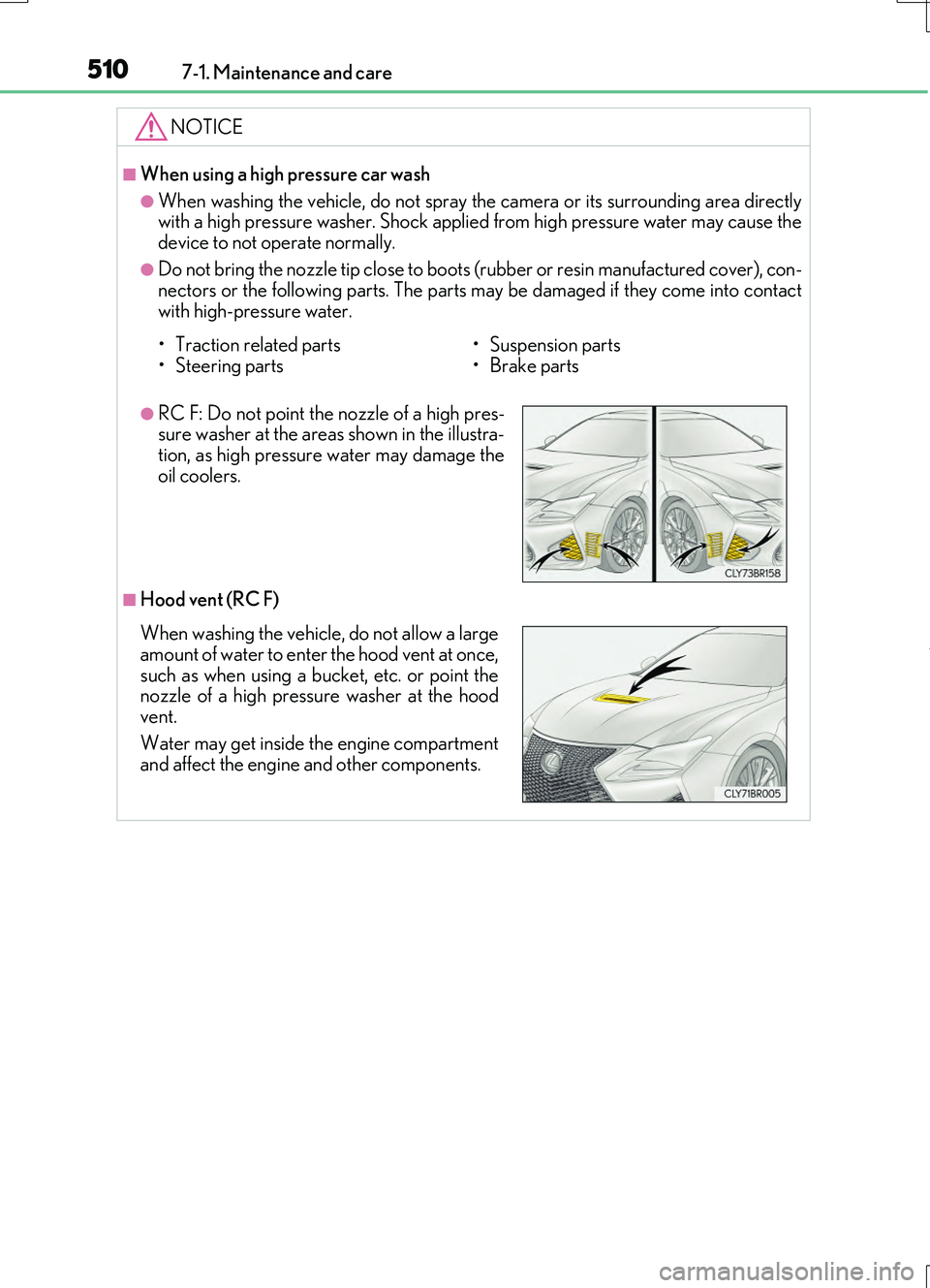
■Hood vent (RC F)
• Traction related parts
• Steering parts
•Suspension parts
• Brake parts
●RC F: Do not point the nozzle of a high pres- sure washer at the areas shown in the illustra-tion, as high pressure water may damage the
oil coolers.
When washing the vehicle, do not allow a large amount of water to enter the hood vent at once,
such as when using a bucket, etc. or point the nozzle of a high pressure washer at the hoodvent.
Water may get inside the engine compartment and affect the engine and other components.
Page 515 of 724
5157-2. Maintenance
7
Maintenance and care
RC200t_RC F_EE(OM24728E)
■Where to go for maintenance service?
In order to maintain your vehicle in the best possible condition, Lexus recommends that maintenance service operations as well as ot her inspections and repairs be carried out by authorized Lexus dealers or repairers or other duly qualified and equipped profes-
sionals. For repairs and services covered by your warranty, please visit an authorized Lexus dealer or repairer, who will use genuine Lexus parts in repairing any difficulties youmay encounter. There can also be advantages in utilizing authorized Lexus dealers or
repairers for non-warranty repa irs and services, as members of the Lexus network will be able to expertly assist you with any difficulties you may encounter.
Your Lexus dealer or repairer, or another duly qualified and equipped professional will
perform all of the scheduled maintenance on your vehicle reliably and economically due to their experience with Lexus vehicles.
■Does your vehicle need repairs?
Be on the alert for changes in performance and sounds, and visual tip-offs that indicate service is needed. Some important clues are:
●Engine missing, stumbling or pinging
●Appreciable loss of power
●Strange engine noises
●A fluid leak under the vehicle (However, water dripping from the air conditioning sys-
tem after use is normal.)
●Change in exhaust sound (This may indicate a dangerous carbon monoxide leak. Drive with the windows open and have the exhaust system checked immediately.)
●Flat-looking tires, excessive tire squeal when cornering, uneven tire wear
●Vehicle pulls to one side when driven straight on a level road
●Strange noises related to suspension movement
●Loss of brake effectiveness, spongy feeling brake pedal, pedal almost touches the floor,vehicle pulls to one side when braking
●Engine coolant temperature continually higher than normal ( P. 118, 124)
If you notice any of these clues, take your vehicle to any authorized Lexus dealer or repairer, or another duly qualified and equipp ed professional as soon as possible. Your vehicle may need adjustment or repair.
WARNING
■If your vehicle is not properly maintained
Improper maintenance could result in serious damage to the vehicle and possible death or serious injury.
■Handling of the battery
Battery posts, terminals and related accessories contain lead and lead compounds which are known to cause brain damage. Wash your hands after handling. ( P. 530)
Page 517 of 724
5177-3. Do-it-yourself maintenance
7
Maintenance and care
RC200t_RC F_EE(OM24728E)
WARNING
The engine compartment contains many mechanisms and fluids that may move suddenly, become hot, or become electrically energize d. To avoid death or serious injury, observe the following precautions.
■When working on the engine compartment
●Keep hands, clothing and tools away from the moving fan and engine drive belt.
●Be careful not to touch the engine, radiator, exhaust manifold, etc. right after driving
as they may be hot. Oil and other fluids may also be hot.
●Do not leave anything that may burn easily, such as paper and rags, in the engine compartment.
●Do not smoke, cause sparks or expose an open flame to fuel or the battery. Fuel andbattery fumes are flammable.
●Be extremely cautious when working on the battery. It contains poisonous and corro-
sive sulfuric acid.
●Take care because brake fluid can harm your hands or eyes and damage painted sur- faces. If fluid gets on your hands or in your eyes, flush the affected area with clean
water immediately. If you still experience discomfort, consult a doctor.
■When working near the electric cooling fans or radiator grille
Be sure the engine switch is off. With the engine switch in IGNITION ON mode, the electric cooling fans may auto-matically start to run if the air conditioning is on and/or the coolant temperature is high.
( P. 529)
■Safety glasses
Wear safety glasses to prevent flying or falling material, fluid spray, etc. from getting in
your eyes.
NOTICE
■If you remove the air cleaner filter
Driving with the air cleaner filter removed may cause excessive engine wear due to dirt in the air.
■If the fluid level is low or high
It is normal for the brake fluid level to go down slightly as the brake pads wear or when the fluid level in the accumulator is high.
If the reservoir needs frequent refillin g, it may indicate a serious problem.
Page 581 of 724
5818-1. Essential information
8
When trouble arises
RC200t_RC F_EE(OM24728E)
Steadily step on the brake pedal with both feet and firmly depress it.
Do not pump the brake pedal repeatedly as this will increase the effort required to slow the vehicle.
Shift the shift lever to N.
If the shift lever is shifted to N
After slowing down, stop the vehicle in a safe place by the road.
Stop the engine.
If the shift lever cannot be shifted to N
Keep depressing the brake pedal with both feet to reduce vehicle speed as
much as possible.
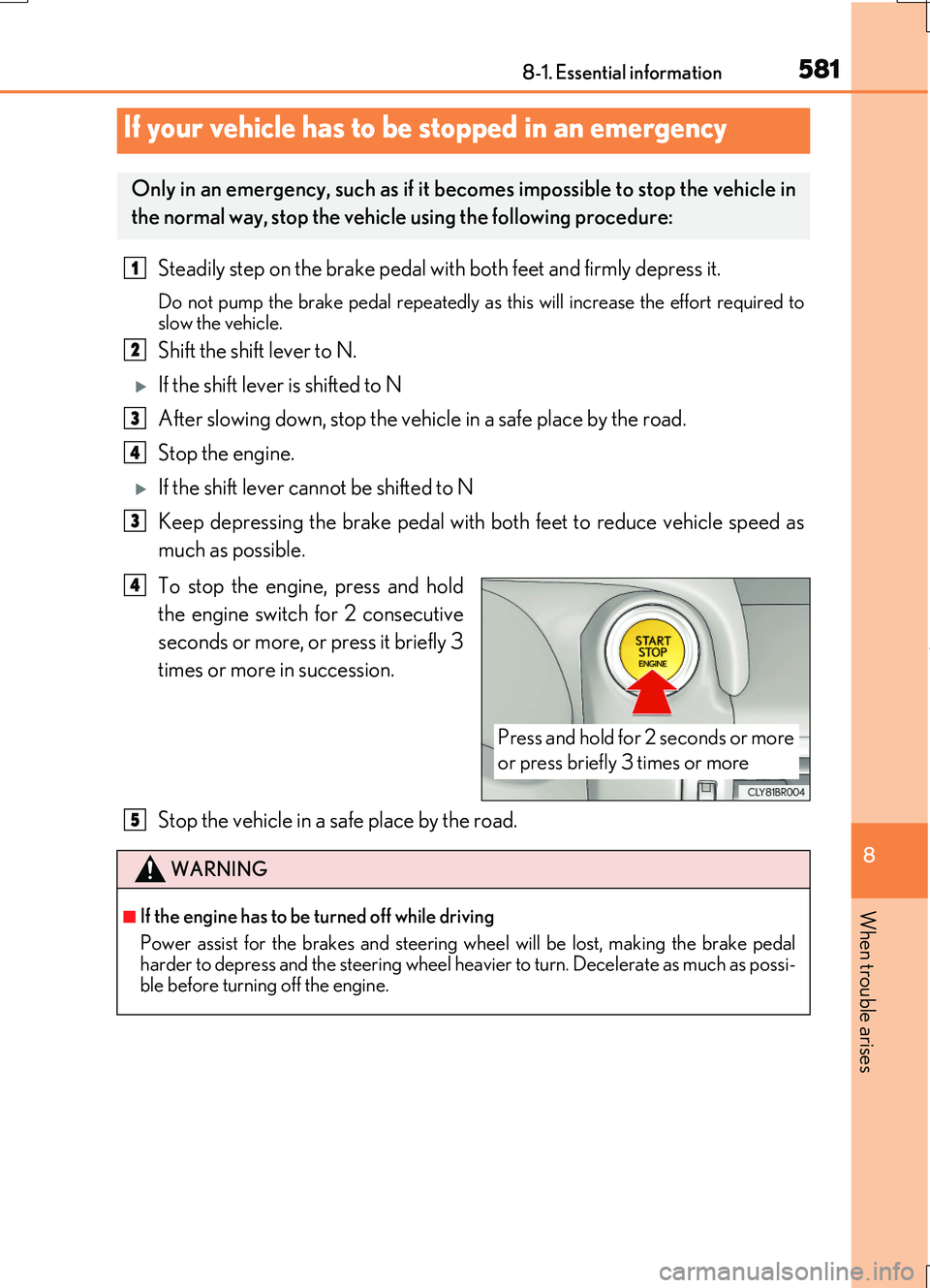
To stop the engine, press and hold
the engine switch for 2 consecutive
seconds or more, or press it briefly 3
times or more in succession.
Stop the vehicle in a safe place by the road.
If your vehicle has to be stopped in an emergency
Only in an emergency, such as if it becomes impossible to stop the vehicle in
the normal way, stop the vehicle using the following procedure:
1
2
3
4
3
Press and hold for 2 seconds or more
or press briefly 3 times or more
4
WARNING
■If the engine has to be turned off while driving
Power assist for the brakes and steering wheel will be lost, making the brake pedal harder to depress and the steering wheel heavier to turn. Decelerate as much as possi-
ble before turning off the engine.
5
Page 584 of 724
5848-2. Steps to take in an emergency
RC200t_RC F_EE(OM24728E)
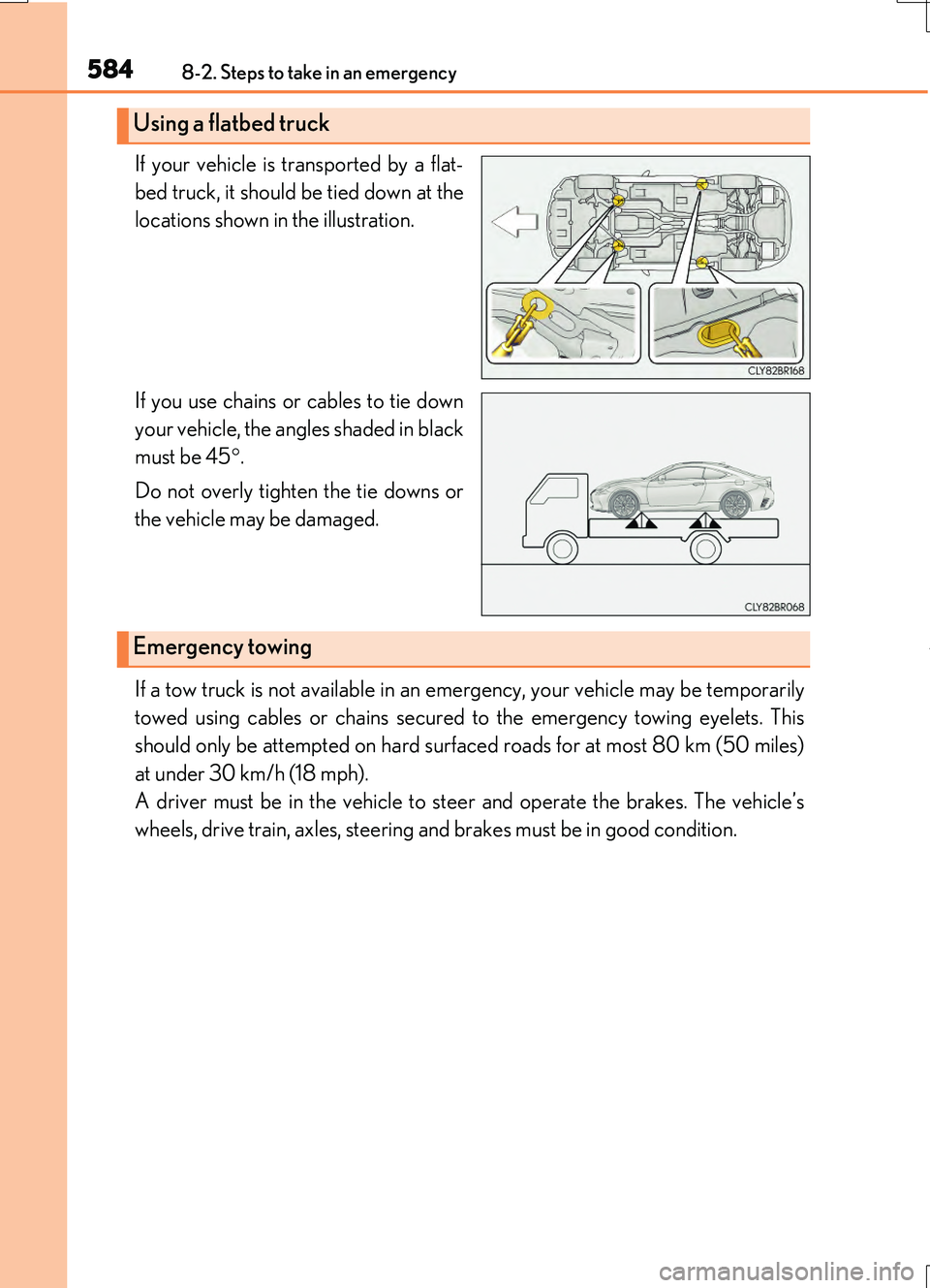
If your vehicle is transported by a flat-
bed truck, it should be tied down at the
locations shown in the illustration.
If you use chains or cables to tie down
your vehicle, the angles shaded in black
must be 45 .
Do not overly tighten the tie downs or
the vehicle may be damaged.
If a tow truck is not available in an emergency, your vehicle may be temporarily
towed using cables or chains secured to the emergency towing eyelets. This
should only be attempted on hard surfac ed roads for at most 80 km (50 miles)
at under 30 km/h (18 mph).
A driver must be in the vehicle to steer and operate the brakes. The vehicle’s
wheels, drive train, axles, steering and brakes must be in good condition.
Using a flatbed truck
Emergency towing