inflation pressure LEXUS RCF 2021 Owner's Manual
[x] Cancel search | Manufacturer: LEXUS, Model Year: 2021, Model line: RCF, Model: LEXUS RCF 2021Pages: 408, PDF Size: 8.25 MB
Page 309 of 408

3097-2. Steps to take in an emergency
7
When trouble arises
WARNING
●If the tire pressure warning light comes
on even after tire inflation pressure
adjustment, it is probable that you have
a flat tire. Check the tires. If a tire is flat,
change it with the spare tire and have
the flat tire repaired by the nearest
Lexus dealer.
●Avoid abrupt maneuvering and brak-
ing. If the vehicle tires deteriorate, you
could lose control of the steering
wheel or the brakes.
Vehicles with an emergency tire punc-
ture repair kit
●Stop your vehicle in a safe place as
soon as possible. Adjust the tire infla-
tion pressure immediately.
●If the tire pressure warning light comes
on even after tire inflation pressure
adjustment, it is probable that you have
a flat tire. Check the tires. If a tire is flat,
repair the flat tire by using emergency
tire puncture repair kit.
●Avoid abrupt maneuvering and brak-
ing. If the vehicle tires deteriorate, you
could lose control of the steering
wheel or the brakes.
■If a blowout or sudden air leakage
should occur
The tire pressure warning system may
not activate immediately.
■Maintenance of the tires
Each tire, including the spare (if pro-
vided), should be checked monthly when
cold and inflated to the inflation pressure
recommended by the vehicle manufac-
turer on the vehicle placard or tire infla-
tion pressure label (tire and load
information label). (I f your vehicle has
tires of a different size than the size indi-
cated on the vehicle placard or tire infla-
tion pressure label [tire and load
information label], yo u should determine
the proper tire infl ation pressure for
those tires.)
As an added safety fe ature, your vehicle
has been equipped with a tire pressure
monitoring system (TPMS-tire pressure
warning system) that illuminates a low
tire pressure telltale (tire pressure warn-
ing light) when one or more of your tires
is significantly under-inflated. Accord-
ingly, when the low ti re pressure telltale
(tire pressure warning light) illuminates,
you should stop and check your tires as
soon as possible, and inflate them to the
proper pressure. Driving on a signifi-
cantly under-inflated tire causes the tire
to overheat and can lead to tire failure.
Under-inflation also reduces fuel effi-
ciency and tire tread life, and may affect
the vehicle’s handling and stopping abil-
ity.
Please note that the TPMS (tire pressure
warning system) is not a substitute for
proper tire maintenance, and it is the
driver’s responsibility to maintain correct
tire pressure, even if under-inflation has
not reached the level to trigger illumina-
tion of the TPMS low tire pressure telltale
(tire pressure warning light).
Your vehicle has also been equipped with
a TPMS (tire pressure warning system)
malfunction indicator to indicate when
the system is not operating properly. The
TPMS (tire pressure warning system)
malfunction indicator is combined with
the low tire pressure telltale (tire pres-
sure warning light) . When the system
detects a malfunction, the telltale will
flash for approximately one minute and
then remain continuously illuminated.
This sequence will continue upon subse-
quent vehicle start-ups as long as the
malfunction exists. When the malfunction
indicator is illuminated, the system may
not be able to detect or signal low tire
pressure as intended.
Page 318 of 408
3187-2. Steps to take in an emergency
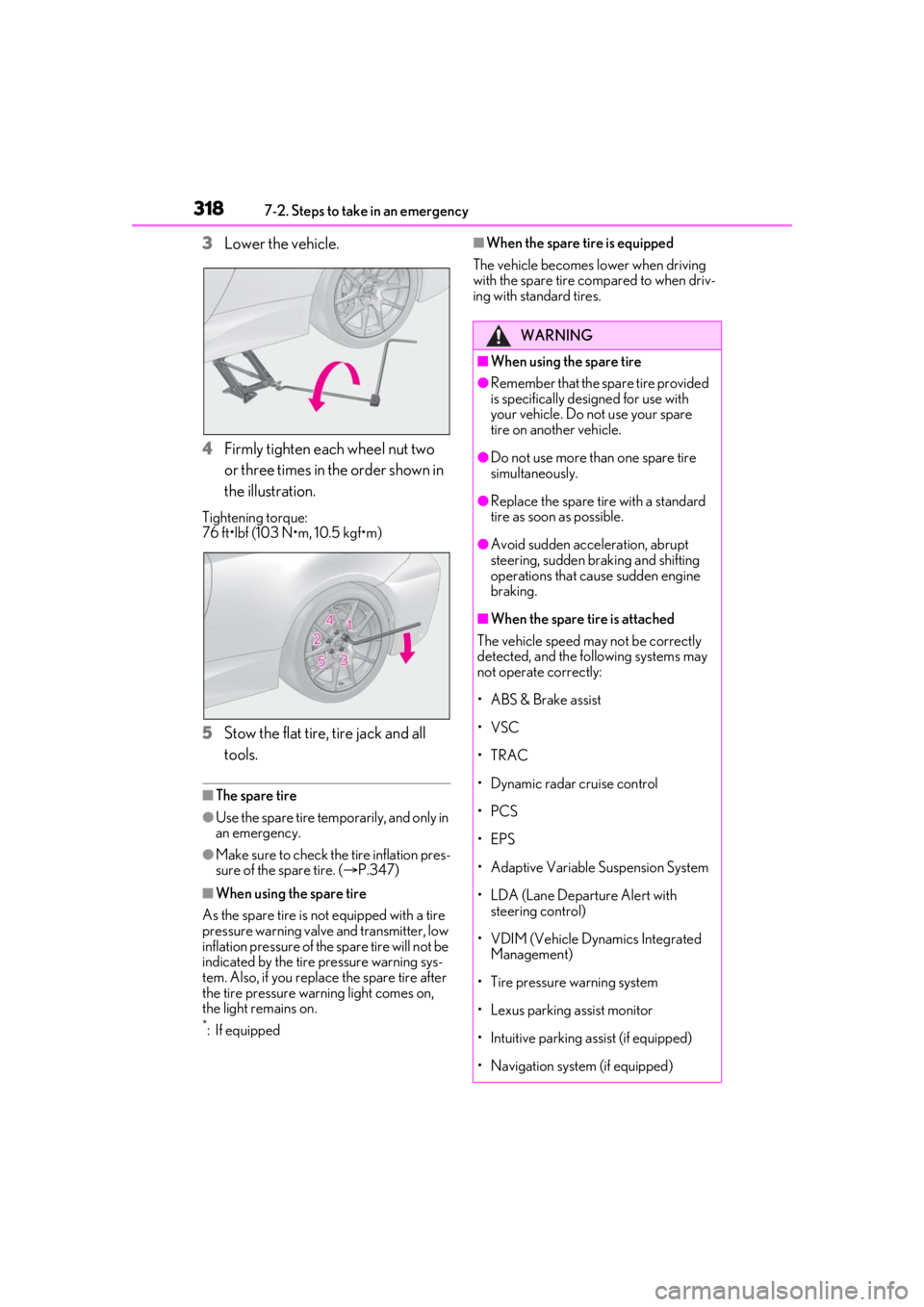
3Lower the vehicle.
4 Firmly tighten each wheel nut two
or three times in the order shown in
the illustration.
Tightening torque:
76 ft•lbf (103 N•m, 10.5 kgf•m)
5Stow the flat tire, tire jack and all
tools.
■The spare tire
●Use the spare tire temporarily, and only in
an emergency.
●Make sure to check the tire inflation pres-
sure of the spare tire. ( P.347)
■When using the spare tire
As the spare tire is not equipped with a tire
pressure warning valve and transmitter, low
inflation pressure of the spare tire will not be
indicated by the tire pressure warning sys-
tem. Also, if you replace the spare tire after
the tire pressure warning light comes on,
the light remains on.
*:If equipped
■When the spare tire is equipped
The vehicle becomes lower when driving
with the spare tire compared to when driv-
ing with standard tires.
WARNING
■When using the spare tire
●Remember that the sp are tire provided
is specifically designed for use with
your vehicle. Do not use your spare
tire on another vehicle.
●Do not use more than one spare tire
simultaneously.
●Replace the spare tire with a standard
tire as soon as possible.
●Avoid sudden acceleration, abrupt
steering, sudden br aking and shifting
operations that cause sudden engine
braking.
■When the spare tire is attached
The vehicle speed may not be correctly
detected, and the following systems may
not operate correctly:
• ABS & Brake assist
•VSC
•TRAC
• Dynamic radar cruise control
•PCS
•EPS
• Adaptive Variable Suspension System
• LDA (Lane Departure Alert with steering control)
• VDIM (Vehicle Dynamics Integrated Management)
• Tire pressure warning system
• Lexus parking assist monitor
• Intuitive parking assist (if equipped)
• Navigation system (if equipped)
Page 325 of 408
3257-2. Steps to take in an emergency
7
When trouble arises
injected.
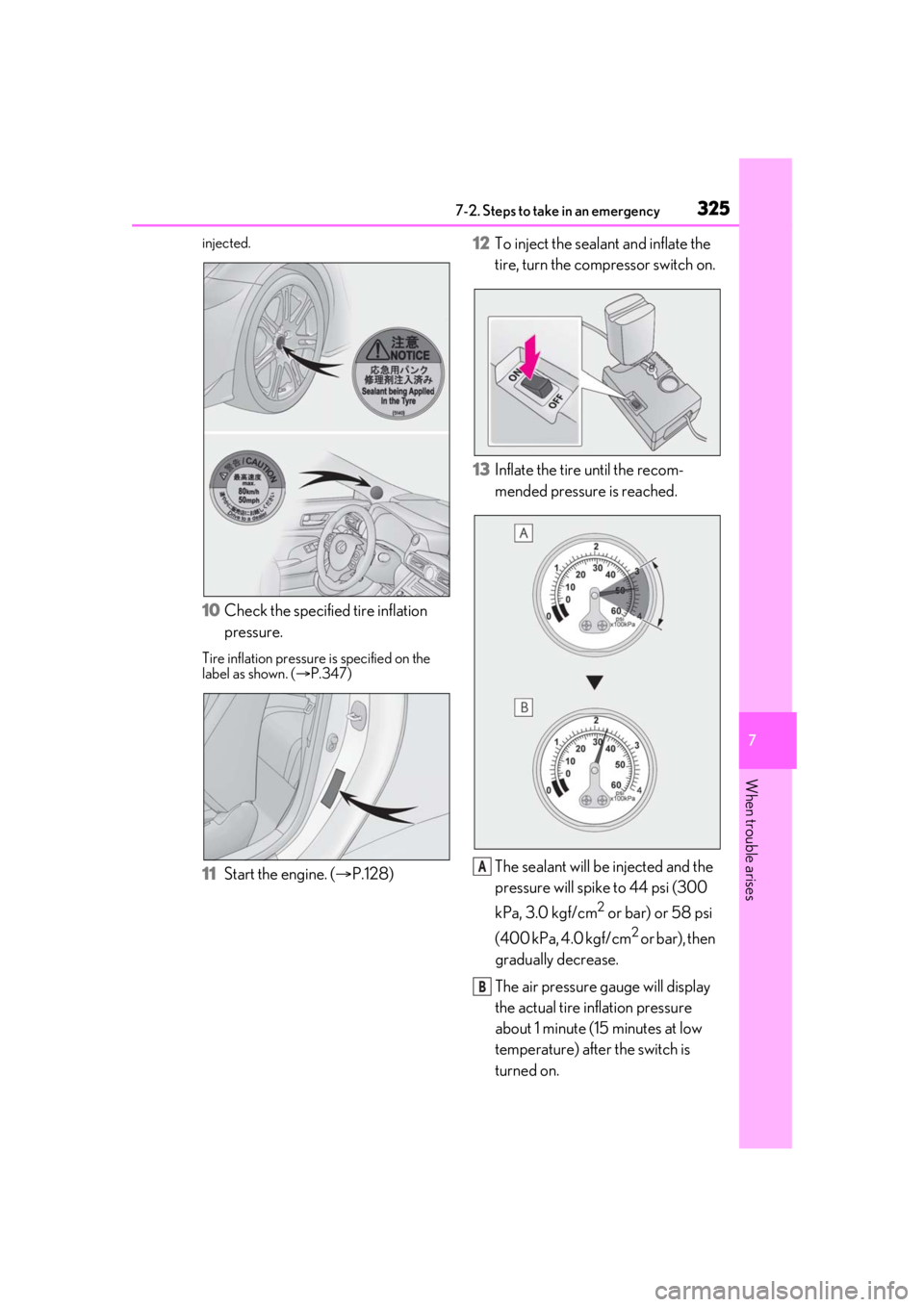
10Check the specified tire inflation
pressure.
Tire inflation pressure is specified on the
label as shown. ( P.347)
11 Start the engine. ( P.128) 12
To inject the sealant and inflate the
tire, turn the compressor switch on.
13 Inflate the tire until the recom-
mended pressure is reached.
The sealant will be injected and the
pressure will spike to 44 psi (300
kPa, 3.0 kgf/cm
2 or bar) or 58 psi
(400 kPa, 4.0 kgf/cm
2 or bar), then
gradually decrease.
The air pressure gauge will display
the actual tire inflation pressure
about 1 minute (15 minutes at low
temperature) after the switch is
turned on.
A
B
Page 326 of 408
3267-2. Steps to take in an emergency
Turn the compressor switch off and then
check the tire inflation pressure. Being
careful not to over inflate, check and
repeat the inflation pr ocedure until the rec-
ommended tire inflation pressure is
reached.
If the tire inflation pre ssure is still lower than
the recommended level after inflation for
10 minutes (35 minutes at low tempera-
ture) with the switch on, the tire is too dam-
aged to be repaired. Turn the compressor
switch off and contact your Lexus dealer.
If the tire inflation pressure exceeds the
recommended level, let out some air to
adjust the tire inflation pressure. ( P.327,
347)
14 With the compressor switch off, dis-
connect the hose from the valve on
the tire and then pull out the power
plug from the power outlet socket.
Some sealant may leak when the hose is
removed.
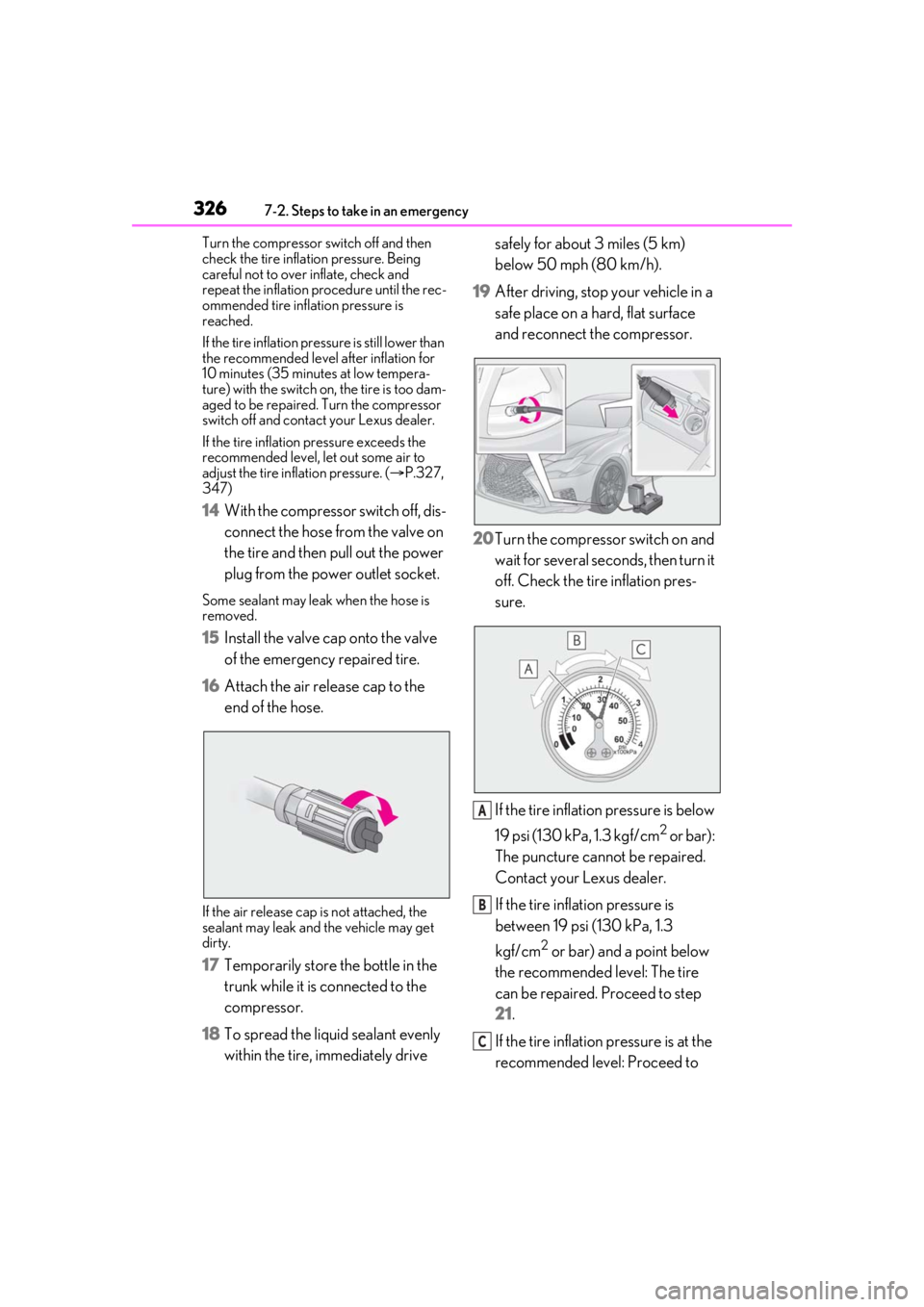
15Install the valve cap onto the valve
of the emergency repaired tire.
16 Attach the air release cap to the
end of the hose.
If the air release cap is not attached, the
sealant may leak and the vehicle may get
dirty.
17Temporarily store the bottle in the
trunk while it is connected to the
compressor.
18 To spread the liquid sealant evenly
within the tire, immediately drive safely for about 3 miles (5 km)
below 50 mph (80 km/h).
19 After driving, stop your vehicle in a
safe place on a hard, flat surface
and reconnect the compressor.
20 Turn the compressor switch on and
wait for several seconds, then turn it
off. Check the tire inflation pres-
sure.
If the tire inflatio n pressure is below
19 psi (130 kPa, 1.3 kgf/cm
2 or bar):
The puncture cannot be repaired.
Contact your Lexus dealer.
If the tire inflation pressure is
between 19 psi (130 kPa, 1.3
kgf/cm
2 or bar) and a point below
the recommended level: The tire
can be repaired. Proceed to step
21 .
If the tire inflation pressure is at the
recommended level: Proceed to
A
B
C
Page 327 of 408
3277-2. Steps to take in an emergency
7
When trouble arises
step 22.
21 Turn the compressor switch on to
inflate the tire until the recom-
mended tire inflation pressure is
reached. Drive for about 3 miles (5
km) and then perform step 19 .
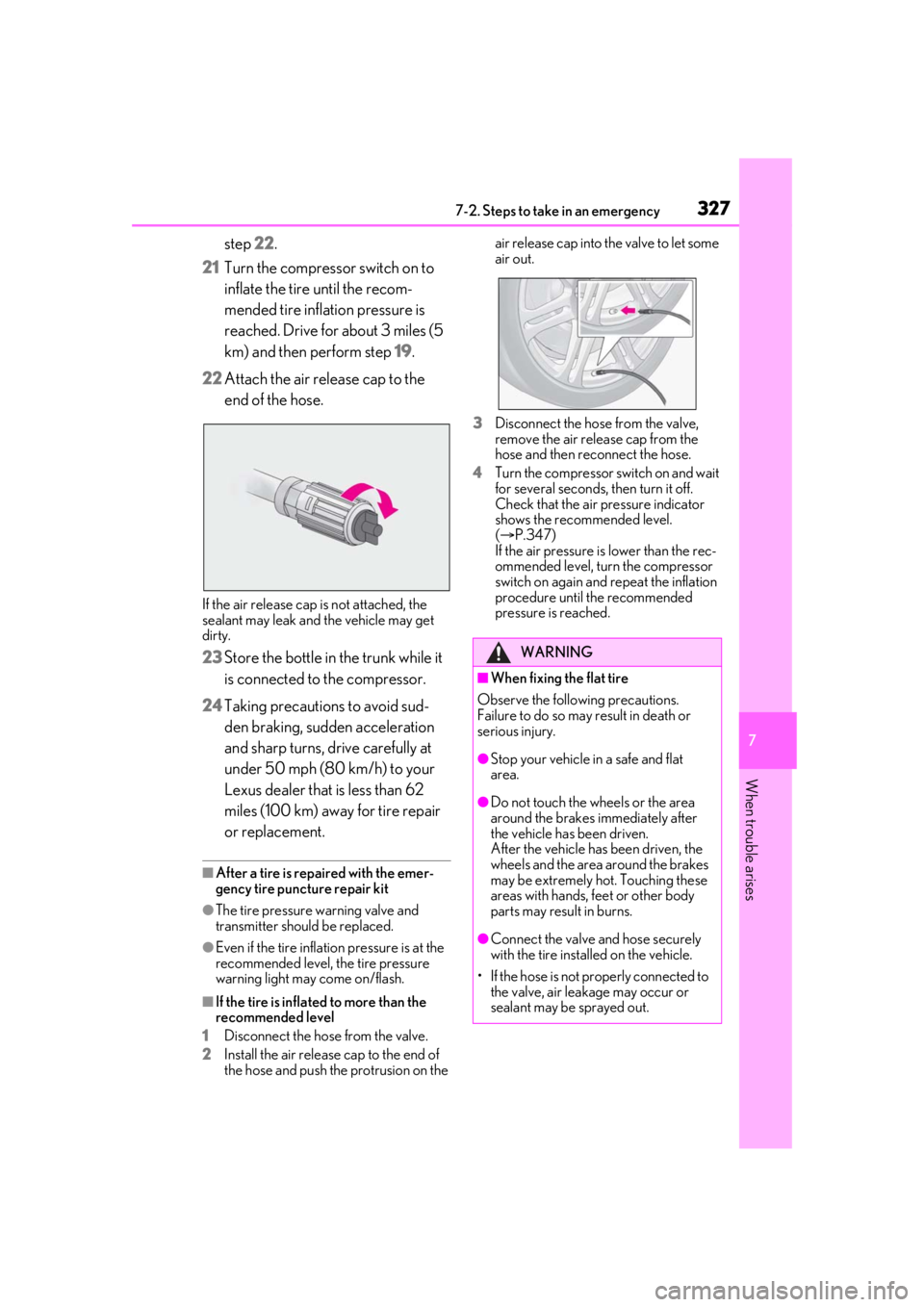
22 Attach the air release cap to the
end of the hose.
If the air release cap is not attached, the
sealant may leak and the vehicle may get
dirty.
23Store the bottle in the trunk while it
is connected to the compressor.
24 Taking precautions to avoid sud-
den braking, sudd en acceleration
and sharp turns, drive carefully at
under 50 mph (80 km/h) to your
Lexus dealer that is less than 62
miles (100 km) away for tire repair
or replacement.
■After a tire is repaired with the emer-
gency tire puncture repair kit
●The tire pressure warning valve and
transmitter should be replaced.
●Even if the tire inflat ion pressure is at the
recommended level, the tire pressure
warning light may come on/flash.
■If the tire is inflated to more than the
recommended level
1 Disconnect the hose from the valve.
2 Install the air release cap to the end of
the hose and push th e protrusion on the air release cap into the valve to let some
air out.
3 Disconnect the hose from the valve,
remove the air release cap from the
hose and then reconnect the hose.
4 Turn the compressor switch on and wait
for several seconds, then turn it off.
Check that the air pressure indicator
shows the recommended level.
( P.347)
If the air pressure is lower than the rec-
ommended level, turn the compressor
switch on again and repeat the inflation
procedure until the recommended
pressure is reached.
WARNING
■When fixing the flat tire
Observe the following precautions.
Failure to do so may result in death or
serious injury.
●Stop your vehicle in a safe and flat
area.
●Do not touch the wheels or the area
around the brakes immediately after
the vehicle has been driven.
After the vehicle has been driven, the
wheels and the area around the brakes
may be extremely hot. Touching these
areas with hands, feet or other body
parts may result in burns.
●Connect the valve and hose securely
with the tire installed on the vehicle.
• If the hose is not properly connected to the valve, air leakage may occur or
sealant may be sprayed out.
Page 328 of 408
3287-2. Steps to take in an emergency
WARNING
• If the hose comes off the valve while inflating the tire, there is a risk that the
hose will move abruptly due to air
pressure.
• After inflation of the tire has com- pleted, the sealant may splatter when
the hose is disconnected or some air is
let out of the tire.
●Follow the operation procedure to
repair the tire. If the procedure is not
followed, the sealant may spray out.
●Keep back from the tire while it is
being repaired, as th ere is a chance of
it bursting while the repair operation is
being performed. If you notice any
cracks or deformation of the tire, turn
off the compressor switch and stop the
repair operation immediately.
●The kit may overheat if operated for a
long period of time. Do not operate
the compressor continuously for more
than 35 minutes.
●Parts of the kit become hot during
operation. Be careful handling the kit
during and after operation. Do not
touch the metal part around the con-
necting area between the bottle and
compressor. It will be extremely hot.
●Do not attach the vehicle speed warn-
ing sticker to an area other than the
one indicated. If the sticker is attached
to an area where an SRS airbag is
located, such as the pad of the steering
wheel, it may prevent the SRS airbag
from operating properly.
■Driving to spread the liquid sealant
evenly
●Drive the vehicle carefully at a low
speed. Be especially careful when
turning and cornering.
●If the vehicle does not drive straight or
you feel a pull through the steering
wheel, stop the vehicle and check the
following:
• Tire condition. The tire may have sepa- rated from the wheel.
• Tire inflation pressure. If tire inflation pressure is 19 psi (130 kPa, 1.3 kgf/cm
2
or bar) or below, this may indicate
severe tire damage.
NOTICE
■When performing an emergency
repair
●Perform the emergency repair with-
out removing the nail or screw that has
punctured the tread of the tire. If the
object that has punctured the tire is
removed, repair by the emergency tire
puncture repair kit may not be possi-
ble.
●The kit is not waterproof. Make sure
that the kit is not exposed to water,
such as when it is being used in the
rain.
●Do not put the kit directly onto dusty
ground such as sand at the side of the
road. If the kit vacuums up dust etc., a
malfunction may occur.
●Make sure to stand the kit with the bot-
tle vertical. The kit cannot work prop-
erly if it is laid on its side.
■Handling the emergency tire punc-
ture repair kit
●The compressor power source should
be 12 V DC suitable for vehicle use.
Do not connect the compressor to any
other source.
●If gasoline splatters on the kit, the kit
may deteriorate. Take care not to allow
gasoline to contact it.
Page 347 of 408
3478-1. Specifications
8
Vehicle specifications
*1: Minimum pedal clearance when depressed with a force of 112.4 lbf (500 N, 51.0 kgf)
while the engine is running.
*2: Parking brake pedal travel when depressed wi th a force of 67.4 lbf (300 N, 30.6 kgf)
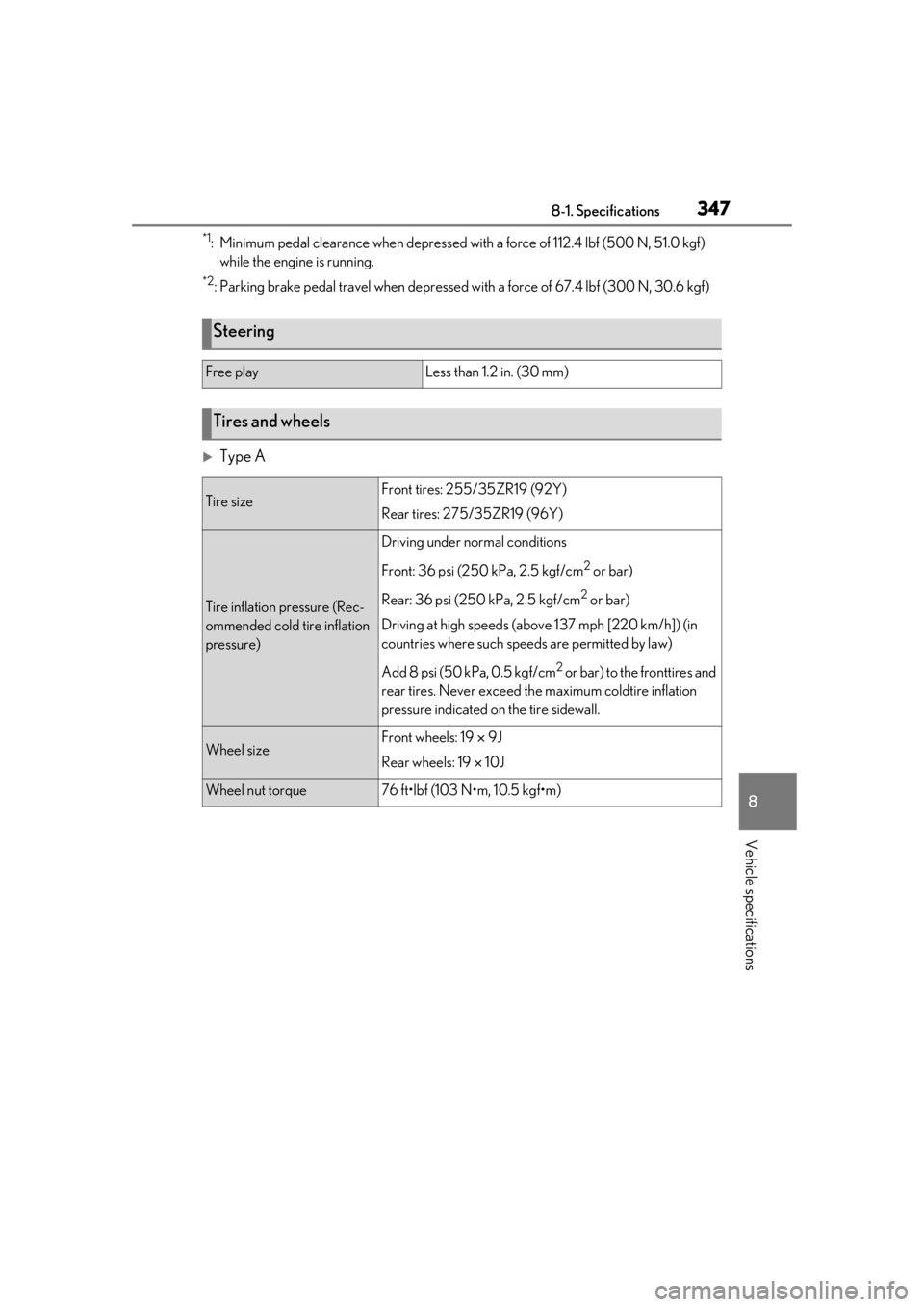
Type A
Steering
Free playLess than 1.2 in. (30 mm)
Tires and wheels
Tire sizeFront tires: 255/35ZR19 (92Y)
Rear tires: 275/35ZR19 (96Y)
Tire inflation pressure (Rec-
ommended cold tire inflation
pressure)
Driving under normal conditions
Front: 36 psi (250 kPa, 2.5 kgf/cm
2 or bar)
Rear: 36 psi (250 kPa, 2.5 kgf/cm
2 or bar)
Driving at high speeds (above 137 mph [220 km/h]) (in
countries where such speeds are permitted by law)
Add 8 psi (50 kPa, 0.5 kgf/cm
2 or bar) to the fronttires and
rear tires. Never exceed th e maximum coldtire inflation
pressure indicated on the tire sidewall.
Wheel sizeFront wheels: 19 9J
Rear wheels: 19 10J
Wheel nut torque76 ft•lbf (103 N•m, 10.5 kgf•m)
Page 348 of 408
3488-1. Specifications
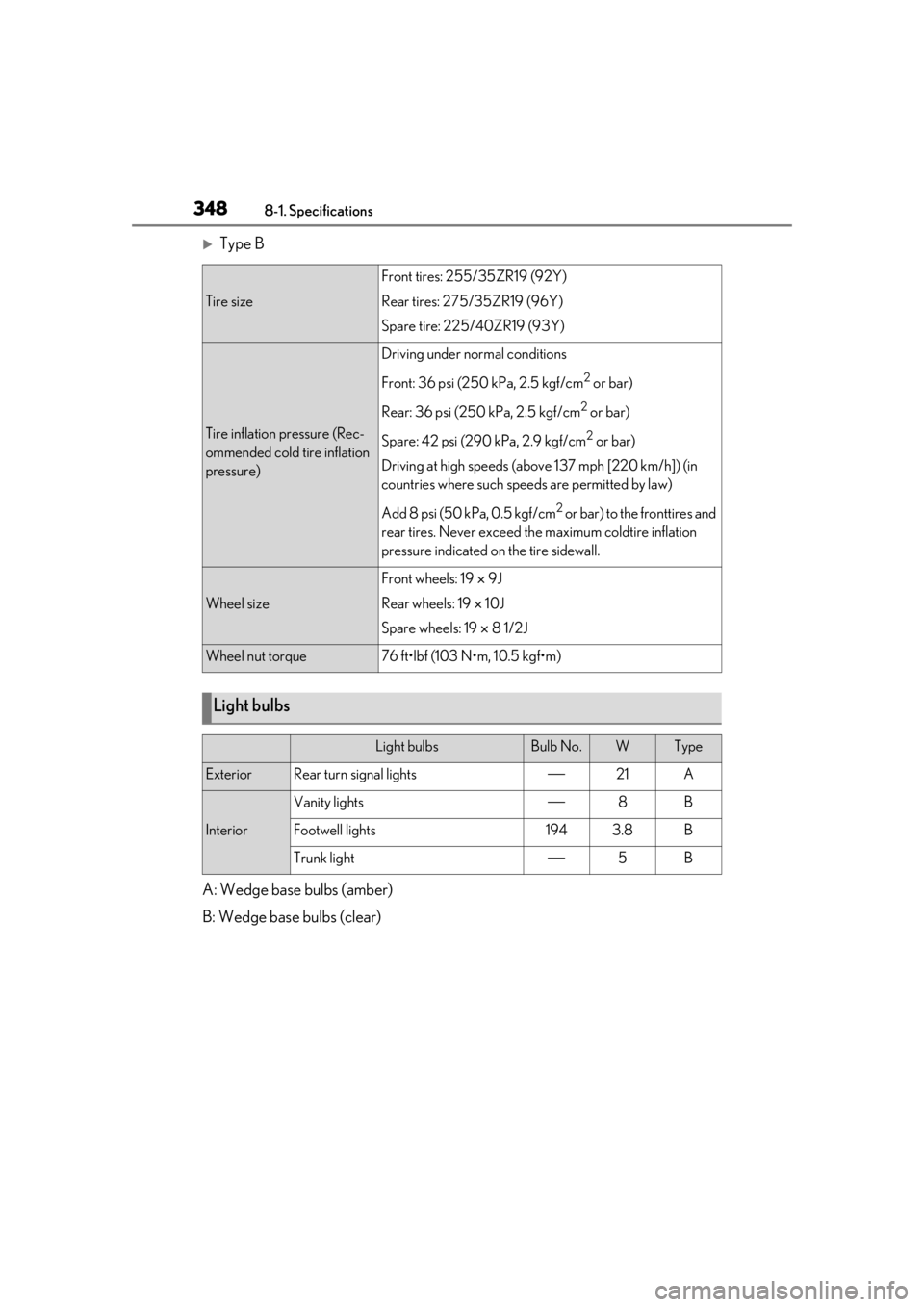
Type B
A: Wedge base bulbs (amber)
B: Wedge base bulbs (clear)
Tire size
Front tires: 255/35ZR19 (92Y)
Rear tires: 275/35ZR19 (96Y)
Spare tire: 225/40ZR19 (93Y)
Tire inflation pressure (Rec-
ommended cold tire inflation
pressure)
Driving under normal conditions
Front: 36 psi (250 kPa, 2.5 kgf/cm
2 or bar)
Rear: 36 psi (250 kPa, 2.5 kgf/cm
2 or bar)
Spare: 42 psi (290 kPa, 2.9 kgf/cm
2 or bar)
Driving at high speeds (above 137 mph [220 km/h]) (in
countries where such speeds are permitted by law)
Add 8 psi (50 kPa, 0.5 kgf/cm
2 or bar) to the fronttires and
rear tires. Never exceed th e maximum coldtire inflation
pressure indicated on the tire sidewall.
Wheel size
Front wheels: 19 9J
Rear wheels: 19 10J
Spare wheels: 19 8 1/2J
Wheel nut torque76 ft•lbf (103 N•m, 10.5 kgf•m)
Light bulbs
Light bulbsBulb No.WType
ExteriorRear turn signal lights21A
Interior
Vanity lights8B
Footwell lights1943.8B
Trunk light5B
Page 351 of 408
3518-1. Specifications
8
Vehicle specifications
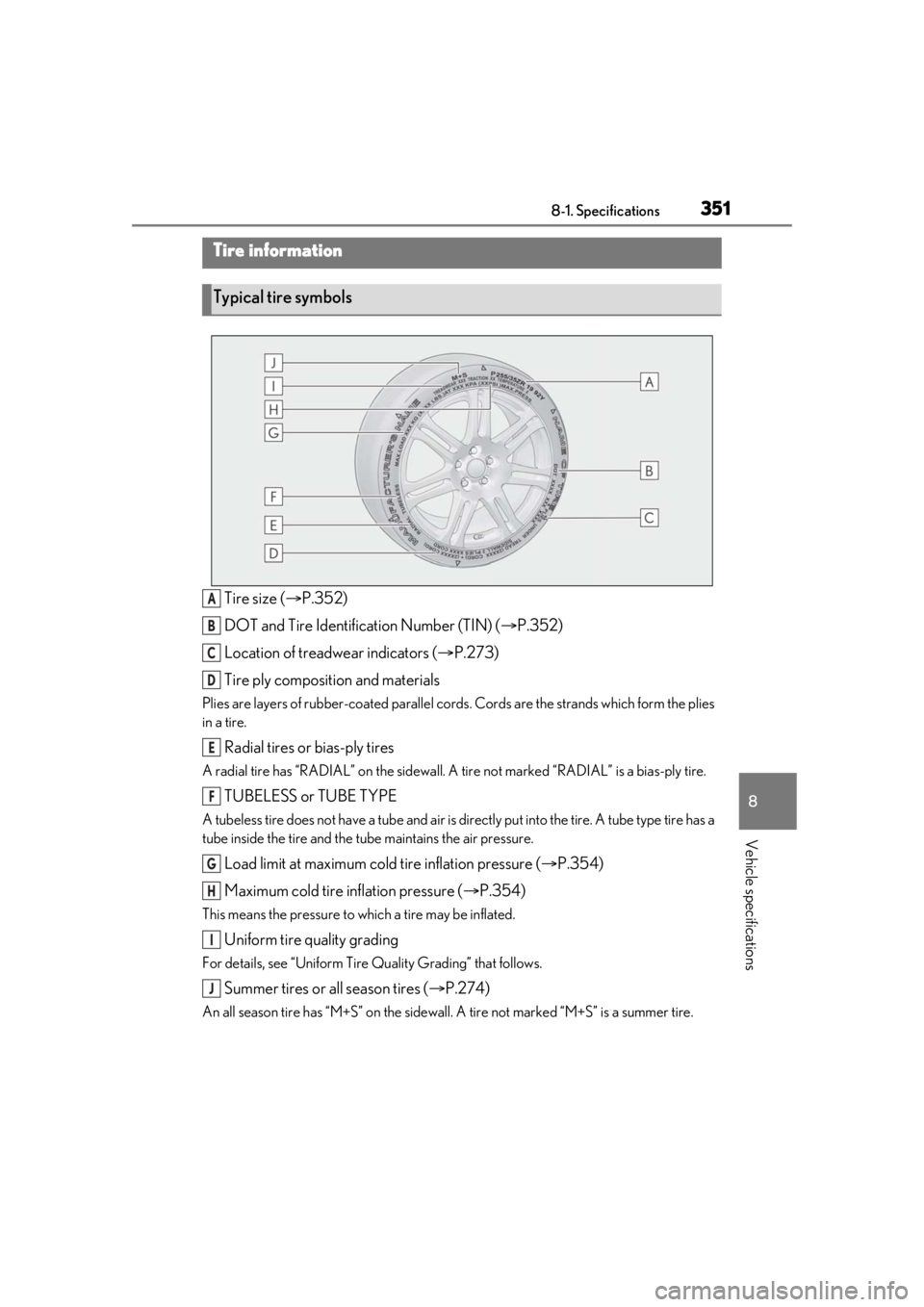
Tire size (P.352)
DOT and Tire Identification Number (TIN) ( P.352)
Location of treadwear indicators ( P.273)
Tire ply composition and materials
Plies are layers of rubber-coated parallel cords. Cords are the strands which form the plies
in a tire.
Radial tires or bias-ply tires
A radial tire has “RADIAL” on the sidewall. A tire not marked “RADIAL” is a bias-ply tire.
TUBELESS or TUBE TYPE
A tubeless tire does not have a tube and air is directly put into the tire. A tube type tire has a
tube inside the tire and the tube maintains the air pressure.
Load limit at maximum cold tire inflation pressure ( P.354)
Maximum cold tire inflation pressure ( P.354)
This means the pressure to which a tire may be inflated.
Uniform tire quality grading
For details, see “Uniform Tire Quality Grading” that follows.
Summer tires or all season tires ( P.274)
An all season tire has “M+S” on the sidewall. A tire not marked “M+S” is a summer tire.
Tire information
Typical tire symbols
A
B
C
D
E
F
G
H
I
J
Page 354 of 408
3548-1. Specifications
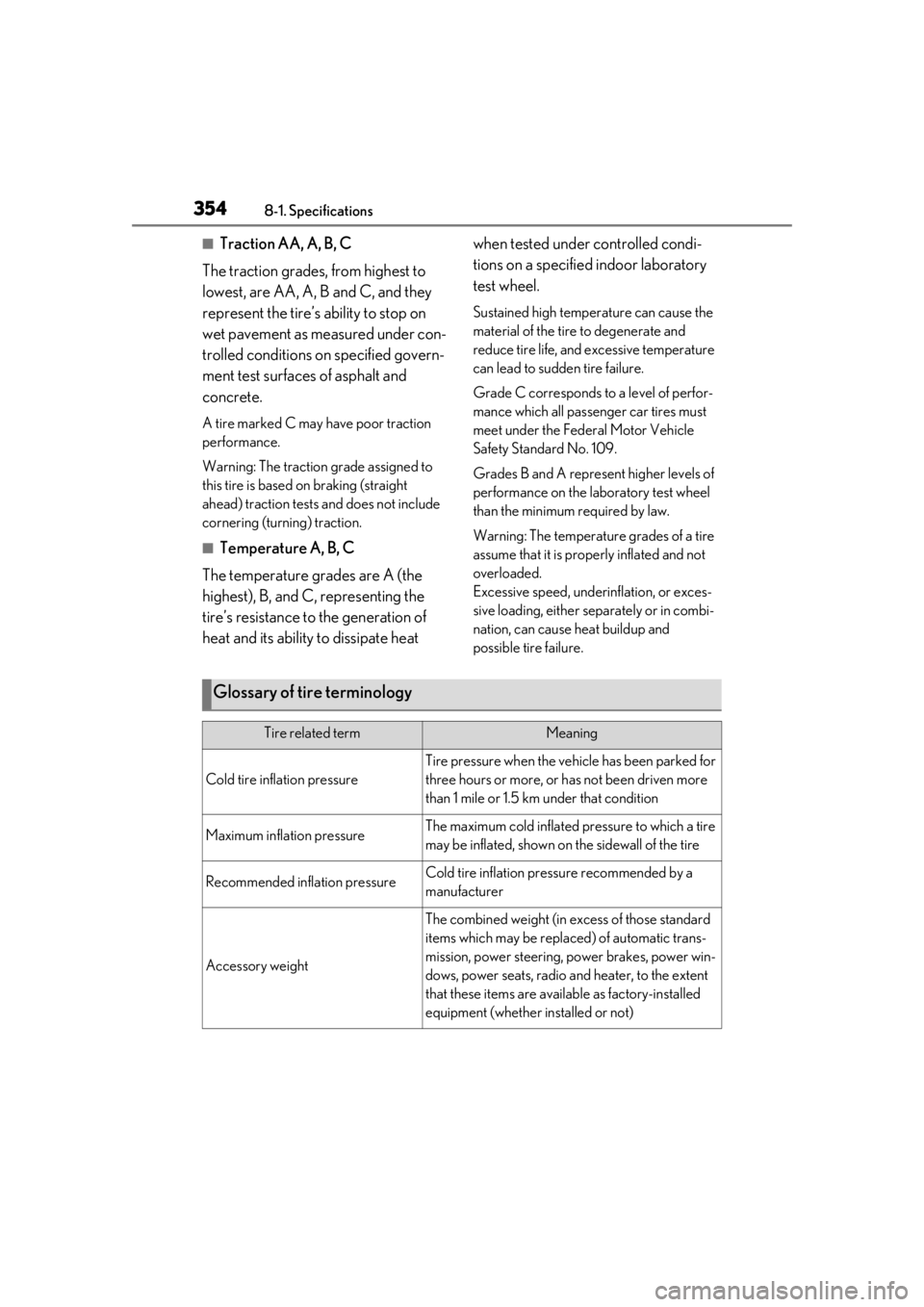
■Traction AA, A, B, C
The traction grades, from highest to
lowest, are AA, A, B and C, and they
represent the tire’s ability to stop on
wet pavement as measured under con-
trolled conditions on specified govern-
ment test surfaces of asphalt and
concrete.
A tire marked C may have poor traction
performance.
Warning: The traction grade assigned to
this tire is based on braking (straight
ahead) traction tests and does not include
cornering (turning) traction.
■Temperature A, B, C
The temperature grades are A (the
highest), B, and C, representing the
tire’s resistance to the generation of
heat and its ability to dissipate heat when tested under controlled condi-
tions on a specified indoor laboratory
test wheel.
Sustained high temperature can cause the
material of the tire to degenerate and
reduce tire life, and excessive temperature
can lead to sudd
en tire failure.
Grade C corresponds to a level of perfor-
mance which all passenger car tires must
meet under the Fede ral Motor Vehicle
Safety Standard No. 109.
Grades B and A represent higher levels of
performance on the laboratory test wheel
than the minimum required by law.
Warning: The temperature grades of a tire
assume that it is properly inflated and not
overloaded.
Excessive speed, unde rinflation, or exces-
sive loading, either separately or in combi-
nation, can cause heat buildup and
possible tire failure.
Glossary of tire terminology
Tire related termMeaning
Cold tire inflation pressure
Tire pressure when the vehicle has been parked for
three hours or more, or has not been driven more
than 1 mile or 1.5 km under that condition
Maximum inflation pressureThe maximum cold inflated pressure to which a tire
may be inflated, shown on the sidewall of the tire
Recommended inflation pressureCold tire inflation pressure recommended by a
manufacturer
Accessory weight
The combined weight (in excess of those standard
items which may be replaced) of automatic trans-
mission, power steering, power brakes, power win-
dows, power seats, radio and heater, to the extent
that these items are available as factory-installed
equipment (whether installed or not)