fog light LEXUS RX200T 2017 User Guide
[x] Cancel search | Manufacturer: LEXUS, Model Year: 2017, Model line: RX200T, Model: LEXUS RX200T 2017Pages: 776, PDF Size: 44.51 MB
Page 272 of 776
2724-3. Operating the lights and wipers
RX350/RX200t_EE_OM48F32E
■Conditions in which the light distribution control of the headlights changes automati-
cally
●When all of the following conditions are met, the high beams will be turned on automat- ically and the system will operate:
• The vehicle speed is approximately 60 km/h (38 mph) or more. • The area ahead of the vehicle is dark.
●When all of the following conditions are me t, the shaded high beams will turn on and the distance that the low beams are projecte d will be adjusted automatically, depending on the location of vehicles ahead:
• The vehicle speed is approximately 60 km/h (38 mph) or more. • The area ahead of the vehicle is dark.• There are vehicles ahead with headlights or tail lights turned on.
●If any of the following conditions is met, the high beams or shaded high beams will be changed to the low beams automatically:
• The vehicle speed is below approximately 60 km/h (38 mph). • The area ahead of the vehicle is not dark.• There are many vehicles ahead.
• Vehicles ahead are moving quickly and the high beams may blind the drivers of the other vehicles.
■Camera sensor detection information
●The high beams may not be automatically changed to the shaded high beams in the fol-lowing situations:
• When vehicles ahead suddenly appear from a curve
• When the vehicle is cut in front of by another vehicle • When vehicles ahead are hidden from sight du e to repeated curves, road dividers or roadside trees
• When vehicles ahead appear from the faraway lane on wide road • When vehicles ahead have no lights
●The high beams may be changed to the shad ed high beams if a vehicle ahead that is using fog lights without its head lights turned on is detected.
●House lights, street lights, traffic signals, and illuminated billboards or signs and other
reflective objects may cause the high beam s to change to the shaded high beams, cause the high beams not to change to the sh aded high beams, or change the area that is not illuminated.
●The following factors may affect the amount of time taken to turn the high beam on or off, or the speed by which the areas not illuminated change:
• The brightness of headlights, fog lig hts, and tail lights of vehicles ahead
• The movement and direction of vehicles ahead • When a vehicle ahead only has operational lights on one side
• When a vehicle ahead is a two-wheeled vehicle • The condition of the road (gradient, curve, condition of the road surface etc.)• The number of passengers and amount of luggage
●The light distribution control of the headlights may change unexpectedly.
Page 273 of 776
2734-3. Operating the lights and wipers
4
Driving
RX350/RX200t_EE_OM48F32E
●Bicycles or similar objects may not be detected.
●In the following situations the system may not be able to correctly detect the surround- ing brightness level. This may cause the low beams to remain on or the high beams to
flash or dazzle pedestrians or vehicles ahead. In such a case, it is necessary to manually switch between the high and low beams.
• When driving in inclement weather (heavy rain, snow, fog, sandstorms, etc.)
• When the windshield is obscured by fog, mist, ice, dirt, etc. • When the windshield is cracked or damaged• When the camera sensor is deformed or dirty
• When the temperature of the camera sensor is extremely high • When the surrounding brightness level is equa l to that of headlights, tail lights or fog lights
• When headlights or tail lights of vehicles ah ead are turned off, dirty, changing color, or not aimed properly• When the vehicle is hit by water, snow, dust, etc. from a preceding vehicle
• When driving through an area of interm ittently changing brightness and darkness • When frequently and repeatedly driving ascending/descending roads, or roads withrough, bumpy or uneven surfaces (such as stone-paved roads, gravel roads, etc.)
• When frequently and repeatedly taking curves or driving on a winding road • When there is a highly reflective object ahead of the vehicle, such as a sign or mirror• When the back of a preceding vehicle is highly reflective, such as a container on a
truck • When the vehicle’s headlights are damaged or dirty, or are not aimed properly• When the vehicle is listing or tilting due to a flat tire, a trailer being towed, etc.
• When the headlights are changed between the high beams and low beams repeat- edly in an abnormal manner• When the driver believes that the high beams may be flashing or dazzling pedestri-
ans or other drivers • When the vehicle is used in an area in which vehicles travel on the opposite side of
the road of the country for which the vehicle was designed, for example using a vehi- cle designed for right-hand traffic in a left-hand traffic area, or vice versa
■Customization
Some functions can be customized. ( P. 740)
Page 276 of 776
2764-3. Operating the lights and wipers
RX350/RX200t_EE_OM48F32E
■Conditions to turn the high beams on/off automatically
●When all of the following conditions are met, the high beams will be turned on automat- ically (after approximately 1 second):
• The vehicle speed is approximately 40 km/h (25 mph) or more.
• The area ahead of the vehicle is dark. • There are no vehicles ahead with headlights or tail lights turned on.• There are few streetlights on the road ahead.
●If any of the following conditions is met, the high beams will turn off automatically:
• The vehicle speed is below approximately 30 km/h (19 mph).
• The area ahead of the vehicle is not dark. • Vehicles ahead have their headli ghts or tail lights turned on. • There are many streetlights on the road ahead.
■Camera sensor detection information
●The high beams may not be automatically turned off in the following situations:
• When a vehicle suddenly appears from around a curve
• When the vehicle is cut in front of by another vehicle • When vehicles ahead cannot be detected due to repeated curves, road dividers orroadside trees
• When vehicles ahead appear in a faraway lane on a wide road • When the lights of vehicles ahead are not on
●The high beams may be turned off if a vehicl e ahead that is using fog lights without its headlights turned on is detected.
●House lights, street lights, traffic signals, and illuminated billboards or signs and other
reflective objects may cause the high beams to change to the low beams, or the low beams to remain on.
●The following factors may affect the amount of time taken for the high beams to turn on
or off:
• The brightness of the headlights, fog lights, and tail lights of vehicles ahead • The movement and direction of vehicles ahead
• When a vehicle ahead only has operational lights on one side • When a vehicle ahead is a two-wheeled vehicle• The condition of the road (gradient, curve, condition of the road surface, etc.)
• The number of passengers and amount of luggage in the vehicle
●The high beams may turn on or off unexpectedly.
●Bicycles or similar vehicles may not be detected.
Page 277 of 776
2774-3. Operating the lights and wipers
4
Driving
RX350/RX200t_EE_OM48F32E
●In the following situations the system may not be able to correctly detect the surround- ing brightness level. This may cause the low beams to remain on or the high beams to flash or dazzle pedestrians or vehicles ahead. In such a case, it is necessary to manually
switch between the high and low beams.
• When driving in inclement weather (heavy rain, snow, fog, sandstorms, etc.) • When the windshield is obscured by fog, mist, ice, dirt, etc.
• When the windshield is cracked or damaged • When the camera sensor is deformed or dirty• When the temperature of the camera sensor is extremely high
• When the surrounding brightness level is equa l to that of headlights, tail lights or fog lights• When headlights or tail lights of vehicles ah ead are turned off, dirty, changing color,
or not aimed properly • When the vehicle is hit by water, snow, dust, etc. from a preceding vehicle• When driving through an area of interm ittently changing brightness and darkness
• When frequently and repeatedly driving ascending/descending roads, or roads with rough, bumpy or uneven surfaces (such as stone-paved roads, gravel roads, etc.)• When frequently and repeatedly taking curves or driving on a winding road
• When there is a highly reflective object ahead of the vehicle, such as a sign or mirror • When the back of a preceding vehicle is highly reflective, such as a container on atruck
• When the vehicle's headlights are damaged or dirty, or are not aimed properly • When the vehicle is listing or titling due to a flat tire, a trailer being towed, etc. • When the headlights are changed between the high beams and low beams repeat-
edly in an abnormal manner • When the driver believes that the high beams may be flashing or dazzling pedestri-ans or other drivers
• When the vehicle is used in an area in which vehicles travel on the opposite side of the road of the country for which the vehicle was designed, for example using a vehi-
cle designed for right-hand traffic in a left-hand traffic area, or vice versa
Page 278 of 776
2784-3. Operating the lights and wipers
RX350/RX200t_EE_OM48F32E
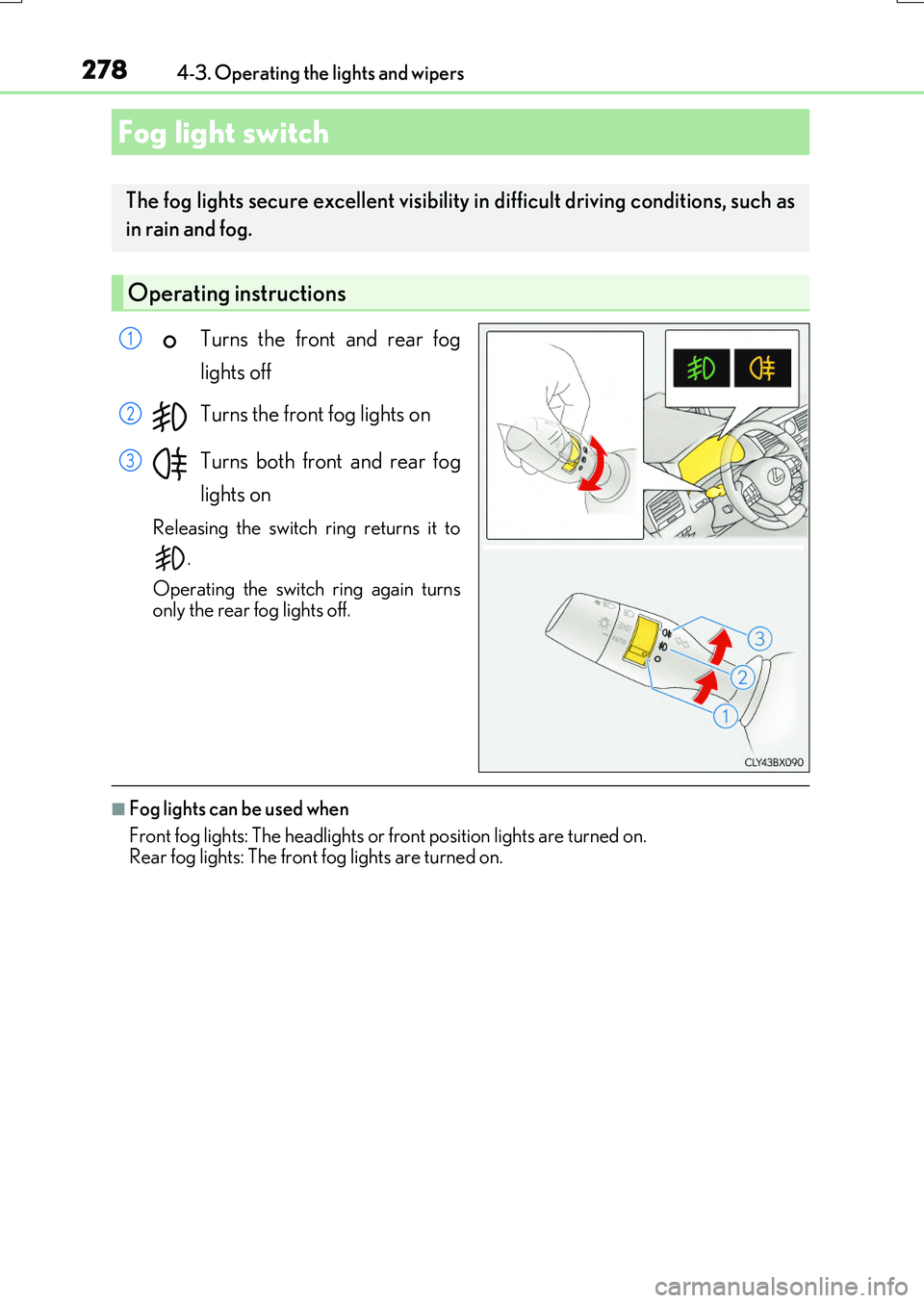
Turns the front and rear fog
lights off
Turns the front fog lights on
Turns both front and rear fog
lights on
Releasing the switch ring returns it to
.
Operating the switch ring again turns only the rear fog lights off.
■Fog lights can be used when
Front fog lights: The headlights or fr ont position lights are turned on. Rear fog lights: The front fog lights are turned on.
Fog light switch
The fog lights secure excellent visibility in difficult driving conditions, such as
in rain and fog.
Operating instructions
1
2
3
Page 295 of 776
2954-5. Using the driving support systems
4
Driving
RX350/RX200t_EE_OM48F32E
WARNING
■To avoid malfunction of the camera sensor
Observe the following precautions.
Otherwise, the camera sensor may not oper ate properly, possibly leading to an acci-
dent resulting in death or serious injury.
●Keep the windshield clean at all times.
• If the windshield is dirty or covered with an oily film, water droplets, snow, etc.,
clear the windshield. • If a glass coating agent is applied to the windshield, it will still be necessary to use the windshield wipers to remove water dr oplets, etc. from the area of the wind-
shield in front of the camera sensor. • If the inner side of the windshield where th e camera sensor is installed is dirty, con- tact any authorized Lexus dealer or repairer, or another duly qualified and
equipped professional.
●If the part of the windshield in front of the camera sensor is fogged up or covered with condensation or ice, use the windshield de fogger to remove the fog, condensation or ice. ( P. 542)
●If water droplets cannot be properly removed from the area of the windshield in front of the camera sensor by the windshield wi pers, replace the wiper insert or wiper blade.
• To replace the wiper insert: P. 636 • If the wiper blades need to be replaced, contact any authorized Lexus dealer orrepairer, or another duly qualif ied and equipped professional.
●Do not attach window tinting to the windshield.
●Replace the windshield if it is damaged or cracked.
If the windshield needs to be replaced, contact any authorized Lexus dealer or repairer, or another duly qualified and equipped professional.
●Do not get the camera sensor wet.
●Do not allow bright lights to shine into the camera sensor.
●Do not dirty or damage the camera sensor. When cleaning the inside of the windshield, do not allow glass cleaner to contact the
lens. Also, do not touch the lens. If the lens is dirty or damaged, contact any authorized Lexus dealer or repairer, oranother duly qualified an d equipped professional.
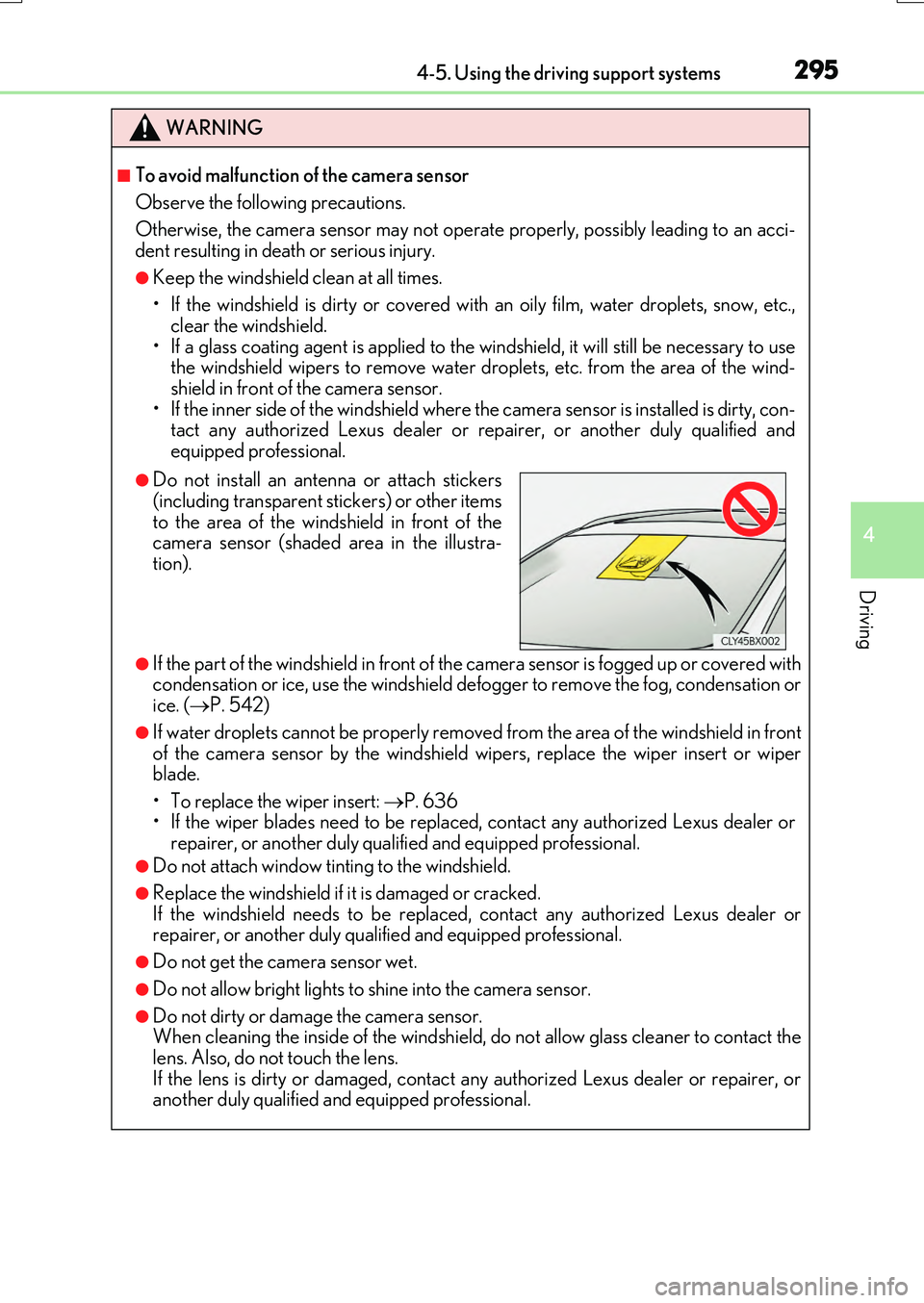
●Do not install an antenna or attach stickers
(including transparent stickers) or other items to the area of the windshield in front of thecamera sensor (shaded area in the illustra-
tion).
Page 310 of 776
3104-5. Using the driving support systems
RX350/RX200t_EE_OM48F32E
■Situations in which the system may not operate properly
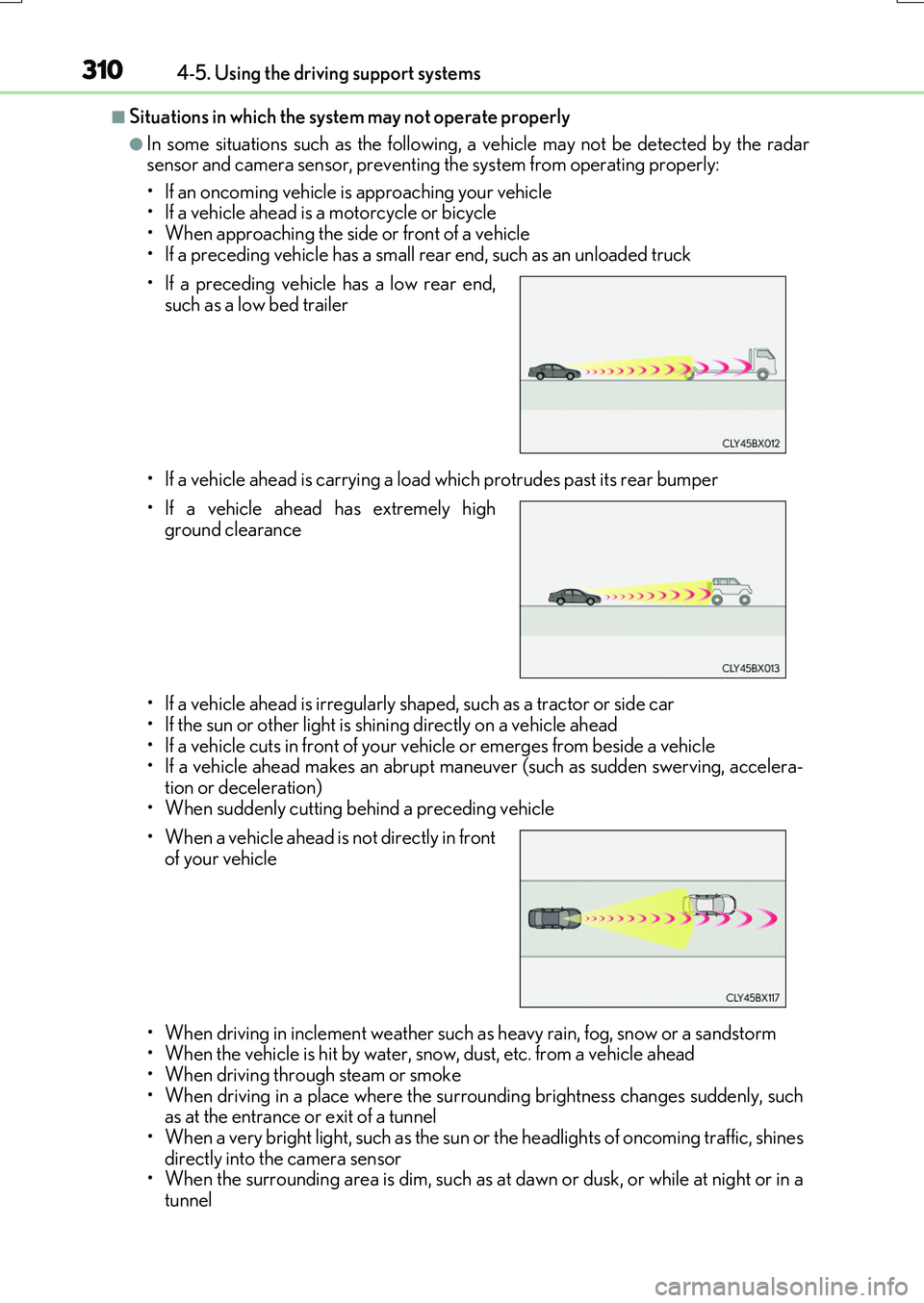
●In some situations such as the following, a vehicle may not be detected by the radar sensor and camera sensor, preventing the system from operating properly:
• If an oncoming vehicle is approaching your vehicle • If a vehicle ahead is a motorcycle or bicycle• When approaching the side or front of a vehicle
• If a preceding vehicle has a small rear end, such as an unloaded truck
• If a vehicle ahead is carrying a load which protrudes past its rear bumper
• If a vehicle ahead is irregularly sh aped, such as a tractor or side car
• If the sun or other light is shin ing directly on a vehicle ahead • If a vehicle cuts in front of your vehicle or emerges from beside a vehicle• If a vehicle ahead makes an abrupt mane uver (such as sudden swerving, accelera-
tion or deceleration) • When suddenly cutting behind a preceding vehicle
• When driving in inclement we ather such as heavy rain, fog, snow or a sandstorm • When the vehicle is hit by water, snow, dust, etc. from a vehicle ahead
• When driving through steam or smoke • When driving in a place where the surro unding brightness changes suddenly, such as at the entrance or exit of a tunnel
• When a very bright light, such as the sun or the headlights of oncoming traffic, shines directly into the camera sensor• When the surrounding area is dim, such as at dawn or dusk, or while at night or in a
tunnel
• If a preceding vehicle has a low rear end,
such as a low bed trailer
• If a vehicle ahead has extremely high
ground clearance
• When a vehicle ahead is not directly in front of your vehicle
Page 312 of 776
3124-5. Using the driving support systems
RX350/RX200t_EE_OM48F32E
●Some pedestrians such as the following may not be detected by the radar sensor and
camera sensor, preventing the system from operating properly*4:
• Pedestrians shorter than approximately 1 m (3 .2 ft.) or taller than approximately 2 m (6.5 ft.)
• Pedestrians wearing oversized clothing (a rain coat, long skirt, etc.), making their sil- houette obscure• Pedestrians who are carrying large baggage, holding an umbrella, etc., hiding part
of their body • Pedestrians who are bending forward or squatting• Pedestrians who are pushing a stroller , wheelchair, bicycle or other vehicle
• Groups of pedestrians which are close together • Pedestrians who are wearing white and look extremely bright• Pedestrians in the dark, such as at night or while in a tunnel
• Pedestrians whose clothing appears to be nearly the same color or brightness as their surroundings• Pedestrians near walls, fences, guardrails, or large objects
• Pedestrians who are on a metal object (manhole cover, steel plate, etc.) on the road • Pedestrians who are walking fast• Pedestrians who are changing speed abruptly
• Pedestrians running out from behi nd a vehicle or a large object • Pedestrians who are extremely close to the side of the vehicle (outside rear viewmirror, etc.)
*4: Depending on the region in which the vehicle was sold, the pedestrian detection
function may not be available.
■If the PCS warning light flashes and a warning message is displayed on the multi-infor- mation display
The pre-crash safety system may be temporar ily unavailable or there may be a malfunc-
tion in the system.
●In the following situations, the warning light will turn off, the message will disappear and the system will become operational when normal operating conditions return:
• When the radar sensor or camera sensor or the area around either sensor is hot, such as in the sun• When the radar sensor or camera sensor or the area around either sensor is cold,
such as in an extremely cold environment • When the radar sensor or front grille embl em is dirty or covered with snow, etc. • When the part of the windshield in front of the camera sensor is fogged up or cov-
ered with condensation or ice (Defogging the windshield: P. 542) • If the camera sensor is obstructed, such as when the hood is open or a sticker isattached to the windshield near the camera sensor
●If the PCS warning light continues to flash or the warning message does not disappear,the system may be malfunctioning. Have the vehicle inspected by any authorized Lexus
dealer or repairer, or another duly qua lified and equipped professional immediately.
■If VSC is disabled
●If VSC is disabled (P. 425), the pre-crash brake assist and pre-crash braking func-
tions are also disabled.
●The PCS warning light will tu rn on and “VSC Turned Off Pre-Crash Brake System Unavailable” will be displayed on the multi-information display.
Page 317 of 776
3174-5. Using the driving support systems
4
Driving
RX350/RX200t_EE_OM48F32E
WARNING
■Before using LKA system
Do not rely solely upon the LKA system. LKA is not a system which automatically drives the vehicle or reduces the amount of attention that must be paid to the area in
front of the vehicle. The driver must always assume full responsibility for driving safely by always paying careful attention to the surrounding conditions and operate the steer-ing wheel to correct the path of the vehicle. Also, make sure to take adequate breaks
when fatigued, such as from driv ing for a long period of time. Failure to perform appropriate driving operat ions and pay careful attention may lead to an accident, resulting in death or serious injury.
■To avoid operating LKA by mistake
When not using the LKA system, use the LKA switch to turn the system off.
■Situations unsuitable for LKA
Do not use the LKA system in the following situations. The system may not operate properly and le ad to an accident, resulting in death or serious injury.
●A spare tire, tire chains, etc., are equipped.
●When the tires have been excessively worn, or when the tire inflation pressure is low.
●Tires which differ by structure, manufacturer, brand or tread pattern are used.
●Objects or patterns that could be mistaken for white (yellow) lines are present on the side of the road (guardrails, cu rbs, reflective poles, etc.).
●Vehicle is driven on a snow-covered road.
●White (yellow) lines are difficult to see due to rain, snow, fog, dust, etc.
●Asphalt repair marks, white (yellow) line marks, etc., are present due to road repair.
●Vehicle is driven in a temporary lane or restricted lane due to construction work.
●Vehicle is driven on a road surface which is slippery due to rainy weather, fallen snow, freezing, etc.
●Vehicle is driven in traffic lanes other than on highways and freeways.
●Vehicle is driven in a construction zone.
●When your vehicle is towing a trailer or during emergency towing
■Preventing LKA system malfunctions and operations performed by mistake
●Do not modify the headlights or place stic kers, etc., on the surface of the lights.
●Do not modify the suspension etc. If the suspension etc. needs to be replaced, con- tact any authorized Lexus dealer or repair er, or another duly qualified and equipped
professional.
●Do not install or place anything on the hood or grille. Also, do not install a grille guard (bull bars, kangaroo bar, etc.).
●If your windshield needs repairs, contact any authorized Lexus dealer or repairer, oranother duly qualified an d equipped professional.
Page 327 of 776
3274-5. Using the driving support systems
4
Driving
RX350/RX200t_EE_OM48F32E
*1: If the turn signal indicator is not operated when changing lanes, the mark does not dis-
play.
*2: Vehicles with a navigation system
In the following situations, the RSA system alerts the driver using a warning dis-
play.
●When the vehicle speed exceeds the speed warning threshold applied to the
speed limit of the sign displayed on the multi-information display, the sign
color becomes inverted.
●If it is detected that your vehicle is overtaking when a no overtaking sign is dis-
played on the multi-information display, the sign flashes.
●Vehicles with a navigation system: When the RSA system recognizes a no-
entry sign and detects that the vehicle has entered a no-entry area based on
the map information of the navigation system, the no-entry sign flashes.
Depending on the situation, traffic environment (traffic direction, speed, unit)
may be detected incorrectly and a warning display may not operate properly.
■Automatic turn-off of RSA sign display
One or more signs automatically turn off in the following situations.
●A new sign is not recognized for a certain distance.
●The road changes due to a left or right turn, etc.
■Conditions in which the function may not operate or detect correctly
In the following situations, RSA does not op erate normally and may not recognize signs,
display the incorrect sign, etc. However, this does not indicate a malfunction.
●The camera sensor is misaligned due to a strong impact being applied to the sensor, etc.
●Dirt, snow, stickers, etc. are on the windshield near the camera sensor.
●In inclement weather such as heavy rain, fog, snow or sand storms
●Light from an oncoming vehicle, the sun, etc. enters the camera sensor.
●The sign is dirty, faded, tilted or bent, and if an electronic sign, the contrast is poor.
●All or part of the sign is hidden by the leaves of a tree, a pole, etc.
●The sign is only visible to the camera sensor for a short amount of time.
●The driving scene (turning, lane change, etc.) is judged incorrectly.
●Even if it is a sign not appropriate for the currently traveled lane, such a sign exists
directly after a freeway branches, or in an adjacent lane just before merging.
●Stickers are attached to the rear of the preceding vehicle.
●A sign resembling a system comp atible sign is recognized.
●The vehicle is driven in a country with a different direction of traffic.
Warning display