lock LEXUS RX350 2011 Owners Manual
[x] Cancel search | Manufacturer: LEXUS, Model Year: 2011, Model line: RX350, Model: LEXUS RX350 2011Pages: 821, PDF Size: 13.27 MB
Page 273 of 821
201
2-3. Operating the lights and windshield wipers
2
When driving
NOTICE
nWhen the windshield is dry
Do not use the wipers, as they may damage the windshield.
nWhen the washer fluid tank is empty
Damage to the washer fluid pump may be caused if the lever is pulled toward you
and held continually.
nWhen a nozzle becomes blocked
Do not try to clear it with a pin or other object. The nozzle will be damaged.
Page 274 of 821
202
2-3. Operating the lights and windshield wipers
Rear window wiper and washer
nThe rear window wiper and washer can be operated when
The “ENGINE START STOP” switch is in IGNITION ON mode.
NOTICE
nWhen the rear window is dry
Do not use the wipers, as they may damage the rear window.
nWhen the washer fluid tank is empty
Damage to the washer fluid pump may be caused if the lever is operated continu-
ally.
nWhen a nozzle becomes blocked
Do not try to clear it with a pin or other object. The nozzle will be damaged.
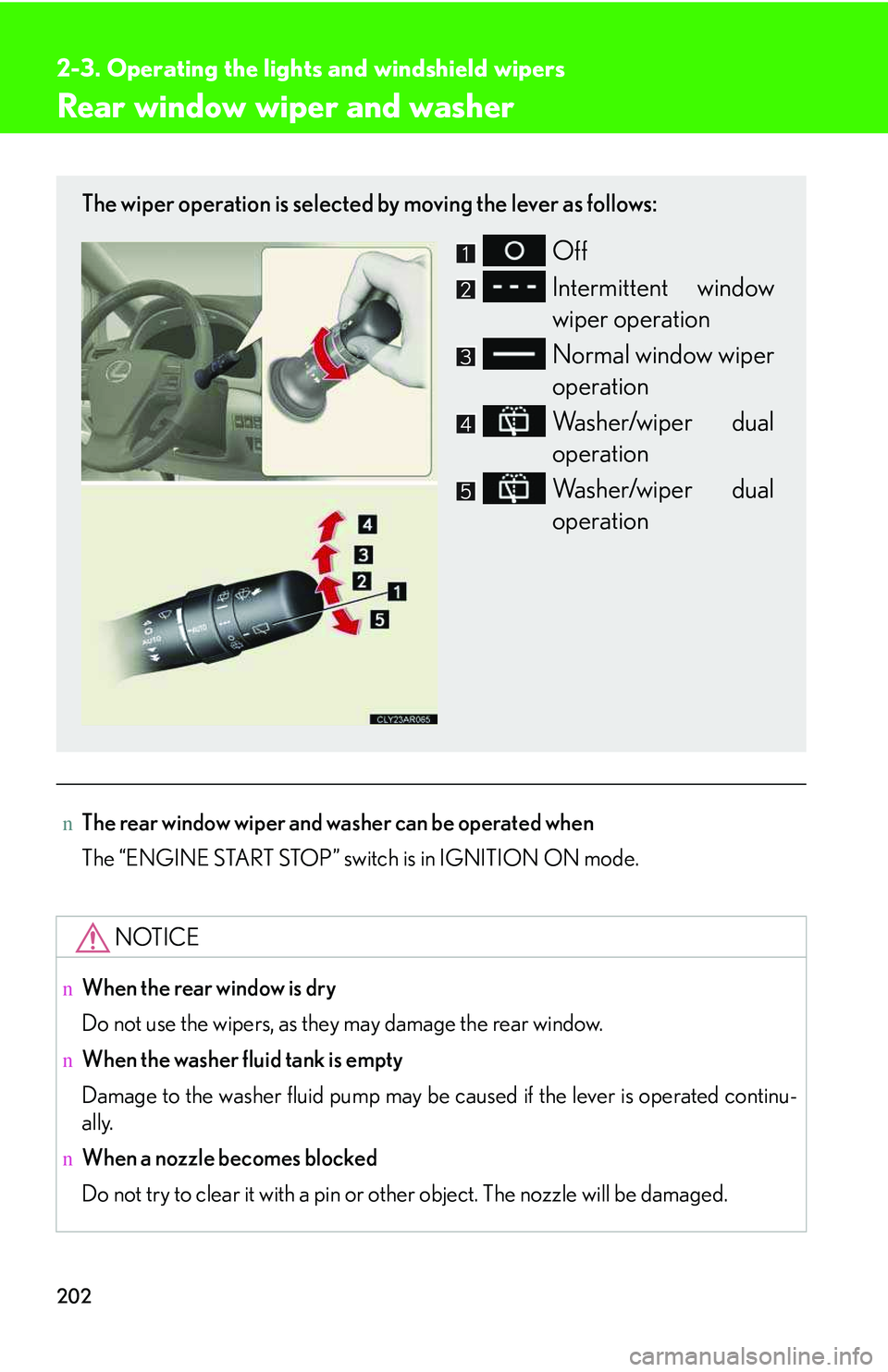
The wiper operation is selected by moving the lever as follows:
Off
Intermittent window
wiper operation
Normal window wiper
operation
Washer/wiper dual
operation
Washer/wiper dual
operation
Page 303 of 821
231
2-4. Using other driving systems
2
When driving
Driving assist systems
To help enhance driving safety and performance, the following systems
operate automatically in response to various driving situations. Be aware,
however, that these systems are supplementary and should not be relied
upon too heavily when operating the vehicle.
nABS (Anti-lock Brake System)
Helps to prevent wheel lock when the brakes are applied suddenly, or if
the brakes are applied while driving on a slippery road surface
nBrake assist
Generates an increased level of braking force after the brake pedal is
depressed, when the system detects a panic stop situation
nVSC (Vehicle Stability Control)
Helps the driver to control skidding when swerving suddenly or turning on
slippery road surfaces
nTRAC (Traction Control)
Helps to maintain drive power and prevent the drive wheels from spinning
when starting the vehicle or accelerating on slippery roads
nHill-start assist control
→P. 2 3 8
nEPS (Electric Power Steering)
Employs an electric motor to reduce the amount of effort needed to turn
the steering wheel
nActive torque control 4WD system (AWD models only)
Automatically switches from front-wheel drive to AWD (All-Wheel Drive)
according to driving conditions, helping to ensure reliable handling and
stability. Examples of conditions where the system will switch to AWD are
when cornering, going uphill, starting off or accelerating, and when the
road surface is slippery due to snow or rain etc.
Page 309 of 821
237
2-4. Using other driving systems
2
When driving
All-wheel drive lock switch (AWD models)
nAll-wheel drive lock mode
lAll-wheel drive lock mode is canceled when the brakes are applied to ensure
the ABS and VSC systems operate effectively.
lAll-wheel drive lock mode is canceled when the vehicle speed exceeds 25 mph
(40 km/h).
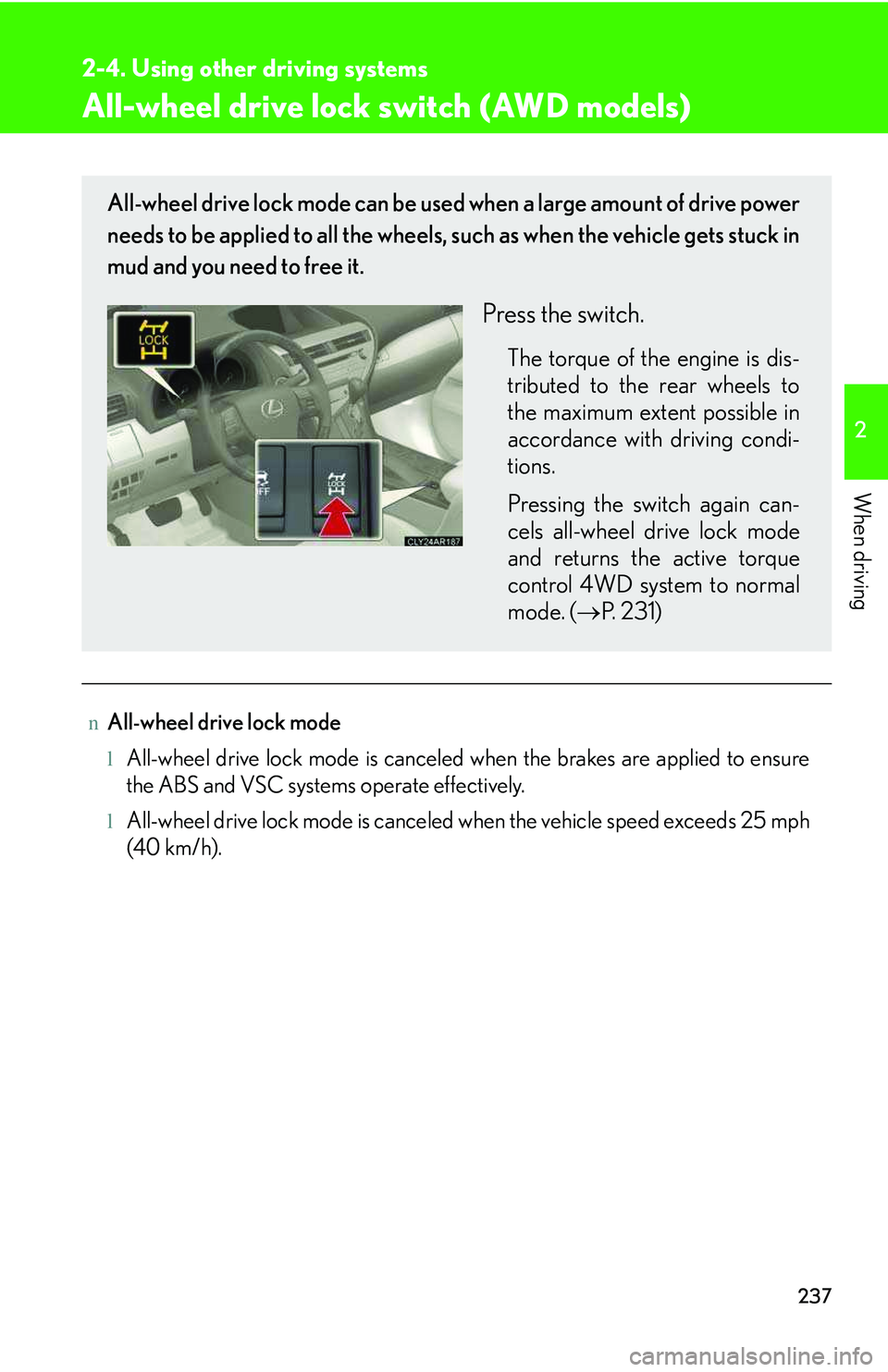
All-wheel drive lock mode can be used when a large amount of drive power
needs to be applied to all the wheels, such as when the vehicle gets stuck in
mud and you need to free it.
Press the switch.
The torque of the engine is dis-
tributed to the rear wheels to
the maximum extent possible in
accordance with driving condi-
tions.
Pressing the switch again can-
cels all-wheel drive lock mode
and returns the active torque
control 4WD system to normal
mode. (→P. 2 3 1 )
Page 314 of 821
242
2-4. Using other driving systems
When the system is activated in the situations described above, there is also a possi-
bility that the seat belts will retract quickly and the brakes will be applied with a force
greater than normal. When the seat belt is locked in the retracted position, stop the
vehicle in a safe place, release the seat belt and refasten it.
nObstacles not detected
The sensor cannot detect plastic obstacles such as traffic cones. There may also be
occasions when the sensor cannot detect pedestrians, animals, bicycles, motorcy-
cles, trees, or snowdrifts.
nWhen there is a malfunction in the system
Warning lights and/or warning messages will turn on or flash. (→P. 535, 545)
nCertification
For vehicles sold in U.S.A.
FCC ID: HYQDNMWR005
This device complies with Part 15 of the FCC Rules. Operation is subject to the fol-
lowing two conditions: (1) this device may not cause harmful interference, and (2)
this device must accept any interference received, including interference that may
cause undesired operation.
FCC WARNING
Changes or modifications not expressly approved by the party responsible for
compliance could void the user's authority to operate the equipment.
Radiofrequency radiation exposure Information:
This equipment complies with FCC radiation exposure limits set forth for an uncon-
trolled environment.
This equipment should be installed and operated with minimum distance of 20 cm
between the radiator (antenna) and your body.
This transmitter must not be co-located or operating in conjunction with any other
antenna or transmitter.
For vehicles sold in Canada
Operation is subject to the following two conditions: (1) this device may not cause
interference, and (2) this device must accept any interference, including interfer-
ence that may cause undesired operation of the device.
Page 319 of 821
247
2-5. Driving information
2
When driving
CAUTION
nOff-road driving precautions
Always observe the following precautions to minimize the risk of death or serious
injury or damage to your vehicle:
lDrive carefully when off the road. Do not take unnecessary risks by driving in
dangerous places.
lDo not grip the steering wheel spokes when driving off-road. A bad bump could
jerk the wheel and injure your hands. Keep both hands and especially your
thumbs on the outside of the rim.
lAlways check your brakes for effectiveness immediately after driving in sand,
mud, water or snow.
lAfter driving through tall grass, mud, rock, sand, water, etc., check that there is no
grass, bush, paper, rags, stone, sand, etc. adhering or trapped to the underbody.
Clear off any such matter from the underbody. If the vehicle is used with these
materials trapped or adhering to the underbody, a breakdown or fire could occur.
lWhen driving off-road or in rugged terrain, do not drive at excessive speeds,
jump, make sharp turns, strike objects, etc. This may cause loss of control or vehi-
cle rollover causing death or serious injury. You are also risking expensive dam-
age to your vehicle’s suspension and chassis.
NOTICE
nTo prevent water damage
Take all necessary safety measures to ensure that water damage to the engine or
other components does not occur.
lWater entering the engine air intake will cause severe engine damage.
lWater entering the automatic transmission will cause deterioration in shift quality,
locking up of your transmission accompanied by vibration, and ultimately dam-
age.
lWater can wash the grease from wheel bearings, causing rusting and premature
failure, and may also enter the differentials, transmission and transfer case, reduc-
ing the gear oil’s lubricating qualities.
Page 323 of 821
251
2-5. Driving information
2
When driving
CAUTION
nThings that must not be carried in the luggage compartment
The following things may cause a fire if loaded in the luggage compartment:
lReceptacles containing gasoline
lAerosol cans
nStorage precautions
Observe the following precautions.
Failure to do so may result in death or serious injury.
lStow cargo and luggage in the luggage compartment whenever possible.
lDo not stack cargo and luggage in the luggage compartment higher than the
seatbacks.
Such items may be thrown about and possibly injure people in the vehicle in the
event of sudden braking or in an accident.
lDo not place cargo or luggage in or on the following locations as the item may
get under the brake or accelerator pedal and prevent pedals from being
depressed properly, block the driver’s vision, or hit the driver or passengers,
causing an accident:
Page 327 of 821
255
2-5. Driving information
2
When driving
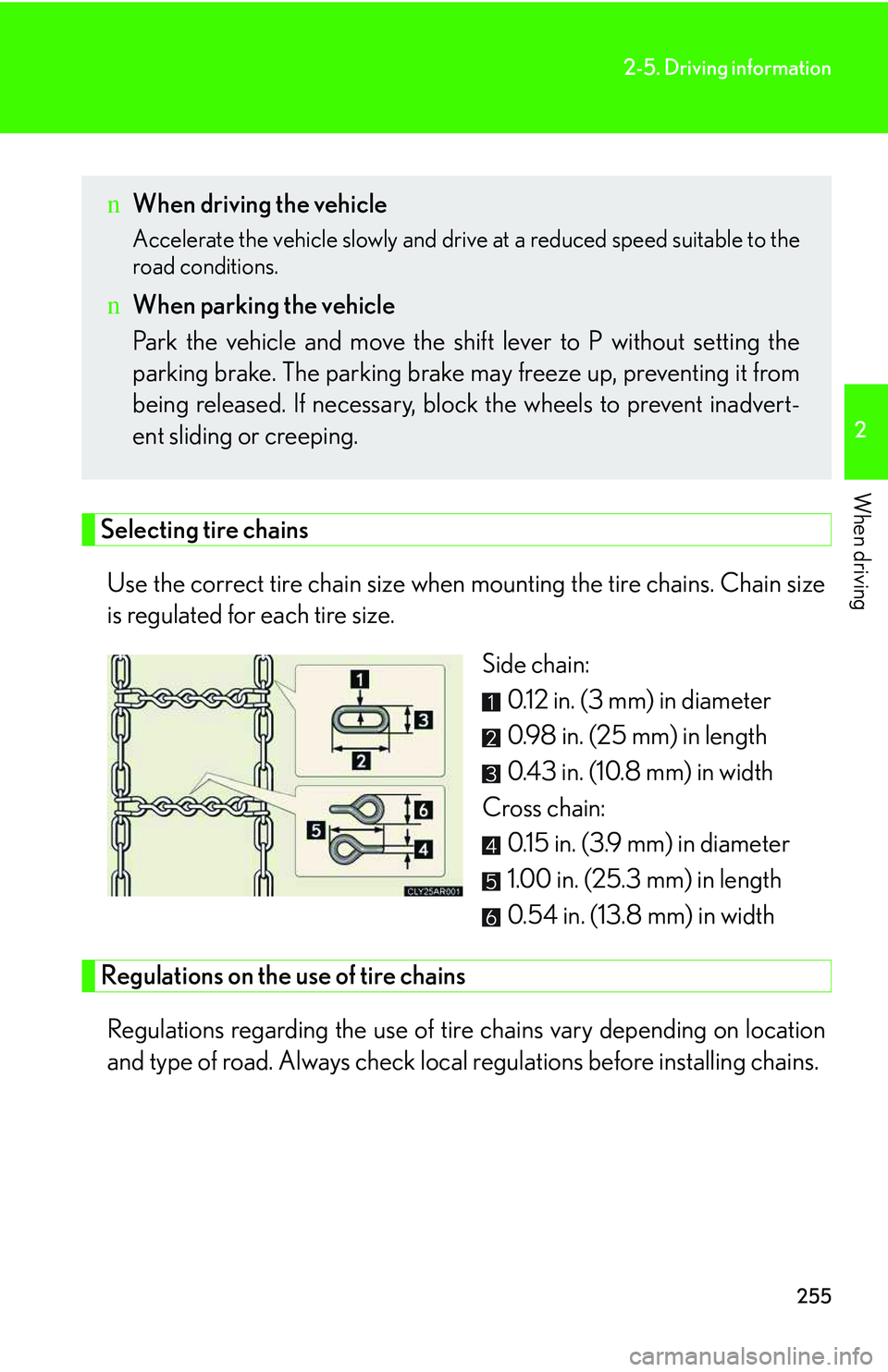
Selecting tire chains
Use the correct tire chain size when mounting the tire chains. Chain size
is regulated for each tire size.
Side chain:
0.12 in. (3 mm) in diameter
0.98 in. (25 mm) in length
0.43 in. (10.8 mm) in width
Cross chain:
0.15 in. (3.9 mm) in diameter
1.00 in. (25.3 mm) in length
0.54 in. (13.8 mm) in width
Regulations on the use of tire chains
Regulations regarding the use of tire chains vary depending on location
and type of road. Always check local regulations before installing chains.
nWhen driving the vehicle
Accelerate the vehicle slowly and drive at a reduced speed suitable to the
road conditions.
nWhen parking the vehicle
Park the vehicle and move the shift lever to P without setting the
parking brake. The parking brake may freeze up, preventing it from
being released. If necessary, block the wheels to prevent inadvert-
ent sliding or creeping.
Page 334 of 821
262
2-5. Driving information
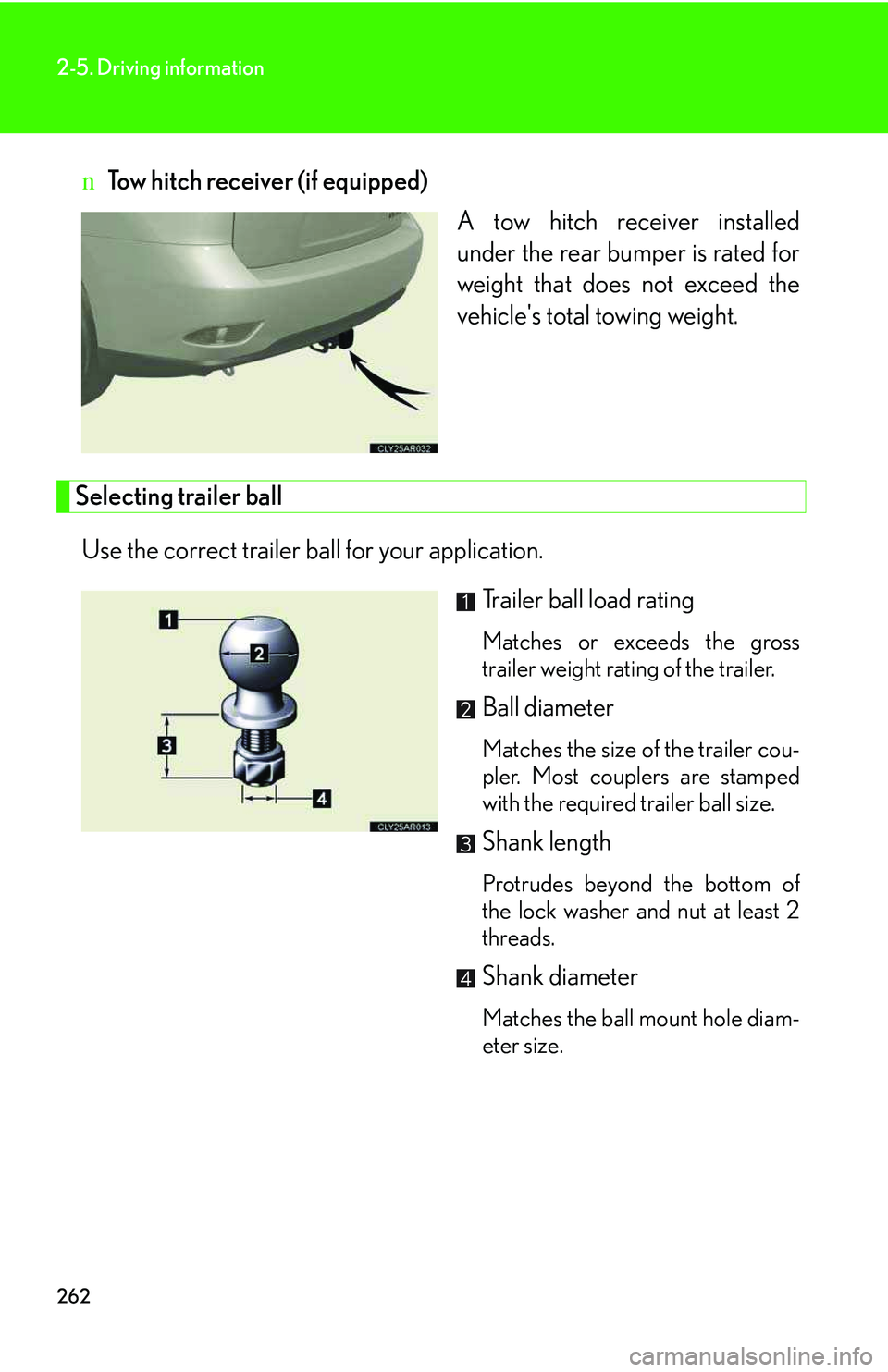
nTow hitch receiver (if equipped)
A tow hitch receiver installed
under the rear bumper is rated for
weight that does not exceed the
vehicle's total towing weight.
Selecting trailer ball
Use the correct trailer ball for your application.
Trailer ball load rating
Matches or exceeds the gross
trailer weight rating of the trailer.
Ball diameter
Matches the size of the trailer cou-
pler. Most couplers are stamped
with the required trailer ball size.
Shank length
Protrudes beyond the bottom of
the lock washer and nut at least 2
threads.
Shank diameter
Matches the ball mount hole diam-
eter size.
Page 337 of 821
265
2-5. Driving information
2
When driving
lCrosswinds and rough roads will adversely affect handling of your
vehicle and trailer, causing sway. Periodically check the rear to prepare
for being passed by large trucks or buses, which may cause your vehi-
cle and trailer to sway. If swaying occurs, firmly grip the steering wheel,
reduce speed immediately but gradually, and steer straight ahead.
Never increase speed. If you make no extreme correction with the
steering or brakes, your vehicle and trailer will stabilize.
lTake care when passing other vehicles. Passing requires considerable
distance. After passing a vehicle, do not forget the length of your
trailer, and be sure you have plenty of room before changing lanes.
lIn order to maintain engine braking efficiency when driving on a long
steep downgrade, do not use overdrive. Transmission shift range posi-
tion must be in 4 in S mode.
lDue to the added load of the trailer, your vehicle's engine may over-
heat on hot days (at temperatures over 85°F [30°C]) when driving up
a long or steep grade. If the engine coolant temperature gauge indi-
cates overheating, immediately turn off the air conditioning (if in use),
pull your vehicle off the road and stop in a safe spot. (→P. 587)
lAlways place wheel blocks under both the vehicle and the trailer
wheels when parking. Apply the parking brake firmly, and put the
transmission in P. Avoid parking on a slope, but if unavoidable, do so
only after performing the following:
Apply the brakes and keep them applied.
Have someone place wheel blocks under both the vehicle and
trailer wheels.
When the wheel blocks are in place, release the brakes slowly
until the blocks absorb the load.
Apply the parking brake firmly.
Shift into P and turn off the engine.
STEP1
STEP2
STEP3
STEP4
STEP5