inflation pressure LEXUS RX350 2011 User Guide
[x] Cancel search | Manufacturer: LEXUS, Model Year: 2011, Model line: RX350, Model: LEXUS RX350 2011Pages: 821, PDF Size: 13.27 MB
Page 557 of 821
487
4-3. Do-it-yourself maintenance
4
Maintenance and care
Tire inflation pressure
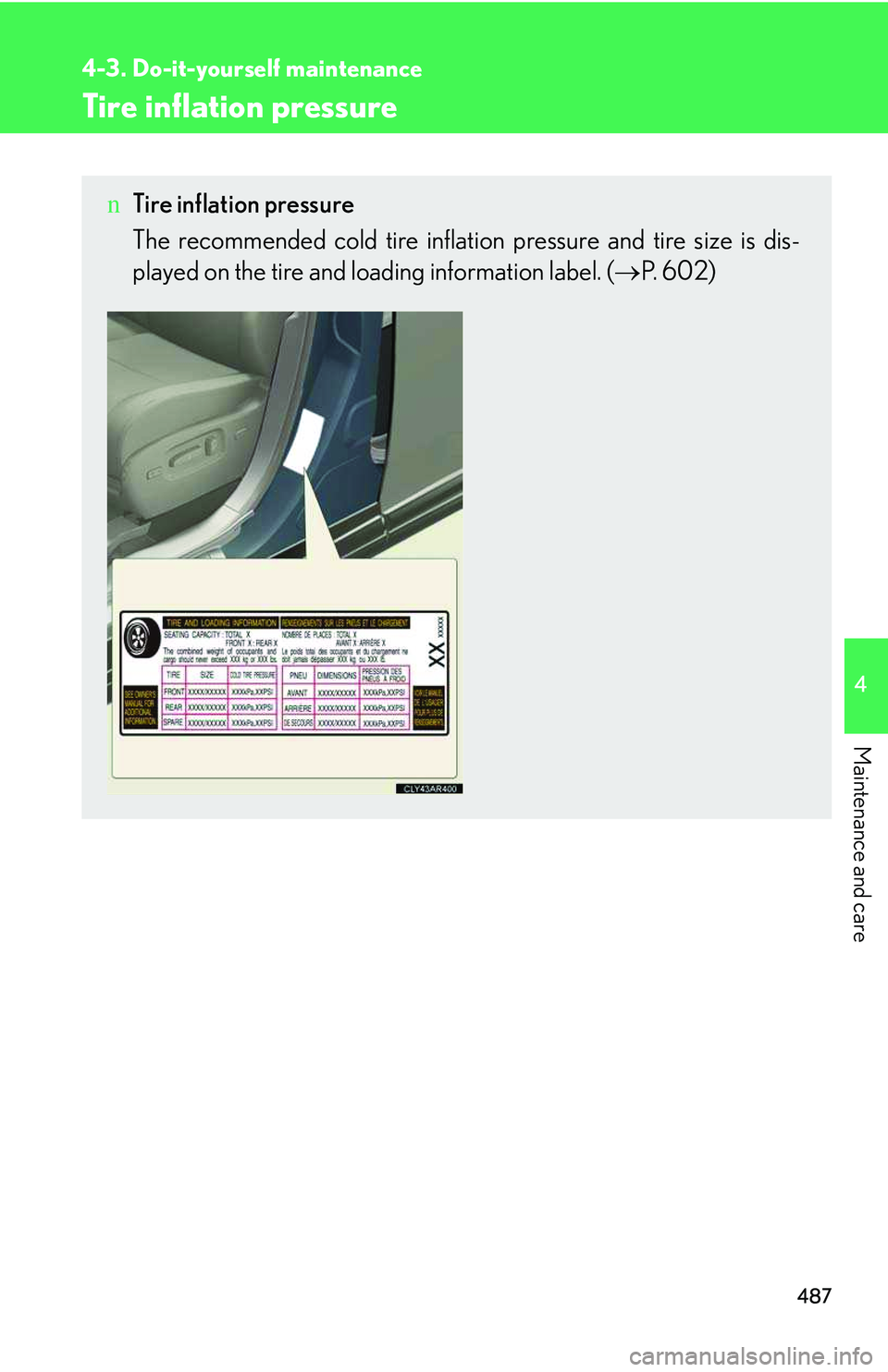
nTire inflation pressure
The recommended cold tire inflation pressure and tire size is dis-
played on the tire and loading information label. (→P. 6 0 2 )
Page 558 of 821
488
4-3. Do-it-yourself maintenance
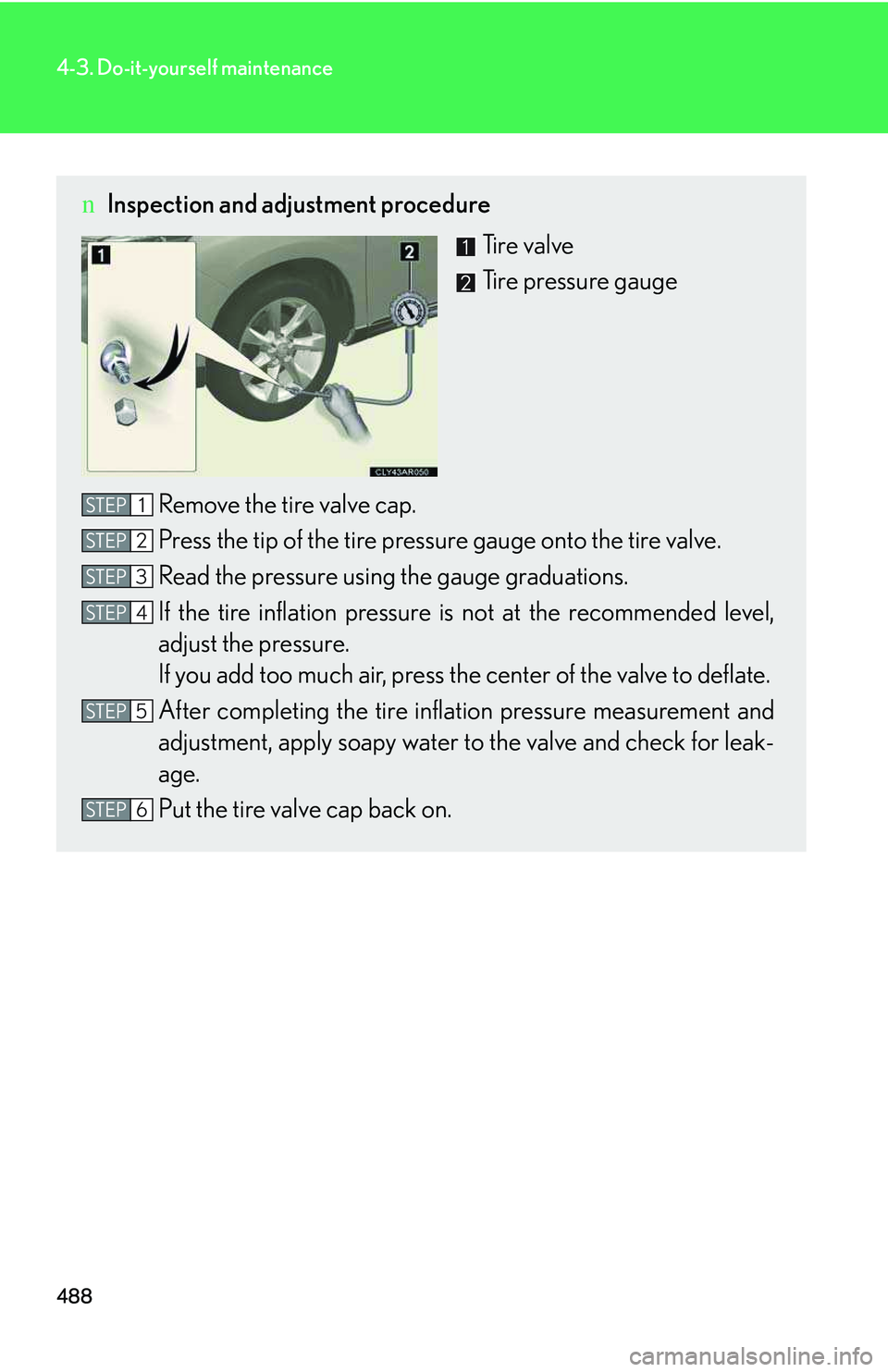
nInspection and adjustment procedure
Tir e v a l v e
Tire pressure gauge
Remove the tire valve cap.
Press the tip of the tire pressure gauge onto the tire valve.
Read the pressure using the gauge graduations.
If the tire inflation pressure is not at the recommended level,
adjust the pressure.
If you add too much air, press the center of the valve to deflate.
After completing the tire inflation pressure measurement and
adjustment, apply soapy water to the valve and check for leak-
age.
Put the tire valve cap back on.
STEP1
STEP2
STEP3
STEP4
STEP5
STEP6
Page 559 of 821
489
4-3. Do-it-yourself maintenance
4
Maintenance and care
nTire inflation pressure check interval
You should check tire inflation pressure every two weeks, or at least once a month.
Do not forget to check the spare.
nEffects of incorrect tire inflation pressure
Driving with incorrect tire inflation pressure may result in the following:
lReduced fuel efficiency
lReduced driving comfort and tire life
lReduced safety
lDamage to the drive train
If a tire needs frequent inflating, have it checked by your Lexus dealer.
nInstructions for checking tire pressure
When checking tire inflation pressure, observe the following:
lCheck only when the tires are cold.
If your vehicle has been parked for at least 3 hours and has not been driven for
more than 1 mile or 1.5 km, you will get an accurate cold tire inflation pressure
reading.
lAlways use a tire pressure gauge.
The appearance of the tire can be misleading. In addition, tire inflation pressures
that are even just a few pounds off can degrade ride and handling.
lDo not reduce tire inflation pressure after driving. It is normal for the tire infla-
tion pressure to be higher after driving.
lNever exceed the vehicle capacity weight.
Passengers and luggage weight should be placed so that the vehicle is bal-
anced.
Page 560 of 821
490
4-3. Do-it-yourself maintenance
CAUTION
nProper inflation is critical to save tire performance
Keep your tires properly inflated. Otherwise, the following conditions may occur
and result in an accident causing death or serious injury:
lExcessive wear
lUneven wear
lPoor handling
lPossibility of blowouts resulting from overheated tires
lPoor sealing of the tire bead
lWheel deformation and/or tire separation
lA greater possibility of tire damage from road hazards
NOTICE
nWhen inspecting and adjusting tire inflation pressure
Be sure to put the tire valve caps back on.
Without the valve caps, dirt or moisture could get into the valve and cause air leak-
age, which could result in an accident. If the caps are lost, replace them as soon as
possible.
Page 561 of 821
491
4-3. Do-it-yourself maintenance
4
Maintenance and care
Wheels
nWhen replacing wheels
The wheels of your vehicle are equipped with tire pressure warning valves and
transmitters that allow the tire pressure warning system to provide advanced warn-
ing in the event of a loss in tire inflation pressure. Whenever wheels are replaced,
tire pressure warning valves and transmitters must be installed. (→P. 4 7 9 )
If a wheel is bent, cracked or heavily corroded, it should be replaced.
Otherwise, the tire may separate from the wheel or cause a loss of han-
dling control.
nWheel selection
When replacing wheels, care should be taken to ensure that they
are equivalent to those removed in load capacity, diameter, rim
width, and inset*.
Replacement wheels are available at your Lexus dealer.
*: Conventionally referred to as “offset”.
Lexus does not recommend using the following:
lWheels of different sizes or types
lUsed wheels
lBent wheels that have been straightened
nAluminum wheel precautions
lUse only Lexus wheel nuts and wrenches designed for use with
your aluminum wheels.
lWhen rotating, repairing or changing your tires, check that the
wheel nuts are still tight after driving 1000 miles (1600 km).
lBe careful not to damage the aluminum wheels when using tire
chains.
lUse only Lexus genuine balance weights or equivalent and a
plastic or rubber hammer when balancing your wheels.
Page 607 of 821
538
5-2. Steps to take in an emergency
*1: Open door warning buzzer:
The open door warning buzzer sounds to alert one or more of the doors is not
fully closed (with the vehicle having reached a speed of 3 mph [5 km/h]).
(→P. 551)
*2: Driver's and front passenger’s seat belt buzzer:
The driver’s and front passenger’s seat belt buzzer sounds to alert the driver and
front passenger that his or her seat belt is not fastened. The buzzer sounds inter-
mittently for 10 seconds after the vehicle reaches a speed of 12 mph (20 km/h).
Then, if the seat belt is still unfastened, the buzzer will sound in a different tone
for 20 more seconds.
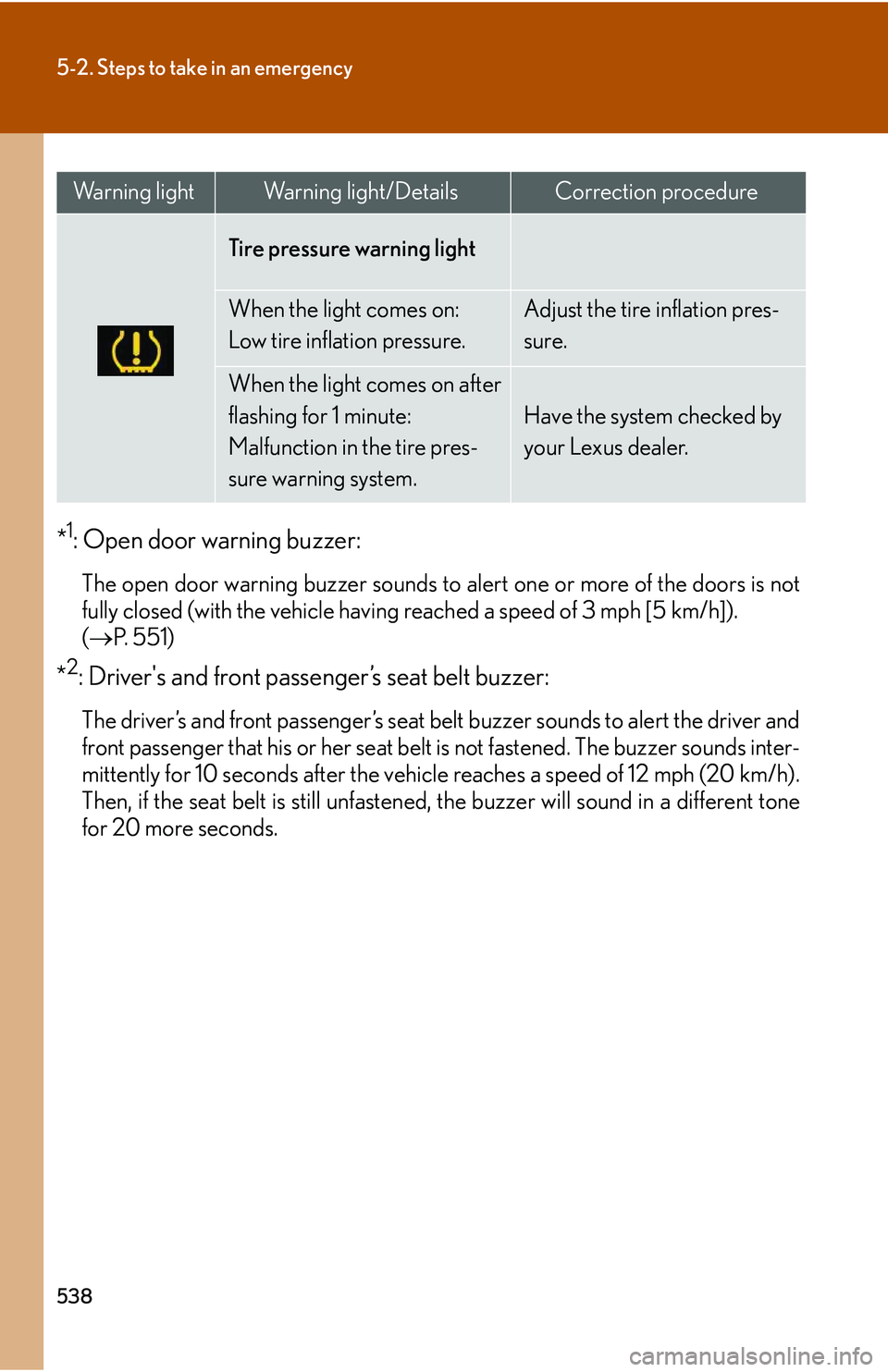
Tire pressure warning light
When the light comes on:
Low tire inflation pressure.
Adjust the tire inflation pres-
sure.
When the light comes on after
flashing for 1 minute:
Malfunction in the tire pres-
sure warning system.
Have the system checked by
your Lexus dealer.
Warning lightWarning light/DetailsCorrection procedure
Page 609 of 821
540
5-2. Steps to take in an emergency
nWhen the tire pressure warning light comes on
Check the tire inflation pressure and adjust to the appropriate level. Pushing the tire
pressure warning reset switch will not turn off the tire pressure warning light.
nThe tire pressure warning light may come on due to natural causes
The tire pressure warning light may come on due to natural causes such as natural
air leaks and tire inflation pressure changes caused by temperature. In this case,
adjusting the tire inflation pressure will turn off the warning light (after a few min-
utes).
nWhen a tire is replaced with a spare tire
Vehicles with a compact spare tire
The compact spare tire is not equipped with a tire pressure warning valve and trans-
mitter. If a tire goes flat, the tire pressure warning light will not turn off even though
the flat tire has been replaced with the spare tire. Replace the spare tire with the
repaired tire and adjust the tire inflation pressure. The tire pressure warning light
will go off after a few minutes.
Vehicles with a full-size spare tire
The spare tire is also equipped with the tire pressure warning valve and transmitter.
The tire pressure warning light will turn on if the tire inflation pressure of the spare
tire is low. If a tire goes flat, even though the flat tire is replaced with the spare tire,
the tire pressure warning light does not turn off. Replace the spare tire with the
repaired tire and adjust the proper tire inflation pressure. The tire pressure warning
light will turn off after a few minutes.
Page 610 of 821
5
When trouble arises
541
5-2. Steps to take in an emergency
nIf the tire pressure warning system is not functioning
The tire pressure warning system will be disabled in the following conditions:
(When the condition becomes normal, the system will work properly.)
lIf tires not equipped with tire pressure warning valves and transmitters are used
lIf the ID code on the tire pressure warning valves and transmitters is not regis-
tered in the tire pressure warning computer
lIf the tire pressure warning select switch is set to a different tire setting.
lIf the tire inflation pressure is 73 psi (500 kPa, 5.1 kgf/cm2 or bar) or higher
The tire pressure warning system may be disabled in the following conditions:
(When the condition becomes normal, the system will work properly.)
lIf electronic devices or facilities using similar radio wave frequencies are nearby
lIf a radio set at similar frequencies is in use in the vehicle
lIf a window tint that affects the radio wave signals is installed
lIf there is a lot of snow or ice on the vehicle, in particular around the wheels or
wheel housings
lIf non-genuine Lexus wheels are used (Even if you use Lexus wheels, the tire
pressure warning system may not work properly with some types of tires.)
lIf tire chains are used
lIf the full-size spare tire is in a location subject to poor radio wave signal recep-
tion.
lIf a large metallic object which can interfere with signal reception is put in the
luggage compartment (vehicles with full-size spare tire).
nIf the tire pressure warning light comes on after flashing frequently for 1 minute
If the tire pressure warning light comes on after flashing frequently for 1 minute
when the “ENGINE START STOP” switch is turned to IGNITION ON mode, have
it checked by your Lexus dealer.
nCustomization
The vehicle speed linked seat belt reminder buzzer can be disabled.
(Customizable features →P. 6 2 1 )
Page 611 of 821
542
5-2. Steps to take in an emergency
CAUTION
nWhen the power steering warning light comes on
The steering wheel may become extremely heavy.
If the steering wheel becomes heavier than usual when operating, hold firmly and
operate it using more force than usual.
nIf the tire pressure warning light comes on
Be sure to observe the following precautions. Failure to do so could cause loss of
vehicle control and result in death or serious injury.
lStop your vehicle in a safe place as soon as possible. Adjust the tire inflation pres-
sure immediately.
lIf the tire pressure warning light comes on even after tire inflation pressure adjust-
ment, it is probable that you have a flat tire. Check the tires. If a tire is flat, change
it with the spare tire and have the flat tire repaired by the nearest Lexus dealer.
lAvoid abrupt maneuvering and braking. If the vehicle tires deteriorate, you could
lose control of the steering wheel or the brakes.
nIf a blowout or sudden air leakage should occur
The tire pressure warning system may not activate immediately.
Page 612 of 821
5
When trouble arises
543
5-2. Steps to take in an emergency
CAUTION
nMaintenance of the tires
Each tire, including the spare (if provided), should be checked monthly when cold
and inflated to the inflation pressure recommended by the vehicle manufacturer on
the vehicle placard or tire inflation pressure label (tire and load information label).
(If your vehicle has tires of a different size than the size indicated on the vehicle
placard or tire inflation pressure label [tire and load information label], you should
determine the proper tire inflation pressure for those tires.)
As an added safety feature, your vehicle has been equipped with a tire pressure
monitoring system (TPMS-tire pressure warning system) that illuminates a low tire
pressure telltale (tire pressure warning light) when one or more of your tires is sig-
nificantly under-inflated. Accordingly, when the low tire pressure telltale (tire pres-
sure warning light) illuminates, you should stop and check your tires as soon as
possible, and inflate them to the proper pressure. Driving on a significantly under-
inflated tire causes the tire to overheat and can lead to tire failure. Under-inflation
also reduces fuel efficiency and tire tread life, and may affect the vehicle's handling
and stopping ability.
Please note that the TPMS (tire pressure warning system) is not a substitute for
proper tire maintenance, and it is the driver's responsibility to maintain correct tire
pressure, even if under-inflation has not reached the level to trigger illumination of
the TPMS low tire pressure telltale (tire pressure warning light).
Your vehicle has also been equipped with a TPMS (tire pressure warning system)
malfunction indicator to indicate when the system is not operating properly. The
TPMS (tire pressure warning system) malfunction indicator is combined with the
low tire pressure telltale (tire pressure warning light). When the system detects a
malfunction, the telltale will flash for approximately one minute and then remain
continuously illuminated. This sequence will continue upon subsequent vehicle
start-ups as long as the malfunction exists. When the malfunction indicator is illumi-
nated, the system may not be able to detect or signal low tire pressure as intended.
TPMS (tire pressure warning system) malfunctions may occur for a variety of rea-
sons, including the installation of replacement or alternate tires or wheels on the
vehicle that prevent the TPMS (tire pressure warning system) from functioning
properly. Always check the TPMS (tire pressure warning system) malfunction tell-
tale after replacing one or more tires or wheels on your vehicle to ensure that the
replacement or alternate tires and wheels allow the TPMS (tire pressure warning
system) to continue to function properly.