tires LEXUS RX350 2011 User Guide
[x] Cancel search | Manufacturer: LEXUS, Model Year: 2011, Model line: RX350, Model: LEXUS RX350 2011Pages: 821, PDF Size: 13.27 MB
Page 329 of 821
257
2-5. Driving information
2
When driving
NOTICE
nRepairing or replacing snow tires
Request repairs or replacement of snow tires from Lexus dealers or legitimate tire
retailers.
This is because the removal and attachment of snow tires affects the operation of
the tire pressure warning valves and transmitters.
nFitting tire chains
The tire pressure warning valves and transmitters may not function correctly when
tire chains are fitted.
Page 338 of 821
266
2-5. Driving information
lWhen restarting after parking on a slope:
With the transmission in the P position, start the engine. Be sure
to keep the brake pedal depressed.
Shift into 3, 2, 1, or the R position (if reversing).
Release the parking brake and brake pedal, and slowly pull or
back away from the wheel blocks. Stop and apply the brakes.
Have someone retrieve the blocks.
nBefore towing
Check that the following conditions are met:
lThe vehicle's tires are properly inflated. (→P. 4 8 7 )
lTrailer tires are inflated according to the trailer manufacturer's recommendation.
lAll trailer lights work.
lAll lights work each time you connect them.
lThe trailer ball is set up at the proper height for the coupler on the trailer.
lThe vehicle remains level when a loaded or unloaded trailer is hitched. Do not
drive if the vehicle is not level, and check for improper tongue load, overloading,
worn suspension, or other possible causes.
lThe trailer cargo is securely loaded.
lThe rear view mirrors conform to all applicable federal, state/provincial or local
regulations. If they do not, install rear view mirrors appropriate for towing pur-
poses.
nBreak-in schedule
If your vehicle is new or equipped with any new power train components (such as
an engine, transmission, differential and wheel bearing), Lexus recommends that
you do not tow a trailer until it has been driven for over 500 miles (800 km).
However, avoid full throttle acceleration.
nMaintenance
lIf you tow a trailer, your vehicle will require more frequent maintenance due to
the additional load. (See “Warranty and Services Guide”, “Owner's Manual Sup-
plement” or “Scheduled Maintenance”.)
lRetighten the fixing bolts of the towing ball and bracket after approximately 600
miles (1000 km) of trailer towing.
STEP1
STEP2
STEP3
STEP4
Page 341 of 821
269
2-5. Driving information
2
When driving
NOTICE
nWhen installing a trailer hitch
lUse only the position recommended by your Lexus dealer. Do not install the
trailer hitch on the bumper; this may cause body damage.
lDo not use axle-mounted hitches, as they can cause damage to the axle housing,
wheel bearings, wheels or tires.
nSafety chain
A safety chain must always be used between the towing vehicle and the trailer.
Leave sufficient slack in the chain for turns. The chain should cross under the trailer
tongue to prevent the tongue from dropping to the ground in the case that it
becomes damaged or separated. For the correct safety chain installation proce-
dure, ask your Lexus dealer.
nDo not directly splice trailer lights
Directly splicing trailer lights may damage your vehicle's electrical system and
cause a malfunction.
Page 548 of 821
478
4-3. Do-it-yourself maintenance
Tires
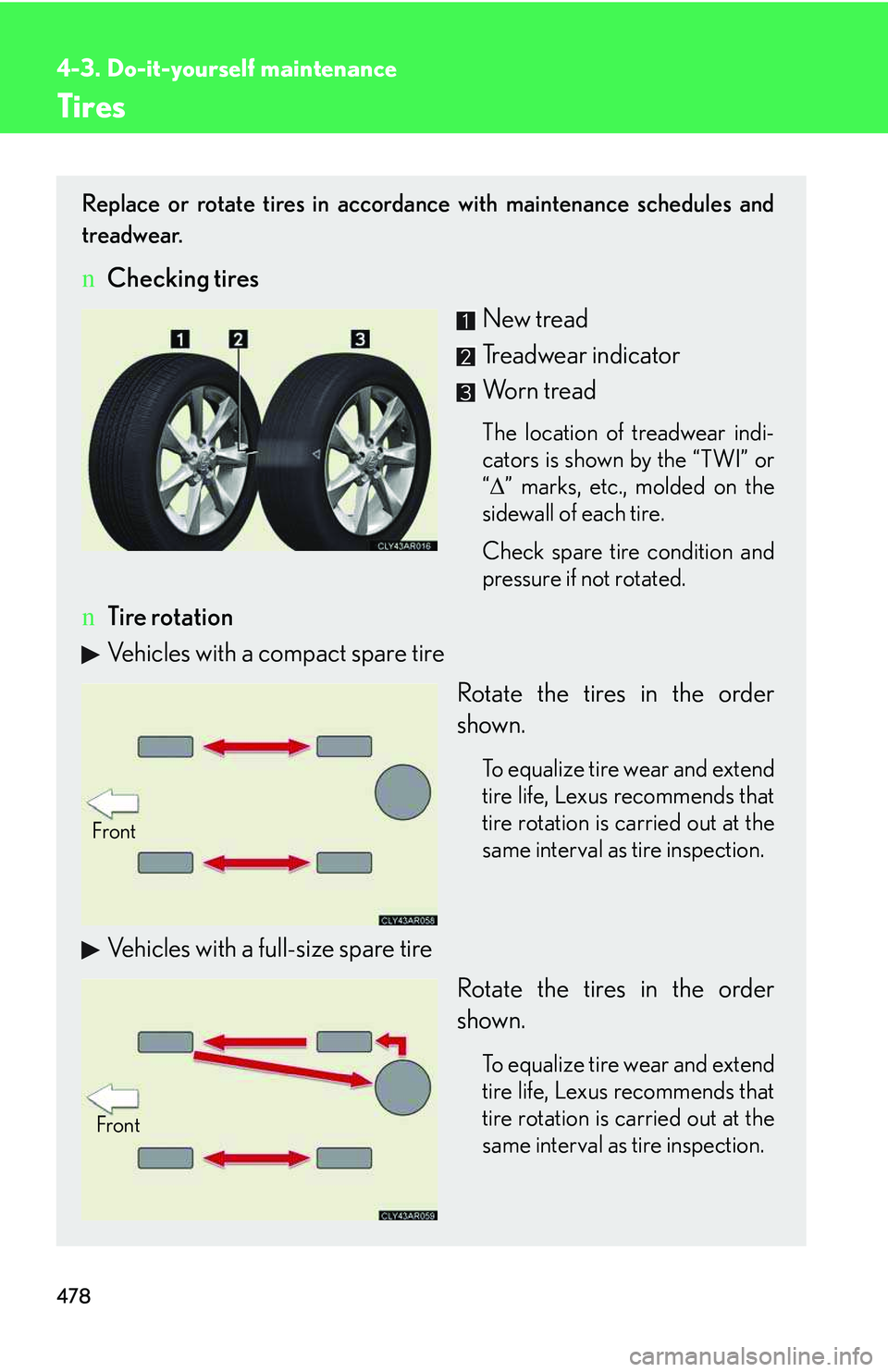
Replace or rotate tires in accordance with maintenance schedules and
treadwear.
nChecking tires
New tread
Treadwear indicator
Worn tread
The location of treadwear indi-
cators is shown by the “TWI” or
“∆” marks, etc., molded on the
sidewall of each tire.
Check spare tire condition and
pressure if not rotated.
nTire rotation
Vehicles with a compact spare tire
Rotate the tires in the order
shown.
To equalize tire wear and extend
tire life, Lexus recommends that
tire rotation is carried out at the
same interval as tire inspection.
Vehicles with a full-size spare tire
Rotate the tires in the order
shown.
To equalize tire wear and extend
tire life, Lexus recommends that
tire rotation is carried out at the
same interval as tire inspection.
Front
Front
Page 549 of 821
479
4-3. Do-it-yourself maintenance
4
Maintenance and care
Installing tire pressure warning valves and transmitters
When replacing tires or wheels, tire pressure warning valves and trans-
mitters must also be installed.
When new tire pressure warning valves and transmitters are installed,
new tire pressure warning valve and transmitter ID codes must be regis-
tered in the tire pressure warning computer and the tire pressure warning
system must be initialized. Have the tire pressure warning valve and
transmitter ID codes registered by your Lexus dealer. (→P. 4 8 1 )
Initializing the tire pressure warning system
nThe tire pressure warning system must be initialized in the following
circumstances:
lWhen the tire inflation pressure is changed such as when changing
travelling speed or load weight
lWhen changing the tire size
When the tire pressure warning system is initialized, the current tire
inflation pressure is set as the benchmark pressure.
nThe tire pressure warning system
Your Lexus is equipped with a tire pressure warning system that uses
tire pressure warning valves and transmitters to detect low tire infla-
tion pressure before serious problems arise. (→P. 537, 545)
Page 551 of 821
481
4-3. Do-it-yourself maintenance
4
Maintenance and care
Registering ID codes
The tire pressure warning valve and transmitter is equipped with a unique
ID code. When replacing a tire pressure warning valve and transmitter, it
is necessary to register the ID code. Have the ID code registered by your
Lexus dealer.
nWhen to replace your vehicle’s tires
Tires should be replaced if:
lYou have tire damage such as cuts, splits, cracks deep enough to expose the
fabric, and bulges indicating internal damage.
lA tire goes flat repeatedly or cannot be properly repaired due to the size or
location of a cut or other damage.
If you are not sure, consult with your Lexus dealer.
nReplacing tires and wheels
If the ID code of the tire pressure warning valve and transmitter is not registered,
the tire pressure warning system will not work properly. After driving for about 20
minutes, the tire pressure warning light flashes for 1 minute and stays on to indicate a
system malfunction.
nTire life
lStandard tire over 6 years old must be checked by a qualified technician even if
they have seldom or never been used or damage is not obvious.
lThe compact spare tire could be deformed gradually in the long term even if
you don't use it. Be sure to have the compact spare tire checked by your Lexus
dealer if it is over 5 years.
nIf the tread on snow tires wears down below 0.16 in. (4 mm)
The effectiveness of the tires as snow tires is lost.
Page 552 of 821
482
4-3. Do-it-yourself maintenance
nMaximum load of tire
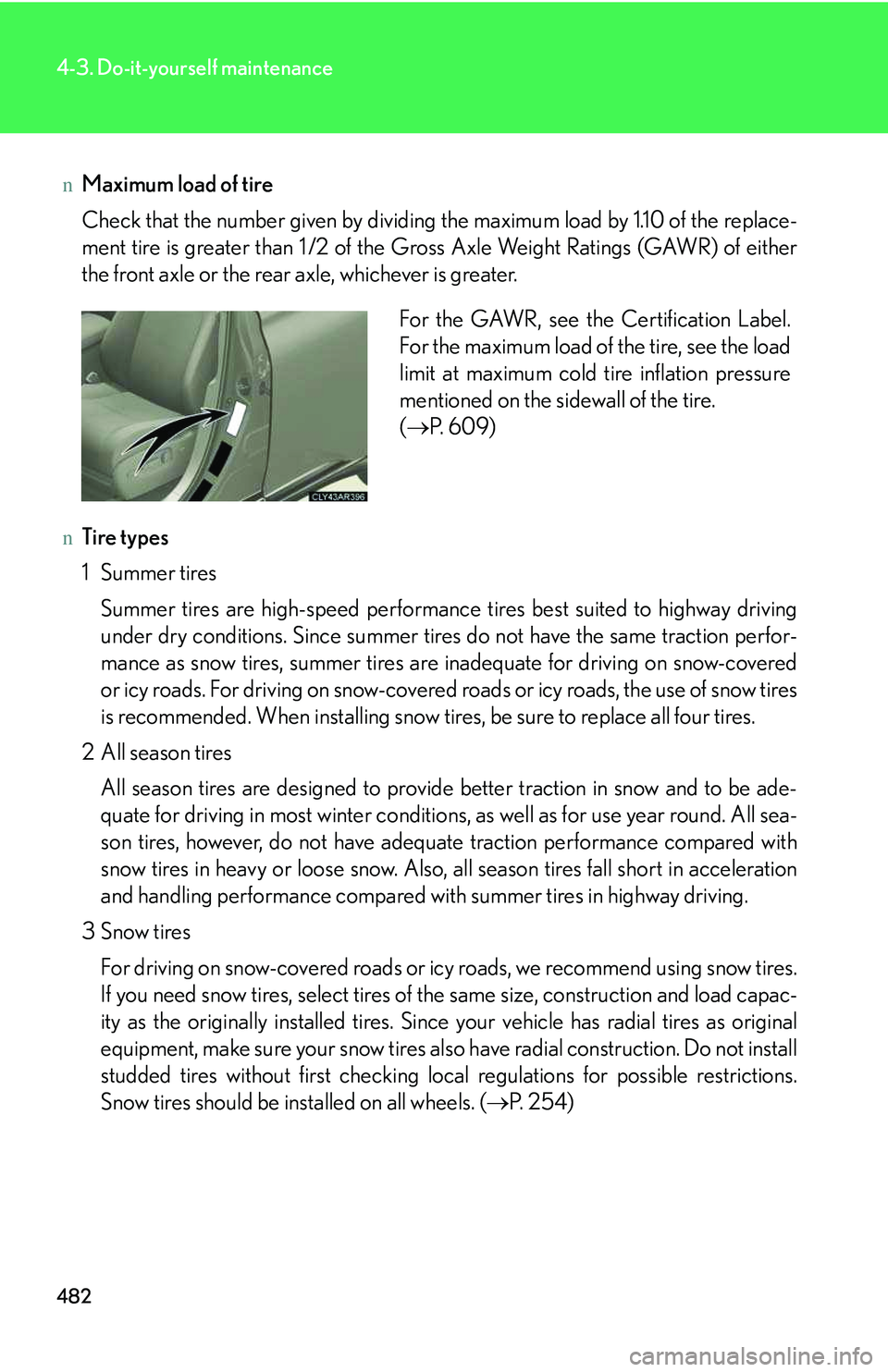
Check that the number given by dividing the maximum load by 1.10 of the replace-
ment tire is greater than 1 /2 of the Gross Axle Weight Ratings (GAWR) of either
the front axle or the rear axle, whichever is greater.
nTire types
1Summer tires
Summer tires are high-speed performance tires best suited to highway driving
under dry conditions. Since summer tires do not have the same traction perfor-
mance as snow tires, summer tires are inadequate for driving on snow-covered
or icy roads. For driving on snow-covered roads or icy roads, the use of snow tires
is recommended. When installing snow tires, be sure to replace all four tires.
2 All season tires
All season tires are designed to provide better traction in snow and to be ade-
quate for driving in most winter conditions, as well as for use year round. All sea-
son tires, however, do not have adequate traction performance compared with
snow tires in heavy or loose snow. Also, all season tires fall short in acceleration
and handling performance compared with summer tires in highway driving.
3Snow tires
For driving on snow-covered roads or icy roads, we recommend using snow tires.
If you need snow tires, select tires of the same size, construction and load capac-
ity as the originally installed tires. Since your vehicle has radial tires as original
equipment, make sure your snow tires also have radial construction. Do not install
studded tires without first checking local regulations for possible restrictions.
Snow tires should be installed on all wheels. (→P. 2 5 4 )
For the GAWR, see the Certification Label.
For the maximum load of the tire, see the load
limit at maximum cold tire inflation pressure
mentioned on the sidewall of the tire.
(→P. 6 0 9 )
Page 555 of 821
485
4-3. Do-it-yourself maintenance
4
Maintenance and care
CAUTION
nTire pressure warning system operation
The tire pressure warning system may not provide warning immediately if a tire
bursts or if sudden air leakage occurs.
nWhen inspecting or replacing tires
Observe the following precautions to prevent accidents. Failure to do so may cause
damage to parts of the drive train, as well as dangerous handling characteristics,
which may lead to an accident resulting in death or serious injury.
lDo not mix tires of different makes, models or tread patterns. Also, do not mix
tires of remarkably different treadwear.
lDo not use tire sizes other than those recommended by Lexus.
lDo not mix differently constructed tires (radial, bias-belted or bias-ply tires).
lDo not mix summer, all season and snow tires.
lDo not use tires that have been used on another vehicle.
Do not use tires if you do not know how they were used previously.
nWhen initializing the tire pressure warning system
Do not push the tire pressure warning reset switch without first adjusting the tire
inflation pressure to the specified level. Otherwise, the tire pressure warning light
may not come on even if the tire inflation pressure is low, or it may come on when
the tire inflation pressure is actually normal.
Page 556 of 821
486
4-3. Do-it-yourself maintenance
NOTICE
nRepairing or replacing tires, wheels, tire pressure warning valves, transmitters
and tire valve caps
lWhen removing or fitting the wheels, tires or the tire pressure warning valve and
transmitter, contact your Lexus dealer as the tire pressure warning valves and
transmitter may be damaged if not handled correctly.
lWhen replacing tire valve caps, do not use tire valve caps other than those speci-
fied. The cap may become stuck.
nTo avoid damage to the tire pressure warning valves and transmitters
When a tire is repaired with liquid sealants, the tire pressure warning valve and
transmitter may not operate properly. If a liquid sealant is used, contact your Lexus
dealer or other qualified service shop as soon as possible. Make sure to replace the
tire pressure warning valve and transmitter when replacing the tire. (→P. 4 7 9 )
nDriving on rough roads
Take particular care when driving on roads with loose surfaces or potholes.
These conditions may cause losses in tire inflation pressure, reducing the cushion-
ing ability of the tires. In addition, driving on rough roads may cause damage to the
tires themselves, as well as the vehicle’s wheels and body.
nIf tire inflation pressures become low while driving
Do not continue driving, or your tires and/or wheels may be ruined.
Page 559 of 821
489
4-3. Do-it-yourself maintenance
4
Maintenance and care
nTire inflation pressure check interval
You should check tire inflation pressure every two weeks, or at least once a month.
Do not forget to check the spare.
nEffects of incorrect tire inflation pressure
Driving with incorrect tire inflation pressure may result in the following:
lReduced fuel efficiency
lReduced driving comfort and tire life
lReduced safety
lDamage to the drive train
If a tire needs frequent inflating, have it checked by your Lexus dealer.
nInstructions for checking tire pressure
When checking tire inflation pressure, observe the following:
lCheck only when the tires are cold.
If your vehicle has been parked for at least 3 hours and has not been driven for
more than 1 mile or 1.5 km, you will get an accurate cold tire inflation pressure
reading.
lAlways use a tire pressure gauge.
The appearance of the tire can be misleading. In addition, tire inflation pressures
that are even just a few pounds off can degrade ride and handling.
lDo not reduce tire inflation pressure after driving. It is normal for the tire infla-
tion pressure to be higher after driving.
lNever exceed the vehicle capacity weight.
Passengers and luggage weight should be placed so that the vehicle is bal-
anced.