weight LEXUS RX350 2011 User Guide
[x] Cancel search | Manufacturer: LEXUS, Model Year: 2011, Model line: RX350, Model: LEXUS RX350 2011Pages: 821, PDF Size: 13.27 MB
Page 333 of 821
261
2-5. Driving information
2
When driving
Trailer tongue load
lA recommended tongue load varies in accordance with the types of
trailers or towing as described below.
lIn order to ensure the recommended values shown below, the trailer
must be loaded by referring to the following instructions.
The trailer cargo load should be distributed so that the tongue load is 9
to 11% of the gross trailer weight, not exceeding the following:
Without towing package: 200 lb. (90 kg)
With towing package: 350 lb. (158 kg)
(Tongue load / Gross trailer weight x 100 = 9 to 11%)
If the gross trailer weight is over 2000 lbs. (900 kg), it is necessary to
use a sway control device with sufficient capacity.
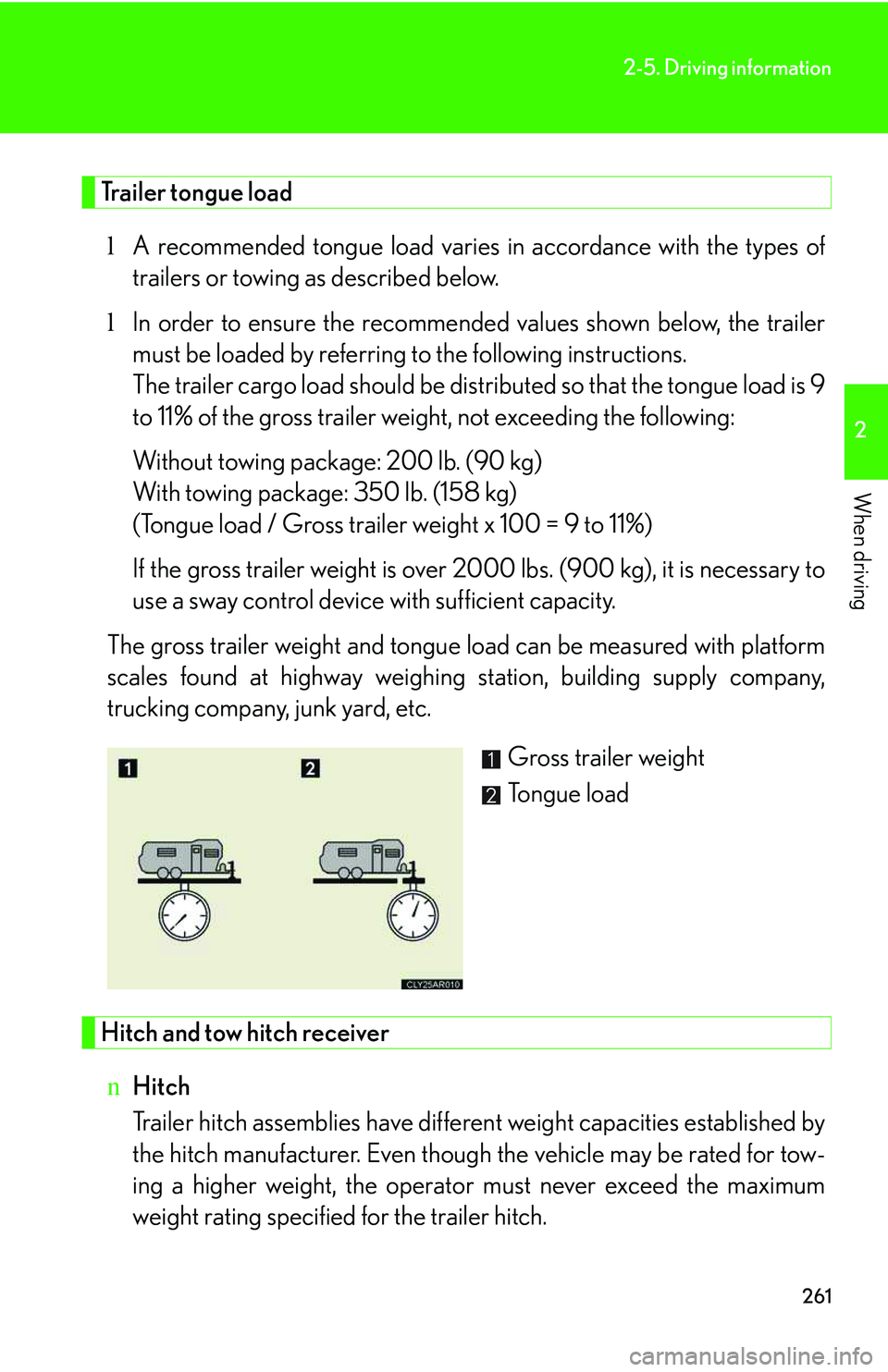
The gross trailer weight and tongue load can be measured with platform
scales found at highway weighing station, building supply company,
trucking company, junk yard, etc.
Gross trailer weight
Tongue load
Hitch and tow hitch receiver
nHitch
Trailer hitch assemblies have different weight capacities established by
the hitch manufacturer. Even though the vehicle may be rated for tow-
ing a higher weight, the operator must never exceed the maximum
weight rating specified for the trailer hitch.
Page 334 of 821
262
2-5. Driving information
nTow hitch receiver (if equipped)
A tow hitch receiver installed
under the rear bumper is rated for
weight that does not exceed the
vehicle's total towing weight.
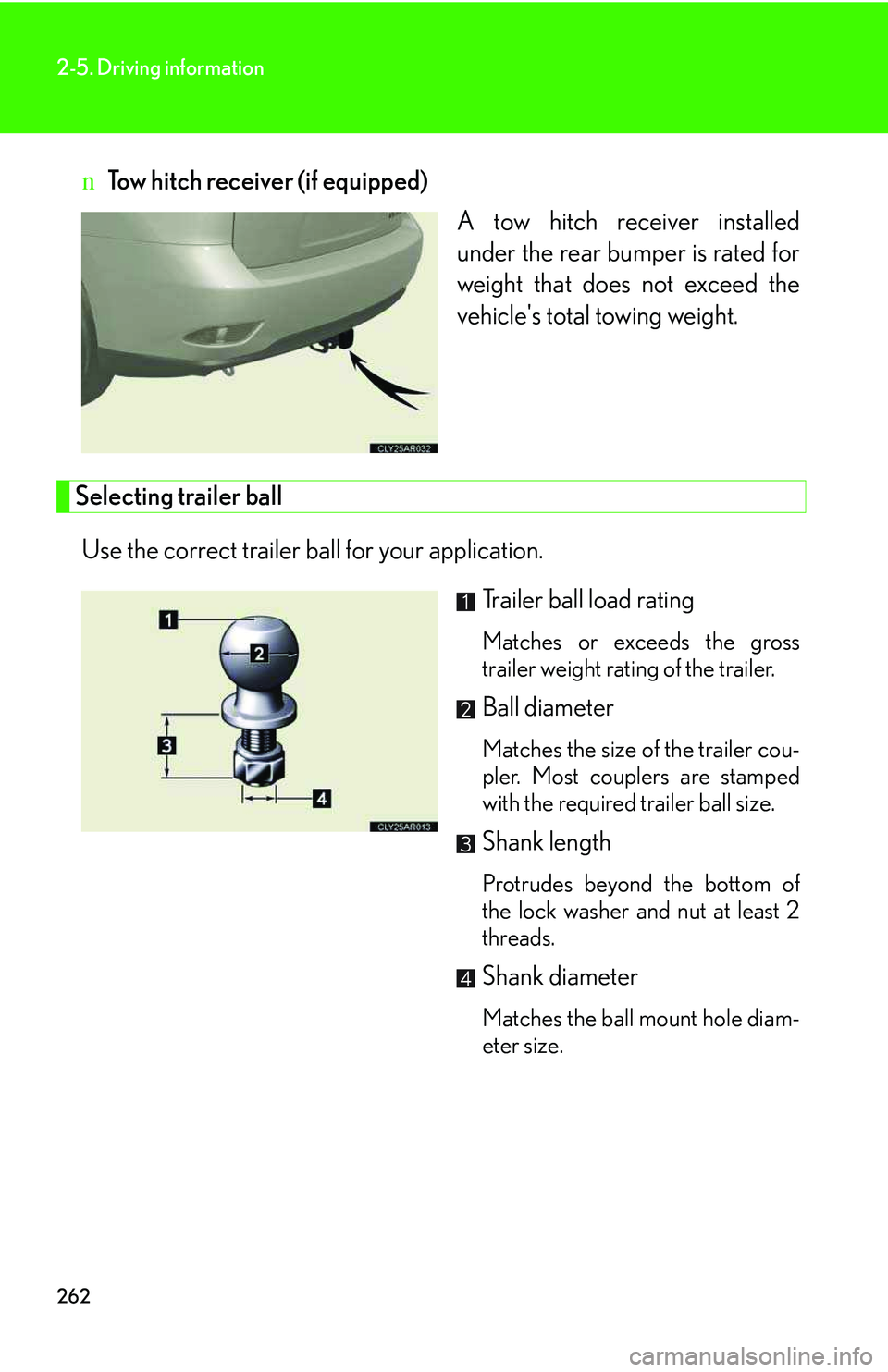
Selecting trailer ball
Use the correct trailer ball for your application.
Trailer ball load rating
Matches or exceeds the gross
trailer weight rating of the trailer.
Ball diameter
Matches the size of the trailer cou-
pler. Most couplers are stamped
with the required trailer ball size.
Shank length
Protrudes beyond the bottom of
the lock washer and nut at least 2
threads.
Shank diameter
Matches the ball mount hole diam-
eter size.
Page 339 of 821
267
2-5. Driving information
2
When driving
CAUTION
nTrailer towing precautions
lFollow all the instructions described in this section. Failure to do so could cause
an accident resulting in death or serious injury.
lExceeding the towing capacity, GVWR or GAWR can cause an accident result-
ing in death or serious personal injuries.
nTo avoid accident or injury
lDo not exceed the trailer hitch assembly weight, gross vehicle weight, gross axle
weight and trailer tongue load capacities.
lNever load more weight in the back than in the front of the trailer. About 60% of
the load should be in the front half of the trailer, and the remaining 40% in the
rear.
lDo not use cruise control when you are towing.
lThe tow hitch receiver installed on your vehicle must never be used on another
vehicle.
lDo not exceed 45 mph (72 km/h) or the posted towing speed limit, whichever is
lower. As instability (swaying) of the towing vehicle-trailer combination increases
as speed increases, exceeding 45 mph (72 km/h) may cause loss of control.
lSlow down and downshift before descending steep or long downhill grades. Do
not make sudden downshifts.
lAvoid holding the brake pedal down too long or applying the brakes too fre-
quently. This could cause the brakes to overheat and result in reduced braking
efficiency.
lDo not tow the vehicle with the compact spare tire installed.
Page 340 of 821
268
2-5. Driving information
CAUTION
nHitches
lIf you wish to install a trailer hitch, contact your Lexus dealer.
lUse only a hitch that conforms to the gross trailer weight requirement.
lFollow the directions supplied by the hitch manufacturer.
lLubricate the hitch ball with a light coat of grease.
lRemove the trailer hitch whenever you are not towing a trailer. After removing
the hitch, seal any mounting hole in the vehicle body to prevent entry of any sub-
stances into the vehicle.
nWhen towing a trailer
lIf the gross trailer weight exceeds 1000 lb. (450 kg), trailer brakes are required.
Lexus recommends trailers with brakes that conform to all applicable federal and
state/provincial regulations.
lNever tap into your vehicle's hydraulic system, as this will lower the vehicle's
braking effectiveness.
lNever tow a trailer without using a safety chain securely attached to both the
trailer and the vehicle. If damage occurs to the coupling unit or hitch ball, there is
danger of the trailer wandering into another lane.
Page 549 of 821
479
4-3. Do-it-yourself maintenance
4
Maintenance and care
Installing tire pressure warning valves and transmitters
When replacing tires or wheels, tire pressure warning valves and trans-
mitters must also be installed.
When new tire pressure warning valves and transmitters are installed,
new tire pressure warning valve and transmitter ID codes must be regis-
tered in the tire pressure warning computer and the tire pressure warning
system must be initialized. Have the tire pressure warning valve and
transmitter ID codes registered by your Lexus dealer. (→P. 4 8 1 )
Initializing the tire pressure warning system
nThe tire pressure warning system must be initialized in the following
circumstances:
lWhen the tire inflation pressure is changed such as when changing
travelling speed or load weight
lWhen changing the tire size
When the tire pressure warning system is initialized, the current tire
inflation pressure is set as the benchmark pressure.
nThe tire pressure warning system
Your Lexus is equipped with a tire pressure warning system that uses
tire pressure warning valves and transmitters to detect low tire infla-
tion pressure before serious problems arise. (→P. 537, 545)
Page 552 of 821
482
4-3. Do-it-yourself maintenance
nMaximum load of tire
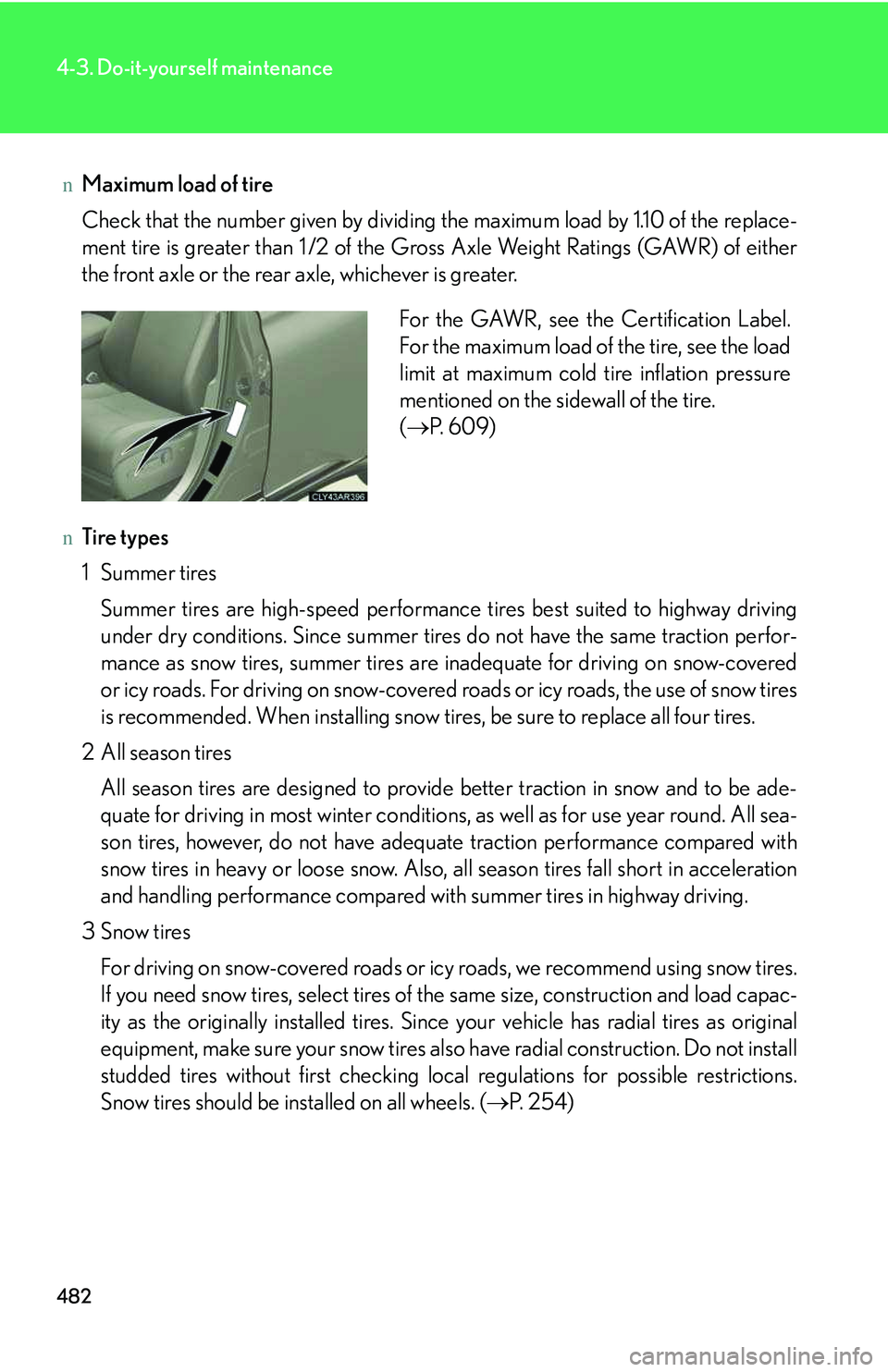
Check that the number given by dividing the maximum load by 1.10 of the replace-
ment tire is greater than 1 /2 of the Gross Axle Weight Ratings (GAWR) of either
the front axle or the rear axle, whichever is greater.
nTire types
1Summer tires
Summer tires are high-speed performance tires best suited to highway driving
under dry conditions. Since summer tires do not have the same traction perfor-
mance as snow tires, summer tires are inadequate for driving on snow-covered
or icy roads. For driving on snow-covered roads or icy roads, the use of snow tires
is recommended. When installing snow tires, be sure to replace all four tires.
2 All season tires
All season tires are designed to provide better traction in snow and to be ade-
quate for driving in most winter conditions, as well as for use year round. All sea-
son tires, however, do not have adequate traction performance compared with
snow tires in heavy or loose snow. Also, all season tires fall short in acceleration
and handling performance compared with summer tires in highway driving.
3Snow tires
For driving on snow-covered roads or icy roads, we recommend using snow tires.
If you need snow tires, select tires of the same size, construction and load capac-
ity as the originally installed tires. Since your vehicle has radial tires as original
equipment, make sure your snow tires also have radial construction. Do not install
studded tires without first checking local regulations for possible restrictions.
Snow tires should be installed on all wheels. (→P. 2 5 4 )
For the GAWR, see the Certification Label.
For the maximum load of the tire, see the load
limit at maximum cold tire inflation pressure
mentioned on the sidewall of the tire.
(→P. 6 0 9 )
Page 559 of 821
489
4-3. Do-it-yourself maintenance
4
Maintenance and care
nTire inflation pressure check interval
You should check tire inflation pressure every two weeks, or at least once a month.
Do not forget to check the spare.
nEffects of incorrect tire inflation pressure
Driving with incorrect tire inflation pressure may result in the following:
lReduced fuel efficiency
lReduced driving comfort and tire life
lReduced safety
lDamage to the drive train
If a tire needs frequent inflating, have it checked by your Lexus dealer.
nInstructions for checking tire pressure
When checking tire inflation pressure, observe the following:
lCheck only when the tires are cold.
If your vehicle has been parked for at least 3 hours and has not been driven for
more than 1 mile or 1.5 km, you will get an accurate cold tire inflation pressure
reading.
lAlways use a tire pressure gauge.
The appearance of the tire can be misleading. In addition, tire inflation pressures
that are even just a few pounds off can degrade ride and handling.
lDo not reduce tire inflation pressure after driving. It is normal for the tire infla-
tion pressure to be higher after driving.
lNever exceed the vehicle capacity weight.
Passengers and luggage weight should be placed so that the vehicle is bal-
anced.
Page 561 of 821
491
4-3. Do-it-yourself maintenance
4
Maintenance and care
Wheels
nWhen replacing wheels
The wheels of your vehicle are equipped with tire pressure warning valves and
transmitters that allow the tire pressure warning system to provide advanced warn-
ing in the event of a loss in tire inflation pressure. Whenever wheels are replaced,
tire pressure warning valves and transmitters must be installed. (→P. 4 7 9 )
If a wheel is bent, cracked or heavily corroded, it should be replaced.
Otherwise, the tire may separate from the wheel or cause a loss of han-
dling control.
nWheel selection
When replacing wheels, care should be taken to ensure that they
are equivalent to those removed in load capacity, diameter, rim
width, and inset*.
Replacement wheels are available at your Lexus dealer.
*: Conventionally referred to as “offset”.
Lexus does not recommend using the following:
lWheels of different sizes or types
lUsed wheels
lBent wheels that have been straightened
nAluminum wheel precautions
lUse only Lexus wheel nuts and wrenches designed for use with
your aluminum wheels.
lWhen rotating, repairing or changing your tires, check that the
wheel nuts are still tight after driving 1000 miles (1600 km).
lBe careful not to damage the aluminum wheels when using tire
chains.
lUse only Lexus genuine balance weights or equivalent and a
plastic or rubber hammer when balancing your wheels.
Page 664 of 821
594
6-1. Specifications
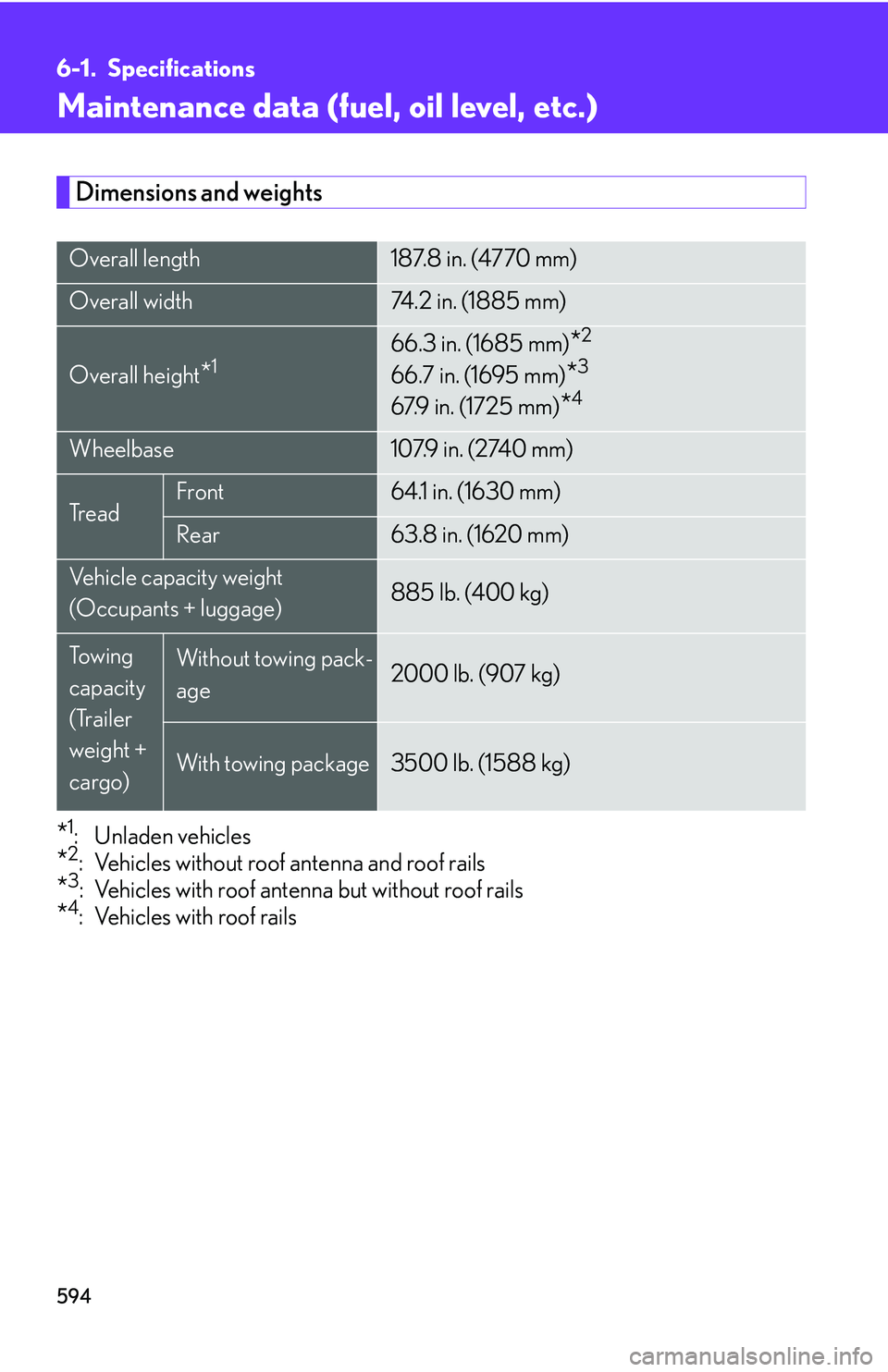
Maintenance data (fuel, oil level, etc.)
Dimensions and weights
*1:Unladen vehicles
*2: Vehicles without roof antenna and roof rails
*3: Vehicles with roof antenna but without roof rails
*4: Vehicles with roof rails
Overall length187.8 in. (4770 mm)
Overall width74.2 in. (1885 mm)
Overall height*166.3 in. (1685 mm)*2
66.7 in. (1695 mm)*3
67.9 in. (1725 mm)*4
Wheelbase107.9 in. (2740 mm)
Tr e a dFront64.1 in. (1630 mm)
Rear63.8 in. (1620 mm)
Vehicle capacity weight
(Occupants + luggage)885 lb. (400 kg)
To w i n g
capacity
(Trailer
weight +
cargo)
Without towing pack-
age2000 lb. (907 kg)
With towing package3500 lb. (1588 kg)
Page 685 of 821
615
6-1. Specifications
6
Vehicle specifications
Warning: The temperature grades for this tire are established for a tire that
is properly inflated and not overloaded.
Excessive speed, underinflation, or excessive loading, either separately or in
combination, can cause heat buildup and possible tire failure.
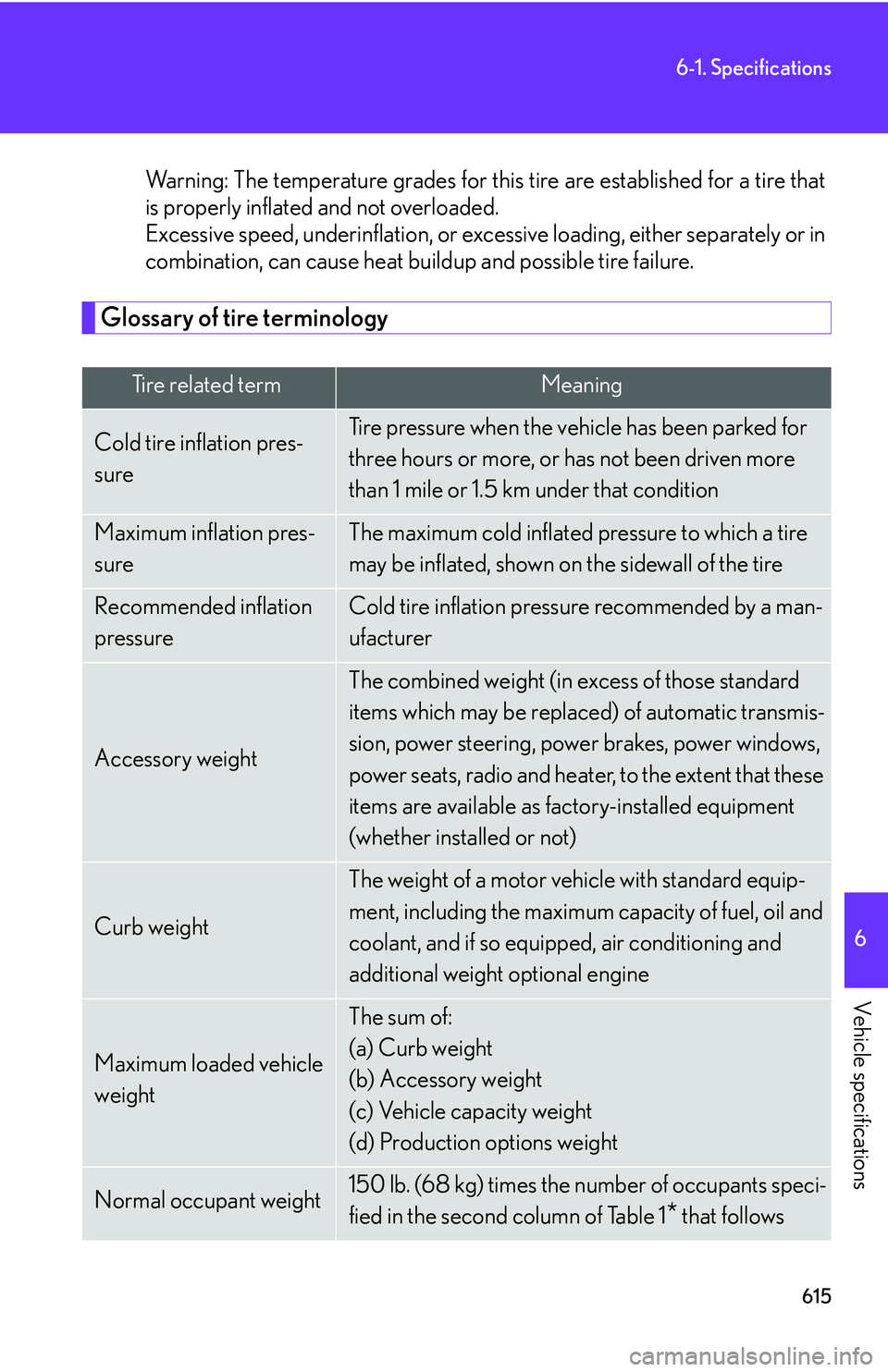
Glossary of tire terminology
Tire related termMeaning
Cold tire inflation pres-
sure
Tire pressure when the vehicle has been parked for
three hours or more, or has not been driven more
than 1 mile or 1.5 km under that condition
Maximum inflation pres-
sure
The maximum cold inflated pressure to which a tire
may be inflated, shown on the sidewall of the tire
Recommended inflation
pressure
Cold tire inflation pressure recommended by a man-
ufacturer
Accessory weight
The combined weight (in excess of those standard
items which may be replaced) of automatic transmis-
sion, power steering, power brakes, power windows,
power seats, radio and heater, to the extent that these
items are available as factory-installed equipment
(whether installed or not)
Curb weight
The weight of a motor vehicle with standard equip-
ment, including the maximum capacity of fuel, oil and
coolant, and if so equipped, air conditioning and
additional weight optional engine
Maximum loaded vehicle
weight
The sum of:
(a) Curb weight
(b) Accessory weight
(c) Vehicle capacity weight
(d) Production options weight
Normal occupant weight150 lb. (68 kg) times the number of occupants speci-
fied in the second column of Table 1* that follows