ESP LEXUS RX350 2011 Service Manual
[x] Cancel search | Manufacturer: LEXUS, Model Year: 2011, Model line: RX350, Model: LEXUS RX350 2011Pages: 821, PDF Size: 13.27 MB
Page 510 of 821
440
3-7. Other interior features
nStolen Vehicle Location
If your vehicle is stolen, Safety Connect can work with local authorities
to assist them in locating and recovering the vehicle. After filing a
police report, call the Safety Connect response center at 1-800-25-
LEXUS (1-800-255-3987) and follow the prompts for Safety Con-
nect to initiate this service.
In addition to assisting law enforcement with recovery of a stolen vehi-
cle, Safety-Connect-equipped vehicle location data may, under cer-
tain circumstances, be shared with third parties to locate your vehicle.
Further information is available at Lexus.com.
nEmergency Assistance Button (“SOS”)
In the event of an emergency on the road, push the “SOS” button to
reach the Safety Connect response center. The answering agent will
determine your vehicle’s location, assess the emergency, and dispatch
the necessary assistance required.
If you accidentally press the “SOS” button, tell the response-center agent
that you are not experiencing an emergency.
nRoadside Assistance
Subscribers can press the “SOS” button to reach a Safety Connect
response-center agent, who can help with a wide range of needs, such
as: towing, flat tire, fuel delivery, etc. For a description of the Roadside
Assistance services and their limitations, please see the Safety Con-
nect Terms and Conditions, which are available at Lexus.com.
Page 518 of 821
448
4-1. Maintenance and care
nCaring for leather areas
Lexus recommends cleaning the interior of the vehicle at least twice a year to main-
tain the quality of the vehicle’s interior.
nShampooing the carpets
There are several commercial foaming-type cleaners available. Use a sponge or
brush to apply the foam. Rub in overlapping circles. Do not apply water. Excellent
results are obtained by keeping the carpet as dry as possible.
nSeat belts
Clean with mild soap and lukewarm water using a cloth or sponge. Also check the
belts periodically for excessive wear, fraying or cuts.
CAUTION
nWater in the vehicle
lDo not splash or spill liquid in the vehicle.
Doing so may cause electrical components etc. to malfunction or catch fire.
lDo not get any of the SRS components or wiring in the vehicle interior wet.
(→P. 111)
An electrical malfunction may cause the airbags to deploy or not function prop-
erly, resulting in death or severe injury.
nCleaning the interior (especially instrument panel)
Do not use polish wax or polish cleaner. The instrument panel may reflect off the
windshield, obstructing the driver's view and leading to an accident, resulting in
death or serious injury.
Page 520 of 821
450
4-2. Maintenance
Maintenance requirements
nRepair and replacement
It is recommended that genuine Lexus parts be used for repair to ensure perfor-
mance of each system. If non-Lexus parts are used in replacement or if a repair
shop other than a Lexus dealer performs repairs, confirm the warranty coverage.
To ensure safe and economical driving, day-to-day care and regular main-
tenance are essential. It is the owner’s responsibility to perform regular
checks. Lexus recommends performing the following maintenance:
nGeneral maintenance
General maintenance should be performed on a daily basis. This
can be done by yourself or by a Lexus dealer.
nScheduled maintenance
Scheduled maintenance should be performed at specified intervals
according to the maintenance schedule.
For details about maintenance items and schedules, refer to the “War-
ranty and Service Guide”, “Owner’s Manual Supplement” or “Scheduled
Maintenance”.
nDo-it-yourself maintenance
You can perform some maintenance procedures yourself.
Please be aware that do-it-yourself maintenance may affect war-
ranty coverage.
The use of Lexus Repair Manuals is recommended.
For details about warranty coverage, refer to the separate “Owner’s
Guide”, “Warranty and Service Guide”, “Owner’s Manual Supplement”
or “Warranty Booklet”.
Page 554 of 821
484
4-3. Do-it-yourself maintenance
nTire pressure warning system certification
TPMS Transmitter FCC ID: PAXPMV107J
IC ID: 3729A-PMV107J
TPMS Receiver FCC ID: HYQ13BCX
IC ID: 1551A-13BCX
For vehicles sold in the U.S.A.
This device complies with part 15 of the FCC Rules. Operation is subject to the fol-
lowing two conditions: (1) This device may not cause harmful interference, and (2)
this device must accept any interference received, including interference that may
cause undesired operation.
FCC WARNING:
Changes or modifications not expressly approved by the party responsible for
compliance could void the user’s authority to operate the equipment.
For vehicles sold in Canada
Operation is subject to the following two conditions: (1) this device may not cause
interference, and (2) this device must accept any interference, including interfer-
ence that may cause undesired operation of the device.
L’utilisation de ce dispositif est autorisée seulement aux deux conditions suivantes:
(1) il ne doit pas produire de brouillage, et (2) l’utilisateur du dispositif doit être prêt
à accepter tout brouillage radioélectrique reçu, même si ce brouillage est
susceptible de compromettre le fonctionnement du dispositif.
Page 612 of 821
5
When trouble arises
543
5-2. Steps to take in an emergency
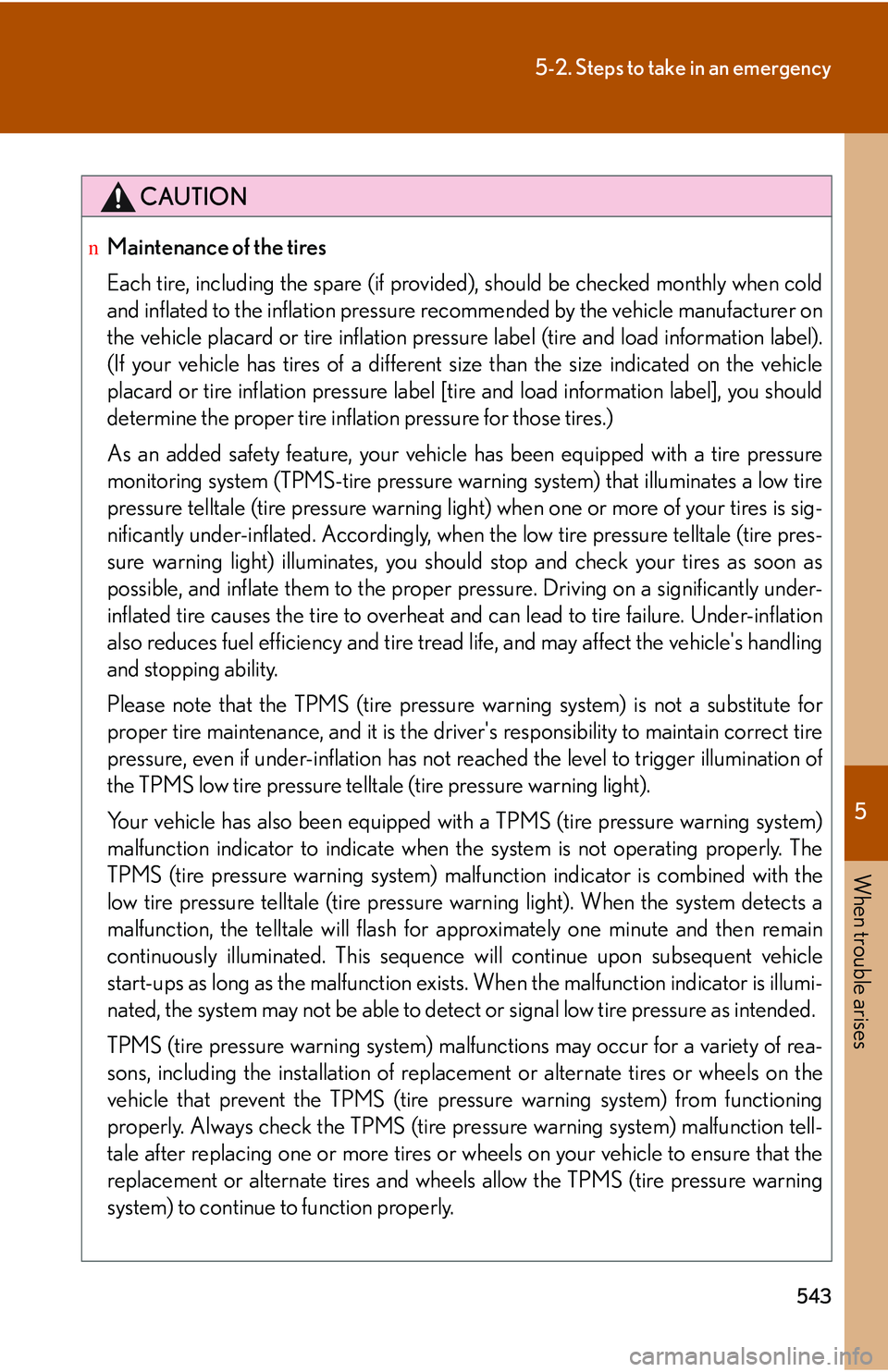
CAUTION
nMaintenance of the tires
Each tire, including the spare (if provided), should be checked monthly when cold
and inflated to the inflation pressure recommended by the vehicle manufacturer on
the vehicle placard or tire inflation pressure label (tire and load information label).
(If your vehicle has tires of a different size than the size indicated on the vehicle
placard or tire inflation pressure label [tire and load information label], you should
determine the proper tire inflation pressure for those tires.)
As an added safety feature, your vehicle has been equipped with a tire pressure
monitoring system (TPMS-tire pressure warning system) that illuminates a low tire
pressure telltale (tire pressure warning light) when one or more of your tires is sig-
nificantly under-inflated. Accordingly, when the low tire pressure telltale (tire pres-
sure warning light) illuminates, you should stop and check your tires as soon as
possible, and inflate them to the proper pressure. Driving on a significantly under-
inflated tire causes the tire to overheat and can lead to tire failure. Under-inflation
also reduces fuel efficiency and tire tread life, and may affect the vehicle's handling
and stopping ability.
Please note that the TPMS (tire pressure warning system) is not a substitute for
proper tire maintenance, and it is the driver's responsibility to maintain correct tire
pressure, even if under-inflation has not reached the level to trigger illumination of
the TPMS low tire pressure telltale (tire pressure warning light).
Your vehicle has also been equipped with a TPMS (tire pressure warning system)
malfunction indicator to indicate when the system is not operating properly. The
TPMS (tire pressure warning system) malfunction indicator is combined with the
low tire pressure telltale (tire pressure warning light). When the system detects a
malfunction, the telltale will flash for approximately one minute and then remain
continuously illuminated. This sequence will continue upon subsequent vehicle
start-ups as long as the malfunction exists. When the malfunction indicator is illumi-
nated, the system may not be able to detect or signal low tire pressure as intended.
TPMS (tire pressure warning system) malfunctions may occur for a variety of rea-
sons, including the installation of replacement or alternate tires or wheels on the
vehicle that prevent the TPMS (tire pressure warning system) from functioning
properly. Always check the TPMS (tire pressure warning system) malfunction tell-
tale after replacing one or more tires or wheels on your vehicle to ensure that the
replacement or alternate tires and wheels allow the TPMS (tire pressure warning
system) to continue to function properly.
Page 684 of 821
614
6-1. Specifications
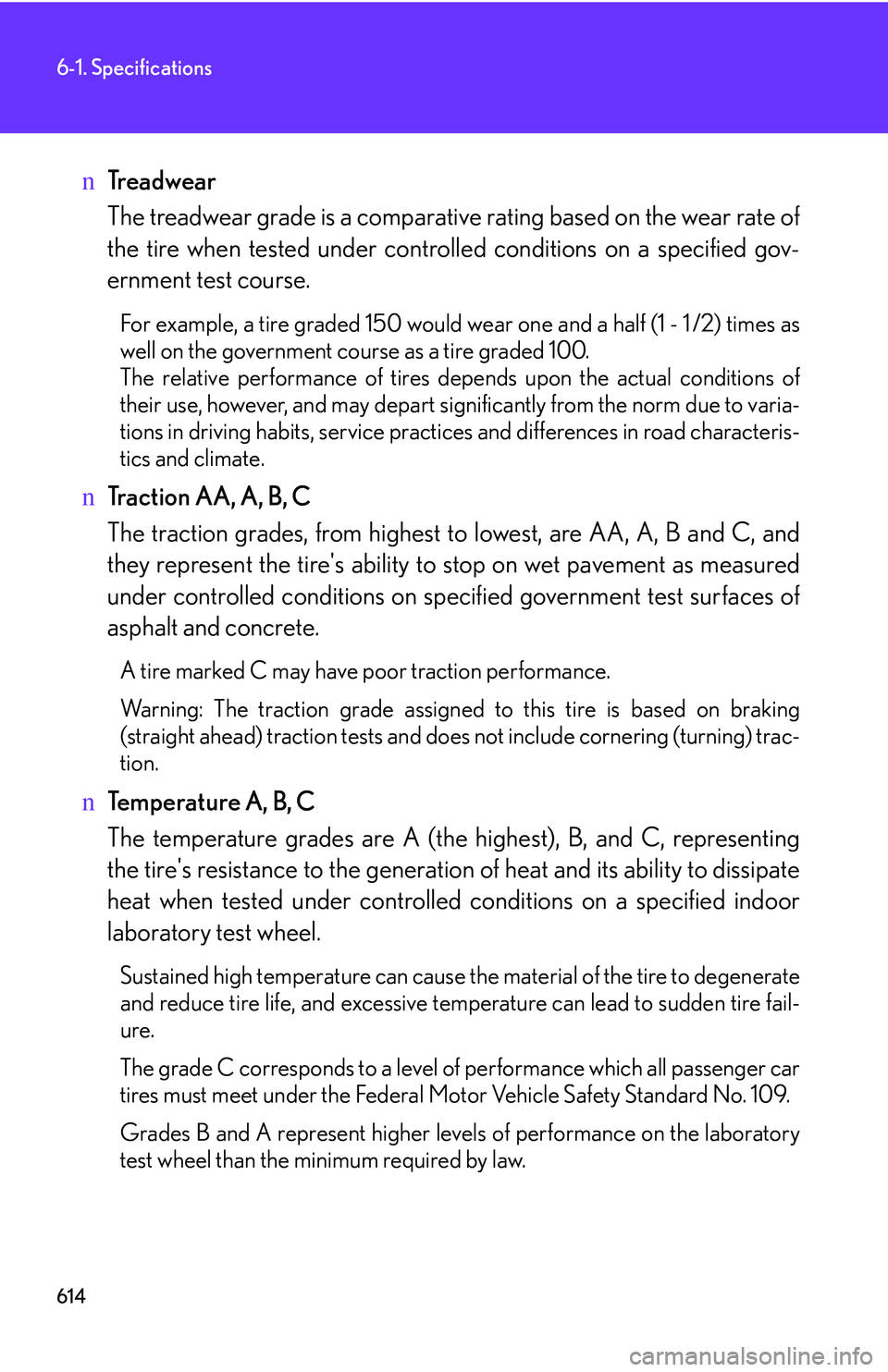
nTreadwear
The treadwear grade is a comparative rating based on the wear rate of
the tire when tested under controlled conditions on a specified gov-
ernment test course.
For example, a tire graded 150 would wear one and a half (1 - 1 /2) times as
well on the government course as a tire graded 100.
The relative performance of tires depends upon the actual conditions of
their use, however, and may depart significantly from the norm due to varia-
tions in driving habits, service practices and differences in road characteris-
tics and climate.
nTraction AA, A, B, C
The traction grades, from highest to lowest, are AA, A, B and C, and
they represent the tire's ability to stop on wet pavement as measured
under controlled conditions on specified government test surfaces of
asphalt and concrete.
A tire marked C may have poor traction performance.
Warning: The traction grade assigned to this tire is based on braking
(straight ahead) traction tests and does not include cornering (turning) trac-
tion.
nTemperature A, B, C
The temperature grades are A (the highest), B, and C, representing
the tire's resistance to the generation of heat and its ability to dissipate
heat when tested under controlled conditions on a specified indoor
laboratory test wheel.
Sustained high temperature can cause the material of the tire to degenerate
and reduce tire life, and excessive temperature can lead to sudden tire fail-
ure.
The grade C corresponds to a level of performance which all passenger car
tires must meet under the Federal Motor Vehicle Safety Standard No. 109.
Grades B and A represent higher levels of performance on the laboratory
test wheel than the minimum required by law.
Page 687 of 821
617
6-1. Specifications
6
Vehicle specifications
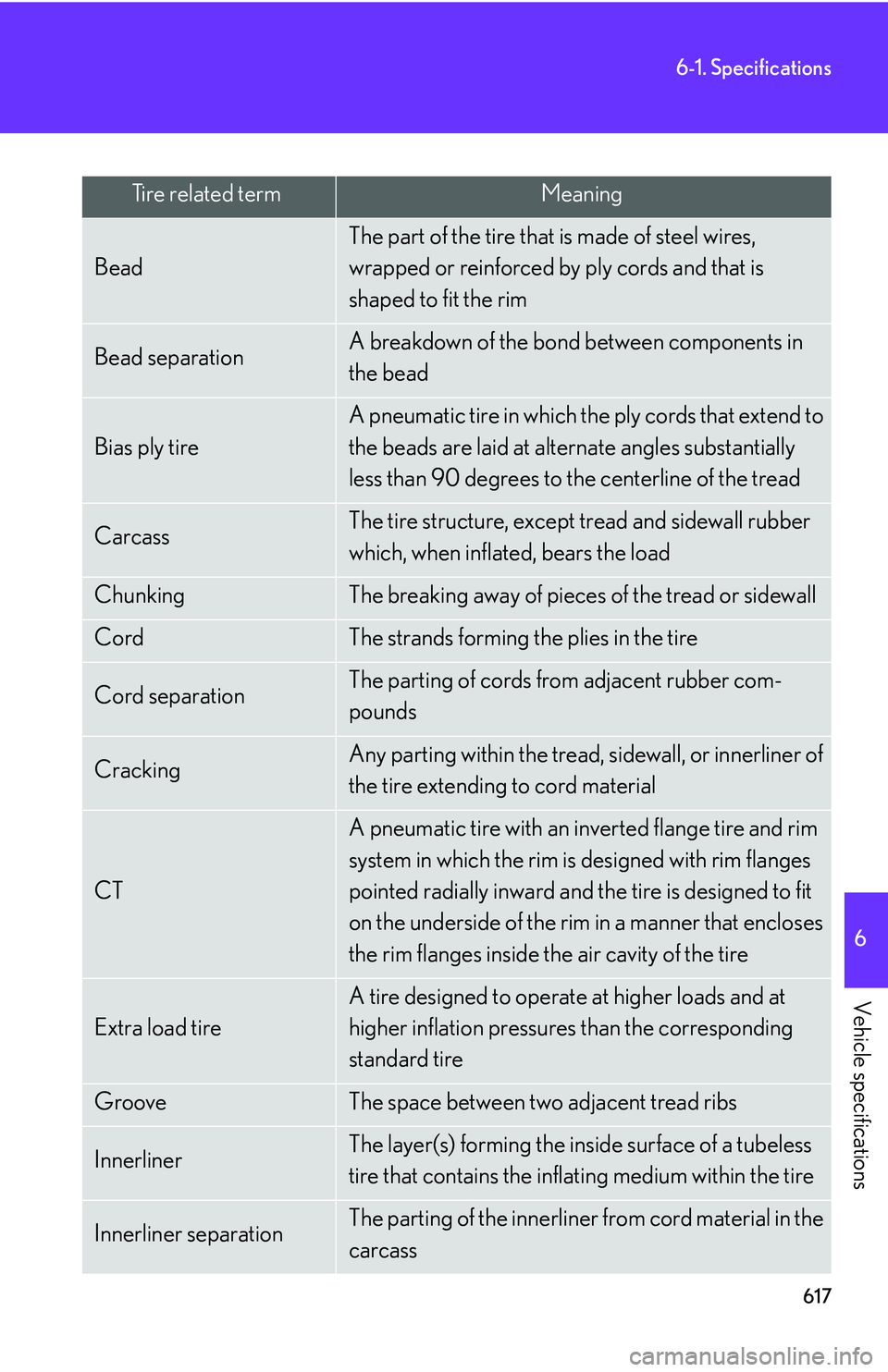
Tire related termMeaning
Bead
The part of the tire that is made of steel wires,
wrapped or reinforced by ply cords and that is
shaped to fit the rim
Bead separationA breakdown of the bond between components in
the bead
Bias ply tire
A pneumatic tire in which the ply cords that extend to
the beads are laid at alternate angles substantially
less than 90 degrees to the centerline of the tread
CarcassThe tire structure, except tread and sidewall rubber
which, when inflated, bears the load
ChunkingThe breaking away of pieces of the tread or sidewall
CordThe strands forming the plies in the tire
Cord separationThe parting of cords from adjacent rubber com-
pounds
CrackingAny parting within the tread, sidewall, or innerliner of
the tire extending to cord material
CT
A pneumatic tire with an inverted flange tire and rim
system in which the rim is designed with rim flanges
pointed radially inward and the tire is designed to fit
on the underside of the rim in a manner that encloses
the rim flanges inside the air cavity of the tire
Extra load tire
A tire designed to operate at higher loads and at
higher inflation pressures than the corresponding
standard tire
GrooveThe space between two adjacent tread ribs
InnerlinerThe layer(s) forming the inside surface of a tubeless
tire that contains the inflating medium within the tire
Innerliner separationThe parting of the innerliner from cord material in the
carcass
Page 689 of 821
619
6-1. Specifications
6
Vehicle specifications
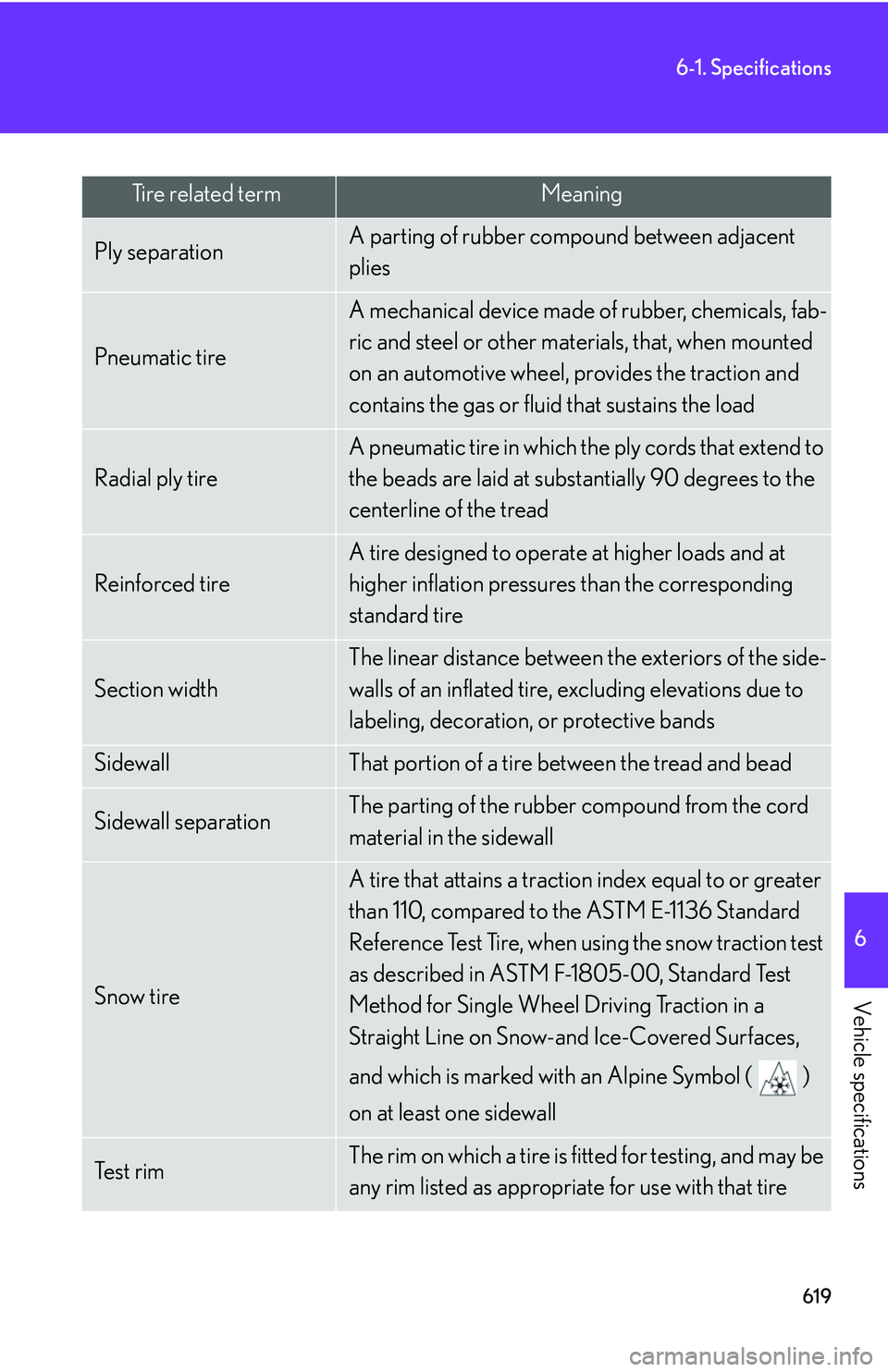
Tire related termMeaning
Ply separationA parting of rubber compound between adjacent
plies
Pneumatic tire
A mechanical device made of rubber, chemicals, fab-
ric and steel or other materials, that, when mounted
on an automotive wheel, provides the traction and
contains the gas or fluid that sustains the load
Radial ply tire
A pneumatic tire in which the ply cords that extend to
the beads are laid at substantially 90 degrees to the
centerline of the tread
Reinforced tire
A tire designed to operate at higher loads and at
higher inflation pressures than the corresponding
standard tire
Section width
The linear distance between the exteriors of the side-
walls of an inflated tire, excluding elevations due to
labeling, decoration, or protective bands
SidewallThat portion of a tire between the tread and bead
Sidewall separationThe parting of the rubber compound from the cord
material in the sidewall
Snow tire
A tire that attains a traction index equal to or greater
than 110, compared to the ASTM E-1136 Standard
Reference Test Tire, when using the snow traction test
as described in ASTM F-1805-00, Standard Test
Method for Single Wheel Driving Traction in a
Straight Line on Snow-and Ice-Covered Surfaces,
and which is marked with an Alpine Symbol ( )
on at least one sidewall
Te s t r i mThe rim on which a tire is fitted for testing, and may be
any rim listed as appropriate for use with that tire
Page 710 of 821
640
ATTENTION
■ Précautions à observer avec les sacs de sécurité gonflables SRS
Respectez les précautions suivantes concernant les sacs de sécurité gonflables
SRS.
À défaut, des blessures graves, voire mortelles, pourraient s'ensuivre.
● Le conducteur et tous les passagers à bord du véhicule doivent porter leur
ceinture de sécurité correctement.
Les sacs de sécurité gonflables SRS sont des dispositifs de protection
complémentaires aux ceintures de sécurité.
● Le sac de sécurité gonflable SRS conducteur se déploie avec une violence
considérable, qui peut être très dangereuse voire mortelle si le conducteur se
trouve très près du sac de sécurité gonflable. L'autorité fédérale chargée de la
sécurité routière aux États-Unis, la NHTSA (National Highway Traffic Safety
Administration) conseille:
La zone à risque du sac de sécurité gonflable conducteur se situant dans les
premiers 2 à 3 in. (50 à 75 mm) de déploiement, vous disposez d'une confortable
marge de sécurité en vous plaçant à 10 in. (250 mm) de votre sac de sécurité
gonflable conducteur. Cette distance est mesurée entre le centre du volant de
direction et votre sternum. Si vous êtes actuellement assis à moins de 10 in. (250
mm), vous pouvez changer votre position de conduite de différentes façons:
Reculez votre siège le plus possible, tout en continuant à pouvoir atteindre
confortablement les pédales.
Inclinez légèrement le dossier du siège.
Bien que les véhicules puissent être différents les uns des autres, la plupart
des conducteurs peuvent s'asseoir à une distance de 10 in. (250 mm), même
avec le siège conducteur complètement avancé, simplement en inclinant un
peu le dossier de siège. Si vous avez des difficultés à voir la route après avoir
incliné votre siège, utilisez un coussin ferme et antidérapant pour vous
rehausser ou, si votre véhicule est équipé du réglage en hauteur du siège,
remontez-le.
Si votre volant de direction est réglable, inclinez-le vers le bas. Ceci a pour
effet de diriger le sac de sécurité gonflable vers votre poitrine plutôt que vers
votre tête et votre cou.
Réglez votre siège selon ces recommandations de la NHTSA, tout en conservant le
contrôle des pédales, du volant de direction et la vue des commandes du tableau
de bord.
Page 714 of 821
644
ATTENTION
■ Précautions à observer avec les sacs de sécurité gonflables SRS
● Ne touchez aucun composant du système immédiatement après le
déclenchement (déploiement) des sacs de sécurité gonflables SRS, car ils sont
alors encore très chauds.
● Si vous avez des difficultés à respirer après le déploiement des sacs de sécurité
gonflables SRS, ouvrez une porte ou une vitre pour faire entrer de l'air frais, ou
bien descendez du véhicule si cela ne présente pas de danger. Essuyez tout
résidu dès que possible afin d'éviter d'éventuelles irritations de la peau.
● Si les parties renfermant les sacs de sécurité gonflables SRS, telles que la
garniture du moyeu de volant et les garnitures de montants avant et arrière,
apparaissent abîmées ou craquelées, faites-les remplacer par votre
concessionnaire Lexus.
● Ne rien disposer sur le siège du passager avant, comme un coussin par exemple.
Le poids du passager s'en trouve réparti sur toute la surface de l'assise, ce qui
empêche le capteur de détecter correctement le poids. En conséquence, le sac
de sécurité gonflable SRS passager avant risque de ne pas se déployer en cas de
choc.