ESP LEXUS RX350 2015 Repair Manual
[x] Cancel search | Manufacturer: LEXUS, Model Year: 2015, Model line: RX350, Model: LEXUS RX350 2015Pages: 886, PDF Size: 11 MB
Page 761 of 886
5
When trouble arises
7615-2. Steps to take in an emergency
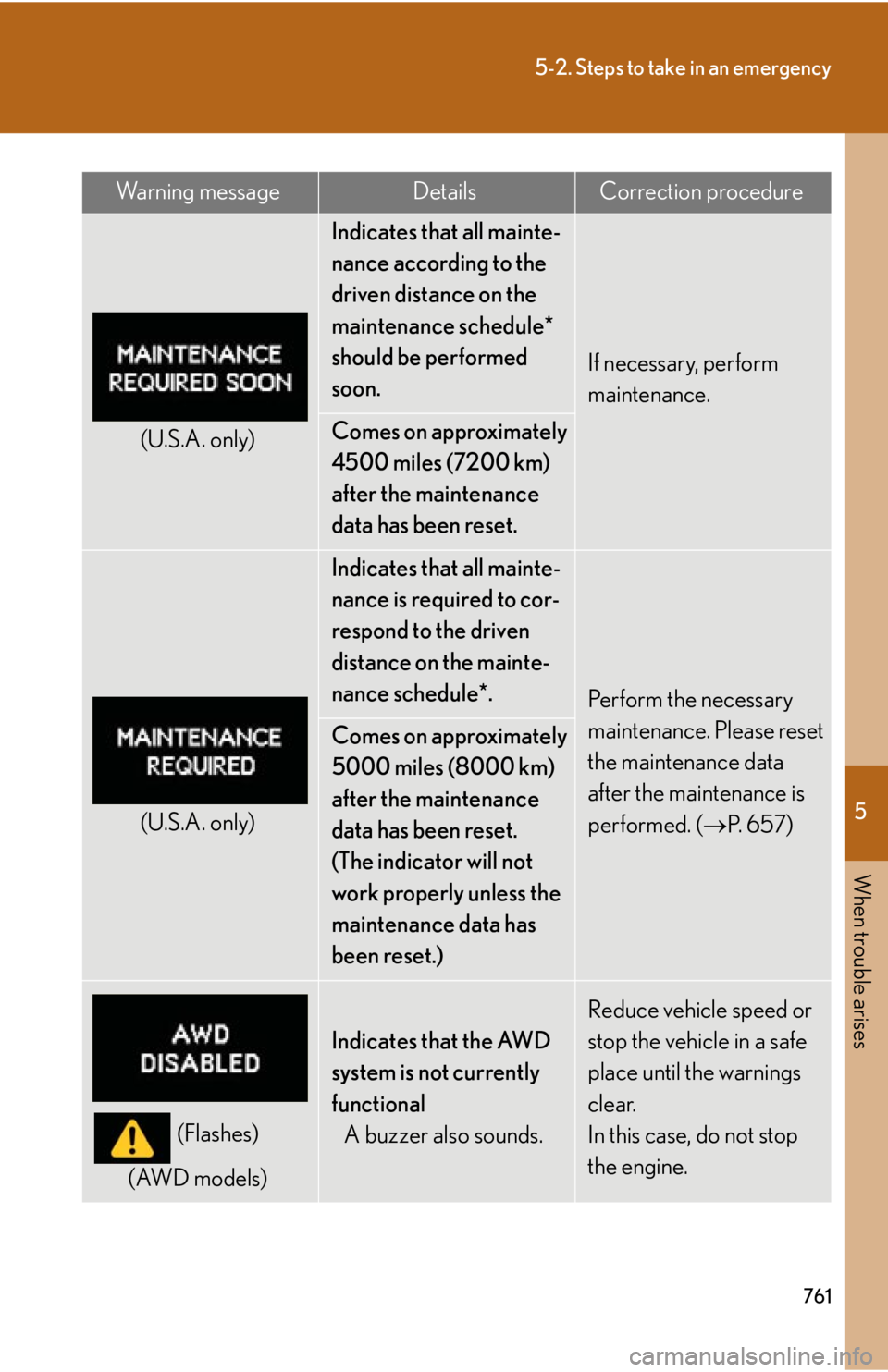
(U.S.A. only) Indicates that all mainte-
nance according to the
driven distance on the
maintenance schedule*
should be performed
soon. If necessary, perform
maintenance.
Comes on approximately
4500 miles (7200 km)
after the maintenance
data has been reset.
(U.S.A. only) Indicates that all mainte-
nance is required to cor-
respond to the driven
distance on the mainte-
nance schedule*.
Perform the necessary
maintenance. Please reset
the maintenance data
after the maintenance is
performed. ( P. 6 5 7 )Comes on approximately
5000 miles (8000 km)
after the maintenance
data has been reset.
(The indicator will not
work properly unless the
maintenance data has
been reset.)
(Flashes)
(AWD models) Indicates that the AWD
system is not currently
functional
A buzzer also sounds. Reduce vehicle speed or
stop the vehicle in a safe
place until the warnings
clear.
In this case, do not stop
the engine.Wa r n i n g m e s s a g e Details Correction procedure
Page 800 of 886
8005-2. Steps to take in an emergency
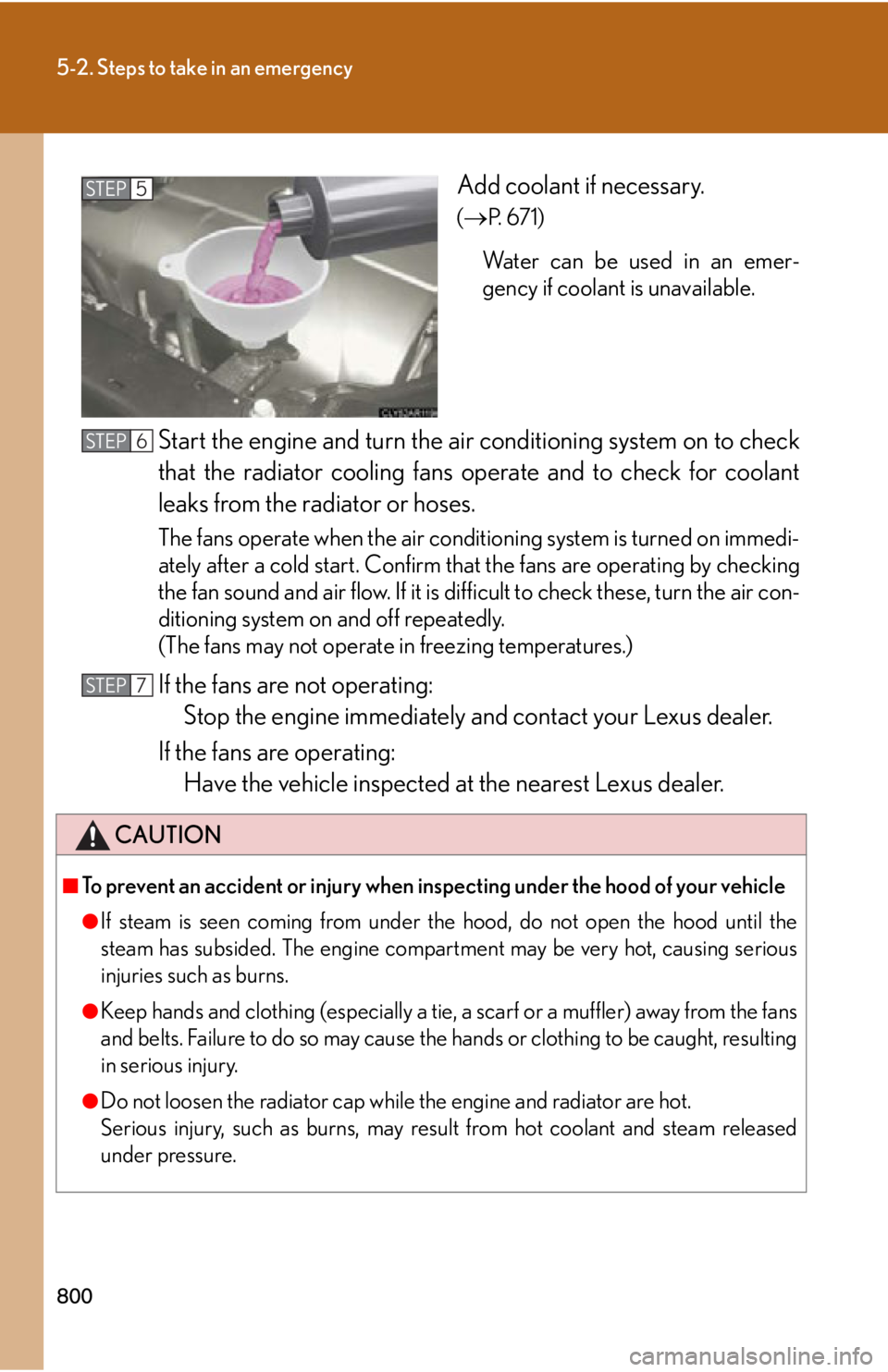
Add coolant if necessary.
(
P. 6 7 1 )
Water can be used in an emer-
gency if coolant is unavailable.
Start the engine and turn the air conditioning system on to check
that the radiator cooling fans op erate and to check for coolant
leaks from the radiator or hoses. The fans operate when the air conditio ning system is turned on immedi-
ately after a cold start. Confirm that the fans are operating by checking
the fan sound and air flow. If it is diff icult to check these, turn the air con-
ditioning system on and off repeatedly.
(The fans may not operate in freezing temperatures.)
If the fans are not operating:
Stop the engine immediately and contact your Lexus dealer.
If the fans are operating:
Have the vehicle inspected at the nearest Lexus dealer.STEP 5
CAUTION■
To prevent an accident or injury when in specting under the hood of your vehicle●
If steam is seen coming from under the hood, do not open the hood until the
steam has subsided. The engine compartm ent may be very hot, causing serious
injuries such as burns.●
Keep hands and clothing (especially a tie, a scarf or a muffler) away from the fans
and belts. Failure to do so may cause the hands or clothing to be caught, resulting
in serious injury.
●
Do not loosen the radiator cap while the engine and radiator are hot.
Serious injury, such as burns, may resu lt from hot coolant and steam released
under pressure.STEP 6
STEP 7
Page 829 of 886

8276-1. Specifications
6
Vehicle specifications ■ Temperature A, B, C
The temperature grades are A (the hi ghest), B, and C, representing
the tire's resistance to the generation of heat and its ability to dissipate
heat when tested under controlled conditions on a specified indoor
laboratory test wheel. Sustained high temperature can cause the material of the tire to degenerate
and reduce tire life, and excessive temperature can lead to sudden tire fail-
ure.
The grade C corresponds to a level of performance which all passenger car
tires must meet under the Federal Mo tor Vehicle Safety Standard No. 109.
Grades B and A represent higher levels of performance on the laboratory
test wheel than the minimum required by law.
Warning: The temperature grades for this tire are established for a tire that
is properly inflated and not overloaded.
Excessive speed, underinflation, or excess ive loading, either separately or in
combination, can cause heat build up and possible tire failure.
Page 832 of 886
8306-1. Specifications
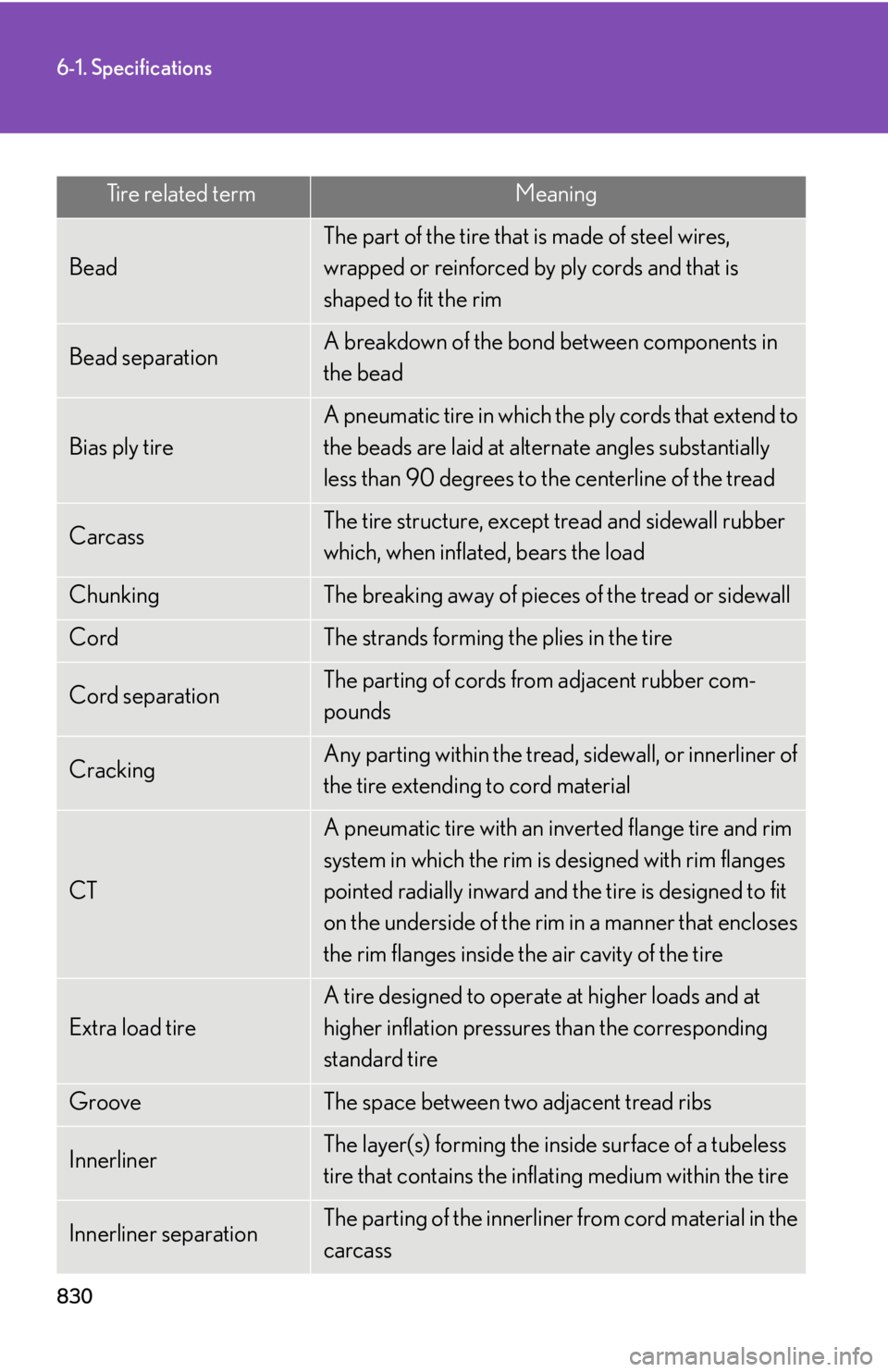
Tire related term Meaning
Bead The part of the tire that is made of steel wires,
wrapped or reinforced by ply cords and that is
shaped to fit the rim
Bead separation A breakdown of the bond between components in
the bead
Bias ply tire A pneumatic tire in which the ply cords that extend to
the beads are laid at alternate angles substantially
less than 90 degrees to the centerline of the tread
Carcass The tire structure, except tread and sidewall rubber
which, when inflated, bears the load
Chunking The breaking away of pieces of the tread or sidewall
Cord The strands forming the plies in the tire
Cord separation The parting of cords from adjacent rubber com-
pounds
Cracking Any parting within the tread, sidewall, or innerliner of
the tire extending to cord material
CT A pneumatic tire with an inverted flange tire and rim
system in which the rim is designed with rim flanges
pointed radially inward and the tire is designed to fit
on the underside of the rim in a manner that encloses
the rim flanges inside the air cavity of the tire
Extra load tire A tire designed to operate at higher loads and at
higher inflation pressures than the corresponding
standard tire
Groove The space between two adjacent tread ribs
Innerliner The layer(s) forming the inside surface of a tubeless
tire that contains the inflating medium within the tire
Innerliner separation The parting of the innerliner from cord material in the
carcass
Page 834 of 886
8326-1. Specifications
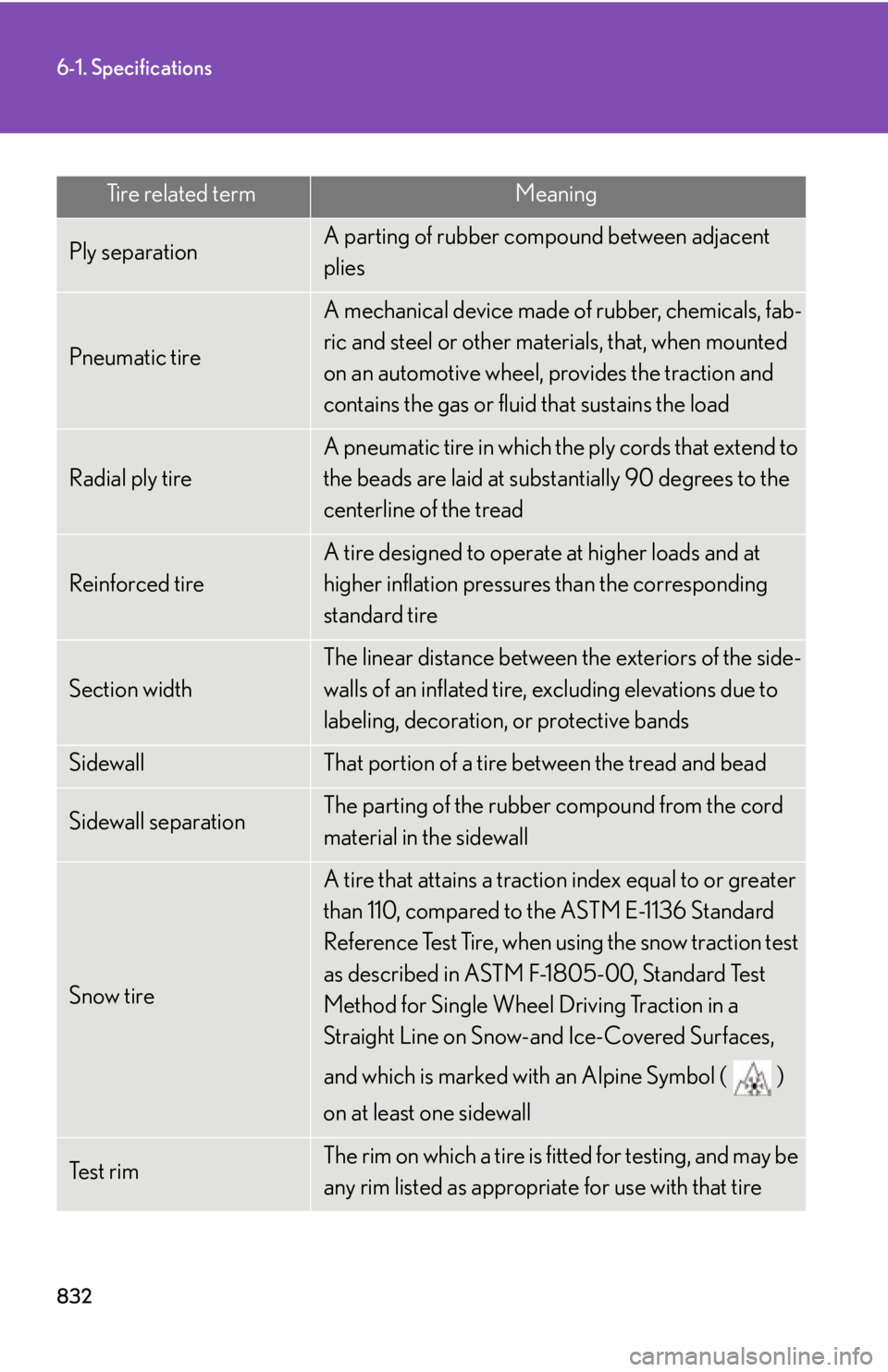
Tire related term Meaning
Ply separation A parting of rubber comp ound between adjacent
plies
Pneumatic tire A mechanical device made of rubber, chemicals, fab-
ric and steel or other mate rials, that, when mounted
on an automotive wheel, provides the traction and
contains the gas or fluid that sustains the load
Radial ply tire A pneumatic tire in which the ply cords that extend to
the beads are laid at substantially 90 degrees to the
centerline of the tread
Reinforced tire A tire designed to operate at higher loads and at
higher inflation pressures than the corresponding
standard tire
Section width The linear distance between the exteriors of the side-
walls of an inflated tire, excluding elevations due to
labeling, decoration, or protective bands
Sidewall That portion of a tire between the tread and bead
Sidewall separation The parting of the rubber compound from the cord
material in the sidewall
Snow tire A tire that attains a traction index equal to or greater
than 110, compared to the ASTM E-1136 Standard
Reference Test Tire, when using the snow traction test
as described in ASTM F-1805-00, Standard Test
Method for Single Wheel Driving Traction in a
Straight Line on Snow-and Ice-Covered Surfaces,
and which is marked with an Alpine Symbol (
)
on at least one sidewall
Te s t r i m The rim on which a tire is fitted for testing, and may be
any rim listed as appropriate for use with that tire
Page 859 of 886
8577
For owners ATTENTION■
Précautions avec les coussins gonflables SRS
Respectez les précautions suivantes avec les coussins gonflables SRS.
Autrement, des blessures graves, voire mortelles, pourraient s’ensuivre. ●
Le conducteur et les passagers du véhicule doivent porter correctement leur
ceinture de sécurité.
Les coussins gonflables SRS sont des dispositifs supplémentaires à utiliser avec
les ceintures de sécurité.●
Le coussin gonflable SRS conducteur se déploie avec une violence considérable,
qui peut être très dangereuse, voire mortelle, si le conducteur se trouve très près
du coussin gonflable . L’autorité fédérale chargée de la sécurité routière aux
États-Unis, la “NHTSA” (National Highway Traffic Safety Administration)
conseille:
La zone à risque du coussin gonflable conducteur se situant dans les premiers 2 à
3 in. (50 - 75 mm) de déploiement, placez-vous à 10 in. (250 mm) de votre
coussin gonflable conducteur vous garantit une marge de sécurité suffisante.
Cette distance est à mesurer entre l’axe du volant et le sternum. Si vous êtes assis
à moins de 10 in. (250 mm), vous pouvez changer votre position de conduite de
plusieurs façons:
Reculez votre siège le plus possible, de manière à pouvoir encore atteindre
confortablement les pédales.
Inclinez légèrement le dossier du siège.
Bien que les véhicules puissent être différents les uns des autres, la plupart
des conducteurs peuvent s’asseoir à une distance de 10 in. (250 mm), même
avec le siège conducteur complètement avancé, simplement en inclinant un
peu le dossier de siège. Si vous avez des difficultés à voir la route après avoir
incliné votre siège, utilisez un coussin ferme et antidérapant pour vous
rehausser ou, si votre véhicule est équipé du réglage en hauteur du siège,
remontez-le.
Si votre volant est réglable, inclinez-le vers le bas. Cela a pour effet d’orienter
le coussins gonflables en direction de votre poitrine plutôt que de votre tête
et de votre cou.
Réglez votre siège selon ces recommandations de la NHTSA, tout en conservant le
contrôle des pédales, du volant et la vue des commandes du tableau de bord.
Page 863 of 886
8617
For owners ATTENTION■
Précautions avec les coussins gonflables SRS ●
Si vous avez des difficultés à respirer après le déploiement des coussins
gonflables SRS, ouvrez une porte ou une vitre pour faire entrer de l’air frais, ou
bien descendez du véhicule si cela ne présente pas de danger. Essuyez tout
résidu dès que possible afin d’éviter d’éventuelles irritations de la peau. ●
Si les parties renfermant les coussins gonflables SRS, telles que la garniture du
moyeu de volant et les garnitures de montants avant et arrière, apparaissent
abîmées ou craquelées, faites-les remplacer par votre concessionnaire Lexus.●
Ne placez rien sur le siège du passager avant, comme un coussin par exemple.
Cela a pour conséquence de répartir le poids du passager sur toute la surface du
siège, ce qui empêche le capteur de détecter correctement le poids du passager.
En conséquence, le coussin gonflable SRS du passager avant risque de ne pas se
déployer en cas de choc.