park assist LEXUS RX350 2015 Owners Manual
[x] Cancel search | Manufacturer: LEXUS, Model Year: 2015, Model line: RX350, Model: LEXUS RX350 2015Pages: 886, PDF Size: 11 MB
Page 2 of 886
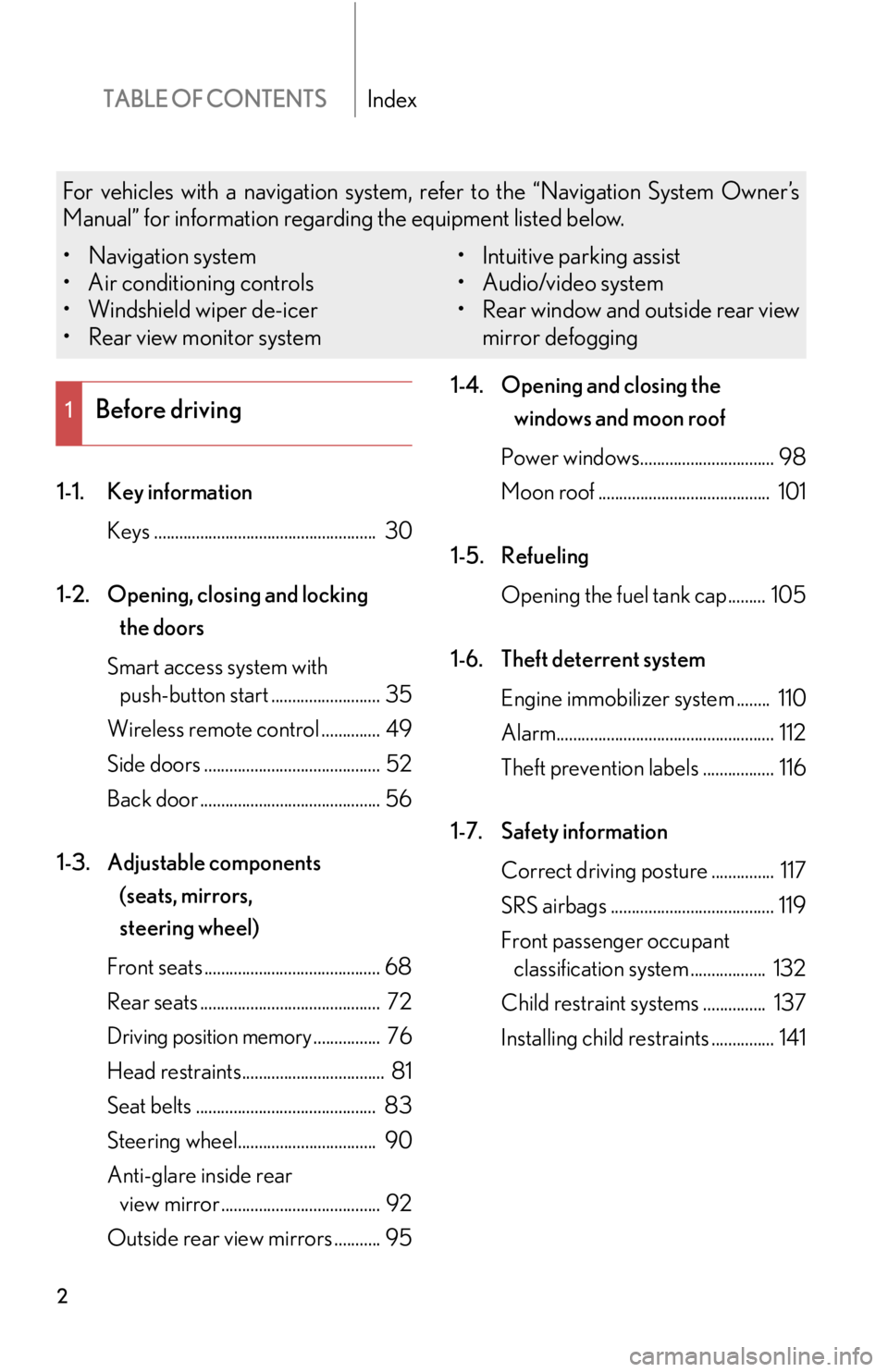
TABLE OF CONTENTS Index
21-1. Key information
Keys ..................................................... 30
1-2. Opening, closing and locking
the doors
Smart access system with
push-button start .......................... 35
Wireless remote control .............. 49
Side doors .......................................... 52
Back door ........................................... 56
1-3. Adjustable components
(seats, mirrors,
steering wheel)
Front seats .......................................... 68
Rear seats ........................................... 72
Driving position memory ................ 76
Head restraints.................................. 81
Seat belts ........................................... 83
Steering wheel................................. 90
Anti-glare inside rear
view mirror ...................................... 92
Outside rear view mirrors ........... 95 1-4. Opening and closing the
windows and moon roof
Power windows................................ 98
Moon roof ......................................... 101
1-5. Refueling
Opening the fuel tank cap......... 105
1-6. Theft deterrent system
Engine immobilizer system ........ 110
Alarm.................................................... 112
Theft prevention labels ................. 116
1-7. Safety information
Correct driving posture ............... 117
SRS airbags ....................................... 119
Front passenger occupant
classification system .................. 132
Child restraint sy stems ............... 137
Installing child restraints ............... 1411
Before drivingFor vehicles with a navigation system, refer to the “Navigation System Owner’s
Manual” for information regarding the equipment listed below.
• Navigation system
• Air conditioning controls
• Windshield wiper de-icer
• Rear view monitor system • Intuitive parking assist
• Audio/video system
• Rear window and outside rear view
mirror defogging
Page 3 of 886

1
2
3
4
5
6
7
32-1. Driving procedures
Driving the vehicle ........................ 154
Engine (ignition) switch .............. 165
Automatic transmission
(6-speed models) ........................ 171
Automatic transmission
(8-speed models) ...................... 178
Turn signal lever ............................ 187
Parking brake ................................. 189
Horn.................................................... 190
2-2. Instrument cluster
Gauges and meters ....................... 191
Indicators and warning
lights................................................. 194
Multi-information display......... 200
Head-up display ........................... 206
2-3. Operating the lights and
windshield wipers
Headlight switch .............................. 211
Fog light switch .............................. 215
Windshield wipers and
washer.............................................. 217
Rear window wiper and
washer............................................ 224
Headlight cleaner switch .......... 226 2-4. Using other driving systems
Cruise control ............................... 227
Dynamic radar cruise
control............................................ 232
Intuitive parking assist ................ 245
Rear view monitor system
(rear view mirror-attached
type) ................................................ 255
Rear view monitor system
(vehicles with the Lexus
Display Audio system) ............ 264
Driving assist systems................. 269
All-wheel drive lock switch ...... 275
Hill-start assist control ............... 276
Pre-Collision System.................. 278
BSM (Blind Spot Monitor) ....... 286
2-5. Driving information
Utility vehicle pre cautions ........ 292
Cargo and luggage ..................... 296
Vehicle load limits ......................... 301
Winter driving tips ....................... 302
Trailer towing ................................ 306
Dinghy towing ............................... 3232
When driving
Page 122 of 886

1221-7. Safety information
Your vehicle is equipped with AD VANCED AIRBAGS designed based
on the US motor vehicl e safety standards (FMV SS208). The airbag sen-
sor assembly (ECU) controls airbag deployment based on information
obtained from the sensors etc. show n in the system components diagram
above. This information includes cras h severity and occupant informa-
tion. As the airbags deploy, a chemica l reaction in the infla tors quic kly fills
the airbags with non-toxi c gas to help restrain th e motion of the occu-
pants.■
If the SRS airbags deploy (inflate) ●
Bruising and slight abrasion s may result from contact with a deploying (inflating)
SRS airbag.●
A loud noise and white powder will be emitted.●
Parts of the airbag module (steering wheel hub, airbag cover and inflator) as
well as the seats, parts of the front and rear pillars, and roof side rails, may be hot
for several minutes. The airbag itself may also be hot.●
The windshield may crack.●
For Safety Connect subscribers, if the SR S airbags deploy or in the event of a
severe rear-end collision, the system is designed to send an emergency call to
the response center, notifying them of the vehicle’s location (without needing to
push the “SOS” button) and an agent will attempt to speak with the occupants
to ascertain the level of emergency and assistance required. If the occupants
are unable to communicate, the agent automatically treats the call as an emer-
gency and helps to dispatch the necessary emergency services. ( P. 6 4 2 )■
SRS airbag deployment conditions (SRS front airbags) ●
The SRS front airbags will deploy in the event of an impact that exceeds the
set threshold level (the level of force corresponding to an approximately 12 -
18 mph [20 - 30 km/h] frontal collision with a fixed wall that does not move or
deform).
However, this threshold velocity will be considerably higher in the following situa-
tions:
• If the vehicle strikes an object, such as a parked vehicle or sign pole, which
can move or deform on impact
• If the vehicle is involved in an underride collision, such as a collision in which
the front of the vehicle “underrides”, or goes under, the bed of a truck
Page 153 of 886
When driving
2
1532-1. Driving procedures
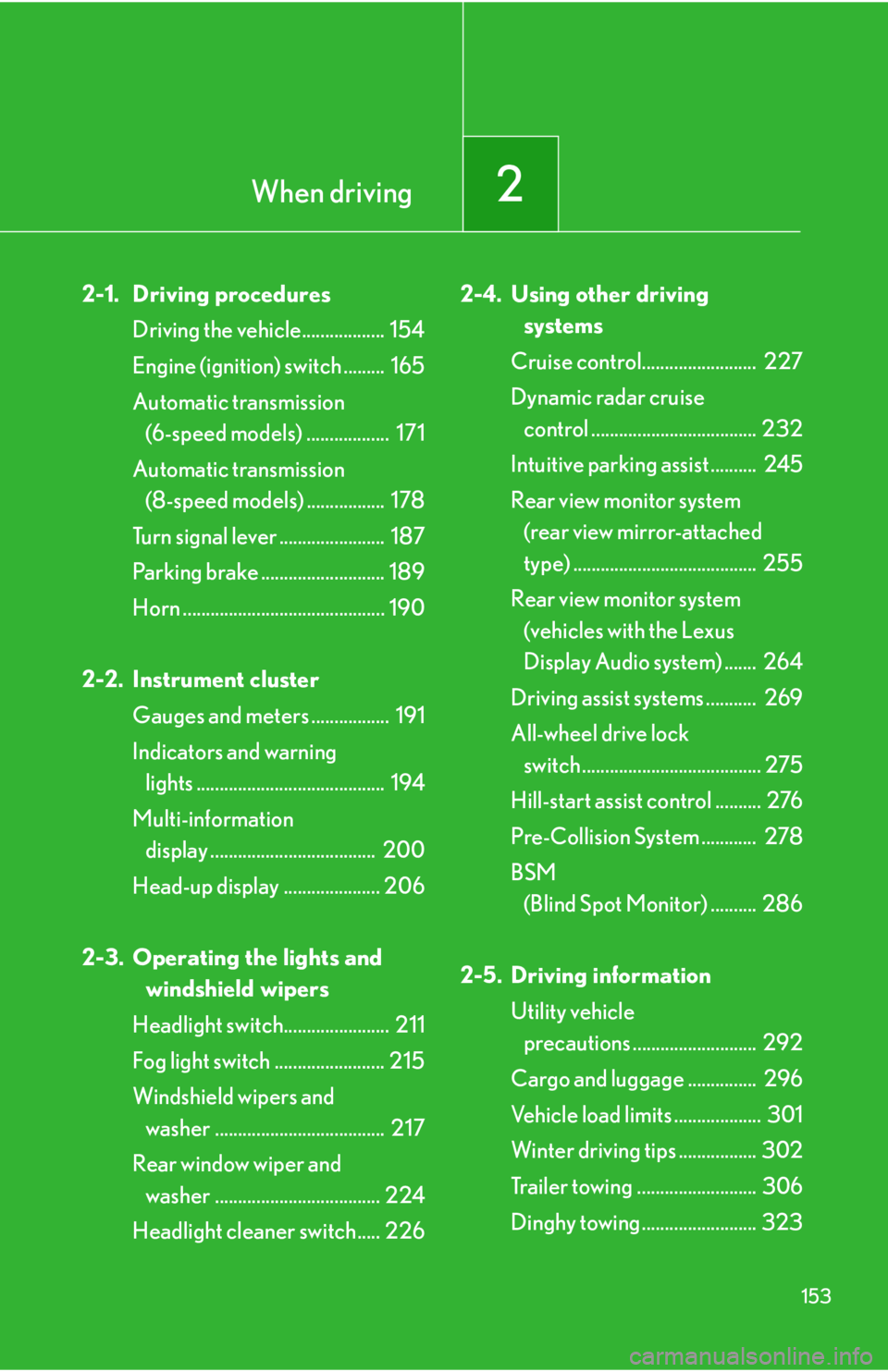
Driving the vehicle.................. 154
Engine (ignition) switch ......... 165
Automatic transmission
(6-speed models) .................. 171
Automatic transmission
(8-speed models) ................. 178
Turn signal lever ....................... 187
Parking brake ........................... 189
Horn ............................................ 190
2-2. Instrument cluster
Gauges and meters ................. 191
Indicators and warning
lights ......................................... 194
Multi-information
display .................................... 200
Head-up display ..................... 206
2-3. Operating the lights and
windshield wipers
Headlight switch....................... 211
Fog light switch ........................ 215
Windshield wipers and
washer ..................................... 217
Rear window wiper and
washer .................................... 224
Headlight cleaner switch..... 226 2-4. Using other driving
systems
Cruise control......................... 227
Dynamic radar cruise
control .................................... 232
Intuitive parking assist .......... 245
Rear view monitor system
(rear view mirror-attached
type) ........................................ 255
Rear view monitor system
(vehicles with the Lexus
Display Audio system) ....... 264
Driving assist systems ........... 269
All-wheel drive lock
switch ....................................... 275
Hill-start assist control .......... 276
Pre-Collision System ............ 278
BSM
(Blind Spot Monitor) .......... 286
2-5. Driving information
Utility vehicle
precautions ........................... 292
Cargo and luggage ............... 296
Vehicle load limits ................... 301
Winter driving tips ................. 302
Trailer towing .......................... 306
Dinghy towing ......................... 323
Page 158 of 886

1582-1. Driving procedures
CAUTION●
Do not shift the shift lever to R while the vehicle is moving forward.
Doing so can damage the transmission and may result in a loss of vehicle control.●
Do not shift the shift lever to D while the vehicle is moving backward.
Doing so can damage the transmission and may result in a loss of vehicle control.●
Moving the shift lever to N while the vehicle is moving will disengage the engine
from the transmission. Engine braking is not available when N is selected.●
During normal driving, do not turn off the engine. Turning the engine off while
driving will not cause loss of steering or braking control, but the power assist to
these systems will be lost. This will make it more difficult to steer and brake, so you
should pull over and stop the vehicle as soon as it is safe to do so.
However, in the event of an emergency, such as if it becomes impossible to stop
the vehicle in the normal way: P. 8 0 4●
Use engine braking (downshift) to maintain a safe speed when driving down a
steep hill.
Using the brakes continuously may cause the brakes to overheat and lose effec-
tiveness. ( P. 171, 178)●
When stopped on an incline, use the brake pedal and parking brake to prevent
the vehicle from rolling backward or forward, causing an accident. ●
Do not adjust the position of the steering wheel, the seat, or the inside or outside
rear view mirrors while driving.
Doing so may result in a loss of vehicle control that can cause accidents, resulting
in death or serious injury.●
Always check that all passengers' arms, heads or other parts of their body are not
outside the vehicle, as this may result in death or serious injury.●
Do not drive in excess of the speed limit. Even if the legal speed limit permits it, do
not drive over 85 mph (140 km/h) unless your vehicle has high-speed capability
tires. Driving over 85 mph (140 km/h) may result in tire failure, loss of control and
possible injury. Be sure to consult a tire dealer to determine whether the tires on
your vehicle are high-speed capability tires or not before driving at such speeds.
Page 162 of 886

1622-1. Driving procedures
CAUTION■
Exhaust gases
Exhaust gases include harmfu l carbon monoxide (CO) th at is colorless and odor-
less. Inhaling exhaust gases may lead to death or a serious health hazard. ●
If the vehicle is in a poorly ventilated ar ea, stop the engine. In a closed area, such
as a garage, exhaust gases may collect and enter the vehicle. This may lead to
death or a serious health hazard.●
The exhaust system should be checked occasionally. If there is a hole or crack
caused by corrosion, damage to a joint or abnormal exhaust noise, be sure to
have the vehicle inspected and repaired by your Lexus dealer . Failure to do so
may allow exhaust gases to enter the vehicl e, resulting in death or a serious health
hazard.■
When taking a nap in the vehicle
Always turn the engine off. Otherwise, if you accidentally move the shift lever or
depress the accelerator pedal, this could cause an accident or fire due to engine
overheating. Additionally, if the vehicle is parked in a poorly ventilated area, exhaust
gases may collect and enter th e vehicle, leading to death or a serious health hazard.■
When braking the vehicle ●
When the brakes are wet, drive more cautiously.
Braking distance increases when the brakes are wet, and this may cause one side
of the vehicle to brake differently than the other side. Also, the parking brake may
not securely hold the vehicle.●
If the power brake assist function does not operate, do not follow other vehicles
closely and avoid hills or sharp turns that require braking.
In this case, braking is still possible, but the brake pedal should be depressed
more firmly than usual. Also, the braking distance will increase. Have your brakes
fixed immediately.●
Do not pump the brake pedal if the engine stalls.
Each push on the brake pedal uses up the reserve for the power-assisted brakes.
●
The brake system consists of 2 individual hydraulic systems; if one of the systems
fails, the other will still operate. In this case, the brake pedal should be depressed
more firmly than usual and the braking distance will increase.
Have your brakes fixed immediately.
Page 197 of 886
1972-2. Instrument cluster
2
When driving ■ Indicators
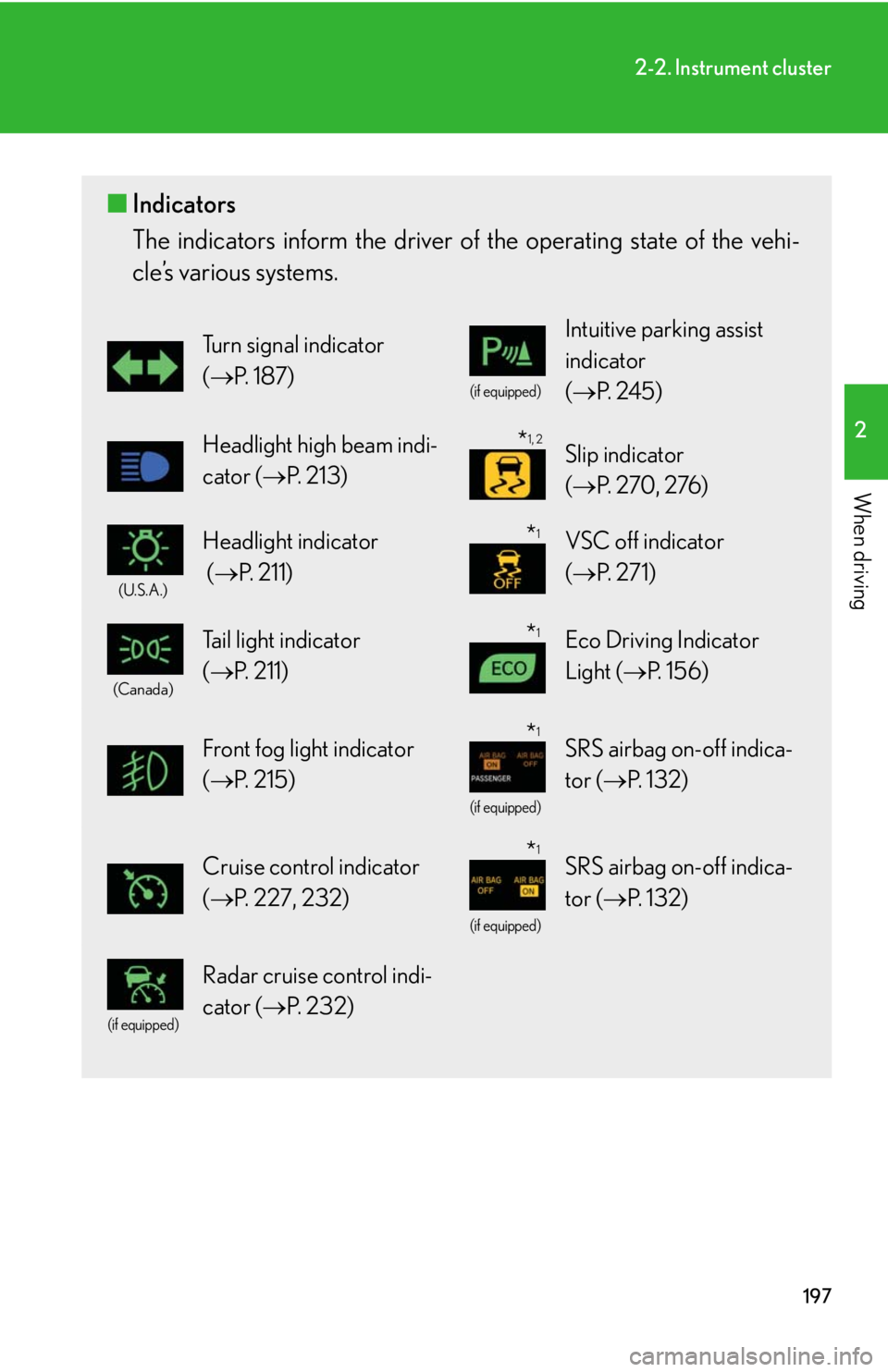
The indicators inform the driver of th e operating state of the vehi-
cle’s various systems. Turn signal indicator
( P. 1 8 7 ) (if equipped)
Intuitive parking assist
indicator
( P. 2 4 5 )
Headlight high beam indi-
cator ( P. 2 1 3 ) Slip indicator
( P. 270, 276)(U.S.A.)
Headlight indicator
( P. 2 1 1 ) VSC off indicator
( P. 2 7 1 )(Canada)
Tail light indicator
( P. 211) Eco Driving Indicator
Light ( P. 1 5 6 )
Front fog light indicator
( P. 2 1 5 ) (if equipped)
SRS airbag on-off indica-
tor ( P. 1 3 2 )
Cruise control indicator
( P. 227, 232) (if equipped)
SRS airbag on-off indica-
tor ( P. 1 3 2 ) (if equipped)
Radar cruise control indi-
cator ( P. 232) * 1, 2
* 1
* 1
* 1
* 1
Page 202 of 886
2022-2. Instrument cluster
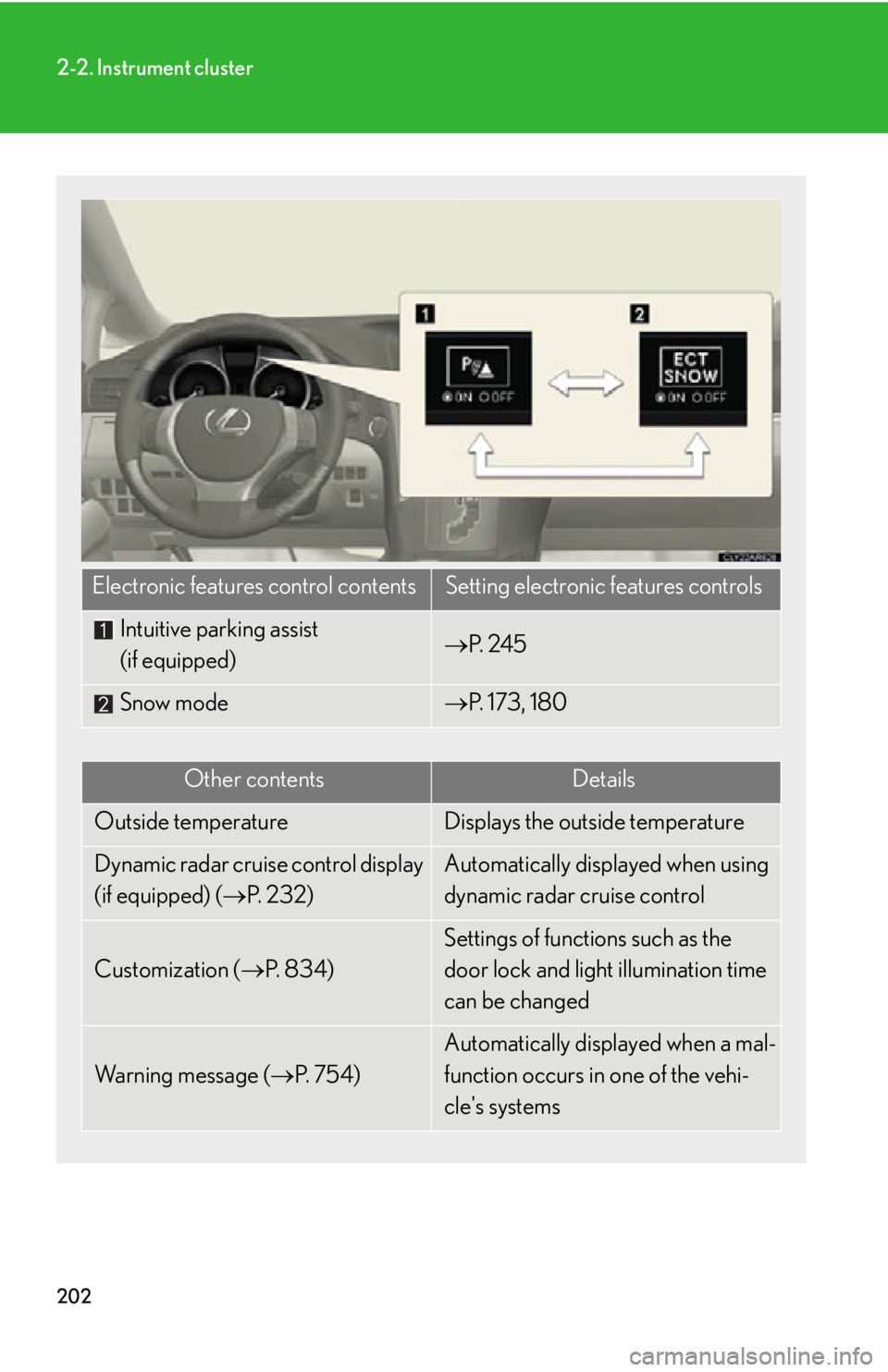
Electronic features control contents Setting electronic features controls
Intuitive parking assist
(if equipped) P. 2 4 5
Snow mode P. 173, 180
Other contents Details
Outside temperature Displays the outside temperature
Dynamic radar cruise control display
(if equipped) ( P. 232) Automatically displayed when using
dynamic radar cruise control
Customization ( P. 8 3 4 ) Settings of functions such as the
door lock and light illumination time
can be changed
Wa r n i n g m e s s a g e ( P. 7 5 4 ) Automatically displayed when a mal-
function occurs in one of the vehi-
cle's systems
Page 204 of 886
2042-2. Instrument cluster
■
Electronic features control can be turned on/off when
The “ENGINE START STOP” switch is in IGNITION ON mode.■
Conditions for ending electronic features control
In the following situations, the electronic features control will end: ●
The menu switch is pressed.●
The dynamic radar cruise control is operated (if equipped).●
Intuitive parking assist starts operating (if equipped).●
No action is performed for some time after the electronic features control
screen is displayed.●
A warning message appears after the electronic features control screen is dis-
played.■
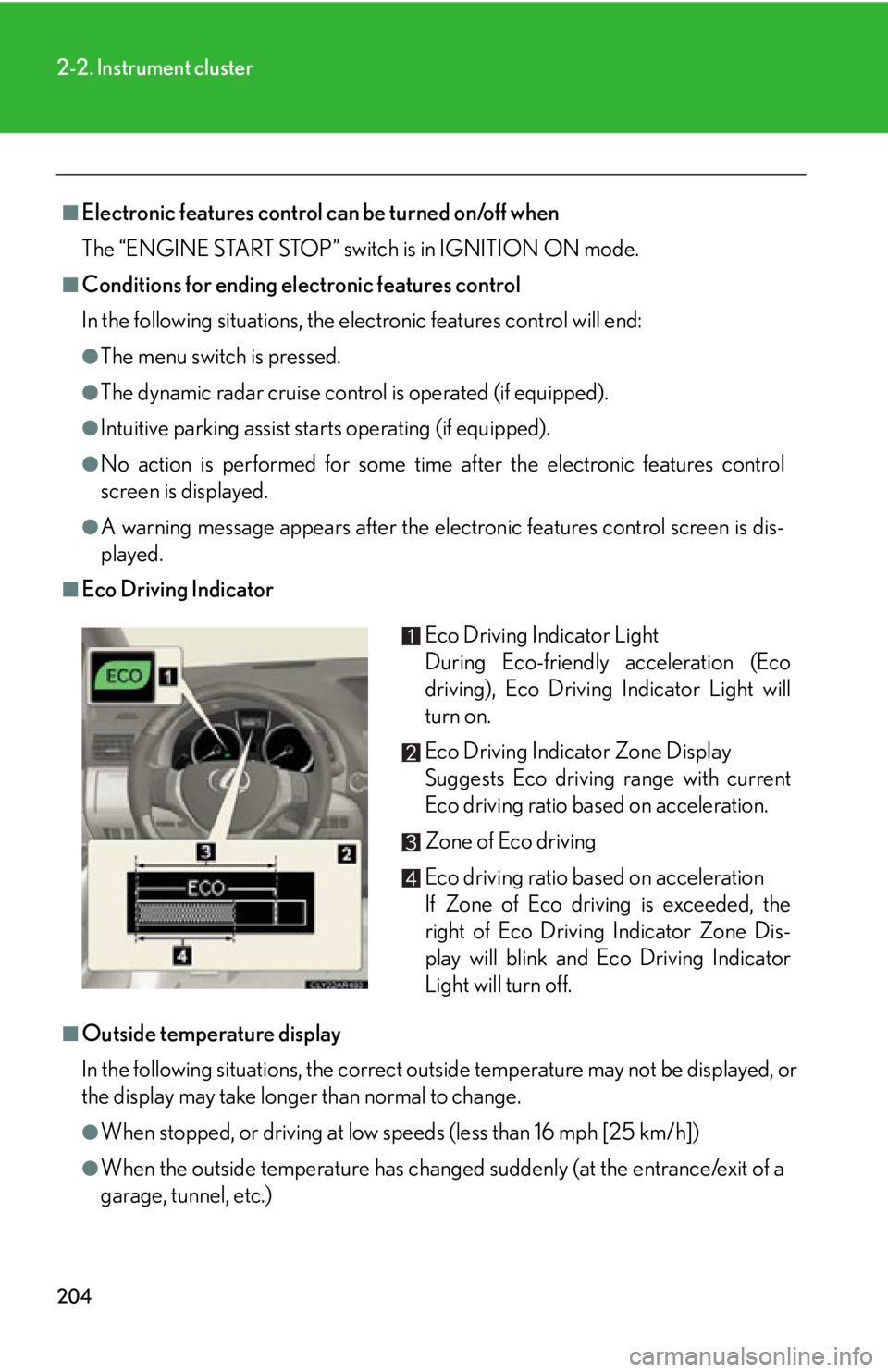
Eco Driving Indicator
■
Outside temperature display
In the following situations, the correct outside temperature may not be displayed, or
the display may take longer than normal to change.
●
When stopped, or driving at low speeds (less than 16 mph [25 km/h])
●
When the outside temperature has changed suddenly (at the entrance/exit of a
garage, tunnel, etc.) Eco Driving Indicator Light
During Eco-friendly acceleration (Eco
driving), Eco Driving Indicator Light will
turn on.
Eco Driving Indicator Zone Display
Suggests Eco driving range with current
Eco driving ratio based on acceleration.
Zone of Eco driving
Eco driving ratio based on acceleration
If Zone of Eco driving is exceeded, the
right of Eco Driving Indicator Zone Dis-
play will blink and Eco Driving Indicator
Light will turn off.
Page 245 of 886
2452-4. Using other driving systems
2
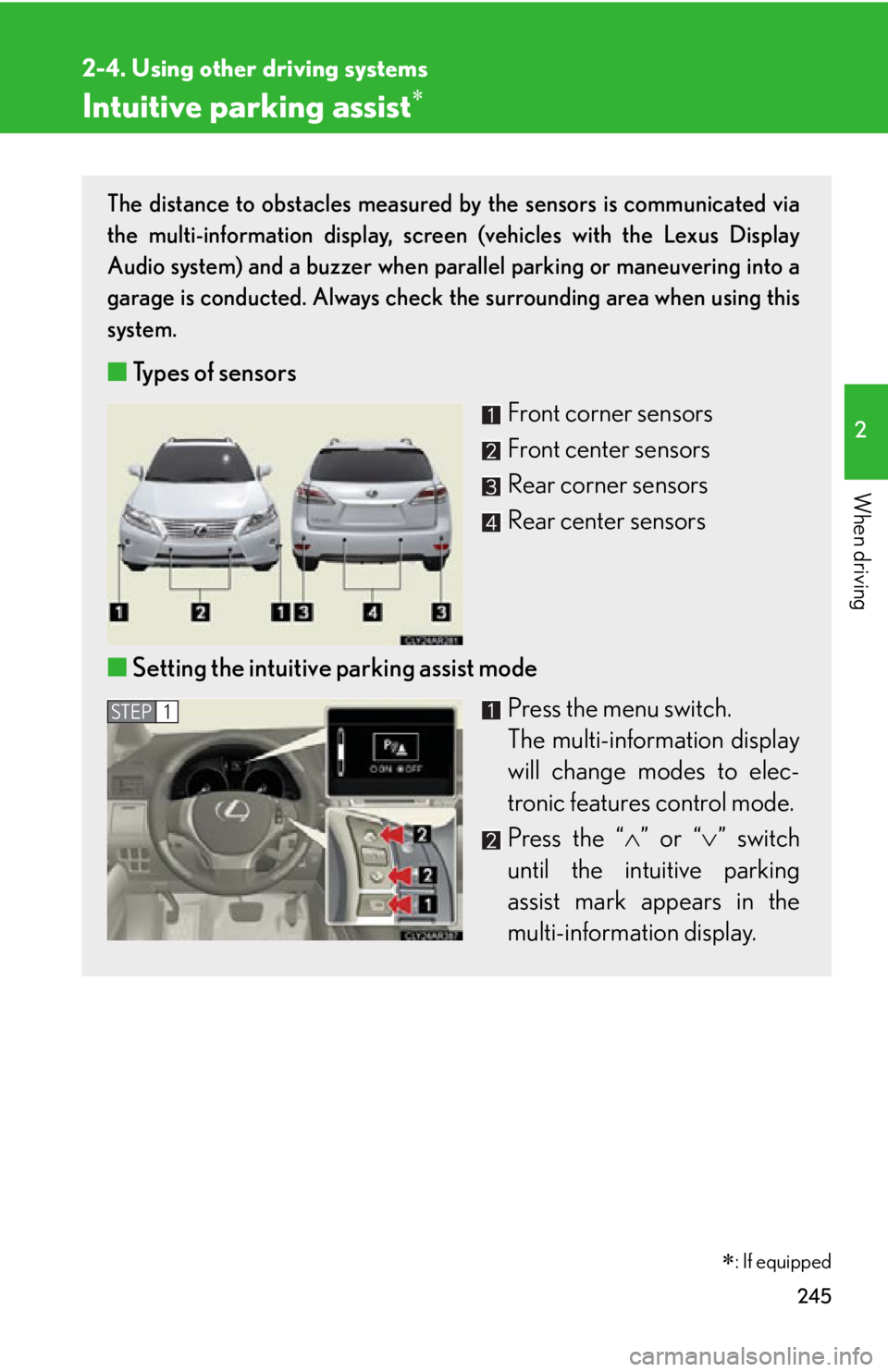
When driving Intuitive parking assist The distance to obstacles measured by the sensors is communicated via
the multi-information display, screen (vehicles with the Lexus Display
Audio system) and a buzzer when parallel parking or maneuvering into a
garage is conducted. Always check the surrounding area when using this
system.
■ Types of sensors
Front corner sensors
Front center sensors
Rear corner sensors
Rear center sensors
■ Setting the intuitive parking assist mode
Press the menu switch.
The multi-information display
will change modes to elec-
tronic features control mode.
Press the “ ” or “ ” switch
until the intuitive parking
assist mark appears in the
multi-information display. STEP 1
: If equipped