brake LEXUS RX350 2015 Repair Manual
[x] Cancel search | Manufacturer: LEXUS, Model Year: 2015, Model line: RX350, Model: LEXUS RX350 2015Pages: 886, PDF Size: 11 MB
Page 659 of 886
6594-2. Maintenance
4
Maintenance and care General maintenance
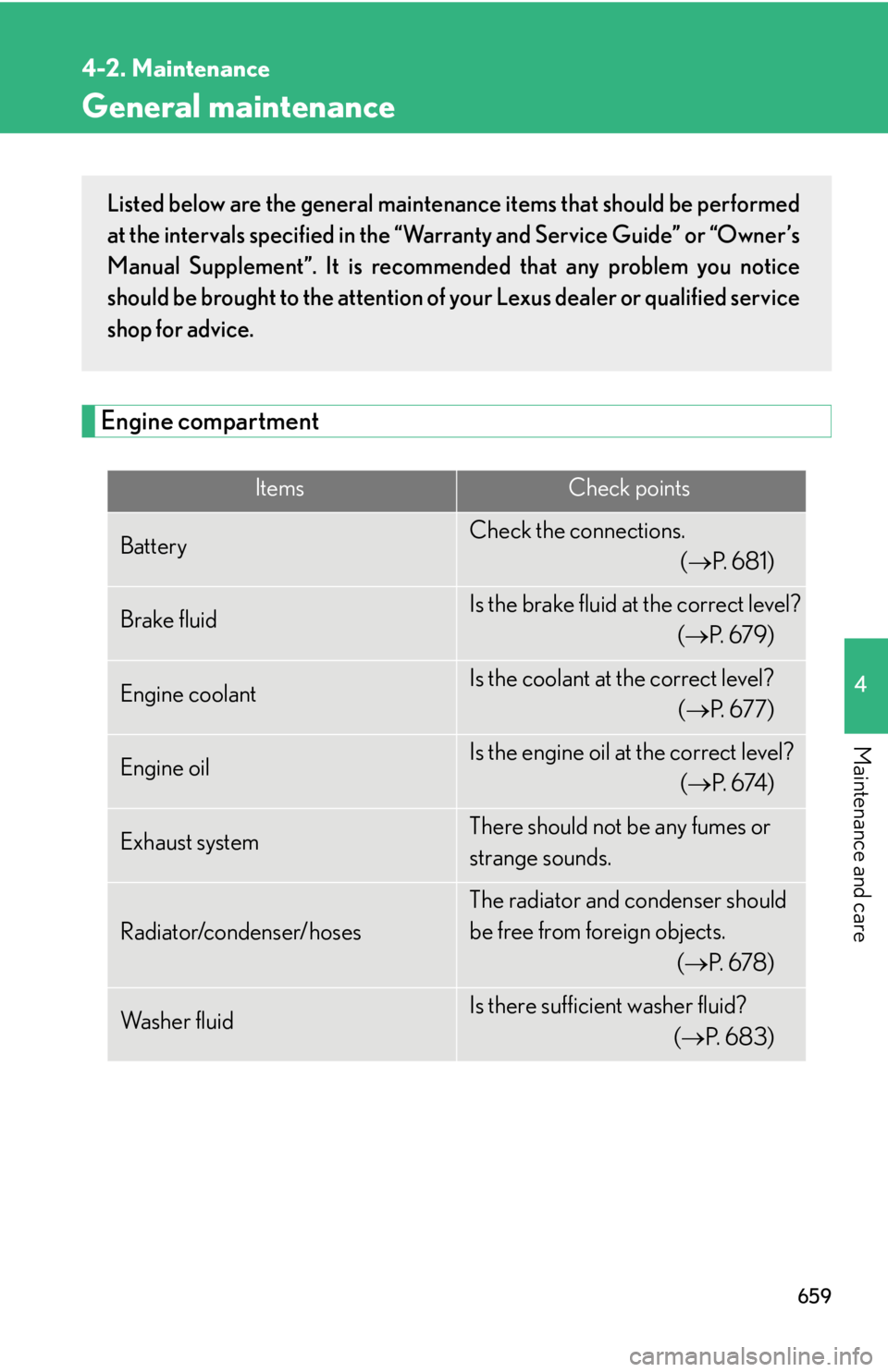
Engine compartment Items Check points
Battery Check the connections.
( P. 6 8 1 )
Brake fluid Is the brake fluid at the correct level?
( P. 6 7 9 )
Engine coolant Is the coolant at the correct level?
( P. 6 7 7 )
Engine oil Is the engine oil at the correct level?
( P. 6 74 )
Exhaust system There should not be any fumes or
strange sounds.
Radiator/condenser/hoses The radiator and condenser should
be free from foreign objects.
( P. 6 7 8 )
Wa s h e r f l u i d Is there sufficient washer fluid?
( P. 6 8 3 )Listed below are the general maintenance items that should be performed
at the intervals specified in the “Warranty and Service Guide” or “Owner’s
Manual Supplement”. It is recomme nded that any problem you notice
should be brought to the attention of your Lexus dealer or qualified service
shop for advice.
Page 660 of 886
6604-2. Maintenance
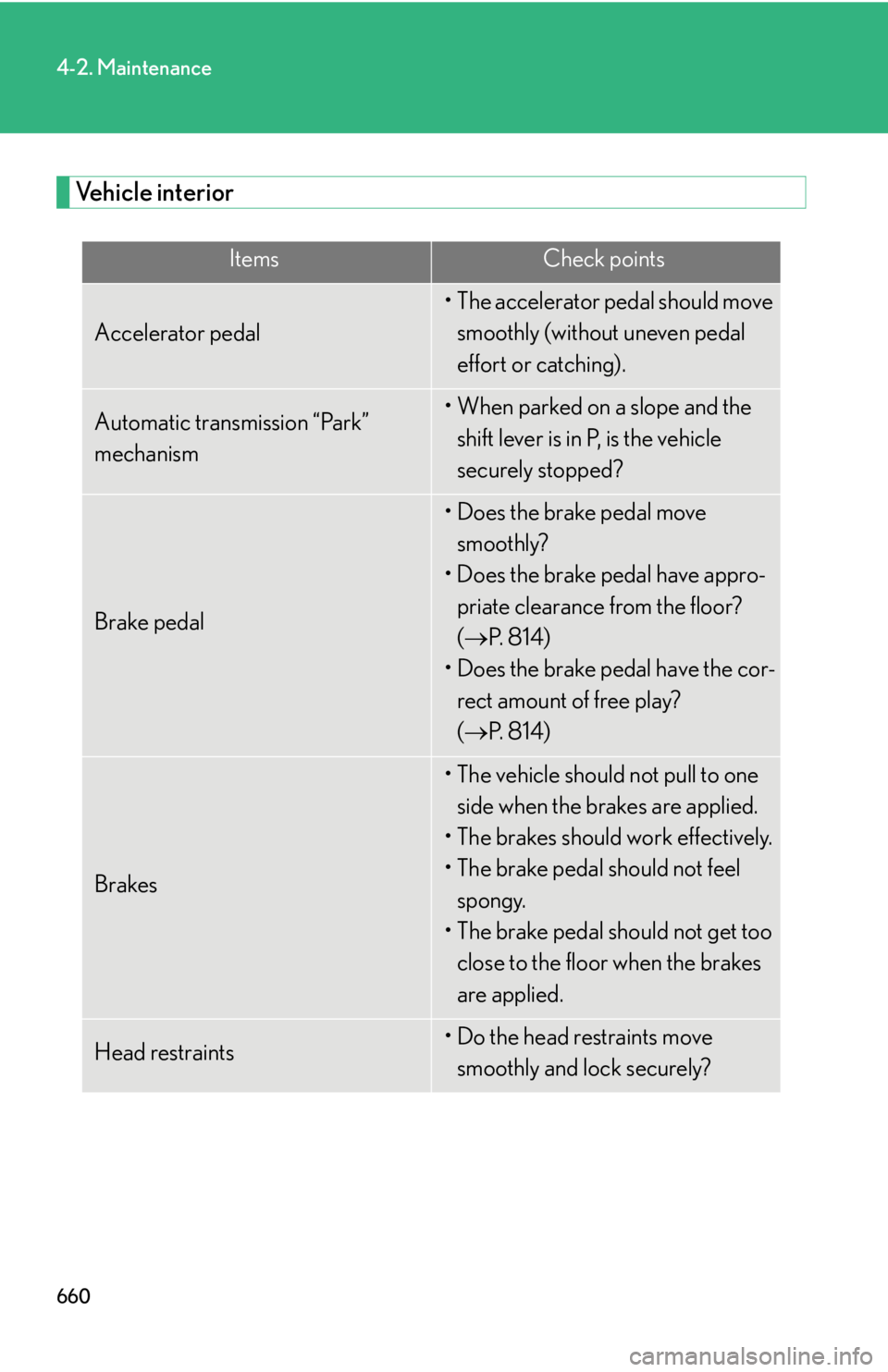
Vehicle interior Items Check points
Accelerator pedal • The accelerator pedal should move
smoothly (without uneven pedal
effort or catching).
Automatic transmission “Park”
mechanism • When parked on a slope and the
shift lever is in P, is the vehicle
securely stopped?
Brake pedal • Does the brake pedal move
smoothly?
• Does the brake pedal have appro-
priate clearance from the floor?
( P. 8 1 4 )
• Does the brake pedal have the cor-
rect amount of free play?
( P. 8 1 4 )
Brakes • The vehicle should not pull to one
side when the brakes are applied.
• The brakes should work effectively.
• The brake pedal should not feel
spongy.
• The brake pedal should not get too
close to the floor when the brakes
are applied.
Head restraints • Do the head restraints move
smoothly and lock securely?
Page 661 of 886
6614-2. Maintenance
4
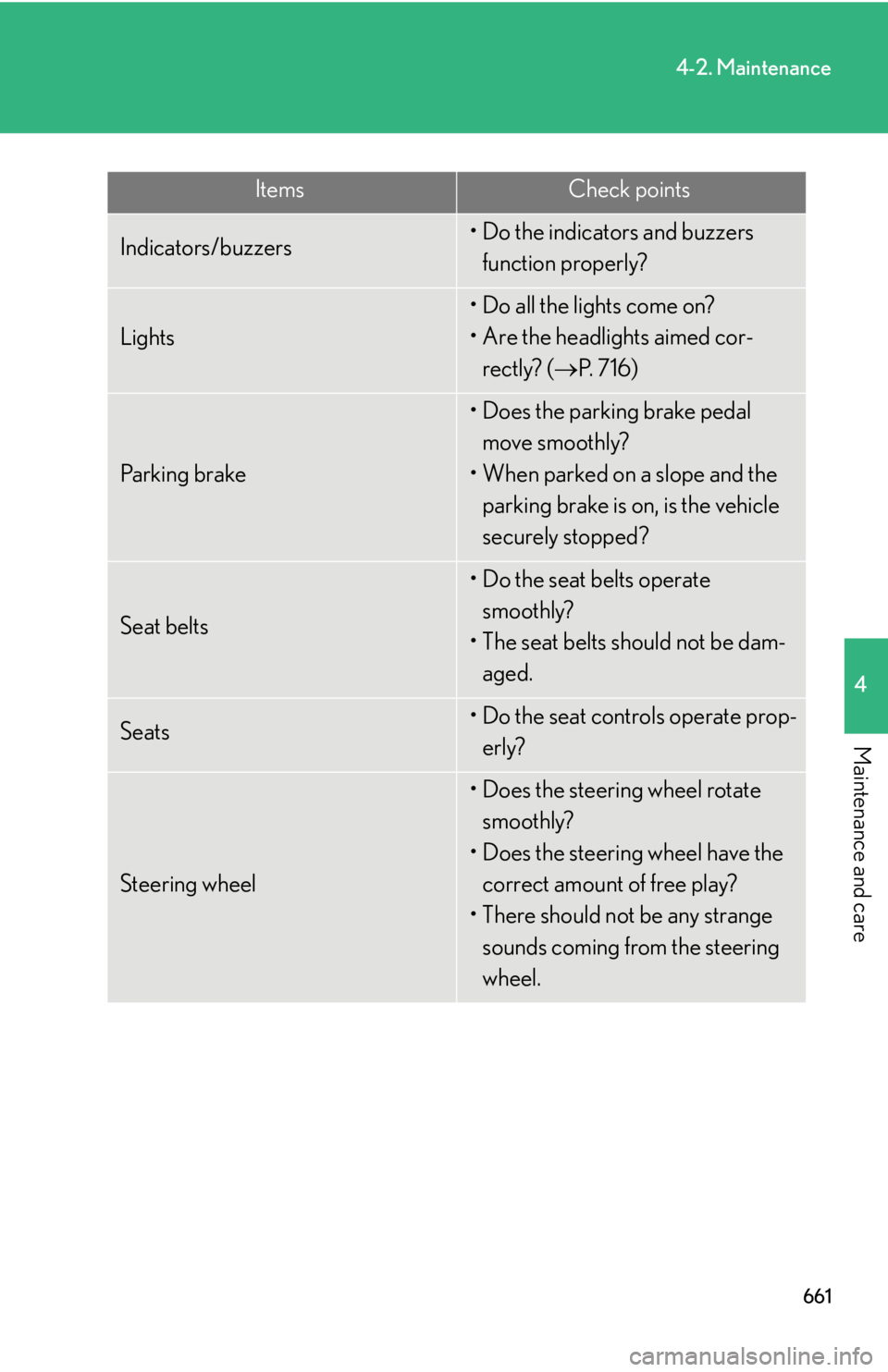
Maintenance and care Items Check points
Indicators/buzzers • Do the indicators and buzzers
function properly?
Lights • Do all the lights come on?
• Are the headlights aimed cor-
rectly? ( P. 7 1 6 )
Pa r k i n g b r a ke • Does the parking brake pedal
move smoothly?
• When parked on a slope and the
parking brake is on, is the vehicle
securely stopped?
Seat belts • Do the seat belts operate
smoothly?
• The seat belts should not be dam-
aged.
Seats • Do the seat controls operate prop-
erly?
Steering wheel • Does the steering wheel rotate
smoothly?
• Does the steering wheel have the
correct amount of free play?
• There should not be any strange
sounds coming from the steering
wheel.
Page 664 of 886
6644-3. Do-it-yourself maintenance
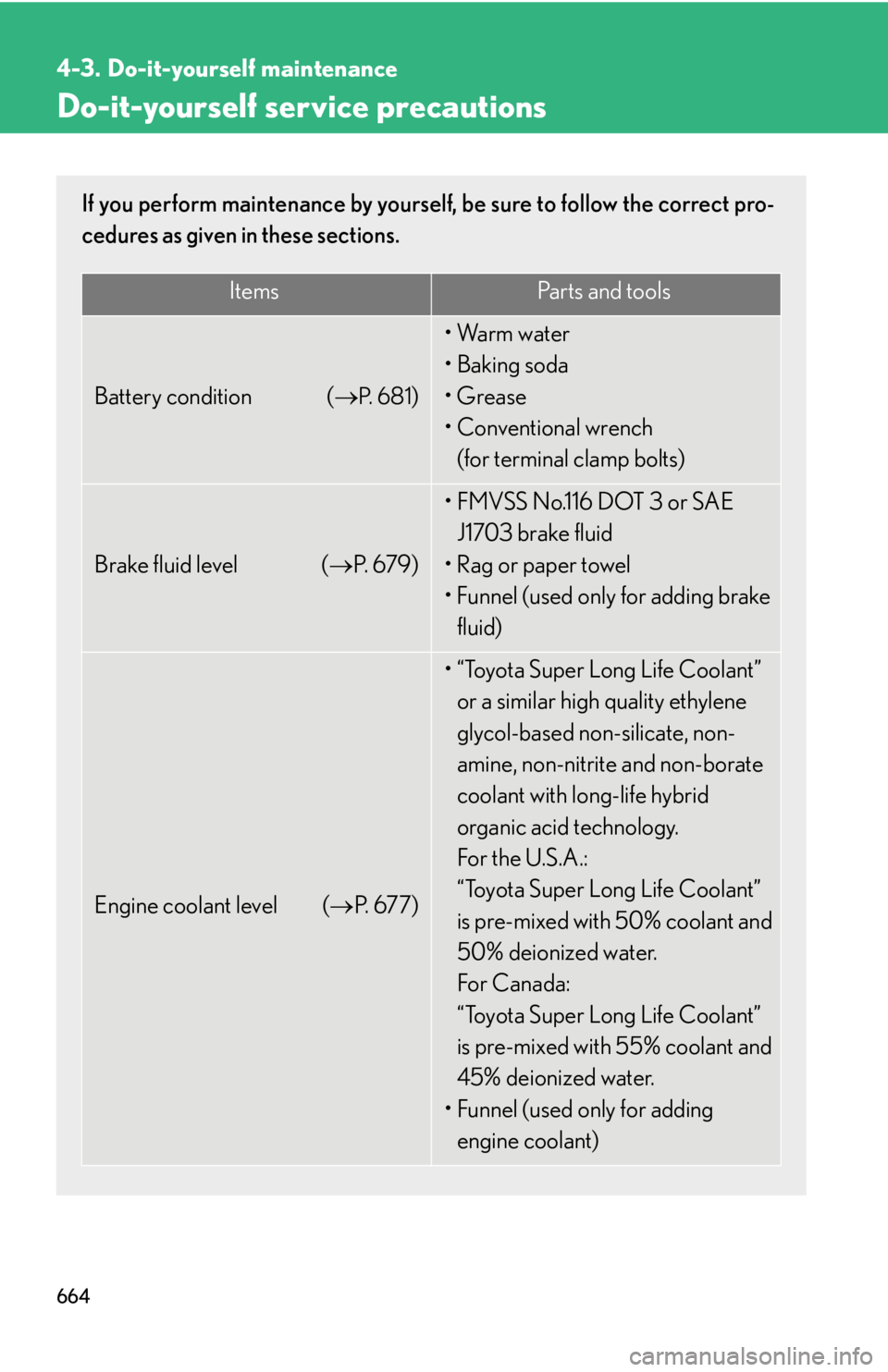
Do-it-yourself service precautions If you perform maintenance by yourself, be sure to follow the correct pro-
cedures as given in these sections.
Items Pa r t s a n d t o o l s
Battery condition ( P. 6 8 1
) •Warm water
• Baking soda
•Grease
• Conventional wrench
(for terminal clamp bolts)
Brake fluid level ( P. 6 7 9 ) • FMVSS No.116 DOT 3 or SAE
J1703 brake fluid
•Rag or paper towel
• Funnel (used only for adding brake
fluid)
Engine coolant level ( P. 6 7 7 ) • “Toyota Super Long Life Coolant”
or a similar high quality ethylene
glycol-based non-silicate, non-
amine, non-nitrite and non-borate
coolant with long-life hybrid
organic acid technology.
For the U.S.A.:
“Toyota Super Long Life Coolant”
is pre-mixed with 50% coolant and
50% deionized water.
For Canada:
“Toyota Super Long Life Coolant”
is pre-mixed with 55% coolant and
45% deionized water.
• Funnel (used only for adding
engine coolant)
Page 669 of 886
6694-3. Do-it-yourself maintenance
4
Maintenance and care CAUTION■
When raising your vehicle
Make sure to observe the following precautions to reduce the possibility of death or
serious injury:
●
When using a floor jack, follow the instructions of the manual provided with the
jack.●
Do not use the jack that wa s supplied with your vehicle.●
Do not put any part of your body underneath the vehicle when it is supported
only by the floor jack.●
Always use floor jack and/or automotive jack stands on a solid, flat, level surface.●
Do not start the engine while the vehicle is supported by the floor jack.●
Stop the vehicle on level, firm ground, firmly set the parking brake and shift the
shift lever to P.●
Make sure to set the floor jack properly at the jack point.
Raising the vehicle with an improperly positioned floor jack will damage the vehi-
cle and may cause the vehicle to fall off the floor jack.●
Do not raise the vehicle while someone is in the vehicle.●
When raising the vehicle, do not place any objects on top of or underneath the
floor jack. ●
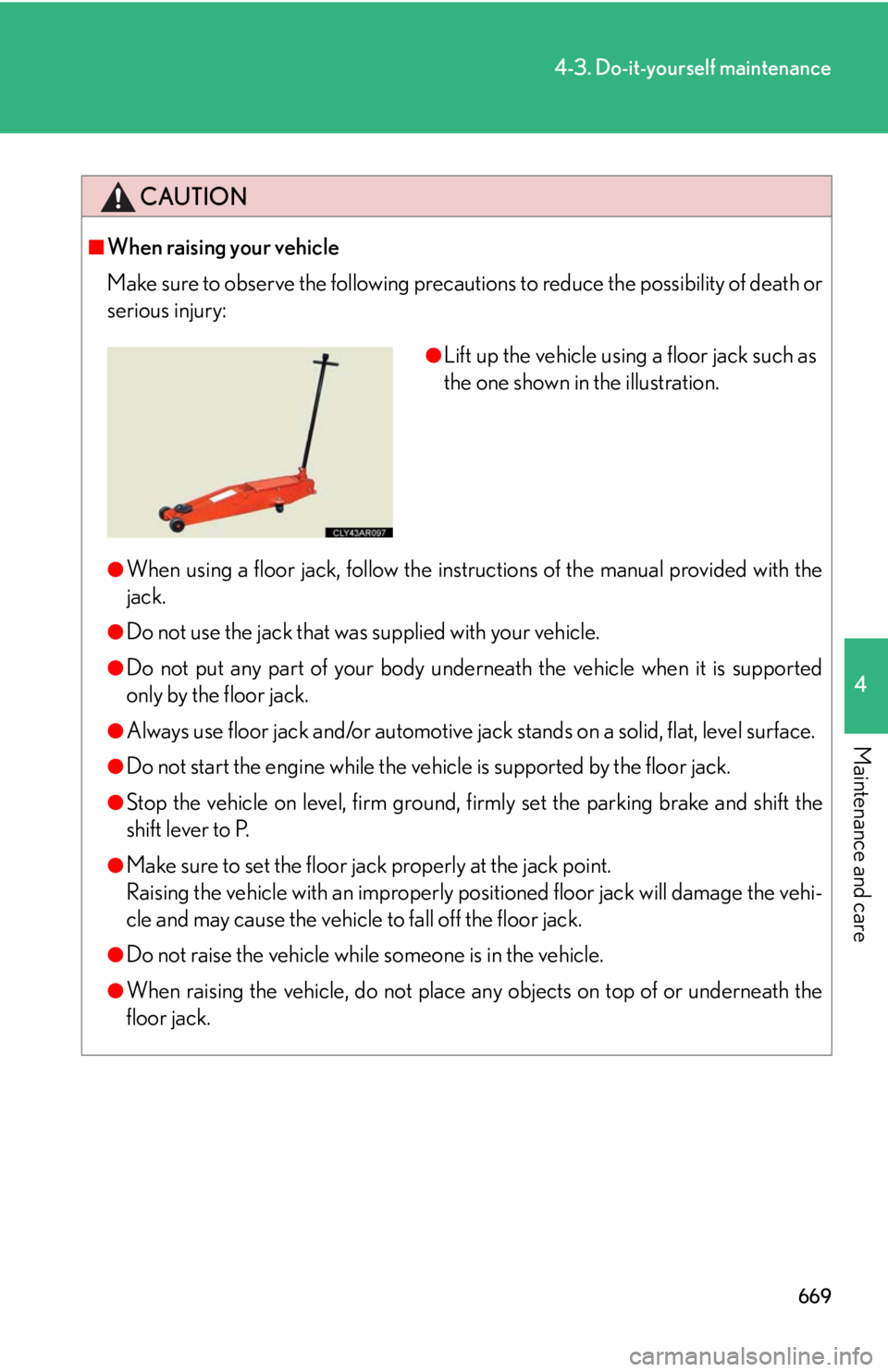
Lift up the vehicle using a floor jack such as
the one shown in the illustration.
Page 670 of 886
6704-3. Do-it-yourself maintenance
Engine compartment
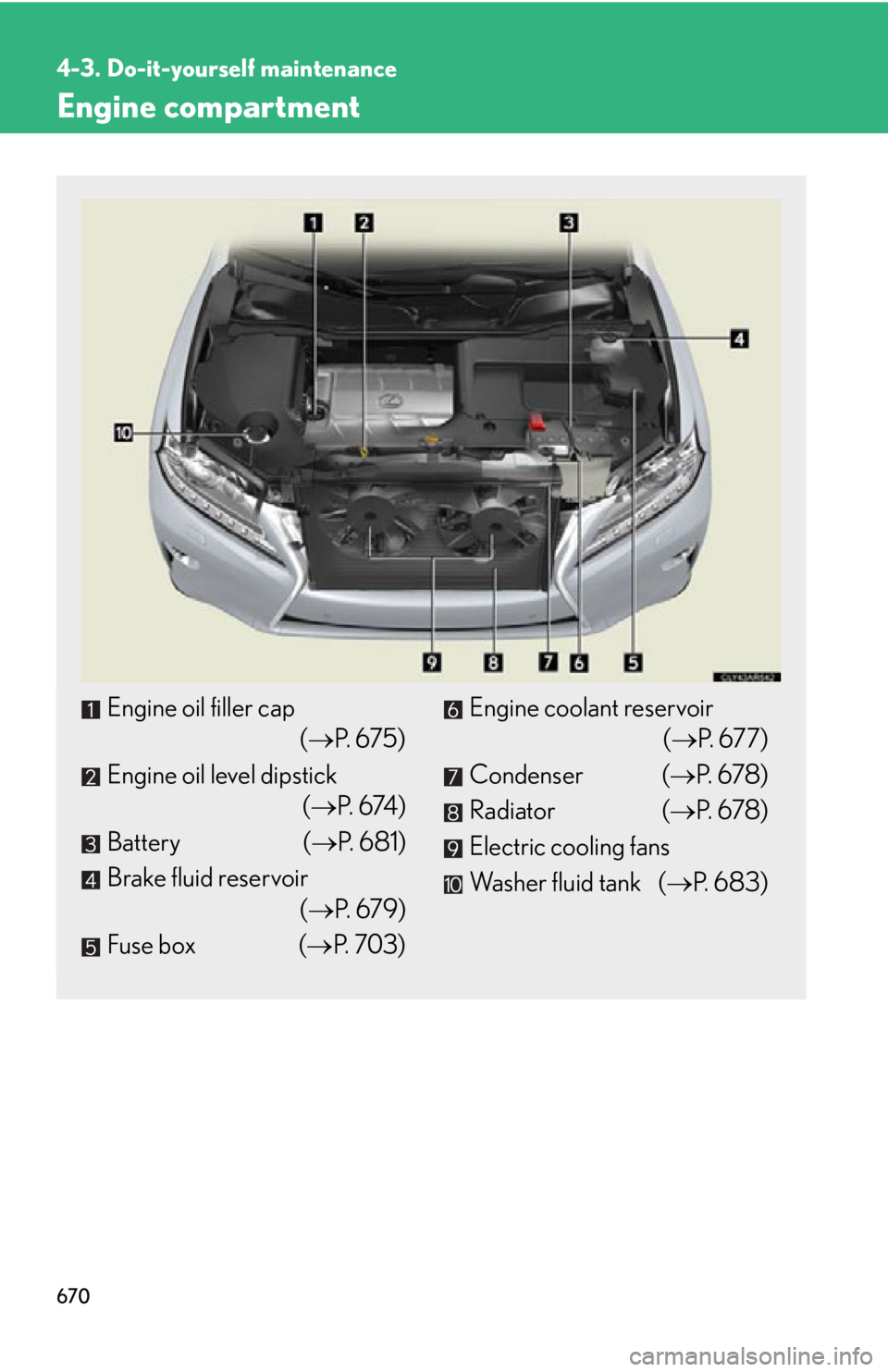
Engine oil filler cap
( P. 675)
Engine oil level dipstick
( P. 6 74 )
Battery ( P. 6 8 1 )
Brake fluid reservoir
( P. 6 7 9 )
Fuse box ( P. 703) Engine coolant reservoir
( P. 677)
Condenser ( P. 6 7 8 )
Radiator ( P. 6 7 8 )
Electric cooling fans
Washer fluid tank ( P. 683)
Page 679 of 886
6794-3. Do-it-yourself maintenance
4
Maintenance and care Brake fluid
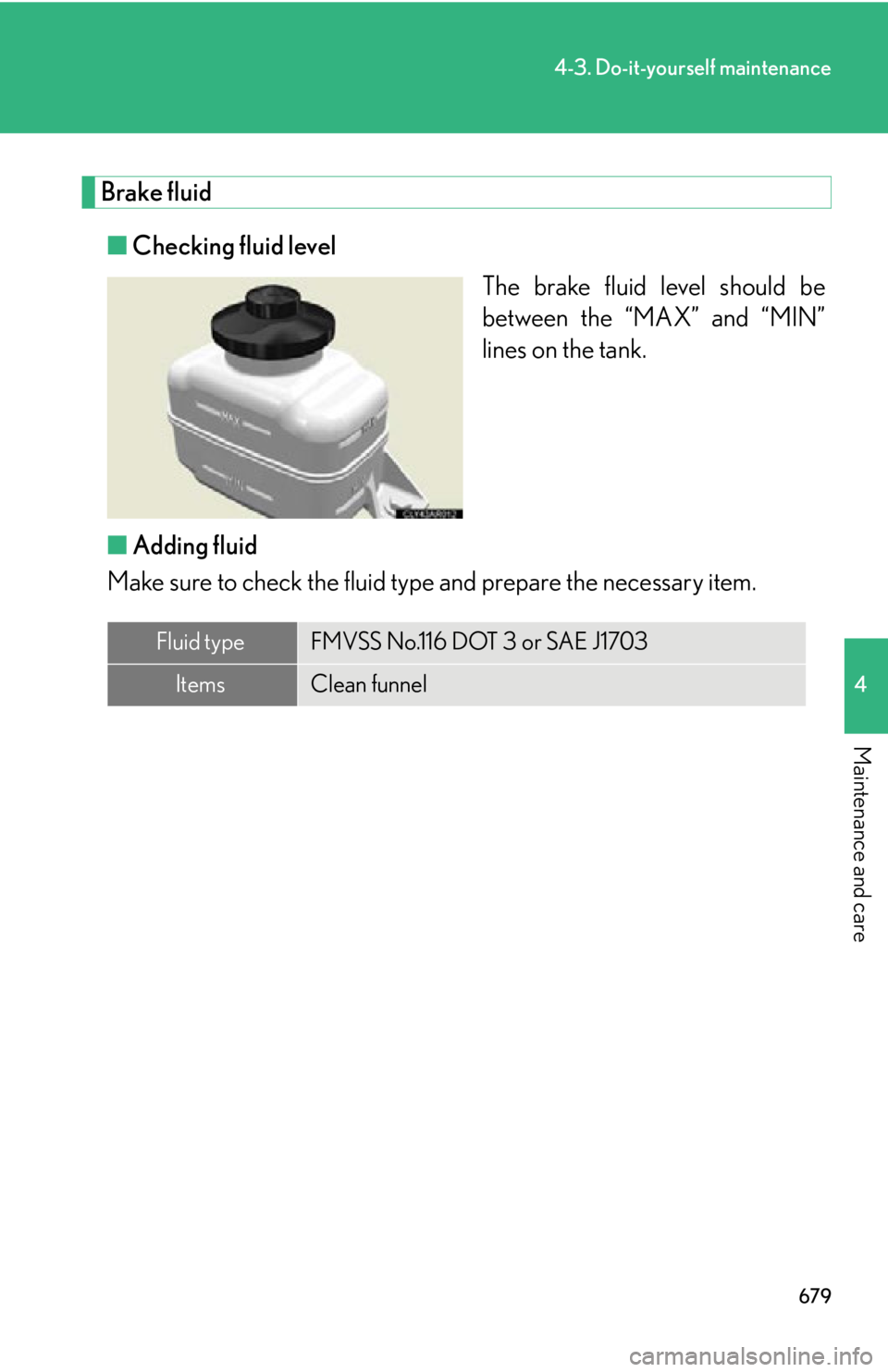
■ Checking fluid level
The brake fluid level should be
between the “MAX” and “MIN”
lines on the tank.
■ Adding fluid
Make sure to check the fluid type and prepare the necessary item. Fluid type FMVSS No.116 DOT 3 or SAE J1703
Items Clean funnel
Page 680 of 886
6804-3. Do-it-yourself maintenance
■
Brake fluid can absorb moisture from the air
Excess moisture in the brake fluid can cause a dangerous loss of braking efficiency.
Use only newly opened brake fluid.
CAUTION■
When filling the reservoir
Take care because brake fluid can harm your hands or eyes and damage painted
surfaces.
If fluid gets on your hands or in your eyes, flush the affected area with clean water
immediately.
If you still experience discomfort, see a doctor.
NOTICE■
If the fluid level is low or high
It is normal for the brake fluid level to go down slightly as the brake pads wear out or
when the fluid level in the accumulator is high.
If the reservoir needs frequent re filling, may be a serious problem.
Page 736 of 886
7365-1. Essential information
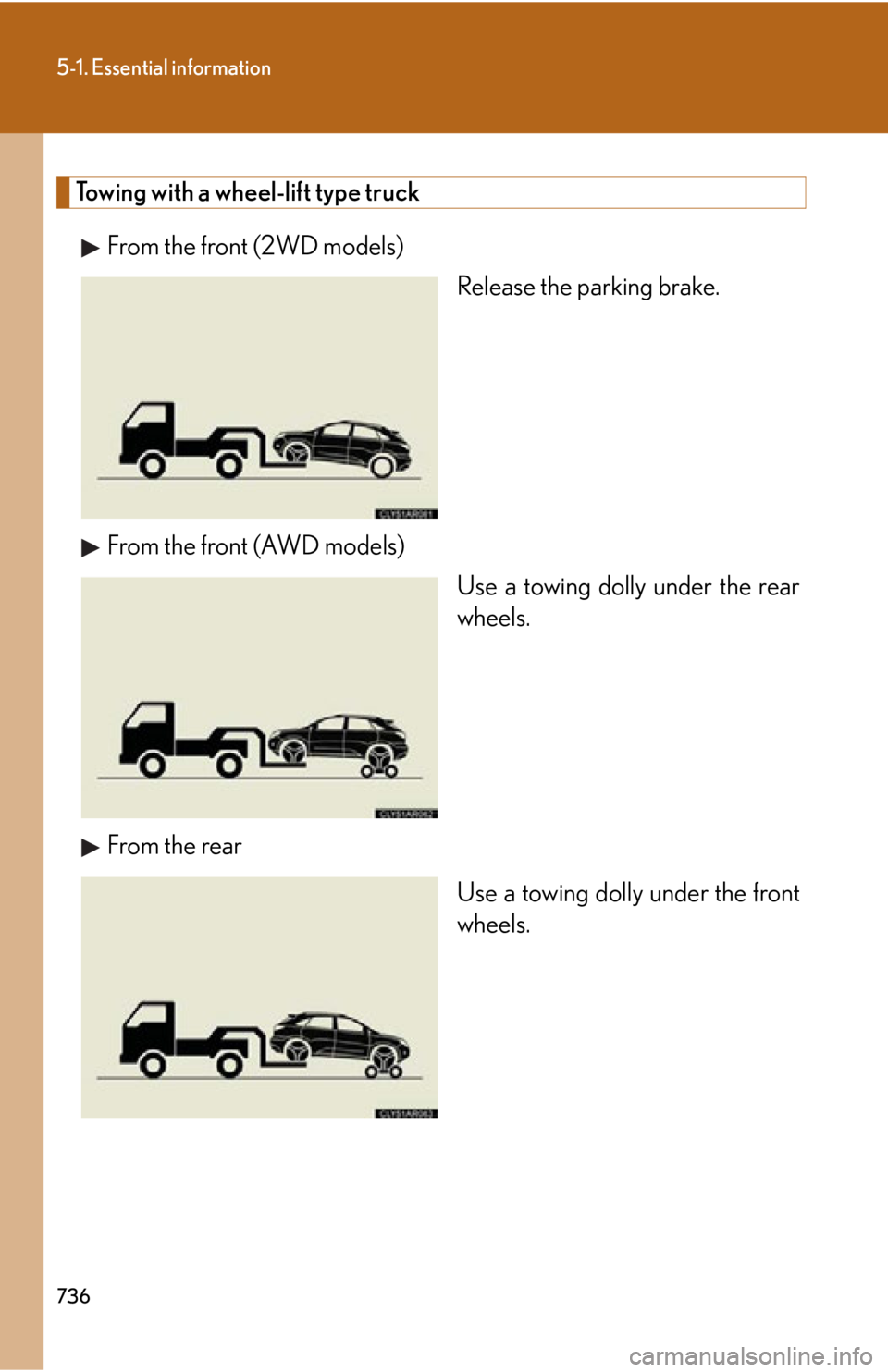
Towing with a wheel-lift type truck
From the front (2WD models)
Release the parking brake.
From the front (AWD models)
Use a towing dolly under the rear
wheels.
From the rear
Use a towing dolly under the front
wheels.
Page 738 of 886
7385-1. Essential information
Emergency towing
If a tow truck is not available in an emergency, your vehicle may be tem-
porarily towed using a cable or chain secured to the emergency towing
eyelet. This should only be attemp ted on hard, surfaced roads for 50
miles (80 km) at under 18 mph (30 km/h).
A driver must be in the vehicle to s teer and operate the brakes. The vehi-
cle’s wheels, drive train, axles, steering and brakes must be in good condi-
tion.
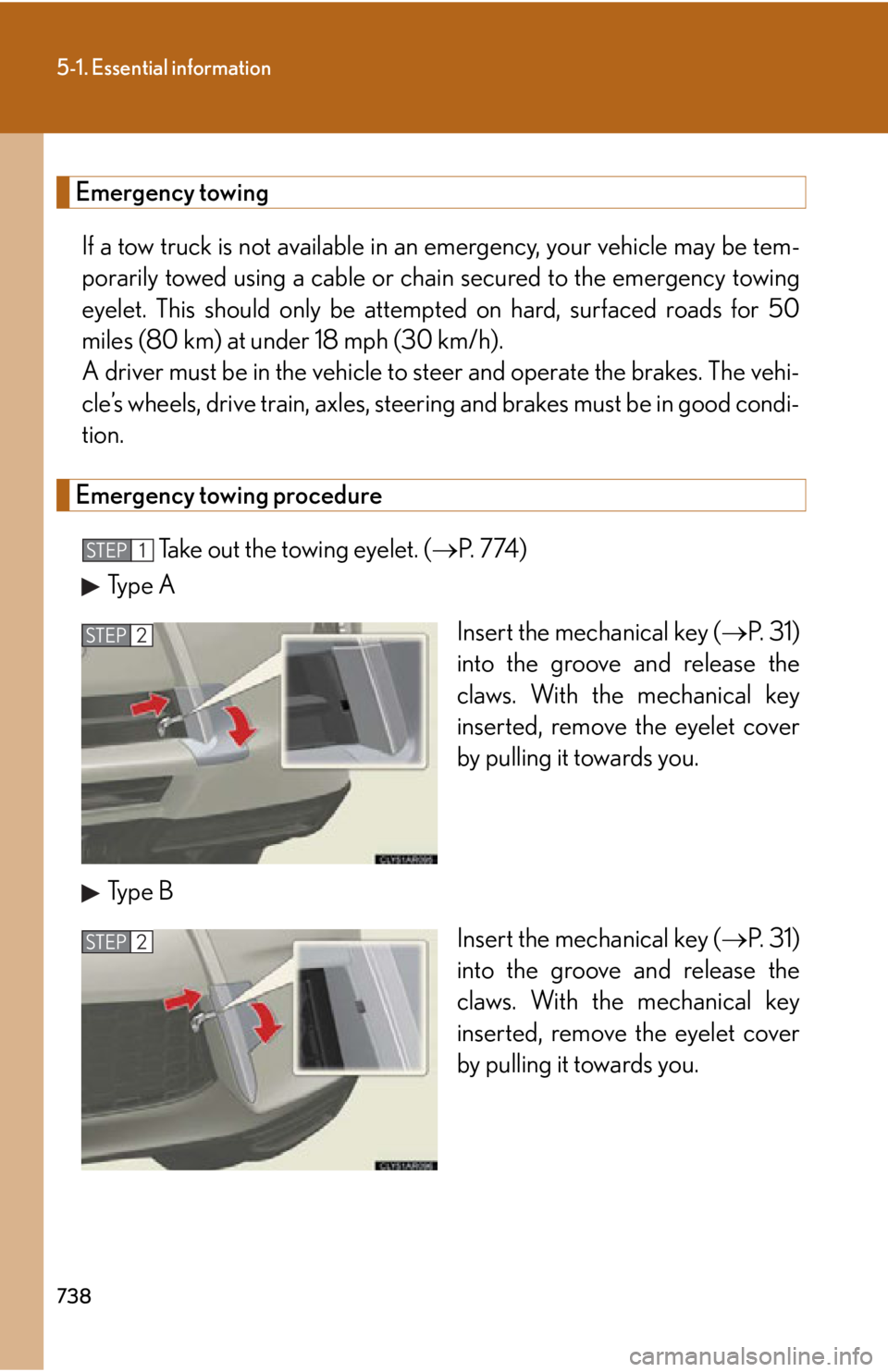
Emergency towing procedure
Take out the towing eyelet. ( P. 7 74 )
Type A
Insert the mechanical key ( P. 31)
into the groove and release the
claws. With the mechanical key
inserted, remove the eyelet cover
by pulling it towards you.
Type B
Insert the mechanical key ( P. 31)
into the groove and release the
claws. With the mechanical key
inserted, remove the eyelet cover
by pulling it towards you. STEP 1
STEP 2
STEP 2