ECO LEXUS RX450h 2022 User Guide
[x] Cancel search | Manufacturer: LEXUS, Model Year: 2022, Model line: RX450h, Model: LEXUS RX450h 2022Pages: 532, PDF Size: 27.62 MB
Page 35 of 532

331-1. For safe use
1
For safety and security
RX450hL: Rear side airbags (outboard second-row seats)
Your vehicle is equipped with ADVANC ED AIRBAGS designed based on the US
motor vehicle safety standards (FMVSS20 8). The airbag sensor assembly (ECU)
controls airbag deployment based on information obtain ed from the sensors etc.
shown in the system components diagram above. This information includes crash
severity and occupant information. As th e airbags deploy, a chemical reaction in
the inflators quickly fills the airbags with no n-toxic gas to help restrain the motion of
the occupants.
■If the SRS airbags deploy (inflate)
●Slight abrasions, burns, bruising etc., may
be sustained from SRS airbags, due to the
extremely high speed deployment (infla-
tion) by hot gases.
●A loud noise and white powder will be
emitted.
●Parts of the airbag module (steering
wheel hub, airbag cover and inflator) as
well as the front seats, parts of the front
and rear pillars, and roof side rails, may
be hot for several minutes. The airbag
itself may also be hot.
●The windshield may crack.
●The hybrid system will be stopped and
fuel supply to the engine will be stopped.
( P.72)
●All of the doors will be unlocked.
(P.110)
●The brakes and stop lights will be con-
trolled automatically. ( P.279)
●The interior lights will turn on automati-
cally. (P.316)
●The emergency flashers will turn on auto-
matically. ( P.402)
●For Lexus Enform Safety Connect sub-
scribers, if any of the following situations
occur, the system is designed to send an
emergency call to the response center,
notifying them of the vehicle’s location
(without needing to push the “SOS” but-
ton) and an agent will attempt to speak
with the occupants to ascertain the level
of emergency and assi stance required. If
the occupants are unable to communi-
cate, the agent automatically treats the
call as an emergency and helps to dis- patch the necessary emergency services.
(
P.60)
• An SRS airbag is deployed.
• A seat belt preten sioner is activated.
• The vehicle is involved in a severe rear-end collision.
■SRS airbag deployment conditions (SRS
front airbags)
●The SRS front airbags will deploy in the
event of an impact that exceeds the set
threshold level (the level of force corre-
sponding to an approximately 12 - 18
mph [20 - 30 km/h] frontal collision with
a fixed wall that does not move or
deform).
However, this threshol d velocity will be
considerably higher in the following situa-
tions:
• If the vehicle strikes an object, such as a parked vehicle or sign pole, which can
move or deform on impact
• If the vehicle is involved in an underride collision, such as a collision in which the
front of the vehicle “u nderrides”, or goes
under, the bed of a truck
●Depending on the type of collision, it is
possible that only the seat belt
pretensioners will activate.
●The SRS seat cushion airbag on the front
passenger seat will not operate if the
occupant is not wearing a seat belt.
■SRS airbag deployment conditions (SRS
side and curtain shield airbags)
●The SRS side and curtain shield airbags
will deploy in the event of an impact that
exceeds the set threshold level (the level
of force corresponding to the impact
force produced by an approximately
3300 lb. [1500 kg] vehicle colliding with
Page 38 of 532

361-1. For safe use
WARNING
■SRS airbag precautions
Observe the following precautions
regarding the SRS airbags.
Failure to do so may cause death or seri-
ous injury.
●The driver and all passengers in the
vehicle must wear their seat belts
properly.
The SRS airbags are supplemental
devices to be used with the seat belts.
●The SRS driver airbag deploys with
considerable force, and can cause
death or serious injury especially if the
driver is very close to the airbag.
The National Highway Traffic Safety
Administration (NHTSA) advises:
Since the risk zone for the driver’s
airbag is the first 2 - 3 in. (50 - 75 mm)
of inflation, placing yourself 10 in. (250
mm) from your driver airbag provides
you with a clear margin of safety. This
distance is measured from the center
of the steering wheel to your breast-
bone. If you sit less than 10 in. (250
mm) away now, you can change your
driving position in several ways:
• Move your seat to the rear as far as you can while still reaching the pedals
comfortably.
• Slightly recline the back of the seat.Although vehicle designs vary, many
drivers can achieve the 10 in. (250
mm) distance, even with the driver seat
all the way forward, simply by reclining
the back of the seat somewhat. If
reclining the back of your seat makes it
hard to see the road, raise yourself by
using a firm, non-slippery cushion, or
raise the seat if your vehicle has that
feature.
•If your steering whee l is adjustable, tilt
it downward. This points the airbag
toward your chest instead of your head
and neck.
The seat should be adjusted as recom-
mended by NHTSA above, while still
maintaining control of the foot pedals,
steering wheel, and your view of the
instrument panel controls.
●If the seat belt extender has been con-
nected to the front seat belt buckles
but the seat belt extender has not also
been fastened to the latch plate of the
seat belt, the SRS front airbags will
judge that the driver and front passen-
ger are wearing the seat belt even
though the seat belt has not been con-
nected. In this case, the SRS front
airbags may not activate correctly in a
collision, resulting in death or serious
injury in the event of a collision. Be
sure to wear the seat belt with the seat
belt extender.
Page 39 of 532

371-1. For safe use
1
For safety and security
WARNING
●The SRS front passenger airbag also
deploys with considerable force, and
can cause death or serious injury
especially if the front passenger is very
close to the airbag. The front passen-
ger seat should be as far from the
airbag as possible with the seatback
adjusted, so the front passenger sits
upright.
●Improperly seated and/or restrained
infants and children can be killed or
seriously injured by a deploying airbag.
An infant or child who is too small to
use a seat belt should be properly
secured using a child restraint system.
Lexus strongly recommends that all
infants and children be placed in the
rear seats of the vehicle and properly
restrained. The rear seats are safer for
infants and children than the front pas-
senger seat. (
P.45)
●Do not sit on the edge of the seat or
lean against the dashboard.
●Do not allow a child to stand in front of
the SRS front passenger airbag unit or
sit on the knees of a front passenger.
●Do not allow the front seat occupants
to hold items on their knees.
●Do not lean against the door, the roof
side rail or the front, side and rear pil-
lars.
●Do not allow anyone to kneel on the
passenger seats toward the door or
put their head or hands outside the
vehicle.
●Do not attach anything to or lean any-
thing against areas such as the dash-
board, steering wheel pad and lower
portion of the instrument panel.
These items can become projectiles
when the SRS driver, front passenger
and knee airbags deploy.
Page 40 of 532

381-1. For safe use
WARNING
●Do not attach anything to areas such
as a door, windshield, side windows,
front or rear pillar, roof side rail and
assist grip.
●Do not hang coat hangers or other
hard objects on the coat hooks. All of
these items could become projectiles
and may cause death or serious injury,
should the SRS curtain shield airbags
deploy.
●If a vinyl cover is put on the area where
the SRS knee airbag will deploy, be
sure to remove it.
●Do not use seat accessories which
cover the parts where the SRS side
airbags and SRS seat cushion airbag
inflate as they may interfere with infla-
tion of the SRS airbags. Such accesso-
ries may prevent the side airbags and
SRS seat cushion airbag from activat-
ing correctly, disable the system or
cause the side airbags and SRS seat
cushion airbag to inflate accidentally,
resulting in death or serious injury.
●Do not strike or apply significant levels
of force to the area of the SRS airbag
components or the front doors. Doing
so can cause the SRS airbags to mal-
function.
●Do not touch any of the component
parts immediately after the SRS
airbags have deployed (inflated) as
they may be hot.
●If breathing becomes difficult after the
SRS airbags have deployed, open a
door or window to allow fresh air in, or
leave the vehicle if it is safe to do so.
Wash off any residue as soon as possi-
ble to prevent skin irritation.
●If the areas where the SRS airbags are
stored, such as the steering wheel pad
and front and rear pillar garnishes, are
damaged or cracked, have them
replaced by your Lexus dealer.
●Do not place anything, such as a cush-
ion, on the front passenger’s seat.
Doing so will disperse the passenger’s
weight, which prevents the sensor
from detecting the passenger’s weight
properly. As a result, the SRS front
airbags for the front passenger may
not deploy in the event of a collision.
■Modification and disposal of SRS
airbag system components
Do not dispose of your vehicle or per-
form any of the following modifications
without consulting your Lexus dealer.
The SRS airbags may malfunction or
deploy (inflate) accidentally, causing
death or serious injury.
●Installation, remova l, disassembly and
repair of the SRS airbags
●Repairs, modifications, removal or
replacement of the steering wheel,
instrument panel, dashboard, seats or
seat upholstery, front, side and rear pil-
lars, roof side rails, front door panels,
front door trims or front door speakers
●Modifications to the front door panel
(such as making a hole in it)
●Repairs or modifications of the front
fender, front bumper, or side of the
occupant compartment
●Installation of a grille guard (bull bars,
kangaroo bar, etc. ), snow plows,
winches or roof luggage carrier
●Modifications to the vehicle’s suspen-
sion system
Page 42 of 532

401-1. For safe use
SRS warning light
Driver’s and front passenger’s seat belt reminder light
For the U.S.A.
“AIR BAG OFF” indicator light
“AIR BAG ON” indicator light
For Canada“AIR BAG OFF” indicator light
“AIR BAG ON” indicator light
System components
A
B
C
D
E
F
WARNING
■Front passenger occupant classifica-
tion system precautions
Observe the following precautions
regarding the front passenger occupant
classification system.
Failure to do so may cause death or seri-
ous injury.
●Wear the seat belt properly.
●Make sure the fron t passenger’s seat
belt plate has not been left inserted
into the buckle before someone sits in
the front passenger seat.
●Make sure the “AIR BAG OFF” indica-
tor light is not illuminated when using
the seat belt extender for the front pas-
senger seat. If the “AIR BAG OFF”
indicator light is illuminated, discon-
nect the extender tongue from the seat
belt buckle, and reconnect the seat
belt. Reconnect the seat belt extender
after making sure the “AIR BAG ON”
indicator light is illuminated. If you use
the seat belt extender while the “AIR
BAG OFF” indicator light is illumi-
nated, the SRS airbags for the front
passenger will not activate, which
could cause death or serious injury in
the event of a collision.
●Do not apply a heavy load to the front
passenger seat or equipment (e.g.
seatback pocket).
Page 45 of 532
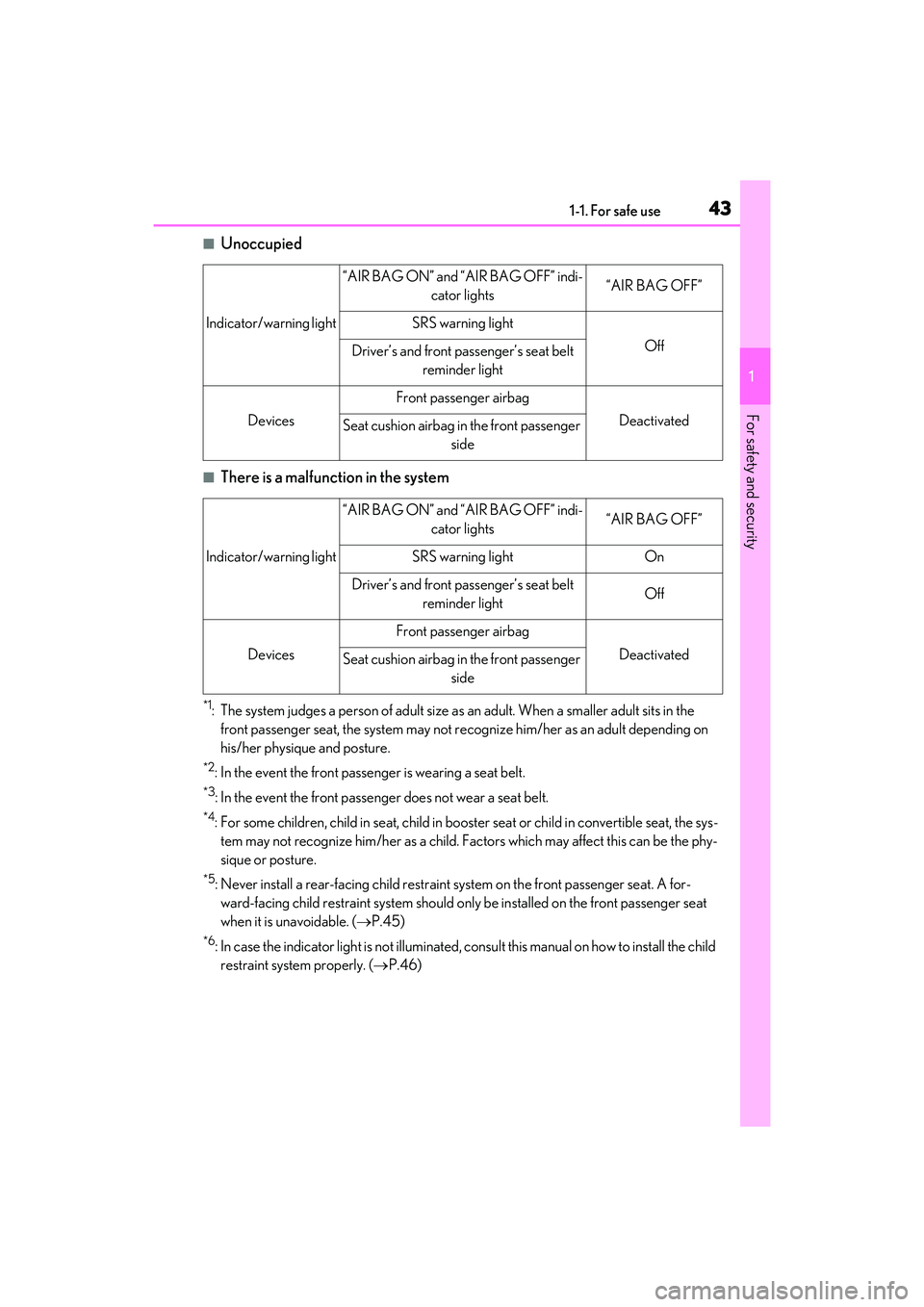
431-1. For safe use
1
For safety and security
■Unoccupied
■There is a malfunction in the system
*1: The system judges a person of adult size as an adult. When a smaller adult sits in the
front passenger seat, the system may not re cognize him/her as an adult depending on
his/her physique and posture.
*2: In the event the front passenger is wearing a seat belt.
*3: In the event the front passenger does not wear a seat belt.
*4: For some children, child in se at, child in booster seat or child in convertible seat, the sys-
tem may not recognize him/her as a child. F actors which may affect this can be the phy-
sique or posture.
*5: Never install a rear-facing child restraint system on the front passenger seat. A for-
ward-facing child restraint syst em should only be installed on the front passenger seat
when it is unavoidable. ( P.45)
*6: In case the indicator light is not illuminated, consult this manual on how to install the child
restraint system properly. ( P.46)
Indicator/warning light
“AIR BAG ON” and “AIR BAG OFF” indi-
cator lights“AIR BAG OFF”
SRS warning light
OffDriver’s and front passenger’s seat belt reminder light
Devices
Front passenger airbag
DeactivatedSeat cushion airbag in the front passenger side
Indicator/warning light
“AIR BAG ON” and “AIR BAG OFF” indi-cator lights“AIR BAG OFF”
SRS warning lightOn
Driver’s and front passenger’s seat belt reminder lightOff
Devices
Front passenger airbag
DeactivatedSeat cushion airbag in the front passenger side
Page 47 of 532

451-2. Child safety
1
For safety and security
1-2.Child safety
Points to remember: P.45
Child restraint system: P.46
When using a child restraint system:
P.48
Child restraint system installation
method
• Fixed with a seat belt: P.50
• Fixed with a child restraint LATCH anchor: P.54
• Using an anchor bracket (for top tether strap): P.57
The laws of all 50 states of the U.S.A.
as well as Canada now require the use
of child restraint systems.
Prioritize and observe the warn-
Riding with children
Observe the following precautions
when children are in the vehicle.
Use a child restraint system appro-
priate for the child, until the child
becomes large enough to properly
wear the vehicle’s seat belt.
It is recommended that children
sit in the rear seats to avoid acci-
dental contact with the shift lever,
wiper switch, etc.
Use the rear door child-protector
lock or the window lock switch to
avoid children op ening the door
while driving or operating the
power window accidentally.
( P.112, 153)
Do not let small children operate
equipment which may catch or
pinch body parts, such as the
power window, hood, back door,
seats etc.
WARNING
■When children are in the vehicle
Never leave children unattended in the
vehicle, and never allow children to have
or use the key.
Children may be able to start the vehicle
or shift the vehicle into neutral. There is
also a danger that children may injure
themselves by playin g with the windows,
the moon roof or panoramic moon roof,
or other features of the vehicle. In addi-
tion, heat build-up or extremely cold
temperatures inside the vehicle can be
fatal to children.
Child restraint systems
Before installing a child restraint
system in the vehicle, there are pre-
cautions that need to be observed,
different types of child restraint sys-
tems, as well as installation meth-
ods, etc., written in this manual.
Use a child restraint system when
riding with a small child that cannot
properly use a seat belt. For the
child’s safety, install the child
restraint system to a second-row
seat. Be sure to follow the installa-
tion method that is in the operation
manual enclosed with the restraint
system.
Table of contents
Points to remember
Page 48 of 532

461-2. Child safety
ings, as well as the laws and regula-
tions for child restraint systems.
Use a child restraint system until the
child becomes large enough to
properly wear the vehicle’s seat belt.
Choose a child restraint system that
suits your vehicle and is appropriate
to the age and size of the child.
■Types of child restraint system installation methods
Confirm with the operation manual enclosed with the child restraint system about
the installation of the child restraint system.
WARNING
■When a child is riding
Observe the following precautions.
Failure to do so may result in death or
serious injury.
●For effective protecti on in automobile
accidents and sudden stops, a child
must be properly restrained, using a
seat belt or child restraint system
which is correctly inst alled. For installa-
tion details, refer to the operation man-
ual enclosed with the child restraint
system. General insta llation instruction
is provided in this manual.
●Lexus strongly urges the use of a
proper child restraint system that con-
forms to the weight and size of the
child, installed on the second-row seat.
According to accident statistics, the
child is safer when properly restrained
in the second-row seat than in the front
seat.
●Holding a child in your or someone
else’s arms is not a substitute for a child
restraint system. In an accident, the
child can be crushe d against the wind-
shield or between the holder and the
interior of the vehicle.
■Handling the child restraint system
If the child re straint system is not prop-
erly fixed in place, th e child or other pas-
sengers may be seriously injured or even
killed in the event of sudden braking, sud-
den swerving, or an accident.
●If the vehicle were to receive a strong
impact from an accident, etc., it is pos-
sible that the child restraint system has
damage that is not readily visible. In
such cases, do not reuse the restraint
system.
●Make sure you have complied with all
installation instruct ions provided with
the child restraint system manufac-
turer and that the system is properly
secured.
●Keep the child rest raint system prop-
erly secured on the seat even if it is not
in use. Do not store the child restraint
system unsecured in the passenger
compartment.
●If it is necessary to detach the child
restraint system, remove it from the
vehicle or store it securely in the lug-
gage compartment.
Child restraint system
Page 50 of 532

481-2. Child safety
*: The third-row seats are not equipped with Child restraint LATCH anchors.
■When installing a child restraint
system to a front passenger seat
For the safety of a child, install child restraint systems to second-row seats.
When installing child restraint system
to a front passenger seat is unavoid-
able, adjust the seat as follows and
install the child restraint system.
Move the seat to the rearmost posi-
Anchor brackets (for top
tether strap) attachment
Second-row seats (RX450h):
P.57
Second-row seats (RX450hL):
Third-row seats (RX450hL)*:
Installation methodPage
When using a child restraint sys-
tem
Page 56 of 532

541-2. Child safety
■Child restraint LATCH anchors
LATCH anchors are provided for the
outboard second-row seats. (Buttons
displaying the location of the anchors
are attached to the seats.)
WARNING
●Do not allow children to play with the
seat belt. If the seat belt becomes
twisted around a child’s neck, it may
lead to choking or other serious inju-
ries that could result in death.
If this occurs and the buckle cannot be
unfastened, scissors should be used to
cut the belt.
●Ensure that the belt and plate are
securely locked and the seat belt is not
twisted.
●Shake the child restraint system left
and right, and forward and backward
to ensure that it has been securely
installed.
●After securing a child restraint system,
never adjust the seat.
●When a booster seat is installed,
always ensure that th e shoulder belt is
positioned across the center of the
child’s shoulder. T he belt should be
kept away from the child’s neck, but
not so that it could fall off the child’s
shoulder.
●Follow all installation instructions pro-
vided by the child restraint system
manufacturer.
●When securing some types of child
restraint systems in rear seats, it may
not be possible to properly use the
seat belts in position s next to the child
restraint without inte rfering with it or
affecting seat belt effectiveness. Be
sure your seat belt fits snugly across
your shoulder and low on your hips. If it
does not, or if it interferes with the
child restraint, move to a different posi-
tion. Failure to do so may result in
death or serious injury.
●When installing a child restraint system
in the rear center se at, adjust both seat
cushions to the same position and
align both seatbacks at the same
angle. The seatbacks must be adjusted
to the same angle. Otherwise, the
child restraint system cannot be
securely restrained and this may cause
death or serious injuries in the event of
sudden braking, sudden swerving or
an accident.
■When installing a booster seat
To prevent the belt from going into ALR
lock mode, do not fully extend the shoul-
der belt. ALR mode causes the belt to
tighten only. This could cause injury or
discomfort to the child. (
P.28)
■Do not use a seat belt extender
If a seat belt extender is used when
installing a child restra int system, the seat
belt will not securely hold the child
restraint system, which could cause
death or serious injury to the child or
other passengers in the event of sudden
braking, sudden swerving or an accident.
Child restraint system fixed with
a child restraint LATCH anchor