code 32 LEXUS SC300 1991 Service Repair Manual
[x] Cancel search | Manufacturer: LEXUS, Model Year: 1991, Model line: SC300, Model: LEXUS SC300 1991Pages: 4087, PDF Size: 75.75 MB
Page 1119 of 4087
.
WIRING DIAGRAM
Ts Terminal Circuit
CIRCUIT DESCRIPTION
The sensor check circuit detects abnormalities in the speed sensor signal w\
hich can not be detected with
the diagnostic trouble cod")
IN±33 ).
WIRING DIAGRAM
Ts Terminal Circuit
CIRCUIT DESCRIPTION
The sensor check circuit detects abnormalities in the speed sensor signal w\
hich can not be detected with
the diagnostic trouble code check.Connecting terminals Ts and E1 of the DLC1 in the engine compartment
starts the check.
DIAGNOSTIC CHARTDIAGNOSTIC CHART
BR±150±
BRAKE SYSTEM ANTI±LOCK BRAKE SYSTEM (ABS)
WhereEverybodyKnowsYourName
Page 1154 of 4087

CodeMaterial
name Heat *
resistant
temperature
limit
°C (°F) Resistance to
alcohol or gasoline Notes
AAS Acrylonitrile
Acrylic Styrene 80
(176) Alcohol is harmless if applied
only for short time in small
amounts (e.g., quick wiping to
remove grease). Avoid gasoline and or-
ganic or aromatic sol-
vents.
ABS Acrylonitrile
Butadiene Styrene 80
(176) Alcohol is harmless if applied
only for short time in small
amounts (e.g., quick wiping to
remove grease).
Avoid gasoline and or-
ganic or aromatic sol-
vents.
AES Acrylonitrile
Ethylene Styrene 80
(176) Alcohol is harmless if applied
only for short time in small
amounts (e.g., quick wiping to
remove grease). Avoid gasoline and or-
ganic or aromatic sol-
vents.
BMC Bulk
Moulding
Compound
150
(302) Alcohol and gasoline are
harmless. Most solvents are
harmless.
CAB Cellulose
Acetate 80
(176) Alcohol is harmless if applied
only for short time in small
amounts (e.g., quick wiping to
remove grease). Avoid gasoline and or-
ganic or aromatic sol-
vents.
EPDM Ethylene
Propylene 100
(212) Alcohol is harmless.
Gasoline is harmless if applied
only for short time in small
amounts. Most solvents are harm-
less but avoid dipping in
gasoline, solvents, etc.
PA Polyamide
(Nylon) 80
(176) Alcohol and gasoline are
harmless.
Avoid battery acid.
PBT Polybutylene
Terephthalate 160
(320) Alcohol and gasoline are
harmless. Most solvents are
harmless.
PC Polycarbonate 120
(248) Alcohol is harmless. Avoid gasoline, brake
fluid, wax, wax removers
and organic solvents.
PE Polyethylene 80
(176) Alcohol and gasoline are
harmless. Most solvents are
harmless.
PET Polyethylene
Terephthalate 75
(167) Alcohol and gasoline are
harmless.
Avoid dipping in water.
HANDLING PRECAUTIONS
1. The repair procedure for plastic body parts must conform with the type o\
f plastic material.
2. Plastic body parts are identified by the codes in the following chart.
3. When repairing metal body parts adjoining plastic body parts (by brazin\
g, frame cutting, welding, paint-
ing, etc.), consideration must given to the property of the plastic.
*Temperatures higher than those listed here may result in material deforma\
tion during repair.
PLASTIC BODY PARTSPP-2
WhereEverybodyKnowsYourName
Page 1155 of 4087

CodeMaterial
name Heat*
resistant
temperature
limit
°C (°F) Resistance to
alcohol or gasoline Notes
PMMA Polymethyl
Methacrylate 80
(176) Alcohol is harmless if applied only
for short time in small amounts.
Avoid dipping or immers-
ing in alcohol, gasoline,
solvents, etc.
POM Polyoxymethylene
(Polyacetal) 100
(212) Alcohol and gasoline are
harmless.
Most solvents are
harmless.
PP Polypropylene 80
(176) Alcohol and gasoline are
harmless.
Most solvents are
harmless.
PPO Modified
Polyphenylene
Oxide
100
(212) Alcohol is harmless. Gasoline is harmless if
applied only for quick
wiping to remove
grease.
PS Polystyrene 60
(140) Alcohol and gasoline are harm-
less if applied only for short time
in small amounts. Avoid dipping or immers-
ing in alcohol, gasoline,
solvents, etc.
PUR Polyurethane 80
(176) Alcohol is harmless if applied only for
very short time in small amounts (e.g.,
quick wiping to remove grease).
Avoid dipping or immers-
ing in alcohol, gasoline,
solvents, etc.
PVC Polyvinylchloride
(Vinyl) 80
(176) Alcohol and gasoline are harmless if
applied only for short time in small
amounts (e.g., quick wiping to remove
grease). Avoid dipping or immers-
ing in alcohol, gasoline,
solvents, etc.
SAN Styrene
Acrylonitrile 80
(176) Alcohol is harmless if applied only
for short time in small amounts
(e.g., quick wiping to remove
grease).
Avoid dipping or immers-
ing in alcohol, gasoline,
solvents, etc.
SMC Sheet
Moulding
Compound
180
(356) Alcohol and gasoline are
harmless.
Avoid alkali
TPO Thermoplastic
Olefine 80
(176) Alcohol is harmless.
Gasoline is harmless if applied only
for short time in small amounts.
Most solvents are harm-
less but avoid dipping in
gasoline, solvents, etc.
TPU Thermoplastic
Polyurethane 80
(176) Alcohol is harmless if applied only for
very short time in small amounts (e.g.,
quick wiping to remove grease).
Avoid dipping or immers-
ing in alcohol, gasoline,
solvents, etc.
UP Unsaturated
Polyester 11 0
(233) Alcohol and gasoline are
harmless.
Avoid alkali
* Temperatures higher than those listed here may result in material deforma\
tion during repair.
PLASTIC BODY PARTSPP-3
WhereEverybodyKnowsYourName
Page 1554 of 4087

2. INSTALL PISTON RINGS
(a) Install the oil ring expander and 2 side rails by hand.
(b) Using a piston ring expander, install the 2 compression ringswith the code mark facing upward.
Code mark:
No.11R or T
No.2 2R or 2T
(c) Position the piston rings so that the ring ends are as shown. NOTICE: Do not align the ring ends.
3. INSTALL BEARINGS
(a) Align the bearing claw with the groove of the connecting rod or connecting cap.
(b) Install the bearings in the connecting rod and connecting rod cap.
EG±178
±
1UZ±FE ENGINE ENGINE MECHANICAL
WhereEverybodyKnowsYourName
Page 1620 of 4087
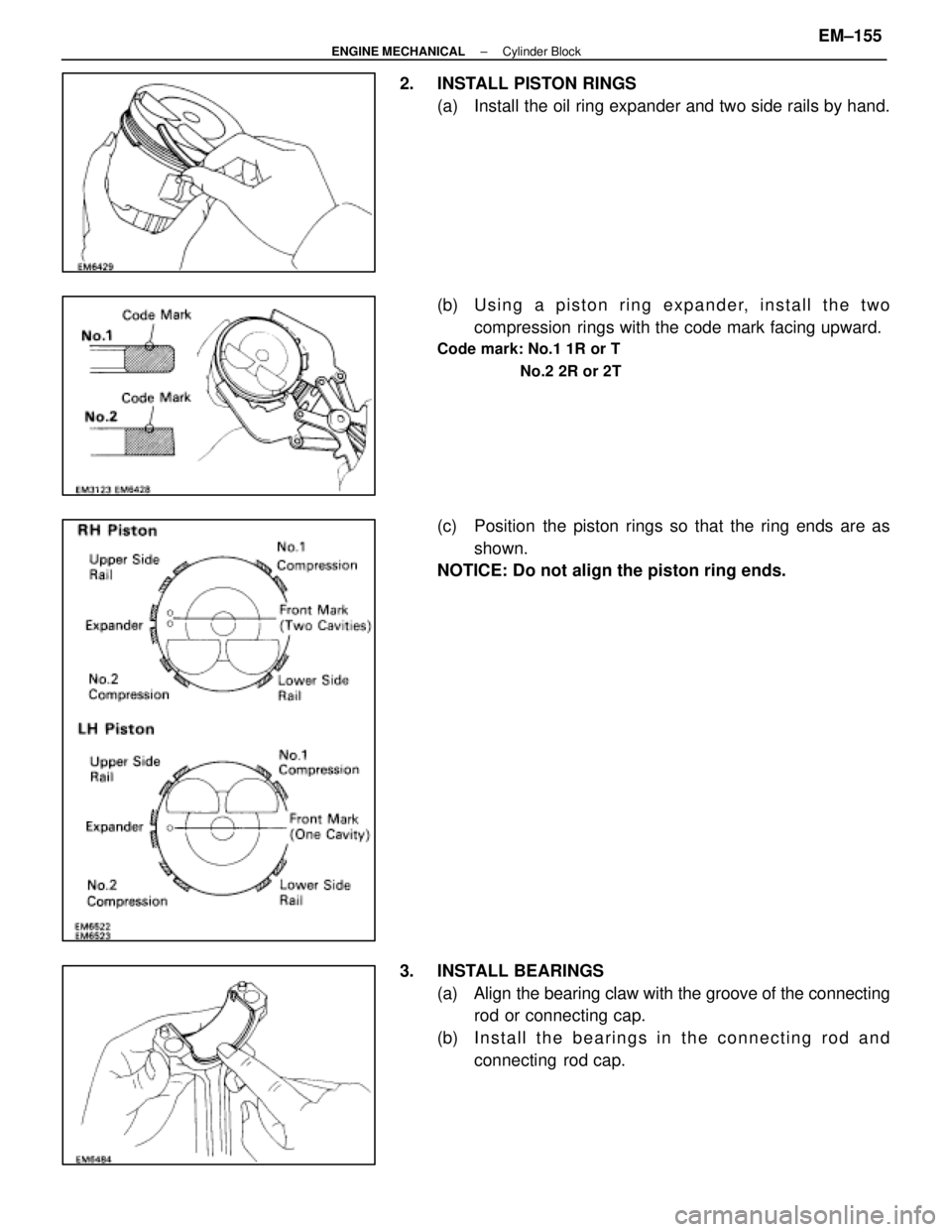
2. INSTALL PISTON RINGS(a) Install the oil ring expander and two side rails by hand.
(b) U s i n g a p i s t o n r i n g e x pander, install the two
compression rings with the code mark facing upward.
Code mark: No.1 1R or T
No.2 2R or 2T
(c) Position the piston rings so that the ring ends are asshown.
NOTICE: Do not align the piston ring ends.
3. INSTALL BEARINGS (a) Align the bearing claw with the groove of the connectingrod or connecting cap.
(b) I n s t a l l t h e b e a r i n g s i n t h e c onnecting rod and
connecting rod cap.
±
ENGINE MECHANICAL Cylinder BlockEM±155
WhereEverybodyKnowsYourName
Page 1850 of 4087
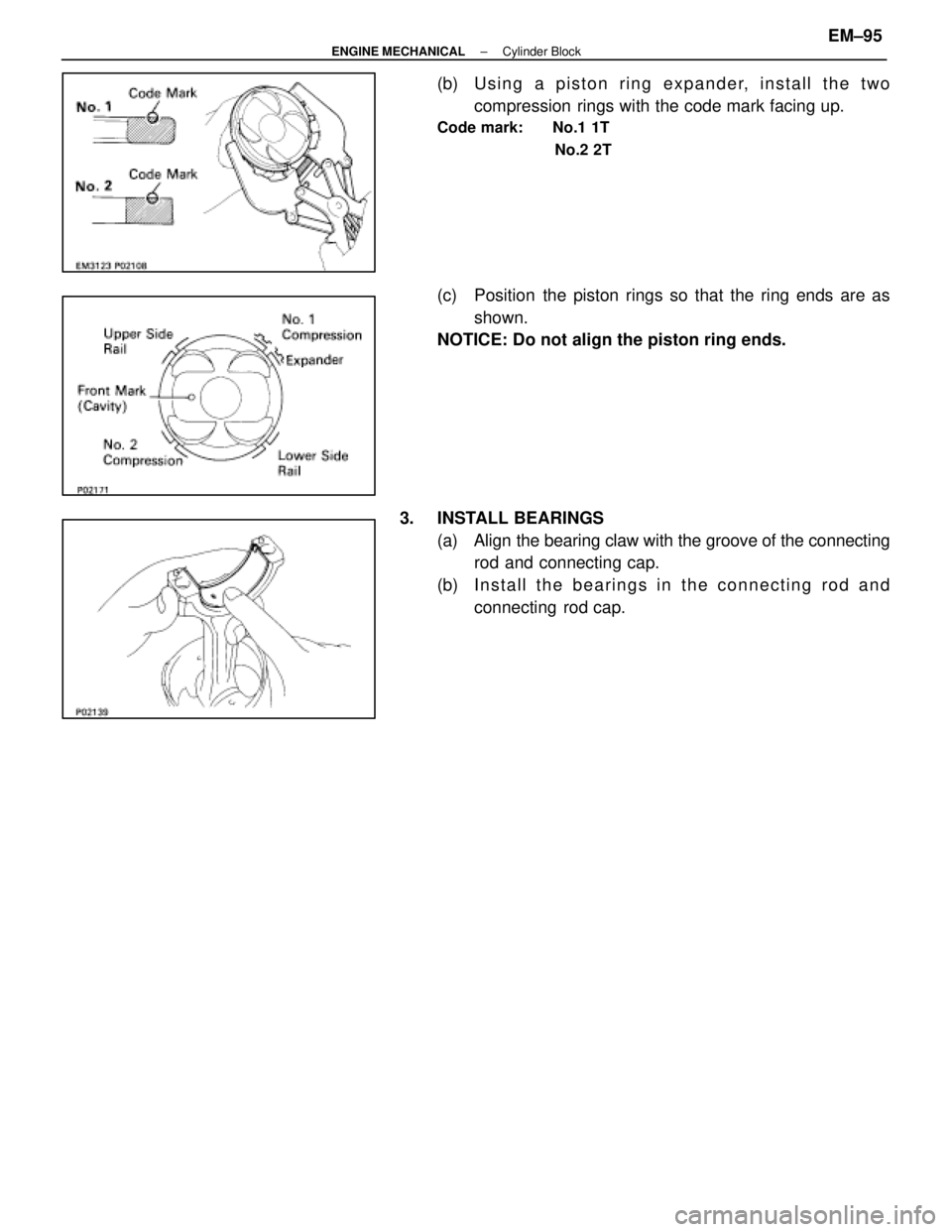
(b) Using a piston ring expander, install the twocompression rings with the code mark facing up.
Code mark: No.1 1T
No.2 2T
(c) Position the piston rings so that the ring ends are asshown.
NOTICE: Do not align the piston ring ends.
3. INSTALL BEARINGS (a) Align the bearing claw with the groove of the connectingrod and connecting cap.
(b) I n s t a l l t h e b e a r i n g s i n t h e c onnecting rod and
connecting rod cap.
±
ENGINE MECHANICAL Cylinder BlockEM±95
WhereEverybodyKnowsYourName
Page 1924 of 4087
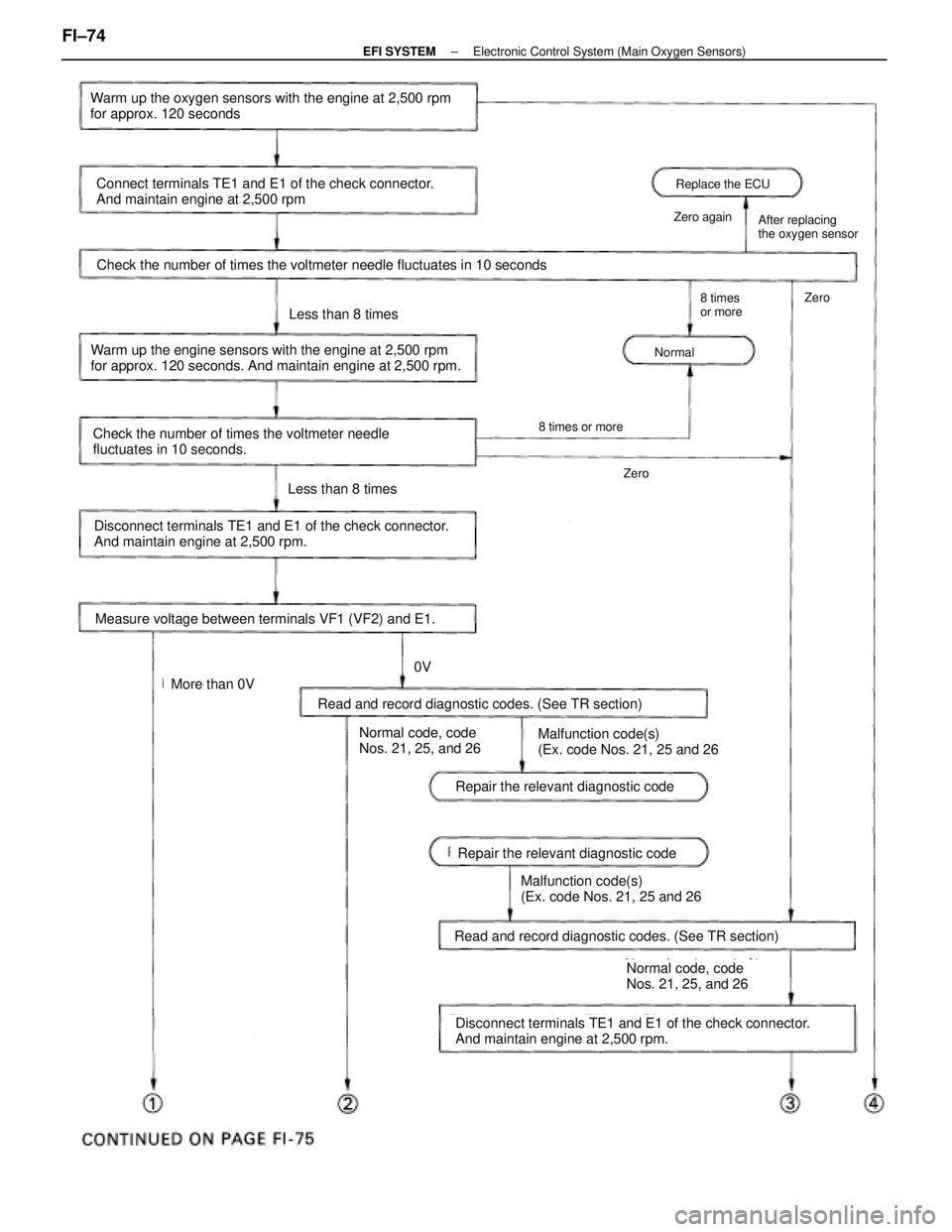
Replace the ECU
Zero againAfter replacing
the oxygen sensor
Normal
8 times
or moreZero
Check the number of times the voltmeter needle fluctuates in 10 seconds
Zero
8 times or more
Warm up the oxygen sensors with the engine at 2,500 rpm
for approx. 120 seconds
Connect terminals TE1 and E1 of the check connector.
And maintain engine at 2,500 rpm
Warm up the engine sensors with the engine at 2,500 rpm
for approx. 120 seconds. And maintain engine at 2,500 rpm.
Check the number of times the voltmeter needle
fluctuates in 10 seconds.
Less than 8 times
Disconnect terminals TE1 and E1 of the check connector.
And maintain engine at 2,500 rpm.
Measure voltage between terminals VF1 (VF2) and E1.
Less than 8 times
More than 0V
0V
Normal code, code
Nos. 21, 25, and 26Malfunction code(s)
(Ex. code Nos. 21, 25 and 26
Read and record diagnostic codes. (See TR section)
Repair the relevant diagnostic code
Disconnect terminals TE1 and E1 of the check connector.
And maintain engine at 2,500 rpm.
Read and record diagnostic codes. (See TR section)
Malfunction code(s)
(Ex. code Nos. 21, 25 and 26
Normal code, code
Nos. 21, 25, and 26
Repair the relevant diagnostic code
FI±74±
EFI SYSTEM Electronic Control System (Main Oxygen Sensors)
WhereEverybodyKnowsYourName
Page 1925 of 4087
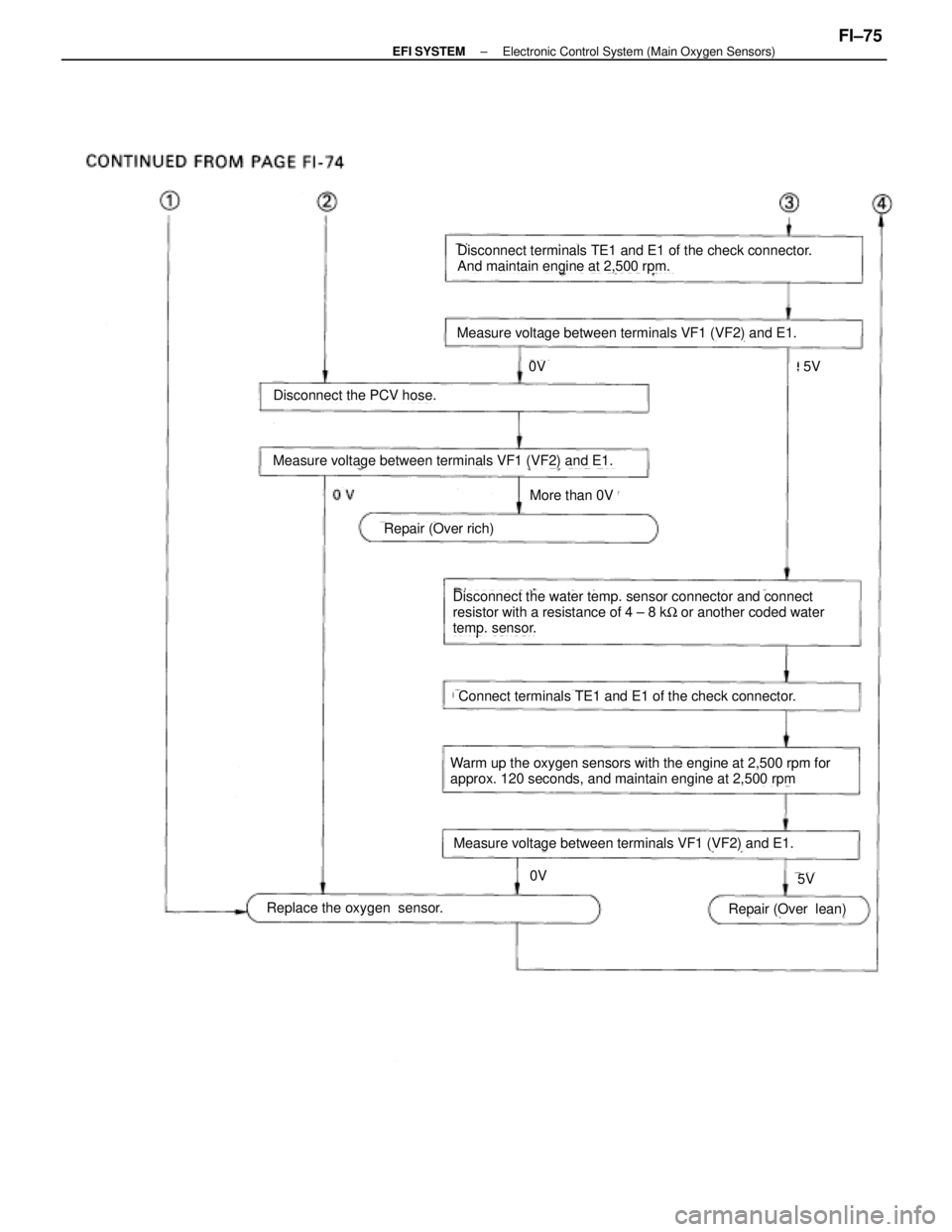
Measure voltage between terminals VF1 (VF2) and E1.
Disconnect terminals TE1 and E1 of the check connector.
And maintain engine at 2,500 rpm.
Measure voltage between terminals VF1 (VF2) and E1.
Disconnect the PCV hose.
0V
5V
More than 0V
Repair (Over rich)
Disconnect the water temp. sensor connector and connect
resistor with a resistance of 4 ± 8 kW or another coded water
temp. sensor.
Connect terminals TE1 and E1 of the check connector.
Warm up the oxygen sensors with the engine at 2,500 rpm for
approx. 120 seconds, and maintain engine at 2,500 rpm
Measure voltage between terminals VF1 (VF2) and E1.
Replace the oxygen sensor.Repair (Over lean)
5V
0V
±
EFI SYSTEM Electronic Control System (Main Oxygen Sensors)FI±75
WhereEverybodyKnowsYourName
Page 1927 of 4087
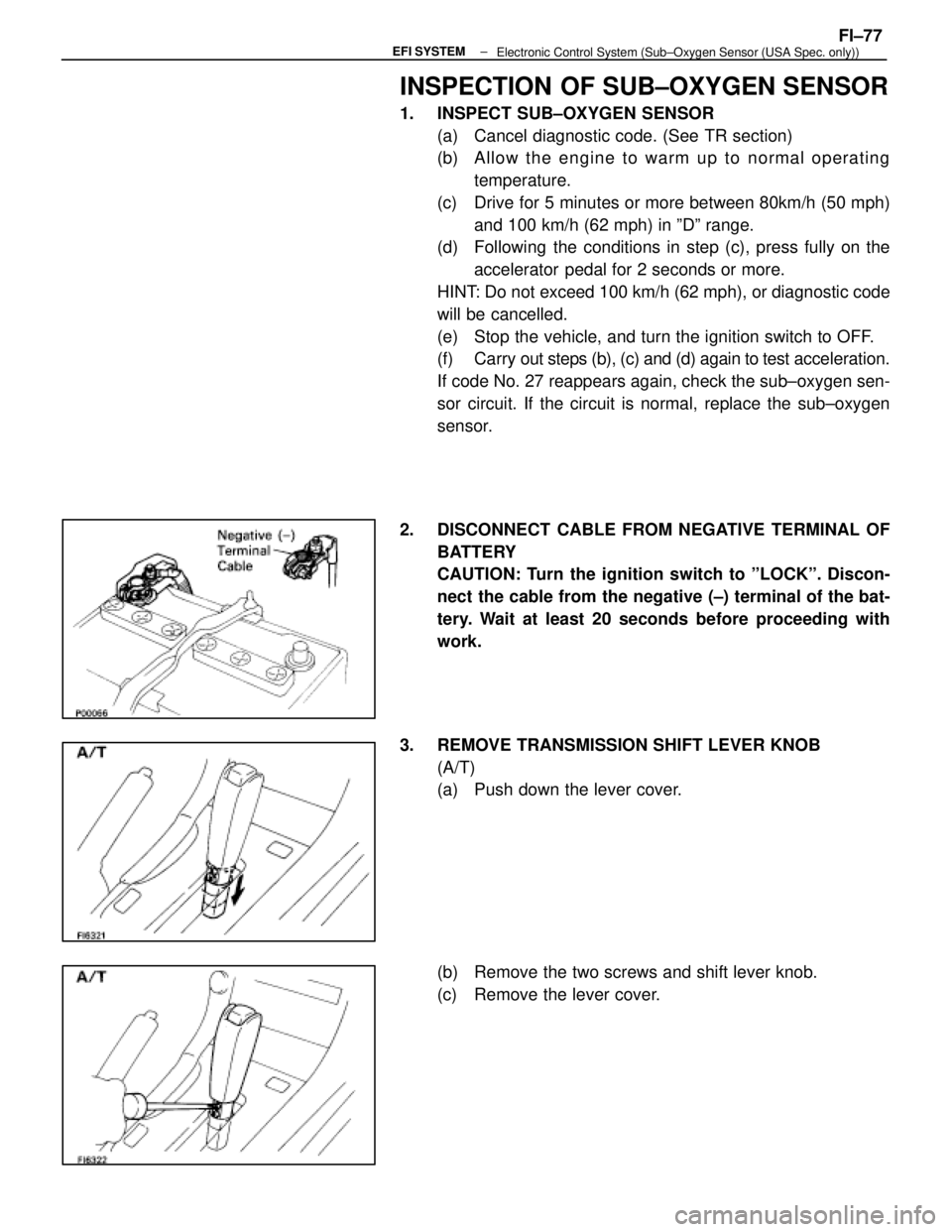
INSPECTION OF SUB±OXYGEN SENSOR
1. INSPECT SUB±OXYGEN SENSOR(a) Cancel diagnostic code. (See TR section)
(b) A llo w th e en g in e to wa rm up to no rma l op e ra tin gtemperature.
(c) Drive for 5 minutes or more between 80km/h (50 mph) and 100 km/h (62 mph) in ºDº range.
(d) Following the conditions in step (c), press fully on the
accelerator pedal for 2 seconds or more.
HINT: Do not exceed 100 km/h (62 mph), or diagnostic code
will be cancelled.
(e) Stop the vehicle, and turn the ignition switch to OFF.
(f) Carry out steps (b), (c) and (d) again to test acceleration.
If code No. 27 reappears again, check the sub±oxygen sen-
sor circuit. If the circuit is normal, replace the sub±oxygen
sensor.
2. DISCONNECT CABLE FROM NEGATIVE TERMINAL OF BATTERY
CAUTION: Turn the ignition switch to ºLOCKº. Discon-
nect the cable from the negative (±) terminal of the bat-
tery. Wait at least 20 seconds before proceeding with
work.
3. REMOVE TRANSMISSION SHIFT LEVER KNOB (A/T)
(a) Push down the lever cover.
(b) Remove the two screws and shift lever knob.
(c) Remove the lever cover.
±
EFI SYSTEMFI±77Electronic Control System (Sub±Oxygen Sensor (USA Spec. only))
WhereEverybodyKnowsYourName
Page 1969 of 4087
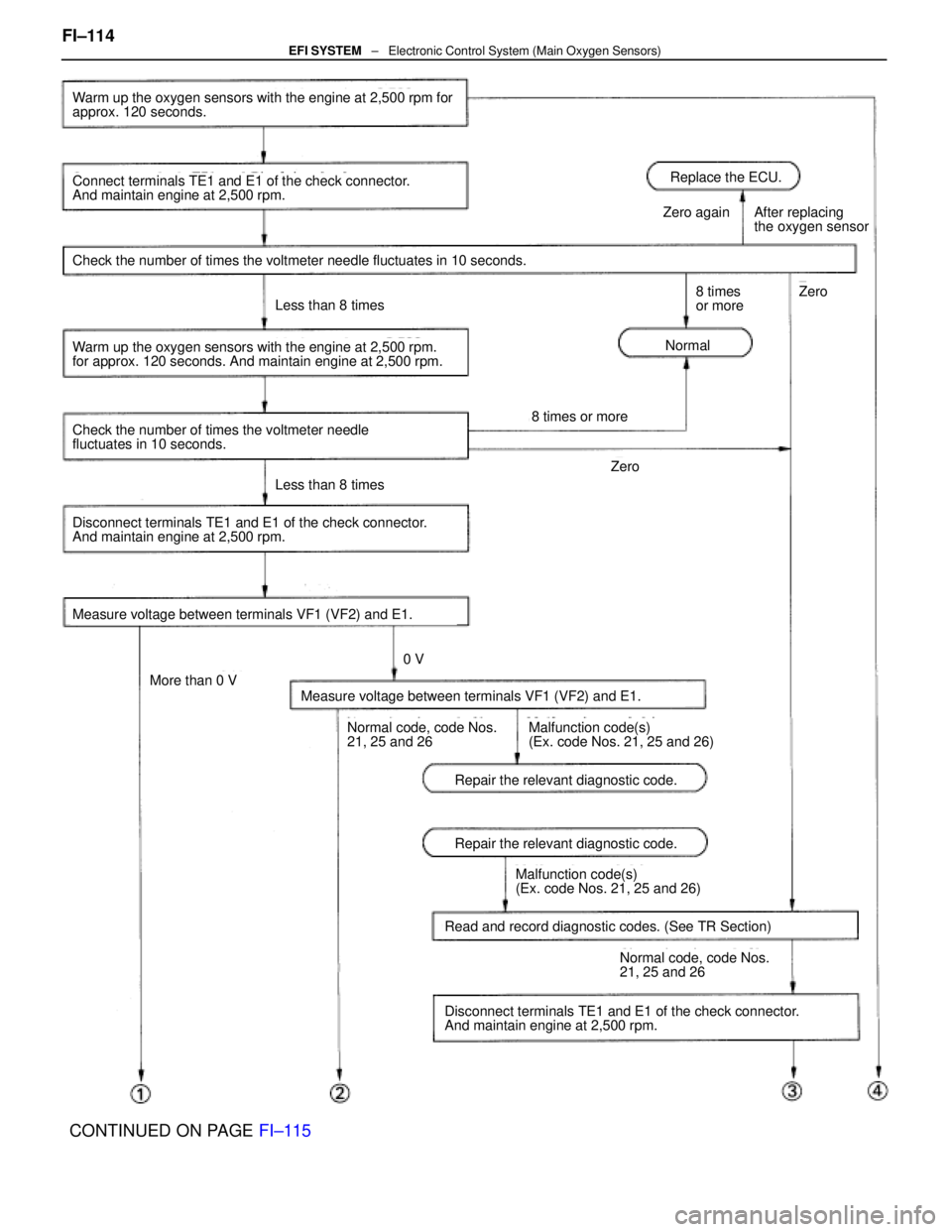
Warm up the oxygen sensors with the engine at 2,500 rpm for
approx. 120 seconds.
Connect terminals TE1 and E1 of the check connector.
And maintain engine at 2,500 rpm.
Check the number of times the voltmeter needle fluctuates in 10 seconds.\
Warm up the oxygen sensors with the engine at 2,500 rpm.
for approx. 120 seconds. And maintain engine at 2,500 rpm.
Check the number of times the voltmeter needle
fluctuates in 10 seconds.
Disconnect terminals TE1 and E1 of the check connector.
And maintain engine at 2,500 rpm.
Measure voltage between terminals VF1 (VF2) and E1.Replace the ECU.
Normal
Measure voltage between terminals VF1 (VF2) and E1.
Read and record diagnostic codes. (See TR Section)
Disconnect terminals TE1 and E1 of the check connector.
And maintain engine at 2,500 rpm. Repair the relevant diagnostic code. Repair the relevant diagnostic code.
Normal code, code Nos.
21, 25 and 26
Malfunction code(s)
(Ex. code Nos. 21, 25 and 26)
Malfunction code(s)
(Ex. code Nos. 21, 25 and 26)Normal code, code Nos.
21, 25 and 26
More than 0 V
0 V
Less than 8 times
Less than 8 times
8 times or more
8 times
or more
Zero
Zero
Zero again After replacing
the oxygen sensor
CONTINUED ON PAGE FI±115
FI±114
EFI SYSTEM
± Electronic Control System (Main Oxygen Sensors)
WhereEverybodyKnowsYourName