code 32 LEXUS SC300 1991 Service Repair Manual
[x] Cancel search | Manufacturer: LEXUS, Model Year: 1991, Model line: SC300, Model: LEXUS SC300 1991Pages: 4087, PDF Size: 75.75 MB
Page 2634 of 4087
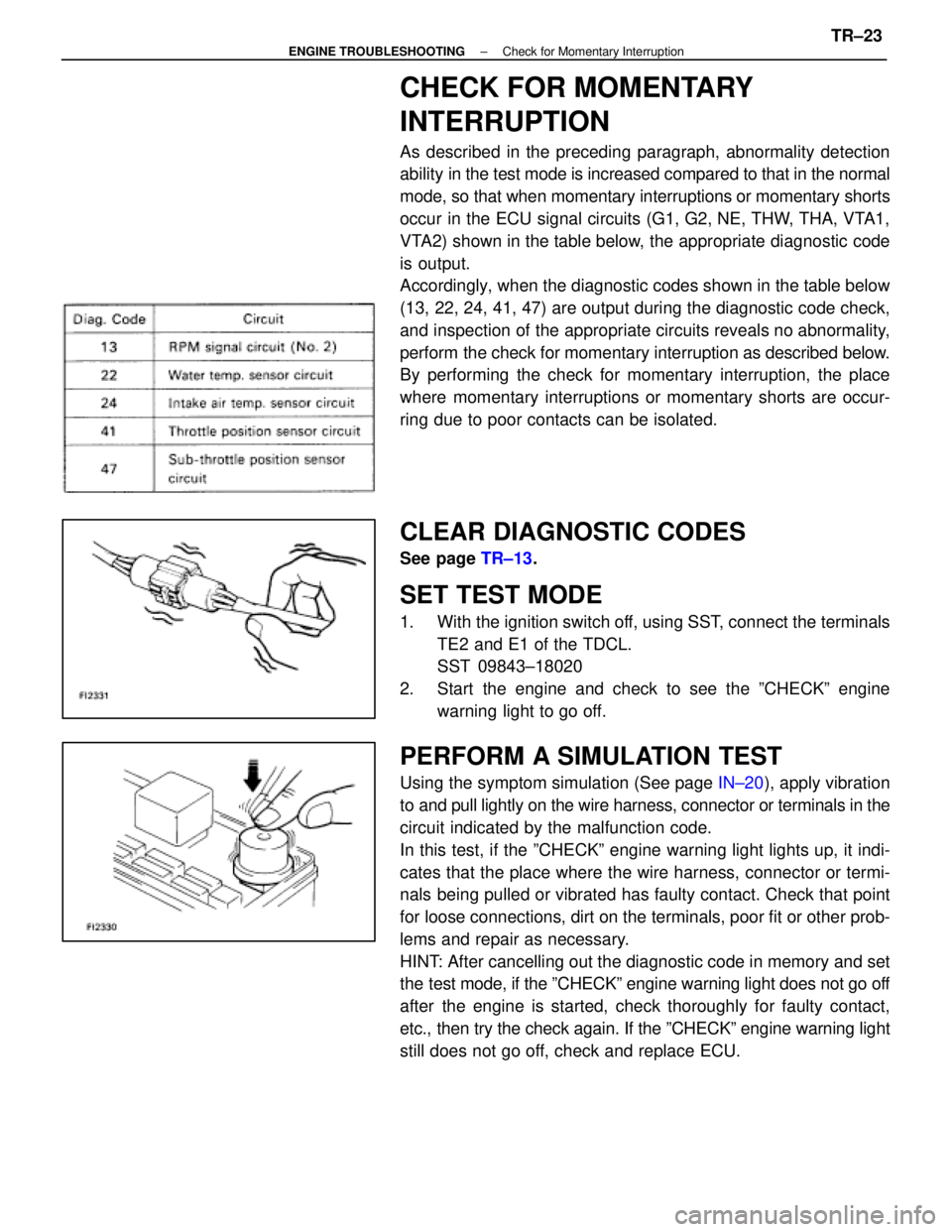
CHECK FOR MOMENTARY
INTERRUPTION
As described in the preceding paragraph, abnormality detection
ability in the test mode is increased compared to that in the normal
mode, so that when momentary interruptions or momentary shorts
occur in the ECU signal circuits (G1, G2, NE, THW, THA, VTA1,
VTA2) shown in the table below, the appropriate diagnostic code
is output.
Accordingly, when the diagnostic codes shown in the table below
(13, 22, 24, 41, 47) are output during the diagnostic code check,
and inspection of the appropriate circuits reveals no abnormality,
perform the check for momentary interruption as described below.
By performing the check for momentary interruption, the place
where momentary interruptions or momentary shorts are occur-
ring due to poor contacts can be isolated.
CLEAR DIAGNOSTIC CODES
See page TR±13.
SET TEST MODE
1. With the ignition switch off, using SST, connect the terminals
TE2 and E1 of the TDCL.
SST 09843±18020
2. Start the engine and check to see the ºCHECKº engine warning light to go off.
PERFORM A SIMULATION TEST
Using the symptom simulation (See page IN±20), apply vibration
to and pull lightly on the wire harness, connector or terminals in the
circuit indicated by the malfunction code.
In this test, if the ºCHECKº engine warning light lights up, it in\
di-
cates that the place where the wire harness, connector or termi-
nals being pulled or vibrated has faulty contact. Check that point
for loose connections, dirt on the terminals, poor fit or other prob-
lems and repair as necessary.
HINT: After cancelling out the diagnostic code in memory and set
the test mode, if the ºCHECKº engine warning light does not go off
after the engine is started, check thoroughly for faulty contact,
etc., then try the check again. If the ºCHECKº engine warning light
still does not go off, check and replace ECU.
±
ENGINE TROUBLESHOOTING Check for Momentary InterruptionTR±23
WhereEverybodyKnowsYourName
Page 2635 of 4087

YESNO
NOYES
YES
NO
OKNG
BASIC INSPECTION
When the normal code is displayed in the diagnostic code check, troubleshoot\
ing should be performed in the
order for all possible circuits to be considered as the causes of the pr\
oblems.
In many cases, by carrying out the basic engine check shown in the follo\
wing flow chart, the location causing
the problem can be found quickly and ef ficiently. Therefore, use of this check is essential in engine troubleshoot-
ing.
1Is battery voltage 11 V or more when engine is stopped?
Charge or replace battery.
2Is engine cracnked?
Proceed to matrix to matrix chart of problem
symptoms on page TR±35.
3Does engine start?
Go to step [7]
4Check air filter
C
Hint
PRemove air filter
Visially check that the air cleaner element is not exces-
sively damaged or oily.
If necessary, clean element with compressed air. First
blow from inside thoroughly, then blow off outside of ele-
ment.
Repair or replace
Go to Step [5].
TR±24±
ENGINE TROUBLESHOOTING Basic Inspection
WhereEverybodyKnowsYourName
Page 2641 of 4087
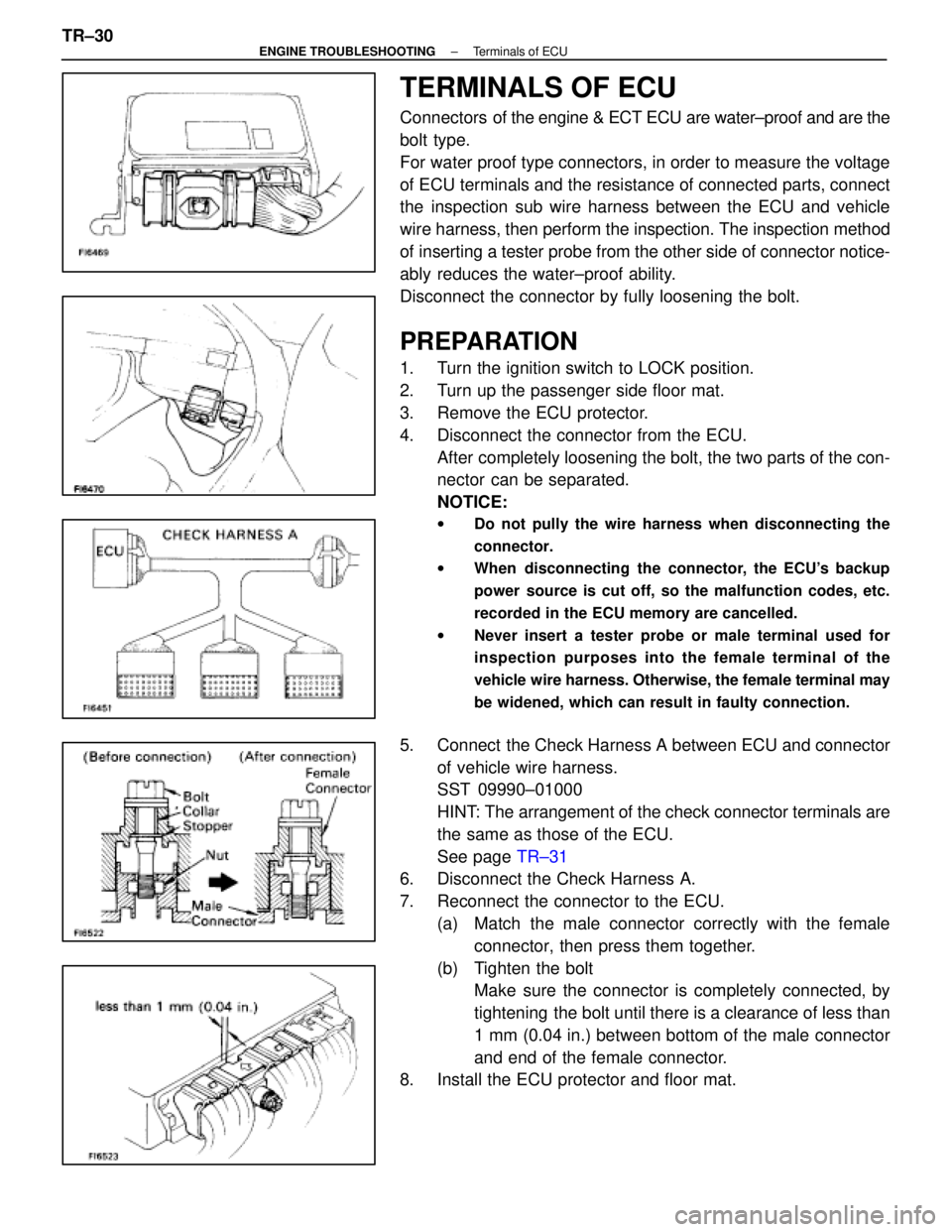
TERMINALS OF ECU
Connectors of the engine & ECT ECU are water±proof and are the
bolt type.
For water proof type connectors, in order to measure the voltage
of ECU terminals and the resistance of connected parts, connect
the inspection sub wire harness between the ECU and vehicle
wire harness, then perform the inspection. The inspection method
of inserting a tester probe from the other side of connector notice-
ably reduces the water±proof ability.
Disconnect the connector by fully loosening the bolt.
PREPARATION
1. Turn the ignition switch to LOCK position.
2. Turn up the passenger side floor mat.
3. Remove the ECU protector.
4. Disconnect the connector from the ECU. After completely loosening the bolt, the two parts of the con-
nector can be separated.
NOTICE:
w Do not pully the wire harness when disconnecting the
connector.
w When disconnecting the connector, the ECU's backup
power source is cut off, so the malfunction codes, etc.
recorded in the ECU memory are cancelled.
w Never insert a tester probe or male terminal used for
inspection purposes into the female terminal of the
vehicle wire harness. Otherwise, the female terminal may
be widened, which can result in faulty connection.
5. Connect the Check Harness A between ECU and connector
of vehicle wire harness.
SST 09990±01000
HINT: The arrangement of the check connector terminals are
the same as those of the ECU.
See page TR±31
6. Disconnect the Check Harness A.
7. Reconnect the connector to the ECU.
(a) Match the male connector correctly with the femaleconnector, then press them together.
(b) Tighten the bolt Make sure the connector is completely connected, by
tightening the bolt until there is a clearance of less than
1 mm (0.04 in.) between bottom of the male connector
and end of the female connector.
8. Install the ECU protector and floor mat.
TR±30
±
ENGINE TROUBLESHOOTING Terminals of ECU
WhereEverybodyKnowsYourName
Page 2646 of 4087
TR±88
TR±10
0
TR±12
2
TR±13
0
TR±13
6
TR±14
0
TR±11
4
TR±14
2 TR±108
TR±11
8
TR±12
4
TR±13
2
AC±84
ST±24
IG±24 IG±6
EM±30
AT±66
IN±32BE±381IG±7
IG±9
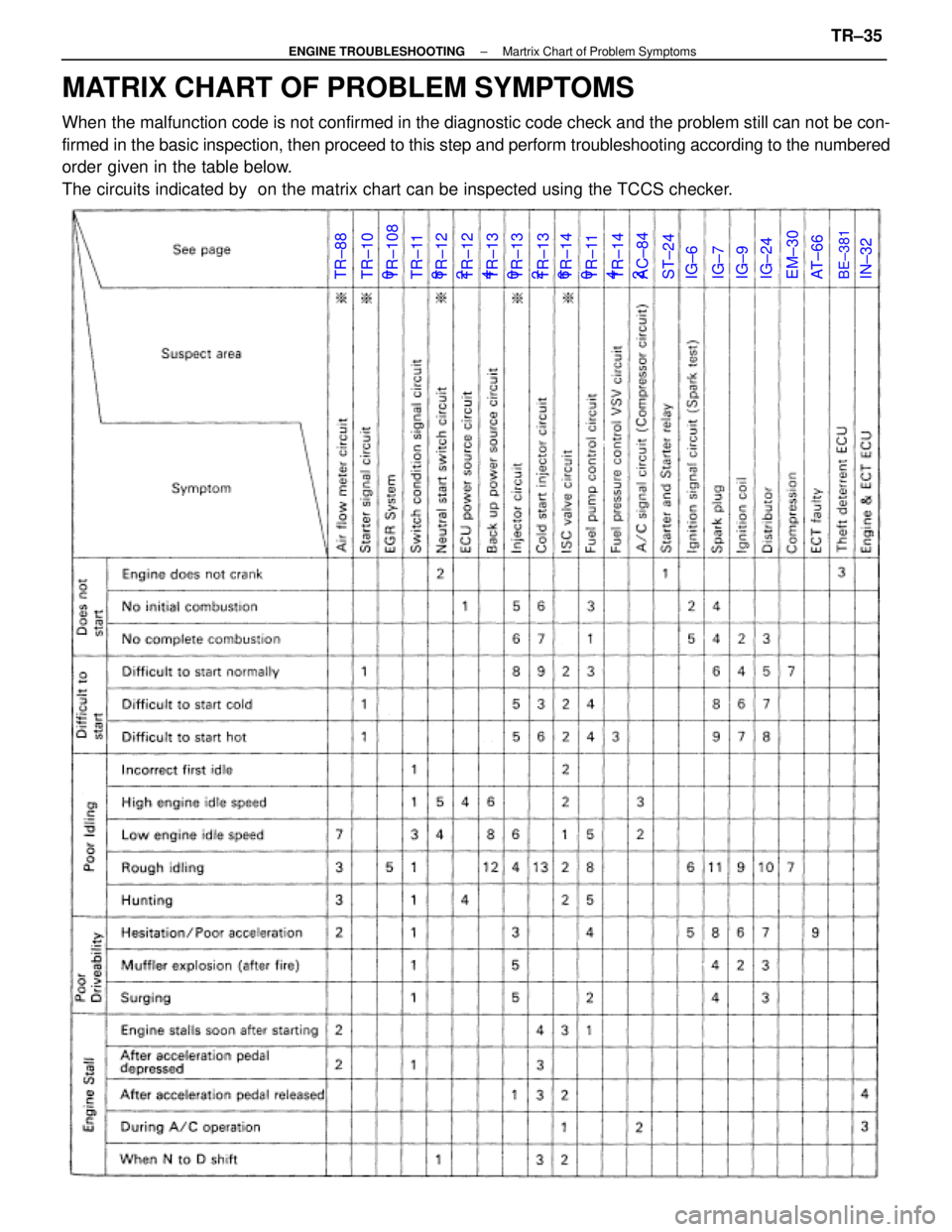
MATRIX CHART OF PROBLEM SYMPTOMS
When the malfunction code is not confirmed in the diagnostic code check and \
the problem still can not be con-
firmed in the basic inspection, then proceed to this step and perform troubles\
hooting according to the numbered
order given in the table below.
The circuits indicated by on the matrix chart can be inspected using th\
e TCCS checker.
±
ENGINE TROUBLESHOOTING Martrix Chart of Problem SymptomsTR±35
WhereEverybodyKnowsYourName
Page 2659 of 4087

CIRCUIT DESCRIPTION
Cam position sensors (G1 and G2 signals) and engine speed sensor (NE sig\
nal) consist of a signal plate
and a pick up c")
CIRCUIT INSPECTIONDiag. Code 12
RPM Signal Circuit (No.1)
CIRCUIT DESCRIPTION
Cam position sensors (G1 and G2 signals) and engine speed sensor (NE sig\
nal) consist of a signal plate
and a pick up coil.
The G1, G2 signal plates have one tooth each on its outer circumference and\
are mounted on the left and
right bank camshafts.
When the camshafts rotate, the protrusion on the signal plate and the air gap on the pick up coil change,
causing fluctuations in the magnetic field and generating an electromotive forc\
e in the pick up coil.
The NE signal plate has 12 teeth and is mounted on the crankshaft. The NE s\
ignal sensor generates 12
NE signals per engine revolution. The ECU detects the standard crankshaf\
t angle based on the G1, G2
signals, and the actual crankshaft angle and the engine speed by the NE \
signals.
Code No.Diagnostic Code Detecting ConditionTrouble Area
wOpen or short in engine speed sensor, No. 1,w Oen or short in engine s eed sensor, No. 1,
No. 2 cam position sensor circuit
12No ºNEº or ºG1º and ºG2º signal to ECU
No. 2 cam osition sensor circuit
w Engine speed sensor12No NE or G1 and G2 signal to ECU
within 2 sec. after cranking.
wEngine s eed sensor
wNo. 1, No. 2 cam position sensorgNo. 1, No. 2 cam osition sensor
wStarter
wECU
TR±48±
ENGINE TROUBLESHOOTING Circuit Inspection
WhereEverybodyKnowsYourName
Page 2663 of 4087
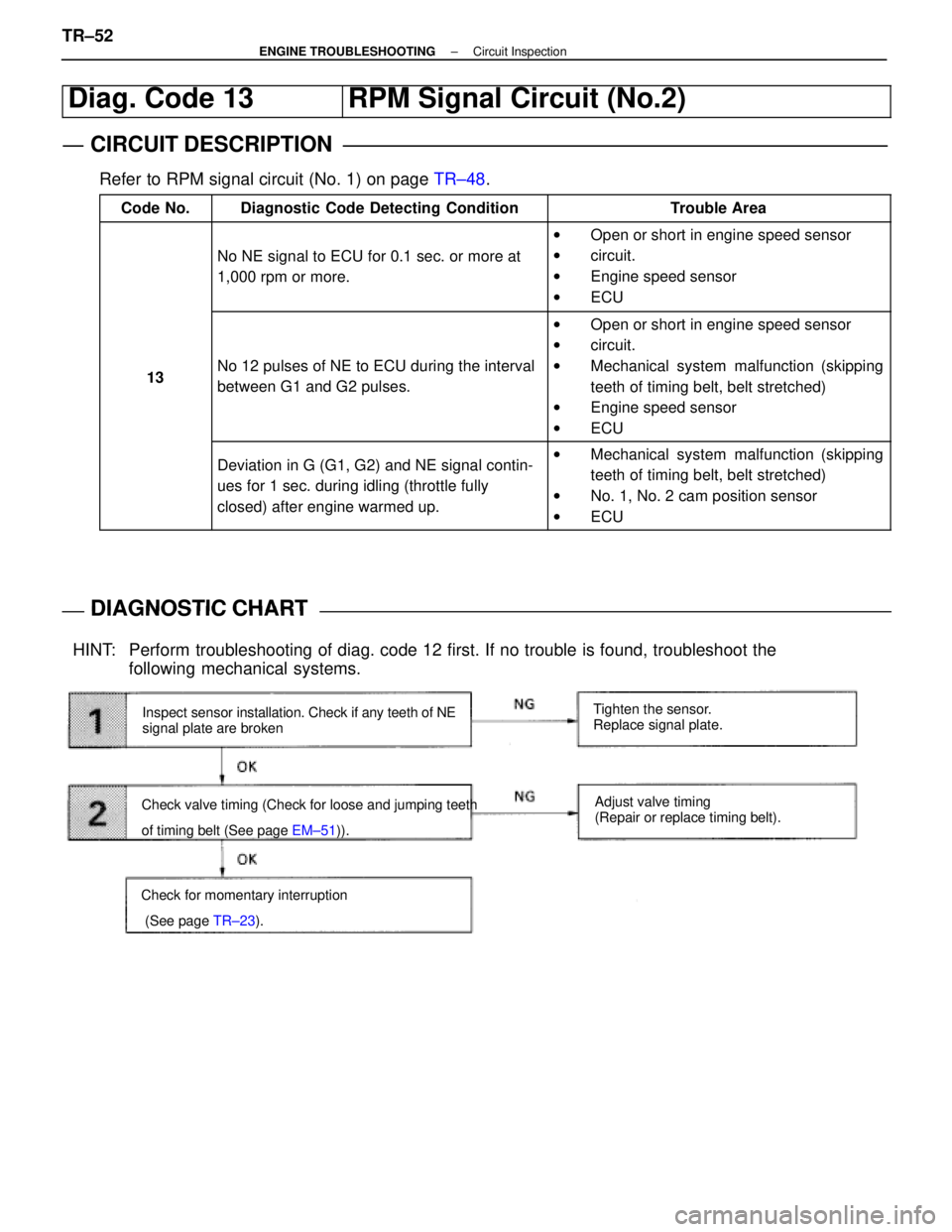
Diag. Code 13RPM Signal Circuit (No.2)
CIRCUIT DESCRIPTION
Refer to RPM signal circuit (No. 1) on page TR±48.
Code No.Diagnostic Code Detecting ConditionTrouble Area
No NE signal to ECU for 0.1 sec. or more at
1,000 rpm or more.
wOpen or short in engine speed sensor
w circuit.
w Engine speed sensor
w ECU
13No 12 pulses of NE to ECU during the interval
between G1 and G2 pulses.
wOpen or short in engine speed sensor
w circuit.
w Mechanical system malfunction (skipping
teeth of timing belt, belt stretched)
w Engine speed sensor
w ECU
Deviation in G (G1, G2) and NE signal contin-
ues for 1 sec. during idling (throttle fully
closed) after engine warmed up.wMechanical system malfunction (skipping
teeth of timing belt, belt stretched)
w No. 1, No. 2 cam position sensor
w ECU
DIAGNOSTIC CHARTDIAGNOSTIC CHART
Inspect sensor installation. Check if any teeth of NE
signal plate are broken
Check valve timing (Check for loose and jumping teeth
of timing belt (See page EM±51)). Tighten the sensor.
Replace signal plate.
Adjust valve timing
(Repair or replace timing belt).
HINT: Perform troubleshooting of diag. code 12 first. If no trouble is found, trouble\
shoot the following mechanical systems.
Check for momentary interruption
(See page TR±23).
TR±52±
ENGINE TROUBLESHOOTING Circuit Inspection
WhereEverybodyKnowsYourName
Page 2665 of 4087
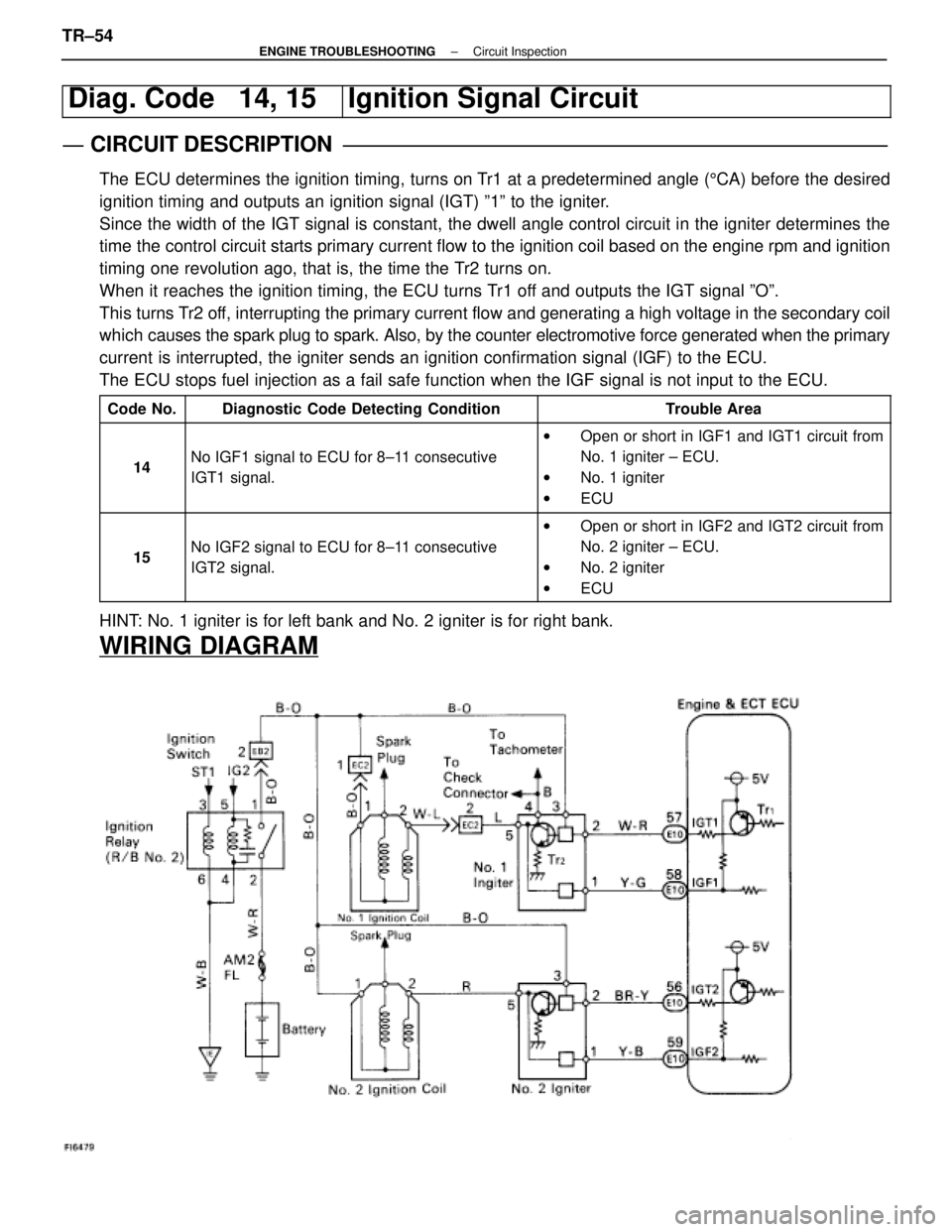
Diag. Code 14, 15Ignition Signal Circuit
CIRCUIT DESCRIPTION
The ECU determines the ignition timing, turns on Tr1 at a predetermined angle (5CA) before the desired
ignition timing and outputs an ignition signal (IGT) º1º to the \
igniter.
Since the width of the IGT signal is constant, the dwell angle control circuit in the ignit\
er determines the
time the control circuit starts primary current flow to the ignition coil bas\
ed on the engine rpm and ignition
timing one revolution ago, that is, the time the Tr2 turns on.
When it reaches the ignition timing, the ECU turns Tr1 off and outputs the IGT signal ºOº.
This turns Tr2 off, interrupting the primary current flow and generating a high voltage i\
n the secondary coil
which causes the spark plug to spark. Also, by the counter electromotive force\
generated when the primary
current is interrupted, the igniter sends an ignition confirmation signal (IGF\
) to the ECU.
The ECU stops fuel injection as a fail safe function when the IGF signal\
is not input to the ECU.
Code No.Diagnostic Code Detecting ConditionTrouble Area
14No IGF1 signal to ECU for 8±11 consecutive
IGT1 signal.
w Open or short in IGF1 and IGT1 circuit from
No. 1 igniter ± ECU.
w No. 1 igniter
w ECU
15No IGF2 signal to ECU for 8±11 consecutive
IGT2 signal.
wOpen or short in IGF2 and IGT2 circuit from
No. 2 igniter ± ECU.
w No. 2 igniter
w ECU
HINT: No. 1 igniter is for left bank and No. 2 igniter is for right bank.
WIRING DIAGRAM
TR±54±
ENGINE TROUBLESHOOTING Circuit Inspection
WhereEverybodyKnowsYourName
Page 2666 of 4087
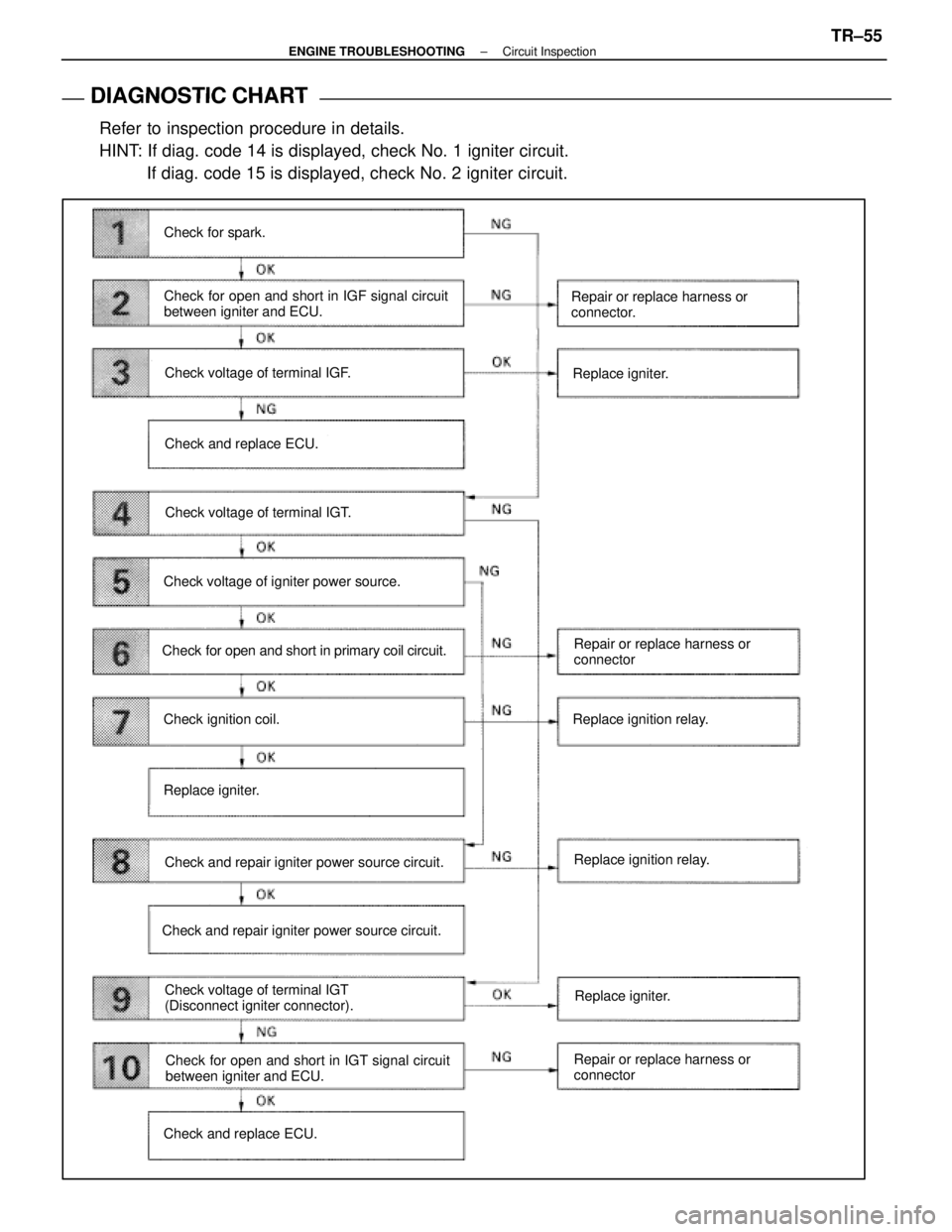
DIAGNOSTIC CHART
DIAGNOSTIC
CHART
Refer to inspection procedure in details.
HINT: If diag. code 14 is displayed, check No. 1 igniter circuit. If diag. code 15 is displayed, check No. 2 igniter circuit.
Check for spark.
Check for open and short in IGF signal circuit
between igniter and ECU.
Check voltage of terminal IGF.
Check and replace ECU.
Check voltage of terminal IGT.
Check voltage of igniter power source.
Check for open and short in primary coil circuit.
Check ignition coil.
Replace igniter.
Check and repair igniter power source circuit.
Check voltage of terminal IGT
(Disconnect igniter connector).
Check and repair igniter power source circuit. Repair or replace harness or
connector.
Replace igniter.
Repair or replace harness or
connector
Replace ignition relay.
Replace ignition relay.
Check for open and short in IGT signal circuit
between igniter and ECU.
Check and replace ECU. Repair or replace harness or
connectorReplace igniter.
±
ENGINE TROUBLESHOOTING Circuit InspectionTR±55
WhereEverybodyKnowsYourName
Page 2667 of 4087
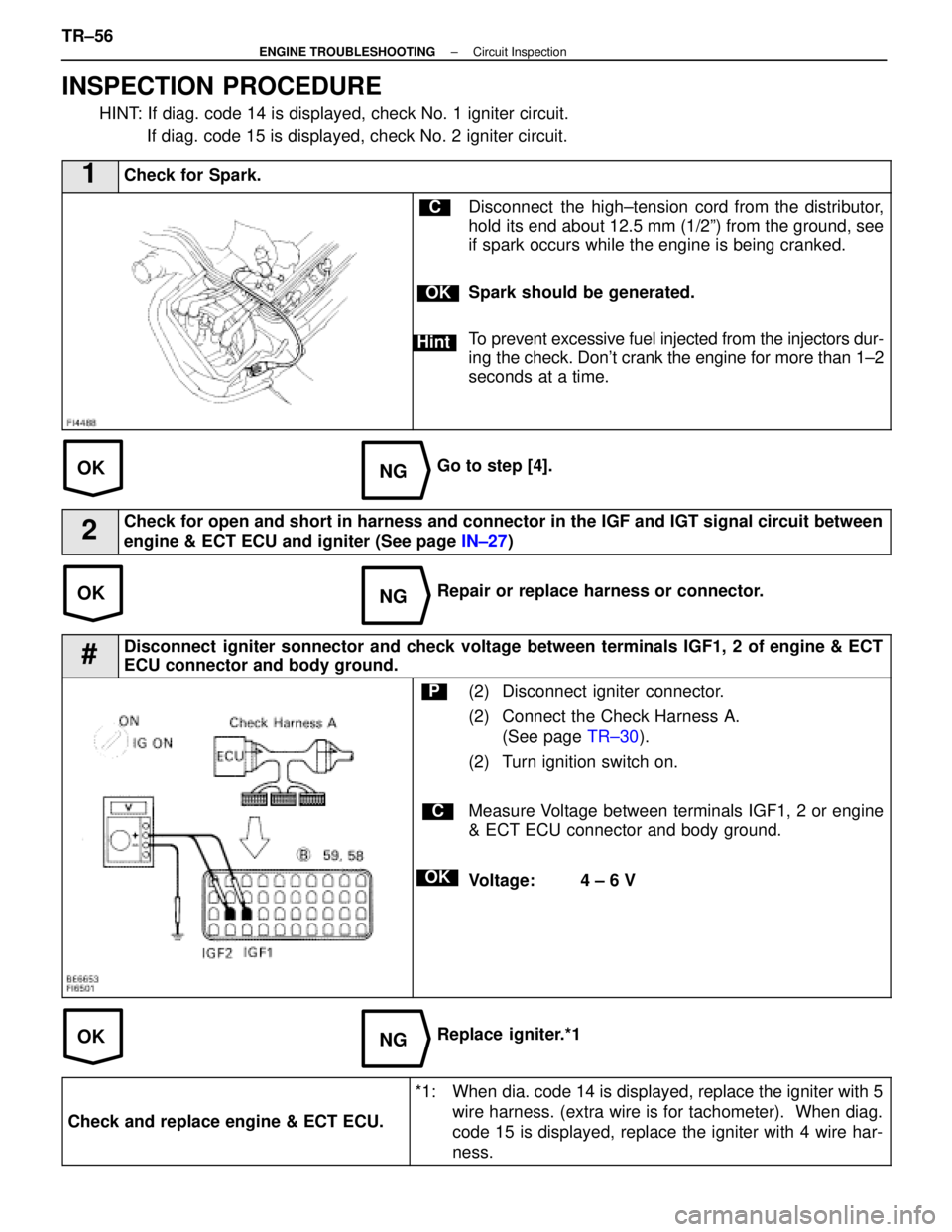
OKNG
OKNG
OKNG
INSPECTION PROCEDURE
HINT: If diag. code 14 is displayed, check No. 1 igniter circuit. If diag. code 15 is displayed, check No. 2 igniter circuit.
1Check for Spark.
C
OK
Hint
Disconnect the high±tension cord from the distributor,
hold its end about 12.5 mm (1/2º) from the ground, see
if spark occurs while the engine is being cranked.
Spark should be generated.
To prevent excessive fuel injected from the injectors dur-
ing the check. Don't crank the engine for more than 1±2
seconds at a time.
Go to step [4].
2Check for open and short in harness and connector in the IGF and IGT signal c\
ircuit between
engine & ECT ECU and igniter (See page IN±27)
Repair or replace harness or connector.
#Disconnect igniter sonnector and check voltage between terminals IGF1, 2 of engine & ECT
ECU connector and body ground.
C
OK
P(2) Disconnect igniter connector.
(2) Connect the Check Harness A.
(See page TR±30).
(2) Turn ignition switch on.
Measure Voltage between terminals IGF1, 2 or engine
& ECT ECU connector and body ground.
Voltage: 4 ± 6 V
Replace igniter.*1
Check and replace engine & ECT ECU.
*1: When dia. code 14 is displayed, replace the igniter with 5 wire harness. (extra wire is for tachometer). When diag.
code 15 is displayed, replace the igniter with 4 wire har-
ness.
TR±56±
ENGINE TROUBLESHOOTING Circuit Inspection
WhereEverybodyKnowsYourName
Page 2669 of 4087
.
Repair or replace harness or connector
#Check ign")
OKNG
OKNG
6Check for open and short in harness and connector between ignition relay and \
ignition coil,
ignition coil and igniter (See page IN±27).
Repair or replace harness or connector
#Check ignition coil.
C
OK
PDisconnect ignition coil connector.
(For No. 1 ignition coil (on left bank), remove the battery)
(2) Check primary coil. Measure resistance between terminals of ignition
coil connector.
(2) Check secondary coil. Measure resistance between terminal 1 of ignition
coil connector and high±tension terminal.
Replace ignition coil.
Replace Igniter. *1
*1: When diag. code 14 is displayed, replace the igniter with 5 wire harness. (extra wire is for tachometer). When diag.
code 15 is displayed, replace the igniter with 4 wire har-
ness
TR±58±
ENGINE TROUBLESHOOTING Circuit Inspection
WhereEverybodyKnowsYourName