engine LEXUS SC400 1991 Service Repair Manual
[x] Cancel search | Manufacturer: LEXUS, Model Year: 1991, Model line: SC400, Model: LEXUS SC400 1991Pages: 4087, PDF Size: 75.75 MB
Page 984 of 4087

CHECK AND ADJUSTMENT
BR0EC±07
BRAKE PEDAL CHECK AND
ADJUSTMENT
1. CHECK THAT PEDAL HEIGHT IS CORRECT
Pedal height from asphalt sheet:150.4±160.4 mm (5.92±6.31 in.)
If the pedal height is incorrect, adjust it.
2. IF NECESSARY, ADJUST PEDAL HEIGHT
(a) Disconnect the connector from the stop light switch.
(b) Loosen the stop light switch lock nut and remove the stop light switch.
(c) Loosen the push rod lock nut.
(d) Adjust the pedal height by turning the pedal push rod.
(e) Tighten the push rod lock nut.
Torque: 25 N Vm (260 kgf Vcm, 19 ft Vlbf)
(f) Install the stop light switch and turn it until it lightly contacts
the pedal stopper.
(g) Turn the stop light switch back one turn.
(h) Check the clearance (A) between stop light switch and pedal.
Clearance:
0.5±2.4 mm (0.02±0.09 in.)
(i) Tighten the stop light switch lock nut.
(j) Connect the connector to the stop light switch.
(k) Check that the stop lights come on when the brake pedal isdepressed, and go off when the brake pedal is released.
(l) After adjusting the pedal height, check the pedal free±play.
HINT: If clearance (A) between the stop light switch and the
brake pedal stopper has been adjusted correctly, the pedal
freeplay will meet the specifications.
3. CHECK THAT PEDAL FREEPLAY IS CORRECT, AS SHOWN
(a) Stop the engine and depress the brake pedal several times until there is no more vacuum left in the booster.
(b) Push in the pedal by hand until the beginning of the second point of resistance is felt, then measure the distance, as
shown.
Pedal freeplay:
1±6 mm (0.04±0.24 in.)
If incorrect, check the stop light switch clearance. And if the
clearance is OK, then troubleshoot the brake system.
HINT: The freeplay to the first point of resistance is due to the
play between the clevis and pin. It is 1±3 mm (0.04±0.12 in.)
on the pedal.
±
BRAKE SYSTEM CHECK AND ADJUSTMENTBR±7
WhereEverybodyKnowsYourName
Page 985 of 4087

4. CHECK THAT PEDAL RESERVE DISTANCE IS CORRECT,
AS SHOWN
Release the parking brake.
With the engine running, depress the pedal and measure the
pedal reserve distance, as shown.
Pedal reserve distance at 490 N (50 kgf, 110.2 lbf):
More than 89 mm (3.50 in.)
If the reserve distance is incorrect, troubleshoot the brake
system.
BRAKE BOOSTER OPERATIONAL TEST
BR03P±0B
1. OPERATING CHECK
(a) Depress the bake pedal several times with the engine off and
check that there is no change in the pedal reserve distance.
(b) Depress the brake pedal and start the engine. If the pedal goes down slightly, operation is normal.
2. AIR TIGHTNESS CHECK
(a) Start the engine and stop it after 1 or 2 minutes. Depress the brake pedal several times slowly. If the pedal goes down the
farthest the 1st time, but gradually rises after the 2nd or 3rd
time, the booster is air tight.
(b) Depress the brake pedal while the engine is running, and stop the engine with the pedal depressed. If there is no
change in the pedal reserve travel after holding the pedal for
30 seconds, the booster is air tight.
BRAKE SYSTEM BLEEDING
BR0ED±04
HINT: If any work is done on the brake system or if air in the
brake lines is suspected, bleed the system of air.
NOTICE: Do not let brake fluid remain on painted sur-
faces. Wash it off immediately.
1. REMOVE RESERVOIR CAP Turn the reservoir cap to the ªopenº side and remove it.
2. FILL RESERVOIR WITH BRAKE FLUID
Fluid: SAE J1703 or FMVSS NO.116DOT3
BR±8±
BRAKE SYSTEM CHECK AND ADJUSTMENT
WhereEverybodyKnowsYourName
Page 987 of 4087

TRAC CONTROL SYSTEM BLEEDING
BR0EE±03
1. BLEED TRACTION CONTROL SYSTEMCAUTION:
w The fluid is under high pressure, and could spray out with
great force, so exercise caution.
w When repairing the brake master cylinder or TRAC
system, bleed the air out of the TRAC system.
(a) Connect a vinyl tube to the bleeder plug of accumulator, then
loosen the bleeder plug.
(b) Start the engine to allow the TRAC pump motor to operate
until all the air has been bled out of the fluid.
(c) Tighten the bleeder plug and stop the engine.
Torque: 8.3 N Vm (85 kgf Vcm, 74 in. Vlbf)
(d) C onnect a vinyl tube to the bleeder plug of the TRAC
actuator, then loosen the bleeder plug.
(e) Start the engine to allow the TRAC pump motor to operate
until all the air has been bled out of the fluid.
(f) Tighten the bleeder plug and stop the engine. Torque: 8.3 N Vm (85 kgf Vcm, 74 in. Vlbf)
(g) Check if any diagnostic trouble code is output which indicates
trouble. If there is, clear the diagnostic trouble code.
2. CHECK FLUID LEVEL IN RESERVOIR Check the fluid level and add fluid if necessary.
Fluid:
SAE J1703 or FMVSS NO. 116DOT3
HINT: Add fluid with the engine idling.
BR±10
±
BRAKE SYSTEM CHECK AND ADJUSTMENT
WhereEverybodyKnowsYourName
Page 1035 of 4087

4. INSPECT BRAKE ACTUATOR OPERATION
(a) Start the engine, and run it at idle speed.
(b) Turn the MAIN selector switch of the actuator checker to theªFRONT RHº position.
(c) Push and hold in the SUB MOTOR switch for a few seconds.
(d) Depress the brake pedal and hold it until step (g) is completed.
(e) Push the MAIN push switch and check that the brake pedal can not be depressed.
NOTICE: Do not keep the MAIN push switch pushing more
than 10 seconds.
(f) Re le a se th e switch , an d ch e ck th a t th e p edal can be
depressed.
(g) Push and hold in the SUB MOTOR switch for a few seconds, and check that the pedal returns.
(h) Release the brake pedal.
(i) Push and hold in the SUB MOTOR switch for a few seconds.
(j) Depress the brake pedal and hold it for about 15 seconds. As
you hold the pedal down, push the SUB MOTOR switch for
a few seconds. Check that the brake pedal does not pulsate.
5. INSPECT FOR OTHER WHEELS
(a) Turn the MAIN selector switch to the ªFRONT LHº position.
(b) Repeat (c) to (j) of step 4, checking the actuator operation in the same way.
(c) Also, inspect the ªREARº positions following the same procedure.
BR±66
±
BRAKE SYSTEM ANTI±LOCK BRAKE SYSTEM (ABS)
WhereEverybodyKnowsYourName
Page 1037 of 4087

w/ TRAC:
1. INSPECT BATTERY POSITIVE VOLTAGE
Battery positive voltage:10±14 V
2. DISCONNECT CONNECTORS FROM ACTUATORDisconnect the 2 connectors from the actuator.
3. CONNECT ACTUATOR CHECKER (SST) TO ACTUATOR
(a) Connect the actuator checker (SST) to the actuator side wire harnesses via the sub±wire harnesses (SST), as shown.
SST 09990±00150 and 09990±00250
(b) Connect the red cable of the checker to the battery positive (+) terminal and the black cable to negative (±) terminal.
Connect the black cable of the sub±wire harnesses to the
battery negative (±) terminal or body ground.
(c) Place ªSHEET Aº (SST) on the actuator checker. SST 09990±00163
4. INSPECT BRAKE ACTUATOR OPERATION
(a) Start the engine, and run it at idle speed.
(b) Turn the selector switch of the actuator checker to the ªFRONT RHº position.
(c) Push and hold in the MOTOR switch for a few seconds.
(d) De p re ss th e bra ke p edal and hold it until step (g) is
completed.
BR±68
±
BRAKE SYSTEM ANTI±LOCK BRAKE SYSTEM (ABS)
WhereEverybodyKnowsYourName
Page 1049 of 4087

SPEED SENSOR SIGNAL CHECK
1. Turn the ignition switch to OFF.
2. Using SST, connect terminals Ts and E1 of DLC1.SST 09843±18020
3. Start the engine.
4. Check that the ABS warning light blinks. HINT: If the ABS warning light does not blink, inspect the ABS
warning light circuit (see page BR±144).
5. Drive vehicle straight forward. HINT: Drive vehicle faster than 45 km/h (28 mph) for several
seconds.
6. Stop the vehicle.
7. Using SST, connect terminals Tc and E1 of DLC1.
SST 09843±18020
8. Read the number of blinks of the ABS warning light. HINT: See the list of diagnosis trouble codes shown on the
next page.
If every sensor is normal, a normal code is output (A cycle of
0.25 sec. on and 0.25 sec. OFF is repeated).
If 2 or more malfunction are indicated at the same time, the
lowest numbered code will be displayed 1st.
9. After performing the check, disconnect terminals Ts and E1,Tc and E1 of DLC1, and ignition switch turned off.
BR±80
±
BRAKE SYSTEM ANTI±LOCK BRAKE SYSTEM (ABS)
WhereEverybodyKnowsYourName
Page 1053 of 4087

LOCATION OF CONNECTORS
Location of Connectors in Engine Compartment
BR±84±
BRAKE SYSTEM ANTI±LOCK BRAKE SYSTEM (ABS)
WhereEverybodyKnowsYourName
Page 1098 of 4087
.
Repair or replace harness or connector.
4Check voltage between terminals PR and E2 of ABS")
OKNG
NGOK
OKNG
3Check harness and connector between ABS & TRAC ECU and TRAC pump & motor (Se\
e page
IN±33).
Repair or replace harness or connector.
4Check voltage between terminals PR and E2 of ABS & TRAC ECU connector.
C
OK
P
OK
C
Notice
1. Remove ABS & TRAC ECU with connectors still
connected.
2. Operate the engine for about 30 seconds at idle speed to raise the pressure of the TRAC actuator
to a high level.
1. Stop the engine and then turn ignition switch ON.
2. Measure voltage between terminals PR and E2 of ABS & TRAC ECU connector.
Voltage: 4 ± 8 V
1. Drain the fluid out of the actuator to reduce the pres-
sure.
2. Measure voltage between terminal PR and E2 of ABS & TRAC ECU connector.
Voltage: 10 ± 14 V
Add fluid to reservoir after the check.
Check and replace ABS & TRAC ECU.
5Check harness and connector between ABS & TRAC ECU and TRAC actuator (See page IN±33).
Repair or replace harness or connector.
Replace TRAC actuator.
±
BRAKE SYSTEM ANTI±LOCK BRAKE SYSTEM (ABS)BR±129
WhereEverybodyKnowsYourName
Page 1100 of 4087
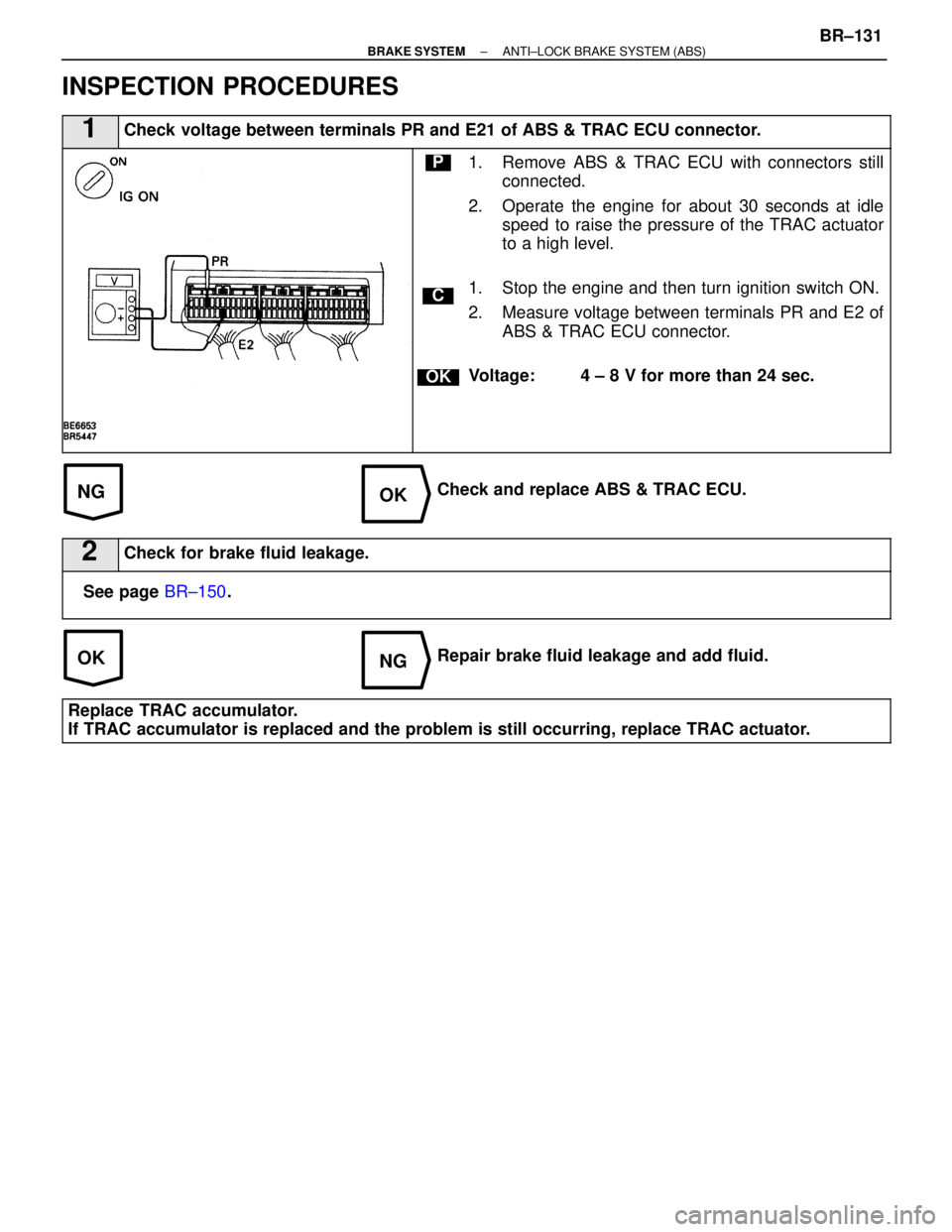
NGOK
OKNG
INSPECTION PROCEDURES
1Check voltage between terminals PR and E21 of ABS & TRAC ECU connector.
C
OK
P1. Remove ABS & TRAC ECU with connectors stillconnected.
2. Operate the engine for about 30 seconds at idle speed to raise the pressure of the TRAC actuator
to a high level.
1. Stop the engine and then turn ignition switch ON.
2. Measure voltage between terminals PR and E2 of ABS & TRAC ECU connector.
Voltage: 4 ± 8 V for more than 24 sec.
Check and replace ABS & TRAC ECU.
2Check for brake fluid leakage.
See page BR±150.
Repair brake fluid leakage and add fluid.
Replace TRAC accumulator.
If TRAC accumulator is replaced and the problem is still occurring, repl\
ace TRAC actuator.
±
BRAKE SYSTEM ANTI±LOCK BRAKE SYSTEM (ABS)BR±131
WhereEverybodyKnowsYourName
Page 1105 of 4087
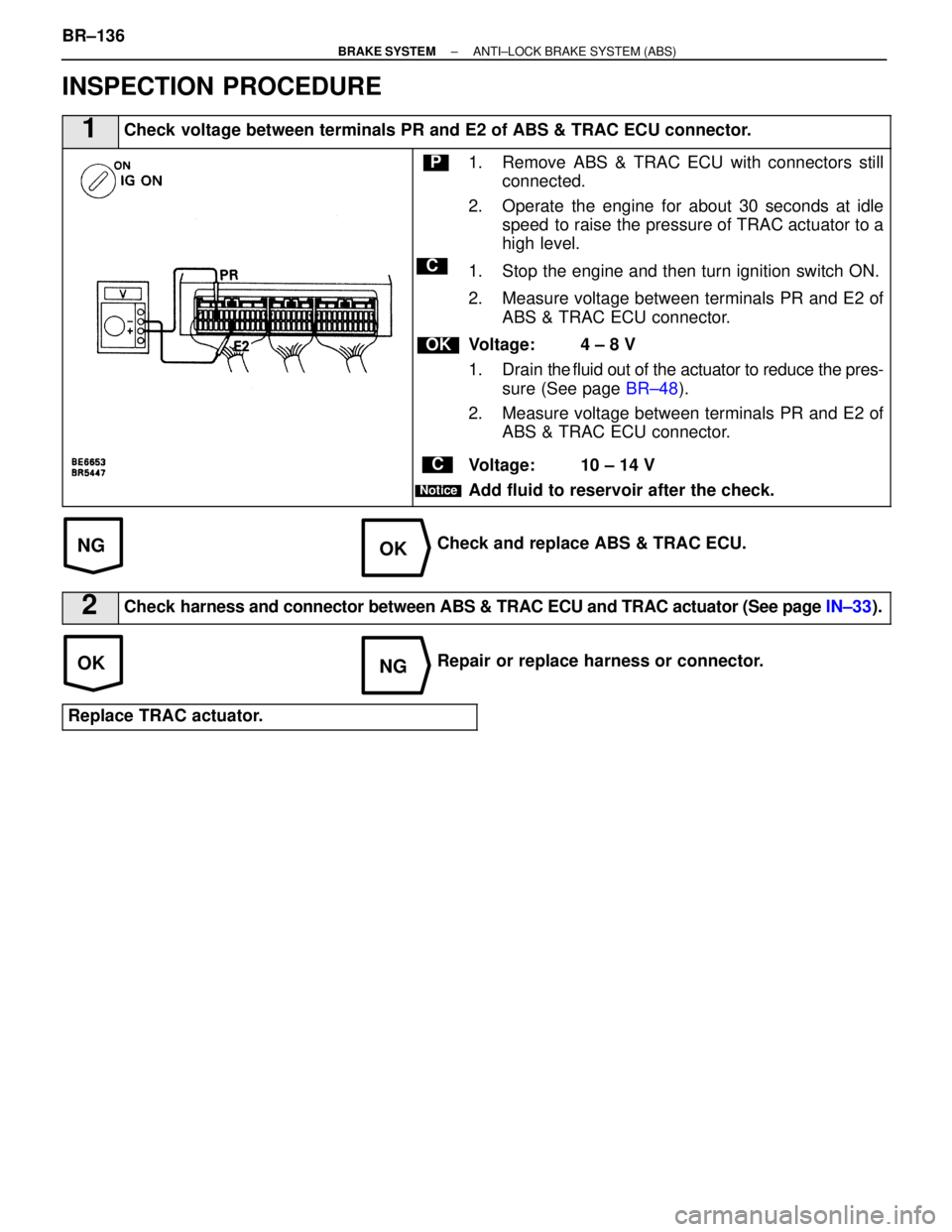
NGOK
OKNG
INSPECTION PROCEDURE
1Check voltage between terminals PR and E2 of ABS & TRAC ECU connector.
C
OK
P
C
Notice
1. Remove ABS & TRAC ECU with connectors stillconnected.
2. Operate the engine for about 30 seconds at idle speed to raise the pressure of TRAC actuator to a
high level.
1. Stop the engine and then turn ignition switch ON.
2. Measure voltage between terminals PR and E2 of ABS & TRAC ECU connector.
Voltage: 4 ± 8 V
1. Drain the fluid out of the actuator to reduce the pres-
sure (See page BR±48).
2. Measure voltage between terminals PR and E2 of ABS & TRAC ECU connector.
Voltage: 10 ± 14 V
Add fluid to reservoir after the check.
Check and replace ABS & TRAC ECU.
2Check harness and connector between ABS & TRAC ECU and TRAC actuator (See page IN±33).
Repair or replace harness or connector.
Replace TRAC actuator.
BR±136±
BRAKE SYSTEM ANTI±LOCK BRAKE SYSTEM (ABS)
WhereEverybodyKnowsYourName