ABS LEXUS SC400 1991 Service Repair Manual
[x] Cancel search | Manufacturer: LEXUS, Model Year: 1991, Model line: SC400, Model: LEXUS SC400 1991Pages: 4087, PDF Size: 75.75 MB
Page 1157 of 4087
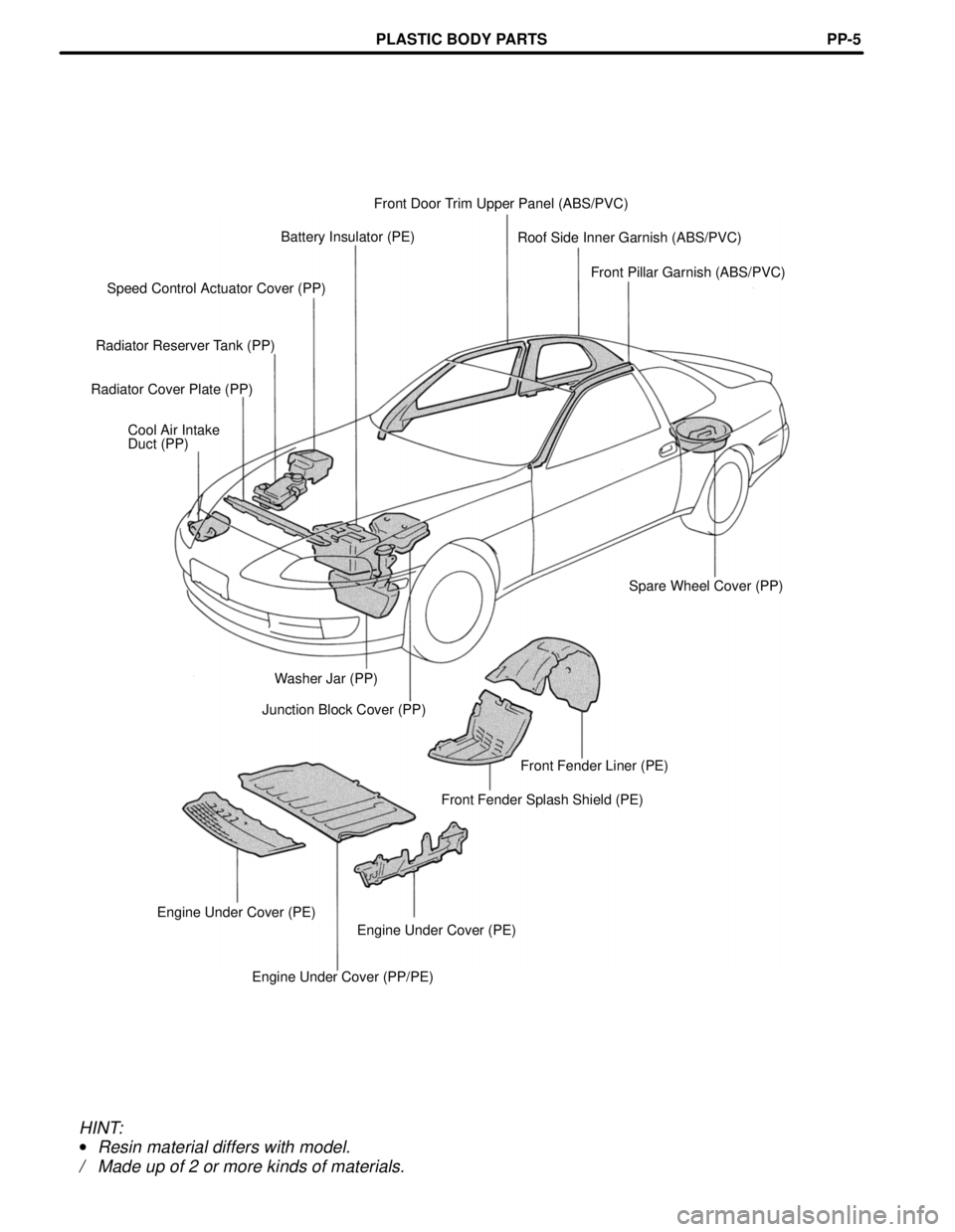
Front Door Trim Upper Panel (ABS/PVC)
Battery Insulator (PE) Roof Side Inner Garnish (ABS/PVC)
Front Pillar Garnish (ABS/PVC)
Speed Control Actuator Cover (PP)
Radiator Reserver Tank (PP)
Radiator Cover Plate (PP) Cool Air Intake
Duct (PP)
Spare Wheel Cover (PP)
Washer Jar (PP)
Junction Block Cover (PP)
Front Fender Liner (PE)
Front Fender Splash Shield (PE)
Engine Under Cover (PE) Engine Under Cover (PE)
Engine Under Cover (PP/PE)
HINT:
wResin material differs with model.
/ Made up of 2 or more kinds of materials.
PLASTIC BODY PARTSPP-5
WhereEverybodyKnowsYourName
Page 1248 of 4087
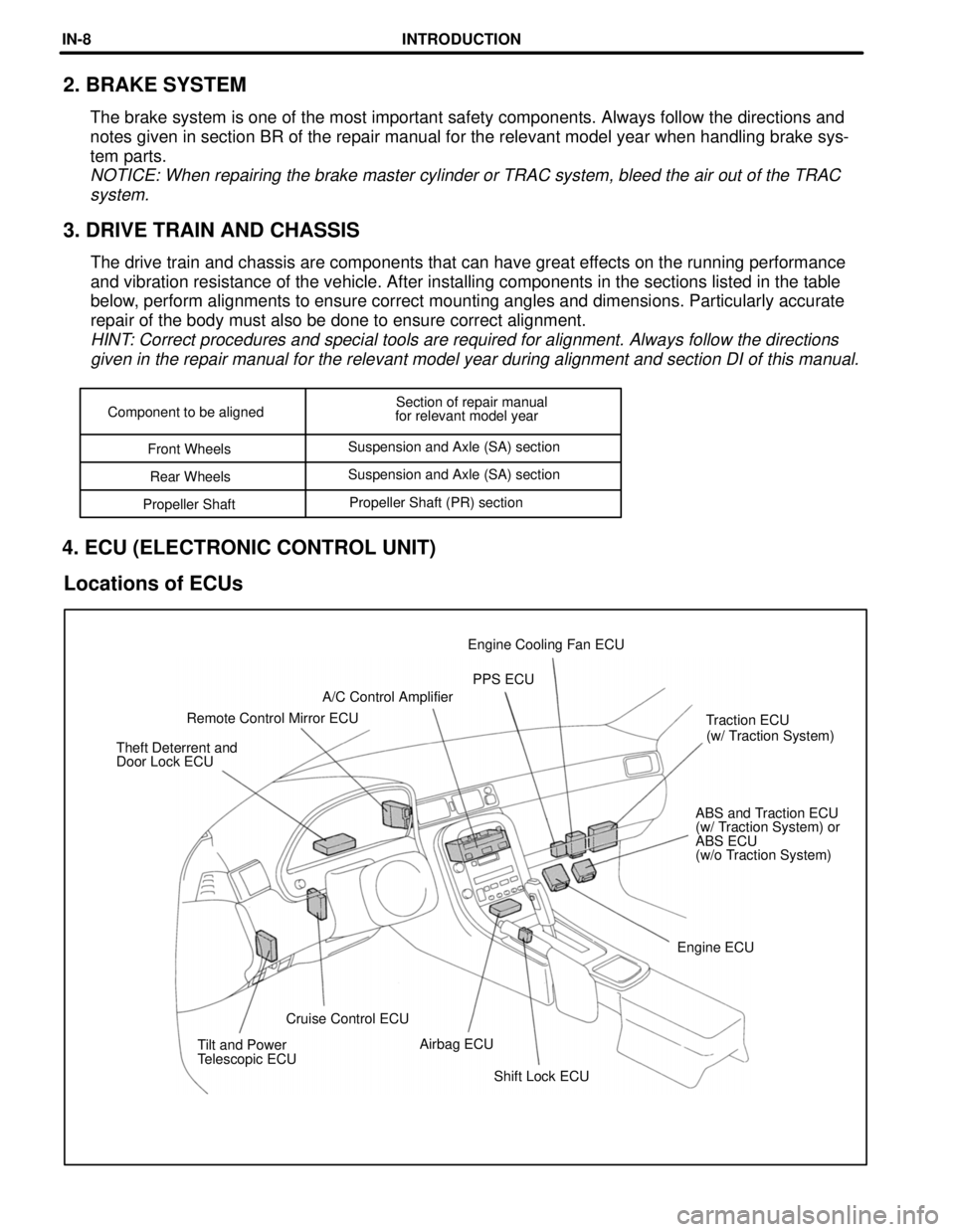
Shift Lock ECU
Tilt and Power
Telescopic ECU
Airbag ECU
Cruise Control ECU Engine ECUABS and Traction ECU
(w/ Traction System) or
ABS ECU
(w/o Traction System)
Theft Deterrent and
Door Lock ECU
(w/ Traction System)
Traction ECU
Remote Control Mirror ECU A/C Control Amplifier
PPS ECU
Engine Cooling Fan ECU
Component to be aligned
Section of repair manual
for relevant model year
Front Wheels Suspension and Axle (SA) section
Rear Wheels Suspension and Axle (SA) section
Propeller Shaft Propeller Shaft (PR) section
2. BRAKE SYSTEM
The brake system is one of the most important safety components. Always \
follow the directions and
notes given in section BR of the repair manual for the relevant model ye\
ar when handling brake sys-
tem parts.
NOTICE: When repairing the brake master cylinder or TRAC system, bleed t\
he air out of the TRAC
system.
3. DRIVE TRAIN AND CHASSIS
The drive train and chassis are components that can have great effects on the running performance
and vibration resistance of the vehicle. After installing components in \
the sections listed in the table
below, perform alignments to ensure correct mounting angles and dimensions. P\
articularly accurate
repair of the body must also be done to ensure correct alignment.
HINT: Correct procedures and special tools are required for alignment. Alway\
s follow the directionsgiven in the repair manual for the relevant model year during alignment \
and section DI of this manual.
4. ECU (ELECTRONIC CONTROL UNIT)
Locations of ECUs
INTRODUCTIONIN-8
WhereEverybodyKnowsYourName
Page 1342 of 4087
 SYSTEM
DESCRIPTION
To reduce HC emission, evaporated fuel from the fuel tank is routed throug\
h the charcoal canister to the
intake manifold for combustion i")
FUEL EVAPORATIVE EMISSION CONTROL (EVAP) SYSTEM
DESCRIPTION
To reduce HC emission, evaporated fuel from the fuel tank is routed throug\
h the charcoal canister to the
intake manifold for combustion in the cylinders.
OPERATION
CoolantVSVThrottle ValveCanister Check ValveCheck
Valve inEvaporated F el (HC)Coolant
Te m p .VSVThrottle Valve
Opening(1)(2)(3)Valve inCapEvaporated Fuel (HC)
BelowNoFulley closedBelow
40 5C (104 5F)
No
OperationFulley closed.±±±±Small volume of HC from
Fully closed or
bellow Specified air
canister enters air intake
chamber.
Above
bellow Specified air
volume.±±±±chamber.
Above
40 5C (104 5F)Operation
Conditions other
than above.±±±±
HC from canister enters air
intake chamber in the amout
programmed in accordance
with the intake air volume.
High pres-
sure in tank±±±OPENCLOSEDCLOSEDHC from tank is absorbed
into the canister.
High vacuum
in tank±±±CLOSEDOPENOPENAir is led into the fuel tank.
INSPECTION OF FUEL VAPOR LINES,
FUEL TANK AND TANK CAP
1. VISUALLY INSPECT LINES AND CONNECTIONS
Look for loose connections, sharp bends or damage.
2. VISUALLY INSPECT FUEL TANK Look for deformation, cracks or fuel leakage.
EC±8
±
EMISSION CONTROL SYSTEMS Fuel Evaporative Emission Control (EVAP) System
WhereEverybodyKnowsYourName
Page 1522 of 4087

(e) Take out the front side of the floor carpet.
(f) Remove the 2 nuts and ECM protector.
(g) Remove the nut, and disconnect the ECM from the floorpanel.
(h) Disconnect the following connectors: (1) 2 connectors from ECM
(2) Connector from ABS & TRAC ECU
(3) 2 connectors from TRAC ECU
(4) 4 connectors from connector cassette
(5) Connector from A/C control assembly
EG±146
±
1UZ±FE ENGINE ENGINE MECHANICAL
WhereEverybodyKnowsYourName
Page 1525 of 4087

36. DISCONNECT TRANSMISSION CONTROL ROD FROMSHIFT LEVER
Remove the nut, and disconnect the control rod from the shift
lever.
37. REMOVE ENGINE AND TRANSMISSION A SSEMBLY
FROM VEHICLE
(a) Attach the engine chain hoist to the engine hangers.
(b) Remove the 2 nuts holding the engine mounting insulators to
the front suspension crossmember.
(c) Remove the 4 bolts, 4 nuts and rear engine m ounting
member. Disconnect the ground strap.
(d) Lift the engine out of the vehicle slowly and carefully. HINT: Make sure the engine is clear of all wirings, hoses and
cables.
NOTICE: Be careful not hit the PS gear housing, PNP switch
and ABS actuator.
(e) Place the engine and transmission assembly onto the stand.
±
1UZ±FE ENGINE ENGINE MECHANICALEG±149
WhereEverybodyKnowsYourName
Page 1571 of 4087

11. CONNECT ENGINE WIRE TO CABIN
(a) Push in the engine wire through the cowl panel.NOTICE: Be careful not to damage the engine wire. Tape
the engine wire.
(b) Install the engine wire retainer with the 3 bolts.
(c) Connect the following connectors: (1) 2 connectors to ECM
(2) Connector to ABS & TRAC ECU
(3) 2 connectors to TRAC ECU
(4) 4 connectors to connector cassette
(5) Connector to A/C control assembly
±
1UZ±FE ENGINE ENGINE MECHANICALEG±195
WhereEverybodyKnowsYourName
Page 1590 of 4087
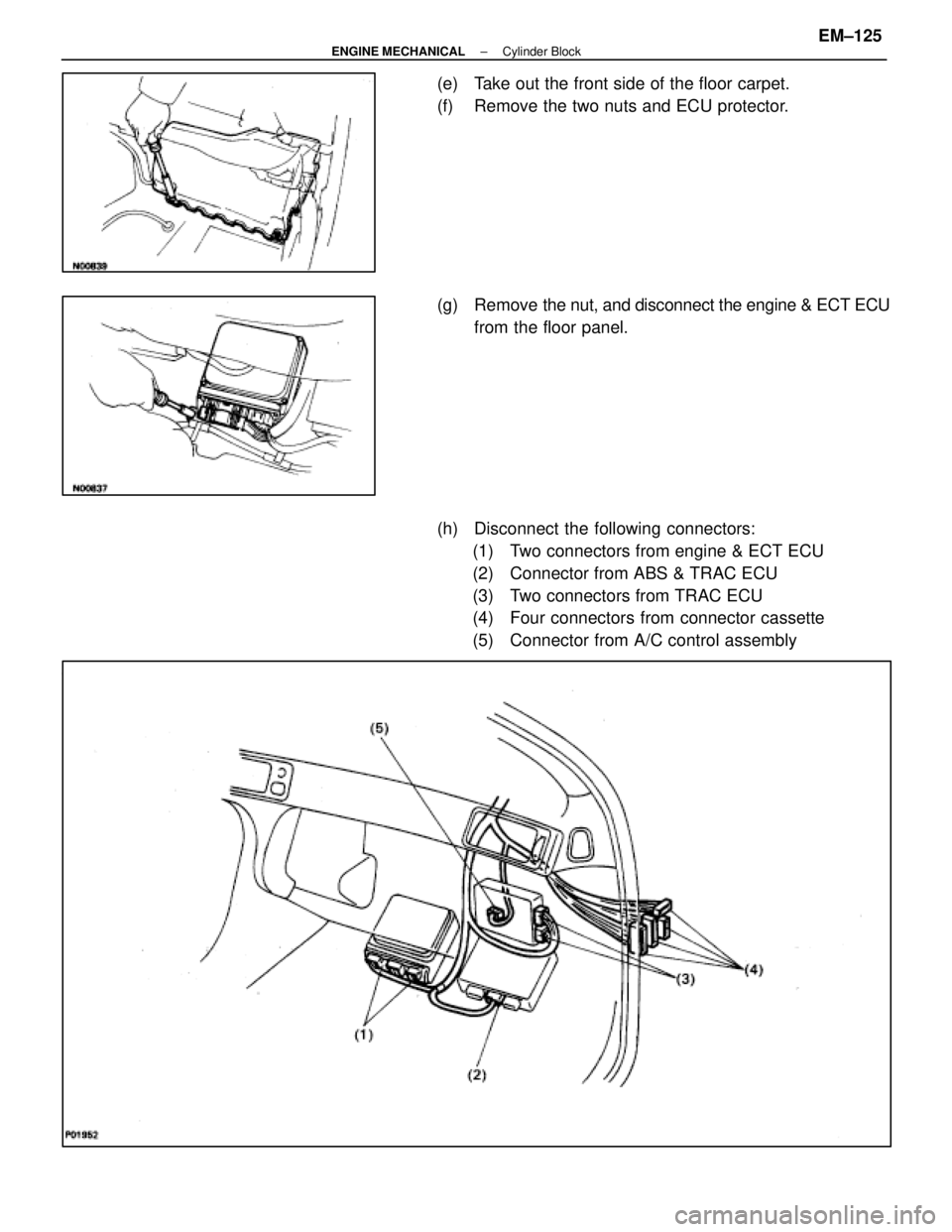
(e) Take out the front side of the floor carpet.
(f) Remove the two nuts and ECU protector.
(g) Remove the nut, and disconnect the engine & ECT ECU
from the floor panel.
(h) Disconnect the following connectors: (1) Two connectors from engine & ECT ECU
(2) Connector from ABS & TRAC ECU
(3) Two connectors from TRAC ECU
(4) Four connectors from connector cassette
(5) Connector from A/C control assembly
±
ENGINE MECHANICAL Cylinder BlockEM±125
WhereEverybodyKnowsYourName
Page 1593 of 4087
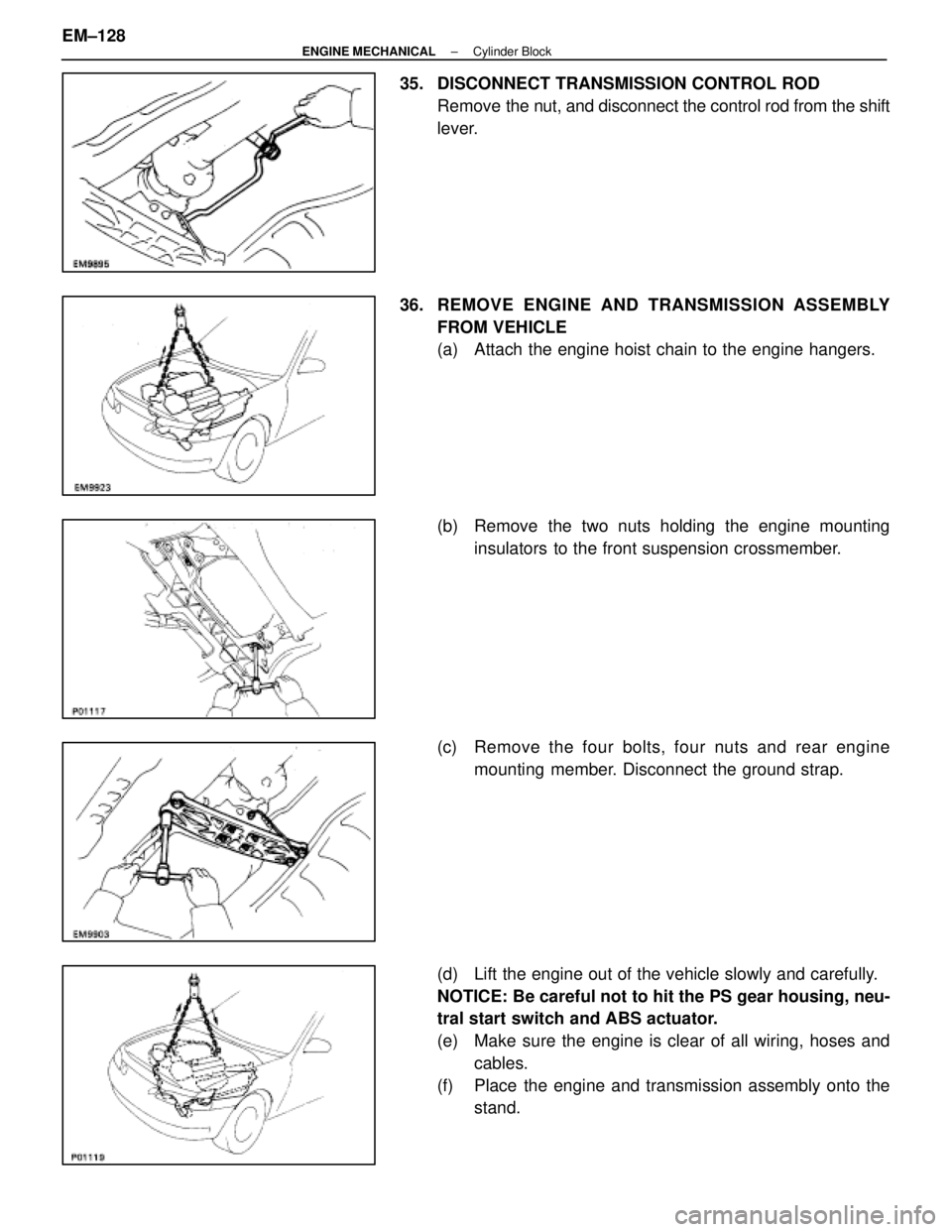
35. DISCONNECT TRANSMISSION CONTROL RODRemove the nut, and disconnect the control rod from the shift
lever.
36. REMOVE ENGINE AND TRANSMISSION A SSEMBLY
FROM VEHICLE
(a) Attach the engine hoist chain to the engine hangers.
(b) Remove the two nuts holding the engine mounting insulators to the front suspension crossmember.
(c) Remove the four bolts, four nuts and rear engine mounting member. Disconnect the ground strap.
(d) Lift the engine out of the vehicle slowly and carefully.
NOTICE: Be careful not to hit the PS gear housing, neu-
tral start switch and ABS actuator.
(e) Make sure the engine is clear of all wiring, hoses and cables.
(f) Place the engine and transmission assembly onto the stand.
EM±128
±
ENGINE MECHANICAL Cylinder Block
WhereEverybodyKnowsYourName
Page 1635 of 4087
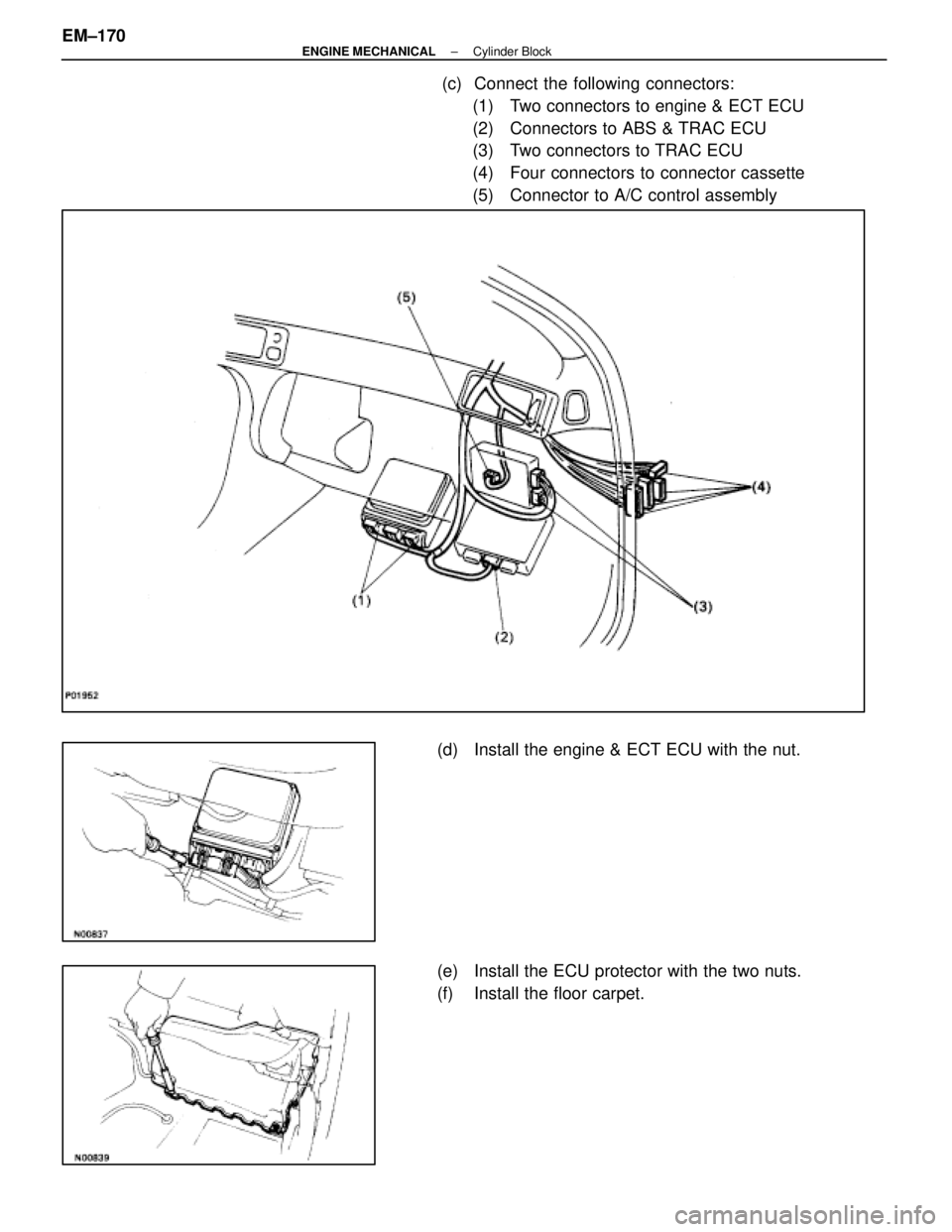
(c) Connect the following connectors:(1) Two connectors to engine & ECT ECU
(2) Connectors to ABS & TRAC ECU
(3) Two connectors to TRAC ECU
(4) Four connectors to connector cassette
(5) Connector to A/C control assembly
(d) Install the engine & ECT ECU with the nut.
(e) Install the ECU protector with the two nuts.
(f) Install the floor carpet.
EM±170
±
ENGINE MECHANICAL Cylinder Block
WhereEverybodyKnowsYourName
Page 1825 of 4087
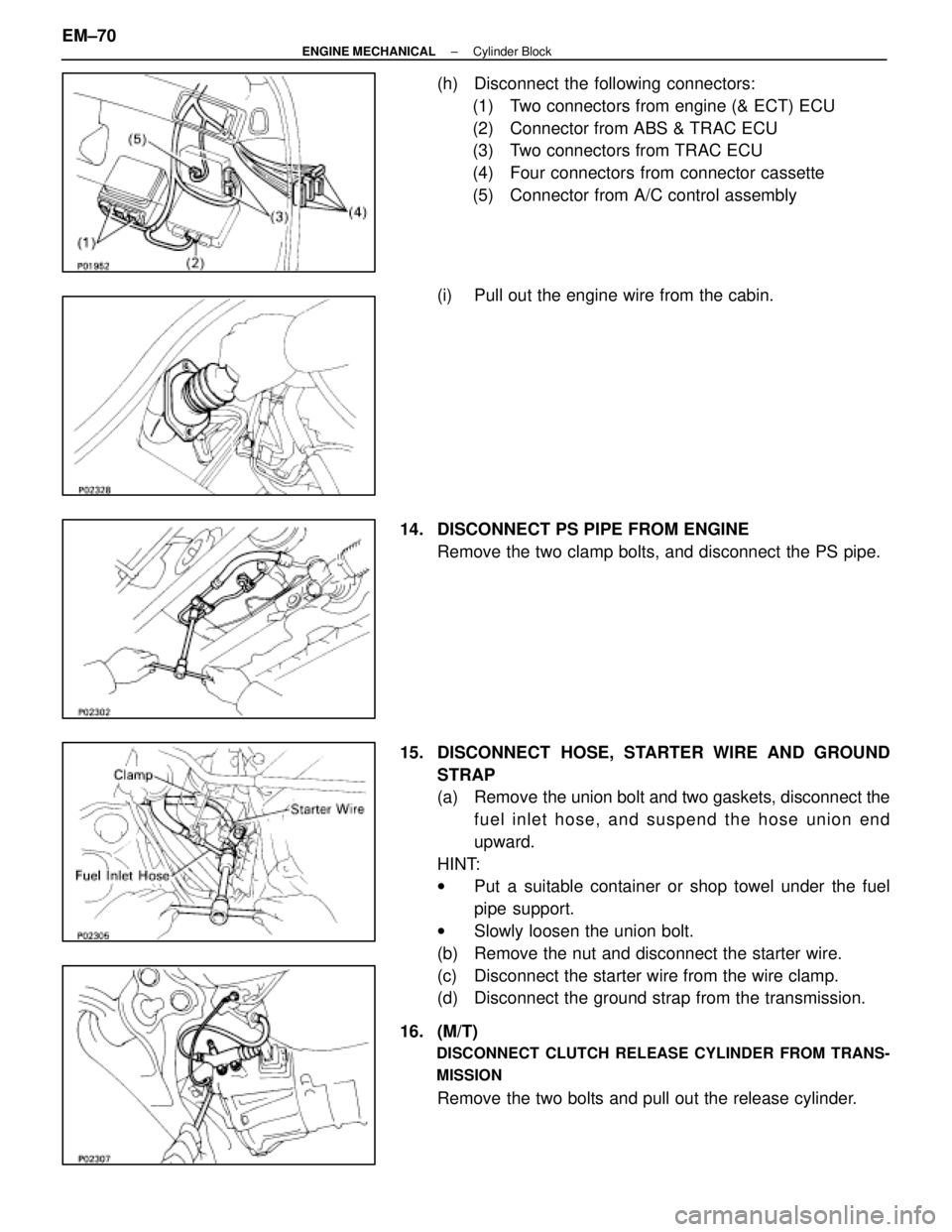
(h) Disconnect the following connectors:(1) Two connectors from engine (& ECT) ECU
(2) Connector from ABS & TRAC ECU
(3) Two connectors from TRAC ECU
(4) Four connectors from connector cassette
(5) Connector from A/C control assembly
(i) Pull out the engine wire from the cabin.
14. DISCONNECT PS PIPE FROM ENGINE Remove the two clamp bolts, and disconnect the PS pipe.
15. DISCONNECT HOSE, STARTER WIRE AND GROUND STRAP
(a) Remove the union bolt and two gaskets, disconnect thefuel inlet hose, and suspend the hose union end
upward.
HINT:
w Put a suitable container or shop towel under the fuel
pipe support.
w Slowly loosen the union bolt.
(b) Remove the nut and disconnect the starter wire.
(c) Disconnect the starter wire from the wire clamp.
(d) Disconnect the ground strap from the transmission.
16. (M/T)
DISCONNECT CLUTCH RELEASE CYLINDER FROM TRANS-
MISSION
Remove the two bolts and pull out the release cylinder.
EM±70
±
ENGINE MECHANICAL Cylinder Block
WhereEverybodyKnowsYourName