lock LEXUS SC400 1991 Service Repair Manual
[x] Cancel search | Manufacturer: LEXUS, Model Year: 1991, Model line: SC400, Model: LEXUS SC400 1991Pages: 4087, PDF Size: 75.75 MB
Page 3776 of 4087

TSIB
IntroductionA musty odor may be emitted from the air conditioning system of some vehicles which are
usually operated in areas with high temperature and humidity. It is most noticeable when
the air conditioner is first turned ªONº after the vehicle has bee\
n parked for several hours.
The odor could result from one or more of the following conditions:
1. Blockage of the evaporator housing drain pipe, resulting in the build up of cond\
ensation.
2. Microbial growth in the evaporator, arising from dampness in the evaporator housing
where the cooling air flow is dehumidified.
To address excessive air conditioning evaporator odor, check the evaporator housing drain
pipe for blockage. If no problems are found, the evaporator and housing\
should be cleaned
and disinfected using the general procedure given on page 2, and the model \
specific
procedure on the pages indicated in the Table of Contents at the bottom of this page.
Affected While this procedure may be used on any Lexus vehicle, this bulletin giv\
es details
Vehicles specifically for the '92±'96 ES 300, all GS 300, '93±'94 LS 400, all SC 300/400 and the\
LX 450.
Tools &
PART NUMBER DESCRIPTION OF TOOLS & MATERIALS QUANTITY SOURCE
Materials08821±00810±01 Spray Gun Kit 1 OTC 08821±00811±01 Spray Gun (replacement) (1) OTC
08821±00812±01 Spray Gun Nozzle (replacement) (1) OTC
08821±00813±01 Freshener Mixing Container (replacement) (1) OTC
08821±00801±DS Air Conditioning Freshener 1 per vehicle TMS
CAUTION:
Wear safety glasses, protective mask, and gloves while working with the
freshener.
Warranty
OPCODE DESCRIPTION TIME OPN T1 T2
Information
N/A No applicable warranty information ± ± ± ±
Table ofMODEL PAGE MODEL PAGE MODEL PAGE MODEL PAGE
Contents
ES 300 3 GS 300 5 LS 400 7
GENERAL 2
SC 300 9 SC 400 9 LX 450 11
General Procedure applies to all models and model years.
The Specific Model Sections cover only the listed ªaffected models.º
HEATING & AIR CONDITIONING
September 12, 1997
Title:
AIR CONDITIONING EVAPORATOR ODOR
Models:
'92±96 ES 300, '93±'94 LS 400,
All GS 300, SC 300/400, LX 450.
Page 1 of 11
AC001±97
WhereEverybodyKnowsYourName
Page 3794 of 4087

SENSOR INSPECTION FOR AIR CONDITIONING SYSTEM ± AC005-04 December 16, 2004
Page 8 of 12
5. Inspect Solar Sensor.
Four types of solar sensors are used on Lexus vehicles depending on the \
vehicle
specifications. The inspection procedure for each type of sensor differs from the
others. Select the appropriate inspection procedure from the table below\
according to
vehicle specifications and perform the inspection.
EQUIPPED WITH AUTOMATICLIGHT CONTROL SYSTEMA/C SYSTEM WITH RIGHT/LEFT
INDEPENDENT TEMPERATURE CONTROLINSPECTION
PROCEDURE
NoNoA
NoYesB
YesYesC
YesNoD
Procedure A:
a. Disconnect the solar sensor connector.
b. Measure the resistance between terminals 1 and 2 of the solar
sensor under the
following conditions:
Cover the sensor with a cloth
to avoid direct light.
Expose the sensor to light
from a distance of 300 mm
(11.81 in.) or less with an
inspection light.
NOTE:
Terminal 1 of the sensor is always on
the right, when the lock is facing up.
When using an analog tester, connect
the positive (+) lead to terminal 2 and
negative (±) lead to terminal 1 of the
solar sensor.
HINT:
If the light is weak, the sensor may not react. Be sure to use an incand\
escent light for
an inspection light.
Standard:
CONDITIONSPECIFICATION
When the sensor is covered with a cloth
(to avoid direct light)Infinite ohms
When the sensor is exposed to lightLess than infinite resistance
InspectionProcedure
(Continued)
Lock
WhereEverybodyKnowsYourName
Page 3795 of 4087
SENSOR INSPECTION FOR AIR CONDITIONING SYSTEM ± AC005-04 December 16, 2004
Page 9 of 12
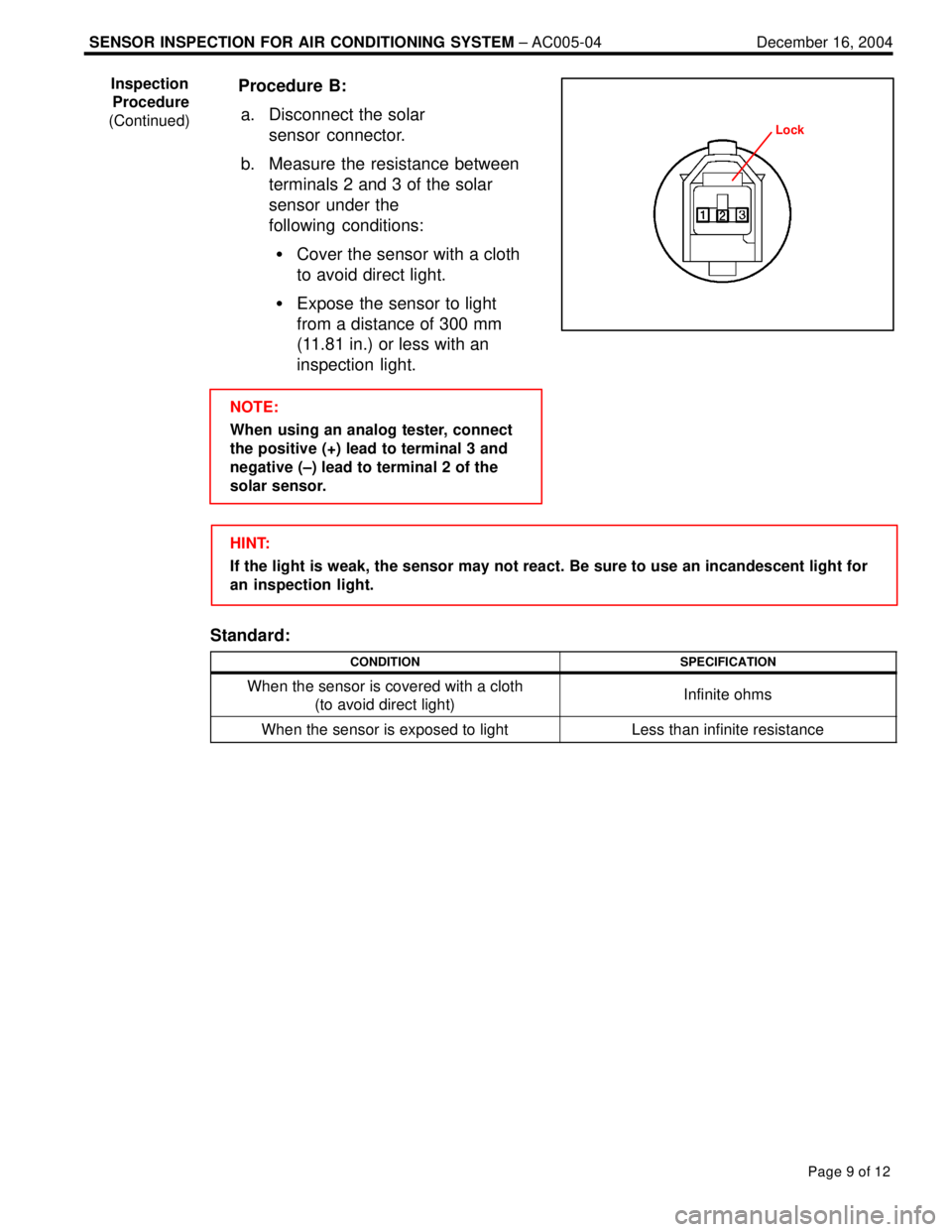
Procedure B:
a. Disconnect the solar sensor connector.
b. Measure the resistance between terminals 2 and 3 of the solar
sensor under the
following conditions:
Cover the sensor with a cloth
to avoid direct light.
Expose the sensor to light
from a distance of 300 mm
(11.81 in.) or less with an
inspection light.
NOTE:
When using an analog tester, connect
the positive (+) lead to terminal 3 and
negative (±) lead to terminal 2 of the
solar sensor.
HINT:
If the light is weak, the sensor may not react. Be sure to use an incand\
escent light for
an inspection light.
Standard:
CONDITIONSPECIFICATION
When the sensor is covered with a cloth
(to avoid direct light)Infinite ohms
When the sensor is exposed to lightLess than infinite resistance
InspectionProcedure
(Continued)
Lock
WhereEverybodyKnowsYourName
Page 3807 of 4087

CHANGE IN SUPPLY PARTS FOR INNER REAR VIEW MIRROR (CONT'D)Page 3 of 3
a) Install inner rear view mirror by re±installing
attachment set screw (Figure 5).
INNER REAR VIEW MIRROR & CENTER
VISOR INSTALLATION:
PARTS LOCATION:
Note: Use thread locking compound on
set screw to ensure screw reten-
tion.
b) Re±connect wire harness.
Note: Check review mirror dimming operation before re±installation of
center visor.
c) Install center visor by re±installing two attachment screws.
d) Re±install visor arm set clip.
WhereEverybodyKnowsYourName
Page 3810 of 4087

SERVICE HINTS FOR REFRIGERANT LEAK DETECTIONPage 1 of 3
Use of electronic leak detectors for checking A/C systems refrigerant leaka\
ge is the only
method approved by TMS. This type of leak detector is sensitive not onl\
y to refrigerant, but
also sensitive to numerous petrochemical substances (motor oil, gasolin\
e, solvents, etc.)
commonly found in a repair shop environment. Because this sensitivity c\
ould diminish the leak
detector 's capacity for accurate leak detection, some service hints have been pro\
vided to help
increase the accuracy of your diagnosis.
SERVICE HINTS:
1. Visual Inspection: Do a quick visual inspection under the hood for signs of refrigerant
leakage. Check for areas of heavy oil leakage at block and piping joint\
s. Many times
these areas have accumulated road dust and dirt.
2. Inspection with leak detector: NOTE: Make sure the system is fully charged. Operate
the system to increase refrigerant pressure. Shut the system off before inspecting with
leak detector.
A. Checking for leakage at a joint:
Wipe the oil/dirt accumulation off the joint with a
clean rag. Do not use solvents to clean the joint. Refrigerant is heavi\
er than air so
start checking for leaks with the detector wand about 1/4 in. below the \
joint. Move the
wand slowly across and around each joint (see illustration below).
Piping Joint Move detector wand slowly across
and around each joint.
Block Joint
HEATING &
AIR CONDITIONING
AC95±001
MARCH 03, 1995
ALL MODELS
WhereEverybodyKnowsYourName
Page 3819 of 4087

11 8
WIRELESS DOOR LOCK REMOTE CONTROL
7 6 10 542931
2 1
2
1E
11
1D
84
1J
1
1B
5
1I
64
1H
13
1D10 3E
7
3A 6
2
3
BY17
IP 1 20
BX1
2 BX1 11 BX1 8 BX19BX116 BX1 15 BX1 3
I8
I15
I7
B4 B7
9
10
6 3 6
3
BL IF IJ IP1
15
E KSW DSW D L1 LSWD1
UL1 LSWD2 LSWP
P±B
W±L
G± W
G±Y
L±W
W±B
W±B
W±B
W±B
W±B G±L
R±L
R
R
R
R±L
P±B
W±L L±W
G±W G±Y
G±W L±W G±Y
G±Y
G±W G±L
R±W Y
G±LY
W±B
G±L
R±W
R±W
W±B
W±B
W±B
W±B
W±B W±B
FROM POWER SOURCE SYSTEM
(
SEE PAGE 56 )
10A
DOME
+B
WIRE LES S DOOR LOCK E CU
WIRE LES S DOOR LOCK
MAIN SW
UNLOCK WARNING SW
[IGNITION SW]
DOOR OPEN
DE TE CTION SW LH
DOOR OPEN
DE TE CTION SW RH
INTEGRATION
RELAY DIODE
TO DOOR LOCK
AND UNLOCK SW LH
TO DOOR LOCK
AND UNLOCK SW RH
W8
I15
D10
D11
W7
2
1
4
6 IF2
15
IP 1
19
G±Y
G±W
I15
G±Y
TO DOOR LOCK
AND UNLOCK SW RH
IP1
8
G±Y
G±Y
WhereEverybodyKnowsYourName
Page 3820 of 4087
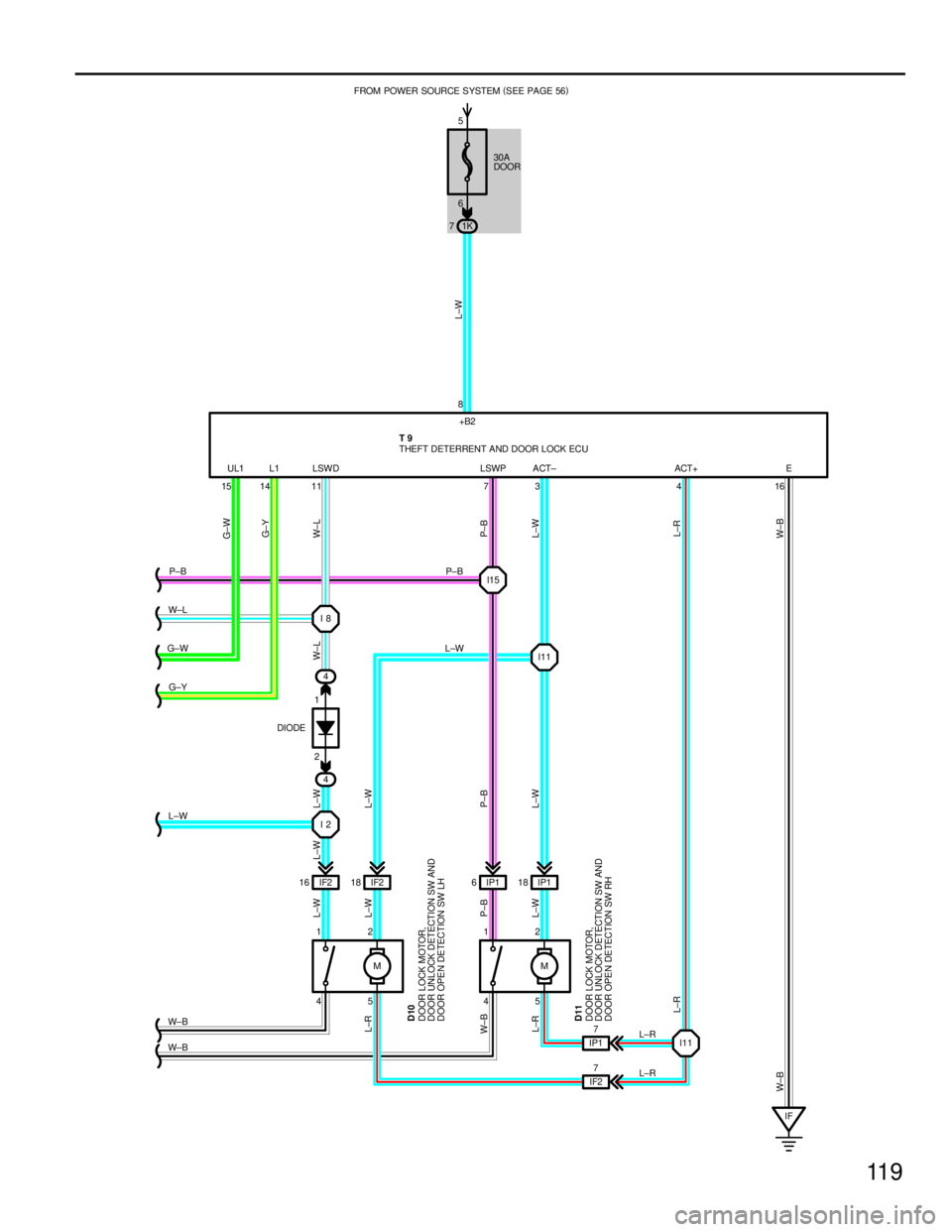
11 9
1K
7
15 14 11 7 3 4 16 8
2 1 4 4
IP17
IF2 7
I2 I8
I11
I11IF
IF2
16 IF2 18 IP1 6IP118
4 1 M
5
2
4
1 M
5
2
UL1 L1 LSWD LSWP ACT± ACT+ E
P±B
L±W
P±B
W±L
G±W
G±Y
L±W
W±B
W±B L±R
L±R
L±W
G±W
G±Y
W±L
P±B
L±W
L±R
W±B
L±W
L±W
L±W
P±B
L±W
W±B
L±R L±R W±L
L±R
W±B
FROM POWER SOURCE SYSTEM (
SEE PAGE 56 )
30A
DOOR
+B2
THEFT DETERRENT AND DOOR LOCK ECU
L±W
L±W
P±B
L±W
DOOR LOCK MOTOR,
DOOR UNLOCK DETECTION SW AND
DOOR OPEN DETECTION SW LH
DOOR LOCK MOTOR,
DOOR UNLOCK DETECTION SW AND
DOOR OPEN DETECTION SW RH
DIODE
D10
D11
T9 6 5
I15
WhereEverybodyKnowsYourName
Page 3821 of 4087
 IS PERFORMED BY REMOTE CONTROL, WI\
THOUT THE IGNITION KEY INSERTED IN
THE DOOR KEY CYLINDER, USING LOW±POWER RADIO WAVES EM")
120
WIRELESS DOOR LOCK REMOTE CONTROL
DOOR LOCK CONTROL (LOCK AND UNLOCK) IS PERFORMED BY REMOTE CONTROL, WI\
THOUT THE IGNITION KEY INSERTED IN
THE DOOR KEY CYLINDER, USING LOW±POWER RADIO WAVES EMITTED BY A TRANSMITTER BUILT INTO IGNITION KEY.
1. WIRELESS DOOR LOCK OR UNLOCK NORMAL OPERATION
WITH THE WIRELESS DOOR LOCK MAIN SW ON, THE IGNITION KEY NOT INSERTED INTO THE IGNITION KEY CYLINDER (UNLOCK
WARNING SW OFF) AND ALL THE DOORS COMPLETELY CLOSED, WHEN THE SWITCH (TRANSMITTER) ON THE IGNITION KEY IS
PUSHED, THE WIRELESS DOOR LOCK ECU RECEIVES THE ELECTRICAL WAVES FROM THE IGNITION KEY (TRANSMITTER),
CAUSING IT TO OPERATE.
AS A RESULT, THE ECU JUDGES WHETHER THE DOOR IS LOCKED OR UNLOCKED BASED ON THE SIGNAL FROM THE DOOR LOCK
MOTOR, AND SENDS A SIGNAL TO THE DOOR LOCK ECU TO SWITCH THE CONDITION FROM LOCK TO UNLOCK OR VICE VERSA,
CAUSING THE DOOR LOCK MOTOR TO OPERATE (FOR THE CURRENT FLOW DURING LOCK AND UNLOCK REFER TO THE DOOR
LOCK CONTROL SYSTEM.)
2. AUTO LOCK OPERATION
AFTER PUSHING THE IGNITION KEY SWITCH (TRANSMITTER) TO UNLOCK ALL THE DOORS, IF A DOOR IS NOT OPENED WITHIN 30
SECONDS, ALL OF THE DOORS ARE AUTOMATICALLY LOCKED AGAIN.
3. WIRELESS DOOR LOCK STOP FUNCTION
IF A DOOR IS OPEN (DOOR COURTESY SW ON), A SIGNAL IS INPUT FROM THE DOOR OPEN COURTESY SW TO THE WIRELESS
DOOR LOCK ECU, STOPPING WIRELESS DOOR LOCK OR UNLOCK.
IF THE IGNITION KEY IS IN THE IGNITION KEY CYLINDER (UNLOCK WARNING SW ON), THE UNLOCK WARNING SWITCH INPUT A
SIGNAL TO THE WIRELESS DOOR LOCK ECU, STOPPING WIRELESS DOOR LOCK OR UNLOCK.
4. DOOR LOCK MOTOR PROTECTIVE FUNCTION
IF THE DOOR LOCK OR UNLOCK CONDITION DOES NOT CHANGE AFTER WIRELESS DOOR L\
OCK OR UNLOCK OPERATION, THE
DOOR LOCK ECU SENDS CURRENT TEN TIMES TO THE DOOR LOCK MOTOR. IF THE DOOR LOCK CONDITION STILL HAS NOT
CHANGED AS A RESULT THE WIRELESS DOOR LOCK ECU STOPS RECEPTION AND STOPS DOOR LOCK AND UNLOCK FUNCTION.
BY MANUALLY OPERATION THE DOOR LOCK OR UNLOCK, THE STOP CONDITION OF THE WIRELESS DOOR LOCK FUNCTION IS
RELEASED.
D10, D11 DOOR OPEN DETECTION SW LH, RH
3±6 : CLOSED WITH DOOR OPENED
I15 UNLOCK WARNING SW [IGNITION SW]
10±9 : CLOSED WITH IGNITION KEY IN CYLINDER
W 8 WIRELESS DOOR LOCK ECU
1±GROUND: APPROX. 12 VOLTS WITH WIRELESS DOOR LOCK MAIN SW ON
7±GROUND: ALWAYS CONTINUITY
10±GROUND: CONTINUITY WITH EACH DOOR OPENED
6±GROUND: CONTINUITY WITH IGNITION KEY IN CYLINDER
: PARTS LOCATION
CODESEE PAGECODESEE PAGECODESEE PAGE
D1030I1529W 729
D1130T 929W 831
: RELAY BLOCKS
CODESEE PAGERELAY BLOCKS (RELAY BLOCK LOCATION)
219ENGINE COMPARTMENT LEFT
423LEFT KICK PANEL (J/B NO.1 LEFT)
: JUNCTION BLOCK AND WIRE HARNESS CONNECTOR
CODESEE PAGEJUNCTION BLOCK AND WIRE HARNESS (CONNECTOR LOCATION)
1B20ENGINE ROOM MAIN WIRE
1D20FRONT DOOR LH WIRE
1E20INSTRUMENT PANEL WIRE
1H
1I20COWL WIRE1J20COWL WIRE
1K
3A22INSTRUMENT PANEL WIRE3E22INSTRUMENT PANEL WIRE
SYSTEM OUTLINE
SERVICE HINTS
WhereEverybodyKnowsYourName
Page 3823 of 4087

201
WIPER AND WASHER
: PARTS LOCATION
CODESEE PAGECODESEE PAGECODESEE PAGE
C15B28W 227
C16A28W 527
: JUNCTION BLOCK AND WIRE HARNESS CONNECTOR
CODESEE PAGEJUNCTION BLOCK AND WIRE HARNESS (CONNECTOR LOCATION)
1H
1J20COWL WIRE
1K
: CONNECTOR JOINING WIRE HARNESS AND WIRE HARNESS
CODESEE PAGEJOINING WIRE HARNESS AND WIRE HARNESS (CONNECTOR LOCATION)
IE136ENGINE ROOM MAIN WIRE AND COWL WIRE (R/B NO. 4)
: GROUND POINTS
CODESEE PAGEGROUND POINTS LOCATION
IF36LEFT KICK PANEL
: SPLICE POINTS
CODESEE PAGEWIRE HARNESS WITH SPLICE POINTSCODESEE PAGEWIRE HARNESS WITH SPLICE POINTS
I 738COWL WIRE
WhereEverybodyKnowsYourName
Page 3826 of 4087

15
ABBREVIATIONS
DISCONNECTION AND CONNECTION OF BOLT
TYPE CONNECTORS
For engine and ECT ECU in this vehicle, connectors are used
which require a bolt built into the connector to be screwed down to
securely connect the connector.
1. Disconnect the connectorAfter completely loosening the bolt, the two parts of the
connector can be separated.
NOTICE:
Do not pull the wire harness when disconnecting the
connector.
2. Connect the connector
NOTICE:
Before connecting the connector, always check that the
terminals are not bent or damaged.
(a) Match the guide section of the male connectorcorrectly with the female connector, then press them
together.
(b) Tighten the bolt. Make sure the connectors are completely connected,
by tightening the bolt until there is a clearance of less
than 1 mm (0.04 in.) between the bottom of male
connector and the end of female connector.
ABBREVIATIONS
The following abbreviations are used in this manual.
A/C = Air Conditioning O/D = Overdrive
ABS = Anti±Lock Brake System R/B = Relay Block
A/T = Automatic Transmission RH = Right±Hand
CB = Circuit Breaker SRS = Supplement Restraint System
COMB. = Combination SW = Switch
ECT = Electronic Controlled Transmission TDCL = Total Diagnostic Communication Link
ECU = Electronic Control Unit TEMP. = Temperature
EGR = Exhaust Gas Recirculation TRAC = Traction Control
FL = Fusible Link VSV = Vacuum Switching Valve
ISC = Idle Speed Control W/ = With
J/B = Junction Block W/O = Without
LH = Left-Hand
* The titles given inside the components are the names of the terminals (ter\
minal codes) and are not treatedas being abbreviations.
WhereEverybodyKnowsYourName