high LEXUS UX250H 2019 Owners Manual
[x] Cancel search | Manufacturer: LEXUS, Model Year: 2019, Model line: UX250H, Model: LEXUS UX250H 2019Pages: 476, PDF Size: 10.51 MB
Page 410 of 476
4107-2. Steps to take in an emergency
If the engine coolant temperature
gauge enters the red zone or
“Engine Coolant Temp High Stop in
a Safe Place See Owner’s Manual”
is shown on the multi-information
display
1
Stop the vehicle in a safe place and
turn off the air conditioning system,
and then stop the hybrid system.
2
If you see steam:
Carefully lift the hood after the
steam subsides.
If you do not see steam:
Carefully lift the hood.
3
After the hybrid system has cooled
down sufficiently, inspect the hoses
WARNING
■When replacing the 12-volt battery
●When the vent plug is close to the hold
down clamp, the battery fluid (acid)
may leak.
●For information regarding battery
replacement, contact your Lexus
dealer.
●After exchanging, securely attach the
elbow connected to the exhaust hose,
and exhaust hole plug to the exhaust
hole of the exchanged 12-volt battery.
If not properly installed, gases (hydro-
gen) may leak into the vehicle interior,
and there is the possible danger of the
gas igniting and exploding.
NOTICE
■When handling jumper cables
When connecting the jumper cables,
ensure that they do not become entan-
gled in the cooling fans or belt.
■To prevent damaging the vehicle
The exclusive jump starting terminal is to
be used when charging the 12-volt bat-
tery from another vehicle in an emer-
gency. It cannot be used to jump start
another vehicle.
If your vehicle overheats
The following may indicate that
your vehicle is overheating.
The engine coolant temperature
gauge ( P.78, 82) enters the
red zone, or a loss of hybrid sys-
tem power is experienced. (For
example, the vehicle speed does
not increase.)
“Engine Coolant Temp High Stop
in a Safe Place See Owner’s
Manual” or “Hybrid system over-
heated Output power reduced” is
shown on the multi-information
display.
Steam comes out from under the
hood.
Correction procedures
Page 411 of 476
4117-2. Steps to take in an emergency
7
When trouble arises
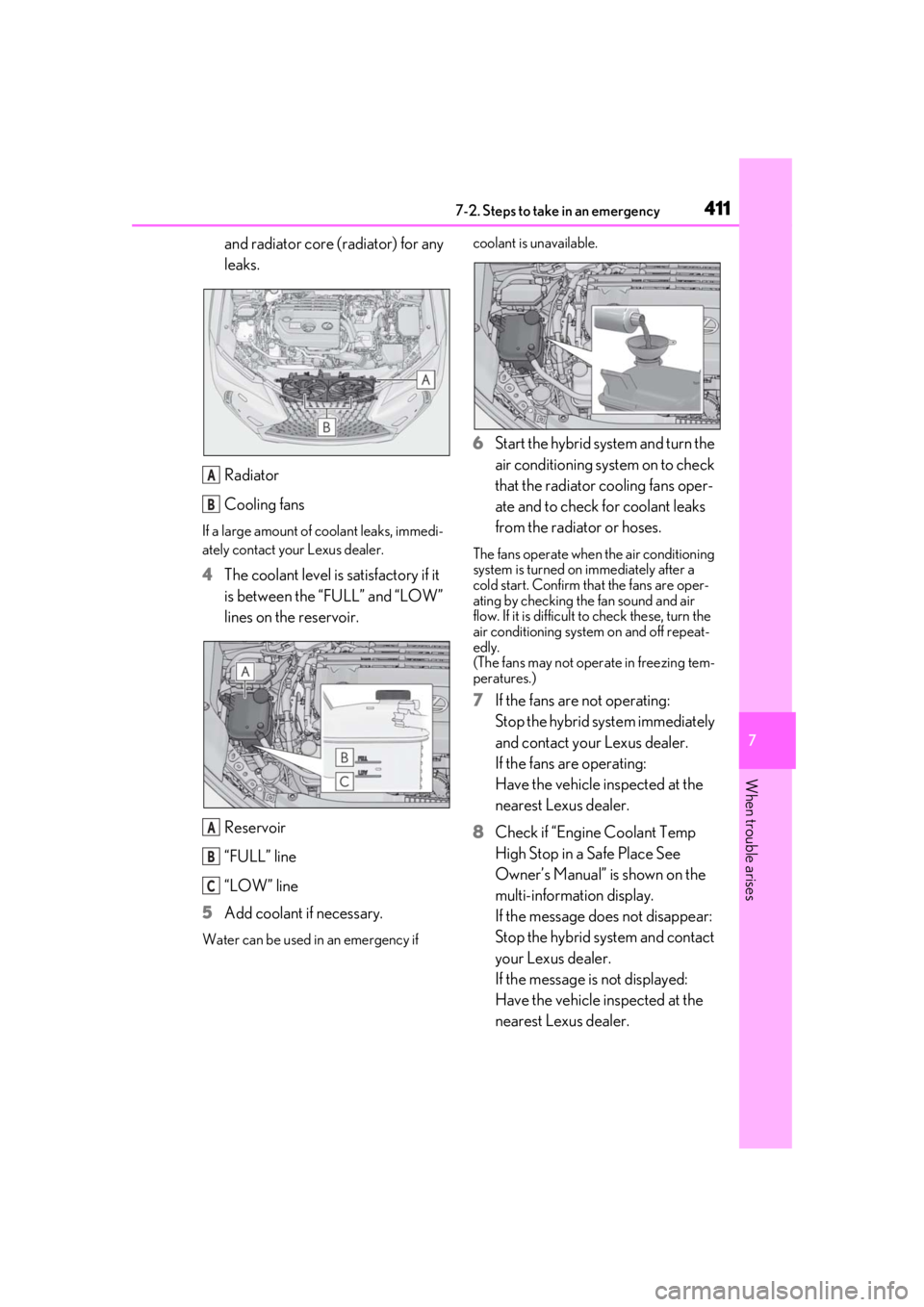
and radiator core (radiator) for any
leaks.
Radiator
Cooling fans
If a large amount of coolant leaks, immedi-
ately contact your Lexus dealer.
4The coolant level is satisfactory if it
is between the “FULL” and “LOW”
lines on the reservoir.
Reservoir
“FULL” line
“LOW” line
5 Add coolant if necessary.
Water can be used in an emergency if coolant is unavailable.
6
Start the hybrid system and turn the
air conditioning system on to check
that the radiator cooling fans oper-
ate and to check for coolant leaks
from the radiator or hoses.
The fans operate when the air conditioning
system is turned on immediately after a
cold start. Confirm that the fans are oper-
ating by checking the fan sound and air
flow. If it is difficult to check these, turn the
air conditioning system on and off repeat-
edly.
(The fans may not oper ate in freezing tem-
peratures.)
7 If the fans are not operating:
Stop the hybrid system immediately
and contact your Lexus dealer.
If the fans are operating:
Have the vehicle inspected at the
nearest Lexus dealer.
8 Check if “Engine Coolant Temp
High Stop in a Safe Place See
Owner’s Manual” is shown on the
multi-information display.
If the message does not disappear:
Stop the hybrid system and contact
your Lexus dealer.
If the message is not displayed:
Have the vehicle inspected at the
nearest Lexus dealer.
A
B
A
B
C
Page 413 of 476
4137-2. Steps to take in an emergency
7
When trouble arises
1Stop the hybrid system. Shift the
shift lever to P and set the parking
brake.
2
Remove the mud, snow or sand
from around the front wheels.
3
Place wood, stones or some other
material under the front wheels to
help provide traction.
4
Restart the hybrid system.
5
Shift the shift lever to D or R and
release the parking brake. Then,
while exercising caution, depress
the accelerator pedal.
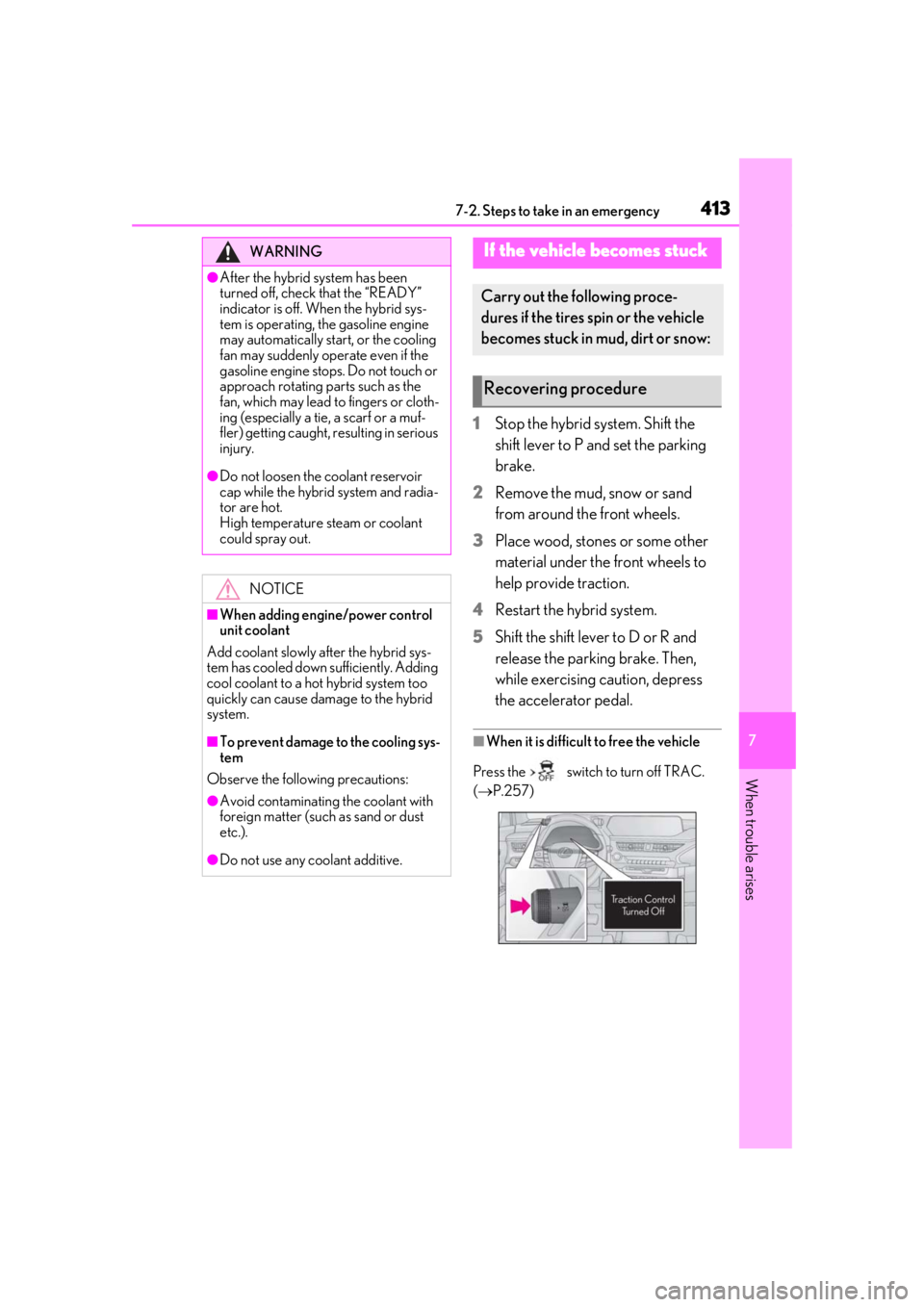
■When it is difficult to free the vehicle
Press the switch to turn off TRAC.
( P.257)
WARNING
●After the hybrid system has been
turned off, check that the “READY”
indicator is off. When the hybrid sys-
tem is operating, the gasoline engine
may automatically start, or the cooling
fan may suddenly operate even if the
gasoline engine stops. Do not touch or
approach rotating parts such as the
fan, which may lead to fingers or cloth-
ing (especially a tie, a scarf or a muf-
fler) getting caught, resulting in serious
injury.
●Do not loosen the coolant reservoir
cap while the hybrid system and radia-
tor are hot.
High temperature steam or coolant
could spray out.
NOTICE
■When adding engine/power control
unit coolant
Add coolant slowly after the hybrid sys-
tem has cooled down sufficiently. Adding
cool coolant to a hot hybrid system too
quickly can cause damage to the hybrid
system.
■To prevent damage to the cooling sys-
tem
Observe the following precautions:
●Avoid contaminating the coolant with
foreign matter (such as sand or dust
etc.).
●Do not use any coolant additive.
If the vehicle becomes stuck
Carry out the following proce-
dures if the tires spin or the vehicle
becomes stuck in mud, dirt or snow:
Recovering procedure
Page 417 of 476
4178-1. Specifications
8
Vehicle specifications
This number is also stamped under the
right-hand front seat.
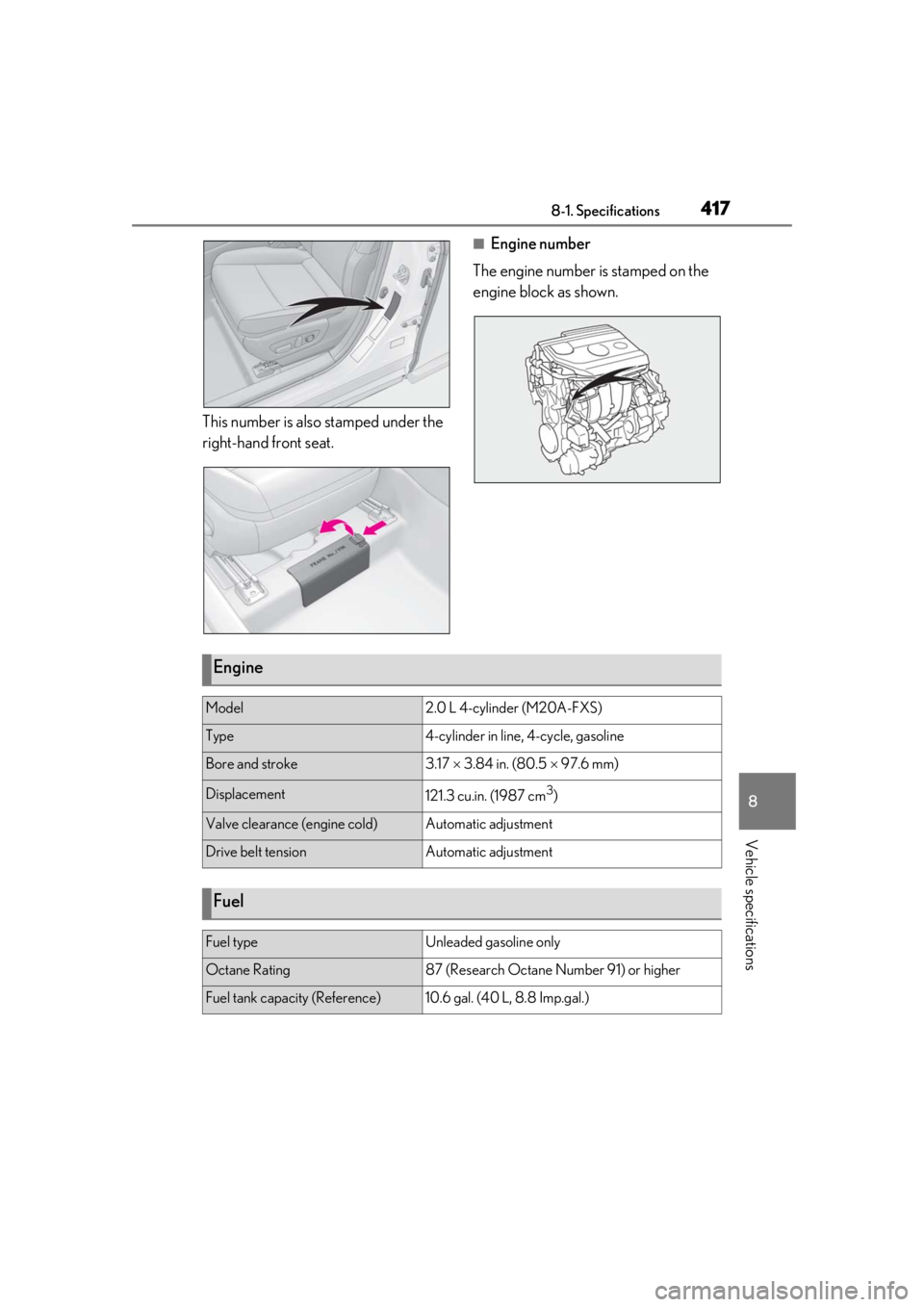
■Engine number
The engine number is stamped on the
engine block as shown.
Engine
Model2.0 L 4-cylinder (M20A-FXS)
Type4-cylinder in line, 4-cycle, gasoline
Bore and stroke3.17 3.84 in. (80.5 97.6 mm)
Displacement121.3 cu.in. (1987 cm3)
Valve clearance (engine cold)Automatic adjustment
Drive belt tensionAutomatic adjustment
Fuel
Fuel typeUnleaded gasoline only
Octane Rating87 (Research Octane Number 91) or higher
Fuel tank capacity (Reference)10.6 gal. (40 L, 8.8 Imp.gal.)
Page 419 of 476
4198-1. Specifications
8
Vehicle specifications
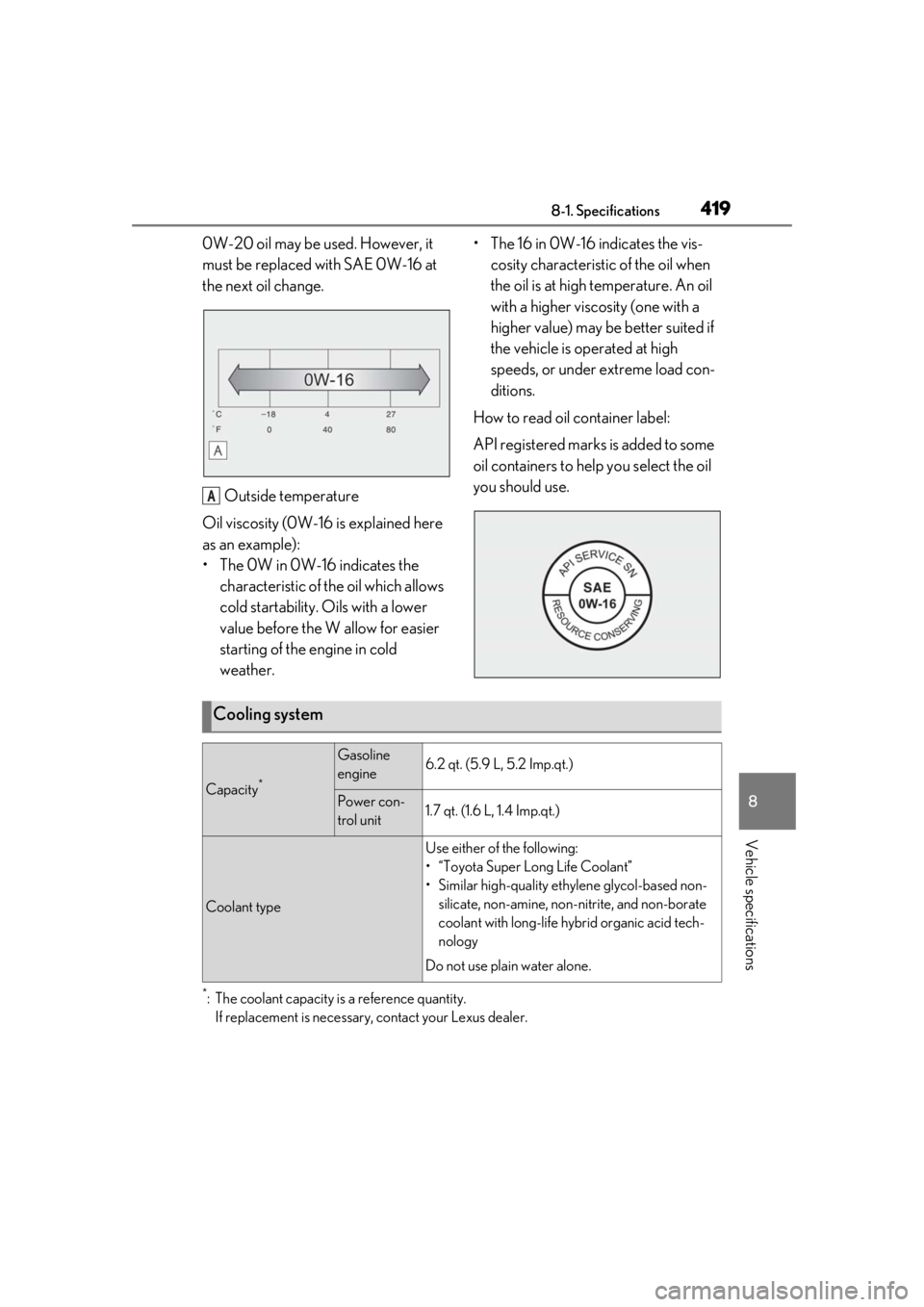
0W-20 oil may be used. However, it
must be replaced with SAE 0W-16 at
the next oil change.Outside temperature
Oil viscosity (0W-16 is explained here
as an example):
• The 0W in 0W-16 indicates the characteristic of the oil which allows
cold startability. Oils with a lower
value before the W allow for easier
starting of the engine in cold
weather. • The 16 in 0W-16 indicates the vis-
cosity characteristic of the oil when
the oil is at high temperature. An oil
with a higher viscosity (one with a
higher value) may be better suited if
the vehicle is operated at high
speeds, or under extreme load con-
ditions.
How to read oil container label:
API registered marks is added to some
oil containers to help you select the oil
you should use.
*: The coolant capacity is a reference quantity. If replacement is necessary, contact your Lexus dealer.
A
Cooling system
Capacity*
Gasoline
engine6.2 qt. (5.9 L, 5.2 Imp.qt.)
Power con-
trol unit1.7 qt. (1.6 L, 1.4 Imp.qt.)
Coolant type
Use either of the following:
• “Toyota Super Long Life Coolant”
• Similar high-quality ethy lene glycol-based non-
silicate, non-amine, non-nitrite, and non-borate
coolant with long-life hy brid organic acid tech-
nology
Do not use plain water alone.
Page 420 of 476
4208-1. Specifications
■Spark plug
■12-volt battery
*: The fluid capacity is a reference quantity.If replacement is necessary, contact your Lexus dealer.
Ignition system
MakeDENSO FC16HR-Q8
Gap0.031 in. (0.8 mm)
NOTICE
■Iridium-tipped spark plugs
Use only iridium-tipped spark plugs. Do not adjust the spark plug gap.
Electrical system
Open voltage at 68°F (20°C):12.0 V or higher
If the voltage is lower than the standard value,
charge the battery.
(After charging the battery, turn on the high beam
headlights for 30 seconds with the power switch
OFF, and turn the headlights off.)
Charging rates:
Quick charge
Slow charge
15 A max.
5 A max.
Hybrid transmission
Fluid capacity*4.0 qt. (3.8 L, 3.3 Imp.qt.)
Fluid typeToyota Genuine ATF WS
NOTICE
■Hybrid transmission fluid type
Using transmission fluid other than “Toyota Genuine ATF WS” may ultimately damage
the hybrid transmission of your vehicle.
Page 423 of 476
4238-1. Specifications
8
Vehicle specifications
■Gasoline quality
In very few cases, driveability problems may
be caused by the brand of gasoline you are
using. If driveability problems persist, try
changing the brand of gasoline. If this does
not correct the problem, consult your Lexus
dealer.
■Recommendation of the use of gasoline
containing detergent additives
●Lexus recommends the use of gasoline
that contains detergent additives to avoid
the build-up of engine deposits.
●All gasoline sold in the U.S.A. contains
minimum detergent additives to clean
and/or keep clean intake systems, per
EPA’s lowest additive s concentration pro-
gram.
●Lexus strongly recommends the use of
Top Tier Detergent Gasoline. For more
information on Top Tier Detergent Gaso-
line and a list of marketers, please go to
the official websit e www.toptiergas.com.
■Recommendation of the use of low
emissions gasoline
Gasolines containing oxygenates such as
ethers and ethanol, as well as reformulated
gasolines, are available in some cities.
These fuels are typically acceptable for use,
providing they meet other fuel require-
ments. Lexus recommends these fuels, since the
formulations allow for reduced vehicle
emissions.
■Non-recommendation of the use of
blended gasoline
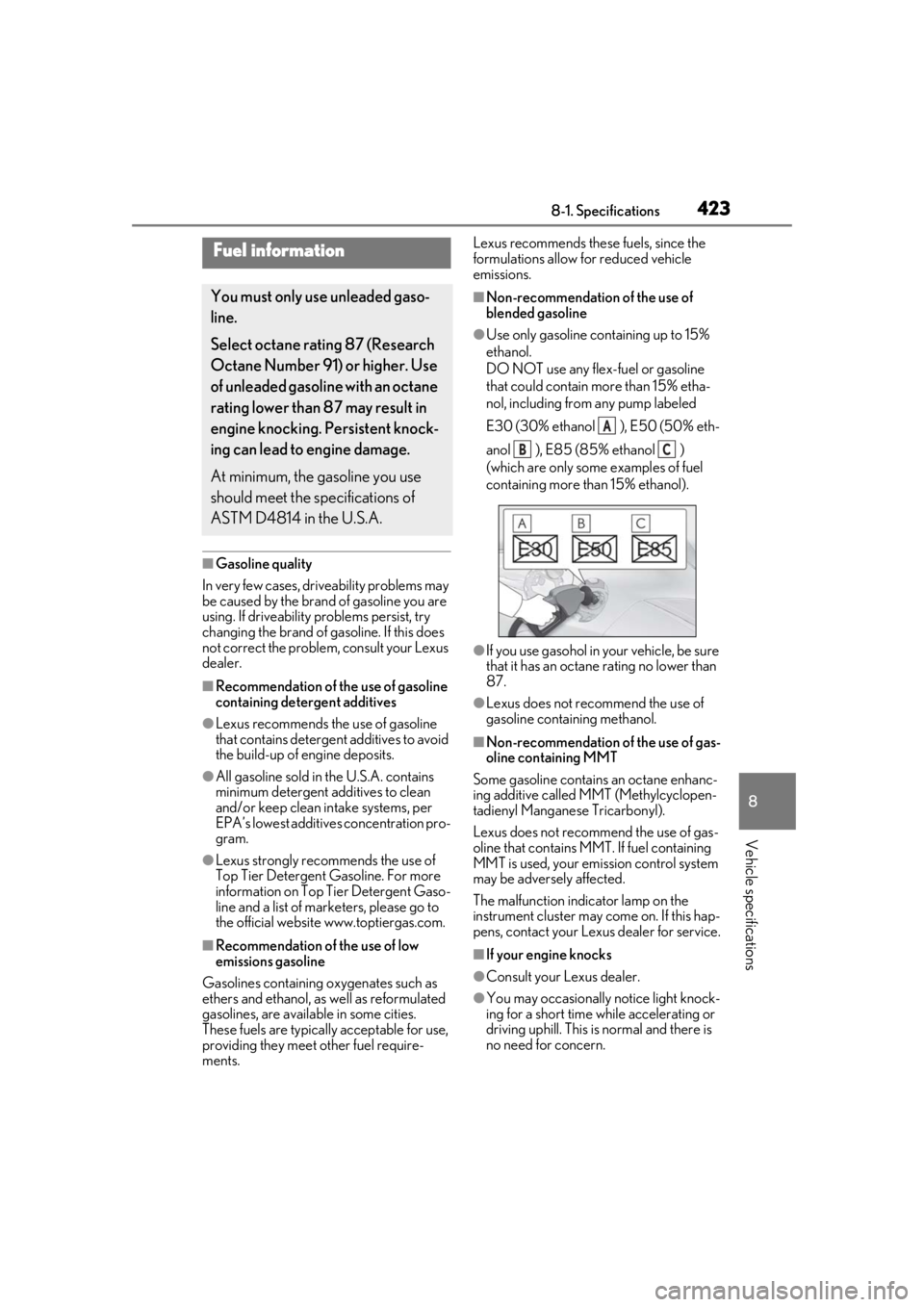
●Use only gasoline containing up to 15%
ethanol.
DO NOT use any flex-fuel or gasoline
that could contain more than 15% etha-
nol, including from
any pump labeled
E30 (30% ethanol ), E50 (50% eth-
anol ), E85 (85% ethanol )
(which are only some examples of fuel
containing more than 15% ethanol).
●If you use gasohol in your vehicle, be sure
that it has an octane rating no lower than
87.
●Lexus does not recommend the use of
gasoline containing methanol.
■Non-recommendation of the use of gas-
oline containing MMT
Some gasoline contains an octane enhanc-
ing additive called MMT (Methylcyclopen-
tadienyl Manganese Tricarbonyl).
Lexus does not recommend the use of gas-
oline that contains MMT. If fuel containing
MMT is used, your emission control system
may be adversely affected.
The malfunction indicator lamp on the
instrument cluster may come on. If this hap-
pens, contact your Lexus dealer for service.
■If your engine knocks
●Consult your Lexus dealer.
●You may occasionally notice light knock-
ing for a short time wh ile accelerating or
driving uphill. This is normal and there is
no need for concern.
Fuel information
You must only use unleaded gaso-
line.
Select octane rating 87 (Research
Octane Number 91) or higher. Use
of unleaded gasoline with an octane
rating lower than 87 may result in
engine knocking. Persistent knock-
ing can lead to engine damage.
At minimum, the gasoline you use
should meet the specifications of
ASTM D4814 in the U.S.A.
A
BC
Page 427 of 476
4278-1. Specifications
8
Vehicle specifications
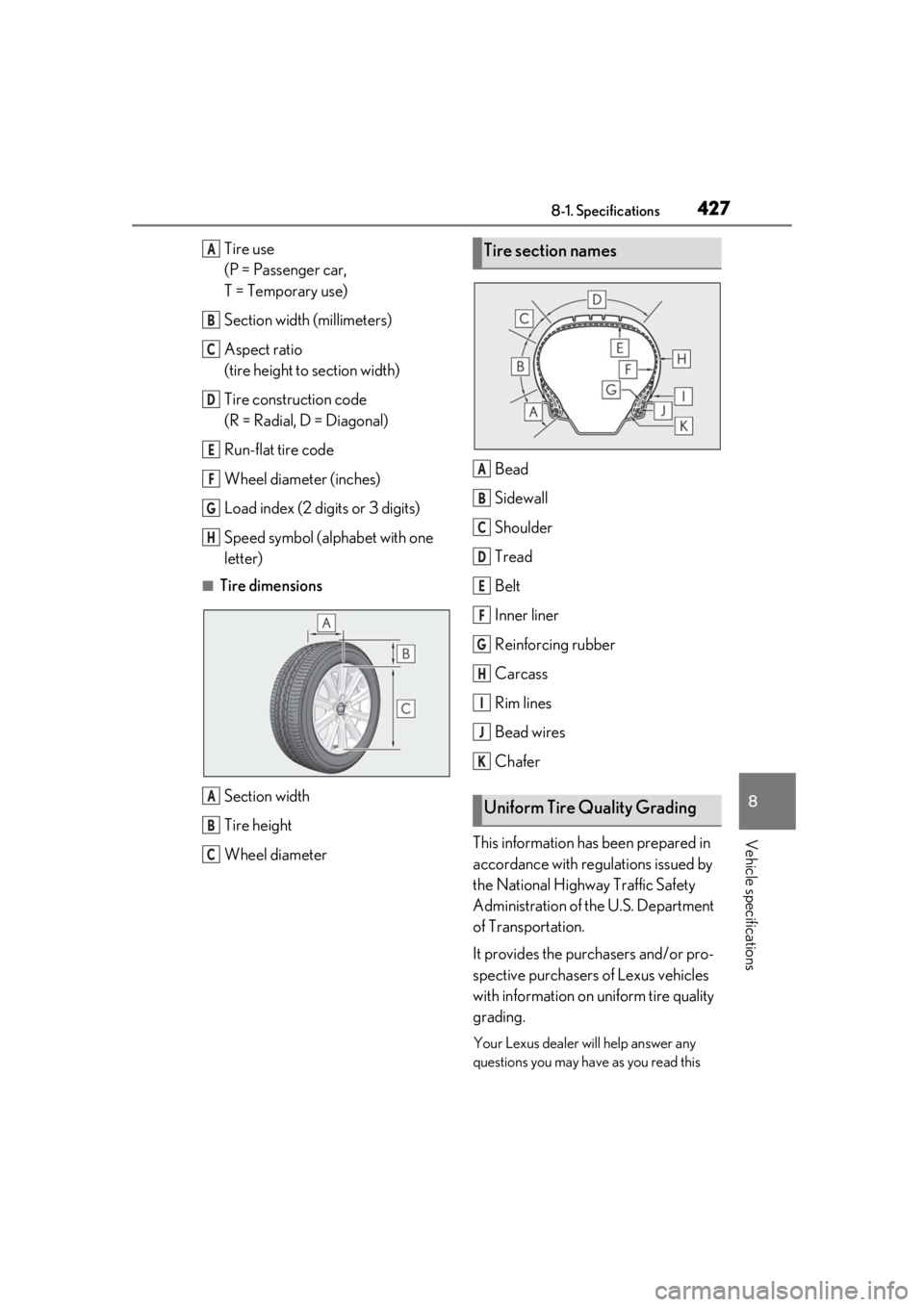
Tire use
(P = Passenger car,
T = Temporary use)
Section width (millimeters)
Aspect ratio
(tire height to section width)
Tire construction code
(R = Radial, D = Diagonal)
Run-flat tire code
Wheel diameter (inches)
Load index (2 digits or 3 digits)
Speed symbol (alphabet with one
letter)
■Tire dimensionsSection width
Tire height
Wheel diameter Bead
Sidewall
Shoulder
Tread
Belt
Inner liner
Reinforcing rubber
Carcass
Rim lines
Bead wires
Chafer
This information has been prepared in
accordance with regulations issued by
the National Highway Traffic Safety
Administration of the U.S. Department
of Transportation.
It provides the purchasers and/or pro-
spective purchasers of Lexus vehicles
with information on uniform tire quality
grading.
Your Lexus dealer will help answer any
questions you may have as you read this
A
B
C
D
E
F
G
H
A
B
C
Tire section names
Uniform Tire Quality Grading
A
B
C
D
E
F
G
H
I
J
K
Page 428 of 476

4288-1. Specifications
information.
■DOT quality grades
All passenger vehicle tires must con-
form to Federal Safety Requirements in
addition to these grades. Quality
grades can be found where applicable
on the tire sidewall between tread
shoulder and maximum section width.
For example: Treadwear 200 Traction AA
Temperature A
■Treadwear
The treadwear grade is a comparative
rating based on the wear rate of the tire
when tested under controlled condi-
tions on a specified government test
course.
For example, a tire graded 150 would wear
one and a half (1 - 1/2) times as well on the
government course as a tire graded 100.
The relative performa nce of tires depends
upon the actual conditions of their use,
however, and may depart significantly from
the norm due to variatio ns in driving habits,
service practices and differences in road
characteristics and climate.
■Traction AA, A, B, C
The traction grades, from highest to
lowest, are AA, A, B and C, and they
represent the tire’s ability to stop on
wet pavement as measured under con-
trolled conditions on specified govern-
ment test surfaces of asphalt and
concrete.
A tire marked C may have poor traction
performance.
Warning: The traction grade assigned to
this tire is based on braking (straight
ahead) traction tests and does not include
cornering (turning) traction.
■Temperature A, B, C
The temperature grades are A (the
highest), B, and C, representing the
tire’s resistance to the generation of
heat and its ability to dissipate heat
when tested under controlled condi-
tions on a specified indoor laboratory
test wheel.
Sustained high temperature can cause the
material of the tire to degenerate and
reduce tire life, and excessive temperature
can lead to sudd en tire failure.
Grade C corresponds to a level of perfor-
mance which all passenger car tires must
meet under the Fede ral Motor Vehicle
Safety Standard No. 109.
Grades B and A represent higher levels of
performance on the laboratory test wheel
than the minimum required by law.
Warning: The temperature grades for this
tire are established for a tire that is prop-
erly inflated and not overloaded.
Excessive speed, unde rinflation, or exces-
sive loading, either separately or in combi-
nation, can cause heat buildup and
possible tire failure.
Page 430 of 476
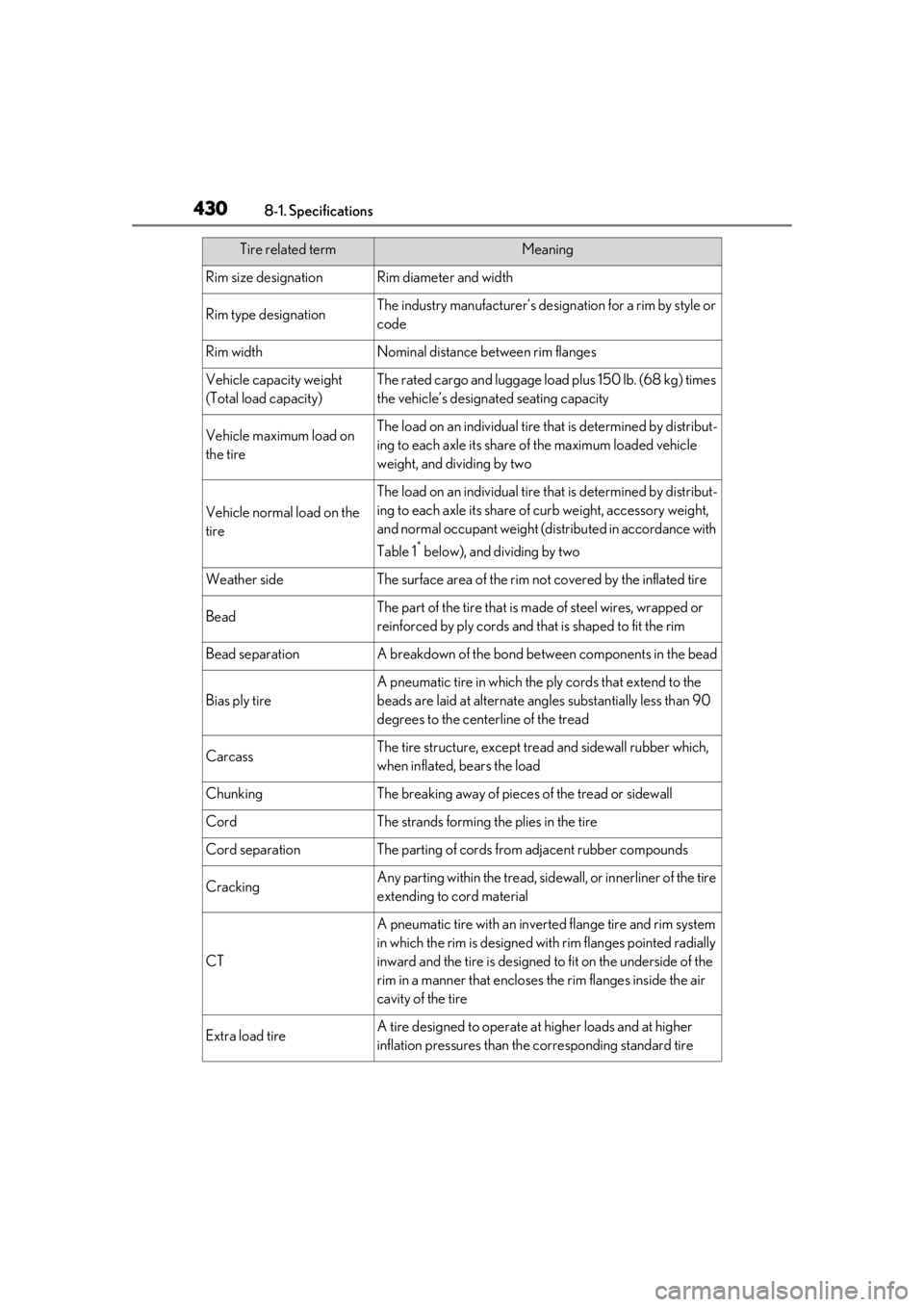
4308-1. Specifications
Rim size designationRim diameter and width
Rim type designationThe industry manufacturer’s designation for a rim by style or
code
Rim widthNominal distance between rim flanges
Vehicle capacity weight
(Total load capacity)The rated cargo and luggage load plus 150 lb. (68 kg) times
the vehicle’s designated seating capacity
Vehicle maximum load on
the tireThe load on an individual tire that is determined by distribut-
ing to each axle its share of the maximum loaded vehicle
weight, and dividing by two
Vehicle normal load on the
tire
The load on an individual tire that is determined by distribut-
ing to each axle its share of curb weight, accessory weight,
and normal occupant weight (distributed in accordance with
Table 1
* below), and dividing by two
Weather sideThe surface area of the rim not covered by the inflated tire
BeadThe part of the tire that is ma de of steel wires, wrapped or
reinforced by ply cords and th at is shaped to fit the rim
Bead separationA breakdown of the bond between components in the bead
Bias ply tire
A pneumatic tire in which the ply cords that extend to the
beads are laid at alternate angles substantially less than 90
degrees to the centerline of the tread
CarcassThe tire structure, except tread and sidewall rubber which,
when inflated, bears the load
ChunkingThe breaking away of pieces of the tread or sidewall
CordThe strands forming the plies in the tire
Cord separationThe parting of cords from adjacent rubber compounds
CrackingAny parting within the tread, side wall, or innerliner of the tire
extending to cord material
CT
A pneumatic tire with an inverted flange tire and rim system
in which the rim is designed wi th rim flanges pointed radially
inward and the tire is designed to fit on the underside of the
rim in a manner that encloses the rim flanges inside the air
cavity of the tire
Extra load tireA tire designed to operate at higher loads and at higher
inflation pressures than the corresponding standard tire
Tire related termMeaning