steering LINCOLN AVIATOR 2004 Owner's Manual
[x] Cancel search | Manufacturer: LINCOLN, Model Year: 2004, Model line: AVIATOR, Model: LINCOLN AVIATOR 2004Pages: 336, PDF Size: 3.69 MB
Page 232 of 336
Canadian customers who require roadside assistance, call
1±800±665±2006.
If you need to arrange roadside assistance for yourself, Ford Motor
Company will reimburse a reasonable amount. To obtain reimbursement
information, U.S. Ford or Mercury vehicles customers call
1-800-241-3673; Lincoln vehicle customers call 1±800±521±4140.
Canadian customers who need to obtain reimbursement information, call
1±800±665±2006.
ROADSIDE COVERAGE BEYOND BASIC WARRANTY
In the United States, you may purchase additional roadside assistance
coverage beyond this period through the Ford Auto Club by contacting
your Ford or Lincoln Mercury dealer.
Similarly in Canada, for uninterrupted Roadside Assistance coverage, you
may purchase extended coverage prior to your Basic Warranty's Roadside
Assistance expiring. For more information and enrollment, contact
1±877±294±2582 or visit our website at www.ford.ca.
HAZARD FLASHER
Use only in an emergency to warn traffic of vehicle breakdown,
approaching danger, etc. The hazard flashers can be operated when the
ignition is off.
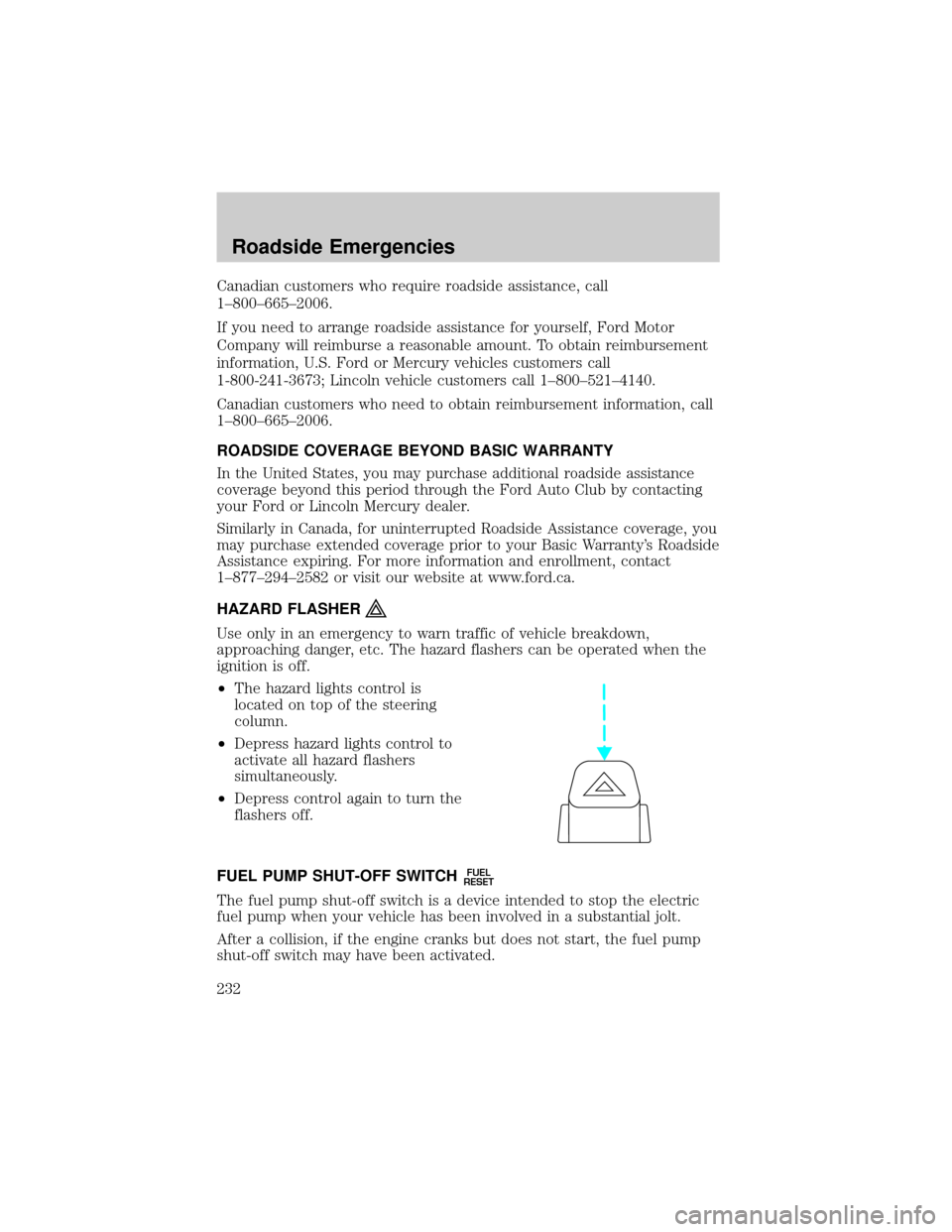
²The hazard lights control is
located on top of the steering
column.
²Depress hazard lights control to
activate all hazard flashers
simultaneously.
²Depress control again to turn the
flashers off.
FUEL PUMP SHUT-OFF SWITCH
FUEL
RESET
The fuel pump shut-off switch is a device intended to stop the electric
fuel pump when your vehicle has been involved in a substantial jolt.
After a collision, if the engine cranks but does not start, the fuel pump
shut-off switch may have been activated.
Roadside Emergencies
232
Page 243 of 336
CHANGING THE TIRES
If you get a flat tire while driving:
²do not brake heavily.
²gradually decrease the vehicle's speed.
²hold the steering wheel firmly.
²slowly move to a safe place on the side of the road.
The use of tire sealants may damage your tires. The use of tire
sealants may also damage your tire pressure monitoring system
(if equipped).
If your vehicle is equipped with a tire pressure monitoring
system, refer toTire Pressure Monitoring System (if
equipped)in theMaintenance and specificationssection for
important information. If the tire pressure monitor sensor becomes
damaged, it will no longer function.
Spare tire information
Your spare tire is not equipped with a tire pressure monitoring system
(TPMS) sensor. The tire pressure monitoring system indicator light will
illuminate when the spare is in use. To restore full functionality of the
monitoring system, all road wheels equipped with tire pressure
monitoring sensors must be mounted on the vehicle.
Have flat tires serviced by a dealer or qualified technician in order to
prevent damage to the TPMS sensor. Replace the spare tire with a road
tire as soon as possible.
If your vehicle is equipped with AWD, a spare tire of a different
diameter than the road tires should not be used. Such a tire
could make the vehicle difficult to control as well as result in damage
to driveline components.
Roadside Emergencies
243
Page 244 of 336
Stopping and securing the vehicle
1. If you get a flat tire while driving,
do not apply the brake heavily;
instead, gradually decrease your
speed. Hold the steering wheel
firmly and slowly move to a safe
place on the side of the road.
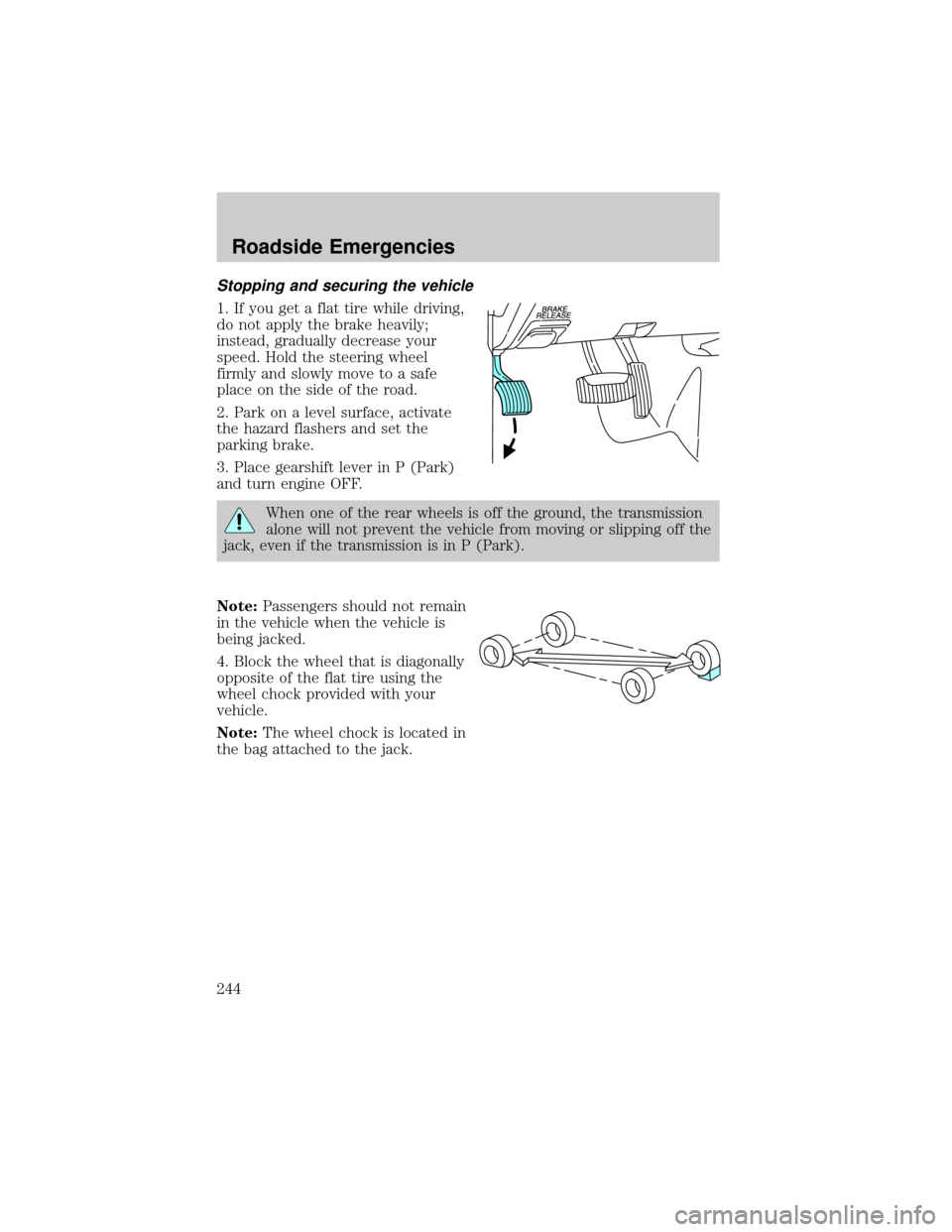
2. Park on a level surface, activate
the hazard flashers and set the
parking brake.
3. Place gearshift lever in P (Park)
and turn engine OFF.
When one of the rear wheels is off the ground, the transmission
alone will not prevent the vehicle from moving or slipping off the
jack, even if the transmission is in P (Park).
Note:Passengers should not remain
in the vehicle when the vehicle is
being jacked.
4. Block the wheel that is diagonally
opposite of the flat tire using the
wheel chock provided with your
vehicle.
Note:The wheel chock is located in
the bag attached to the jack.
Roadside Emergencies
244
Page 253 of 336
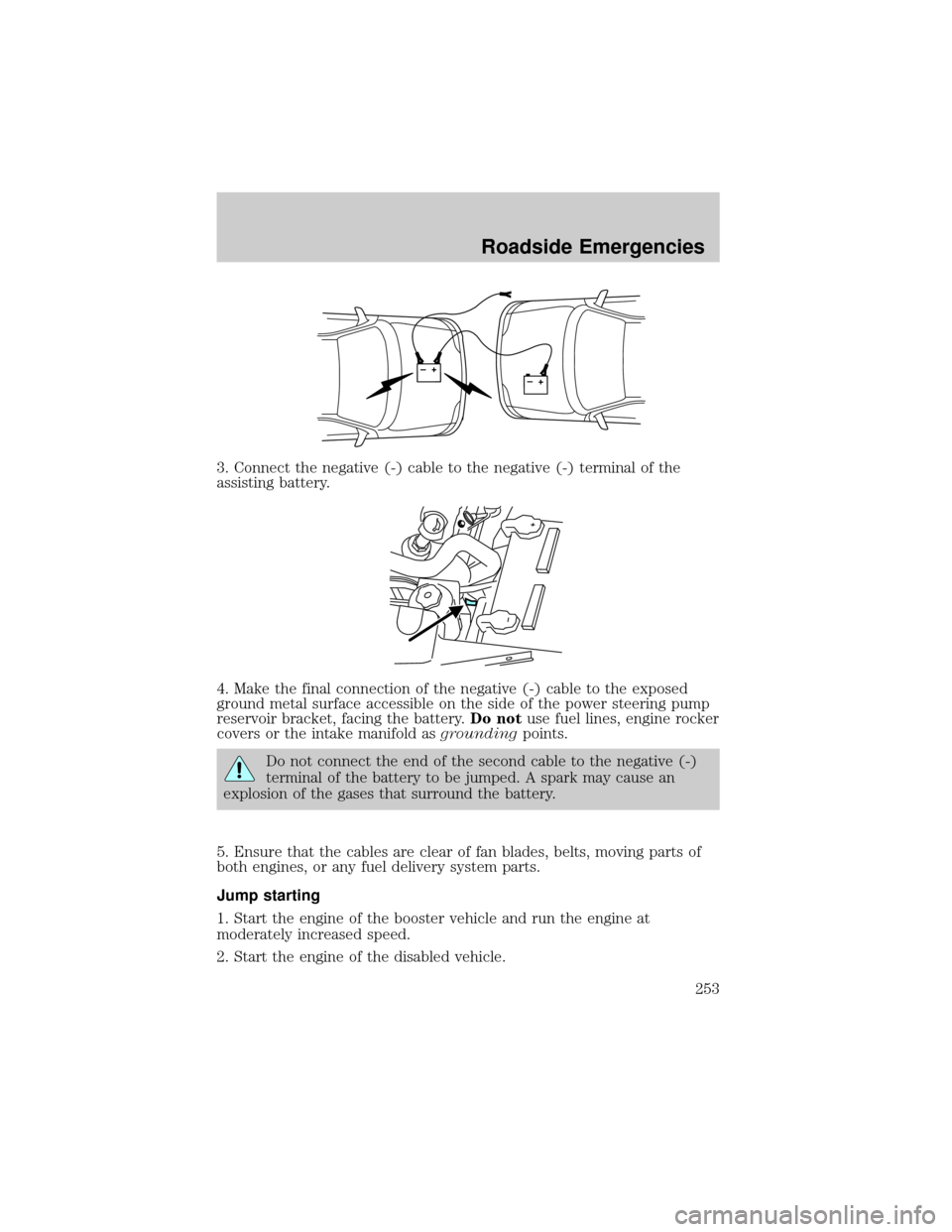
3. Connect the negative (-) cable to the negative (-) terminal of the
assisting battery.
4. Make the final connection of the negative (-) cable to the exposed
ground metal surface accessible on the side of the power steering pump
reservoir bracket, facing the battery.Do notuse fuel lines, engine rocker
covers or the intake manifold asgroundingpoints.
Do not connect the end of the second cable to the negative (-)
terminal of the battery to be jumped. A spark may cause an
explosion of the gases that surround the battery.
5. Ensure that the cables are clear of fan blades, belts, moving parts of
both engines, or any fuel delivery system parts.
Jump starting
1. Start the engine of the booster vehicle and run the engine at
moderately increased speed.
2. Start the engine of the disabled vehicle.
+–+–
Roadside Emergencies
253
Page 269 of 336
Do not use sharp objects, such as a razor blade, to clean the
inside of the rear window or to remove decals, as it may cause
damage to the rear window defroster's heated grid lines.
INSTRUMENT PANEL AND CLUSTER LENS
Clean the instrument panel with a damp cloth, then dry with a dry cloth.
²Avoid cleaners or polish that increase the gloss of the upper portion of
the instrument panel. The dull finish in this area helps protect the
driver from undesirable windshield reflection.
Do not use chemical solvents or strong detergents when cleaning
the steering wheel or instrument panel to avoid contamination of
the air bag system.
²Be certain to wash or wipe your hands clean if you have been in
contact with certain products such as insect repellent and suntan
lotion in order to avoid possible damage to the interior painted
surfaces.
INTERIOR
For fabric, carpets, cloth seats, safety belts and seats equipped with side
air bags:
²Remove dust and loose dirt with a vacuum cleaner.
²Remove light stains and soil with Motorcraft Extra Strength
Upholstery Cleaner (ZC-41).
²If grease or tar is present on the material, spot-clean the area first
with Motorcraft Spot and Stain Remover (ZC-14).
²Never saturate the seat covers with cleaning solution.
²Do not use household cleaning products or glass cleaners, which can
stain and discolor the fabric and affect the flame retardant abilities of
the seat materials.
Do not use cleaning solvents, bleach or dye on the vehicle's
safety belts, as these actions may weaken the belt webbing.
Do not use chemical solvents or strong detergents when cleaning
the seat-mounted side air bag. Such products could contaminate
the side air bag system and affect performance of the side air bag in a
collision.
Cleaning
269
Page 274 of 336
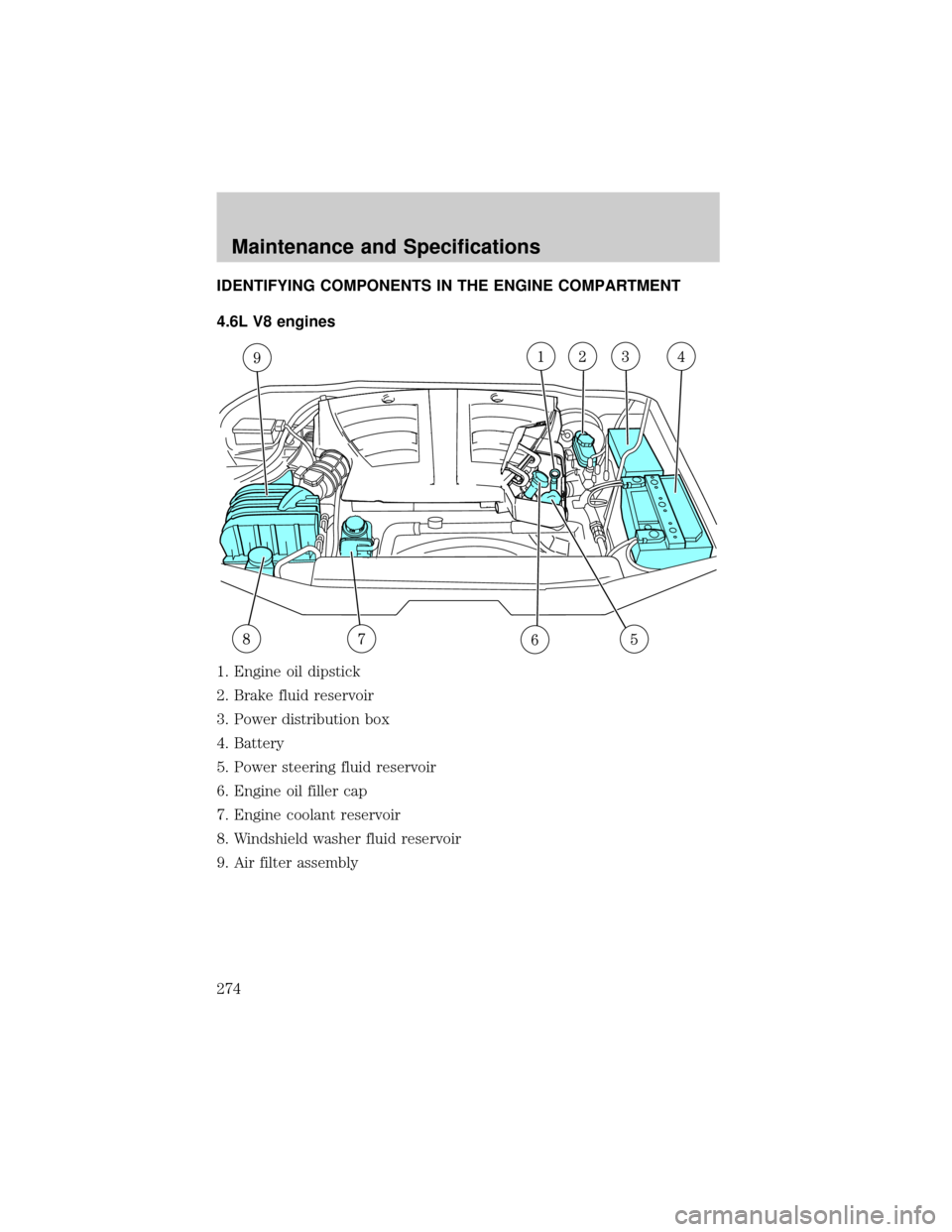
IDENTIFYING COMPONENTS IN THE ENGINE COMPARTMENT
4.6L V8 engines
1. Engine oil dipstick
2. Brake fluid reservoir
3. Power distribution box
4. Battery
5. Power steering fluid reservoir
6. Engine oil filler cap
7. Engine coolant reservoir
8. Windshield washer fluid reservoir
9. Air filter assembly
Maintenance and Specifications
274
Page 284 of 336
The coolant concentration in severe climates must always be
between 40% and 60%.Coolant concentrations not within the
40%-60% range may cause engine damage.
Refer to the chart on the coolant container to ensure the coolant
concentration in your vehicle will provide adequate protection at the
temperatures in which you drive.
What you should know about fail-safe cooling
If the engine coolant supply is depleted, this feature allows the vehicle to
be driven temporarily before incremental component damage is incurred.
The ªfail-safeº distance depends on ambient temperatures, vehicle load
and terrain.
How fail-safe cooling works
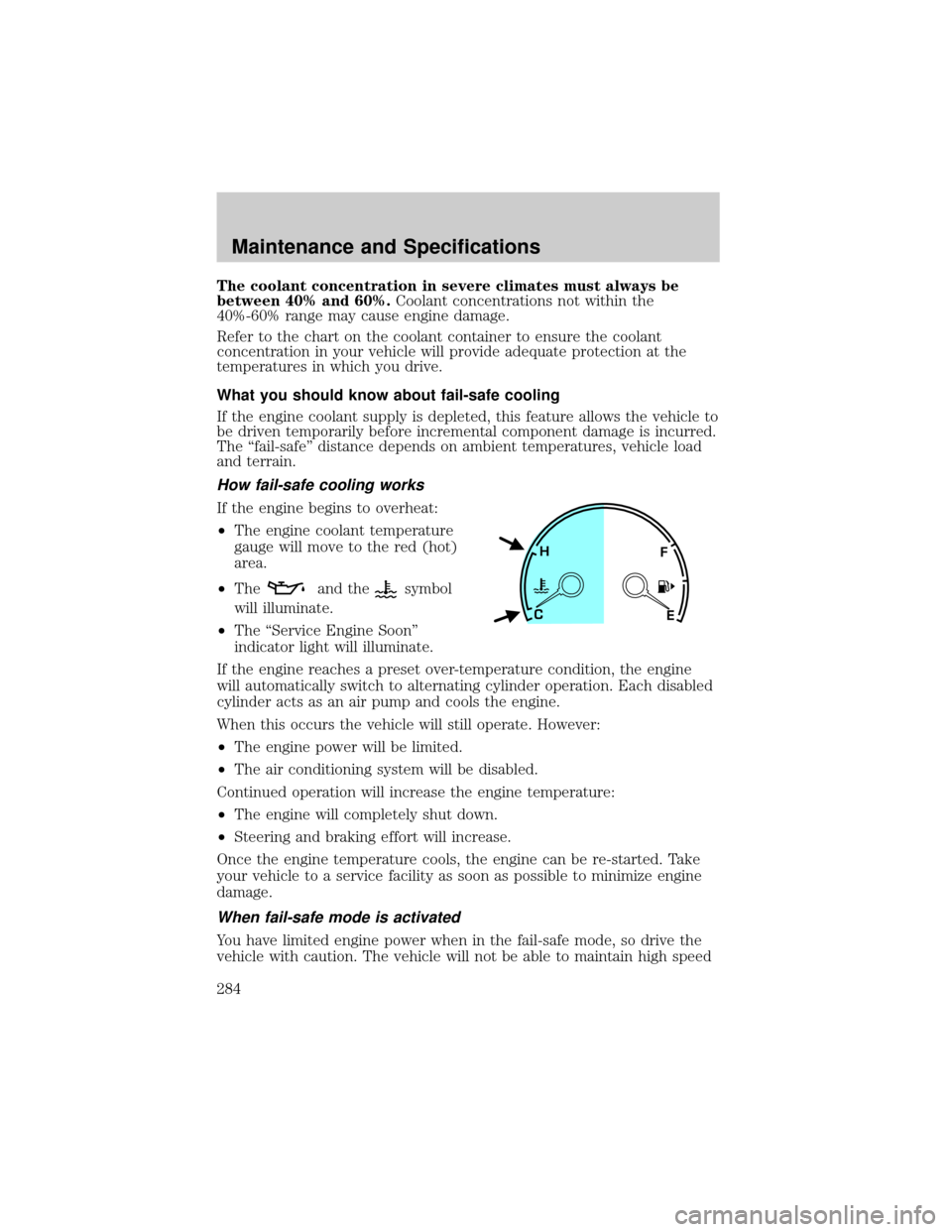
If the engine begins to overheat:
²The engine coolant temperature
gauge will move to the red (hot)
area.
²The
and thesymbol
will illuminate.
²The ªService Engine Soonº
indicator light will illuminate.
If the engine reaches a preset over-temperature condition, the engine
will automatically switch to alternating cylinder operation. Each disabled
cylinder acts as an air pump and cools the engine.
When this occurs the vehicle will still operate. However:
²The engine power will be limited.
²The air conditioning system will be disabled.
Continued operation will increase the engine temperature:
²The engine will completely shut down.
²Steering and braking effort will increase.
Once the engine temperature cools, the engine can be re-started. Take
your vehicle to a service facility as soon as possible to minimize engine
damage.
When fail-safe mode is activated
You have limited engine power when in the fail-safe mode, so drive the
vehicle with caution. The vehicle will not be able to maintain high speed
Maintenance and Specifications
284
Page 295 of 336
Allow the vehicle to sit for at least eight hours without starting the
engine. Then, start the engine and complete the above driving cycle. The
engine must warm up to its normal operating temperature. Once started,
do not turn off the engine until the above driving cycle is complete.
CHECKING AND ADDING POWER STEERING FLUID
Check the power steering fluid. Refer to the scheduled maintenance
guide for the service interval schedules. If adding fluid is necessary, use
only Ford Premium Power Steering Fluid or MERCONtAT F.
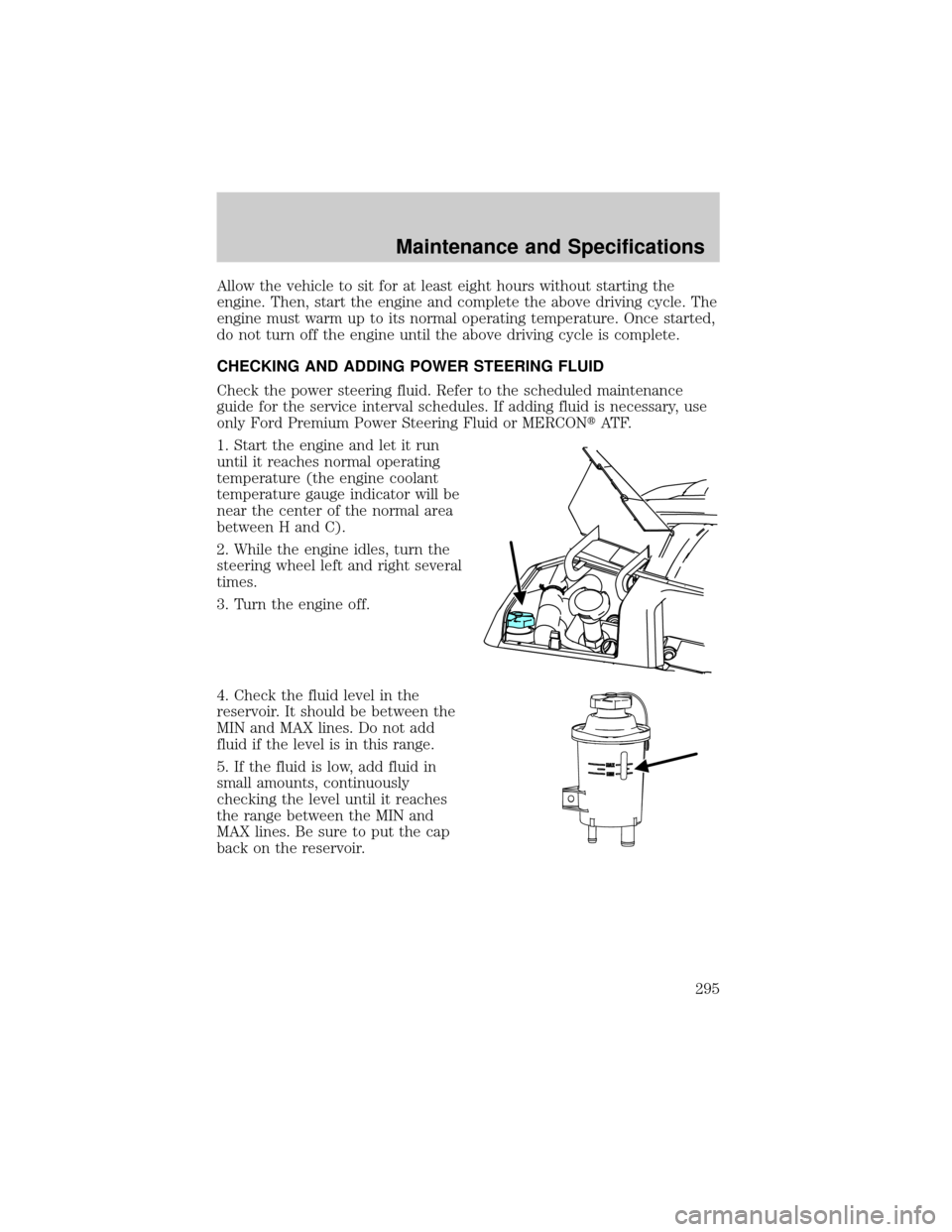
1. Start the engine and let it run
until it reaches normal operating
temperature (the engine coolant
temperature gauge indicator will be
near the center of the normal area
between H and C).
2. While the engine idles, turn the
steering wheel left and right several
times.
3. Turn the engine off.
4. Check the fluid level in the
reservoir. It should be between the
MIN and MAX lines. Do not add
fluid if the level is in this range.
5. If the fluid is low, add fluid in
small amounts, continuously
checking the level until it reaches
the range between the MIN and
MAX lines. Be sure to put the cap
back on the reservoir.
Maintenance and Specifications
295
Page 312 of 336
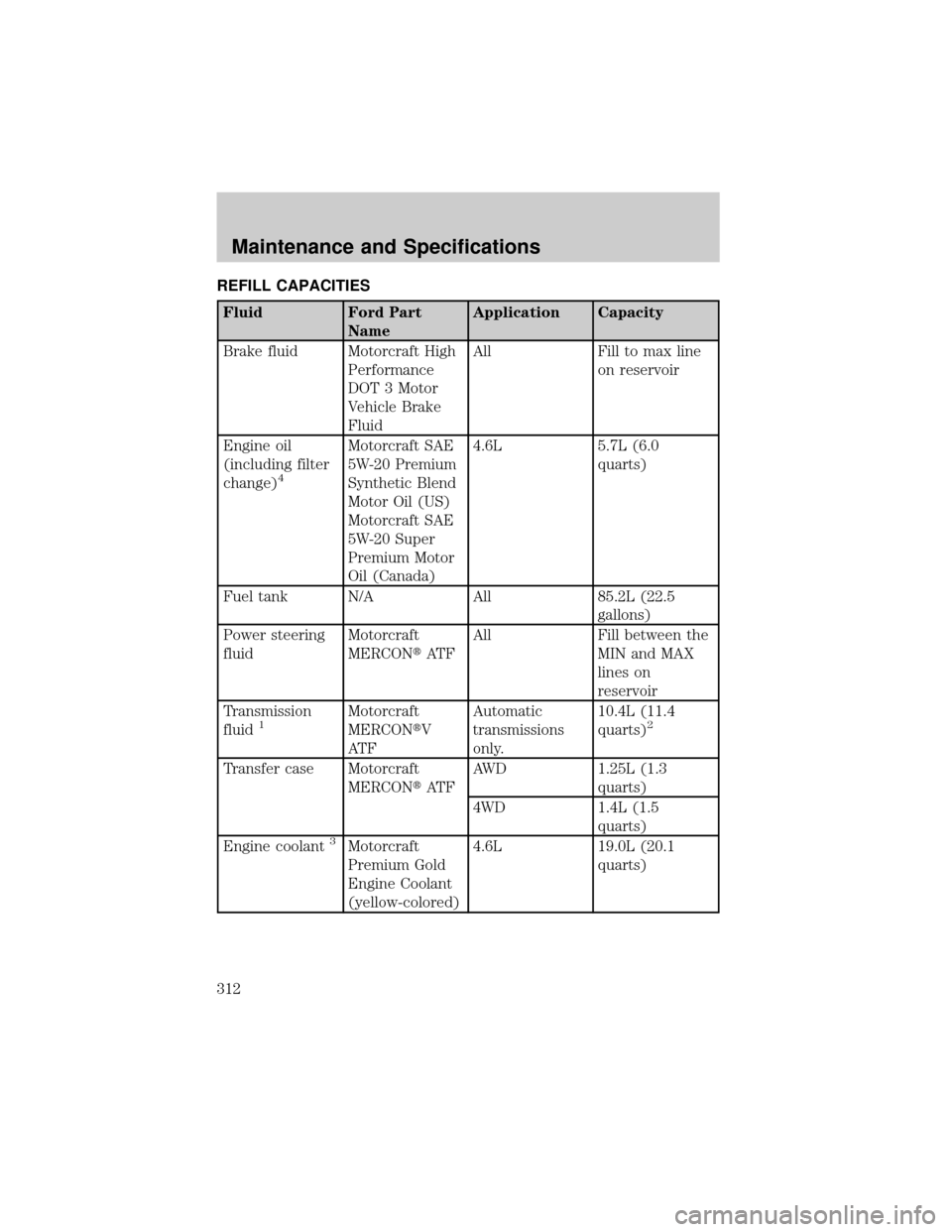
REFILL CAPACITIES
Fluid Ford Part
NameApplication Capacity
Brake fluid Motorcraft High
Performance
DOT 3 Motor
Vehicle Brake
FluidAll Fill to max line
on reservoir
Engine oil
(including filter
change)
4
Motorcraft SAE
5W-20 Premium
Synthetic Blend
Motor Oil (US)
Motorcraft SAE
5W-20 Super
Premium Motor
Oil (Canada)4.6L 5.7L (6.0
quarts)
Fuel tank N/A All 85.2L (22.5
gallons)
Power steering
fluidMotorcraft
MERCONtAT FAll Fill between the
MIN and MAX
lines on
reservoir
Transmission
fluid
1Motorcraft
MERCONtV
AT FAutomatic
transmissions
only.10.4L (11.4
quarts)2
Transfer case Motorcraft
MERCONtAT FAWD 1.25L (1.3
quarts)
4WD 1.4L (1.5
quarts)
Engine coolant
3Motorcraft
Premium Gold
Engine Coolant
(yellow-colored)4.6L 19.0L (20.1
quarts)
Maintenance and Specifications
312
Page 315 of 336
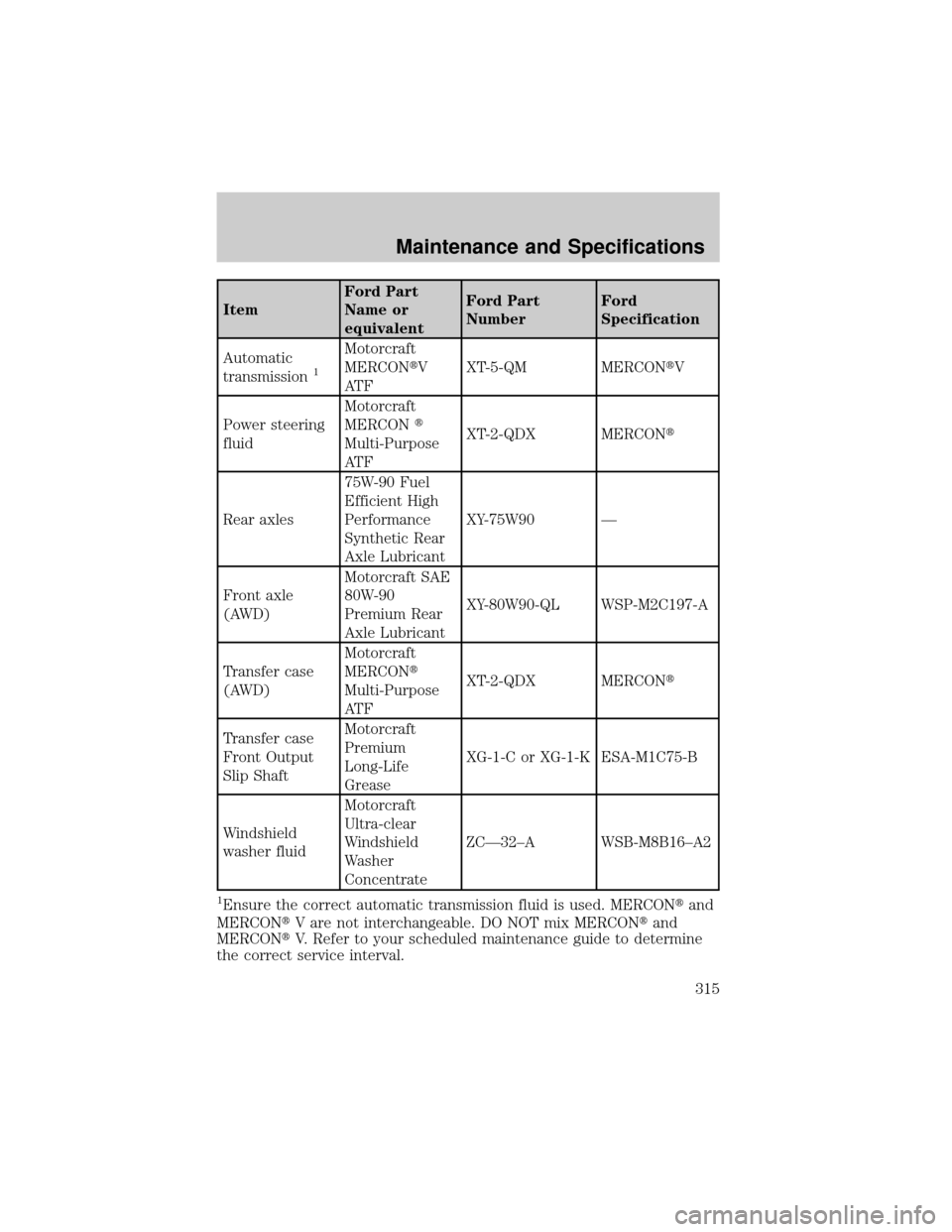
ItemFord Part
Name or
equivalentFord Part
NumberFord
Specification
Automatic
transmission
1
Motorcraft
MERCONtV
AT FXT-5-QM MERCONtV
Power steering
fluidMotorcraft
MERCONt
Multi-Purpose
AT FXT-2-QDX MERCONt
Rear axles75W-90 Fuel
Efficient High
Performance
Synthetic Rear
Axle LubricantXY-75W90 Ð
Front axle
(AWD)Motorcraft SAE
80W-90
Premium Rear
Axle LubricantXY-80W90-QL WSP-M2C197-A
Transfer case
(AWD)Motorcraft
MERCONt
Multi-Purpose
AT FXT-2-QDX MERCONt
Transfer case
Front Output
Slip ShaftMotorcraft
Premium
Long-Life
GreaseXG-1-C or XG-1-K ESA-M1C75-B
Windshield
washer fluidMotorcraft
Ultra-clear
Windshield
Washer
ConcentrateZCÐ32±A WSB-M8B16±A2
1Ensure the correct automatic transmission fluid is used. MERCONtand
MERCONtV are not interchangeable. DO NOT mix MERCONtand
MERCONtV. Refer to your scheduled maintenance guide to determine
the correct service interval.
Maintenance and Specifications
315