tire pressure LINCOLN AVIATOR 2004 Owner's Manual
[x] Cancel search | Manufacturer: LINCOLN, Model Year: 2004, Model line: AVIATOR, Model: LINCOLN AVIATOR 2004Pages: 336, PDF Size: 3.69 MB
Page 305 of 336
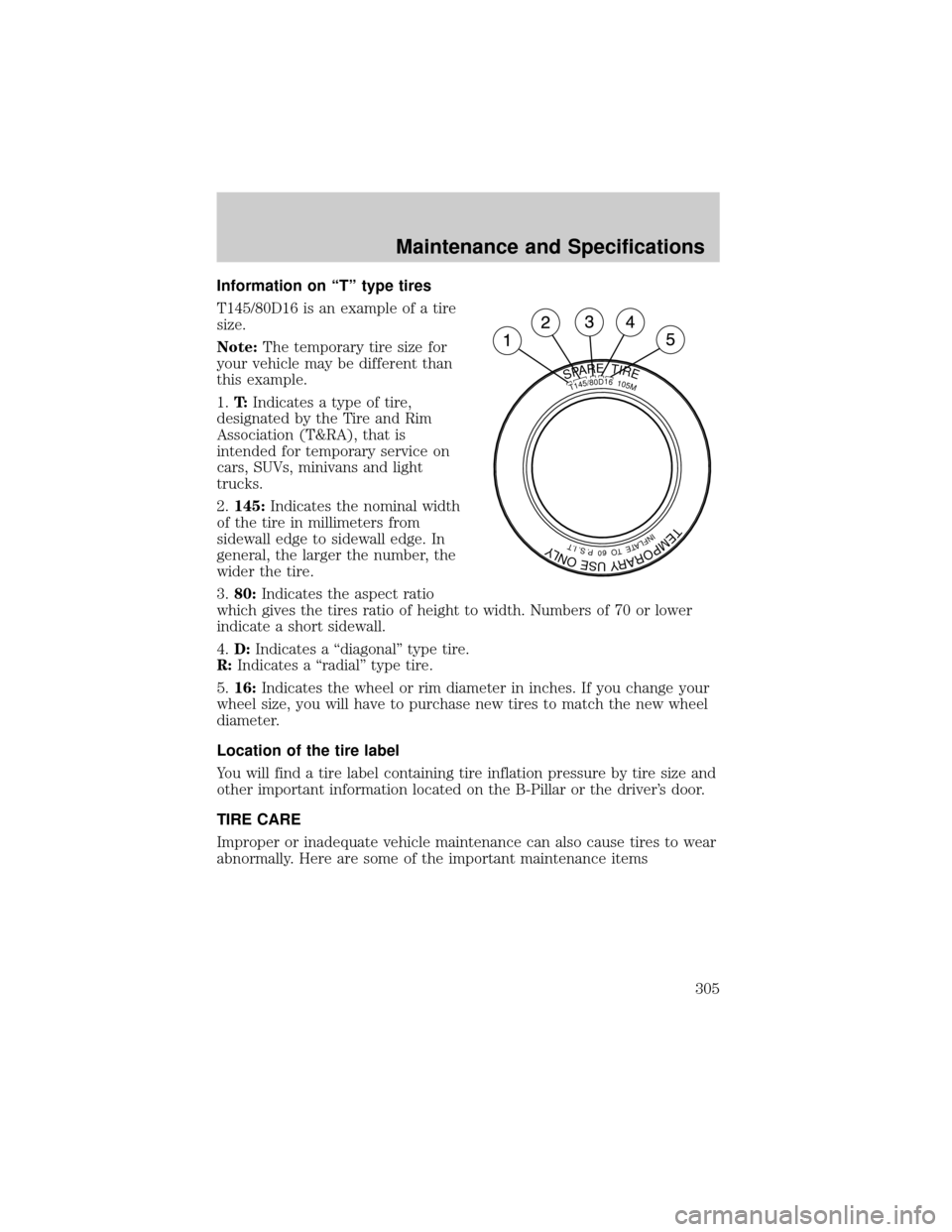
Information on ªTº type tires
T145/80D16 is an example of a tire
size.
Note:The temporary tire size for
your vehicle may be different than
this example.
1.T:Indicates a type of tire,
designated by the Tire and Rim
Association (T&RA), that is
intended for temporary service on
cars, SUVs, minivans and light
trucks.
2.145:Indicates the nominal width
of the tire in millimeters from
sidewall edge to sidewall edge. In
general, the larger the number, the
wider the tire.
3.80:Indicates the aspect ratio
which gives the tires ratio of height to width. Numbers of 70 or lower
indicate a short sidewall.
4.D:Indicates a ªdiagonalº type tire.
R:Indicates a ªradialº type tire.
5.16:Indicates the wheel or rim diameter in inches. If you change your
wheel size, you will have to purchase new tires to match the new wheel
diameter.
Location of the tire label
You will find a tire label containing tire inflation pressure by tire size and
other important information located on the B-Pillar or the driver's door.
TIRE CARE
Improper or inadequate vehicle maintenance can also cause tires to wear
abnormally. Here are some of the important maintenance items
SPARETIRE
TEMPORARYUSEONLY
INFLATETO60P.S.I.T
T145/80D16105M
Maintenance and Specifications
305
Page 306 of 336
Tire inflation pressure
Use a tire gauge to check the tire inflation pressure at least monthly
(check the tire inflation pressure in the spare tire every 6 months) and
before long trips. You are strongly urged to buy a reliable tire pressure
gauge, as automatic service station gauges may be inaccurate. Ford
recommends the use of a digital or dial type tire pressure gauge rather
than a stick type of tire pressure gauge.
Use the recommended cold inflation pressure for optimum tire
performance and wear. Under-inflation or over-inflation may cause
uneven treadwear patterns.
Under-inflation is the most common cause of tire failures and
may result in severe tire cracking, tread separation or9blowout9,
with unexpected loss of vehicle control and increased risk of injury.
Under-inflation increases sidewall flexing and rolling resistance,
resulting in heat buildup and internal damage to the tire. It also may
result in unnecessary tire stress, irregular wear, loss of vehicle control
and accidents. A tire can lose up to half of its air pressure and not
appear to be flat!
When weather temperature changes occur, tire inflation pressures also
change. A 10 degree temperature change causes a corresponding drop of
7 kPa (1 psi) in inflation pressure. Check your tire pressures frequently
and adjust them to the proper pressure which can be found on the tire
label or certification label.
If checking tire pressure when the tire is hot, (i.e. driven more than 1.6
km [1mile]), never ªbleedº or reduce air pressure. The tires are hot from
driving and it is normal for pressures to increase above recommended
cold pressures. A hot tire at or below recommended cold inflation
pressure could be significantly under-inflated.
To check the pressure in your tire(s):
1. Make sure the tires are cool, meaning they are not hot from driving
even a mile.
Note:If you have to drive a distance to get air for your tire(s), check
and record the tire pressure first and add the appropriate air pressure
when you get to the pump. It is normal for tires to heat up and the air
pressure inside to go up as you drive. Never ªbleedº or reduce air
pressure when tires are hot.
2. Remove the cap from the valve on one tire, then firmly press the tire
gauge onto the valve.
Maintenance and Specifications
306
Page 307 of 336

3. Add air to reach the recommended air pressure
Note:If you overfill the tire, release air by pushing on the metal stem in
the center of the valve. Then recheck the pressure with your tire gauge.
4. Replace the valve cap.
5. Repeat this procedure for each tire, including the spare.
Note:Some spare tires require higher inflation pressure than the other
tires.
6. Visually inspect the tires to make sure there are no nails or other
objects embedded that could poke a hole in the tire and cause an air
leak.
7. Check the sidewalls to make sure there are no gouges, cuts, bulges or
other irregularities.
Tire and wheel alignment
A bad jolt from hitting a curb or pothole can cause the front end of your
vehicle to become misaligned or damage to your tires. If your vehicle
seems to pull to one side, vibrate or shake when you're driving, the
wheels may be out of alignment. Have a qualified technician at a
reputable repair facility check the wheel alignment periodically.
Wheel misalignment in the front or the rear can cause uneven and rapid
treadwear of your tires and should be corrected by a qualified technician
at a reputable repair facility. Front wheel drive (FWD) vehicles, and
those with independent front suspension require alignment of all four
wheels.
The tires should also be balanced periodically. An unbalanced tire and
wheel assembly may result in irregular tire wear.
Tire rotation
Rotating your tires at the recommended interval (as indicated in the
Service Maintenance Guide that comes with your vehicle) will help your
tires wear more evenly providing better tire performance and longer tire
life. Unless otherwise specified, rotate the tires approximately every
8,000 km (5,000 miles).
Maintenance and Specifications
307
Page 329 of 336

Special notice
ambulance conversions ..............7
utility-type vehicles ....................7
Specification chart,
lubricants ...........................314, 316
Speed control ............................109
Starting your vehicle ........193±195
jump starting ..........................251
Steering
speed sensitive .......................203
Steering wheel
controls ....................................111
T
Tire Pressure Monitoring
System (TPMS)
Driving .....................................216
Maintenance and
Specifications ..........................299
Roadside Emergencies ...........243
Warning Displays ......................14
Tires ...........................243, 296±297
changing ..................243, 247, 250
replacing ..................................247
snow tires and chains ............310
spare tire .................243, 245±246
tire grades ...............................297
treadwear ................................297
Towing .......................................225
recreational towing .................230
trailer towing ..........................225
wrecker ....................................256Transmission .............................204
brake-shift interlock (BSI) ....204
fluid, checking and adding
(automatic) .............................296
fluid, refill capacities ..............312
lubricant specifications ..314, 316
Trunk .........................................139
Turn signal ..................................87
V
Vehicle dimensions ...................316
Vehicle Identification Number
(VIN) ..........................................318
Vehicle loading ..........................221
Ventilating your vehicle ...........196
W
Warning lights (see Lights) .......10
Washer fluid ..............................275
Water, Driving through .............221
Windows
power .......................................102
rear wiper/washer .....................98
Windshield washer fluid and
wipers ..........................................97
checking and adding fluid .....275
checking and cleaning ..............98
liftgate reservoir .....................275
replacing wiper blades .............98
Wrecker towing .........................256
Index
329