engine LINCOLN CONTINENTAL 1996 Customer Assistance Guide
[x] Cancel search | Manufacturer: LINCOLN, Model Year: 1996, Model line: CONTINENTAL, Model: LINCOLN CONTINENTAL 1996Pages: 320, PDF Size: 1.8 MB
Page 255 of 320
The low-maintenance battery has removable vent
caps for checking the electrolyte level and adding
water. The electrolyte level should be checked at
least every 24 months or 24,000 miles (40,000 km)
in temperatures up to 90'F (32'C) and more often in
temperatures above 90'F (32'C). Keep the
electrolyte level in each cell up to the level
indicator. Do not overfill.
If the level gets low, refill the battery with distilled
water. If necessary, you can add tap water to the
battery, provided the water is not hard or does not
have a high mineral or alkali content. If the battery
needs water quite often, have the charging system
checked for a possible malfunction.
Help Us Protect Our Environment
Ford Motor Company strongly recommends that
used lead-acid batteries be returned to an authorized
recycling facility for disposal.Battery recycling symbol
Because your vehicle's engine is electronically
controlled by a computer, some control conditions
are maintained by power from the battery. If you
ever disconnect the battery or install a new battery,
you must allow the computer to "relearn" its idle
conditions before your vehicle will drive properly.
To let the engine do this, put the gearshift in P
(Park), turn off all the accessories, and start the
vehicle. Let the engine idle for at least one minute.
(Engine must be warm in order to "learn.") Also,
allow approximately 10 miles (16 km) of stop and go
traffic for your vehicle's engine to completely
girelearn" its idle.
253
Page 256 of 320
If you do not let the engine relearn its idle, the idle
quality of your vehicle may be adversely affected
until the idle is relearned. Your vehicle will
eventually relearn its idle while you drive it, but it
takes much longer than if you use the previous
procedure.
Windshield Washer Fluid and
Wipers
Washer Fluid
Check the level of the windshield washer fluid every
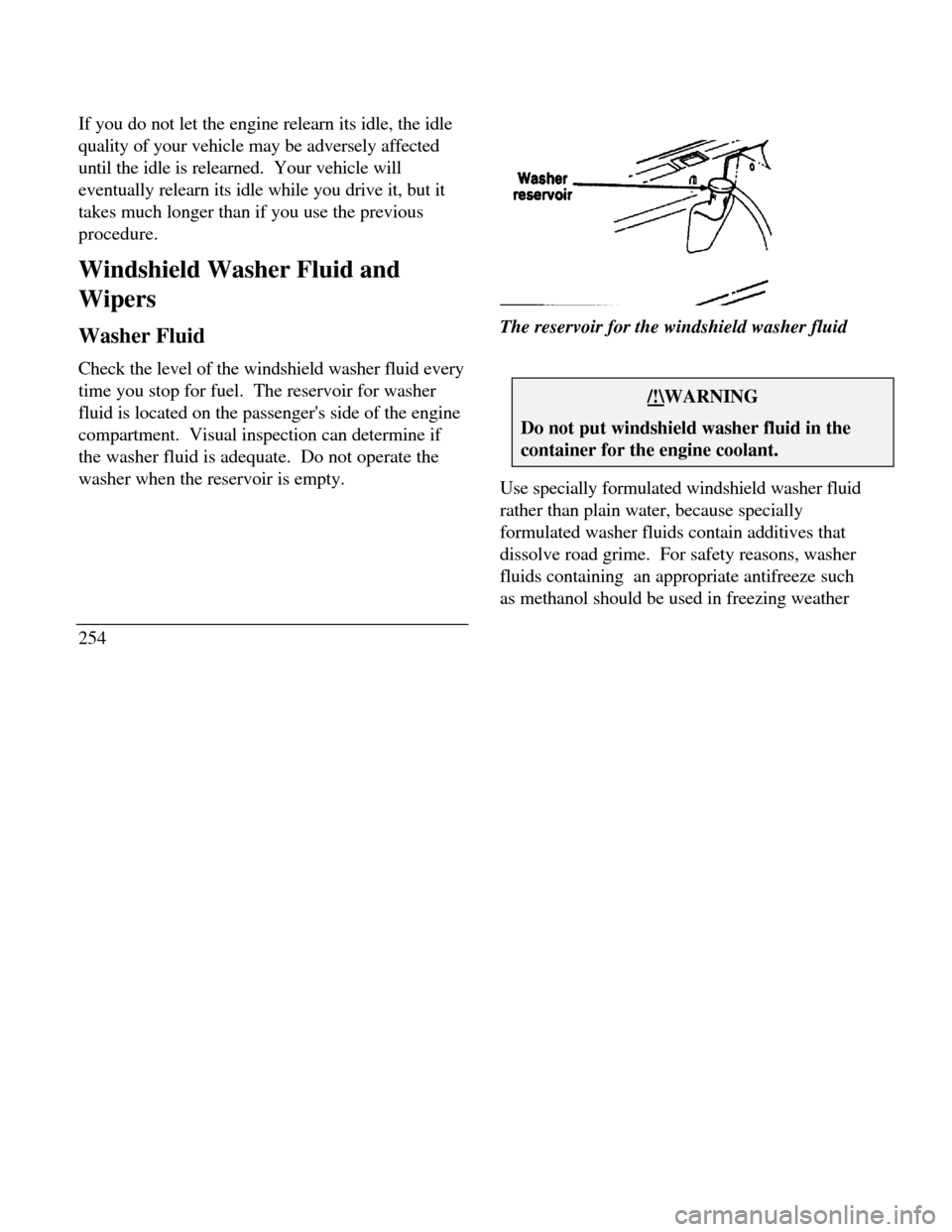
time you stop for fuel. The reservoir for washer
fluid is located on the passenger's side of the engine
compartment. Visual inspection can determine if
the washer fluid is adequate. Do not operate the
washer when the reservoir is empty.
254Washer reservoirThe reservoir for the windshield washer fluid/!\WARNINGDo not put windshield washer fluid in thecontainer for the engine coolant.Use specially formulated windshield washer fluid
rather than plain water, because specially
formulated washer fluids contain additives that
dissolve road grime. For safety reasons, washer
fluids containing an appropriate antifreeze such
as methanol should be used in freezing weather
Page 263 of 320

See Securitires in the Features chapter for more
information.
Automatic Transaxle Fluid
Under normal circumstances, you do not need to
check the fluid level of the transaxle, since your
vehicle does not use up transaxle fluid. Refer to the
Maintenance Schedule and Record booklet for
replacement intervals. However, if the transaxle is
not working properly - for instance, the transaxle
may slip or shift slowly, or you may notice some
sign of fluid leakage - the fluid level should be
checked.
NOTE: If the vehicle has been operated for an
extended period at high speeds or in city traffic
during hot weather, or pulling a trailer, the vehicle
should be turned off for about 30 minutes to allow
the fluid to cool before checking.Checking the Automatic Transaxle Fluid
With the vehicle on a level surface and the brake fully
applied, start the engine and move the gear shift
selector through all of the gears allowing sufficient
time for each position to engage. Securely latch the
gear shift selector in the P (Park) position. Fully set
the parking brake and leave the engine running.
Wipe off the dipstick cap and pull the dipstick out.
Wipe the indicator end clean. Put the dipstick back
into the filler tube and make sure it is fully seated.
Pull the dipstick out and read the fluid level.
NOTE: Your vehicle should not be driven until
some fluid has been added if the fluid level is below
the bottom dimple on the dipstick and the outside
temperature is above 50°F (10°C). Add only enough
fluid to bring the level above the bottom hole.
261
Page 265 of 320
Brake Fluid
Under normal circumstances, your vehicle should
not use up brake fluid rapidly. However, expect the
level of the brake fluid to slowly fall as you put
more mileage on your vehicle and the brake lining
wears.
You should check the brake fluid at every scheduled
engine oil change, but be sure to check it at least
once a year. You can do this by looking at the fluid
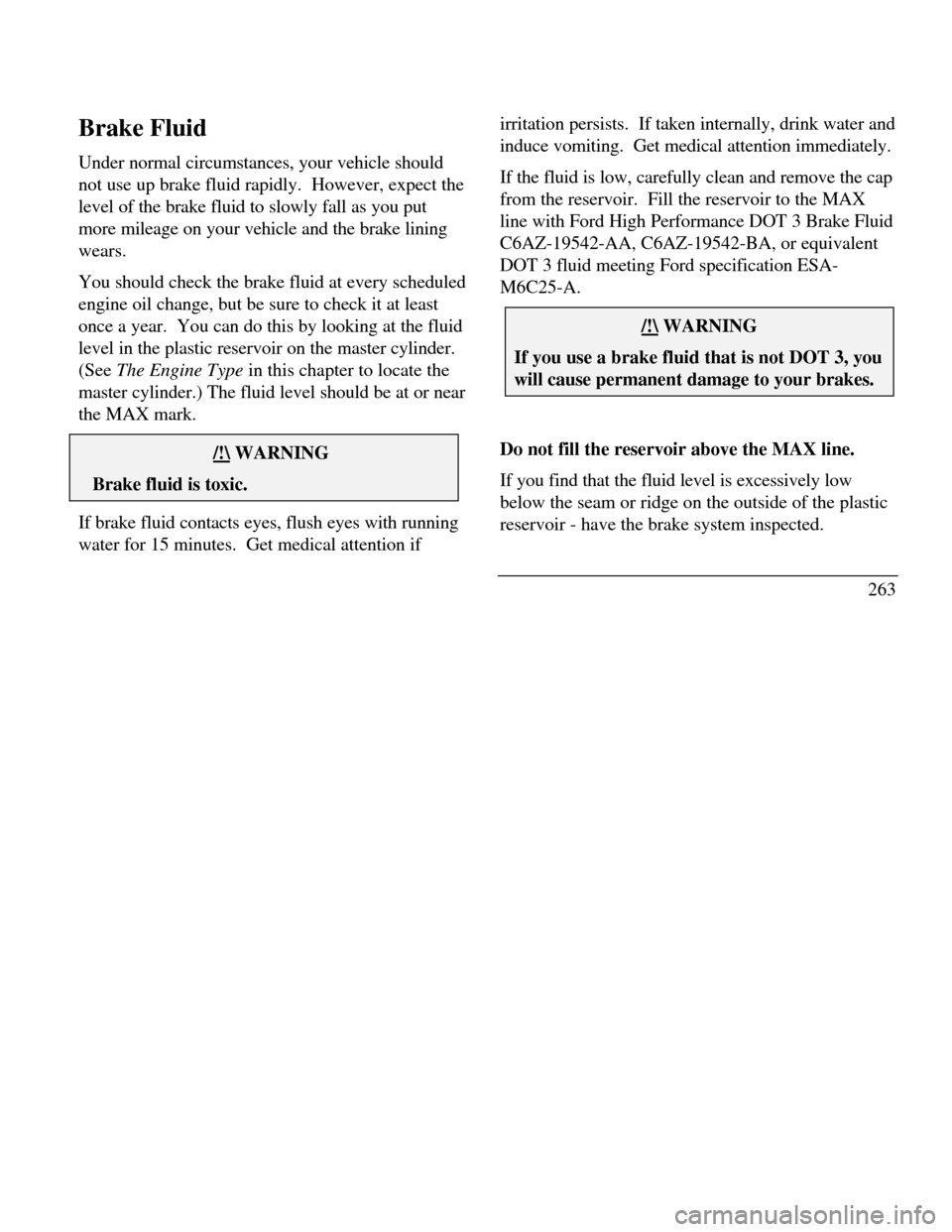
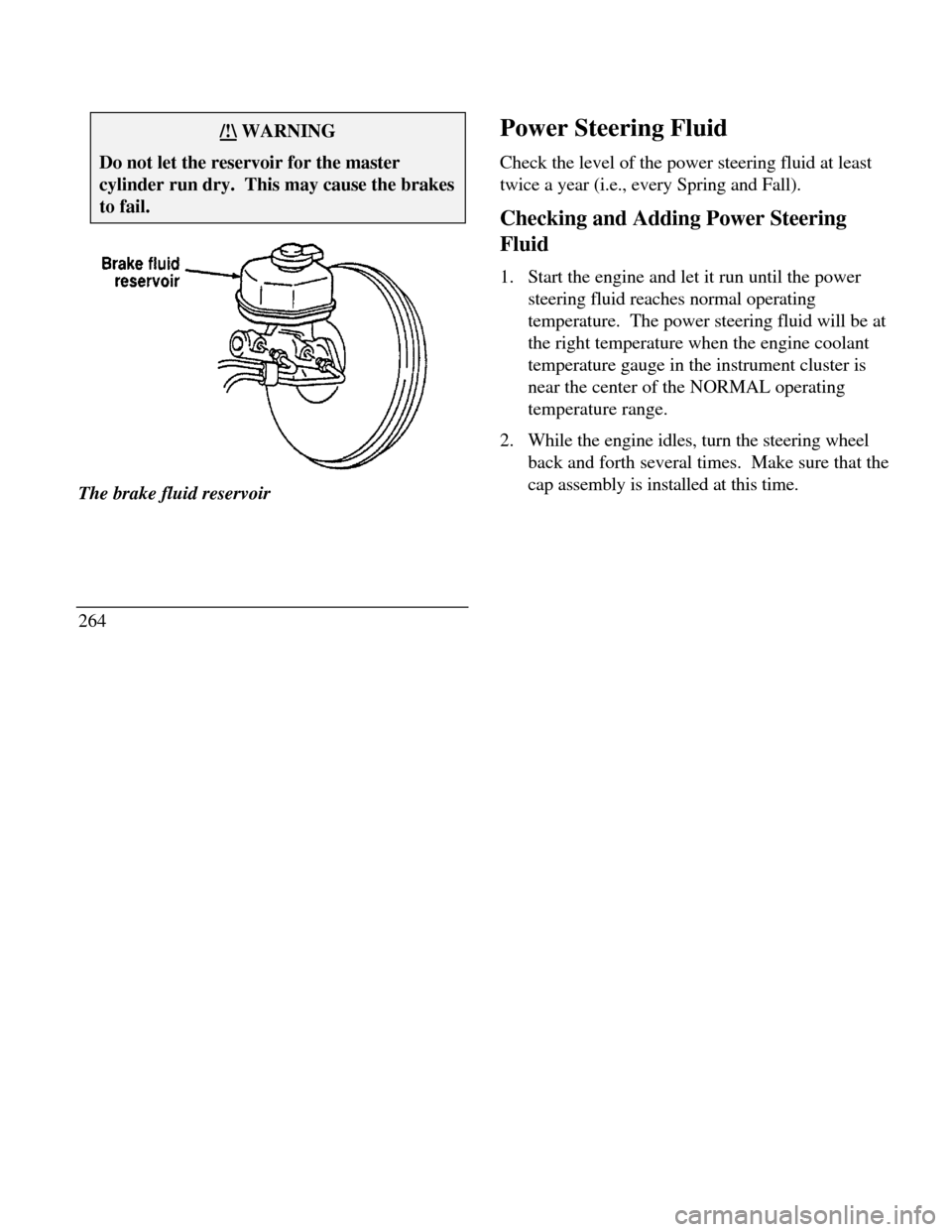
level in the plastic reservoir on the master cylinder.
(See The Engine Type in this chapter to locate the
master cylinder.) The fluid level should be at or near
the MAX mark./!\ WARNINGBrake fluid is toxic.If brake fluid contacts eyes, flush eyes with running
water for 15 minutes. Get medical attention ifirritation persists. If taken internally, drink water and
induce vomiting. Get medical attention immediately.
If the fluid is low, carefully clean and remove the cap
from the reservoir. Fill the reservoir to the MAX
line with Ford High Performance DOT 3 Brake Fluid
C6AZ-19542-AA, C6AZ-19542-BA, or equivalent
DOT 3 fluid meeting Ford specification ESA-
M6C25-A./!\ WARNINGIf you use a brake fluid that is not DOT 3, youwill cause permanent damage to your brakes.Do not fill the reservoir above the MAX line.
If you find that the fluid level is excessively low
below the seam or ridge on the outside of the plastic
reservoir - have the brake system inspected.
263
Page 266 of 320
/!\ WARNINGDo not let the reservoir for the mastercylinder run dry. This may cause the brakesto fail.The brake fluid reservoir
264Power Steering Fluid
Check the level of the power steering fluid at least
twice a year (i.e., every Spring and Fall).
Checking and Adding Power Steering
Fluid
1. Start the engine and let it run until the power
steering fluid reaches normal operating
temperature. The power steering fluid will be at
the right temperature when the engine coolant
temperature gauge in the instrument cluster is
near the center of the NORMAL operating
temperature range.
2. While the engine idles, turn the steering wheel
back and forth several times. Make sure that the
cap assembly is installed at this time.
Page 267 of 320
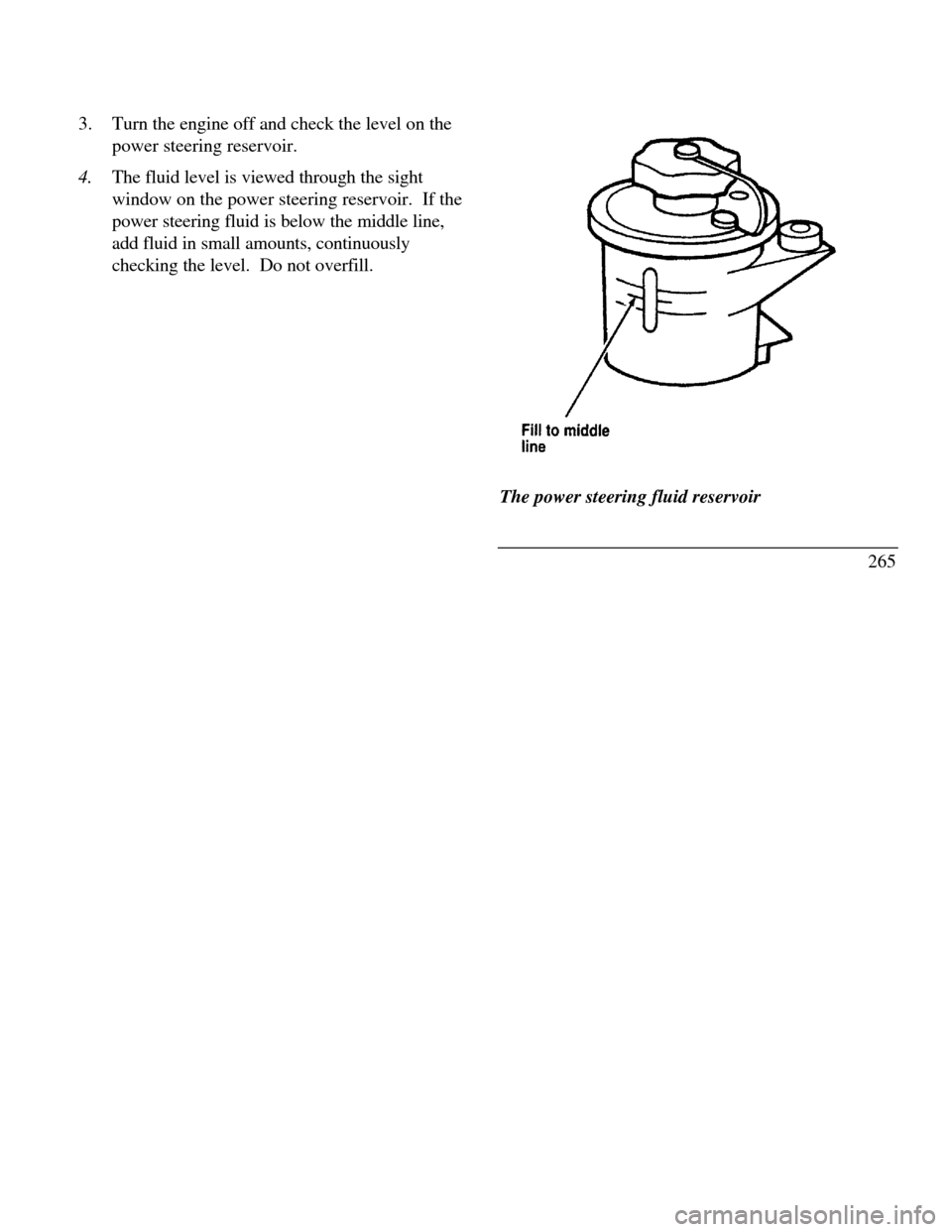
3.Turn the engine off and check the level on the
power steering reservoir.
4.The fluid level is viewed through the sight
window on the power steering reservoir. If the
power steering fluid is below the middle line,
add fluid in small amounts, continuously
checking the level. Do not overfill.The power steering fluid reservoir
265
Page 273 of 320

Fuse
LocationFuse Amp
RatingDescription2810A
· Shift interlock
· VDM logic power
· Instrument cluster logic power
· Rear defrost control2910A
· Luxury RCU station signal
· Navigation module signal3010A
· Heated mirror right
· Heated mirror left3115A
· Voltage dimming for FCU
and stand alone clock
· Courtesy lamps in the doors
Rear reading lamps
· Map lamps
· RH & LH I/P courtesy lamps
· Engine compartment lamp
· Visor lamps
· Storage bin lamp (5 passenger
only)
· Luggage compartment lamp
· Glove box lamp3215A
· Speed control brake deact
switch
· Stop lamp switchFuse
LocationFuse Amp
RatingDescription33(Not used)3415A
· Back-up L & R lamp ext.
· DRL module (Canada only)
· EATC clutch
· Speed control logic
· IMRC3520A
· L & R heated seat module power36(Not used)37(Not used)3810A
· OBD 11 scan tool connection3910A
· DSM logic power
· DDM logic power
· Door lock switches
· Keyless keypad switch
· Memory set switch
· Driver seat switch
· Power mirror switch4010A
· Blend door actuator
· LTPS4120A
· Door locks (DDM)271
Page 274 of 320
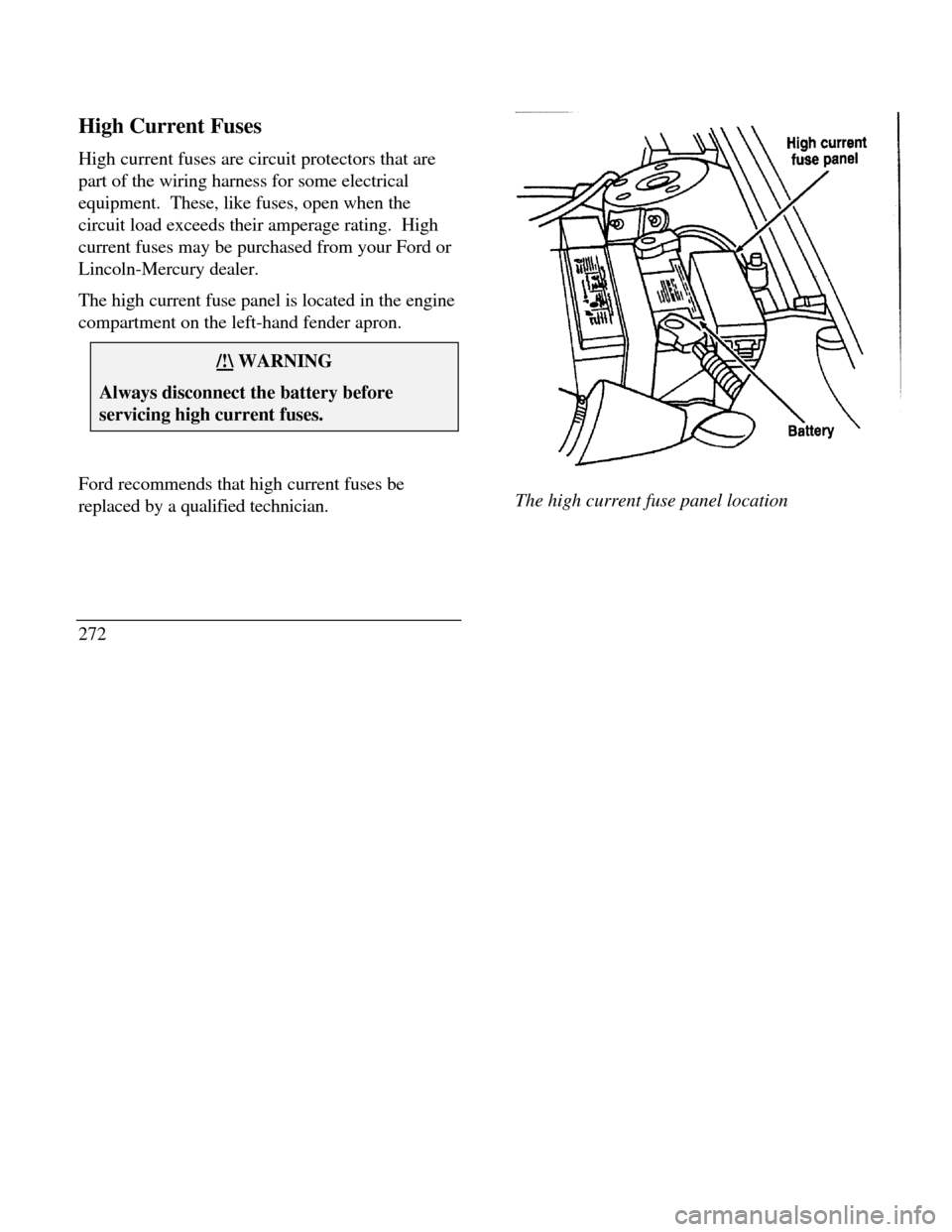
High Current Fuses
High current fuses are circuit protectors that are
part of the wiring harness for some electrical
equipment. These, like fuses, open when the
circuit load exceeds their amperage rating. High
current fuses may be purchased from your Ford or
Lincoln-Mercury dealer.
The high current fuse panel is located in the engine
compartment on the left-hand fender apron./!\ WARNINGAlways disconnect the battery beforeservicing high current fuses.Ford recommends that high current fuses be
replaced by a qualified technician.
272The high current fuse panel location
Page 276 of 320

Fuse
LocationMaxi-Fuse
Amp
RatingDescriptionFuse
LocationMaxi-Fuse
Amp RatingDescription1
2
340A
60A
60A· EATC blower motor
· Engine cooling fans
· Air suspension compressor relay1330A
· DSM
· Heated seats
· Driver 4-way power
lumbar seats460A
· ABS module
· EVAC and fill14 30A
· Passenger power seat
· Passenger 4-way power560A
· Fuse panel to LCM
· OBD 111530A
· Luxury radio
· Sub woofer amplifier
· CD player660A
· Fuse panel to LCM CD player1620A
· HI beam730A
· VDM1720A
· Horn840A
· Heated mirrors
· Heated backlight1810A
· Air bags940A
· DDM
· LH power windows
· Door locks19Not used1040A
· RH power windows2010A
· PCM KAPWR1140A
· Ignition switch to fuse panel2110A
· Alternator sensor
· Alternator field supply1240A
· Ignition switch to fuse panel
274
Page 286 of 320
Emission Control System
Your vehicle is equipped with three (3) catalytic
converters which are used to enable your vehicle to
comply with applicable exhaust emissions
requirements./!\ WARNINGExhaust leaks may result in the entry ofharmful and potentially lethal fumes into thepassenger compartment. Under extremeconditions excessive exhaust temperaturescould damage the fuel system, the interiorfloor covering, or other vehicle components,possibly causing a fire.To make sure that the catalytic converters and the
other emissions control parts continue to work
properly: Use only premium unleaded fuel.
284 Avoid running out of fuel. Do not turn off the ignition while your vehicle is
moving, especially at high speeds. Do not push start your vehicle. Have the services listed in the Maintenance
Schedule and Record booklet performed according
to the specified schedule. The scheduled
maintenance services are required because they are
considered essential to the life and performance of
your vehicle and to its emissions system.
In general, maintenance, replacement, or service of
the emissions control devices or systems in your new
Ford Motor Company vehicle or engine may be
performed at your expense by any automotive repair
establishment or individual using automotive parts
equivalent to those which your vehicle or engine was
originally equipped.