ECU LINCOLN CONTINENTAL 1997 Owner's Manual
[x] Cancel search | Manufacturer: LINCOLN, Model Year: 1997, Model line: CONTINENTAL, Model: LINCOLN CONTINENTAL 1997Pages: 321, PDF Size: 2.37 MB
Page 161 of 321
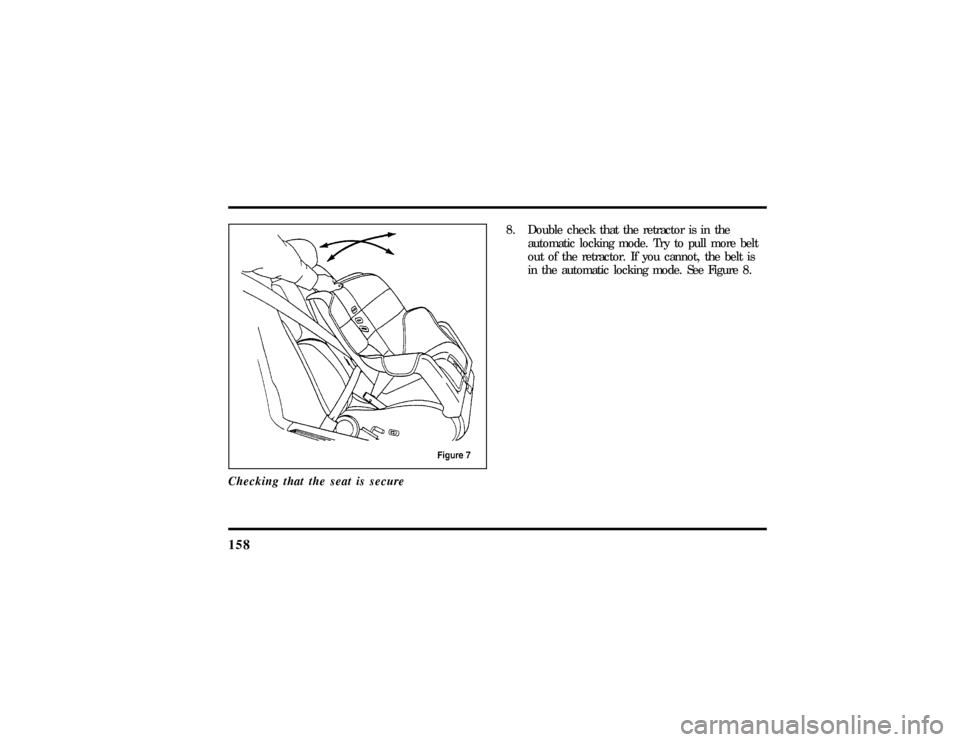
158Checking that the seat is secure
8. Double check that the retractor is in the
automatic locking mode. Try to pull more belt
out of the retractor. If you cannot, the belt is
in the automatic locking mode. See Figure 8.
File:06fnssc.ex
Update:Mon Jun 17 14:19:23 1996
Page 162 of 321
159
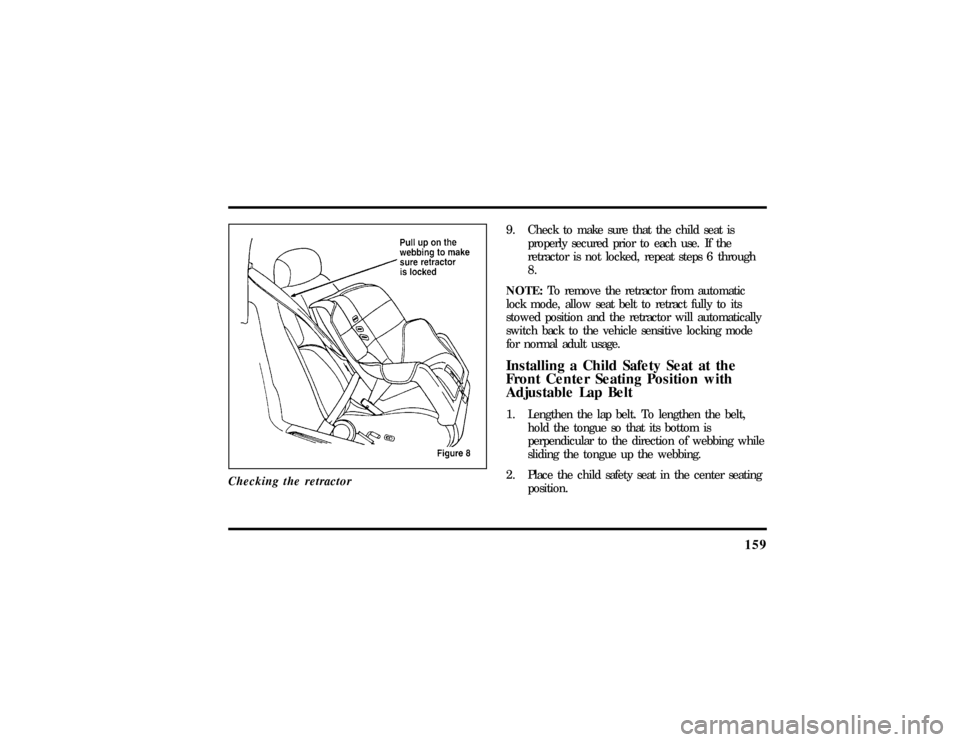
Checking the retractor
9. Check to make sure that the child seat is
properly secured prior to each use. If the
retractor is not locked, repeat steps 6 through
8.
NOTE:To remove the retractor from automatic
lock mode, allow seat belt to retract fully to its
stowed position and the retractor will automatically
switch back to the vehicle sensitive locking mode
for normal adult usage.Installing a Child Safety Seat at the
Front Center Seating Position with
Adjustable Lap Belt1. Lengthen the lap belt. To lengthen the belt,
hold the tongue so that its bottom is
perpendicular to the direction of webbing while
sliding the tongue up the webbing.
2. Place the child safety seat in the center seating
position.
File:06fnssc.ex
Update:Mon Jun 17 14:19:23 1996
Page 181 of 321
179
WARNING
DO NO TDRIV EYOU RVEHICLE
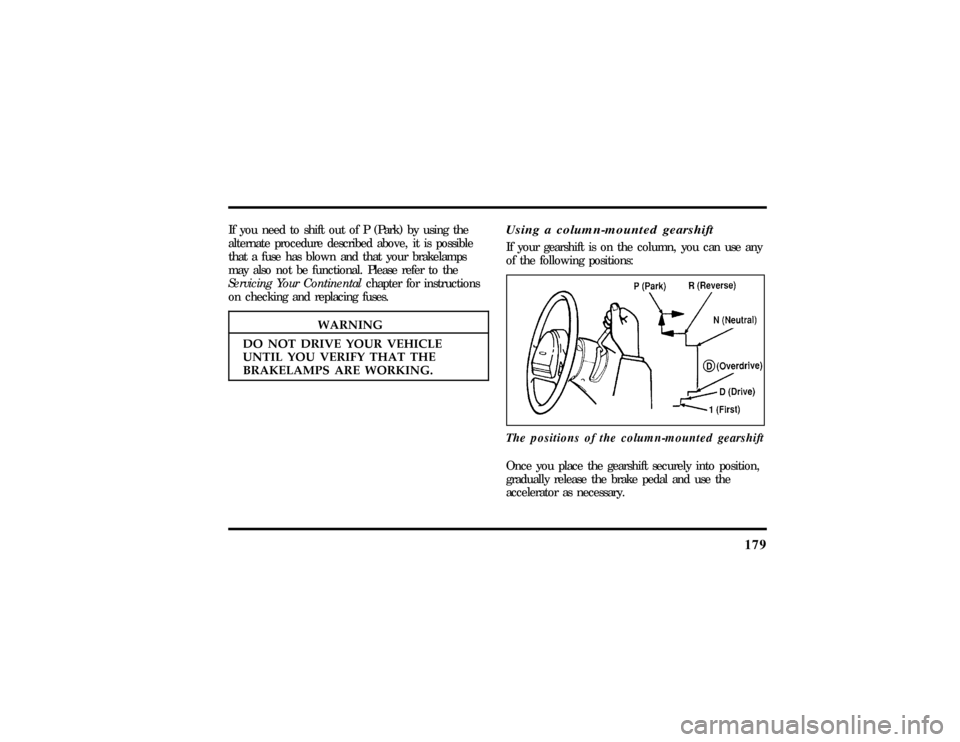
Onc eyo uplac ethe gearshif tsecurel yint oposition,
Page 183 of 321

181
The console-mounted gearshift thumb button and
brake pedal must be depressed to move the
gearshift lever out of P (Park). The thumb button
pops out automatically when the gearshift latches
into position. Once the gearshift is secure, gradually
release the brake pedal and use the accelerator as
necessary.Gear Selection (Column- and
Console-Mounted Control)R (Reverse)With the gearshift in the R (Reverse) position, the
vehicle will move backward. You should always
come to a complete stop before shifting into or out
of R (Reverse).N (Neutral)With the gearshift in the N (Neutral) position, the
vehicle can be started and is free to roll. Hold the
brake pedal down while in this position.
DrivingWhen to usej(Overdrive)j(Overdrive) is the usual driving position for an
automatic overdrive transaxle. It works the same
way D (Drive) works, automatically upshifting or
downshifting as the vehicle speeds or slows.
However,j(Overdrive) also shifts into a fourth
gear Ð an overdrive gear Ð when your vehicle
cruises at a consistent speed for any length of time.
This fourth gear will increase your fuel economy
when you travel at cruising speeds.
j(Overdrive) may not be appropriate for certain
terrain. If the transaxle shifts back and forth
between third and fourth gears while you are
driving on hilly roads or if your vehicle requires
additional power for climbing hills, shift to D
(Drive).
File:09fngfc.ex
Update:Fri Sep 6 08:48:49 1996
Page 184 of 321

182When to use D (Drive)D (Drive) eliminates the excessive shifting between
third and fourth gears that your vehicle sometimes
does when you are traveling through hilly terrain in
jOverdrive. It also gives more engine braking to
slow your vehicle on downgrades thanj
Overdrive.When to use 1 (First)Use 1 (First) when added engine braking is desired
when descending steep hills.
The automatic transaxle will shift to the proper gear
to ascend any grade without any need to shift to 1
(First).
P (Park)Always come to a complete stop before you shift
into P (Park). Make sure that the gearshift is
securely latched in P (Park). This locks the transaxle
and prevents the front wheels from rotating.
Always set the parking brake fully and make sure
the gearshift is latched in P (Park). Turn off the
ignition whenever you leave your vehicle.
You can tell a column-mounted gearshift is securely
latched in P (Park) if the lever is adjacent to the P
(Park) and you cannot move it without pulling it
toward you and rotating it downward.
You can tell a console-mounted gearshift is securely
latched in P (Park) if the lever is adjacent to the P
(Park) and you cannot move it without pushing in
the thumb button.
File:09fngfc.ex
Update:Fri Sep 6 08:48:49 1996
Page 211 of 321
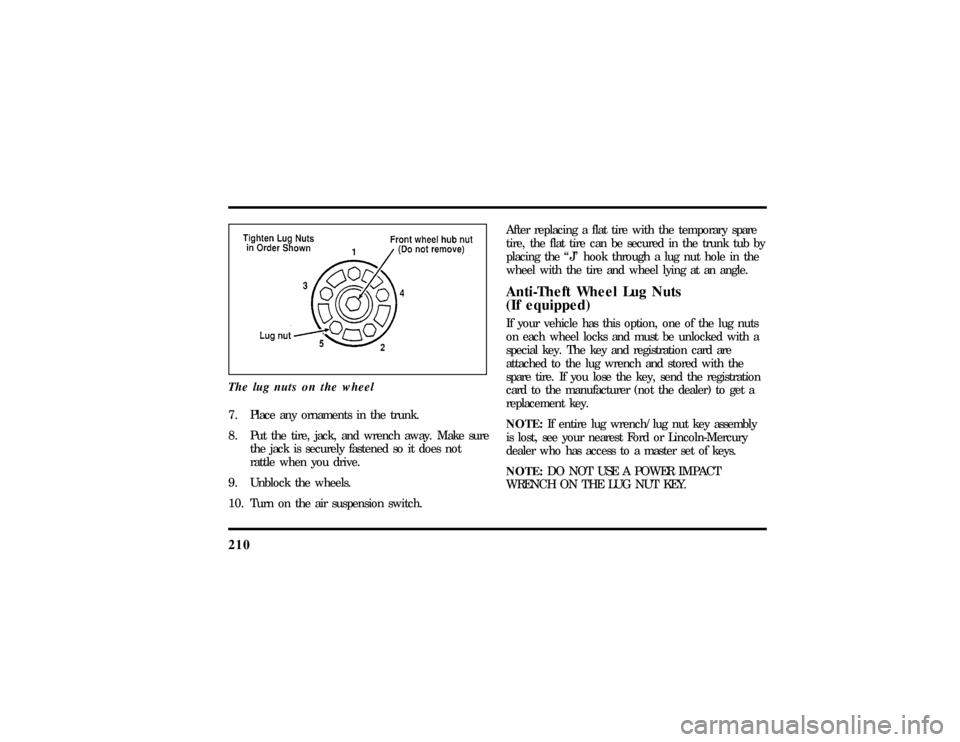
210The lug nuts on the wheel7. Place any ornaments in the trunk.
8. Put the tire, jack, and wrench away. Make sure
the jack is securely fastened so it does not
rattle when you drive.
9. Unblock the wheels.
10. Turn on the air suspension switch.After replacing a flat tire with the temporary spare
tire, the flat tire can be secured in the trunk tub by
placing the ªJº hook through a lug nut hole in the
wheel with the tire and wheel lying at an angle.
Anti-Theft Wheel Lug Nuts
(If equipped)If your vehicle has this option, one of the lug nuts
on each wheel locks and must be unlocked with a
special key. The key and registration card are
attached to the lug wrench and stored with the
spare tire. If you lose the key, send the registration
card to the manufacturer (not the dealer) to get a
replacement key.
NOTE:If entire lug wrench/lug nut key assembly
is lost, see your nearest Ford or Lincoln-Mercury
dealer who has access to a master set of keys.
NOTE:DO NOT USE A POWER IMPACT
WRENCH ON THE LUG NUT KEY.
File:10fnerc.ex
Update:Fri Sep 6 08:49:57 1996
Page 220 of 321

219
Maintenance and CareService Made EasyFord has two goals for servicing your vehicle.
1. When we can, we design parts that do not
need to be serviced.
2. We want to make servicing your vehicle as
easy as possible. To help you:q
We highlight do-it-yourself items in yellow in
the engine compartment so that you can find
them easily.
q
When possible, we design parts that can be
replaced without tools.
q
We give you a Maintenance Schedule that
makes tracking routine service for your vehicle
easy. The maintenance schedule is located in
theMaintenance Schedulebooklet.This chapter tells you about the basic parts that you
need to check and service regularly.
If your vehicle needs professional servicing, your
dealership can provide the parts and service
required. Check yourWarranty Information Booklet
to find out which parts and services are covered.
Also see theCustomer Assistancechapter of this
Owner Guide.
Ford Motor Company recommends that the Owner
Maintenance Checks listed in theMaintenance
Schedulebooklet be performed for the proper
operation of your vehicle. In addition to the
conditions listed in theOwner Maintenance
Checklist, be alert for any unusual noise, vibration,
or other indication that your vehicle may need
service. If you do notice something unusual, see
that your vehicle is serviced promptly.
File:11fnmcc.ex
Update:Fri Sep 6 08:51:16 1996
Page 225 of 321
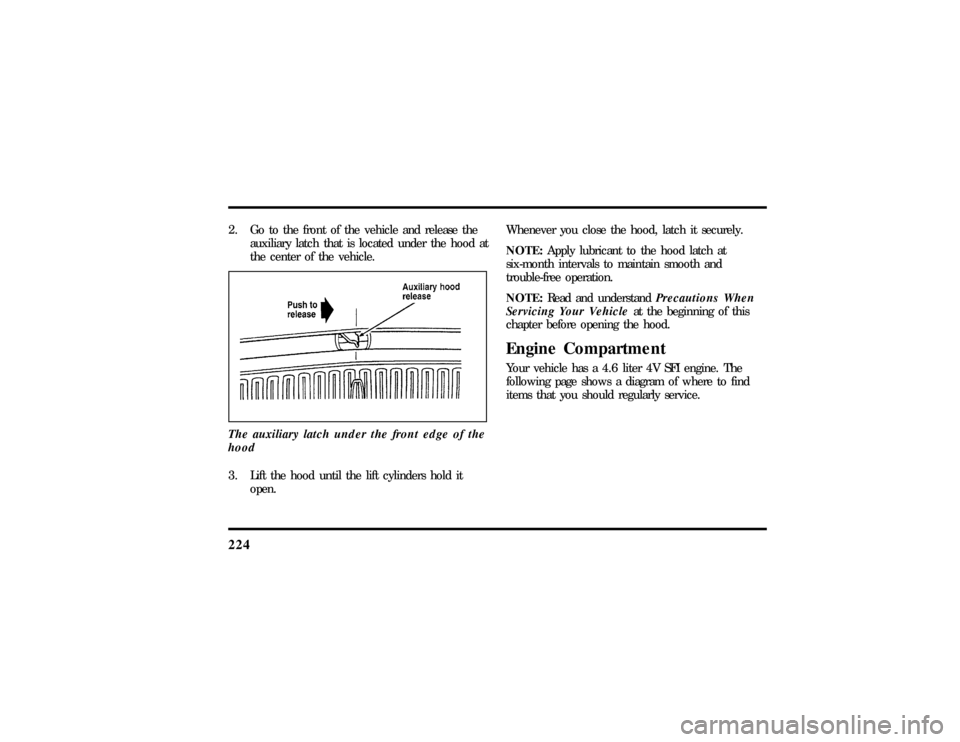
2242. Go to the front of the vehicle and release the
auxiliary latch that is located under the hood at
the center of the vehicle.
The auxiliary latch under the front edge of the
hood3. Lift the hood until the lift cylinders hold it
open.Whenever you close the hood, latch it securely.
NOTE:Apply lubricant to the hood latch at
six-month intervals to maintain smooth and
trouble-free operation.
NOTE:Read and understandPrecautions When
Servicing Your Vehicleat the beginning of this
chapter before opening the hood.
Engine CompartmentYour vehicle has a 4.6 liter 4V SFI engine. The
following page shows a diagram of where to find
items that you should regularly service.
File:11fnmcc.ex
Update:Fri Sep 6 08:51:16 1996
Page 228 of 321
227
Checking and Adding Engine OilSince the proper amount of engine oil is important
for safe engine operation, check the oil using the
dipstick each time you put fuel in your vehicle.
Remember the engine must be off, the oil must be
warm and the vehicle must be parked on level
ground.
Checking the engine oil level:
1. Turn the engine off after it has warmed up and
allow a few minutes for the engine oil to drain
back into the oil pan.
2. Set the parking brake, making sure the gearshift
is securely latched in P (Park).
3. Open the hood. Protect yourself from engine
heat.
4. Locate the engine oil dipstick (highlighted in
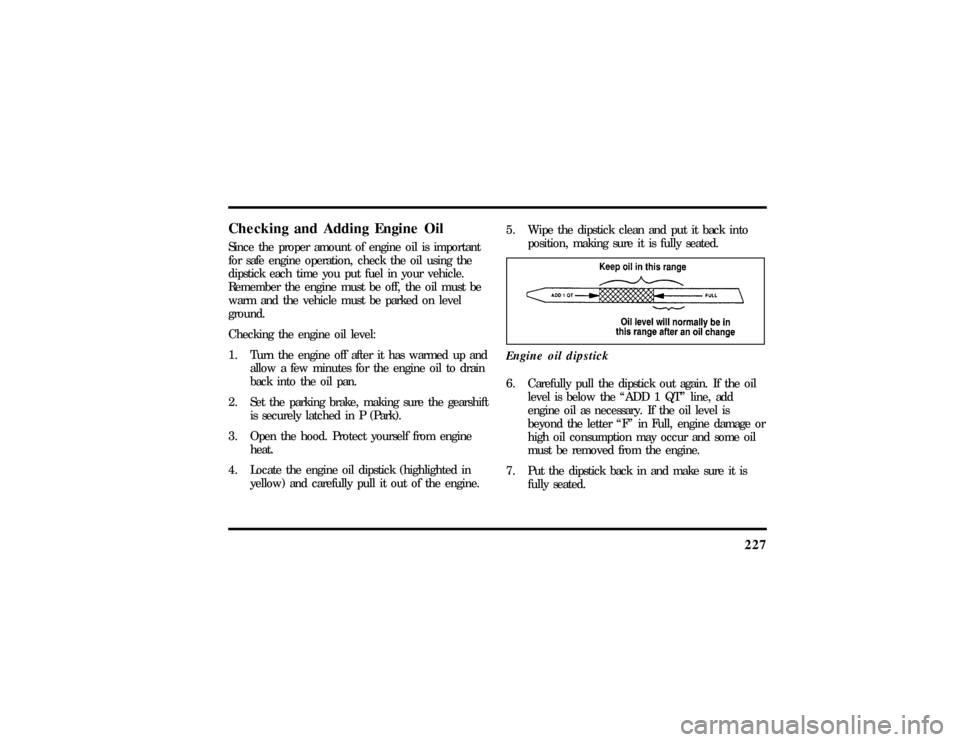
yellow) and carefully pull it out of the engine.5. Wipe the dipstick clean and put it back into
position, making sure it is fully seated.
Engine oil dipstick
6. Carefully pull the dipstick out again. If the oil
level is below the ªADD 1 QTº line, add
engine oil as necessary. If the oil level is
beyond the letter ªFº in Full, engine damage or
high oil consumption may occur and some oil
must be removed from the engine.
7. Put the dipstick back in and make sure it is
fully seated.
File:11fnmcc.ex
Update:Fri Sep 6 08:51:16 1996
Page 240 of 321

239
Checking the Automatic Transaxle
FluidWith the vehicle on a level surface and the brake
fully applied, start the engine and move the gear
shift selector through all of the gears allowing
sufficient time for each position to engage. Securely
latch the gear shift selector in the P (Park) position.
Fully set the parking brake and leave the engine
running.
Wipe off the dipstick cap and pull the dipstick out.
Wipe the indicator end clean. Put the dipstick back
into the filler tube and make sure it is fully seated.
Pull the dipstick out and read the fluid level.
NOTE:Your vehicle should not be driven until
some fluid has been added if the fluid level is
below the bottom dimple on the dipstick and the
outside temperature is above50ÊF(10ÊC). Addonly
enough fluid to bring the level above the bottom
hole.If the vehicle has not been driven and the fluid
level is above the bottom dimple on the dipstick, do
not add fluid. Recheck the fluid level after your
vehicle has reached normal operating temperature.
Normal operating temperature is reached after
driving approximately 20 miles (30 km). The fluid
level should be within the crosshatched area on the
dipstick.
NOTE:If the vehicle has been operated for an
extended period at high speeds, driven in city traffic
during hot weather, or has been pulling a trailer,
the vehicle should be turned off for about 30
minutes to allow the fluid to cool before checking.
File:11fnmcc.ex
Update:Fri Sep 6 08:51:16 1996