engine LINCOLN CONTINENTAL 1997 Owner's Guide
[x] Cancel search | Manufacturer: LINCOLN, Model Year: 1997, Model line: CONTINENTAL, Model: LINCOLN CONTINENTAL 1997Pages: 321, PDF Size: 2.37 MB
Page 217 of 321

216Jump-Starting1. Make sure that the jumper cables are not in
the way of moving engine parts, then start the
booster vehicle. Run the engine at a moderate
speed.
2. Let the discharged battery charge for a few
minutes and then start the disabled vehicle. It
may take a couple of tries before the vehicle
starts. If the vehicle does not start after several
attempts, there may be a different problem.
3. When both vehicles are running, let them idle
for a few minutes to charge the discharged
battery.Removing jumper cables1.Always remove the jumper cables in the
reverse order.Remove the negative (s) end
of the jumper cable from the metallic surface
on the engine or frame of the disabled vehicle.2. Remove the negative (s) cable from the
booster battery.
3. Remove the positive (+) cable from the booster
battery.
4. Remove the other end of the positive (+) cable
from the discharged battery.
After the vehicle is started, let it idle for a while to
let the engine ªrelearnº its idle conditions. Drive it
around for a while with all electrical accessories
turned off to let the battery recharge. Driveability
may be deteriorated slightly until all drive modes
are ªrelearned.ºYou may need to use a battery
charger to fully recharge the battery.
If you need to replace your battery, seeBatteryin
theMaintenance and Carechapter.
File:10fnerc.ex
Update:Fri Sep 6 08:49:57 1996
Page 220 of 321

219
Maintenance and CareService Made EasyFord has two goals for servicing your vehicle.
1. When we can, we design parts that do not
need to be serviced.
2. We want to make servicing your vehicle as
easy as possible. To help you:q
We highlight do-it-yourself items in yellow in
the engine compartment so that you can find
them easily.
q
When possible, we design parts that can be
replaced without tools.
q
We give you a Maintenance Schedule that
makes tracking routine service for your vehicle
easy. The maintenance schedule is located in
theMaintenance Schedulebooklet.This chapter tells you about the basic parts that you
need to check and service regularly.
If your vehicle needs professional servicing, your
dealership can provide the parts and service
required. Check yourWarranty Information Booklet
to find out which parts and services are covered.
Also see theCustomer Assistancechapter of this
Owner Guide.
Ford Motor Company recommends that the Owner
Maintenance Checks listed in theMaintenance
Schedulebooklet be performed for the proper
operation of your vehicle. In addition to the
conditions listed in theOwner Maintenance
Checklist, be alert for any unusual noise, vibration,
or other indication that your vehicle may need
service. If you do notice something unusual, see
that your vehicle is serviced promptly.
File:11fnmcc.ex
Update:Fri Sep 6 08:51:16 1996
Page 225 of 321
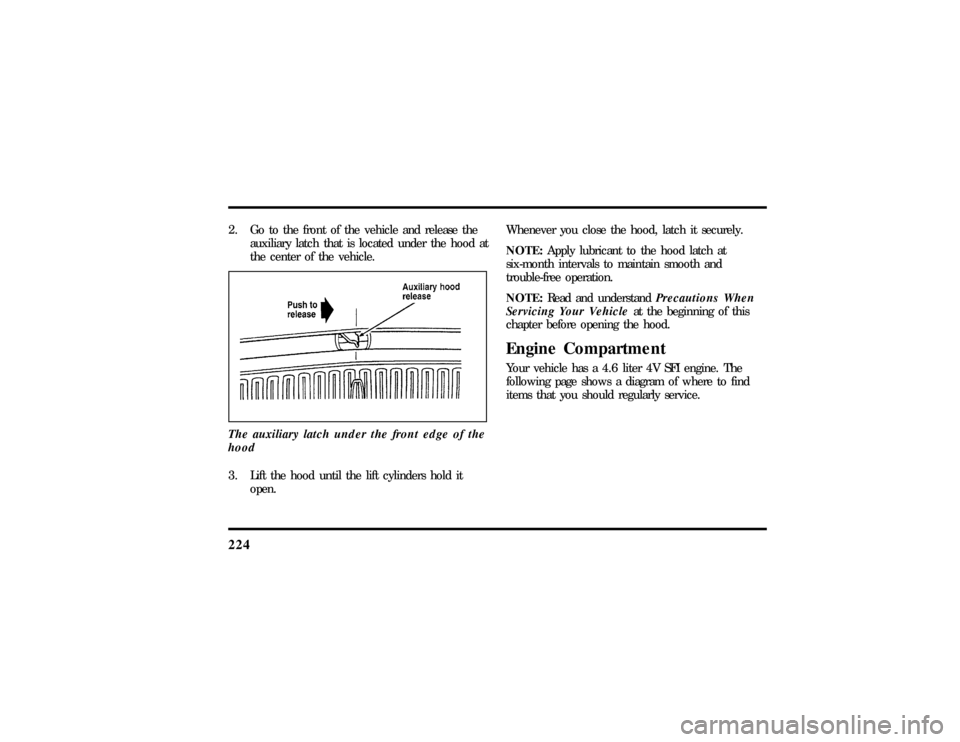
2242. Go to the front of the vehicle and release the
auxiliary latch that is located under the hood at
the center of the vehicle.
The auxiliary latch under the front edge of the
hood3. Lift the hood until the lift cylinders hold it
open.Whenever you close the hood, latch it securely.
NOTE:Apply lubricant to the hood latch at
six-month intervals to maintain smooth and
trouble-free operation.
NOTE:Read and understandPrecautions When
Servicing Your Vehicleat the beginning of this
chapter before opening the hood.
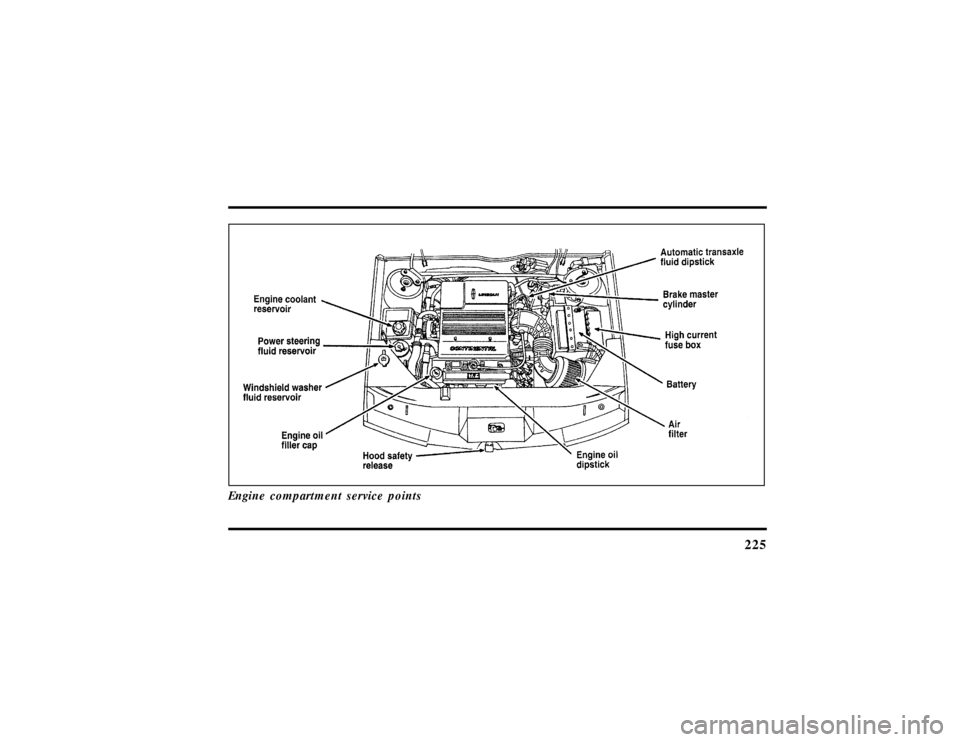
Engine CompartmentYour vehicle has a 4.6 liter 4V SFI engine. The
following page shows a diagram of where to find
items that you should regularly service.
File:11fnmcc.ex
Update:Fri Sep 6 08:51:16 1996
Page 226 of 321
225
Engine compartment service points
File:11fnmcc.ex
Update:Fri Sep 6 08:51:16 1996
Page 227 of 321
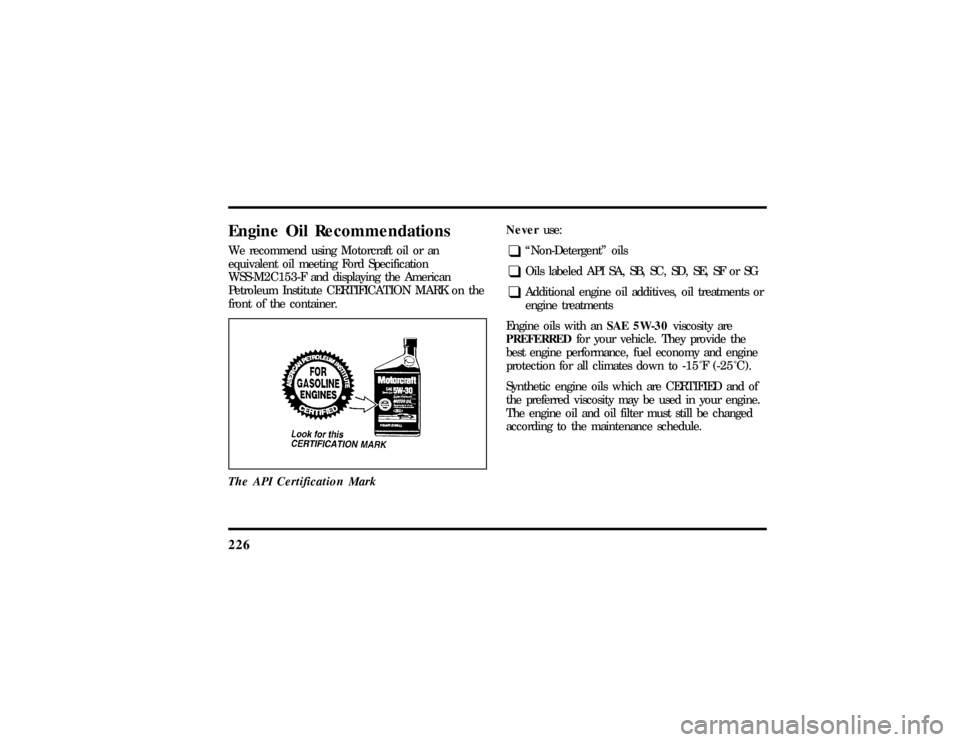
226Engine Oil RecommendationsWe recommend using Motorcraft oil or an
equivalent oil meeting Ford Specification
WSS-M2C153-F and displaying the American
Petroleum Institute CERTIFICATION MARK on the
front of the container.
The API Certification Mark
Neveruse:q
ªNon-Detergentº oils
q
Oils labeled API SA, SB, SC, SD, SE, SF or SG
q
Additional engine oil additives, oil treatments or
engine treatments
Engine oils with anSAE 5W-30viscosity are
PREFERREDfor your vehicle. They provide the
best engine performance, fuel economy and engine
protection for all climates down to-15ÊF (-25ÊC).
Synthetic engine oils which are CERTIFIED and of
the preferred viscosity may be used in your engine.
The engine oil and oil filter must still be changed
according to the maintenance schedule.
File:11fnmcc.ex
Update:Fri Sep 6 08:51:16 1996
Page 228 of 321
227
Checking and Adding Engine OilSince the proper amount of engine oil is important
for safe engine operation, check the oil using the
dipstick each time you put fuel in your vehicle.
Remember the engine must be off, the oil must be
warm and the vehicle must be parked on level
ground.
Checking the engine oil level:
1. Turn the engine off after it has warmed up and
allow a few minutes for the engine oil to drain
back into the oil pan.
2. Set the parking brake, making sure the gearshift
is securely latched in P (Park).
3. Open the hood. Protect yourself from engine
heat.
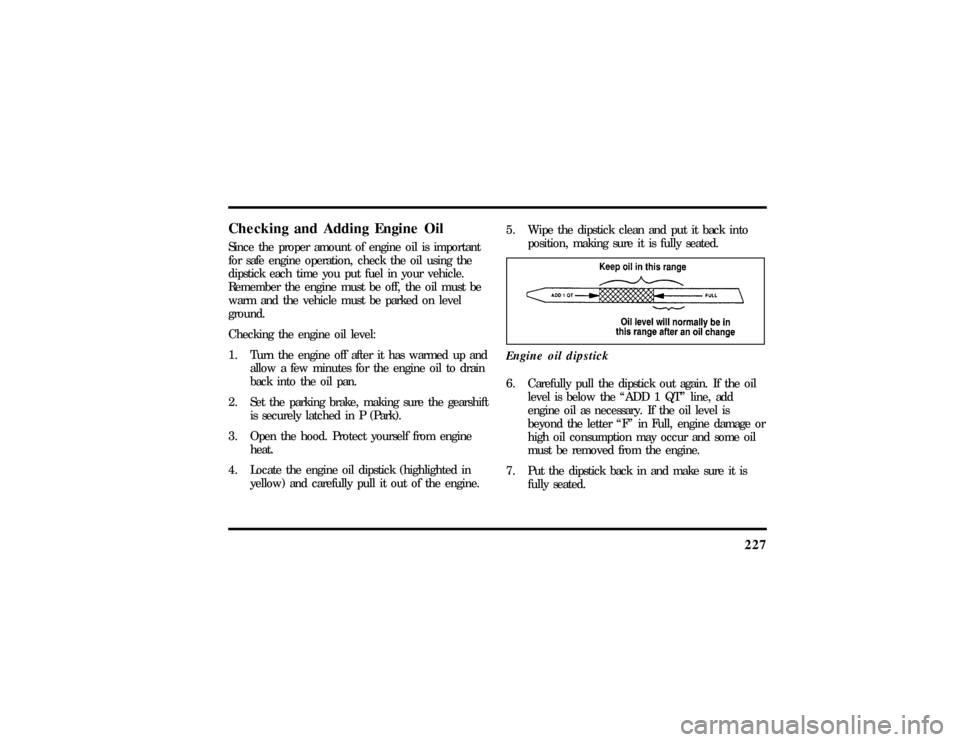
4. Locate the engine oil dipstick (highlighted in
yellow) and carefully pull it out of the engine.5. Wipe the dipstick clean and put it back into
position, making sure it is fully seated.
Engine oil dipstick
6. Carefully pull the dipstick out again. If the oil
level is below the ªADD 1 QTº line, add
engine oil as necessary. If the oil level is
beyond the letter ªFº in Full, engine damage or
high oil consumption may occur and some oil
must be removed from the engine.
7. Put the dipstick back in and make sure it is
fully seated.
File:11fnmcc.ex
Update:Fri Sep 6 08:51:16 1996
Page 229 of 321
228It may be necessary to add some oil between oil
changes. Make sure you use a CERTIFIED engine
oil of the preferred viscosity. Your vehicle's
warranty coverage may not apply if engine damage
is caused by the use of improper engine oil.
Add engine oil through the oil filler cap highlighted
in yellow. To add oil, remove the filler cap and use
a funnel to pour oil into the opening. Be careful not
to overfill the engine. Recheck the oil level after 30
minutes to allow the oil to settle.Changing the Engine Oil and the Oil
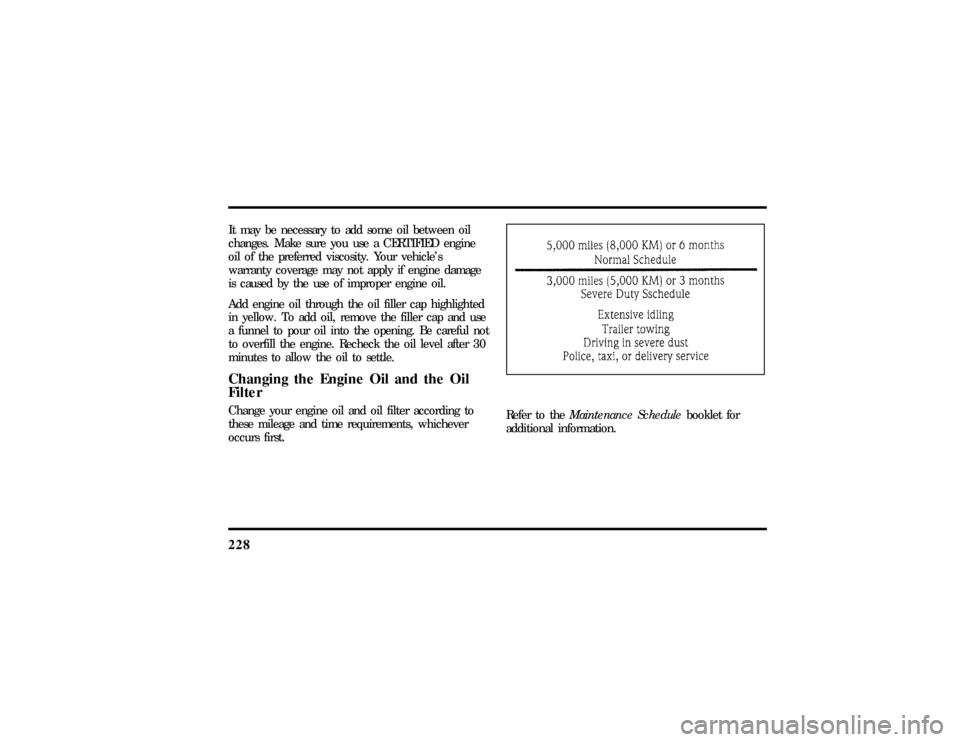
FilterChange your engine oil and oil filter according to
these mileage and time requirements, whichever
occurs first.
Refer to theMaintenance Schedulebooklet for
additional information.
File:11fnmcc.ex
Update:Fri Sep 6 08:51:16 1996
Page 235 of 321

234Do not use alcohol or methanol antifreeze or any
engine coolants mixed with alcohol or methanol
antifreeze. Do not use supplemental coolant
additives in your vehicle. These additives may harm
your engine cooling system. The use of an improper
coolant may void the warranty of your vehicle's
engine cooling system.Recycled engine coolantFord Motor Company recommends that Ford and
Lincoln-Mercury dealers use recycled engine coolant
produced by Ford-approved processes. Not all
coolant recycling processes produce coolant which
meets Ford specification ESE-M97B44-A, and use of
such coolant may harm engine and cooling system
components.
Always dispose of used automotive fluids in a
responsible manner. Follow your community's
regulations and standards for recycling and disposing
of automotive fluids.
Coolant refill capacityTo find out how much fluid your vehicle's cooling
system can hold, refer toRefill capacitiesin the
Capacities and specificationschapter.
Have your dealer check the engine cooling system
for leaks if you have to add more than a quart
(liter) of engine coolant per month.Severe winter climateIf you drive in extremely cold climates (less than
-34ÊF[-36ÊC]), it may benecessary to increase the
coolant concentration above 50%. Refer to the chart
on the coolant container to ensure the coolant
concentration in your vehicle is such that the
coolant will not freeze at the temperature level in
which you drive during winter months. Never
increase the engine coolant concentration above
60%. Leave a 50/50 mixture of engine coolant and
water in your vehicle year-round in non-extreme
climates.
File:11fnmcc.ex
Update:Fri Sep 6 08:51:16 1996
Page 236 of 321

235
Engine Coolant Refill ProcedureProper procedures for a complete coolant drain and
flush of the cooling system can be found in theCar
Service Manual.Following these recommended
procedures will ensure that the specified coolant
level and a 50/50 or appropriate mixture of coolant
and water is maintained.Engine Coolant Refill ProcedureWhen the entire cooling system is drained and
refilled, the following procedure should be used to
ensure a complete fill:
NOTE:It is imperative the following procedure be
adhered to. Failure to do so could result in damage
to your engine.q
Remove coolant reservoir pressure cap.
q
Remove the engine coolant outlet tube fill plug
on the engine.
q
With the engine off and cool, add a 50/50
mixture of recommended cooling system fluid
and water to the coolant outlet tube fill neck
until the reservoir is full.
NOTE:DO NOT FILL COOLANT SYSTEM
THROUGH COOLANT RESERVOIR. COOLANT
WILL NOT ENTER ENGINE, WHICH CAN LEAD
TO ENGINE DAMAGE.
NOTE:Avoid spilling coolant on the front end
accessory drive belt, as this will allow the belt to
slip and become noisy.
q
Reinstall the pressure cap to the coolant
reservoir.
q
Continue filling at the engine coolant tube fill
neck slowly while allowing air to escape.
q
Reinstall the engine coolant tube fill plug when
the system is full.
File:11fnmcc.ex
Update:Fri Sep 6 08:51:16 1996
Page 237 of 321

236q
Select maximum heater temperature and fan
speed settings. Position control to discharge air
at A/C vents in instrument panel.
q
Start engine and allow to idle. While engine is
idling, feel for hot air at A/C vents.
NOTE:IF AIR DISCHARGE REMAINS COOL AND
ENGINE TEMPERATURE GAUGE DOES NOT
MOVE,SHUT ENGINE OFF IMMEDIATELY.
This is an indication of low coolant level and/or air
pockets in coolant system. Allow engine to cool and
repeat the previous steps.
q
Allow to idle until normal operating temperature
is reached. Hot air should discharge from A/C
vents. The engine temperature gauge should
maintain a stabilized reading in the middle of
the ªNORMALº range and the lower radiator
hose should feel hot to the touch.
q
Shut off the engine and allow to cool down.
q
After the engine cools down, recheck the
engine coolant level. Fill reservoir to the
COLD-FULL level as required.
q
Check for leaks at the draincock, block plug
and vent plug.
q
Recheck the engine coolant level, using the
recommended procedure, after one or two
occasions of vehicle use. Fill to COLD-FULL
level as required.
File:11fnmcc.ex
Update:Fri Sep 6 08:51:16 1996