belt LINCOLN CORSAIR 2023 User Guide
[x] Cancel search | Manufacturer: LINCOLN, Model Year: 2023, Model line: CORSAIR, Model: LINCOLN CORSAIR 2023Pages: 690, PDF Size: 15.04 MB
Page 52 of 690
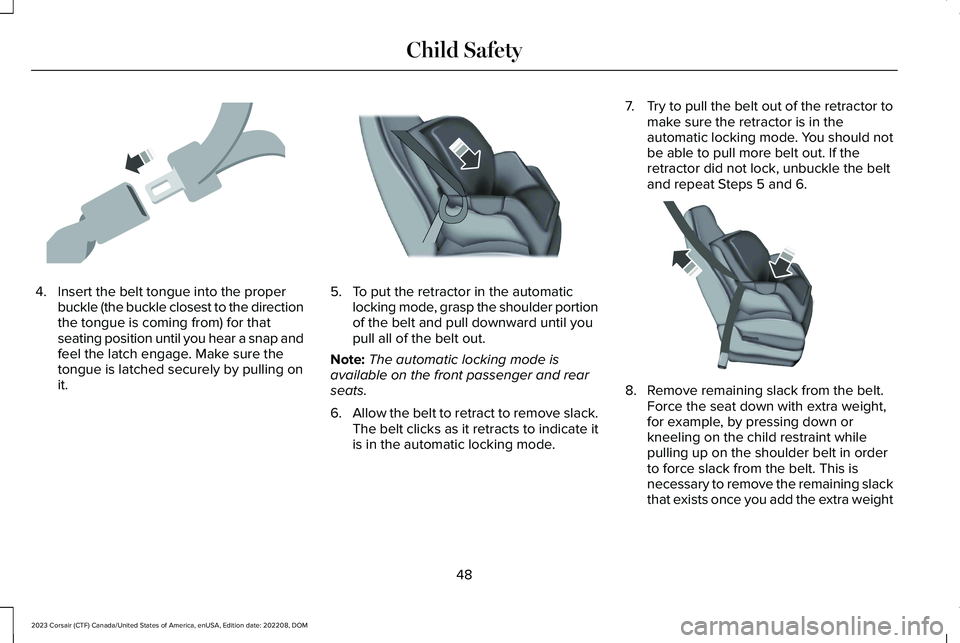
4.Insert the belt tongue into the properbuckle (the buckle closest to the directionthe tongue is coming from) for thatseating position until you hear a snap andfeel the latch engage. Make sure thetongue is latched securely by pulling onit.
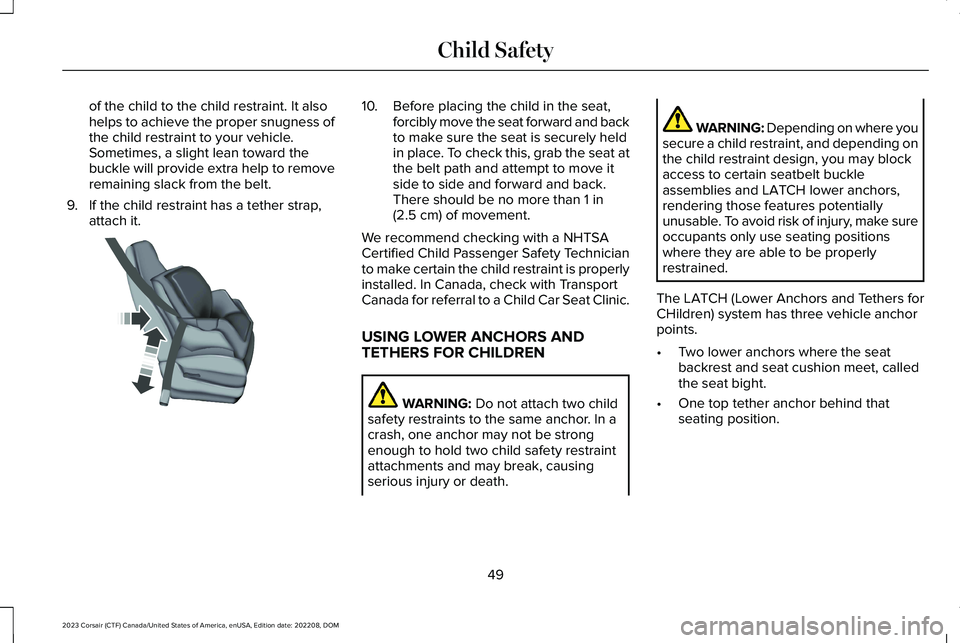
5.To put the retractor in the automaticlocking mode, grasp the shoulder portionof the belt and pull downward until youpull all of the belt out.
Note:The automatic locking mode isavailable on the front passenger and rearseats.
6.Allow the belt to retract to remove slack.The belt clicks as it retracts to indicate itis in the automatic locking mode.
7.Try to pull the belt out of the retractor tomake sure the retractor is in theautomatic locking mode. You should notbe able to pull more belt out. If theretractor did not lock, unbuckle the beltand repeat Steps 5 and 6.
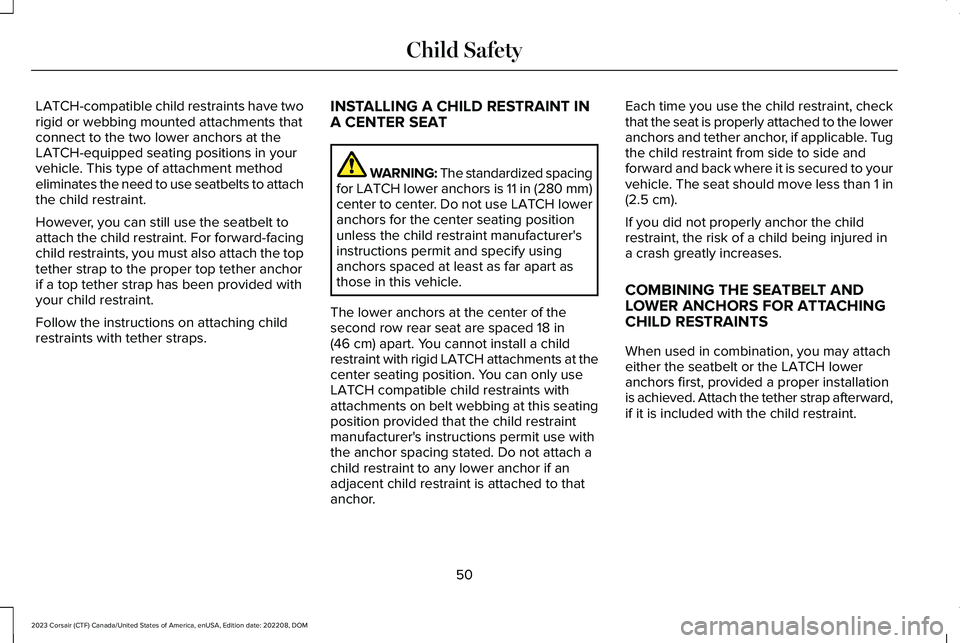
8.Remove remaining slack from the belt.Force the seat down with extra weight,for example, by pressing down orkneeling on the child restraint whilepulling up on the shoulder belt in orderto force slack from the belt. This isnecessary to remove the remaining slackthat exists once you add the extra weight
48
2023 Corsair (CTF) Canada/United States of America, enUSA, Edition date: 202208, DOMChild SafetyE142531 E142875 E142533
Page 53 of 690
of the child to the child restraint. It alsohelps to achieve the proper snugness ofthe child restraint to your vehicle.Sometimes, a slight lean toward thebuckle will provide extra help to removeremaining slack from the belt.
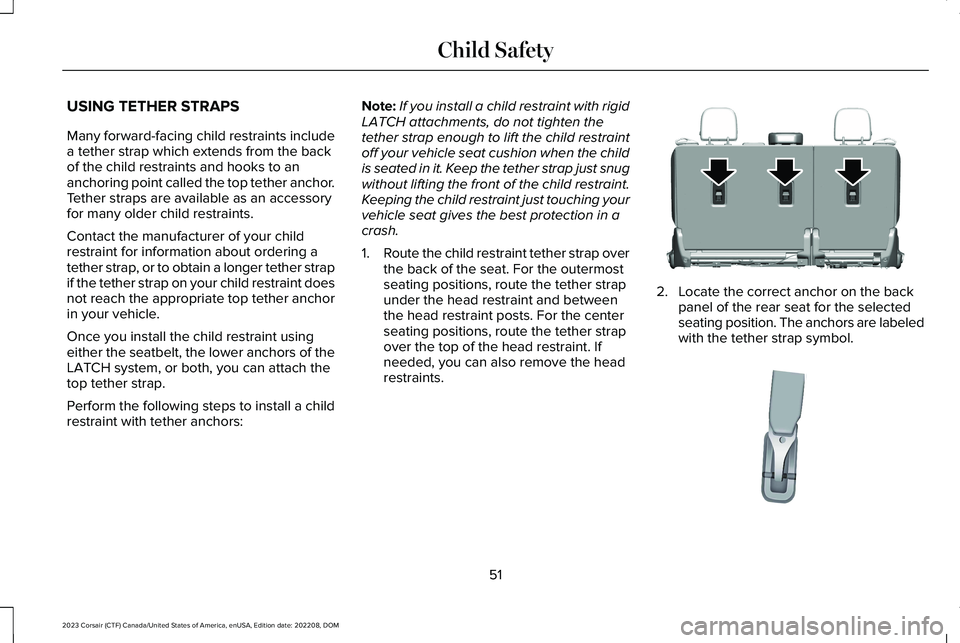
9.If the child restraint has a tether strap,attach it.
10.Before placing the child in the seat,forcibly move the seat forward and backto make sure the seat is securely heldin place. To check this, grab the seat atthe belt path and attempt to move itside to side and forward and back.There should be no more than 1 in(2.5 cm) of movement.
We recommend checking with a NHTSACertified Child Passenger Safety Technicianto make certain the child restraint is properlyinstalled. In Canada, check with TransportCanada for referral to a Child Car Seat Clinic.
USING LOWER ANCHORS ANDTETHERS FOR CHILDREN
WARNING: Do not attach two childsafety restraints to the same anchor. In acrash, one anchor may not be strongenough to hold two child safety restraintattachments and may break, causingserious injury or death.
WARNING: Depending on where yousecure a child restraint, and depending onthe child restraint design, you may blockaccess to certain seatbelt buckleassemblies and LATCH lower anchors,rendering those features potentiallyunusable. To avoid risk of injury, make sureoccupants only use seating positionswhere they are able to be properlyrestrained.
The LATCH (Lower Anchors and Tethers forCHildren) system has three vehicle anchorpoints.
•Two lower anchors where the seatbackrest and seat cushion meet, calledthe seat bight.
•One top tether anchor behind thatseating position.
49
2023 Corsair (CTF) Canada/United States of America, enUSA, Edition date: 202208, DOMChild SafetyE142534
Page 54 of 690
LATCH-compatible child restraints have tworigid or webbing mounted attachments thatconnect to the two lower anchors at theLATCH-equipped seating positions in yourvehicle. This type of attachment methodeliminates the need to use seatbelts to attachthe child restraint.
However, you can still use the seatbelt toattach the child restraint. For forward-facingchild restraints, you must also attach the toptether strap to the proper top tether anchorif a top tether strap has been provided withyour child restraint.
Follow the instructions on attaching childrestraints with tether straps.
INSTALLING A CHILD RESTRAINT INA CENTER SEAT
WARNING: The standardized spacingfor LATCH lower anchors is 11 in (280 mm)center to center. Do not use LATCH loweranchors for the center seating positionunless the child restraint manufacturer'sinstructions permit and specify usinganchors spaced at least as far apart asthose in this vehicle.
The lower anchors at the center of thesecond row rear seat are spaced 18 in(46 cm) apart. You cannot install a childrestraint with rigid LATCH attachments at thecenter seating position. You can only useLATCH compatible child restraints withattachments on belt webbing at this seatingposition provided that the child restraintmanufacturer's instructions permit use withthe anchor spacing stated. Do not attach achild restraint to any lower anchor if anadjacent child restraint is attached to thatanchor.
Each time you use the child restraint, checkthat the seat is properly attached to the loweranchors and tether anchor, if applicable. Tugthe child restraint from side to side andforward and back where it is secured to yourvehicle. The seat should move less than 1 in(2.5 cm).
If you did not properly anchor the childrestraint, the risk of a child being injured ina crash greatly increases.
COMBINING THE SEATBELT ANDLOWER ANCHORS FOR ATTACHINGCHILD RESTRAINTS
When used in combination, you may attacheither the seatbelt or the LATCH loweranchors first, provided a proper installationis achieved. Attach the tether strap afterward,if it is included with the child restraint.
50
2023 Corsair (CTF) Canada/United States of America, enUSA, Edition date: 202208, DOMChild Safety
Page 55 of 690
USING TETHER STRAPS
Many forward-facing child restraints includea tether strap which extends from the backof the child restraints and hooks to ananchoring point called the top tether anchor.Tether straps are available as an accessoryfor many older child restraints.
Contact the manufacturer of your childrestraint for information about ordering atether strap, or to obtain a longer tether strapif the tether strap on your child restraint doesnot reach the appropriate top tether anchorin your vehicle.
Once you install the child restraint usingeither the seatbelt, the lower anchors of theLATCH system, or both, you can attach thetop tether strap.
Perform the following steps to install a childrestraint with tether anchors:
Note:If you install a child restraint with rigidLATCH attachments, do not tighten thetether strap enough to lift the child restraintoff your vehicle seat cushion when the childis seated in it. Keep the tether strap just snugwithout lifting the front of the child restraint.Keeping the child restraint just touching yourvehicle seat gives the best protection in acrash.
1.Route the child restraint tether strap overthe back of the seat. For the outermostseating positions, route the tether strapunder the head restraint and betweenthe head restraint posts. For the centerseating positions, route the tether strapover the top of the head restraint. Ifneeded, you can also remove the headrestraints.
2.Locate the correct anchor on the backpanel of the rear seat for the selectedseating position. The anchors are labeledwith the tether strap symbol.
51
2023 Corsair (CTF) Canada/United States of America, enUSA, Edition date: 202208, DOMChild SafetyE305488 E142539
Page 56 of 690
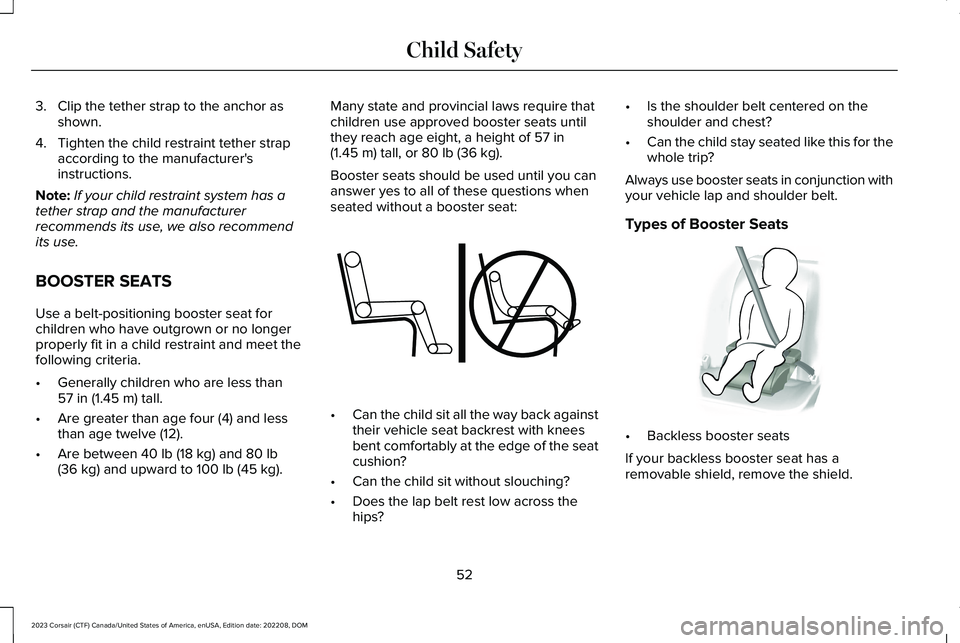
3.Clip the tether strap to the anchor asshown.
4.Tighten the child restraint tether strapaccording to the manufacturer'sinstructions.
Note:If your child restraint system has atether strap and the manufacturerrecommends its use, we also recommendits use.
BOOSTER SEATS
Use a belt-positioning booster seat forchildren who have outgrown or no longerproperly fit in a child restraint and meet thefollowing criteria.
•Generally children who are less than57 in (1.45 m) tall.
•Are greater than age four (4) and lessthan age twelve (12).
•Are between 40 lb (18 kg) and 80 lb(36 kg) and upward to 100 lb (45 kg).
Many state and provincial laws require thatchildren use approved booster seats untilthey reach age eight, a height of 57 in(1.45 m) tall, or 80 lb (36 kg).
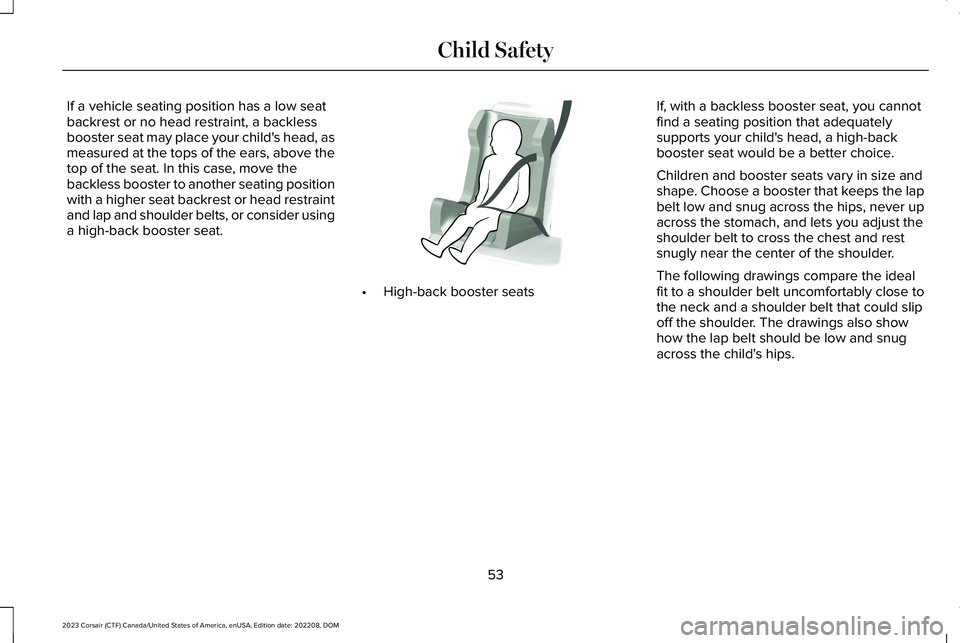
Booster seats should be used until you cananswer yes to all of these questions whenseated without a booster seat:
•Can the child sit all the way back againsttheir vehicle seat backrest with kneesbent comfortably at the edge of the seatcushion?
•Can the child sit without slouching?
•Does the lap belt rest low across thehips?
•Is the shoulder belt centered on theshoulder and chest?
•Can the child stay seated like this for thewhole trip?
Always use booster seats in conjunction withyour vehicle lap and shoulder belt.
Types of Booster Seats
•Backless booster seats
If your backless booster seat has aremovable shield, remove the shield.
52
2023 Corsair (CTF) Canada/United States of America, enUSA, Edition date: 202208, DOMChild SafetyE142595 E68924
Page 57 of 690
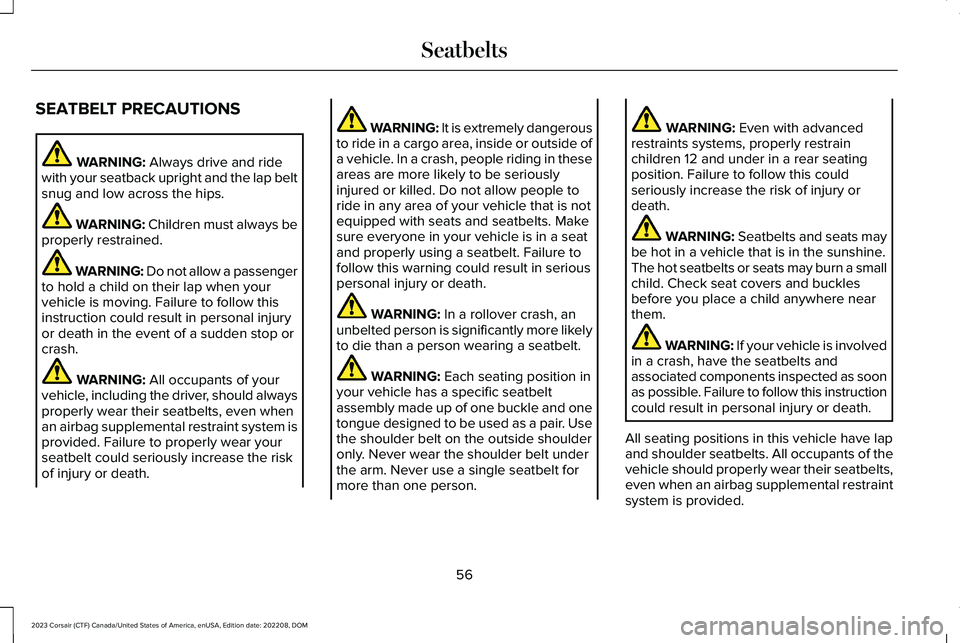
If a vehicle seating position has a low seatbackrest or no head restraint, a backlessbooster seat may place your child's head, asmeasured at the tops of the ears, above thetop of the seat. In this case, move thebackless booster to another seating positionwith a higher seat backrest or head restraintand lap and shoulder belts, or consider usinga high-back booster seat.
•High-back booster seats
If, with a backless booster seat, you cannotfind a seating position that adequatelysupports your child's head, a high-backbooster seat would be a better choice.
Children and booster seats vary in size andshape. Choose a booster that keeps the lapbelt low and snug across the hips, never upacross the stomach, and lets you adjust theshoulder belt to cross the chest and restsnugly near the center of the shoulder.
The following drawings compare the idealfit to a shoulder belt uncomfortably close tothe neck and a shoulder belt that could slipoff the shoulder. The drawings also showhow the lap belt should be low and snugacross the child's hips.
53
2023 Corsair (CTF) Canada/United States of America, enUSA, Edition date: 202208, DOMChild SafetyE70710
Page 60 of 690
SEATBELT PRECAUTIONS
WARNING: Always drive and ridewith your seatback upright and the lap beltsnug and low across the hips.
WARNING: Children must always beproperly restrained.
WARNING: Do not allow a passengerto hold a child on their lap when yourvehicle is moving. Failure to follow thisinstruction could result in personal injuryor death in the event of a sudden stop orcrash.
WARNING: All occupants of yourvehicle, including the driver, should alwaysproperly wear their seatbelts, even whenan airbag supplemental restraint system isprovided. Failure to properly wear yourseatbelt could seriously increase the riskof injury or death.
WARNING: It is extremely dangerousto ride in a cargo area, inside or outside ofa vehicle. In a crash, people riding in theseareas are more likely to be seriouslyinjured or killed. Do not allow people toride in any area of your vehicle that is notequipped with seats and seatbelts. Makesure everyone in your vehicle is in a seatand properly using a seatbelt. Failure tofollow this warning could result in seriouspersonal injury or death.
WARNING: In a rollover crash, anunbelted person is significantly more likelyto die than a person wearing a seatbelt.
WARNING: Each seating position inyour vehicle has a specific seatbeltassembly made up of one buckle and onetongue designed to be used as a pair. Usethe shoulder belt on the outside shoulderonly. Never wear the shoulder belt underthe arm. Never use a single seatbelt formore than one person.
WARNING: Even with advancedrestraints systems, properly restrainchildren 12 and under in a rear seatingposition. Failure to follow this couldseriously increase the risk of injury ordeath.
WARNING: Seatbelts and seats maybe hot in a vehicle that is in the sunshine.The hot seatbelts or seats may burn a smallchild. Check seat covers and bucklesbefore you place a child anywhere nearthem.
WARNING: If your vehicle is involvedin a crash, have the seatbelts andassociated components inspected as soonas possible. Failure to follow this instructioncould result in personal injury or death.
All seating positions in this vehicle have lapand shoulder seatbelts. All occupants of thevehicle should properly wear their seatbelts,even when an airbag supplemental restraintsystem is provided.
56
2023 Corsair (CTF) Canada/United States of America, enUSA, Edition date: 202208, DOMSeatbelts
Page 61 of 690
The seatbelt system consists of:
•Lap and shoulder seatbelts.
•A shoulder seatbelt with automaticlocking mode, except driver seatbelt.
•Height adjusters at the front outermostseating positions.
•Seatbelt pretensioners at the frontoutermost and second row outermostseating positions.
•Belt tension sensor at the front outermostpassenger seating position.
A seatbelt warning light and tone.
Crash sensors and monitoringsystem with readiness indicator.
The seatbelt pretensioners are designed totighten the seatbelts when activated. Infrontal and near-frontal crashes, the seatbeltpretensioners may be activated alone or, ifthe crash is of sufficient severity, togetherwith the front airbags. The pretensioners mayalso activate when a Safety Canopy airbagdeploys.
FASTENING THE SEATBELTS
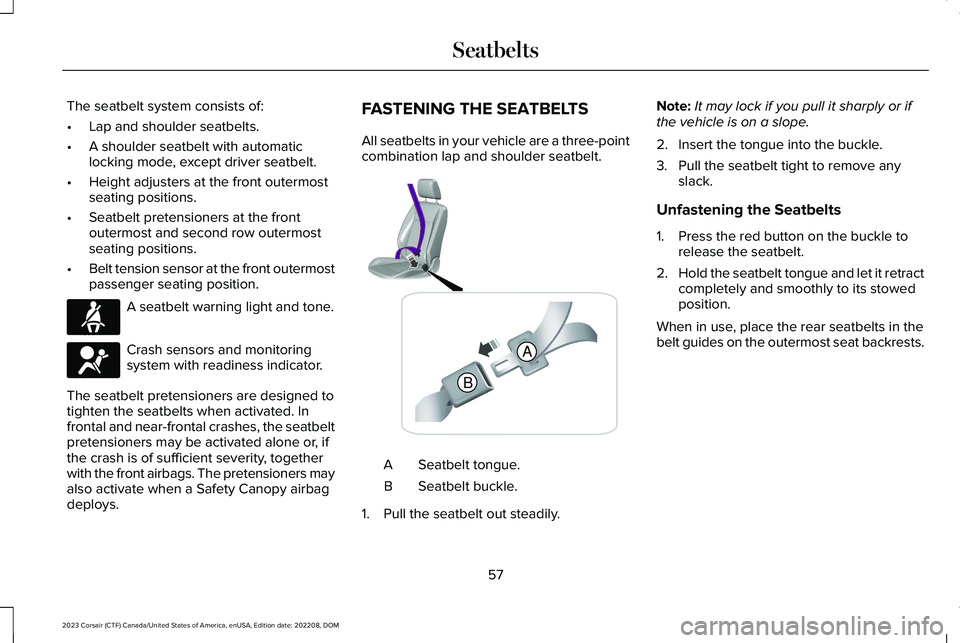
All seatbelts in your vehicle are a three-pointcombination lap and shoulder seatbelt.
Seatbelt tongue.A
Seatbelt buckle.B
1.Pull the seatbelt out steadily.
Note:It may lock if you pull it sharply or ifthe vehicle is on a slope.
2.Insert the tongue into the buckle.
3.Pull the seatbelt tight to remove anyslack.
Unfastening the Seatbelts
1.Press the red button on the buckle torelease the seatbelt.
2.Hold the seatbelt tongue and let it retractcompletely and smoothly to its stowedposition.
When in use, place the rear seatbelts in thebelt guides on the outermost seat backrests.
57
2023 Corsair (CTF) Canada/United States of America, enUSA, Edition date: 202208, DOMSeatbeltsE71880 E67017 BA E338014
Page 62 of 690
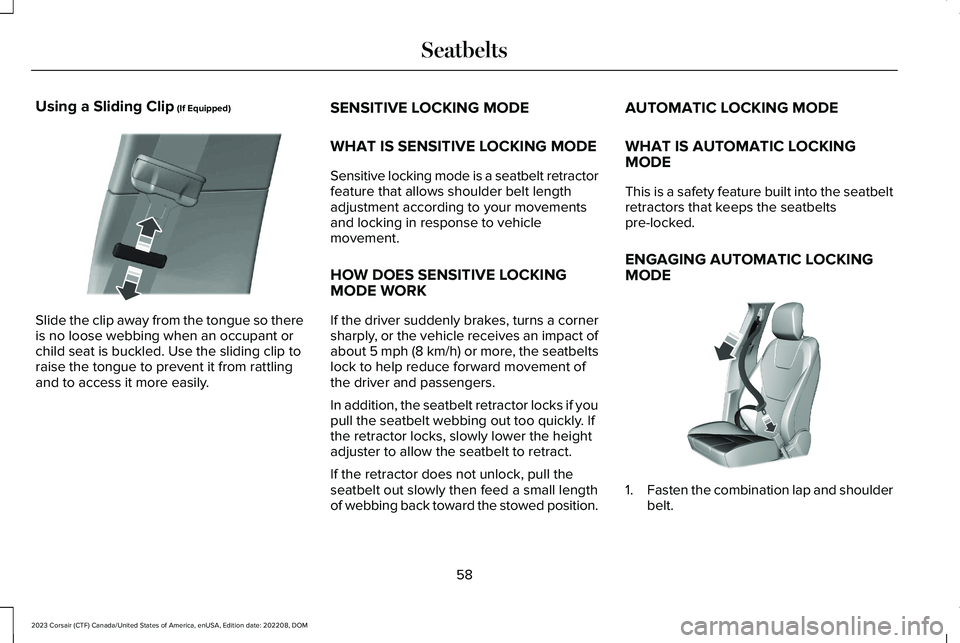
Using a Sliding Clip (If Equipped)
Slide the clip away from the tongue so thereis no loose webbing when an occupant orchild seat is buckled. Use the sliding clip toraise the tongue to prevent it from rattlingand to access it more easily.
SENSITIVE LOCKING MODE
WHAT IS SENSITIVE LOCKING MODE
Sensitive locking mode is a seatbelt retractorfeature that allows shoulder belt lengthadjustment according to your movementsand locking in response to vehiclemovement.
HOW DOES SENSITIVE LOCKINGMODE WORK
If the driver suddenly brakes, turns a cornersharply, or the vehicle receives an impact ofabout 5 mph (8 km/h) or more, the seatbeltslock to help reduce forward movement ofthe driver and passengers.
In addition, the seatbelt retractor locks if youpull the seatbelt webbing out too quickly. Ifthe retractor locks, slowly lower the heightadjuster to allow the seatbelt to retract.
If the retractor does not unlock, pull theseatbelt out slowly then feed a small lengthof webbing back toward the stowed position.
AUTOMATIC LOCKING MODE
WHAT IS AUTOMATIC LOCKINGMODE
This is a safety feature built into the seatbeltretractors that keeps the seatbeltspre-locked.
ENGAGING AUTOMATIC LOCKINGMODE
1.Fasten the combination lap and shoulderbelt.
58
2023 Corsair (CTF) Canada/United States of America, enUSA, Edition date: 202208, DOMSeatbeltsE200788 E142591
Page 63 of 690
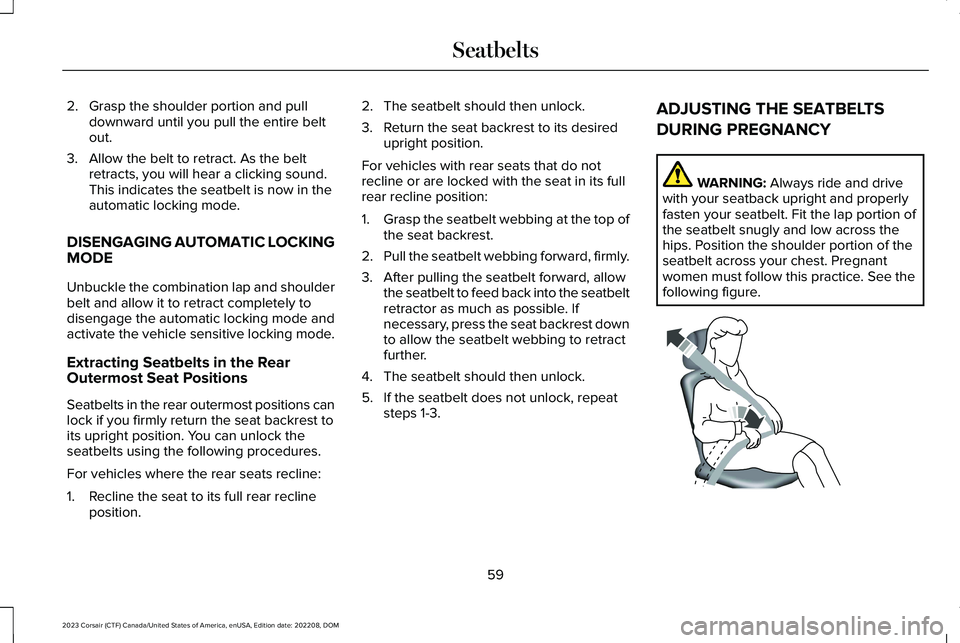
2.Grasp the shoulder portion and pulldownward until you pull the entire beltout.
3.Allow the belt to retract. As the beltretracts, you will hear a clicking sound.This indicates the seatbelt is now in theautomatic locking mode.
DISENGAGING AUTOMATIC LOCKINGMODE
Unbuckle the combination lap and shoulderbelt and allow it to retract completely todisengage the automatic locking mode andactivate the vehicle sensitive locking mode.
Extracting Seatbelts in the RearOutermost Seat Positions
Seatbelts in the rear outermost positions canlock if you firmly return the seat backrest toits upright position. You can unlock theseatbelts using the following procedures.
For vehicles where the rear seats recline:
1.Recline the seat to its full rear reclineposition.
2.The seatbelt should then unlock.
3.Return the seat backrest to its desiredupright position.
For vehicles with rear seats that do notrecline or are locked with the seat in its fullrear recline position:
1.Grasp the seatbelt webbing at the top ofthe seat backrest.
2.Pull the seatbelt webbing forward, firmly.
3.After pulling the seatbelt forward, allowthe seatbelt to feed back into the seatbeltretractor as much as possible. Ifnecessary, press the seat backrest downto allow the seatbelt webbing to retractfurther.
4.The seatbelt should then unlock.
5.If the seatbelt does not unlock, repeatsteps 1-3.
ADJUSTING THE SEATBELTS
DURING PREGNANCY
WARNING: Always ride and drivewith your seatback upright and properlyfasten your seatbelt. Fit the lap portion ofthe seatbelt snugly and low across thehips. Position the shoulder portion of theseatbelt across your chest. Pregnantwomen must follow this practice. See thefollowing figure.
59
2023 Corsair (CTF) Canada/United States of America, enUSA, Edition date: 202208, DOMSeatbeltsE142590