warning LINCOLN CORSAIR 2023 Owners Manual
[x] Cancel search | Manufacturer: LINCOLN, Model Year: 2023, Model line: CORSAIR, Model: LINCOLN CORSAIR 2023Pages: 690, PDF Size: 15.04 MB
Page 471 of 690
WARNING: Only usereplacement tires and wheels that arethe same size, load index, speedrating, and type as those originallyprovided for your vehicle. Therecommended tire and wheel sizescan be found on the Tire Label on thedriver side door frame or the edge ofthe driver door. If this information isnot found in those locations, or foradditional options, contact yourauthorized dealer. Use of any tire orwheel not recommended, could affectthe safety and performance of yourvehicle, which could result in anincreased risk of loss of vehiclecontrol, vehicle rollover, personalinjury and death.
WARNING: To reduce the risk ofserious injury, when mountingreplacement tires and wheels, youshould not exceed the maximumpressure indicated on the sidewall ofthe tire to set the beads withoutadditional precautions listed below. Ifthe beads do not seat at the maximumpressure indicated, re-lubricate andtry again.
WARNING: For a mountingpressure more than 20 psi (1.38 bar)greater than the maximum pressure,a Ford dealer or other tire serviceprofessional should do the mounting.
WARNING: Always inflate steelcarcass tires with a remote air fill withthe person inflating standing at aminimum of 12 ft (3.66 m) away fromthe wheel and tire assembly.
WARNING: Only use thespecified jacking points. If you use anyother locations you could damagevehicle components, such as brakelines.
WARNING: When inflating thetire for mounting pressures up to20 psi (1.38 bar) greater than themaximum pressure on the tire sidewall,the following precautions must betaken to protect the person mountingthe tire:
•Make sure that you have the correcttire and wheel size.
•Lubricate the tire bead and wheelbead seat area again.
•Stand at a minimum of 12 ft (3.66 m)away from the wheel and tireassembly.
•Use both eye and ear protection.
Important: Remember to replace thewheel valve stems when the road tiresare replaced on your vehicle.
467
2023 Corsair (CTF) Canada/United States of America, enUSA, Edition date: 202208, DOMWheel and Tire Information
Page 472 of 690
It is recommended that the two fronttires or two rear tires generally bereplaced as a pair if the worn tires stillhave usable depth.
To avoid potential All-Wheel Drive (AWD)malfunction or (AWD) system damage,it is recommended to replace all fourtires rather than mixing significantly worntires with new tires.
The tire pressure sensors mounted inthe wheels (originally installed on yourvehicle) are not designed to be used inaftermarket wheels.
The use of wheels or tires notrecommended may affect the operationof your tire pressure monitoring system.
If the tire pressure monitoring system
indicator is flashing, your system ismalfunctioning. Your replacement tiremight be incompatible with your tirepressure monitoring system, or somecomponent of the system may bedamaged.
Age
WARNING: Tires degrade overtime depending on many factors suchas weather, storage conditions, andconditions of use (load, speed, inflationpressure) the tires experiencethroughout their lives.In general, tires should be replacedafter six years regardless of treadwear. However, heat caused by hotclimates or frequent high loadingconditions can accelerate the agingprocess and may require tires to bereplaced more frequently.You should replace your spare tirewhen you replace the road tires orafter six years due to aging even if it
has not been used.
U.S. DOT Tire Identification Number
Both United States and Canada Federalregulations require tire manufacturersto place standardized information on thesidewall of all tires. This informationidentifies and describes the fundamentalcharacteristics of the tire and alsoprovides a U.S. DOT Tire IdentificationNumber for safety standard certificationand in case of a recall.
This begins with the letters DOT andindicates that the tire meets all federalstandards. The next two numbers orletters are the plant code designatingwhere it was manufactured, the next twoare the tire size code and the last fournumbers represent the week and yearthe tire was built. For example, the
numbers 317 mean the 31st week of1997. After 2000, the numbers go to fourdigits. For example, 2501 means the25th week of 2001. The numbers inbetween are identification codes usedfor traceability. This information is usedto contact customers if a tire defectrequires a recall.
468
2023 Corsair (CTF) Canada/United States of America, enUSA, Edition date: 202208, DOMWheel and Tire Information
Page 473 of 690
USING SNOW CHAINS
WARNING: Do not exceed 30 mph(50 km/h). Failure to follow this instructioncould result in the loss of control of yourvehicle, personal injury or death.
WARNING: Do not use snow chainson snow-free roads.
WARNING: Only fit snow chains tospecified tires.
WARNING: If your vehicle is fittedwith wheel trims, remove them beforefitting snow chains.
WARNING: If you are driving inslippery conditions that require tire chainsor cables, then it is critical that you drivecautiously. Keep speeds down, allow forlonger stopping distances and avoidaggressive steering to reduce the chancesof a loss of vehicle control which can leadto serious injury or death. If the rear endof your vehicle slides while cornering, steerin the direction of the slide until you regaincontrol of your vehicle.
WARNING: Remember that evenadvanced technology cannot defy the lawsof physics. It's always possible to losecontrol of a vehicle due to inappropriatedriver input for the conditions. Aggressivedriving on any road condition can causeyou to lose control of your vehicleincreasing the risk of personal injury orproperty damage. Activation of theelectronic stability control system is an
indication that at least some of the tireshave exceeded their ability to grip theroad; this could reduce the operator'sability to control the vehicle potentiallyresulting in a loss of vehicle control, vehiclerollover, personal injury and death.
WARNING: Wheels and tires mustbe the same size, load index and speedrating as those originally fitted on thevehicle. Use of any other tire or wheel canaffect the safety and performance of yourvehicle. Additionally, the use ofnon-recommended tires and wheels cancause steering, suspension, axle, transfercase or power transfer unit failure. Followthe recommended tire inflation pressuresfound on the Safety ComplianceCertification label, or the Tire Label on theB-Pillar or the edge of the driver door.Failure to follow this instruction could resultin loss of vehicle control, vehicle rollover,or personal injury or death.
469
2023 Corsair (CTF) Canada/United States of America, enUSA, Edition date: 202208, DOMWheel and Tire Information
Page 475 of 690
CHECKING THE TIRE PRESSURES
Safe operation of your vehicle requiresthat your tires are properly inflated.Every day before you drive, check yourtires.
At least once a month and before longtrips, inspect each tire and check the tirepressure with a tire gauge. Inflate alltires to the recommended inflationpressure. See Inflating the Tires (page471).
INFLATING THE TIRES
WARNING: Under-inflation is themost common cause of tire failures
and may result in severe tire cracking,tread separation or blowout, withunexpected loss of vehicle control andincreased risk of injury. Under-inflationincreases sidewall flexing and rollingresistance, resulting in heat buildup
and internal damage to the tire. It alsomay result in unnecessary tire stress,irregular wear, loss of vehicle controland accidents. A tire can lose up tohalf of its air pressure and not appearto be flat!
WARNING: Do not use the tirepressure displayed in the informationdisplay as a tire pressure gauge.Failure to follow this instruction couldresult in personal injury or death.
Use the recommended cold inflationpressure for optimum tire performanceand wear. Under-inflation orover-inflation may cause uneventreadwear patterns.
Inflate your tires to the recommendedinflation pressure even if it is less thanthe maximum inflation pressureinformation found on the tire. You canfind the tire label with the recommendedtire inflation pressure next to the tire sizeon the B-Pillar or the edge of the driverdoor.
The recommended tire inflation pressureis also found on the Safety ComplianceCertification Label, affixed to either thedoor hinge pillar, door-latch post, or thedoor edge that meets the door-latch onthe B-pillar, or on the edge of the driverdoor.
Failure to follow the tire pressurerecommendations can cause uneventreadwear patterns and adversely affectthe way your vehicle handles.
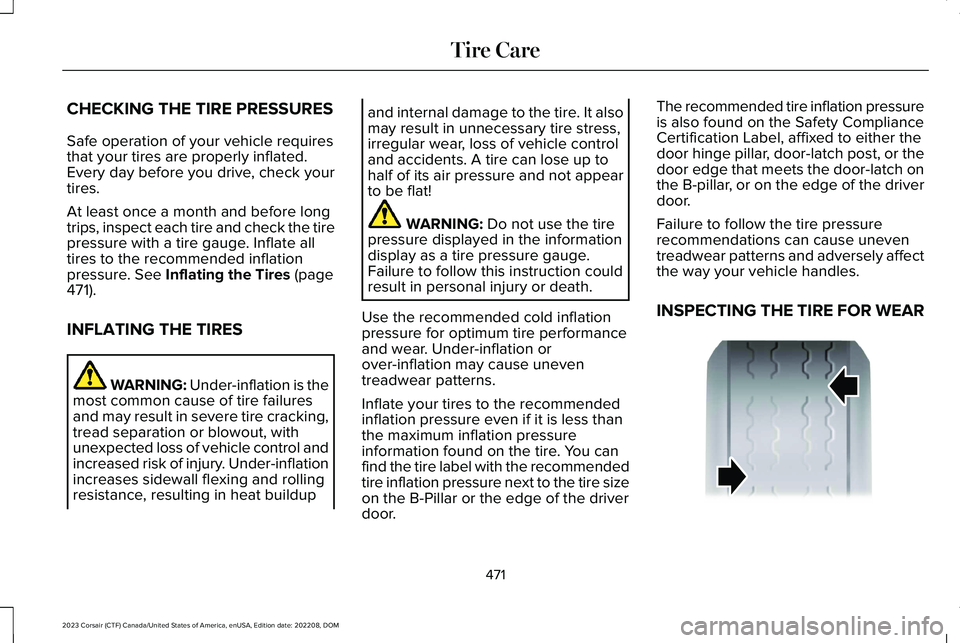
INSPECTING THE TIRE FOR WEAR
471
2023 Corsair (CTF) Canada/United States of America, enUSA, Edition date: 202208, DOMTire CareE142546
Page 476 of 690
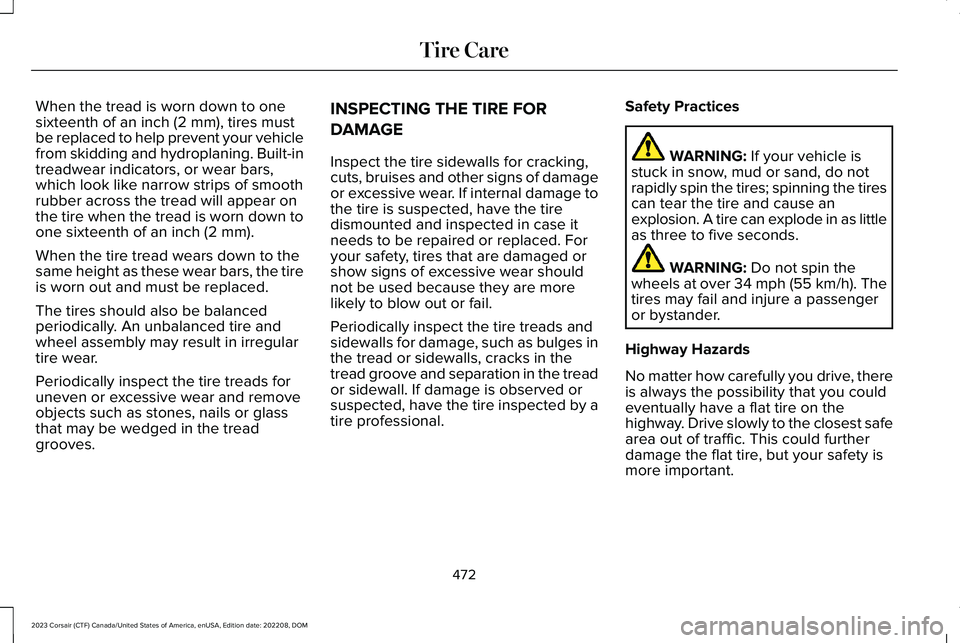
When the tread is worn down to onesixteenth of an inch (2 mm), tires mustbe replaced to help prevent your vehiclefrom skidding and hydroplaning. Built-intreadwear indicators, or wear bars,which look like narrow strips of smoothrubber across the tread will appear onthe tire when the tread is worn down toone sixteenth of an inch (2 mm).
When the tire tread wears down to thesame height as these wear bars, the tireis worn out and must be replaced.
The tires should also be balancedperiodically. An unbalanced tire andwheel assembly may result in irregulartire wear.
Periodically inspect the tire treads foruneven or excessive wear and remove
objects such as stones, nails or glassthat may be wedged in the treadgrooves.
INSPECTING THE TIRE FOR
DAMAGE
Inspect the tire sidewalls for cracking,cuts, bruises and other signs of damageor excessive wear. If internal damage tothe tire is suspected, have the tiredismounted and inspected in case itneeds to be repaired or replaced. Foryour safety, tires that are damaged orshow signs of excessive wear shouldnot be used because they are morelikely to blow out or fail.
Periodically inspect the tire treads andsidewalls for damage, such as bulges inthe tread or sidewalls, cracks in thetread groove and separation in the treador sidewall. If damage is observed orsuspected, have the tire inspected by atire professional.
Safety Practices
WARNING: If your vehicle isstuck in snow, mud or sand, do notrapidly spin the tires; spinning the tirescan tear the tire and cause anexplosion. A tire can explode in as littleas three to five seconds.
WARNING: Do not spin thewheels at over 34 mph (55 km/h). Thetires may fail and injure a passengeror bystander.
Highway Hazards
No matter how carefully you drive, thereis always the possibility that you could
eventually have a flat tire on thehighway. Drive slowly to the closest safearea out of traffic. This could furtherdamage the flat tire, but your safety ismore important.
472
2023 Corsair (CTF) Canada/United States of America, enUSA, Edition date: 202208, DOMTire Care
Page 477 of 690
If you feel a sudden vibration or ridedisturbance while driving, or you suspectyour tire or vehicle has been damaged,immediately reduce your speed. Drivewith caution until you can safely pull offthe road. Stop and inspect the tires fordamage. If a tire is under-inflated ordamaged, deflate it, remove the wheeland replace it with your spare tire andwheel. If you cannot detect a cause,have the vehicle towed to the nearestrepair facility or tire dealer to have thevehicle inspected.
Tire and Wheel Alignment
A bad jolt from hitting a curb or potholecan cause the front end of your vehicleto become misaligned or cause damageto your tires. If your vehicle seems topull to one side when you are driving,the wheels could be out of alignment.Have an authorized dealer check thewheel alignment periodically.
Wheel misalignment in the front or therear can cause uneven and rapidtreadwear of your tires and should becorrected by an authorized dealer.
INSPECTING THE WHEEL VALVE
STEMS
Check the valve stems for holes, cracks,or cuts that could permit air leakage.
TIRE ROTATION
WARNING: If the tire label showsdifferent tire pressures for the frontand rear tires and the vehicle has atire pressure monitoring system, thenyou need to update the settings forthe system sensors. Always performthe system reset procedure after tirerotation. If you do not reset the system,it may not provide a low tire pressurewarning when necessary.
Rotating your tires at the recommendedinterval will help your tires wear moreevenly, providing better tire performanceand longer tire life.
Note:If your tires show any unevenwear have the alignment checked byan authorized dealer before rotatingtires.
Note:If you have a dissimilar sparewheel and tire assembly, it is intendedfor temporary use only and should notbe used in a tire rotation.
Note:After having your tires rotated,inflation pressure must be checked andadjusted to the vehicle requirements.
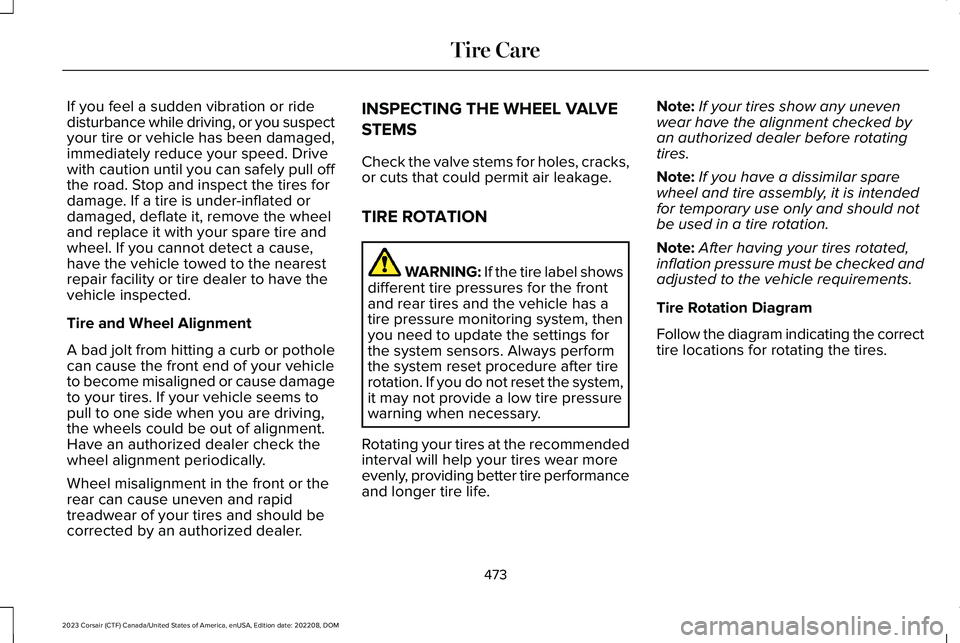
Tire Rotation Diagram
Follow the diagram indicating the correcttire locations for rotating the tires.
473
2023 Corsair (CTF) Canada/United States of America, enUSA, Edition date: 202208, DOMTire Care
Page 479 of 690
WHAT IS THE TIRE SEALANT AND
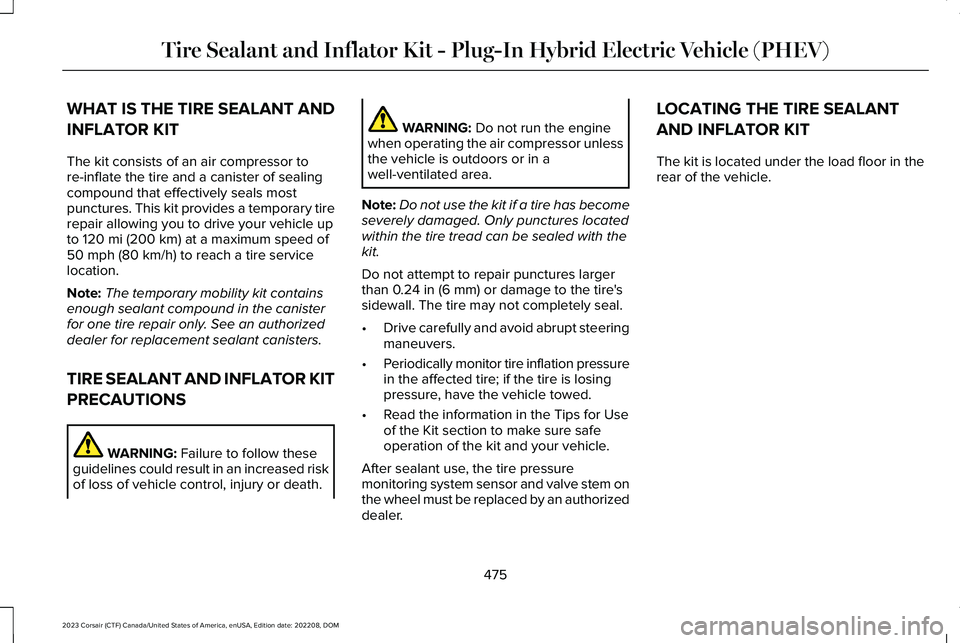
INFLATOR KIT
The kit consists of an air compressor tore-inflate the tire and a canister of sealingcompound that effectively seals mostpunctures. This kit provides a temporary tirerepair allowing you to drive your vehicle upto 120 mi (200 km) at a maximum speed of50 mph (80 km/h) to reach a tire servicelocation.
Note:The temporary mobility kit containsenough sealant compound in the canisterfor one tire repair only. See an authorizeddealer for replacement sealant canisters.
TIRE SEALANT AND INFLATOR KIT
PRECAUTIONS
WARNING: Failure to follow theseguidelines could result in an increased riskof loss of vehicle control, injury or death.
WARNING: Do not run the enginewhen operating the air compressor unlessthe vehicle is outdoors or in awell-ventilated area.
Note:Do not use the kit if a tire has becomeseverely damaged. Only punctures locatedwithin the tire tread can be sealed with thekit.
Do not attempt to repair punctures largerthan 0.24 in (6 mm) or damage to the tire'ssidewall. The tire may not completely seal.
•Drive carefully and avoid abrupt steeringmaneuvers.
•Periodically monitor tire inflation pressurein the affected tire; if the tire is losingpressure, have the vehicle towed.
•Read the information in the Tips for Useof the Kit section to make sure safeoperation of the kit and your vehicle.
After sealant use, the tire pressuremonitoring system sensor and valve stem onthe wheel must be replaced by an authorizeddealer.
LOCATING THE TIRE SEALANT
AND INFLATOR KIT
The kit is located under the load floor in therear of the vehicle.
475
2023 Corsair (CTF) Canada/United States of America, enUSA, Edition date: 202208, DOMTire Sealant and Inflator Kit - Plug-In Hybrid Electric Vehicle (PHEV)
Page 481 of 690
What to do when a tire is punctured
A tire puncture within the tire's tread areacan be repaired in two stages with the kit.
•In the first stage, the tire is reinflated witha sealing compound and air. After the tirehas been inflated, drive the vehicle ashort distance approximately 4 mi (6 km)to distribute the sealant in the tire.
•In the second stage, check the tirepressure and adjust, if necessary, to thevehicle's specified tire inflation pressure.
First Stage: Reinflating the Tire withsealing compound and air
WARNING: Do not stand directly overthe kit while inflating the tire. If you noticeany unusual bulges or deformations in thetire's sidewall during inflation, stop and callroadside assistance.
WARNING: If the tire does not inflateto the recommended tire pressure within15 minutes, stop and call roadsideassistance.
Park the vehicle in a safe, level and securearea, away from moving traffic.
Turn the hazard lights on. Apply the parkingbrake and power off the vehicle. Inspect theflat tire for visible damage.
If a puncture is located in the tire sidewall,stop and call roadside assistance.
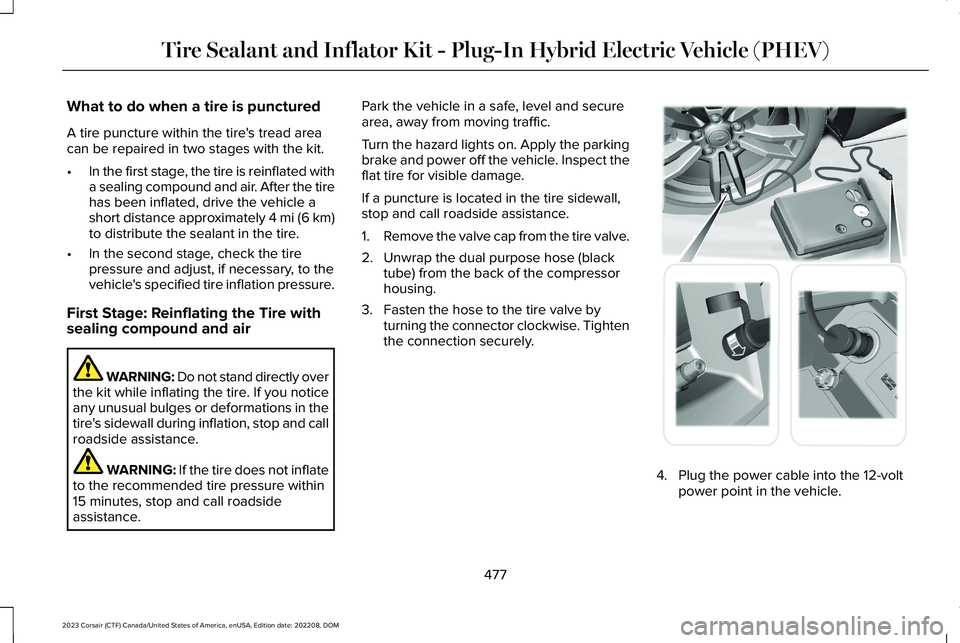
1.Remove the valve cap from the tire valve.
2.Unwrap the dual purpose hose (blacktube) from the back of the compressorhousing.
3.Fasten the hose to the tire valve byturning the connector clockwise. Tightenthe connection securely.
4.Plug the power cable into the 12-voltpower point in the vehicle.
477
2023 Corsair (CTF) Canada/United States of America, enUSA, Edition date: 202208, DOMTire Sealant and Inflator Kit - Plug-In Hybrid Electric Vehicle (PHEV) E175979
Page 482 of 690
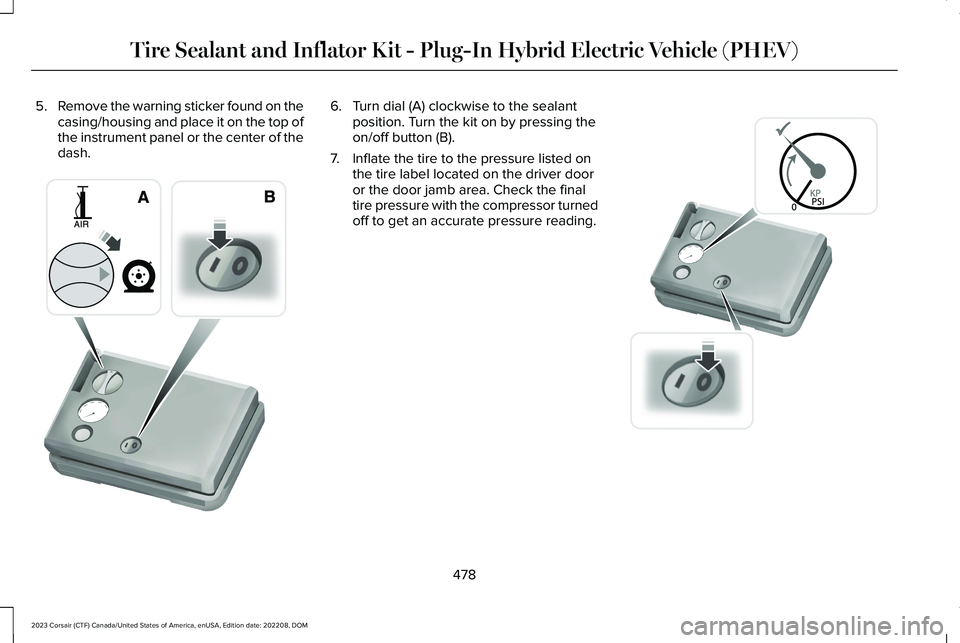
5.Remove the warning sticker found on thecasing/housing and place it on the top ofthe instrument panel or the center of thedash.
6.Turn dial (A) clockwise to the sealantposition. Turn the kit on by pressing theon/off button (B).
7.Inflate the tire to the pressure listed onthe tire label located on the driver dooror the door jamb area. Check the finaltire pressure with the compressor turnedoff to get an accurate pressure reading.
478
2023 Corsair (CTF) Canada/United States of America, enUSA, Edition date: 202208, DOMTire Sealant and Inflator Kit - Plug-In Hybrid Electric Vehicle (PHEV)E175981 E175982
Page 483 of 690
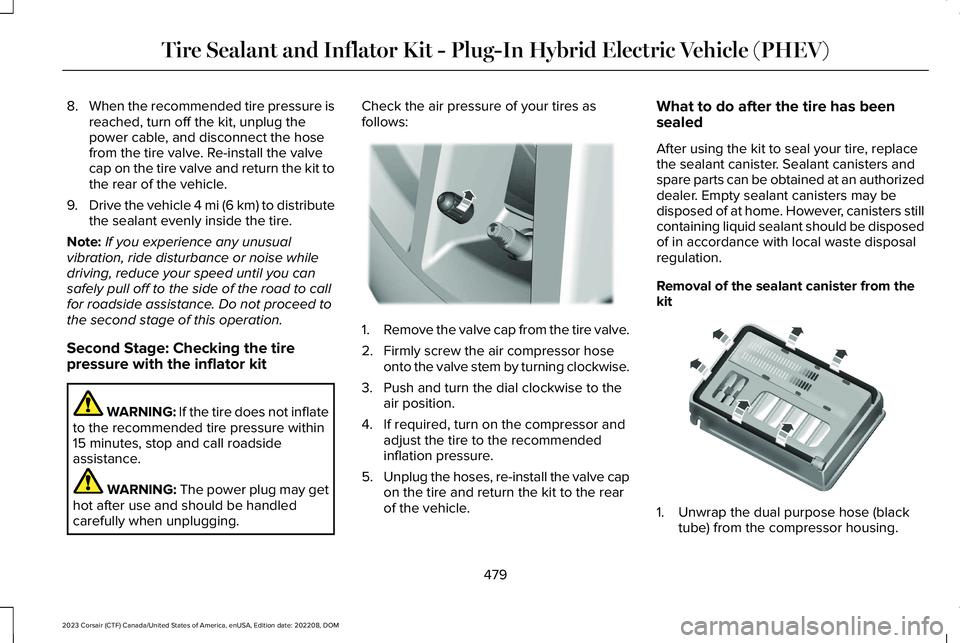
8.When the recommended tire pressure isreached, turn off the kit, unplug thepower cable, and disconnect the hosefrom the tire valve. Re-install the valvecap on the tire valve and return the kit tothe rear of the vehicle.
9.Drive the vehicle 4 mi (6 km) to distributethe sealant evenly inside the tire.
Note:If you experience any unusualvibration, ride disturbance or noise whiledriving, reduce your speed until you cansafely pull off to the side of the road to callfor roadside assistance. Do not proceed tothe second stage of this operation.
Second Stage: Checking the tirepressure with the inflator kit
WARNING: If the tire does not inflateto the recommended tire pressure within15 minutes, stop and call roadsideassistance.
WARNING: The power plug may gethot after use and should be handledcarefully when unplugging.
Check the air pressure of your tires asfollows:
1.Remove the valve cap from the tire valve.
2.Firmly screw the air compressor hoseonto the valve stem by turning clockwise.
3.Push and turn the dial clockwise to theair position.
4.If required, turn on the compressor andadjust the tire to the recommendedinflation pressure.
5.Unplug the hoses, re-install the valve capon the tire and return the kit to the rearof the vehicle.
What to do after the tire has beensealed
After using the kit to seal your tire, replacethe sealant canister. Sealant canisters andspare parts can be obtained at an authorizeddealer. Empty sealant canisters may bedisposed of at home. However, canisters stillcontaining liquid sealant should be disposedof in accordance with local waste disposalregulation.
Removal of the sealant canister from thekit
1.Unwrap the dual purpose hose (blacktube) from the compressor housing.
479
2023 Corsair (CTF) Canada/United States of America, enUSA, Edition date: 202208, DOMTire Sealant and Inflator Kit - Plug-In Hybrid Electric Vehicle (PHEV)E175983 E175984