maintenance LINCOLN MARK VIII 1997 User Guide
[x] Cancel search | Manufacturer: LINCOLN, Model Year: 1997, Model line: MARK VIII, Model: LINCOLN MARK VIII 1997Pages: 315, PDF Size: 2.18 MB
Page 193 of 315

188If you tow in D (Overdrive) while riding through
hilly country, your vehicle may frequently shift
between Overdrive and Third gears. To prevent
your vehicle from shifting too much, press the
Transmission Control Switch located on the shift
lever. This will also give the engine more power
going up hills and better engine braking going down
hills.
If you use the speed control while you are towing
on very long, steep grades, the speed control may
shut off.
Servicing Your Vehicle If You TowIf you tow a trailer for a long distance, your vehicle
will need to be serviced more frequently than usual.
Refer to theMaintenance Schedulebooklet for
additional information.
File:09fngf8.ex
Update:Wed Jun 19 10:45:23 1996
Page 218 of 315
213
After the vehicle is started, let it idle for a while to
let the engine ªrelearnº its idle conditions. Drive it
around for a while with all electrical accessories
turned off to let the battery recharge. Driveability
may be deteriorated slightly until all drive modes
are ªrelearned.ºYou may need to use a battery
charger to fully recharge the battery.
If you need to replace your battery, seeBatteryin
theMaintenance and Carechapter.
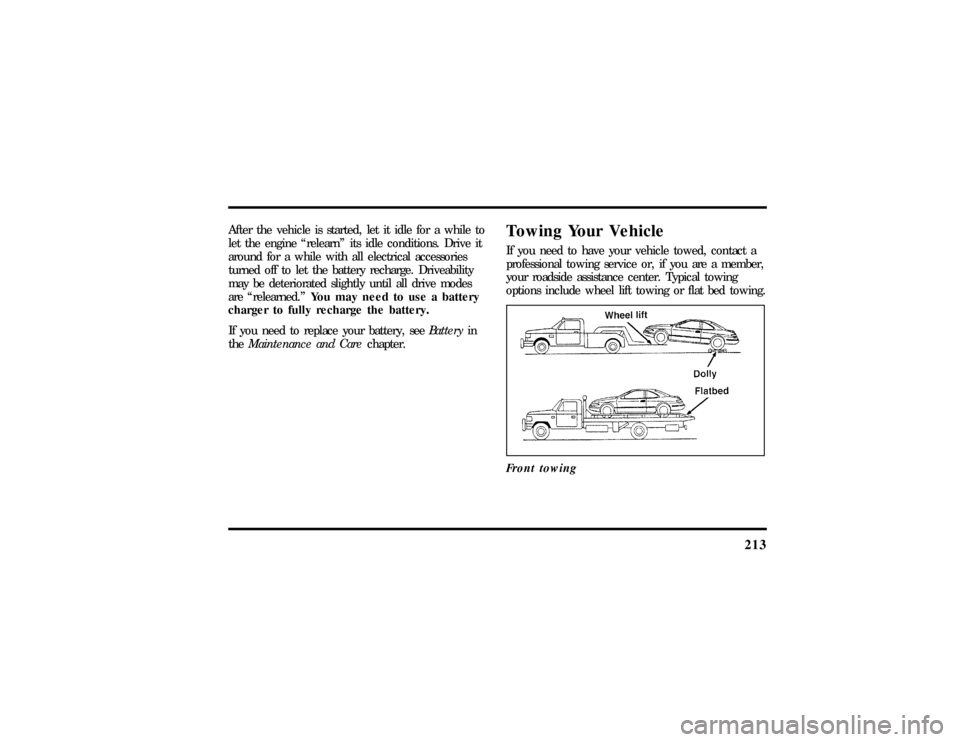
Towing Your VehicleIf you need to have your vehicle towed, contact a
professional towing service or, if you are a member,
your roadside assistance center. Typical towing
options include wheel lift towing or flat bed towing.
Front towing
File:10fner8.ex
Update:Thu Jun 20 14:27:22 1996
Page 220 of 315

215
Maintenance and CareService Made EasyFord has two goals for servicing your vehicle.
1. When we can, we design parts that do not
need to be serviced.
2. We want to make servicing your vehicle as
easy as possible. To help you:q
We highlight do-it-yourself items in yellow in
the engine compartment so that you can find
them easily.
q
When possible, we design parts that can be
replaced without tools.
q
We give you a Maintenance Schedule that
makes tracking routine service for your vehicle
easy. The maintenance schedule is located in
theMaintenance Schedulebooklet.This chapter tells you about the basic parts that you
need to check and service regularly.
If your vehicle needs professional servicing, your
dealership can provide the parts and service
required. Check yourWarranty Information Booklet
to find out which parts and services are covered.
Also see theCustomer Assistancechapter of this
Owner Guide.
Ford Motor Company recommends that the Owner
Maintenance Checks listed in theMaintenance
Schedulebooklet be performed for the proper
operation of your vehicle. In addition to the
conditions listed in theOwner Maintenance
Checklist, be alert for any unusual noise, vibration,
or other indication that your vehicle may need
service. If you do notice something unusual, see
that your vehicle is serviced promptly.
File:11fnmc8.ex
Update:Thu Jun 20 14:28:32 1996
Page 227 of 315
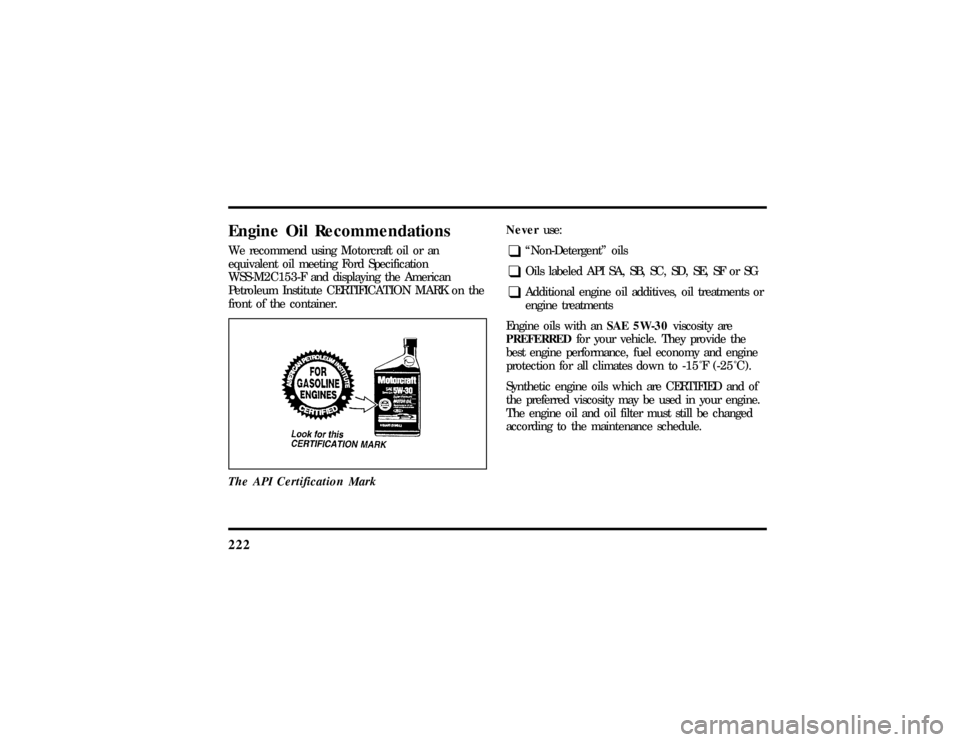
222Engine Oil RecommendationsWe recommend using Motorcraft oil or an
equivalent oil meeting Ford Specification
WSS-M2C153-F and displaying the American
Petroleum Institute CERTIFICATION MARK on the
front of the container.
The API Certification Mark
Neveruse:q
ªNon-Detergentº oils
q
Oils labeled API SA, SB, SC, SD, SE, SF or SG
q
Additional engine oil additives, oil treatments or
engine treatments
Engine oils with anSAE 5W-30viscosity are
PREFERREDfor your vehicle. They provide the
best engine performance, fuel economy and engine
protection for all climates down to-15ÊF (-25ÊC).
Synthetic engine oils which are CERTIFIED and of
the preferred viscosity may be used in your engine.
The engine oil and oil filter must still be changed
according to the maintenance schedule.
File:11fnmc8.ex
Update:Thu Jun 20 14:28:32 1996
Page 239 of 315
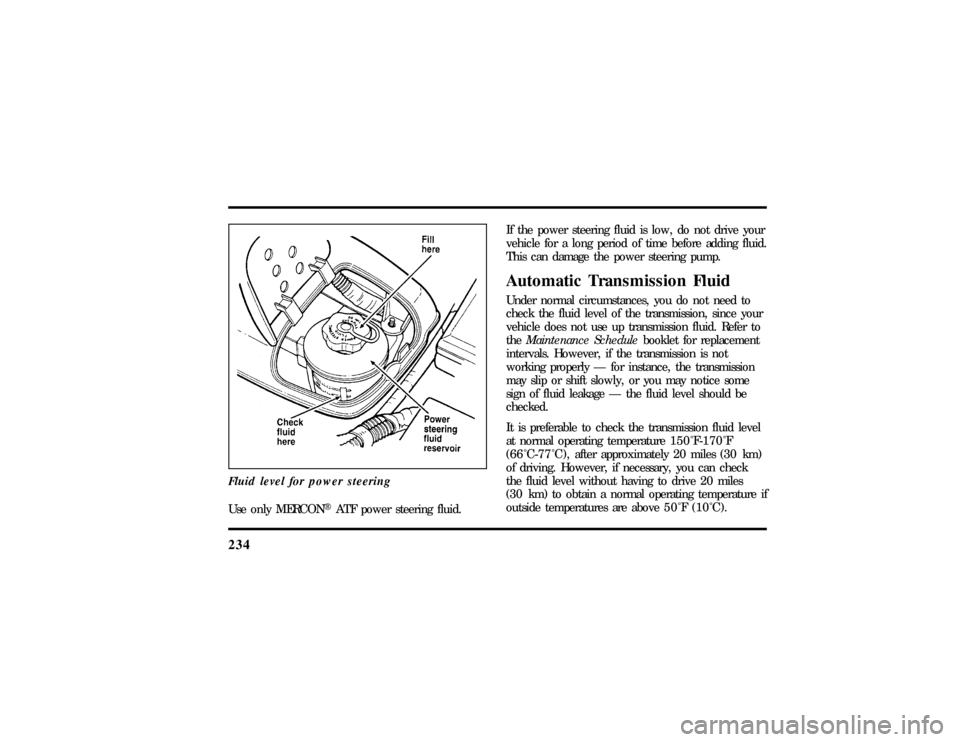
234Fluid level for power steeringUse only MERCONHATF power steering fluid.If the power steering fluid is low, do not drive your
vehicle for a long period of time before adding fluid.
This can damage the power steering pump.
Automatic Transmission FluidUnder normal circumstances, you do not need to
check the fluid level of the transmission, since your
vehicle does not use up transmission fluid. Refer to
theMaintenance Schedulebooklet for replacement
intervals. However, if the transmission is not
working properly Ð for instance, the transmission
may slip or shift slowly, or you may notice some
sign of fluid leakage Ð the fluid level should be
checked.
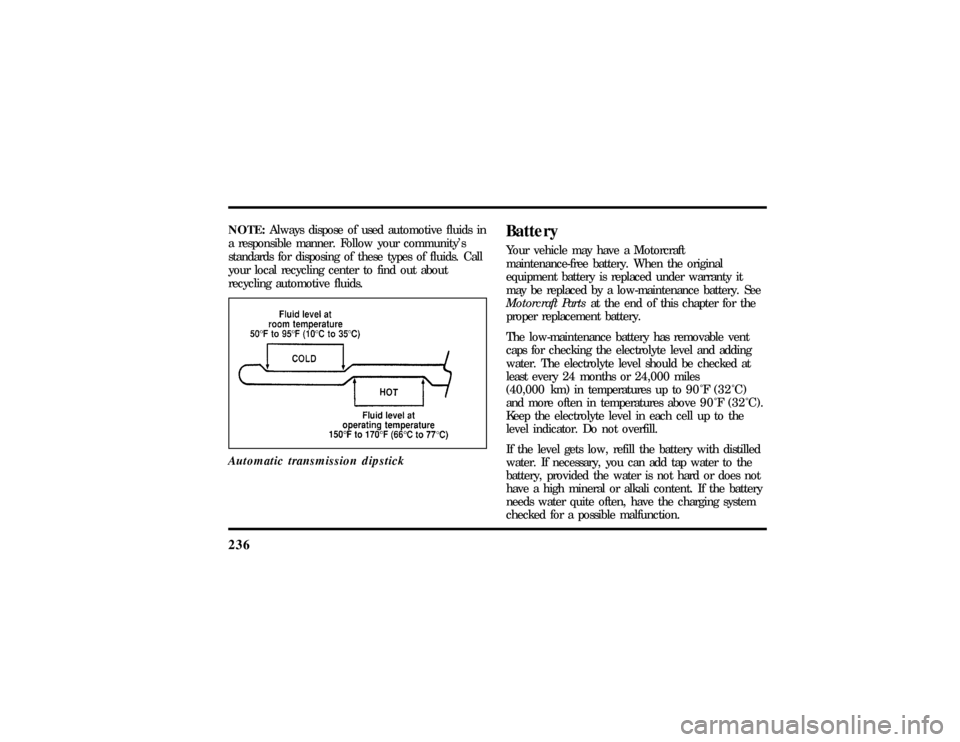
It is preferable to check the transmission fluid level
at normal operating temperature150ÊF-170ÊF
(66ÊC-77ÊC),after approximately 20 miles (30 km)
of driving. However, if necessary, you can check
the fluid level without having to drive 20 miles
(30 km) to obtain a normal operating temperature if
outside temperatures are above50ÊF(10ÊC).
File:11fnmc8.ex
Update:Thu Jun 20 14:28:32 1996
Page 241 of 315
236NOTE:Always dispose of used automotive fluids in
a responsible manner. Follow your community's
standards for disposing of these types of fluids. Call
your local recycling center to find out about
recycling automotive fluids.
Automatic transmission dipstick
BatteryYour vehicle may have a Motorcraft
maintenance-free battery. When the original
equipment battery is replaced under warranty it
may be replaced by a low-maintenance battery. See
Motorcraft Partsat the end of this chapter for the
proper replacement battery.
The low-maintenance battery has removable vent
caps for checking the electrolyte level and adding
water. The electrolyte level should be checked at
least every 24 months or 24,000 miles
(40,000 km) in temperatures up to90ÊF(32ÊC)
and more often in temperatures above90ÊF(32ÊC).
Keep the electrolyte level in each cell up to the
level indicator. Do not overfill.
If the level gets low, refill the battery with distilled
water. If necessary, you can add tap water to the
battery, provided the water is not hard or does not
have a high mineral or alkali content. If the battery
needs water quite often, have the charging system
checked for a possible malfunction.
File:11fnmc8.ex
Update:Thu Jun 20 14:28:32 1996
Page 244 of 315
239
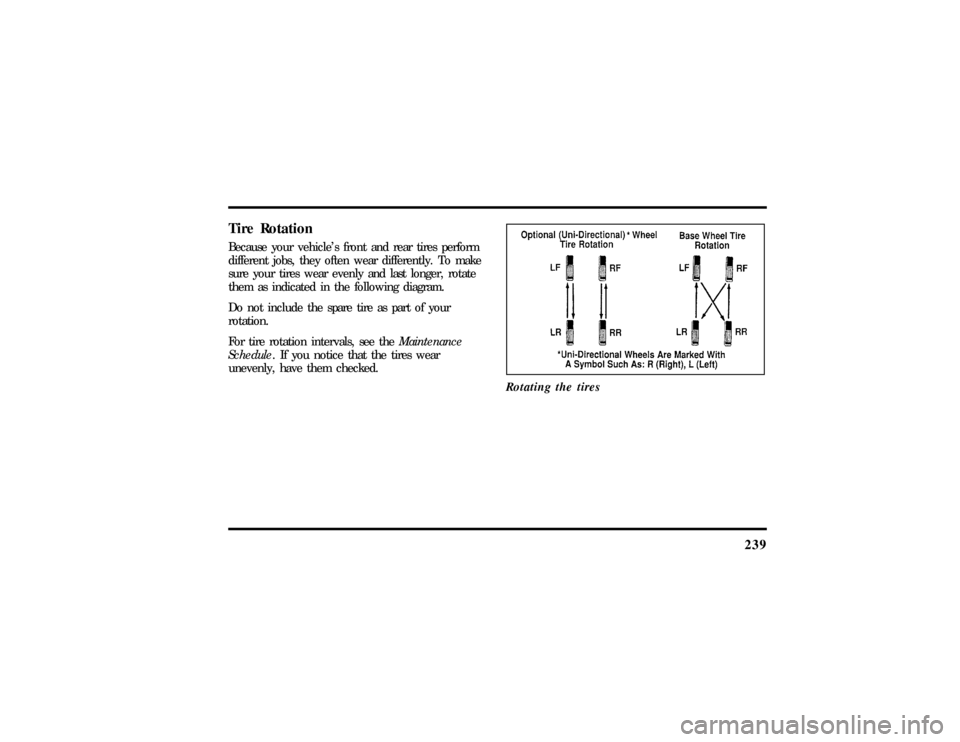
Tire RotationBecause your vehicle's front and rear tires perform
different jobs, they often wear differently. To make
sure your tires wear evenly and last longer, rotate
them as indicated in the following diagram.
Do not include the spare tire as part of your
rotation.
For tire rotation intervals, see theMaintenance
Schedule. If you notice that the tires wear
unevenly, have them checked.
Rotating the tires
File:11fnmc8.ex
Update:Thu Jun 20 14:28:32 1996
Page 254 of 315

249
To calculate fuel economy:
1. Fill the tank completely and record the initial
odometer reading.
2. Every time you buy fuel record the amount (in
gallons or liters) purchased.
3. After at least three to five tankfuls, fill the fuel
tank and record the final odometer reading.
4. Use these equations to calculate your fuel
economy.q
English: MPG = (total miles)/(gallons used).
q
Metric: L/100K = (liters used) x 100/(total
kilometers)
Comparisons With Environmental
Protection Agency (EPA) and Transport
Canada (TC) Fuel Economy EstimatesEPA fuel economy figures are obtained from
laboratory tests under simulated road conditions and
may not reflect the actual conditions you experience
or your style of driving. The EPA fuel economy
estimate is not a guarantee that you will achieve
the fuel economy shown.
The following decrease fuel economy:q
Lack of regular, scheduled maintenance
q
Rapid acceleration and excessive speed
q
Driving with your foot on the brake
q
Sudden stops
q
Extended engine idling
q
Using speed control in hilly terrain
File:11fnmc8.ex
Update:Thu Jun 20 14:28:32 1996
Page 256 of 315

251
To make sure that the catalytic converter and the
other emission control parts continue to work
properly:q
Use only premium unleaded fuel.
q
Avoid running out of fuel.
q
Do not turn off the ignition while your vehicle
is moving, especially at high speeds.
q
Do not push start your vehicle.
q
Have the services listed in theMaintenance
Schedulebooklet performed according to the
specified schedule. The scheduled maintenance
services are required because they are
considered essential to the life and performance
of your vehicle and to its emissions system.In general, maintenance, replacement, or service of
the emissions control devices or systems in your
new Ford Motor Company vehicle or engine may
be performed at your expense by any automotive
repair establishment or individual using automotive
parts equivalent to those which your vehicle or
engine was originally equipped.
Ford strongly recommends the use of genuine Ford
replacement parts. If other than Ford or Motorcraft
parts or Ford authorized remanufactured parts are
used for maintenance replacements or for the
service of components affecting emission control,
such non-Ford parts should be equivalent to genuine
Ford Motor Company parts in performance and
durability. It is the owner's responsibility to
determine the equivalency of such parts. Please
consult your warranty booklet for complete
warranty information.
File:11fnmc8.ex
Update:Thu Jun 20 14:28:32 1996
Page 258 of 315

253
How to Prepare Your Vehicle for
Inspection/Maintenance (I/M) TestingIn some localities it may become a legal
requirement to pass an Inspection/Maintenance
(I/M) test of the On-Board Diagnostic (OBD) II
system. If the vehicle's powertrain system or its
battery has just been serviced, the OBD II system is
reset to a not ready for I/M testing condition. To
prepare for I/M testing, the law specifies that
additional mixed city and highway driving is
required to complete the check of the OBD II
system.
The driving modes required to reach the ready
condition consist of a minimum of 30 minutes of
city and highway driving as described below:q
At least twenty minutes driving in stop and go,
city type traffic with at least four idle periods.
q
At least ten minutes of driving on an
expressway or highway.Before completing the above driving modes, the
engine must be warmed up and at operating
temperature. Once started, the vehicle must not be
turned off during these driving modes.
Lights and Bulb ReplacementIt is a good idea to check the operation of the
following lights frequently:q
headlamps
q
high-mount brakelamp
q
tail lamps
q
brakelamps
q
hazard flasher
q
turn signals
q
license plate lamps
File:11fnmc8.ex
Update:Thu Jun 20 14:28:32 1996