Rear end LINCOLN MARK VIII 1997 Owners Manual
[x] Cancel search | Manufacturer: LINCOLN, Model Year: 1997, Model line: MARK VIII, Model: LINCOLN MARK VIII 1997Pages: 315, PDF Size: 2.18 MB
Page 71 of 315

66AntennaThe antenna for the audio system is integral to the
rear window glass. The AM portion of the antenna
uses the same pattern of lines as the grid for the
rear defroster. The FM portion of the antenna uses
the top three lines on the glass, which are indicated
by the word ªRADIO.ºCommon Radio Reception
ConditionsSeveral conditions prevent FM reception from being
completely clear and noise-free, such as the
following:Distance/StrengthThe strength of the FM signal is directly related to
the distance the signal must travel. The listenable
range of an average FM signal is approximately 24
miles (40 km). Beyond this distance, the radio is
operating in a ªfringeº area and the signal becomes
weaker. Also, ªSignal Modulationº is used by somestations to increase their ªloudnessº relative to other
stations. The difference in loudness can be a result
of signal modulation as well as signal strength.
TerrainThe terrain (hilly, mountainous, tall buildings) of the
area over which the signal travels may prevent the
FM signal from being noise-free.
If there is a building or large structure between the
antenna and station, some of the signal ªbendsº
around the building, but certain spots receive almost
no signal. Moving out of the ªshadowº of the
structure will allow the station to return to normal.
When the radio waves are reflected off objects or
structures, the reflected signal cancels the normal
signal, causing the antenna to pick up noise and
distortion. Cancellation effects are most prominent
in metropolitan areas, but also can become quite
severe in hilly terrain and depressed roadways.
File:04fnas8.ex
Update:Wed Jun 19 10:43:44 1996
Page 102 of 315
97
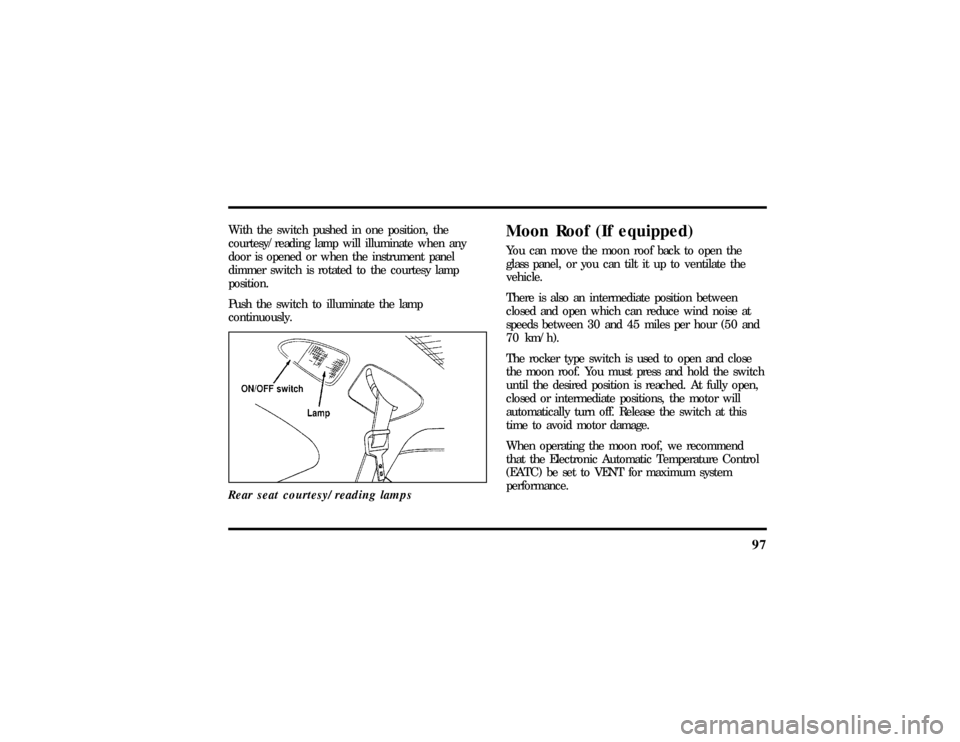
With the switch pushed in one position, the
courtesy/reading lamp will illuminate when any
door is opened or when the instrument panel
dimmer switch is rotated to the courtesy lamp
position.
Push the switch to illuminate the lamp
continuously.
Rear seat courtesy/reading lamps
Moon Roof (If equipped)You can move the moon roof back to open the
glass panel, or you can tilt it up to ventilate the
vehicle.
There is also an intermediate position between
closed and open which can reduce wind noise at
speeds between 30 and 45 miles per hour (50 and
70 km/h).
The rocker type switch is used to open and close
the moon roof. You must press and hold the switch
until the desired position is reached. At fully open,
closed or intermediate positions, the motor will
automatically turn off. Release the switch at this
time to avoid motor damage.
When operating the moon roof, we recommend
that the Electronic Automatic Temperature Control
(EATC) be set to VENT for maximum system
performance.
File:05fncf8.ex
Update:Thu Jun 27 10:02:20 1996
Page 149 of 315
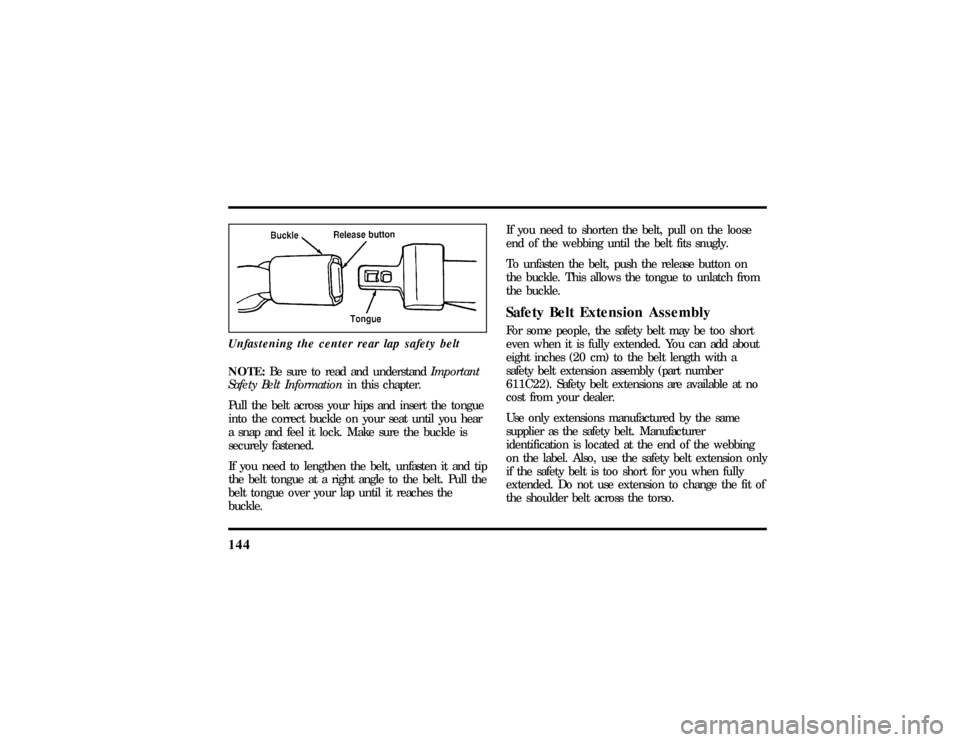
144Unfastening the center rear lap safety beltNOTE:Be sure to read and understandImportant
Safety Belt Informationin this chapter.
Pull the belt across your hips and insert the tongue
into the correct buckle on your seat until you hear
a snap and feel it lock. Make sure the buckle is
securely fastened.
If you need to lengthen the belt, unfasten it and tip
the belt tongue at a right angle to the belt. Pull the
belt tongue over your lap until it reaches the
buckle.If you need to shorten the belt, pull on the loose
end of the webbing until the belt fits snugly.
To unfasten the belt, push the release button on
the buckle. This allows the tongue to unlatch from
the buckle.
Safety Belt Extension AssemblyFor some people, the safety belt may be too short
even when it is fully extended. You can add about
eight inches (20 cm) to the belt length with a
safety belt extension assembly (part number
611C22). Safety belt extensions are available at no
cost from your dealer.
Use only extensions manufactured by the same
supplier as the safety belt. Manufacturer
identification is located at the end of the webbing
on the label. Also, use the safety belt extension only
if the safety belt is too short for you when fully
extended. Do not use extension to change the fit of
the shoulder belt across the torso.
File:06fnss8.ex
Update:Wed Jun 19 15:04:39 1996
Page 180 of 315

175
NOTE:Engine torque reduction isNOTactive
when engine coolant temperature is below-10ÊF
(-23ÊC).
During the Traction Control
TM
function, which most
often occurs during low speed acceleration on
slippery surfaces, a noise may be heard coming from
the engine compartment. This is normal and may
last for a few seconds during the acceleration of the
vehicle.
In general, this system improves your vehicle's
stability and acceleration performance when road
conditions warrant. Traction Control
TM
is fully
effective at all vehicle speeds.
If the Traction Control
TM
system is cycled
excessively, the brake portion of the system will
shut down to prevent the rear brakes from
overheating. A limited Traction Control
TM
function
using engine torque will still control wheels from
spinning. A cooling down period is required to
prevent damage to the brakes. This time periodvaries and depends on brake usage during the
cooling down period. Anti-Lock braking is not
affected and will function normally during the cool
down period.
After the cool down period, the full Traction
Control
TM
function is restored.
Air Suspension SystemYour vehicle is equipped with an automatic load
leveling air suspension system. This system
maintains the vehicle height at a constant level by
automatically adding air or releasing air from the air
springs to offset changes in vehicle loads.
A shutoff switch is located in the trunk behind the
left hand vertical trim panel. If this switch is in the
OFF position, the automatic leveling system will not
operate. The switch should be OFF whenever
jacking up the vehicle. ªAIR RIDE SWITCH OFFº
will appear in the Message Center when the
File:09fngf8.ex
Update:Wed Jun 19 10:45:23 1996
Page 191 of 315

186Do not use hitches that clamp onto your vehicle's
bumper. The bumper is not designed to bear the
load.
Always check the pressure in all your vehicle's tires
when preparing to tow (see inflation
recommendation on the tire label).Using the hitchYour vehicle uses aload carryinghitch. Because
this type of hitch places the tongue load of a trailer
on the rear wheels of your vehicle, you must
distribute the load in your trailer so that only 10 to
15% of the total weight of the trailer is on the
tongue.
Tie down the load so that it does not shift and
change the weight on the hitch. This will prevent
damage to your vehicle and make your vehicle
easier to handle.
Connecting the safety chainsAlways attach the trailer's safety chains to your
vehicle. They help protect your trailer if the hitch
breaks.
To connect the trailer's safety chains:
1. Cross the chains under the trailer tongue and
attach them to your vehicle's frame or hook
retainers. Never attach the safety chains to your
vehicle's bumper. The bumper is not designed
to bear the weight of a trailer.
2. Make sure that you leave enough slack in the
chains to allow you to turn corners.
If you use a rental trailer, follow the instructions
that the rental agency gives you.
File:09fngf8.ex
Update:Wed Jun 19 10:45:23 1996
Page 271 of 315

266NOTE:Rear axle lube quantities must be replaced
every 100,000 miles (160,000 km) or if the axle
has been submerged in water. Otherwise, the lube
should not be checked or changed unless a leak is
suspected or repair required.Vehicle StorageMaintenance TipsIf you plan on storing your vehicle for an extended
period of time (60 days or more), refer to the
following maintenance recommendations to ensure
your vehicle stays in good operating condition.Generalq
Store all vehicles in a dry, ventilated place.
q
Protect from sunlight, if possible.
q
If vehicles are stored outside, they require
regular maintenance to protect against rust and
damage.
Bodyq
Wash vehicle thoroughly to remove dirt, grease,
oil, tar or mud from exterior surfaces, rear
wheel housing and underside of front fenders.
q
Periodically wash vehicles stored in exposed
locations.
q
Touch-up raw or primed metal to prevent rust.
q
Cover chrome and stainless steel parts with a
thick coat of auto wax to prevent discoloration.
Re-wax as necessary when the vehicle is
washed.
q
Lubricate all hood, door and trunk lid hinges
and latches with a light grade oil.
q
Cover interior soft trim to prevent fading.
q
Keep all rubber parts free from oil and solvents.
File:12fncs8.ex
Update:Thu Jun 20 14:28:48 1996