seats LINCOLN MKC 2017 Owners Manual
[x] Cancel search | Manufacturer: LINCOLN, Model Year: 2017, Model line: MKC, Model: LINCOLN MKC 2017Pages: 538, PDF Size: 4.8 MB
Page 4 of 538
Introduction
About This Manual............................................7
Symbols Glossary
..............................................7
Data Recording
..................................................9
California Proposition 65................................11
Perchlorate........................................................12
Lincoln Automotive Financial Services
.........................................................12
Replacement Parts Recommendation........12
Special Notices
.................................................13
Mobile Communications Equipment
...........14
Export Unique Options...................................14
Environment
Protecting the Environment..........................16
Child Safety
General Information
........................................17
Installing Child Restraints
..............................19
Booster Seats..................................................25
Child Restraint Positioning
...........................28
Child Safety Locks..........................................29 Seatbelts
Principle of Operation
.....................................31
Fastening the Seatbelts................................32
Seatbelt Height Adjustment.........................35
Seatbelt Warning Lamp and Indicator Chime
............................................................35
Seatbelt Reminder..........................................36
Child Restraint and Seatbelt Maintenance
................................................38
Seatbelt Extension.........................................39
Personal Safety System ™
Personal Safety System ™
..............................40
Supplementary Restraints System
Principle of Operation
.....................................41
Driver and Passenger Airbags
....................42
Front Passenger Sensing System..............44
Side Airbags.....................................................47
Driver Knee Airbag.........................................48
Safety Canopy™
...............................................48
Crash Sensors and Airbag Indicator
..........49 Airbag Disposal
................................................51
Keys and Remote Controls
General Information on Radio Frequencies.................................................52
Remote Control...............................................53
Replacing a Lost Key or Remote Control...........................................................57
MyKey™
Principle of Operation...................................58
Creating a MyKey...........................................59
Clearing All MyKeys.......................................60
Checking MyKey System Status.................60
Using MyKey With Remote Start Systems..........................................................61
MyKey Troubleshooting
.................................61
Locks
Locking and Unlocking
.................................63
Power Liftgate
.................................................68
Keyless Entry.....................................................71
1
MKC (TME) Canada/United States of America, enUSA, Edition date: 01/2016, First Printing Table of Contents
Page 5 of 538
Security
Passive Anti-Theft System............................75
Anti-Theft Alarm..............................................76
Steering Wheel
Adjusting the Steering Wheel......................78
Audio Control
...................................................79
Voice Control
...................................................80
Cruise Control
.................................................80
Information Display Control
.........................80
Heated Steering Wheel..................................81
Wipers and Washers
Windshield Wipers
.........................................82
Autowipers.......................................................83
Windshield Washers
.......................................84
Rear Window Wiper and Washers..............84
Lighting
General Information.......................................86
Lighting Control
..............................................86
Autolamps.........................................................87
Instrument Lighting Dimmer........................88 Headlamp Exit Delay.....................................89
Daytime Running Lamps...............................89
Automatic High Beam Control
....................90
Direction Indicators.........................................91
Welcome Lighting
............................................91
Interior Lamps..................................................92
Ambient Lighting
............................................92
Windows and Mirrors
Power Windows
..............................................93
Global Opening and Closing.......................94
Exterior Mirrors
................................................94
Interior Mirror
...................................................97
Sun Visors.........................................................98
Moonroof..........................................................98
Instrument Cluster
Gauges..............................................................101
Warning Lamps and Indicators..................103
Audible Warnings and Indicators..............107
Information Displays
General Information......................................108 Information Messages
...................................114
Climate Control
Automatic Climate Control..........................133
Hints on Controlling the Interior Climate.........................................................135
Heated Windows and Mirrors....................136
Cabin Air Filter................................................137
Remote Start
...................................................137
Seats
Sitting in the Correct Position....................138
Head Restraints
.............................................138
Power Seats.....................................................141
Memory Function..........................................143
Rear Seats.......................................................144
Heated Seats..................................................145
Climate Controlled Seats
............................146
Rear Seat Armrest.........................................147
Universal Garage Door Opener
Universal Garage Door Opener
................148
2
MKC (TME) Canada/United States of America, enUSA, Edition date: 01/2016, First Printing Table of Contents
Page 8 of 538
Cleaning Products.......................................305
Cleaning the Exterior..................................306
Waxing.............................................................307
Cleaning the Engine
....................................307
Cleaning the Windows and Wiper Blades.........................................................308
Cleaning the Interior....................................308
Cleaning the Instrument Panel and Instrument Cluster Lens..........................310
Cleaning Leather Seats................................311
Repairing Minor Paint Damage...................311
Cleaning the Alloy Wheels.........................312
Vehicle Storage
.............................................312
Wheels and Tires
General Information......................................315
Tire Care
..........................................................317
Using Snow Chains
.......................................331
Tire Pressure Monitoring System.............332
Changing a Road Wheel.............................336
Technical Specifications
.............................342 Capacities and Specifications
Engine Specifications - 2.0L
EcoBoost™..................................................344
Engine Specifications - 2.3L EcoBoost™..................................................345
Motorcraft Parts - 2.0L EcoBoost™...........346
Motorcraft Parts - 2.3L EcoBoost™
............347
Vehicle Identification Number..................348
Vehicle Certification Label.........................348
Transmission Code Designation..............349
Capacities and Specifications - 2.0L EcoBoost™..................................................350
Capacities and Specifications - 2.3L EcoBoost™..................................................356
Audio System
General Information
.....................................362
Audio Unit - Vehicles With: Premium AM/ FM/CD.........................................................363
Media Hub
......................................................365
SYNC™ 3
General Information.....................................366
Home Screen
................................................384 Using Voice Recognition............................385
Entertainment................................................396
Climate............................................................409
Phone
...............................................................413
Navigation......................................................420
Apps
..................................................................431
Settings...........................................................434
SYNC™ 3 Troubleshooting
...........................451
Accessories
Accessories...................................................468
Lincoln Protect
Lincoln Protect
..............................................470
Scheduled Maintenance
General Maintenance Information...........472
Normal Scheduled Maintenance..............476
Special Operating Conditions Scheduled Maintenance.............................................480
Scheduled Maintenance Record..............484
5
MKC (TME) Canada/United States of America, enUSA, Edition date: 01/2016, First Printing Table of Contents
Page 16 of 538
Collision Repairs
We hope that you never experience a
collision, but accidents do happen. Genuine
Ford replacement collision parts meet our
stringent requirements for fit, finish, structural
integrity, corrosion protection and dent
resistance. During vehicle development we
validate that these parts deliver the intended
level of protection as a whole system. A
great way to know for sure you are getting
this level of protection is to use genuine Ford
replacement collision parts.
Warranty on Replacement Parts
Genuine Ford and Motorcraft replacement
parts are the only replacement parts that
benefit from a Lincoln Warranty. Damage
caused to your vehicle as a result of the
failure of non-Ford parts may not be covered
by the Lincoln Warranty. For additional
information, refer to the terms and conditions
of the Lincoln Warranty.
SPECIAL NOTICES
New Vehicle Limited Warranty
For a detailed description of what is covered
and what is not covered by your vehicle
’s
New Vehicle Limited Warranty, refer to the
Warranty Manual that is provided to you
along with your Owner’ s Manual.
Special Instructions
For your added safety, your vehicle is fitted
with sophisticated electronic controls. WARNINGS
You risk death or serious injury to
yourself and others if you do not follow
the instruction highlighted by the warning
symbol. Failure to follow the specific
warnings and instructions could result in
personal injury. Never place front seat mounted
rear-facing child or infant seats in front
of an active passenger airbag. On Board Diagnostics Data Link
Connector
WARNING
Use of wireless plug-in devices in the
OBD Data Link Connector (DLC) may
allow unauthorized third parties to gain
access to vehicle systems and data which
could impair the function of various vehicle
systems, including safety-related systems.
The DLC should only be used by a repair
facility that operates in accordance with
Ford’ s service and repair instructions. Your vehicle has an OBD Data Link
Connector (DLC) that is used in conjunction
with a diagnostic scan tool for vehicle
diagnostics, repairs and reprogramming
services. Installing an aftermarket device that
uses the DLC during normal driving for
purposes such as remote insurance company
monitoring, transmission of vehicle data to
other devices or entities, or altering the
performance of the vehicle, may cause
13
MKC (TME) Canada/United States of America, enUSA, Edition date: 01/2016, First Printing Introduction
Page 20 of 538
GENERAL INFORMATION
See the following sections for directions on
how to properly use safety restraints for
children.
WARNINGS
Always make sure your child is secured
properly in a device that is appropriate
for their height, age and weight. Child safety
restraints must be bought separately from
your vehicle. Failure to follow these
instructions and guidelines may result in an
increased risk of serious injury or death to
your child. WARNINGS
All children are shaped differently. The
recommendations for safety restraints
are based on probable child height, age and
weight thresholds from the National Highway
Traffic Safety Administration and other safety
organizations, or are the minimum
requirements of law. We recommend
checking with a NHTSA Certified Child
Passenger Safety Technician (CPST) and
consult your pediatrician to make sure your
child seat is appropriate for your child, and
is compatible with and properly installed in
your vehicle. To locate a child seat fitting
station and CPST, contact NHTSA toll free
at 1-888-327-4236 or go to
http://www.nhtsa.dot.gov. In Canada, contact WARNINGS
Transport Canada toll free at 1-800-333-0371
or go to www.tc.gc.ca to find a Child Car Seat
Clinic in your area. Failure to properly restrain
children in safety seats made especially for
their height, age, and weight may result in
an increased risk of serious injury or death
to your child. Do not leave children or animals
unattended in the vehicle. On hot days,
the temperature in the trunk or vehicle
interior can rise very quickly. Exposure of
people or animals to these high
temperatures for even a short time can cause
death or serious heat-related injuries,
including brain damage. Small children are
particularly at risk. 17
MKC (TME) Canada/United States of America, enUSA, Edition date: 01/2016, First Printing Child Safety
Page 22 of 538
•
You are required by law to properly use
safety seats for infants and toddlers in
the United States and Canada.
• Many states and provinces require that
small children use approved booster
seats until they reach age eight, a height
of 4 feet 9 inches (1.45 meters) tall, or 80
pounds (36 kilograms). Check your local
and state or provincial laws for specific
requirements about the safety of children
in your vehicle.
• When possible, always properly restrain
children 12 years of age and under in a
rear seating position of your vehicle.
Accident statistics suggest that children
are safer when properly restrained in the
rear seating positions than in a front
seating position. See Front Passenger
Sensing System (page 44). INSTALLING CHILD RESTRAINTS
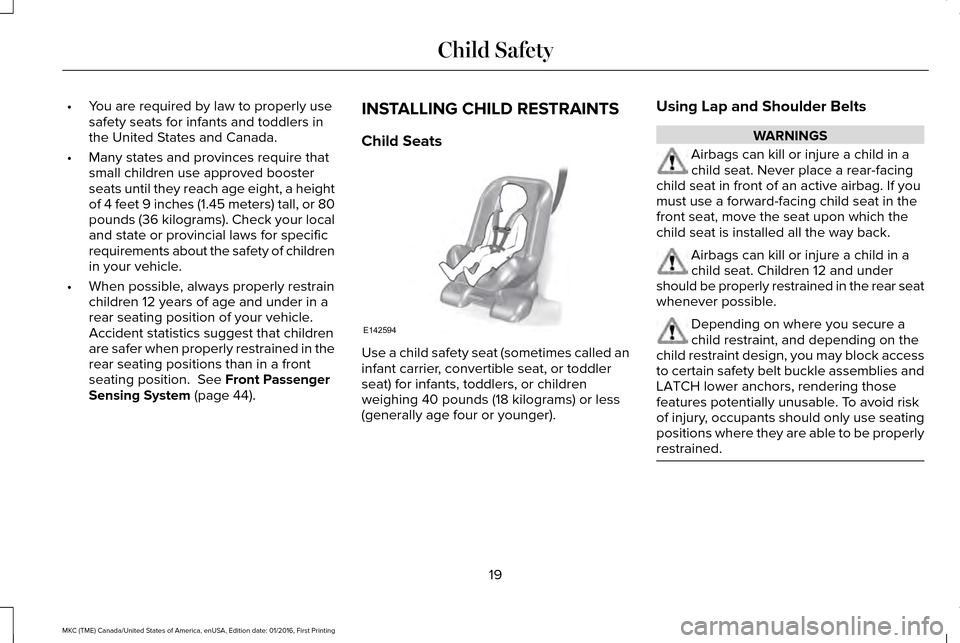
Child Seats
Use a child safety seat (sometimes called an
infant carrier, convertible seat, or toddler
seat) for infants, toddlers, or children
weighing 40 pounds (18 kilograms) or less
(generally age four or younger).Using Lap and Shoulder Belts WARNINGS
Airbags can kill or injure a child in a
child seat. Never place a rear-facing
child seat in front of an active airbag. If you
must use a forward-facing child seat in the
front seat, move the seat upon which the
child seat is installed all the way back. Airbags can kill or injure a child in a
child seat. Children 12 and under
should be properly restrained in the rear seat
whenever possible. Depending on where you secure a
child restraint, and depending on the
child restraint design, you may block access
to certain safety belt buckle assemblies and
LATCH lower anchors, rendering those
features potentially unusable. To avoid risk
of injury, occupants should only use seating
positions where they are able to be properly
restrained. 19
MKC (TME) Canada/United States of America, enUSA, Edition date: 01/2016, First Printing Child SafetyE142594
Page 24 of 538
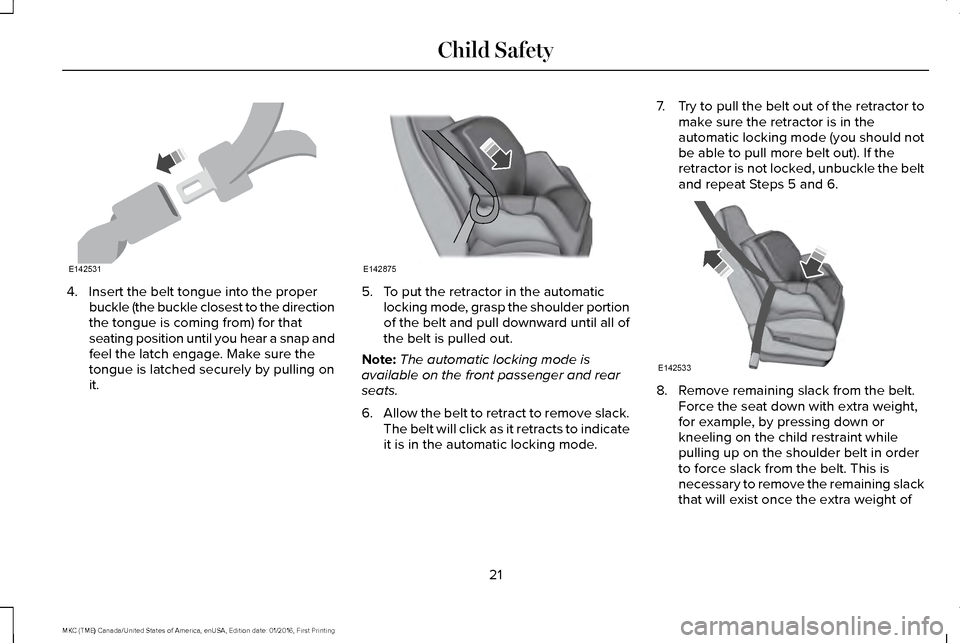
4. Insert the belt tongue into the proper
buckle (the buckle closest to the direction
the tongue is coming from) for that
seating position until you hear a snap and
feel the latch engage. Make sure the
tongue is latched securely by pulling on
it. 5. To put the retractor in the automatic
locking mode, grasp the shoulder portion
of the belt and pull downward until all of
the belt is pulled out.
Note: The automatic locking mode is
available on the front passenger and rear
seats.
6. Allow the belt to retract to remove slack.
The belt will click as it retracts to indicate
it is in the automatic locking mode. 7.
Try to pull the belt out of the retractor to
make sure the retractor is in the
automatic locking mode (you should not
be able to pull more belt out). If the
retractor is not locked, unbuckle the belt
and repeat Steps 5 and 6. 8. Remove remaining slack from the belt.
Force the seat down with extra weight,
for example, by pressing down or
kneeling on the child restraint while
pulling up on the shoulder belt in order
to force slack from the belt. This is
necessary to remove the remaining slack
that will exist once the extra weight of
21
MKC (TME) Canada/United States of America, enUSA, Edition date: 01/2016, First Printing Child SafetyE142531 E142875 E142533
Page 25 of 538
the child is added to the child restraint.
It also helps to achieve the proper
snugness of the child seat to your
vehicle. Sometimes, a slight lean toward
the buckle will additionally help to
remove remaining slack from the belt.
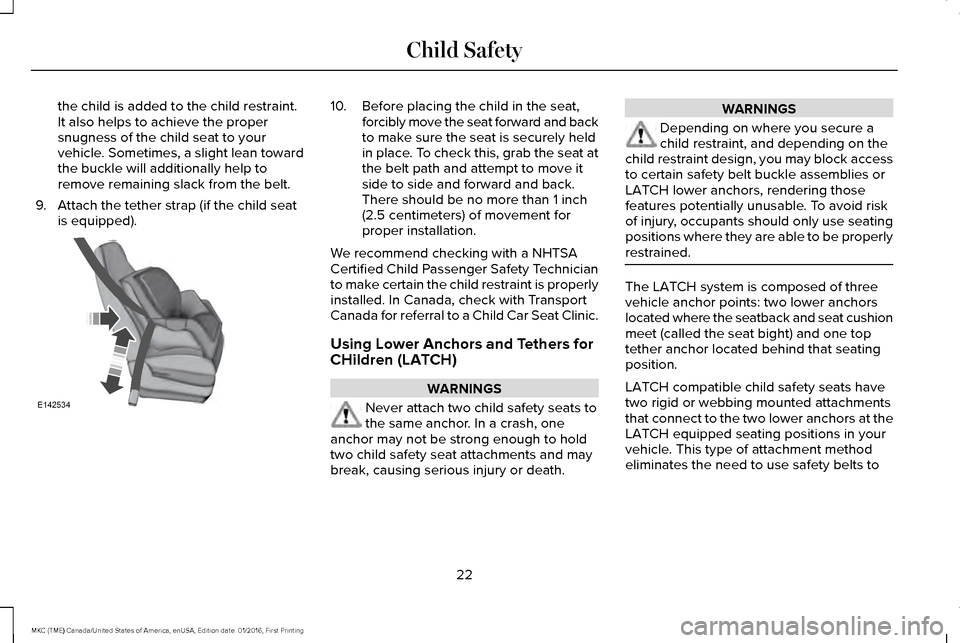
9. Attach the tether strap (if the child seat is equipped). 10. Before placing the child in the seat,
forcibly move the seat forward and back
to make sure the seat is securely held
in place. To check this, grab the seat at
the belt path and attempt to move it
side to side and forward and back.
There should be no more than 1 inch
(2.5 centimeters) of movement for
proper installation.
We recommend checking with a NHTSA
Certified Child Passenger Safety Technician
to make certain the child restraint is properly
installed. In Canada, check with Transport
Canada for referral to a Child Car Seat Clinic.
Using Lower Anchors and Tethers for
CHildren (LATCH) WARNINGS
Never attach two child safety seats to
the same anchor. In a crash, one
anchor may not be strong enough to hold
two child safety seat attachments and may
break, causing serious injury or death. WARNINGS
Depending on where you secure a
child restraint, and depending on the
child restraint design, you may block access
to certain safety belt buckle assemblies or
LATCH lower anchors, rendering those
features potentially unusable. To avoid risk
of injury, occupants should only use seating
positions where they are able to be properly
restrained. The LATCH system is composed of three
vehicle anchor points: two lower anchors
located where the seatback and seat cushion
meet (called the seat bight) and one top
tether anchor located behind that seating
position.
LATCH compatible child safety seats have
two rigid or webbing mounted attachments
that connect to the two lower anchors at the
LATCH equipped seating positions in your
vehicle. This type of attachment method
eliminates the need to use safety belts to
22
MKC (TME) Canada/United States of America, enUSA, Edition date: 01/2016, First Printing Child SafetyE142534
Page 26 of 538
attach the child seat, however the safety belt
can still be used to attach the child seat. For
forward-facing child seats, the top tether
strap must also be attached to the proper
top tether anchor, if a top tether strap has
been provided with your child seat.
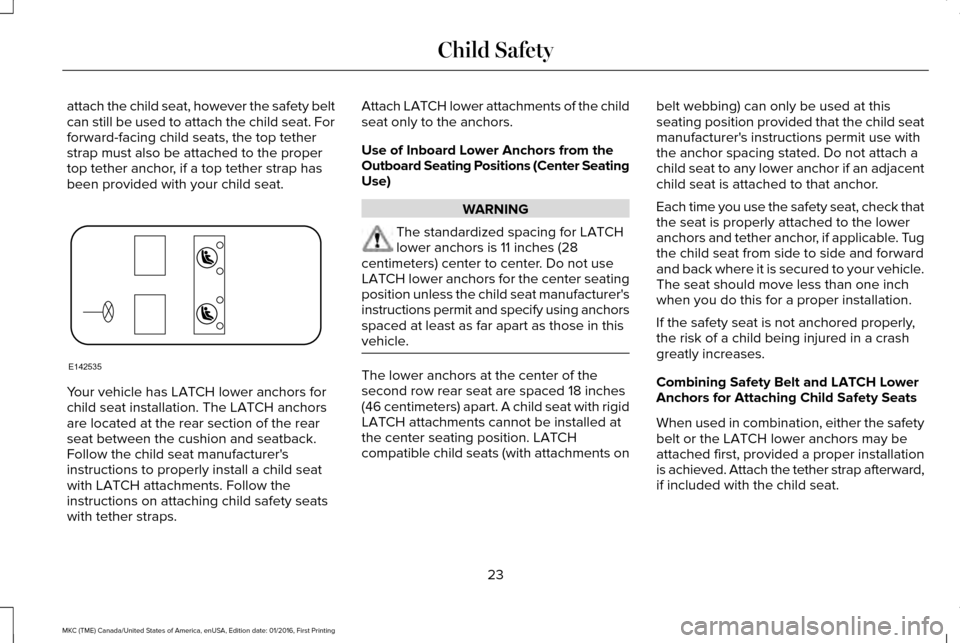
Your vehicle has LATCH lower anchors for
child seat installation. The LATCH anchors
are located at the rear section of the rear
seat between the cushion and seatback.
Follow the child seat manufacturer's
instructions to properly install a child seat
with LATCH attachments. Follow the
instructions on attaching child safety seats
with tether straps. Attach LATCH lower attachments of the child
seat only to the anchors.
Use of Inboard Lower Anchors from the
Outboard Seating Positions (Center Seating
Use)
WARNING
The standardized spacing for LATCH
lower anchors is 11 inches (28
centimeters) center to center. Do not use
LATCH lower anchors for the center seating
position unless the child seat manufacturer's
instructions permit and specify using anchors
spaced at least as far apart as those in this
vehicle. The lower anchors at the center of the
second row rear seat are spaced 18 inches
(46 centimeters) apart. A child seat with rigid
LATCH attachments cannot be installed at
the center seating position. LATCH
compatible child seats (with attachments onbelt webbing) can only be used at this
seating position provided that the child seat
manufacturer's instructions permit use with
the anchor spacing stated. Do not attach a
child seat to any lower anchor if an adjacent
child seat is attached to that anchor.
Each time you use the safety seat, check that
the seat is properly attached to the lower
anchors and tether anchor, if applicable. Tug
the child seat from side to side and forward
and back where it is secured to your vehicle.
The seat should move less than one inch
when you do this for a proper installation.
If the safety seat is not anchored properly,
the risk of a child being injured in a crash
greatly increases.
Combining Safety Belt and LATCH Lower
Anchors for Attaching Child Safety Seats
When used in combination, either the safety
belt or the LATCH lower anchors may be
attached first, provided a proper installation
is achieved. Attach the tether strap afterward,
if included with the child seat.
23
MKC (TME) Canada/United States of America, enUSA, Edition date: 01/2016, First Printing Child SafetyE142535
Page 27 of 538
Using Tether Straps
Many forward-facing child safety
seats include a tether strap which
extends from the back of the child
safety seat and hooks to an anchoring point
called the top tether anchor. Tether straps
are available as an accessory for many older
safety seats.
Contact the manufacturer of your child seat
for information about ordering a tether strap,
or to obtain a longer tether strap if the tether
strap on your safety seat does not reach the
appropriate top tether anchor in your vehicle.
Once the child safety seat has been installed
using either the safety belt, the lower
anchors of the LATCH system, or both, you
can attach the top tether strap.
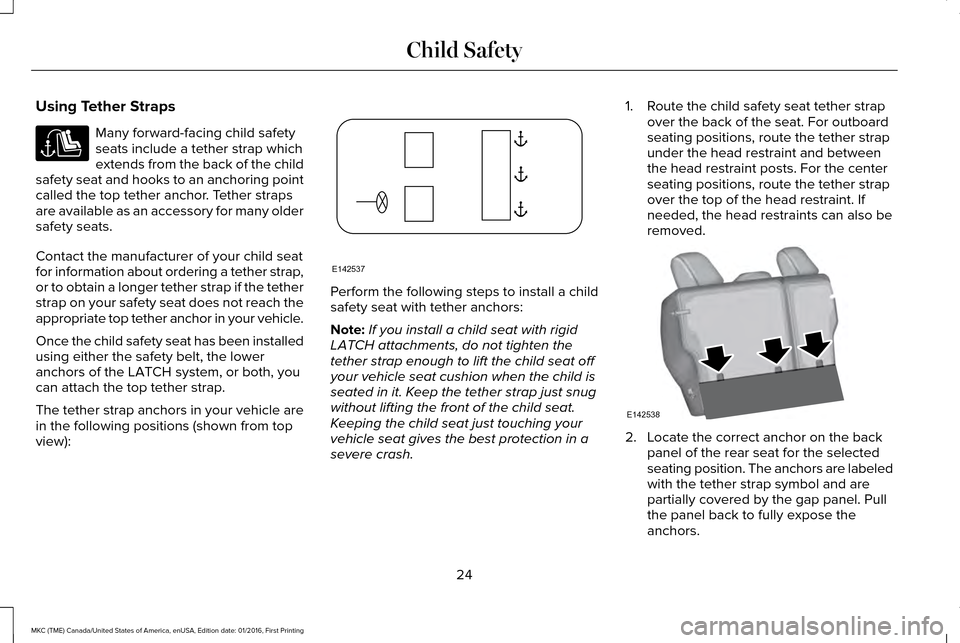
The tether strap anchors in your vehicle are
in the following positions (shown from top
view): Perform the following steps to install a child
safety seat with tether anchors:
Note:
If you install a child seat with rigid
LATCH attachments, do not tighten the
tether strap enough to lift the child seat off
your vehicle seat cushion when the child is
seated in it. Keep the tether strap just snug
without lifting the front of the child seat.
Keeping the child seat just touching your
vehicle seat gives the best protection in a
severe crash. 1. Route the child safety seat tether strap
over the back of the seat. For outboard
seating positions, route the tether strap
under the head restraint and between
the head restraint posts. For the center
seating positions, route the tether strap
over the top of the head restraint. If
needed, the head restraints can also be
removed. 2. Locate the correct anchor on the back
panel of the rear seat for the selected
seating position. The anchors are labeled
with the tether strap symbol and are
partially covered by the gap panel. Pull
the panel back to fully expose the
anchors.
24
MKC (TME) Canada/United States of America, enUSA, Edition date: 01/2016, First Printing Child Safety E142537 E142538