warning LINCOLN MKC 2018 User Guide
[x] Cancel search | Manufacturer: LINCOLN, Model Year: 2018, Model line: MKC, Model: LINCOLN MKC 2018Pages: 571, PDF Size: 4.39 MB
Page 21 of 571
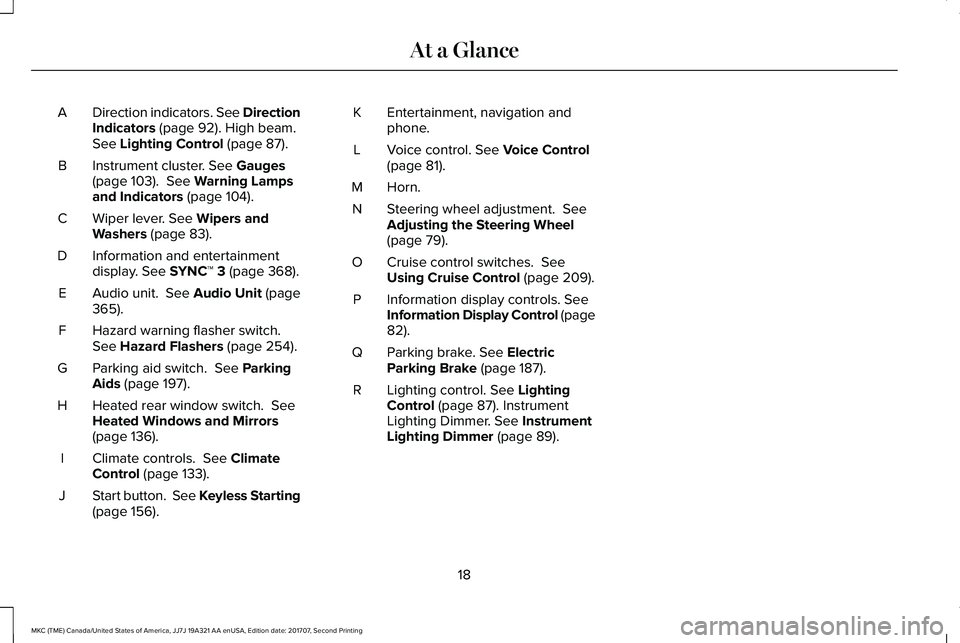
Direction indicators. See DirectionIndicators (page 92). High beam.See Lighting Control (page 87).
A
Instrument cluster. See Gauges(page 103). See Warning Lampsand Indicators (page 104).
B
Wiper lever. See Wipers andWashers (page 83).C
Information and entertainmentdisplay. See SYNC™ 3 (page 368).D
Audio unit. See Audio Unit (page365).E
Hazard warning flasher switch.See Hazard Flashers (page 254).F
Parking aid switch. See ParkingAids (page 197).G
Heated rear window switch. SeeHeated Windows and Mirrors(page 136).
H
Climate controls. See ClimateControl (page 133).I
Start button. See Keyless Starting(page 156).J
Entertainment, navigation andphone.K
Voice control. See Voice Control(page 81).L
Horn.M
Steering wheel adjustment. SeeAdjusting the Steering Wheel(page 79).
N
Cruise control switches. SeeUsing Cruise Control (page 209).O
Information display controls. SeeInformation Display Control (page82).
P
Parking brake. See ElectricParking Brake (page 187).Q
Lighting control. See LightingControl (page 87). InstrumentLighting Dimmer. See InstrumentLighting Dimmer (page 89).
R
18
MKC (TME) Canada/United States of America, JJ7J 19A321 AA enUSA, Edition date: 201707, Second Printing
At a Glance
Page 22 of 571
GENERAL INFORMATION
See the following sections for directions onhow to properly use safety restraints forchildren.
WARNINGS
Always make sure your child is securedproperly in a device that is appropriatefor their height, age and weight. Child safetyrestraints must be bought separately fromyour vehicle. Failure to follow theseinstructions and guidelines may result in anincreased risk of serious injury or death toyour child.
WARNINGS
All children are shaped differently. TheNational Highway Traffic SafetyAdministration and other safetyorganizations, base their recommendationsfor child restraints on probable child height,age and weight thresholds, or on theminimum requirements of the law. Werecommend that you check with a NHTSACertified Child Passenger Safety Technician(CPST) to make sure that you properly installthe child restraint in your vehicle and thatyou consult your pediatrician to make sureyou have a child restraint appropriate foryour child. To locate a child restraint fittingstation and CPST, contact NHTSA toll freeat 1-888-327-4236 or go to
WARNINGS
www.nhtsa.dot.gov. In Canada, contactTransport Canada toll free at 1-800-333-0371or go to www.tc.gc.ca to find a Child Car SeatClinic in your area. Failure to properly restrainchildren in child restraints made especiallyfor their height, age and weight, may resultin an increased risk of serious injury or deathto your child.
On hot days, the temperature insidethe vehicle can rise very quickly.Exposure of people or animals to these hightemperatures for even a short time can causedeath or serious heat related injuries,including brain damage. Small children areparticularly at risk.
19
MKC (TME) Canada/United States of America, JJ7J 19A321 AA enUSA, Edition date: 201707, Second Printing
Child Safety
Page 24 of 571
•You are required by law to properly usesafety seats for infants and toddlers inthe United States and Canada.
•Many states and provinces require thatsmall children use approved boosterseats until they reach age eight, a heightof 4 feet 9 inches (1.45 meters) tall, or80 lb (36 kg). Check your local and stateor provincial laws for specificrequirements about the safety of childrenin your vehicle.
•When possible, always properly restrainchildren 12 years of age and under in arear seating position of your vehicle.Accident statistics suggest that childrenare safer when properly restrained in therear seating positions than in a frontseating position. See Front PassengerSensing System (page 46).
INSTALLING CHILD RESTRAINTS
Child Seats
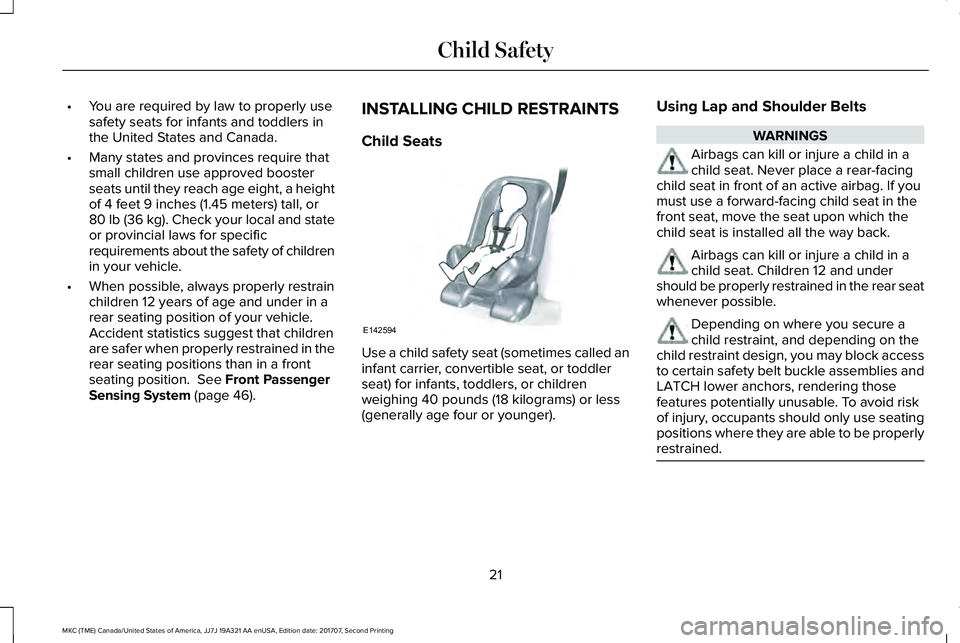
Use a child safety seat (sometimes called aninfant carrier, convertible seat, or toddlerseat) for infants, toddlers, or childrenweighing 40 pounds (18 kilograms) or less(generally age four or younger).
Using Lap and Shoulder Belts
WARNINGS
Airbags can kill or injure a child in achild seat. Never place a rear-facingchild seat in front of an active airbag. If youmust use a forward-facing child seat in thefront seat, move the seat upon which thechild seat is installed all the way back.
Airbags can kill or injure a child in achild seat. Children 12 and undershould be properly restrained in the rear seatwhenever possible.
Depending on where you secure achild restraint, and depending on thechild restraint design, you may block accessto certain safety belt buckle assemblies andLATCH lower anchors, rendering thosefeatures potentially unusable. To avoid riskof injury, occupants should only use seatingpositions where they are able to be properlyrestrained.
21
MKC (TME) Canada/United States of America, JJ7J 19A321 AA enUSA, Edition date: 201707, Second Printing
Child SafetyE142594
Page 27 of 571
the child is added to the child restraint.It also helps to achieve the propersnugness of the child seat to yourvehicle. Sometimes, a slight lean towardthe buckle will additionally help toremove remaining slack from the belt.
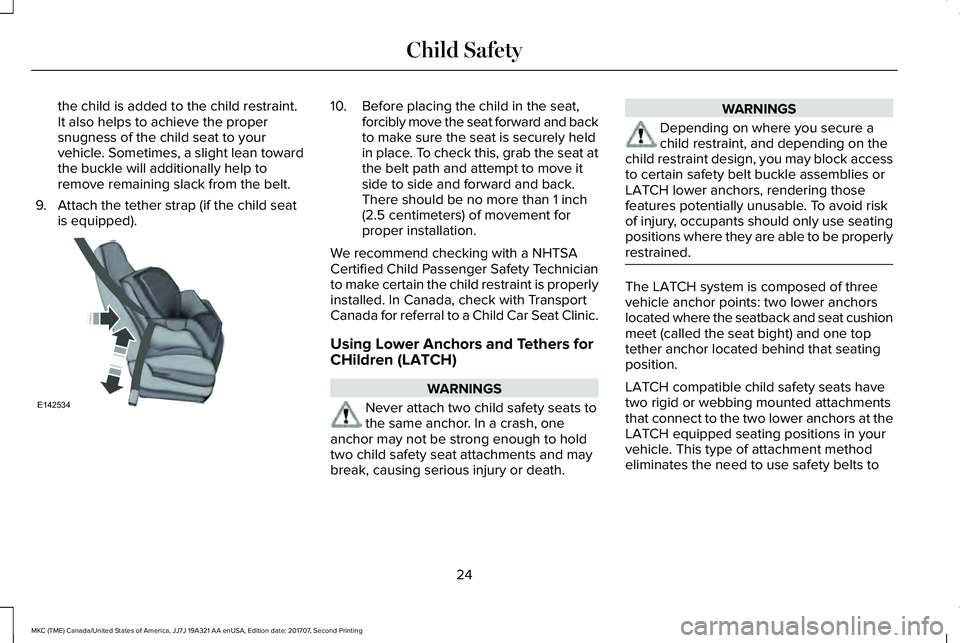
9. Attach the tether strap (if the child seatis equipped).
10. Before placing the child in the seat,forcibly move the seat forward and backto make sure the seat is securely heldin place. To check this, grab the seat atthe belt path and attempt to move itside to side and forward and back.There should be no more than 1 inch(2.5 centimeters) of movement forproper installation.
We recommend checking with a NHTSACertified Child Passenger Safety Technicianto make certain the child restraint is properlyinstalled. In Canada, check with TransportCanada for referral to a Child Car Seat Clinic.
Using Lower Anchors and Tethers forCHildren (LATCH)
WARNINGS
Never attach two child safety seats tothe same anchor. In a crash, oneanchor may not be strong enough to holdtwo child safety seat attachments and maybreak, causing serious injury or death.
WARNINGS
Depending on where you secure achild restraint, and depending on thechild restraint design, you may block accessto certain safety belt buckle assemblies orLATCH lower anchors, rendering thosefeatures potentially unusable. To avoid riskof injury, occupants should only use seatingpositions where they are able to be properlyrestrained.
The LATCH system is composed of threevehicle anchor points: two lower anchorslocated where the seatback and seat cushionmeet (called the seat bight) and one toptether anchor located behind that seatingposition.
LATCH compatible child safety seats havetwo rigid or webbing mounted attachmentsthat connect to the two lower anchors at theLATCH equipped seating positions in yourvehicle. This type of attachment methodeliminates the need to use safety belts to
24
MKC (TME) Canada/United States of America, JJ7J 19A321 AA enUSA, Edition date: 201707, Second Printing
Child SafetyE142534
Page 28 of 571
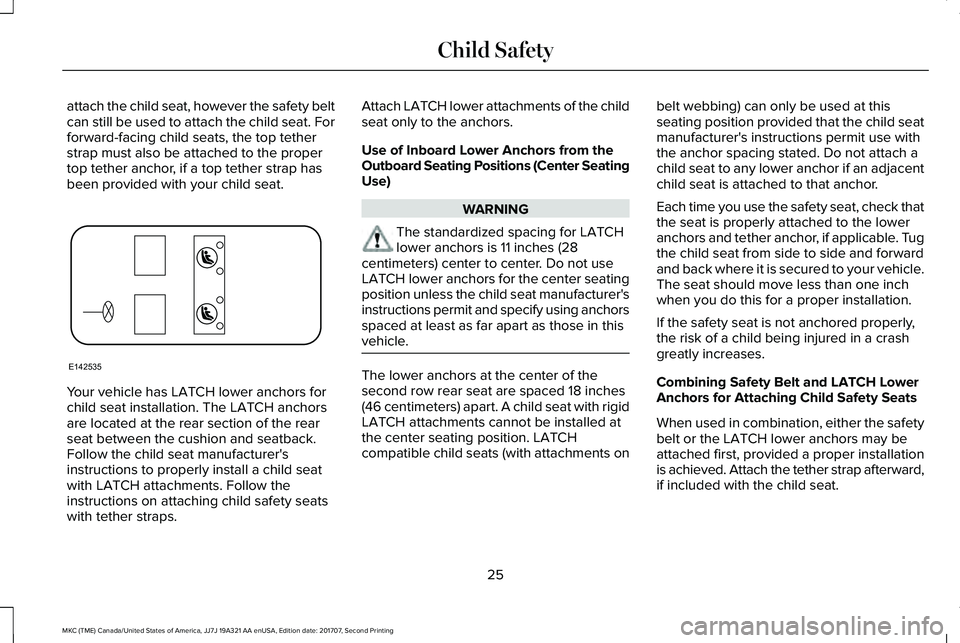
attach the child seat, however the safety beltcan still be used to attach the child seat. Forforward-facing child seats, the top tetherstrap must also be attached to the propertop tether anchor, if a top tether strap hasbeen provided with your child seat.
Your vehicle has LATCH lower anchors forchild seat installation. The LATCH anchorsare located at the rear section of the rearseat between the cushion and seatback.Follow the child seat manufacturer'sinstructions to properly install a child seatwith LATCH attachments. Follow theinstructions on attaching child safety seatswith tether straps.
Attach LATCH lower attachments of the childseat only to the anchors.
Use of Inboard Lower Anchors from theOutboard Seating Positions (Center SeatingUse)
WARNING
The standardized spacing for LATCHlower anchors is 11 inches (28centimeters) center to center. Do not useLATCH lower anchors for the center seatingposition unless the child seat manufacturer'sinstructions permit and specify using anchorsspaced at least as far apart as those in thisvehicle.
The lower anchors at the center of thesecond row rear seat are spaced 18 inches(46 centimeters) apart. A child seat with rigidLATCH attachments cannot be installed atthe center seating position. LATCHcompatible child seats (with attachments on
belt webbing) can only be used at thisseating position provided that the child seatmanufacturer's instructions permit use withthe anchor spacing stated. Do not attach achild seat to any lower anchor if an adjacentchild seat is attached to that anchor.
Each time you use the safety seat, check thatthe seat is properly attached to the loweranchors and tether anchor, if applicable. Tugthe child seat from side to side and forwardand back where it is secured to your vehicle.The seat should move less than one inchwhen you do this for a proper installation.
If the safety seat is not anchored properly,the risk of a child being injured in a crashgreatly increases.
Combining Safety Belt and LATCH LowerAnchors for Attaching Child Safety Seats
When used in combination, either the safetybelt or the LATCH lower anchors may beattached first, provided a proper installationis achieved. Attach the tether strap afterward,if included with the child seat.
25
MKC (TME) Canada/United States of America, JJ7J 19A321 AA enUSA, Edition date: 201707, Second Printing
Child SafetyE142535
Page 30 of 571
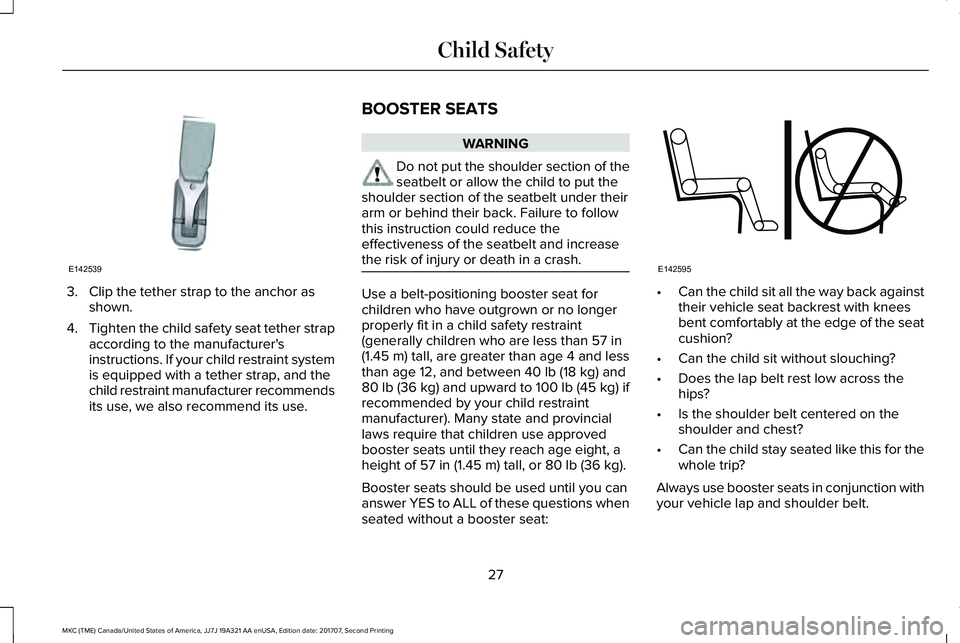
3. Clip the tether strap to the anchor asshown.
4.Tighten the child safety seat tether strapaccording to the manufacturer'sinstructions. If your child restraint systemis equipped with a tether strap, and thechild restraint manufacturer recommendsits use, we also recommend its use.
BOOSTER SEATS
WARNING
Do not put the shoulder section of theseatbelt or allow the child to put theshoulder section of the seatbelt under theirarm or behind their back. Failure to followthis instruction could reduce theeffectiveness of the seatbelt and increasethe risk of injury or death in a crash.
Use a belt-positioning booster seat forchildren who have outgrown or no longerproperly fit in a child safety restraint(generally children who are less than 57 in(1.45 m) tall, are greater than age 4 and lessthan age 12, and between 40 lb (18 kg) and80 lb (36 kg) and upward to 100 lb (45 kg) ifrecommended by your child restraintmanufacturer). Many state and provinciallaws require that children use approvedbooster seats until they reach age eight, aheight of 57 in (1.45 m) tall, or 80 lb (36 kg).
Booster seats should be used until you cananswer YES to ALL of these questions whenseated without a booster seat:
•Can the child sit all the way back againsttheir vehicle seat backrest with kneesbent comfortably at the edge of the seatcushion?
•Can the child sit without slouching?
•Does the lap belt rest low across thehips?
•Is the shoulder belt centered on theshoulder and chest?
•Can the child stay seated like this for thewhole trip?
Always use booster seats in conjunction withyour vehicle lap and shoulder belt.
27
MKC (TME) Canada/United States of America, JJ7J 19A321 AA enUSA, Edition date: 201707, Second Printing
Child SafetyE142539 E142595
Page 33 of 571
If the booster seat slides on the vehicle seatupon which it is being used, placing arubberized mesh sold as shelf or carpet linerunder the booster seat may improve thiscondition. Do not introduce any item thickerthan this under the booster seat. Check withthe booster seat manufacturer's instructions.
CHILD RESTRAINT POSITIONING
WARNINGS
Airbags can kill or injure a child in achild seat. Never place a rear-facingchild seat in front of an active airbag. If youmust use a forward-facing child seat in thefront seat, move the vehicle seat upon whichthe child seat is installed all the way back.When possible, all children age 12 and undershould be properly restrained in a rearseating position. If all children cannot beseated and restrained properly in a rearseating position, properly restrain the largestchild in the front seat.
WARNINGS
Always carefully follow the instructionsand warnings provided by themanufacturer of any child restraint todetermine if the restraint device isappropriate for your child's size, height,weight, or age. Follow the child restraintmanufacturer's instructions and warningsprovided for installation and use inconjunction with the instructions andwarnings provided by your vehiclemanufacturer. A safety seat that is improperlyinstalled or utilized, is inappropriate for yourchild's height, age, or weight or does notproperly fit the child may increase the risk ofserious injury or death.
Never let a passenger hold a child onhis or her lap while your vehicle ismoving. The passenger cannot protect thechild from injury in a crash, which may resultin serious injury or death.
WARNINGS
Never use pillows, books, or towels toboost a child. They can slide aroundand increase the likelihood of injury or deathin a crash.
Always restrain an unoccupied childseat or booster seat. These objectsmay become projectiles in a crash or suddenstop, which may increase the risk of seriousinjury.
Never place, or allow a child to place,the shoulder belt under a child's armor behind the back because it reduces theprotection for the upper part of the body andmay increase the risk of injury or death in acrash.
To avoid risk of injury, do not leavechildren or pets unattended in yourvehicle.
30
MKC (TME) Canada/United States of America, JJ7J 19A321 AA enUSA, Edition date: 201707, Second Printing
Child Safety
Page 36 of 571
PRINCIPLE OF OPERATION
WARNINGS
Always drive and ride with yourseatback upright and the lap belt snugand low across the hips.
To reduce the risk of injury, make surechildren sit where they can be properlyrestrained.
Never let a passenger hold a child onhis or her lap while your vehicle ismoving. The passenger cannot protect thechild from injury in a crash.
All occupants of your vehicle, includingthe driver, should always properly weartheir safety belts, even when an airbagsupplemental restraint system is provided.
WARNINGS
It is extremely dangerous to ride in acargo area, inside or outside of avehicle. In a crash, people riding in theseareas are more likely to be seriously injuredor killed. Do not allow people to ride in anyarea of your vehicle that is not equipped withseats and safety belts. Be sure everyone inyour vehicle is in a seat and using a safetybelt properly.
In a rollover crash, an unbelted personis significantly more likely to die thana person wearing a safety belt.
Each seating position in your vehiclehas a specific safety belt assemblywhich is made up of one buckle and onetongue that are designed to be used as apair. 1) Use the shoulder belt on the outsideshoulder only. Never wear the shoulder beltunder the arm. 2) Never swing the safety beltaround your neck over the inside shoulder.3) Never use a single belt for more than oneperson.
When possible, all children 12 years oldand under should be properlyrestrained in a rear seating position.
WARNINGS
Safety belts and seats can become hotin a vehicle that has been closed up insunny weather; they could burn a small child.Check seat covers and buckles before youplace a child anywhere near them.
Front and rear seat occupants,including pregnant women, shouldwear safety belts for optimum protection inan accident.
All seating positions in this vehicle have lapand shoulder safety belts. All occupants ofthe vehicle should always properly wear theirsafety belts, even when an airbagsupplemental restraint system is provided.
The safety belt system consists of:
•lap and shoulder safety belts
•shoulder safety belt with automaticlocking mode, (except driver safety belt)
•height adjuster at the front outboardseating positions
33
MKC (TME) Canada/United States of America, JJ7J 19A321 AA enUSA, Edition date: 201707, Second Printing
Seatbelts
Page 37 of 571
•retractor and anchor pretensioner at thefront outboard seating positions
•belt tension sensor at the front outboardpassenger seating position
•safety belt warning light and chime
•crash sensors and monitoring systemwith readiness indicator.
The safety belt pretensioners are designedto activate in frontal, near-frontal and sidecrashes, and in rollovers. The safety beltpretensioners on the retractor and anchor atthe front seating positions are designed totighten the safety belts firmly against theoccupant's body when activated. This helpsincrease the effectiveness of the safety belts.In frontal crashes, the safety beltpretensioners can be activated alone or, ifthe crash is of sufficient severity, togetherwith the front airbags.
FASTENING THE SEATBELTS
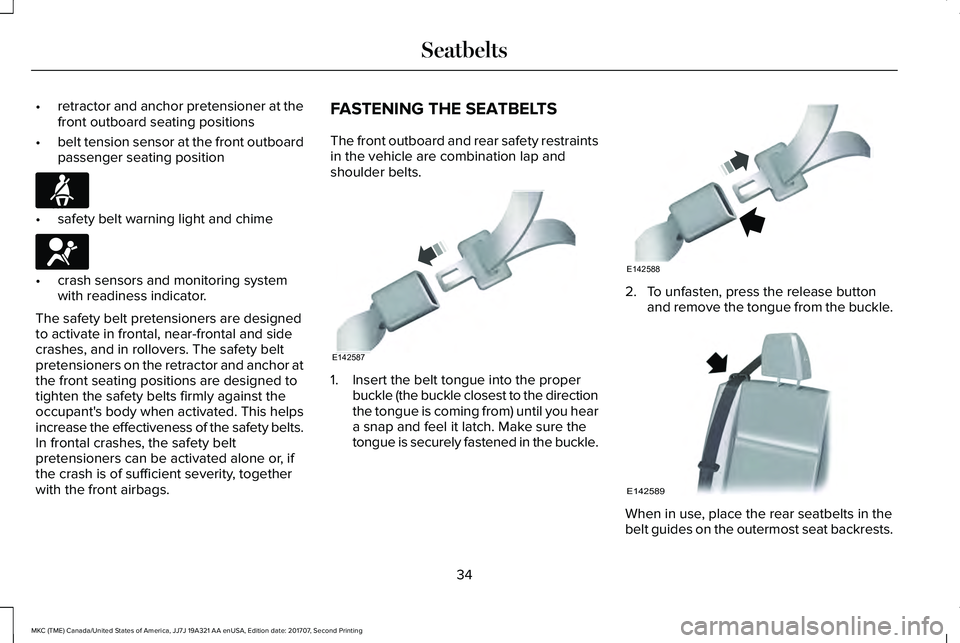
The front outboard and rear safety restraintsin the vehicle are combination lap andshoulder belts.
1. Insert the belt tongue into the properbuckle (the buckle closest to the directionthe tongue is coming from) until you heara snap and feel it latch. Make sure thetongue is securely fastened in the buckle.
2. To unfasten, press the release buttonand remove the tongue from the buckle.
When in use, place the rear seatbelts in thebelt guides on the outermost seat backrests.
34
MKC (TME) Canada/United States of America, JJ7J 19A321 AA enUSA, Edition date: 201707, Second Printing
SeatbeltsE71880 E67017 E142587 E142588 E142589
Page 38 of 571
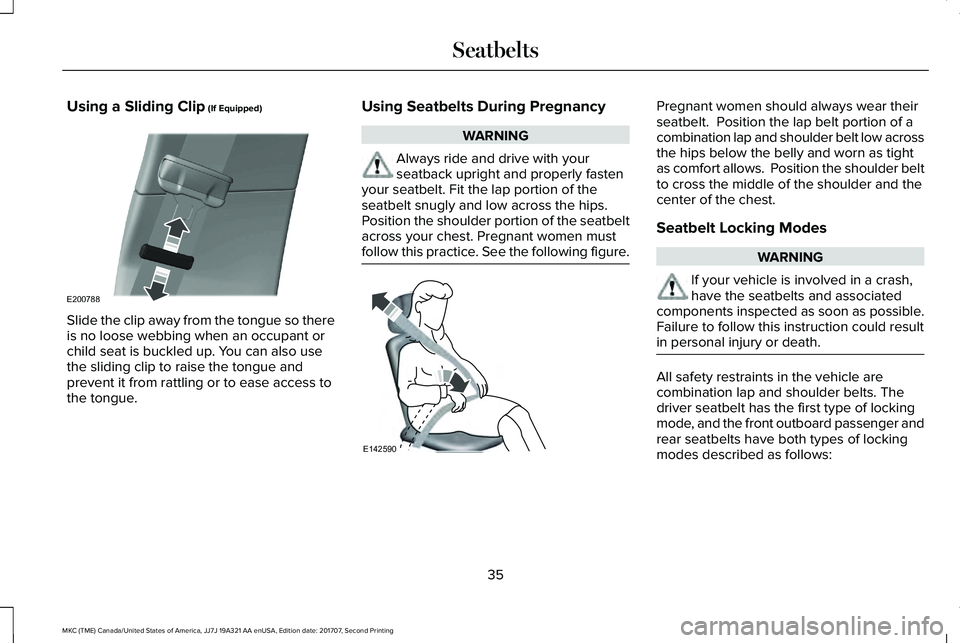
Using a Sliding Clip (If Equipped)
Slide the clip away from the tongue so thereis no loose webbing when an occupant orchild seat is buckled up. You can also usethe sliding clip to raise the tongue andprevent it from rattling or to ease access tothe tongue.
Using Seatbelts During Pregnancy
WARNING
Always ride and drive with yourseatback upright and properly fastenyour seatbelt. Fit the lap portion of theseatbelt snugly and low across the hips.Position the shoulder portion of the seatbeltacross your chest. Pregnant women mustfollow this practice. See the following figure.
Pregnant women should always wear theirseatbelt. Position the lap belt portion of acombination lap and shoulder belt low acrossthe hips below the belly and worn as tightas comfort allows. Position the shoulder beltto cross the middle of the shoulder and thecenter of the chest.
Seatbelt Locking Modes
WARNING
If your vehicle is involved in a crash,have the seatbelts and associatedcomponents inspected as soon as possible.Failure to follow this instruction could resultin personal injury or death.
All safety restraints in the vehicle arecombination lap and shoulder belts. Thedriver seatbelt has the first type of lockingmode, and the front outboard passenger andrear seatbelts have both types of lockingmodes described as follows:
35
MKC (TME) Canada/United States of America, JJ7J 19A321 AA enUSA, Edition date: 201707, Second Printing
SeatbeltsE200788 E142590