weight LINCOLN MKT 2017 Owners Manual
[x] Cancel search | Manufacturer: LINCOLN, Model Year: 2017, Model line: MKT, Model: LINCOLN MKT 2017Pages: 558, PDF Size: 4.59 MB
Page 7 of 558
Load Carrying
Rear Under Floor Storage..........................236
Cargo Nets
.....................................................236
Luggage Covers
...........................................236
Load Limit
.......................................................237
Towing
Towing a Trailer.............................................242
Trailer Sway Control....................................243
Recommended Towing Weights...............243
Essential Towing Checks
............................245
Towing the Vehicle on Four Wheels - 3.5L Ecoboost™/3.7L.........................................248
Driving Hints
Breaking-In......................................................251
Economical Driving
.......................................251
Driving Through Water
................................251
Floor Mats
......................................................252
Roadside Emergencies
Roadside Assistance
...................................254
Hazard Warning Flashers
...........................255 Fuel Shutoff...................................................255
Jump Starting the Vehicle
..........................256
Customer Assistance
Getting the Services You Need................259
In California (U.S. Only)...............................260
The Better Business Bureau (BBB) Auto Line Program (U.S. Only)
.........................261
Utilizing the Mediation/Arbitration Program (Canada Only)
...........................................262
Getting Assistance Outside the U.S. and Canada.......................................................263
Ordering Additional Owner's Literature....................................................265
Reporting Safety Defects (U.S. Only)......265
Reporting Safety Defects (Canada Only)............................................................266
Fuses
Fuse Specification Chart............................267
Changing a Fuse..........................................283
Maintenance
General Information
.....................................286 Opening and Closing the Hood...............287
Under Hood Overview - 3.5L
Ecoboost™..................................................288
Under Hood Overview - 3.7L....................290
Engine Oil Dipstick - 3.5L Ecoboost™/ 3.7L..............................................................292
Engine Oil Check.........................................292
Oil Change Indicator Reset
.......................293
Engine Coolant Check................................294
Automatic Transmission Fluid Check - 3.5L Ecoboost™/3.7L.........................................298
Brake Fluid Check.......................................300
Power Steering Fluid Check.......................301
Washer Fluid Check.....................................301
Changing the 12V Battery...........................301
Checking the Wiper Blades.......................303
Changing the Wiper Blades......................303
Adjusting the Headlamps...........................304
Removing a Headlamp
...............................305
Changing a Bulb...........................................305
Bulb Specification Chart.............................307
Changing the Engine Air Filter
..................310
4
MKT (TP4) , enUSA, First Printing Table of Contents
Page 21 of 558
GENERAL INFORMATION
See the following sections for directions on
how to properly use safety restraints for
children.
WARNINGS
Always make sure your child is secured
properly in a device that is appropriate
for their height, age and weight. Child safety
restraints must be bought separately from
your vehicle. Failure to follow these
instructions and guidelines may result in an
increased risk of serious injury or death to
your child. WARNINGS
All children are shaped differently. The
National Highway Traffic Safety
Administration and other safety
organizations, base their recommendations
for child restraints on probable child height,
age and weight thresholds, or on the
minimum requirements of the law. We
recommend that you check with a NHTSA
Certified Child Passenger Safety Technician
(CPST) to make sure that you properly install
the child restraint in your vehicle and that
you consult your pediatrician to make sure
you have a child restraint appropriate for
your child. To locate a child restraint fitting
station and CPST, contact NHTSA toll free
at 1-888-327-4236 or go to WARNINGS
www.nhtsa.dot.gov. In Canada, contact
Transport Canada toll free at 1-800-333-0371
or go to www.tc.gc.ca to find a Child Car Seat
Clinic in your area. Failure to properly restrain
children in child restraints made especially
for their height, age and weight, may result
in an increased risk of serious injury or death
to your child. On hot days, the temperature inside
the vehicle can rise very quickly.
Exposure of people or animals to these high
temperatures for even a short time can cause
death or serious heat related injuries,
including brain damage. Small children are
particularly at risk. 18
MKT (TP4) , enUSA, First Printing Child Safety
Page 22 of 558
Recommendations for Safety Restraints for Children
Recommended restraint type
Child size, height, weight, or age
Child
Use a child safety seat (sometimes called aninfant carrier, convertible seat, or toddler seat).
Children weighing 40 lb (18 kg) or less (generally age four or
younger).
Infants or toddlers
Use a belt-positioning booster seat.
Children who have outgrown or no longer properly fit in a child
safety seat (generally children who are less than 4 ft. 9 in. (1.45 m)\
tall, are greater than age four and less than age 12, and between 40 lb (18 kg)
and 80 lb (36 kg) and upward to 100 lb (45 kg) if
recommended by your child restraint manufacturer).
Small children
Use a vehicle safety belt having the lap beltsnug and low across the hips, shoulder belt
centered across the shoulder and chest, and seatback upright.
Children who have outgrown or no longer properly fit in a belt-
positioning booster seat (generally children who are at least 4 ft. 9 in. (1.45 m) tall or greater than
80 lb (36 kg) or 100 lb (45 kg) if
recommended by child restraint manufacturer).
Larger children
19
MKT (TP4) , enUSA, First Printing Child Safety
Page 26 of 558
7.
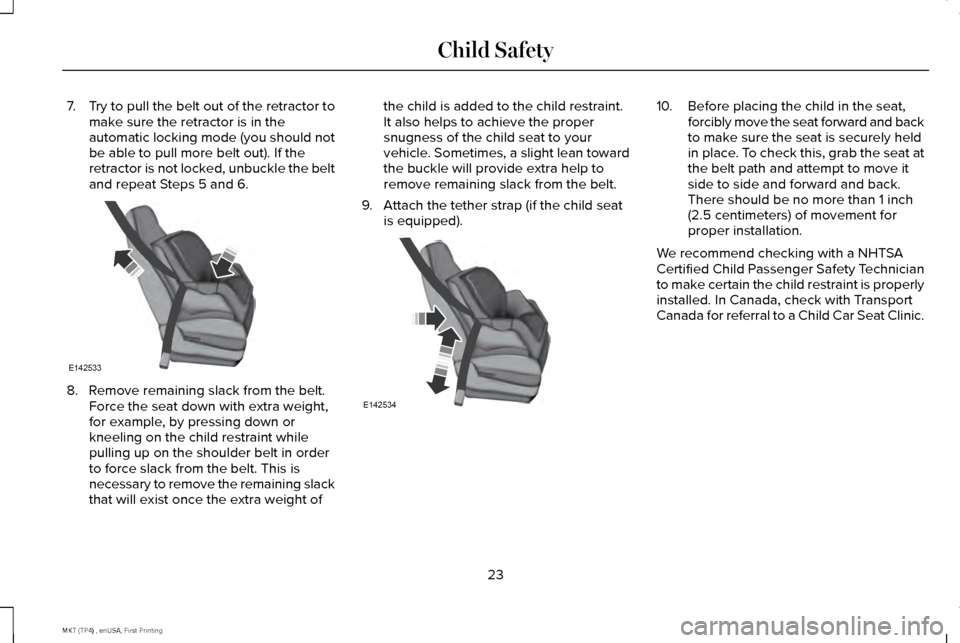
Try to pull the belt out of the retractor to
make sure the retractor is in the
automatic locking mode (you should not
be able to pull more belt out). If the
retractor is not locked, unbuckle the belt
and repeat Steps 5 and 6. 8. Remove remaining slack from the belt.
Force the seat down with extra weight,
for example, by pressing down or
kneeling on the child restraint while
pulling up on the shoulder belt in order
to force slack from the belt. This is
necessary to remove the remaining slack
that will exist once the extra weight of the child is added to the child restraint.
It also helps to achieve the proper
snugness of the child seat to your
vehicle. Sometimes, a slight lean toward
the buckle will provide extra help to
remove remaining slack from the belt.
9. Attach the tether strap (if the child seat is equipped). 10. Before placing the child in the seat,
forcibly move the seat forward and back
to make sure the seat is securely held
in place. To check this, grab the seat at
the belt path and attempt to move it
side to side and forward and back.
There should be no more than 1 inch
(2.5 centimeters) of movement for
proper installation.
We recommend checking with a NHTSA
Certified Child Passenger Safety Technician
to make certain the child restraint is properly
installed. In Canada, check with Transport
Canada for referral to a Child Car Seat Clinic.
23
MKT (TP4) , enUSA, First Printing Child SafetyE142533 E142534
Page 29 of 558
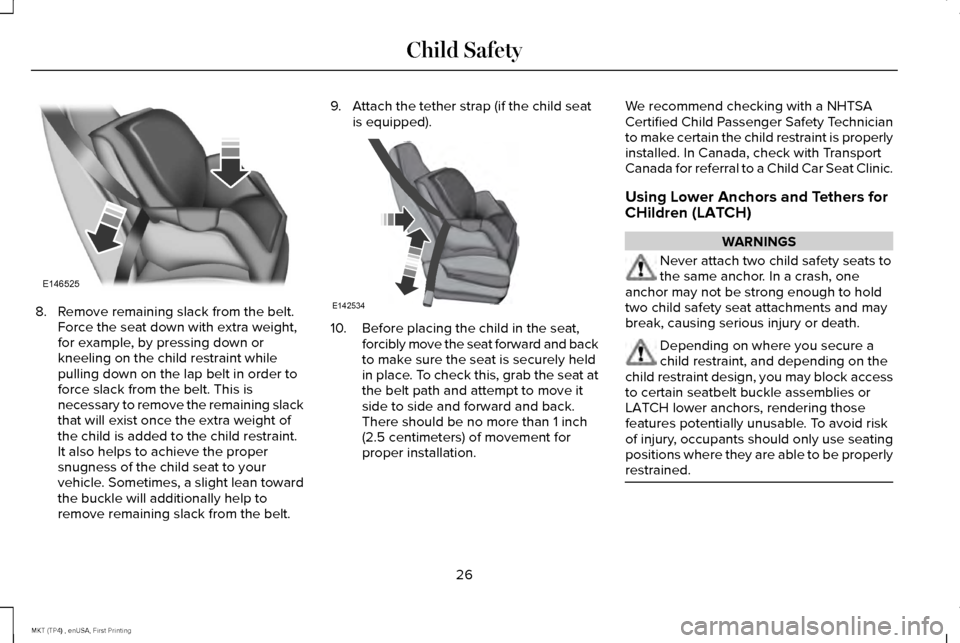
8. Remove remaining slack from the belt.
Force the seat down with extra weight,
for example, by pressing down or
kneeling on the child restraint while
pulling down on the lap belt in order to
force slack from the belt. This is
necessary to remove the remaining slack
that will exist once the extra weight of
the child is added to the child restraint.
It also helps to achieve the proper
snugness of the child seat to your
vehicle. Sometimes, a slight lean toward
the buckle will additionally help to
remove remaining slack from the belt. 9. Attach the tether strap (if the child seat
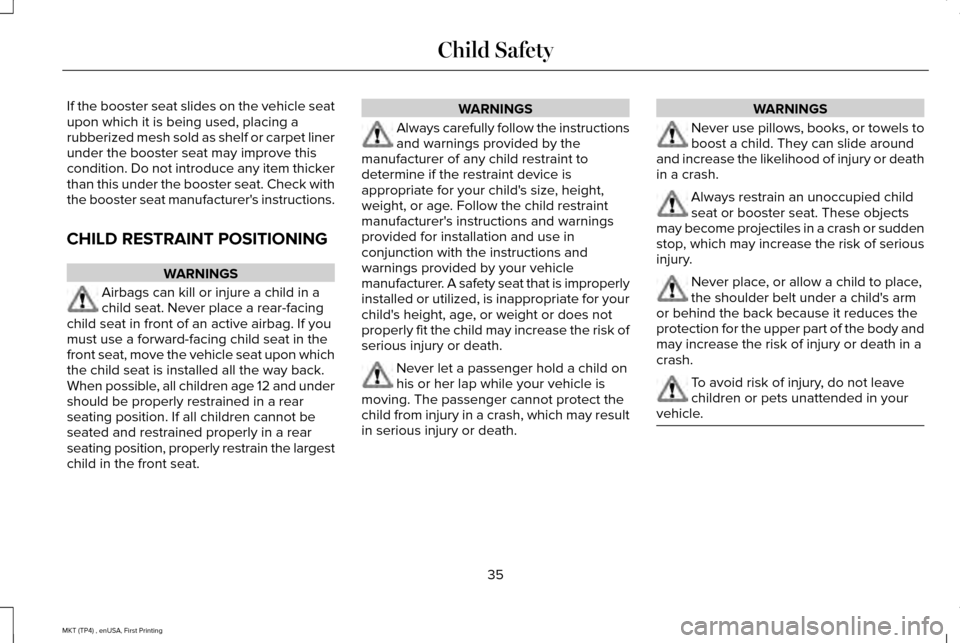
is equipped). 10. Before placing the child in the seat,
forcibly move the seat forward and back
to make sure the seat is securely held
in place. To check this, grab the seat at
the belt path and attempt to move it
side to side and forward and back.
There should be no more than 1 inch
(2.5 centimeters) of movement for
proper installation. We recommend checking with a NHTSA
Certified Child Passenger Safety Technician
to make certain the child restraint is properly
installed. In Canada, check with Transport
Canada for referral to a Child Car Seat Clinic.
Using Lower Anchors and Tethers for
CHildren (LATCH) WARNINGS
Never attach two child safety seats to
the same anchor. In a crash, one
anchor may not be strong enough to hold
two child safety seat attachments and may
break, causing serious injury or death. Depending on where you secure a
child restraint, and depending on the
child restraint design, you may block access
to certain seatbelt buckle assemblies or
LATCH lower anchors, rendering those
features potentially unusable. To avoid risk
of injury, occupants should only use seating
positions where they are able to be properly
restrained. 26
MKT (TP4) , enUSA, First Printing Child SafetyE146525 E142534
Page 38 of 558
If the booster seat slides on the vehicle seat
upon which it is being used, placing a
rubberized mesh sold as shelf or carpet liner
under the booster seat may improve this
condition. Do not introduce any item thicker
than this under the booster seat. Check with
the booster seat manufacturer's instructions.
CHILD RESTRAINT POSITIONING
WARNINGS
Airbags can kill or injure a child in a
child seat. Never place a rear-facing
child seat in front of an active airbag. If you
must use a forward-facing child seat in the
front seat, move the vehicle seat upon which
the child seat is installed all the way back.
When possible, all children age 12 and under
should be properly restrained in a rear
seating position. If all children cannot be
seated and restrained properly in a rear
seating position, properly restrain the largest
child in the front seat. WARNINGS
Always carefully follow the instructions
and warnings provided by the
manufacturer of any child restraint to
determine if the restraint device is
appropriate for your child's size, height,
weight, or age. Follow the child restraint
manufacturer's instructions and warnings
provided for installation and use in
conjunction with the instructions and
warnings provided by your vehicle
manufacturer. A safety seat that is improperly
installed or utilized, is inappropriate for your
child's height, age, or weight or does not
properly fit the child may increase the risk of
serious injury or death. Never let a passenger hold a child on
his or her lap while your vehicle is
moving. The passenger cannot protect the
child from injury in a crash, which may result
in serious injury or death. WARNINGS
Never use pillows, books, or towels to
boost a child. They can slide around
and increase the likelihood of injury or death
in a crash. Always restrain an unoccupied child
seat or booster seat. These objects
may become projectiles in a crash or sudden
stop, which may increase the risk of serious
injury. Never place, or allow a child to place,
the shoulder belt under a child's arm
or behind the back because it reduces the
protection for the upper part of the body and
may increase the risk of injury or death in a
crash. To avoid risk of injury, do not leave
children or pets unattended in your
vehicle. 35
MKT (TP4) , enUSA, First Printing Child Safety
Page 39 of 558
Recommendations for attaching child safety restraints for children
Use any attachment method as indicated below by X
Combined weight of child and child seat
Restraint Type Safety belt only
Safety belt and
LATCH (lower
anchors and top tether anchor)
Safety belt and top
tether anchor
LATCH (lower
anchors only)
LATCH (lower
anchors and top tether anchor)
X
X
Up to 65 lb
(29.5 kg)
Rear facing child
seat
X
Over
65 lb
(29.5 kg)
Rear facing child
seat
X
X
X
Up to
65 lb
(29.5 kg)
Forward facing
child seat
X
X
Over
65 lb
(29.5 kg)
Forward facing
child seat
Note: The child seat must rest tightly against
the vehicle seat upon which it is installed. It
may be necessary to lift or remove the head
restraint.
See Seats (page 136). CHILD SAFETY LOCKS
When these locks are set, the rear doors
cannot be opened from the inside.
36
MKT (TP4) , enUSA, First Printing Child Safety
Page 56 of 558
FRONT PASSENGER SENSING
SYSTEM
WARNINGS
Even with Advanced Restraints
Systems, children 12 and under should
be properly restrained in a rear seating
position. Failure to follow this could seriously
increase the risk of injury or death. Sitting improperly out of position or
with the seatback reclined too far can
take off weight from the seat cushion and
affect the decision of the front passenger
sensing system, resulting in serious injury or
death in a crash. Always sit upright against
your seatback, with your feet on the floor. Any alteration or modification to the
front passenger seat may affect the
performance of the front passenger sensing
system which could seriously increase the
risk of injury or death. This system works with sensors that are part
of the front passenger seat and seatbelt to
detect the presence of a properly-seated
occupant and determine if the front
passenger frontal airbag should be enabled
(may inflate) or not.
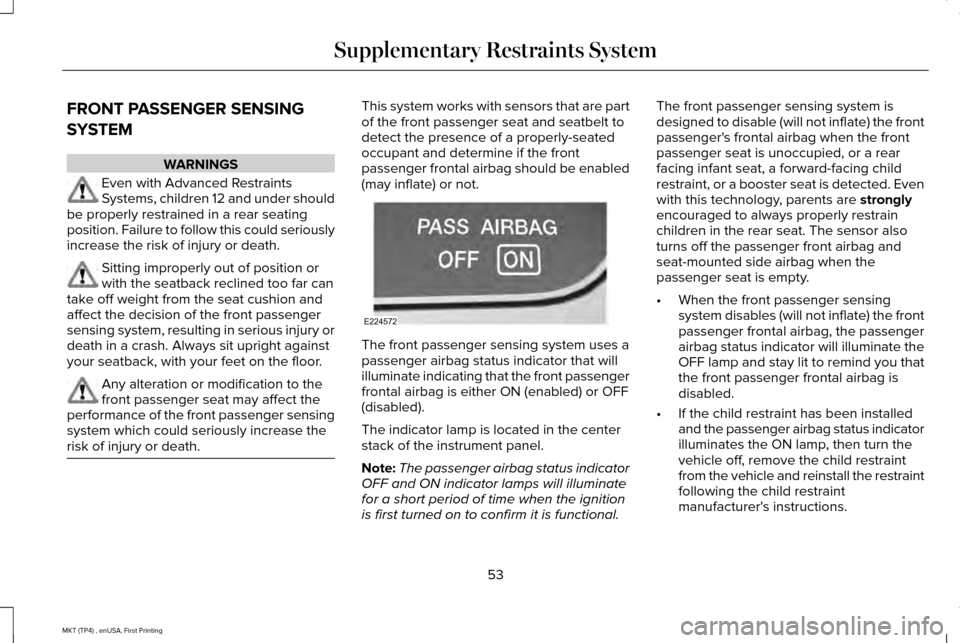
The front passenger sensing system uses a
passenger airbag status indicator that will
illuminate indicating that the front passenger
frontal airbag is either ON (enabled) or OFF
(disabled).
The indicator lamp is located in the center
stack of the instrument panel.
Note:
The passenger airbag status indicator
OFF and ON indicator lamps will illuminate
for a short period of time when the ignition
is first turned on to confirm it is functional. The front passenger sensing system is
designed to disable (will not inflate) the front
passenger's frontal airbag when the front
passenger seat is unoccupied, or a rear
facing infant seat, a forward-facing child
restraint, or a booster seat is detected. Even
with this technology, parents are strongly
encouraged to always properly restrain
children in the rear seat. The sensor also
turns off the passenger front airbag and
seat-mounted side airbag when the
passenger seat is empty.
• When the front passenger sensing
system disables (will not inflate) the front
passenger frontal airbag, the passenger
airbag status indicator will illuminate the
OFF lamp and stay lit to remind you that
the front passenger frontal airbag is
disabled.
• If the child restraint has been installed
and the passenger airbag status indicator
illuminates the ON lamp, then turn the
vehicle off, remove the child restraint
from the vehicle and reinstall the restraint
following the child restraint
manufacturer's instructions.
53
MKT (TP4) , enUSA, First Printing Supplementary Restraints SystemE224572
Page 79 of 558
WARNINGS
Keep keys out of reach of children. Do
not allow children to operate or play
near an open or moving power liftgate. You
should supervise the operation of the power
liftgate at all times. Note:
Make sure that you close the liftgate
before operating or moving your vehicle,
especially in an enclosure, like a garage or
a parking structure. This could damage the
liftgate and its components.
Note: Do not hang anything, for example a
bike rack, from the glass or liftgate. This
could damage the liftgate and its
components.
The liftgate only operates with the
transmission in park (P). Three warning tones sound as the liftgate
begins to power close. If there is a problem
with the open or close request, one of the
following may occur:
•
One tone sounds if the ignition is on and
the transmission is not in park (P).
• Three tones sound if the battery voltage
is below the minimum operating voltage.
• One tone sounds if the vehicle speed is
at or above 3 mph (5 km/h).
If the liftgate starts to close after it has fully
opened, this indicates there may be
excessive weight on the liftgate or a possible
gas strut failure. A repetitive tone sounds
and the liftgate closes under control. Remove
any excessive weight from the liftgate. If the
liftgate continues to close after opening,
have the system checked by an authorized
dealer.
Opening and Closing the Liftgate WARNING
Make sure all persons are clear of the
power liftgate area before using the
power liftgate control. Note:
Be careful when opening or closing
the liftgate in a garage or other enclosed
area to avoid damaging the liftgate.
Note: Do not leave the liftgate open while
driving. This could damage the liftgate and
its components.
From the Instrument Panel Press the button on the instrument
panel.
With the Remote Control Press the button twice within three
seconds.
With the Outside Control Button
Opening the Liftgate
1. Unlock the liftgate with the remote control or power door unlock control. If
an intelligent access key is within
3 ft
(1 m) of the liftgate, the liftgate unlocks
when you press the liftgate release
button.
76
MKT (TP4) , enUSA, First Printing Doors and Locks E138630
Page 139 of 558
SITTING IN THE CORRECT
POSITION
WARNINGS
Sitting improperly, out of position or
with the seatback reclined too far can
take weight off the seat cushion and affect
the decision of the passenger sensing
system, resulting in serious injury or death
in the event of a crash. Always sit upright
against your seat back, with your feet on the
floor. Do not recline the seatback as this can
cause the occupant to slide under the
safety belt, resulting in serious injury in the
event of a crash. Do not place objects higher than the
seatback to reduce the risk of serious
injury in the event of a crash or during heavy
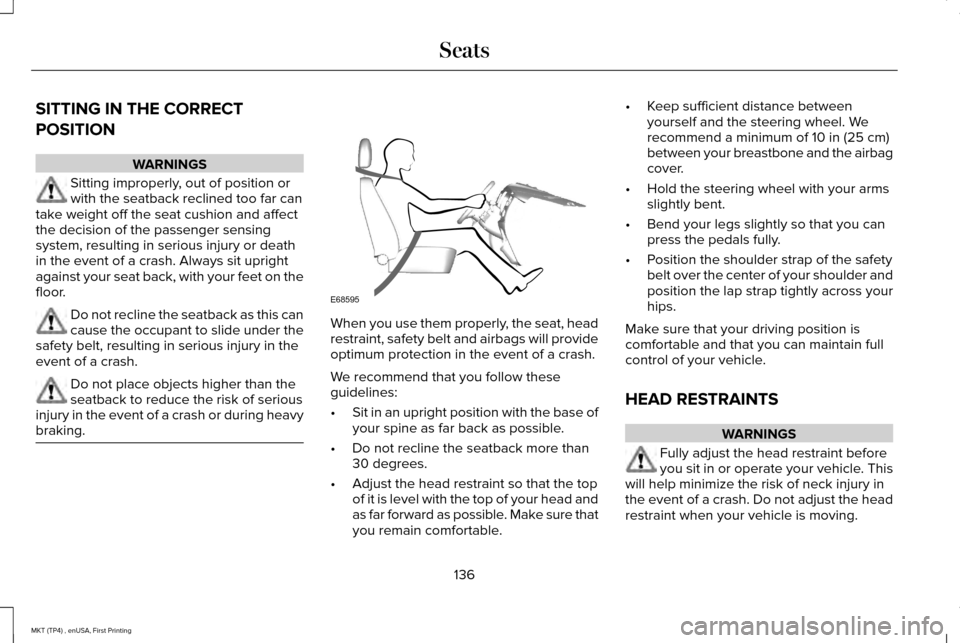
braking. When you use them properly, the seat, head
restraint, safety belt and airbags will provide
optimum protection in the event of a crash.
We recommend that you follow these
guidelines:
•
Sit in an upright position with the base of
your spine as far back as possible.
• Do not recline the seatback more than
30 degrees.
• Adjust the head restraint so that the top
of it is level with the top of your head and
as far forward as possible. Make sure that
you remain comfortable. •
Keep sufficient distance between
yourself and the steering wheel. We
recommend a minimum of 10 in (25 cm)
between your breastbone and the airbag
cover.
• Hold the steering wheel with your arms
slightly bent.
• Bend your legs slightly so that you can
press the pedals fully.
• Position the shoulder strap of the safety
belt over the center of your shoulder and
position the lap strap tightly across your
hips.
Make sure that your driving position is
comfortable and that you can maintain full
control of your vehicle.
HEAD RESTRAINTS WARNINGS
Fully adjust the head restraint before
you sit in or operate your vehicle. This
will help minimize the risk of neck injury in
the event of a crash. Do not adjust the head
restraint when your vehicle is moving.
136
MKT (TP4) , enUSA, First Printing SeatsE68595