trailer LINCOLN MKT 2019 Owner's Manual
[x] Cancel search | Manufacturer: LINCOLN, Model Year: 2019, Model line: MKT, Model: LINCOLN MKT 2019Pages: 575, PDF Size: 4.66 MB
Page 244 of 575
Distribute the trailer load so 10-15% of thetotal trailer weight is on the tongue.
Weight-Distributing Hitch
WARNING: Do not adjust the springbars so that your vehicle's rear bumper ishigher than before attaching the trailer.Doing so will defeat the function of theweight-distributing hitch, which may causeunpredictable handling, and could resultin serious personal injury.
When hooking-up a trailer using aweight-distributing hitch, always use thefollowing procedure:
1. Park your vehicle, without the trailer, ona level surface.
2. Measure the height of the top of yourvehicle’s front wheel opening on thefender. This is H1.
3.Attach the trailer to your vehicle withoutthe weight-distributing bars connected.
4. Measure the height of the top of yourvehicle’s front wheel opening on thefender a second time. This is H2.
5. Install and adjust the tension in theweight distributing bars so that the heightof the front fender is approximatelyhalfway between H1 and H2.
6.Check that the trailer is level. If not level,adjust the ball height accordingly andrepeat Steps 3–6.
Safety Chains
Note:Never attach safety chains to thebumper.
Always connect the safety chains to the hookretainers of your vehicle hitch.
To connect the safety chains, cross themunder the trailer tongue and allow enoughslack for turning tight corners. Do not allowthe chains to drag on the ground.
Trailer Brakes
WARNING: Do not connect a trailer'shydraulic brake system directly to yourvehicle's brake system. Your vehicle maynot have enough braking power and yourchances of having a collision greatlyincrease.
Electric brakes and manual, automatic orsurge-type trailer brakes are safe if you installthem properly and adjust them to themanufacturer's specifications. The trailerbrakes must meet local and federalregulations.
The rating for the tow vehicle's brakingsystem operation is at the gross vehicleweight rating, not the gross combinedweight rating.
Separate functioning brake systems arerequired for safe control of towed vehiclesand trailers weighing more than 1500 lb(680 kg) when loaded.
241
MKT (TP4) , enUSA, Edition date: 201803, Second-Printing
Towing
Page 245 of 575
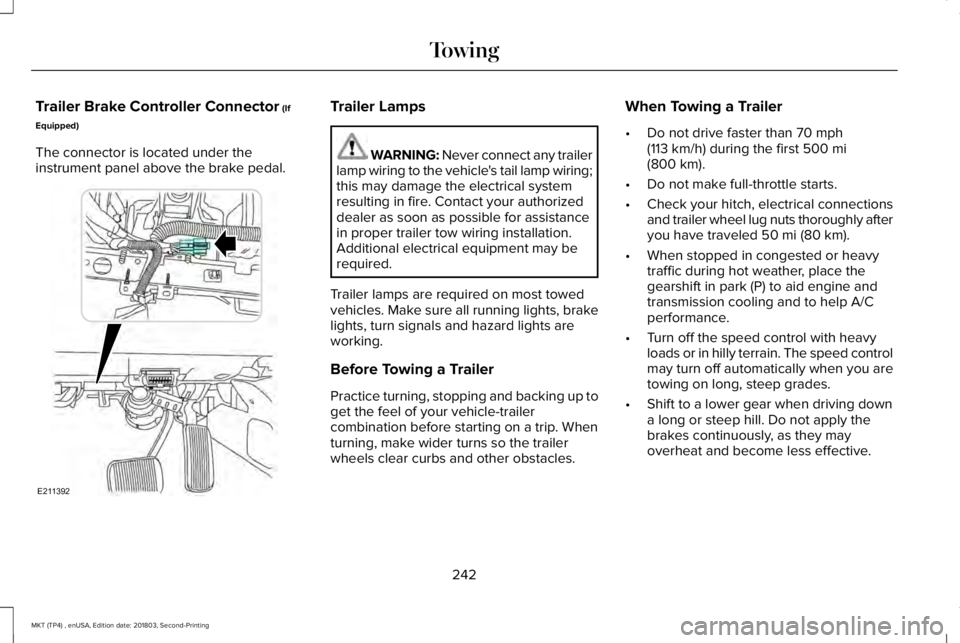
Trailer Brake Controller Connector (If
Equipped)
The connector is located under theinstrument panel above the brake pedal.
Trailer Lamps
WARNING: Never connect any trailerlamp wiring to the vehicle's tail lamp wiring;this may damage the electrical systemresulting in fire. Contact your authorizeddealer as soon as possible for assistancein proper trailer tow wiring installation.Additional electrical equipment may berequired.
Trailer lamps are required on most towedvehicles. Make sure all running lights, brakelights, turn signals and hazard lights areworking.
Before Towing a Trailer
Practice turning, stopping and backing up toget the feel of your vehicle-trailercombination before starting on a trip. Whenturning, make wider turns so the trailerwheels clear curbs and other obstacles.
When Towing a Trailer
•Do not drive faster than 70 mph(113 km/h) during the first 500 mi(800 km).
•Do not make full-throttle starts.
•Check your hitch, electrical connectionsand trailer wheel lug nuts thoroughly afteryou have traveled 50 mi (80 km).
•When stopped in congested or heavytraffic during hot weather, place thegearshift in park (P) to aid engine andtransmission cooling and to help A/Cperformance.
•Turn off the speed control with heavyloads or in hilly terrain. The speed controlmay turn off automatically when you aretowing on long, steep grades.
•Shift to a lower gear when driving downa long or steep hill. Do not apply thebrakes continuously, as they mayoverheat and become less effective.
242
MKT (TP4) , enUSA, Edition date: 201803, Second-Printing
TowingE211392
Page 246 of 575
•If your transmission is equipped with aGrade Assist or Tow/Haul feature, usethis feature when towing. This providesengine braking and helps eliminateexcessive transmission shifting foroptimum fuel economy and transmissioncooling.
•Allow more distance for stopping with atrailer attached. Anticipate stops andbrake gradually.
•Avoid parking on a grade. However, ifyou must park on a grade:
1. Turn the steering wheel to point yourvehicle tires away from traffic flow.
2. Set your vehicle parking brake.
3.Place the automatic transmission in park(P).
4. Place wheel chocks in front and back ofthe trailer wheels. Chocks are notincluded with your vehicle.
Launching or Retrieving a Boat orPersonal Watercraft (PWC)
Note:Disconnect the wiring to the trailerbefore backing the trailer into the water.
Note:Reconnect the wiring to the trailerafter removing the trailer from the water.
When backing down a ramp during boatlaunching or retrieval:
•Do not allow the static water level to riseabove the bottom edge of the rearbumper.
•Do not allow waves to break higher than6 in (15 cm) above the bottom edge ofthe rear bumper.
Exceeding these limits may allow water toenter vehicle components:
•Causing internal damage to thecomponents.
•Affecting driveability, emissions, andreliability.
Any time the rear axle submerges in water,replace the rear axle lubricant. Water maycontaminate the rear axle lubricant, which isnot a normal maintenance inspection itemunless there is a possibility of a leak or otheraxle repair is required.
TOWING THE VEHICLE ON FOUR
WHEELS
Emergency Towing
If your vehicle becomes inoperable (withoutaccess to wheel dollies or vehicle transporttrailer), it can be flat-towed (all wheels on theground, regardless of the powertrain andtransmission configuration) under thefollowing conditions:
•Your vehicle is facing forward for towingin a forward direction.
•Shift into neutral (N). If you cannot shiftthe transmission into neutral (N), you mayneed to override it. See Transmission(page 175).
•Maximum speed is 35 mph (56 km/h).
•Maximum distance is 50 mi (80 km).
WARNING: If your vehicle has asteering wheel lock make sure the ignitionis in the accessory or on position whenbeing towed.
243
MKT (TP4) , enUSA, Edition date: 201803, Second-Printing
Towing
Page 247 of 575

Recreational Towing
Note: Put your climate control system inrecirculated air mode to prevent exhaustfumes from entering the vehicle. SeeClimate Control (page 125).
Follow these guidelines if you have a needfor recreational (RV) towing. An example ofrecreational towing would be towing yourvehicle behind a motorhome. We designedthese guidelines to prevent damage to yourtransmission.
You can tow your 3.5L or 3.7L equippedvehicle with all four wheels on the ground.
If you tow your vehicle with all four wheelson the ground:
•Tow only in the forward direction.
•Release the parking brake.
•Do not exceed 65 mph (105 km/h).
•Start the engine and allow it to run forfive minutes at the beginning of each dayand every six hours thereafter. With theengine running and your foot on thebrake, shift into drive (D) and then intoreverse (R) before shifting back intoneutral (N).
1. Start the vehicle by pressing the brakepedal, and then pressing the keyless startbutton until the vehicle starts.
2. Press the brake pedal and shift thetransmission into neutral (N).
3. Switch your vehicle off by pressing thekeyless start button once.
4. Disconnect the negative (black) cablefrom the battery. You need the door keyto lock and unlock doors when thebattery cable is disconnected. SeeChanging the 12V Battery (page 295).
Note:The anti-theft system does not workuntil you reconnect the battery cable.
Start the engine within 15 minutes ofreconnecting the battery cable.
Front-wheel Drive Vehicles
Alternatively, you can tow your front-wheeldrive vehicle with the front wheels off theground by using a tow dolly, or with all fourwheels off the ground using a vehicletransport trailer. If you are using a tow dolly,follow the instructions specified by theequipment provider.
All-wheel Drive Vehicles
Alternatively, you can tow your all-wheeldrive vehicle with all four wheels off theground using a vehicle transport trailer. Donot tow your all-wheel drive vehicle with thefront wheels off the ground (by using a towdolly) and the rear wheels on the ground.This causes damage to your all-wheel drivesystem. If you are using a vehicle transporttrailer, follow the instruction specified by theequipment provider.
244
MKT (TP4) , enUSA, Edition date: 201803, Second-Printing
Towing
Page 251 of 575
ROADSIDE ASSISTANCE
Vehicles Sold in the United States:Getting Roadside Assistance
To fully assist you should you have a vehicleconcern, Lincoln Motor Company offers acomplimentary roadside assistance program.This program is separate from the NewVehicle Limited Warranty.
The service is available:
•Throughout the life of the vehicle fororiginal owners.
•For six years or 70,000 mi (110,000 km)(whichever comes first) for subsequentowners.
Roadside Assistance covers:
•A flat tire change with a good spare(except vehicles supplied with a tireinflation kit).
•Battery jump start.
•Lock-out assistance (key replacementcost is the client's responsibility).
•Fuel delivery — independent servicecontractors, if not prohibited by state,local or municipal law shall deliver up to2 gal (8 L) of gasoline or 5 gal (20 L) ofdiesel fuel to a disabled vehicle.Roadside Assistance limits fuel deliveryservice to two no-charge occurrenceswithin a 12-month period.
•Winch out — available within 100 ft (30 m)of a paved or county maintained road,no recoveries.
•Towing — independent servicecontractors, if not prohibited by state,local or municipal law shall tow Lincolneligible vehicles to the client's selling orpreferred dealer within 100 mi (160 km)of the disablement location or to thenearest Lincoln dealer. If a client requestsa tow to a selling or preferred dealer thatis more than 100 mi (160 km) from thedisablement location, the client isresponsible for any mileage costs inexcess of 100 mi (160 km).
•Roadside Assistance includes up to $200for a towed trailer if the disabled eligiblevehicle requires service at the nearestauthorized dealer. If the towing vehicleis operational but the trailer is not, thenthe trailer does not qualify for anyroadside services.
Vehicles Sold in the United States:Using Roadside Assistance
United States clients who require roadsideassistance, call 1-800-521-4140.
248
MKT (TP4) , enUSA, Edition date: 201803, Second-Printing
Roadside Emergencies
Page 266 of 575
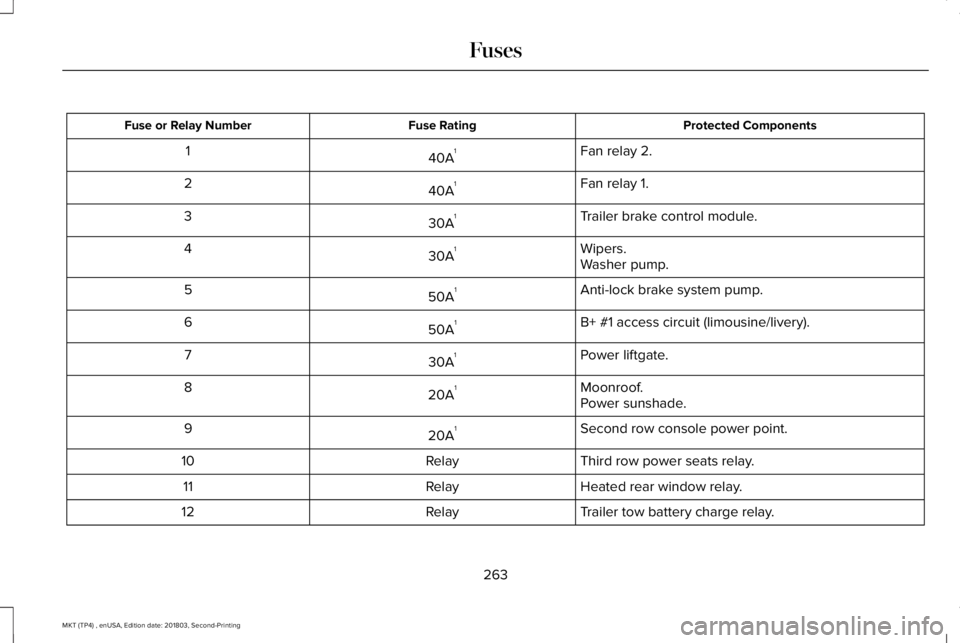
Protected ComponentsFuse RatingFuse or Relay Number
Fan relay 2.40A11
Fan relay 1.40A12
Trailer brake control module.30A13
Wipers.30A14Washer pump.
Anti-lock brake system pump.50A15
B+ #1 access circuit (limousine/livery).50A16
Power liftgate.30A17
Moonroof.20A18Power sunshade.
Second row console power point.20A19
Third row power seats relay.Relay10
Heated rear window relay.Relay11
Trailer tow battery charge relay.Relay12
263
MKT (TP4) , enUSA, Edition date: 201803, Second-Printing
Fuses
Page 267 of 575
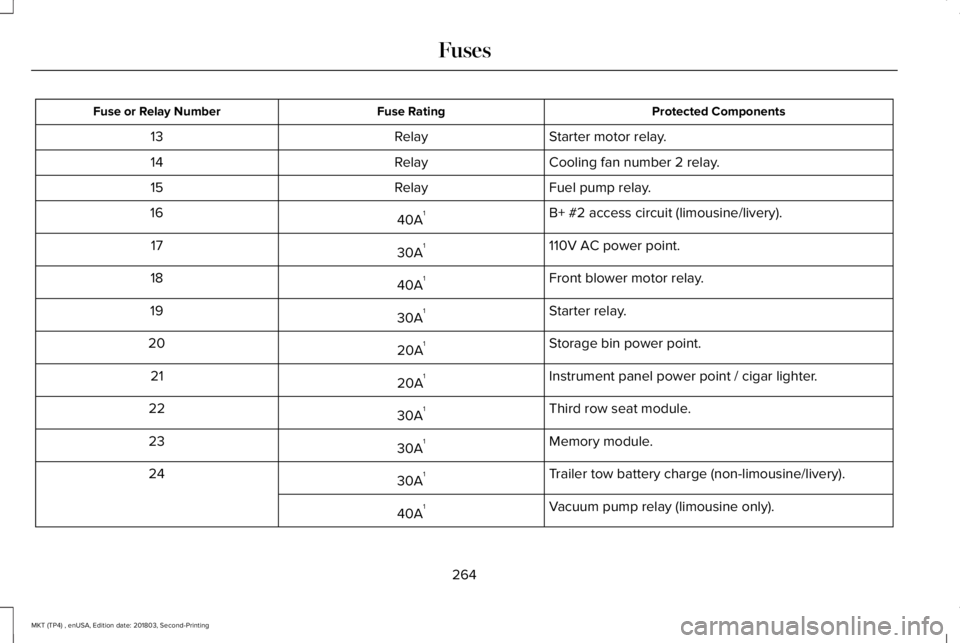
Protected ComponentsFuse RatingFuse or Relay Number
Starter motor relay.Relay13
Cooling fan number 2 relay.Relay14
Fuel pump relay.Relay15
B+ #2 access circuit (limousine/livery).40A116
110V AC power point.30A117
Front blower motor relay.40A118
Starter relay.30A119
Storage bin power point.20A120
Instrument panel power point / cigar lighter.20A121
Third row seat module.30A122
Memory module.30A123
Trailer tow battery charge (non-limousine/livery).30A124
Vacuum pump relay (limousine only).40A1
264
MKT (TP4) , enUSA, Edition date: 201803, Second-Printing
Fuses
Page 268 of 575
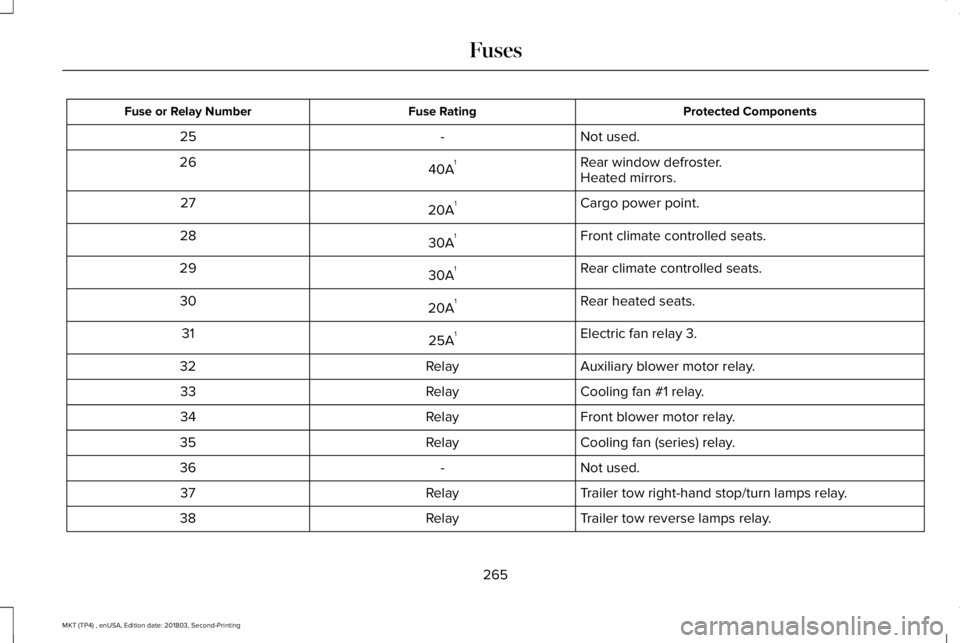
Protected ComponentsFuse RatingFuse or Relay Number
Not used.-25
Rear window defroster.40A126Heated mirrors.
Cargo power point.20A127
Front climate controlled seats.30A128
Rear climate controlled seats.30A129
Rear heated seats.20A130
Electric fan relay 3.25A131
Auxiliary blower motor relay.Relay32
Cooling fan #1 relay.Relay33
Front blower motor relay.Relay34
Cooling fan (series) relay.Relay35
Not used.-36
Trailer tow right-hand stop/turn lamps relay.Relay37
Trailer tow reverse lamps relay.Relay38
265
MKT (TP4) , enUSA, Edition date: 201803, Second-Printing
Fuses
Page 270 of 575
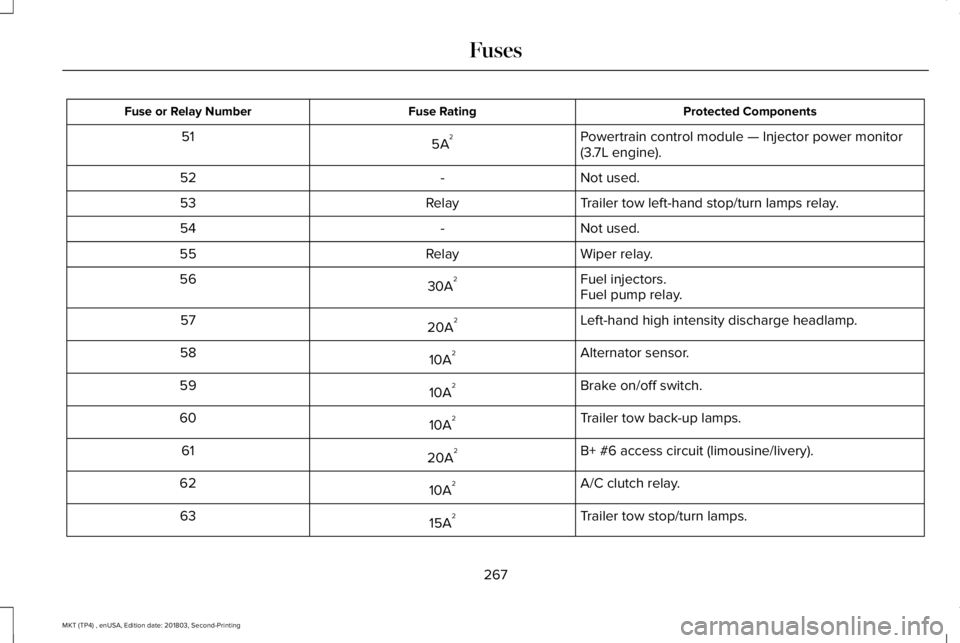
Protected ComponentsFuse RatingFuse or Relay Number
Powertrain control module — Injector power monitor(3.7L engine).5A251
Not used.-52
Trailer tow left-hand stop/turn lamps relay.Relay53
Not used.-54
Wiper relay.Relay55
Fuel injectors.30A256Fuel pump relay.
Left-hand high intensity discharge headlamp.20A257
Alternator sensor.10A258
Brake on/off switch.10A259
Trailer tow back-up lamps.10A260
B+ #6 access circuit (limousine/livery).20A261
A/C clutch relay.10A262
Trailer tow stop/turn lamps.15A263
267
MKT (TP4) , enUSA, Edition date: 201803, Second-Printing
Fuses
Page 272 of 575
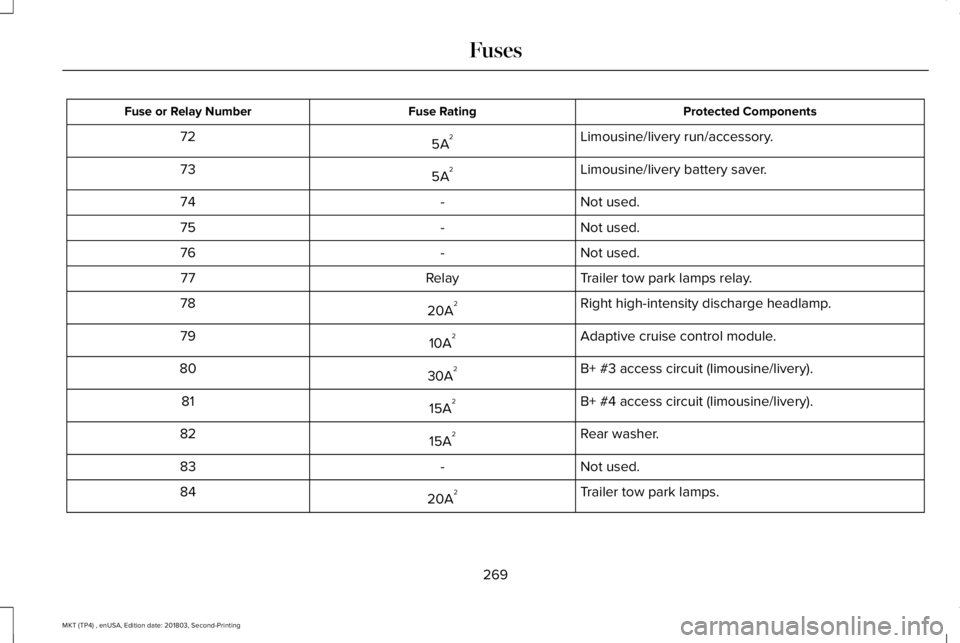
Protected ComponentsFuse RatingFuse or Relay Number
Limousine/livery run/accessory.5A272
Limousine/livery battery saver.5A273
Not used.-74
Not used.-75
Not used.-76
Trailer tow park lamps relay.Relay77
Right high-intensity discharge headlamp.20A278
Adaptive cruise control module.10A279
B+ #3 access circuit (limousine/livery).30A280
B+ #4 access circuit (limousine/livery).15A281
Rear washer.15A282
Not used.-83
Trailer tow park lamps.20A284
269
MKT (TP4) , enUSA, Edition date: 201803, Second-Printing
Fuses