ECU LINCOLN MKT 2019 Owners Manual
[x] Cancel search | Manufacturer: LINCOLN, Model Year: 2019, Model line: MKT, Model: LINCOLN MKT 2019Pages: 575, PDF Size: 4.66 MB
Page 5 of 575
Liftgate
Power Liftgate.................................................74
Security
Passive Anti-Theft System...........................77
Anti-Theft Alarm.............................................79
Steering Wheel
Adjusting the Steering Wheel....................80
Audio Control..................................................81
Voice Control...................................................81
Cruise Control.................................................81
Information Display Control........................82
Heated Steering Wheel...............................82
Pedals
Adjusting the Pedals.....................................83
Wipers and Washers
Autowipers......................................................84
Windshield Washers.....................................84
Rear Window Wiper and Washers............85
Lighting
General Information......................................86
Lighting Control.............................................86
Autolamps........................................................87
Instrument Lighting Dimmer.......................88
Headlamp Exit Delay....................................88
Daytime Running Lamps..............................89
Automatic High Beam Control...................89
Front Fog Lamps.............................................91
Adaptive Headlamps.....................................91
Direction Indicators.......................................92
Interior Lamps.................................................92
Ambient Lighting...........................................93
Windows and Mirrors
Power Windows.............................................94
Global Opening and Closing......................95
Exterior Mirrors...............................................95
Interior Mirror..................................................97
Sun Visors........................................................97
Moonroof.........................................................98
Instrument Cluster
Gauges...........................................................100
Warning Lamps and Indicators..................101
Audible Warnings and Indicators.............104
Information Displays
General Information....................................105
Information Messages.................................112
Climate Control
Automatic Climate Control........................125
Hints on Controlling the Interior Climate.......................................................................126
Rear Passenger Climate Controls............127
Heated Rear Window..................................128
Heated Exterior Mirrors..............................128
Cabin Air Filter..............................................129
Remote Start..................................................129
Seats
Sitting in the Correct Position...................130
Head Restraints.............................................131
Power Seats...................................................133
2
MKT (TP4) , enUSA, Edition date: 201803, Second-Printing
Table of Contents
Page 17 of 575
interference with or even damage to vehiclesystems. We do not recommend or endorsethe use of aftermarket plug-in devices unlessapproved by Ford. The vehicle Warranty willnot cover damage caused by an aftermarketplug-in device.
MOBILE COMMUNICATIONS
EQUIPMENT
WARNING: Driving while distractedcan result in loss of vehicle control, crashand injury. We strongly recommend thatyou use extreme caution when using anydevice that may take your focus off theroad. Your primary responsibility is the safeoperation of your vehicle. We recommendagainst the use of any hand-held devicewhile driving and encourage the use ofvoice-operated systems when possible.Make sure you are aware of all applicablelocal laws that may affect the use ofelectronic devices while driving.
Using mobile communications equipment isbecoming increasingly important in theconduct of business and personal affairs. However, you must not compromise yourown or others’ safety when using suchequipment. Mobile communications canenhance personal safety and security whenappropriately used, particularly in emergencysituations. Safety must be paramount whenusing mobile communications equipment toavoid negating these benefits. Mobilecommunication equipment includes, but isnot limited to, cellular phones, pagers,portable email devices, text messagingdevices and portable two-way radios.
EXPORT UNIQUE OPTIONS
For your particular global region, your vehiclemay be equipped with features and optionsthat are different from the features andoptions that are described in this Owner’sManual. A market unique supplement maybe supplied that complements this book. Byreferring to the market unique supplement,if provided, you can properly identify thosefeatures, recommendations and
specifications that are unique to your vehicle.This Owner’s Manual is written primarily forthe U.S. and Canadian Markets. Features orequipment listed as standard may bedifferent on units built for export. Refer tothis Owner’s Manual for all other requiredinformation and warnings.
14
MKT (TP4) , enUSA, Edition date: 201803, Second-Printing
Introduction
Page 21 of 575
GENERAL INFORMATION
See the following sections for directions onhow to properly use safety restraints forchildren.
WARNING: Always make sure yourchild is secured properly in a device thatis appropriate for their height, age andweight. Child safety restraints must bebought separately from your vehicle.Failure to follow these instructions andguidelines may result in an increased riskof serious injury or death to your child.
WARNING: All children are shapeddifferently. The National Highway TrafficSafety Administration and other safetyorganizations, base their recommendationsfor child restraints on probable child height,age and weight thresholds, or on theminimum requirements of the law. Werecommend that you check with a NHTSACertified Child Passenger SafetyTechnician (CPST) to make sure that youproperly install the child restraint in yourvehicle and that you consult yourpediatrician to make sure you have a childrestraint appropriate for your child. Tolocate a child restraint fitting station andCPST, contact NHTSA toll free at
1-888-327-4236 or go towww.nhtsa.dot.gov. In Canada, contactTransport Canada toll free at1-800-333-0371 or go to www.tc.gc.ca tofind a Child Car Seat Clinic in your area.Failure to properly restrain children in childrestraints made especially for their height,age and weight, may result in an increasedrisk of serious injury or death to your child.
WARNING: On hot days, thetemperature inside the vehicle can risevery quickly. Exposure of people or animalsto these high temperatures for even a shorttime can cause death or serious heatrelated injuries, including brain damage.Small children are particularly at risk.
18
MKT (TP4) , enUSA, Edition date: 201803, Second-Printing
Child Safety
Page 23 of 575
•You are required by law to properly usesafety seats for infants and toddlers inthe United States and Canada.
•Many states and provinces require thatsmall children use approved boosterseats until they reach age eight, a heightof 4 feet 9 inches (1.45 meters) tall, or80 lb (36 kg). Check your local and stateor provincial laws for specificrequirements about the safety of childrenin your vehicle.
•When possible, always properly restrainchildren 12 years of age and under in arear seating position of your vehicle.Accident statistics suggest that childrenare safer when properly restrained in therear seating positions than in a frontseating position. See Front PassengerSensing System (page 52).
INSTALLING CHILD RESTRAINTS
Child Seats
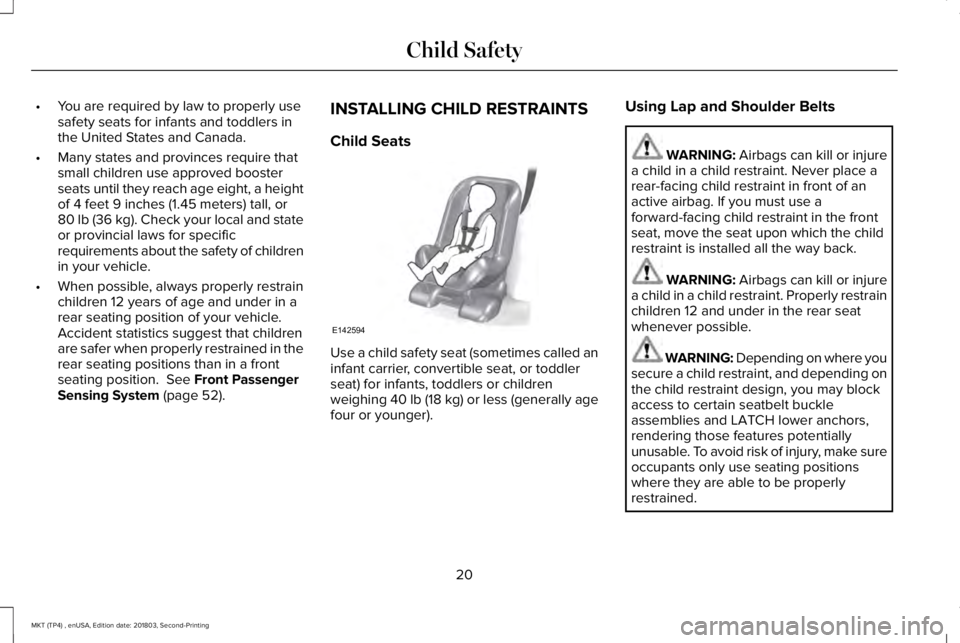
Use a child safety seat (sometimes called aninfant carrier, convertible seat, or toddlerseat) for infants, toddlers or childrenweighing 40 lb (18 kg) or less (generally agefour or younger).
Using Lap and Shoulder Belts
WARNING: Airbags can kill or injurea child in a child restraint. Never place arear-facing child restraint in front of anactive airbag. If you must use aforward-facing child restraint in the frontseat, move the seat upon which the childrestraint is installed all the way back.
WARNING: Airbags can kill or injurea child in a child restraint. Properly restrainchildren 12 and under in the rear seatwhenever possible.
WARNING: Depending on where yousecure a child restraint, and depending onthe child restraint design, you may blockaccess to certain seatbelt buckleassemblies and LATCH lower anchors,rendering those features potentiallyunusable. To avoid risk of injury, make sureoccupants only use seating positionswhere they are able to be properlyrestrained.
20
MKT (TP4) , enUSA, Edition date: 201803, Second-Printing
Child SafetyE142594
Page 24 of 575
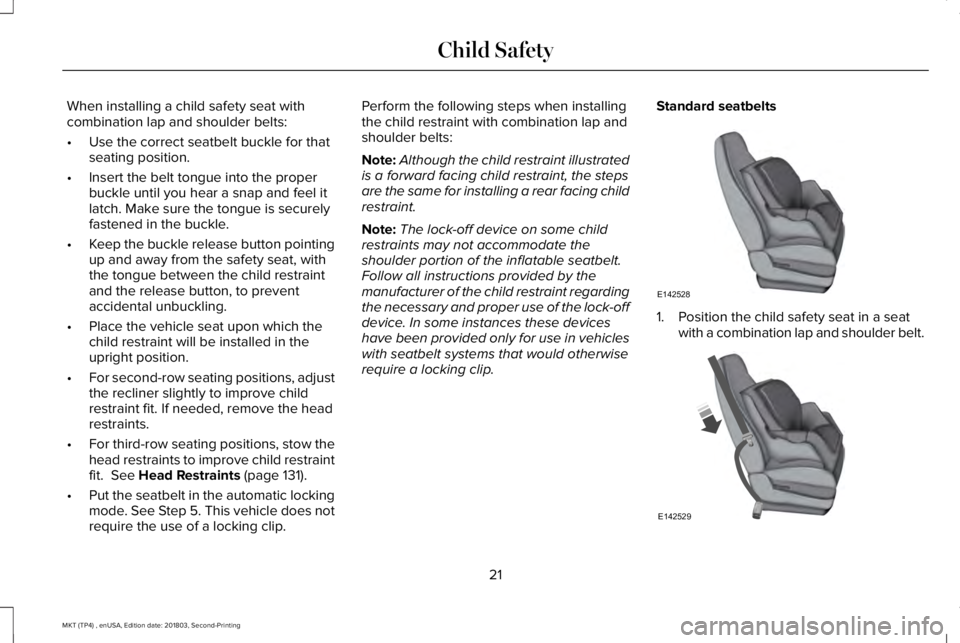
When installing a child safety seat withcombination lap and shoulder belts:
•Use the correct seatbelt buckle for thatseating position.
•Insert the belt tongue into the properbuckle until you hear a snap and feel itlatch. Make sure the tongue is securelyfastened in the buckle.
•Keep the buckle release button pointingup and away from the safety seat, withthe tongue between the child restraintand the release button, to preventaccidental unbuckling.
•Place the vehicle seat upon which thechild restraint will be installed in theupright position.
•For second-row seating positions, adjustthe recliner slightly to improve childrestraint fit. If needed, remove the headrestraints.
•For third-row seating positions, stow thehead restraints to improve child restraintfit. See Head Restraints (page 131).
•Put the seatbelt in the automatic lockingmode. See Step 5. This vehicle does notrequire the use of a locking clip.
Perform the following steps when installingthe child restraint with combination lap andshoulder belts:
Note:Although the child restraint illustratedis a forward facing child restraint, the stepsare the same for installing a rear facing childrestraint.
Note:The lock-off device on some childrestraints may not accommodate theshoulder portion of the inflatable seatbelt.Follow all instructions provided by themanufacturer of the child restraint regardingthe necessary and proper use of the lock-offdevice. In some instances these deviceshave been provided only for use in vehicleswith seatbelt systems that would otherwiserequire a locking clip.
Standard seatbelts
1. Position the child safety seat in a seatwith a combination lap and shoulder belt.
21
MKT (TP4) , enUSA, Edition date: 201803, Second-Printing
Child SafetyE142528 E142529
Page 25 of 575
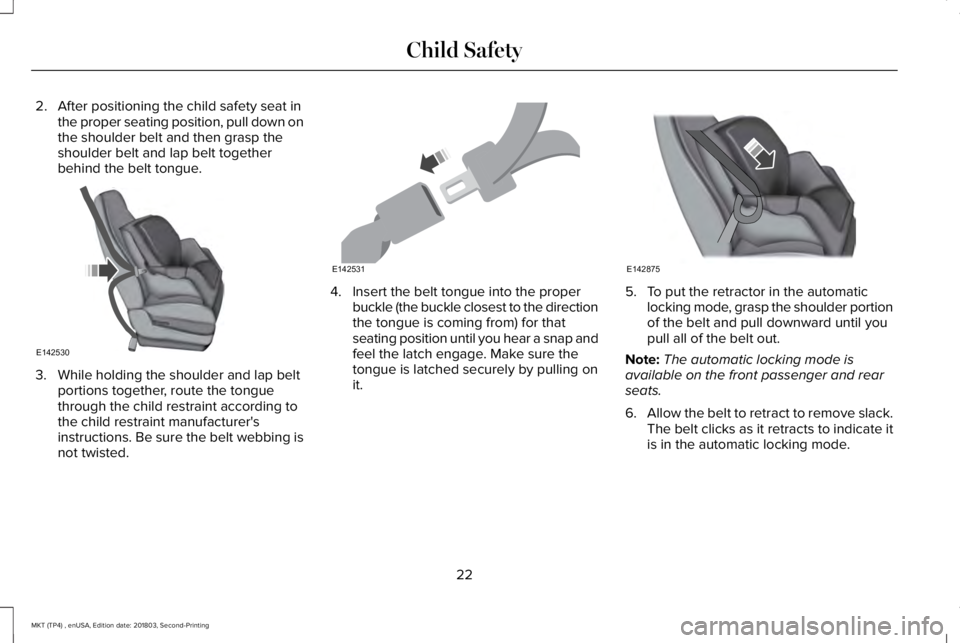
2. After positioning the child safety seat inthe proper seating position, pull down onthe shoulder belt and then grasp theshoulder belt and lap belt togetherbehind the belt tongue.
3. While holding the shoulder and lap beltportions together, route the tonguethrough the child restraint according tothe child restraint manufacturer'sinstructions. Be sure the belt webbing isnot twisted.
4. Insert the belt tongue into the properbuckle (the buckle closest to the directionthe tongue is coming from) for thatseating position until you hear a snap andfeel the latch engage. Make sure thetongue is latched securely by pulling onit.
5. To put the retractor in the automaticlocking mode, grasp the shoulder portionof the belt and pull downward until youpull all of the belt out.
Note:The automatic locking mode isavailable on the front passenger and rearseats.
6.Allow the belt to retract to remove slack.The belt clicks as it retracts to indicate itis in the automatic locking mode.
22
MKT (TP4) , enUSA, Edition date: 201803, Second-Printing
Child SafetyE142530 E142531 E142875
Page 26 of 575
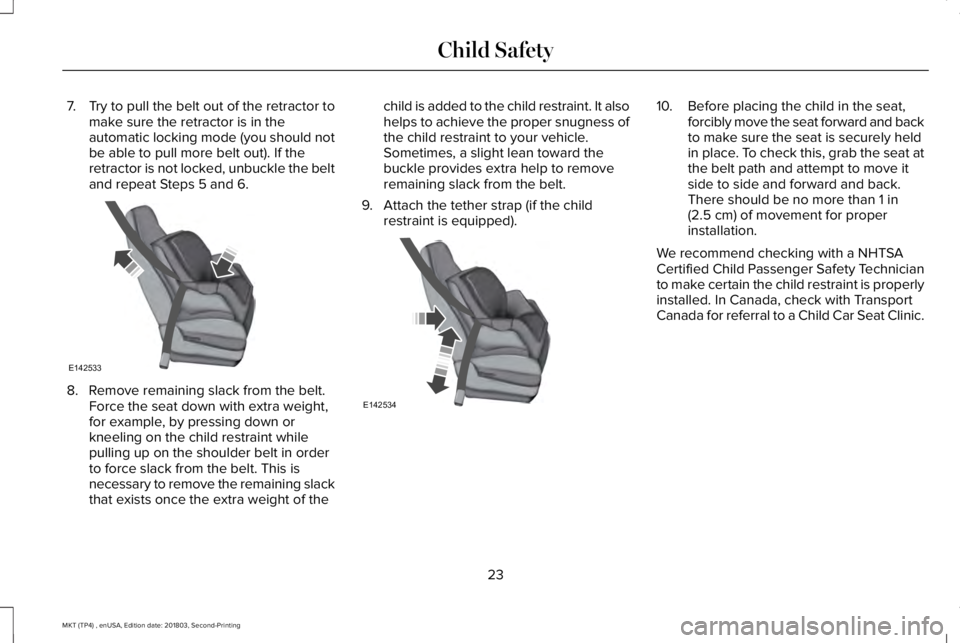
7.Try to pull the belt out of the retractor tomake sure the retractor is in theautomatic locking mode (you should notbe able to pull more belt out). If theretractor is not locked, unbuckle the beltand repeat Steps 5 and 6.
8. Remove remaining slack from the belt.Force the seat down with extra weight,for example, by pressing down orkneeling on the child restraint whilepulling up on the shoulder belt in orderto force slack from the belt. This isnecessary to remove the remaining slackthat exists once the extra weight of the
child is added to the child restraint. It alsohelps to achieve the proper snugness ofthe child restraint to your vehicle.Sometimes, a slight lean toward thebuckle provides extra help to removeremaining slack from the belt.
9. Attach the tether strap (if the childrestraint is equipped).
10. Before placing the child in the seat,forcibly move the seat forward and backto make sure the seat is securely heldin place. To check this, grab the seat atthe belt path and attempt to move itside to side and forward and back.There should be no more than 1 in(2.5 cm) of movement for properinstallation.
We recommend checking with a NHTSACertified Child Passenger Safety Technicianto make certain the child restraint is properlyinstalled. In Canada, check with TransportCanada for referral to a Child Car Seat Clinic.
23
MKT (TP4) , enUSA, Edition date: 201803, Second-Printing
Child SafetyE142533 E142534
Page 28 of 575
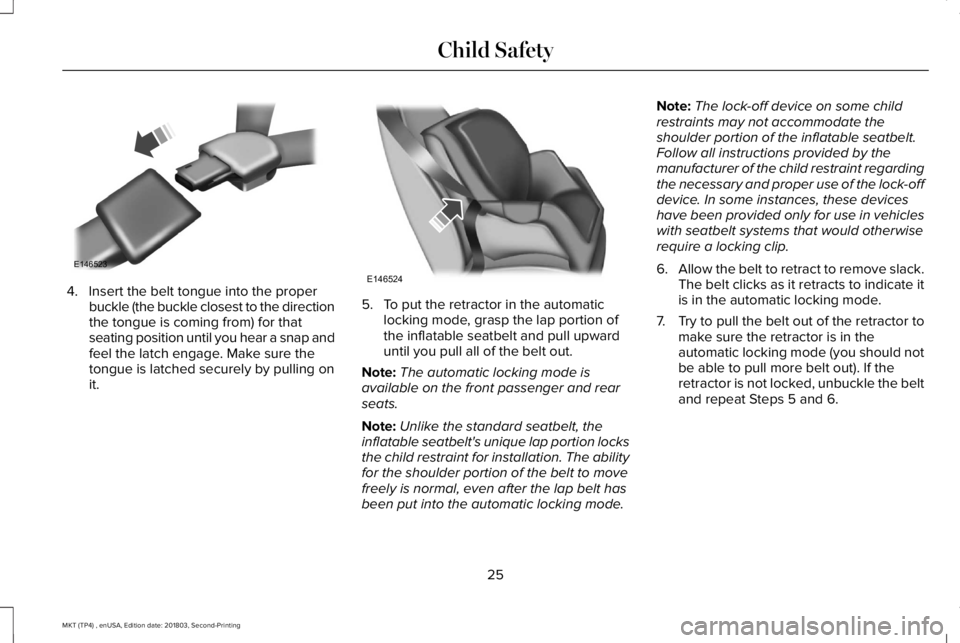
4. Insert the belt tongue into the properbuckle (the buckle closest to the directionthe tongue is coming from) for thatseating position until you hear a snap andfeel the latch engage. Make sure thetongue is latched securely by pulling onit.
5. To put the retractor in the automaticlocking mode, grasp the lap portion ofthe inflatable seatbelt and pull upwarduntil you pull all of the belt out.
Note:The automatic locking mode isavailable on the front passenger and rearseats.
Note:Unlike the standard seatbelt, theinflatable seatbelt's unique lap portion locksthe child restraint for installation. The abilityfor the shoulder portion of the belt to movefreely is normal, even after the lap belt hasbeen put into the automatic locking mode.
Note:The lock-off device on some childrestraints may not accommodate theshoulder portion of the inflatable seatbelt.Follow all instructions provided by themanufacturer of the child restraint regardingthe necessary and proper use of the lock-offdevice. In some instances, these deviceshave been provided only for use in vehicleswith seatbelt systems that would otherwiserequire a locking clip.
6.Allow the belt to retract to remove slack.The belt clicks as it retracts to indicate itis in the automatic locking mode.
7.Try to pull the belt out of the retractor tomake sure the retractor is in theautomatic locking mode (you should notbe able to pull more belt out). If theretractor is not locked, unbuckle the beltand repeat Steps 5 and 6.
25
MKT (TP4) , enUSA, Edition date: 201803, Second-Printing
Child SafetyE146523 E146524
Page 29 of 575
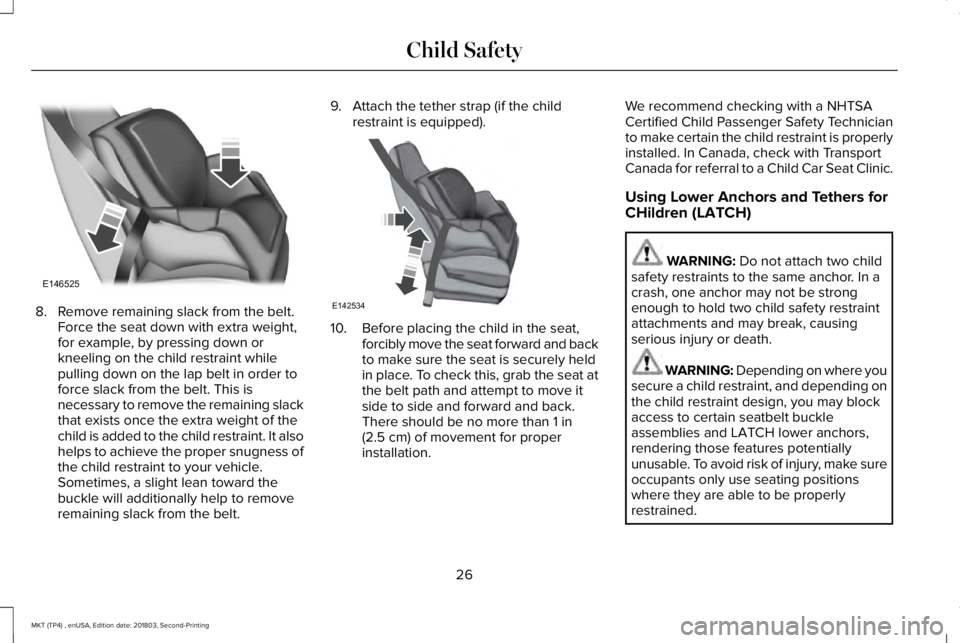
8. Remove remaining slack from the belt.Force the seat down with extra weight,for example, by pressing down orkneeling on the child restraint whilepulling down on the lap belt in order toforce slack from the belt. This isnecessary to remove the remaining slackthat exists once the extra weight of thechild is added to the child restraint. It alsohelps to achieve the proper snugness ofthe child restraint to your vehicle.Sometimes, a slight lean toward thebuckle will additionally help to removeremaining slack from the belt.
9. Attach the tether strap (if the childrestraint is equipped).
10. Before placing the child in the seat,forcibly move the seat forward and backto make sure the seat is securely heldin place. To check this, grab the seat atthe belt path and attempt to move itside to side and forward and back.There should be no more than 1 in(2.5 cm) of movement for properinstallation.
We recommend checking with a NHTSACertified Child Passenger Safety Technicianto make certain the child restraint is properlyinstalled. In Canada, check with TransportCanada for referral to a Child Car Seat Clinic.
Using Lower Anchors and Tethers for
CHildren (LATCH)
WARNING: Do not attach two childsafety restraints to the same anchor. In acrash, one anchor may not be strongenough to hold two child safety restraintattachments and may break, causingserious injury or death.
WARNING: Depending on where yousecure a child restraint, and depending onthe child restraint design, you may blockaccess to certain seatbelt buckleassemblies and LATCH lower anchors,rendering those features potentiallyunusable. To avoid risk of injury, make sureoccupants only use seating positionswhere they are able to be properlyrestrained.
26
MKT (TP4) , enUSA, Edition date: 201803, Second-Printing
Child SafetyE146525 E142534
Page 31 of 575
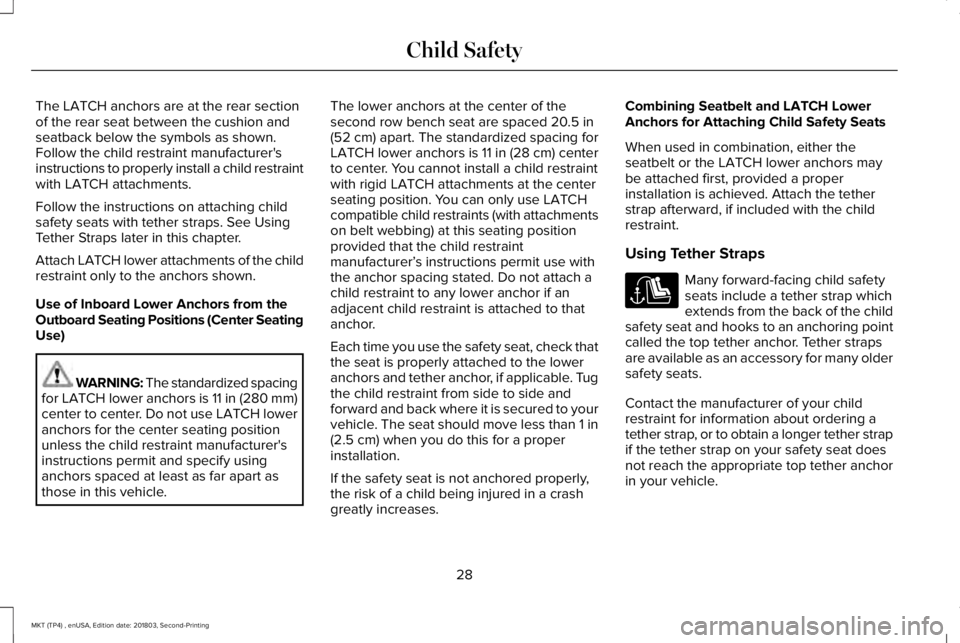
The LATCH anchors are at the rear sectionof the rear seat between the cushion andseatback below the symbols as shown.Follow the child restraint manufacturer'sinstructions to properly install a child restraintwith LATCH attachments.
Follow the instructions on attaching childsafety seats with tether straps. See UsingTether Straps later in this chapter.
Attach LATCH lower attachments of the childrestraint only to the anchors shown.
Use of Inboard Lower Anchors from theOutboard Seating Positions (Center SeatingUse)
WARNING: The standardized spacingfor LATCH lower anchors is 11 in (280 mm)center to center. Do not use LATCH loweranchors for the center seating positionunless the child restraint manufacturer'sinstructions permit and specify usinganchors spaced at least as far apart asthose in this vehicle.
The lower anchors at the center of thesecond row bench seat are spaced 20.5 in(52 cm) apart. The standardized spacing forLATCH lower anchors is 11 in (28 cm) centerto center. You cannot install a child restraintwith rigid LATCH attachments at the centerseating position. You can only use LATCHcompatible child restraints (with attachmentson belt webbing) at this seating positionprovided that the child restraintmanufacturer’s instructions permit use withthe anchor spacing stated. Do not attach achild restraint to any lower anchor if anadjacent child restraint is attached to thatanchor.
Each time you use the safety seat, check thatthe seat is properly attached to the loweranchors and tether anchor, if applicable. Tugthe child restraint from side to side andforward and back where it is secured to yourvehicle. The seat should move less than 1 in(2.5 cm) when you do this for a properinstallation.
If the safety seat is not anchored properly,the risk of a child being injured in a crashgreatly increases.
Combining Seatbelt and LATCH LowerAnchors for Attaching Child Safety Seats
When used in combination, either theseatbelt or the LATCH lower anchors maybe attached first, provided a properinstallation is achieved. Attach the tetherstrap afterward, if included with the childrestraint.
Using Tether Straps
Many forward-facing child safetyseats include a tether strap whichextends from the back of the childsafety seat and hooks to an anchoring pointcalled the top tether anchor. Tether strapsare available as an accessory for many oldersafety seats.
Contact the manufacturer of your childrestraint for information about ordering atether strap, or to obtain a longer tether strapif the tether strap on your safety seat doesnot reach the appropriate top tether anchorin your vehicle.
28
MKT (TP4) , enUSA, Edition date: 201803, Second-Printing
Child Safety