seats LINCOLN MKX 2018 User Guide
[x] Cancel search | Manufacturer: LINCOLN, Model Year: 2018, Model line: MKX, Model: LINCOLN MKX 2018Pages: 603, PDF Size: 4.94 MB
Page 33 of 603
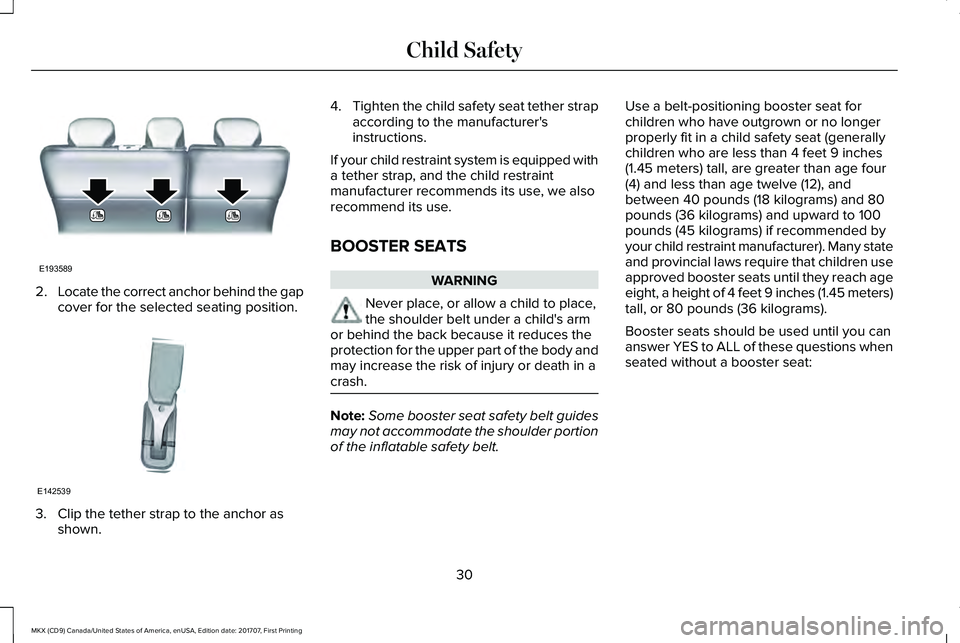
2.Locate the correct anchor behind the gapcover for the selected seating position.
3. Clip the tether strap to the anchor asshown.
4.Tighten the child safety seat tether strapaccording to the manufacturer'sinstructions.
If your child restraint system is equipped witha tether strap, and the child restraintmanufacturer recommends its use, we alsorecommend its use.
BOOSTER SEATS
WARNING
Never place, or allow a child to place,the shoulder belt under a child's armor behind the back because it reduces theprotection for the upper part of the body andmay increase the risk of injury or death in acrash.
Note:Some booster seat safety belt guidesmay not accommodate the shoulder portionof the inflatable safety belt.
Use a belt-positioning booster seat forchildren who have outgrown or no longerproperly fit in a child safety seat (generallychildren who are less than 4 feet 9 inches(1.45 meters) tall, are greater than age four(4) and less than age twelve (12), andbetween 40 pounds (18 kilograms) and 80pounds (36 kilograms) and upward to 100pounds (45 kilograms) if recommended byyour child restraint manufacturer). Many stateand provincial laws require that children useapproved booster seats until they reach ageeight, a height of 4 feet 9 inches (1.45 meters)tall, or 80 pounds (36 kilograms).
Booster seats should be used until you cananswer YES to ALL of these questions whenseated without a booster seat:
30
MKX (CD9) Canada/United States of America, enUSA, Edition date: 201707, First Printing
Child SafetyE193589 E142539
Page 34 of 603
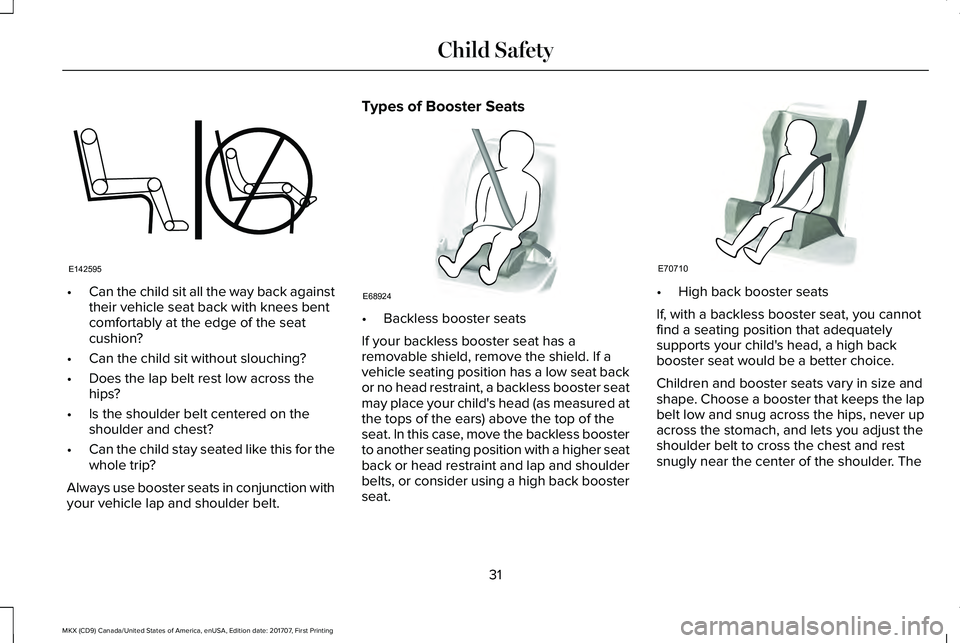
•Can the child sit all the way back againsttheir vehicle seat back with knees bentcomfortably at the edge of the seatcushion?
•Can the child sit without slouching?
•Does the lap belt rest low across thehips?
•Is the shoulder belt centered on theshoulder and chest?
•Can the child stay seated like this for thewhole trip?
Always use booster seats in conjunction withyour vehicle lap and shoulder belt.
Types of Booster Seats
•Backless booster seats
If your backless booster seat has aremovable shield, remove the shield. If avehicle seating position has a low seat backor no head restraint, a backless booster seatmay place your child's head (as measured atthe tops of the ears) above the top of theseat. In this case, move the backless boosterto another seating position with a higher seatback or head restraint and lap and shoulderbelts, or consider using a high back boosterseat.
•High back booster seats
If, with a backless booster seat, you cannotfind a seating position that adequatelysupports your child's head, a high backbooster seat would be a better choice.
Children and booster seats vary in size andshape. Choose a booster that keeps the lapbelt low and snug across the hips, never upacross the stomach, and lets you adjust theshoulder belt to cross the chest and restsnugly near the center of the shoulder. The
31
MKX (CD9) Canada/United States of America, enUSA, Edition date: 201707, First Printing
Child SafetyE142595 E68924 E70710
Page 37 of 603
Recommendations for attaching child safety restraints for children
Use any attachment method as indicated below by X
Combined weight ofchild and child seatRestraint TypeSafety belt onlySafety belt andLATCH (loweranchors and toptether anchor)
Safety belt and toptether anchorLATCH (loweranchors only)LATCH (loweranchors and toptether anchor)
XXUp to 65 lb(29.5 kg)Rear facing childseat
XOver 65 lb(29.5 kg)Rear facing childseat
XXXUp to 65 lb(29.5 kg)Forward facingchild seat
XXOver 65 lb(29.5 kg)Forward facingchild seat
Note:The child seat must rest tightly againstthe vehicle seat upon which it is installed. Itmay be necessary to lift or remove the headrestraint. See Seats (page 150).
CHILD SAFETY LOCKS
When these locks are set, the rear doorscannot be opened from the inside.
34
MKX (CD9) Canada/United States of America, enUSA, Edition date: 201707, First Printing
Child Safety
Page 39 of 603
PRINCIPLE OF OPERATION
WARNINGS
Always drive and ride with yourseatback upright and the lap belt snugand low across the hips.
To reduce the risk of injury, make surechildren sit where they can be properlyrestrained.
Never let a passenger hold a child onhis or her lap while your vehicle ismoving. The passenger cannot protect thechild from injury in a crash.
All occupants of your vehicle, includingthe driver, should always properly weartheir safety belts, even when an airbagsupplemental restraint system is provided.Failure to properly wear your safety beltcould seriously increase the risk of injury ordeath.
WARNINGS
It is extremely dangerous to ride in acargo area, inside or outside of avehicle. In a crash, people riding in theseareas are more likely to be seriously injuredor killed. Do not allow people to ride in anyarea of your vehicle that is not equipped withseats and safety belts. Be sure everyone inyour vehicle is in a seat and using a safetybelt properly.
In a rollover crash, an unbelted personis significantly more likely to die thana person wearing a safety belt.
Each seating position in your vehiclehas a specific safety belt assemblywhich is made up of one buckle and onetongue that are designed to be used as apair. 1) Use the shoulder belt on the outsideshoulder only. Never wear the shoulder beltunder the arm. 2) Never swing the safety beltaround your neck over the inside shoulder.3) Never use a single belt for more than oneperson.
WARNINGS
When possible, all children 12 years oldand under should be properlyrestrained in a rear seating position. Failureto follow this could seriously increase therisk of injury or death.
Safety belts and seats can become hotin a vehicle that has been closed up insunny weather; they could burn a small child.Check seat covers and buckles before youplace a child anywhere near them.
Front and rear seat occupants,including pregnant women, shouldwear safety belts for optimum protection inan accident.
All seating positions in your vehicle have lapand shoulder safety belts. All occupants ofthe vehicle should always properly wear theirsafety belts, even when an airbagsupplemental restraint system is provided.
The safety belt system consists of:
•Lap and shoulder safety belts.
•Shoulder safety belt with automaticlocking mode, (except driver safety belt).
36
MKX (CD9) Canada/United States of America, enUSA, Edition date: 201707, First Printing
Seatbelts
Page 43 of 603
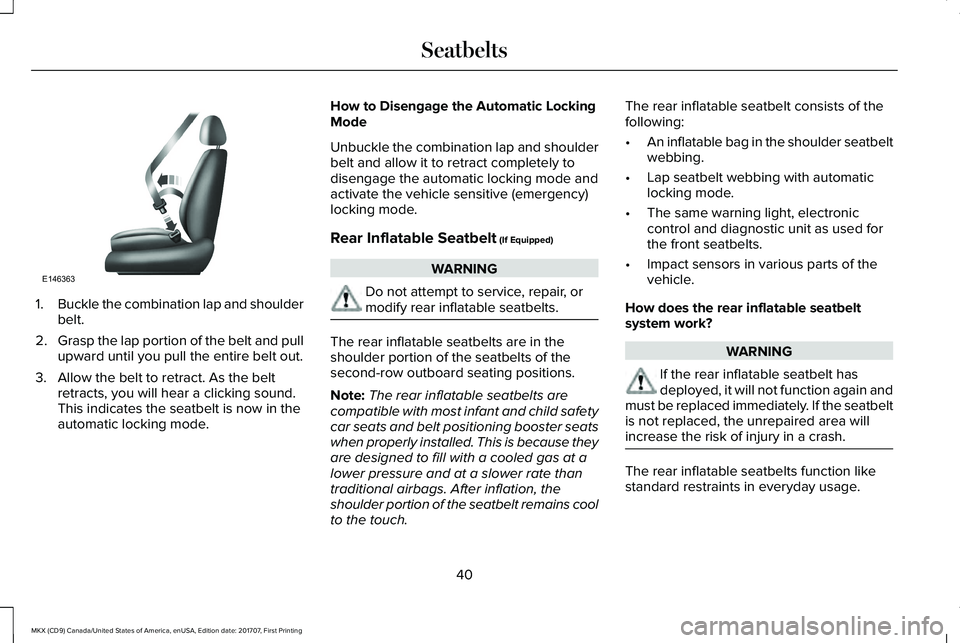
1.Buckle the combination lap and shoulderbelt.
2.Grasp the lap portion of the belt and pullupward until you pull the entire belt out.
3. Allow the belt to retract. As the beltretracts, you will hear a clicking sound.This indicates the seatbelt is now in theautomatic locking mode.
How to Disengage the Automatic LockingMode
Unbuckle the combination lap and shoulderbelt and allow it to retract completely todisengage the automatic locking mode andactivate the vehicle sensitive (emergency)locking mode.
Rear Inflatable Seatbelt (If Equipped)
WARNING
Do not attempt to service, repair, ormodify rear inflatable seatbelts.
The rear inflatable seatbelts are in theshoulder portion of the seatbelts of thesecond-row outboard seating positions.
Note:The rear inflatable seatbelts arecompatible with most infant and child safetycar seats and belt positioning booster seatswhen properly installed. This is because theyare designed to fill with a cooled gas at alower pressure and at a slower rate thantraditional airbags. After inflation, theshoulder portion of the seatbelt remains coolto the touch.
The rear inflatable seatbelt consists of thefollowing:
•An inflatable bag in the shoulder seatbeltwebbing.
•Lap seatbelt webbing with automaticlocking mode.
•The same warning light, electroniccontrol and diagnostic unit as used forthe front seatbelts.
•Impact sensors in various parts of thevehicle.
How does the rear inflatable seatbeltsystem work?
WARNING
If the rear inflatable seatbelt hasdeployed, it will not function again andmust be replaced immediately. If the seatbeltis not replaced, the unrepaired area willincrease the risk of injury in a crash.
The rear inflatable seatbelts function likestandard restraints in everyday usage.
40
MKX (CD9) Canada/United States of America, enUSA, Edition date: 201707, First Printing
SeatbeltsE146363
Page 52 of 603
Proper Driver and Front PassengerSeating Adjustment
WARNING
National Highway Traffic SafetyAdministration (NHTSA) recommendsa minimum distance of at least 10 in (25 cm)between an occupant's chest and the driverairbag module.
To properly position yourself away from theairbag:
•Move your seat to the rear as far as youcan while still reaching the pedalscomfortably.
•Recline the seat slightly (one or twodegrees) from the upright position.
After all occupants have adjusted their seatsand put on seatbelts, it is very important thatthey continue to sit properly. A properlyseated occupant sits upright, leaning againstthe seatback, and centered on the seatcushion, with their feet comfortably extendedon the floor. Sitting improperly can increase
the chance of injury in a crash event. Forexample, if an occupant slouches, lies down,turns sideways, sits forward, leans forwardor sideways, or puts one or both feet up, thechance of injury during a crash is greatlyincreased.
Children and Airbags
WARNING
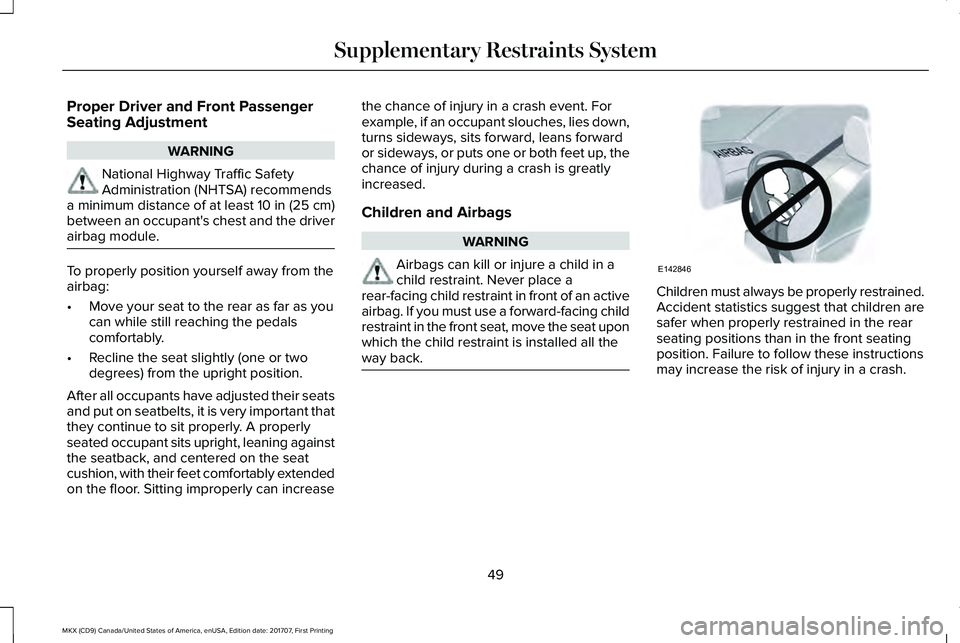
Airbags can kill or injure a child in achild restraint. Never place arear-facing child restraint in front of an activeairbag. If you must use a forward-facing childrestraint in the front seat, move the seat uponwhich the child restraint is installed all theway back.
Children must always be properly restrained.Accident statistics suggest that children aresafer when properly restrained in the rearseating positions than in the front seatingposition. Failure to follow these instructionsmay increase the risk of injury in a crash.
49
MKX (CD9) Canada/United States of America, enUSA, Edition date: 201707, First Printing
Supplementary Restraints SystemE142846
Page 55 of 603
Note:When the passenger airbag statusindicator off light is illuminated, thepassenger (seat mounted) side airbag maybe disabled to avoid the risk of airbagdeployment injuries.
After all occupants have adjusted their seatsand put on seatbelts, it is very important thatthey continue to sit properly. A properlyseated occupant sits upright, leaning againstthe seatback, and centered on the seatcushion, with their feet comfortably extendedon the floor. Sitting improperly can increasethe chance of injury in a crash event. Forexample, if an occupant slouches, lies down,turns sideways, sits forward, leans forwardor sideways, or puts one or both feet up, thechance of injury during a crash greatlyincreases.
If you think that the status of the passengerairbag off indicator lamp is incorrect, checkfor the following:
•Objects lodged underneath the seat.
•Objects between the seat cushion andthe center console.
•Objects hanging off the seatback.
•Objects stowed in the seatback mappocket.
•Objects placed on the occupant's lap.
•Cargo interference with the seat
•Other passengers pushing or pulling onthe seat.
•Rear passenger feet and knees restingor pushing on the seat.
The conditions listed above may cause theweight of a properly seated occupant to beincorrectly interpreted by the front passengersensing system. The person in the frontpassenger seat may appear heavier or lighterdue to the conditions described in the listabove.
Make sure the front passengersensing system is operatingproperly. See Crash Sensors andAirbag Indicator (page 55).
If the airbag readiness light is lit, do thefollowing:
The driver and adult passengers shouldcheck for objects lodged underneath thefront passenger seat, or cargo interferingwith the seat.
If there are lodged objects, or cargo isinterfering with the seat, take the followingsteps to remove the obstruction:
•Pull the vehicle over.
•Switch the vehicle off.
•Driver and adult passengers shouldcheck for any objects lodged underneaththe front passenger seat or cargointerfering with the seat.
•Remove the obstruction(s) (if found).
•Restart the vehicle.
•Wait at least two minutes and verify thatthe airbag readiness light is no longerilluminated.
•If the airbag readiness light remainsilluminated, this may or may not be aproblem due to the front passengersensing system.
Do not attempt to repair or service thesystem. Take your vehicle immediately to anauthorized dealer.
52
MKX (CD9) Canada/United States of America, enUSA, Edition date: 201707, First Printing
Supplementary Restraints SystemE67017
Page 56 of 603
If it is necessary to modify an advanced frontairbag system to accommodate a personwith disabilities, contact the Ford CustomerRelationship Center. See Getting theServices You Need (page 280).
SIDE AIRBAGS
WARNINGS
Do not place objects or mountequipment on or near the airbag cover,on the side of the seatbacks (of the frontseats), or in front seat areas that may comeinto contact with a deploying airbag. Failureto follow these instructions may increase therisk of personal injury in the event of a crash.
Do not use accessory seat covers. Theuse of accessory seat covers mayprevent the deployment of the side airbagsand increase the risk of injury in an accident.
Do not lean your head on the door. Theside airbag could injure you as itdeploys from the side of the seatback.
WARNINGS
Do not attempt to service, repair, ormodify the seat airbag supplementalrestraint systems, its fuses or the seat coveron a vehicle containing seat airbags as youcould be seriously injured or killed. Contactyour authorized dealer as soon as possible.
If the side airbag has deployed, theairbag will not function again. The sideairbag system (including the seat) must beinspected as soon as possible. If the airbagis not replaced, the unrepaired area willincrease the risk of injury in a crash.
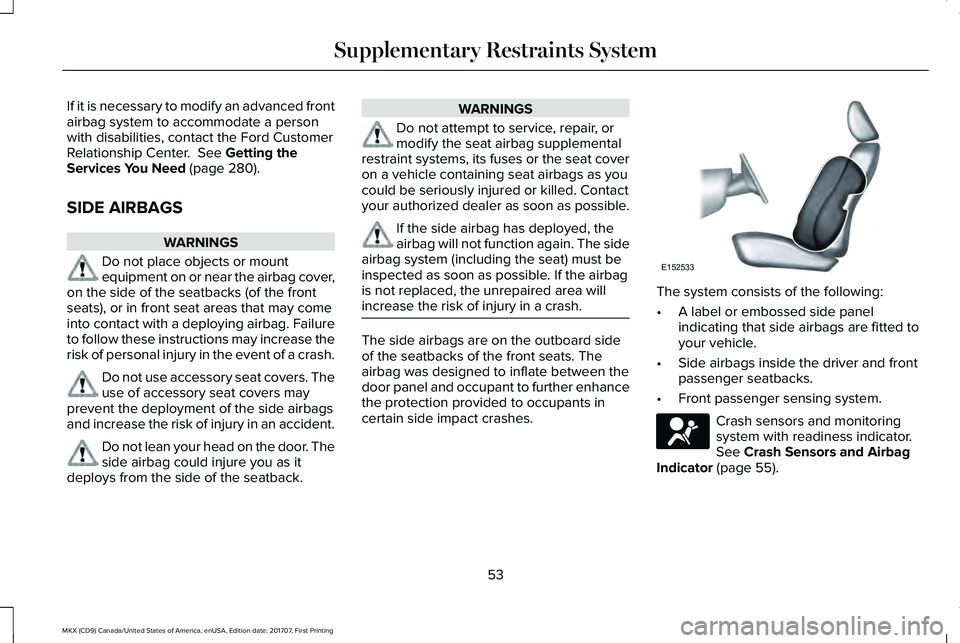
The side airbags are on the outboard sideof the seatbacks of the front seats. Theairbag was designed to inflate between thedoor panel and occupant to further enhancethe protection provided to occupants incertain side impact crashes.
The system consists of the following:
•A label or embossed side panelindicating that side airbags are fitted toyour vehicle.
•Side airbags inside the driver and frontpassenger seatbacks.
•Front passenger sensing system.
Crash sensors and monitoringsystem with readiness indicator.See Crash Sensors and AirbagIndicator (page 55).
53
MKX (CD9) Canada/United States of America, enUSA, Edition date: 201707, First Printing
Supplementary Restraints SystemE152533 E67017
Page 58 of 603
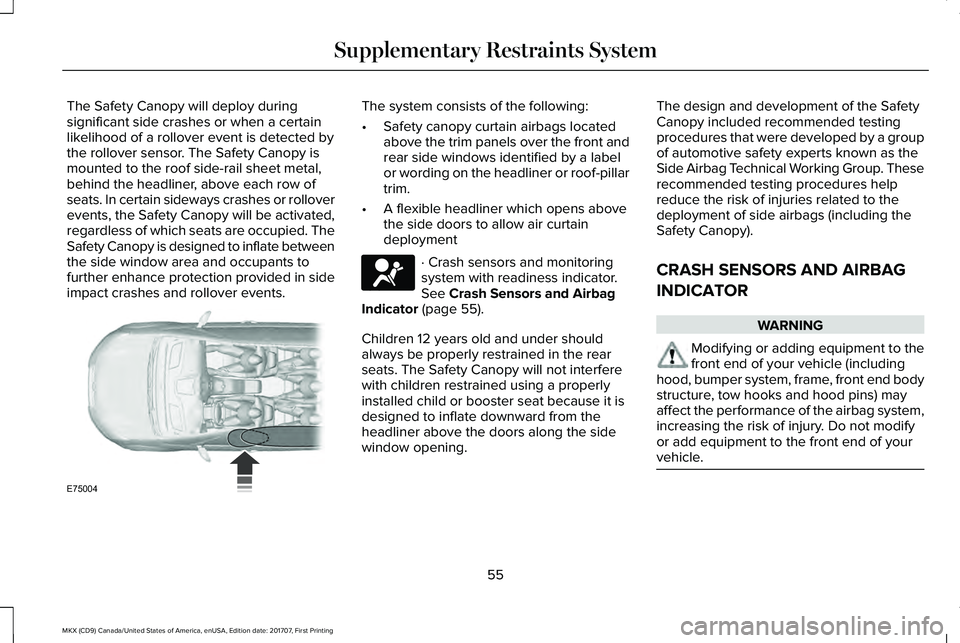
The Safety Canopy will deploy duringsignificant side crashes or when a certainlikelihood of a rollover event is detected bythe rollover sensor. The Safety Canopy ismounted to the roof side-rail sheet metal,behind the headliner, above each row ofseats. In certain sideways crashes or rolloverevents, the Safety Canopy will be activated,regardless of which seats are occupied. TheSafety Canopy is designed to inflate betweenthe side window area and occupants tofurther enhance protection provided in sideimpact crashes and rollover events.
The system consists of the following:
•Safety canopy curtain airbags locatedabove the trim panels over the front andrear side windows identified by a labelor wording on the headliner or roof-pillartrim.
•A flexible headliner which opens abovethe side doors to allow air curtaindeployment
· Crash sensors and monitoringsystem with readiness indicator.See Crash Sensors and AirbagIndicator (page 55).
Children 12 years old and under shouldalways be properly restrained in the rearseats. The Safety Canopy will not interferewith children restrained using a properlyinstalled child or booster seat because it isdesigned to inflate downward from theheadliner above the doors along the sidewindow opening.
The design and development of the SafetyCanopy included recommended testingprocedures that were developed by a groupof automotive safety experts known as theSide Airbag Technical Working Group. Theserecommended testing procedures helpreduce the risk of injuries related to thedeployment of side airbags (including theSafety Canopy).
CRASH SENSORS AND AIRBAG
INDICATOR
WARNING
Modifying or adding equipment to thefront end of your vehicle (includinghood, bumper system, frame, front end bodystructure, tow hooks and hood pins) mayaffect the performance of the airbag system,increasing the risk of injury. Do not modifyor add equipment to the front end of yourvehicle.
55
MKX (CD9) Canada/United States of America, enUSA, Edition date: 201707, First Printing
Supplementary Restraints SystemE75004 E67017
Page 83 of 603
MANUAL LIFTGATE (If Equipped)
WARNINGS
It is extremely dangerous to ride in acargo area, inside or outside of avehicle. In a crash, people riding in theseareas are more likely to be seriously injuredor killed. Do not allow people to ride in anyarea of your vehicle that is not equipped withseats and seatbelts. Make sure everyone inyour vehicle is in a seat and properly usinga seatbelt. Failure to follow this warningcould result in serious personal injury ordeath..
Make sure to close and latch theliftgate to prevent drawing exhaustfumes into your vehicle. This will also preventpassengers and cargo from falling out. If youmust drive with the liftgate open, keep thevents or windows open so outside air comesinto your vehicle. Failure to follow thiswarning could result in serious personalinjury.
Note:Be careful when opening or closingthe liftgate in a garage or other enclosedarea to avoid damaging the liftgate.
Note: Do not hang anything, for example abike rack, from the glass or liftgate. Thiscould damage the liftgate and itscomponents.
Note: Do not leave the liftgate open whiledriving. This could damage the liftgate andits components.
Opening the Liftgate
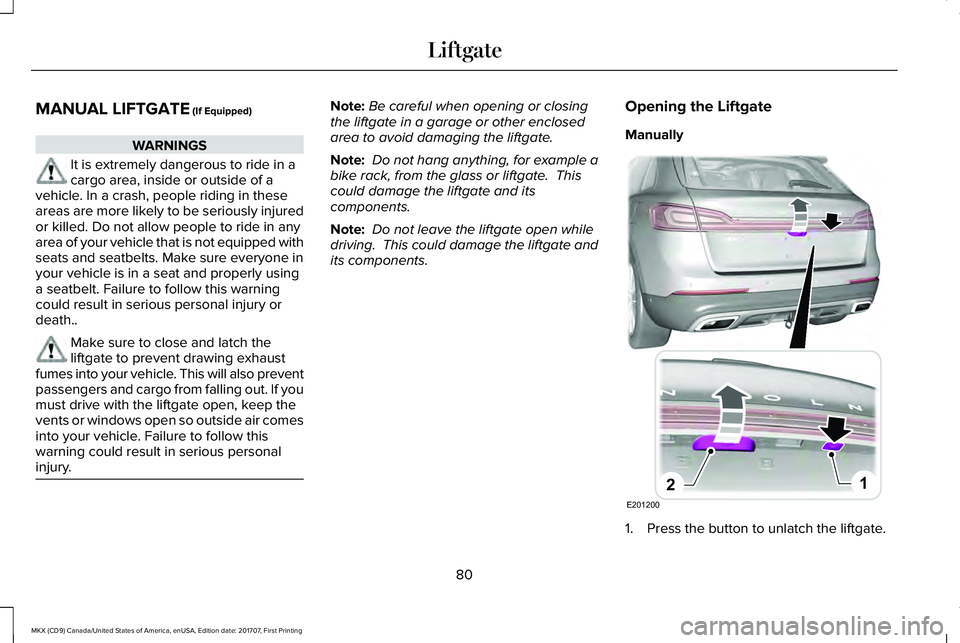
Manually
1. Press the button to unlatch the liftgate.
80
MKX (CD9) Canada/United States of America, enUSA, Edition date: 201707, First Printing
LiftgateE201200
12