automatic transmission LINCOLN MKZ 2013 Owner's Manual
[x] Cancel search | Manufacturer: LINCOLN, Model Year: 2013, Model line: MKZ, Model: LINCOLN MKZ 2013Pages: 474, PDF Size: 3.79 MB
Page 191 of 474
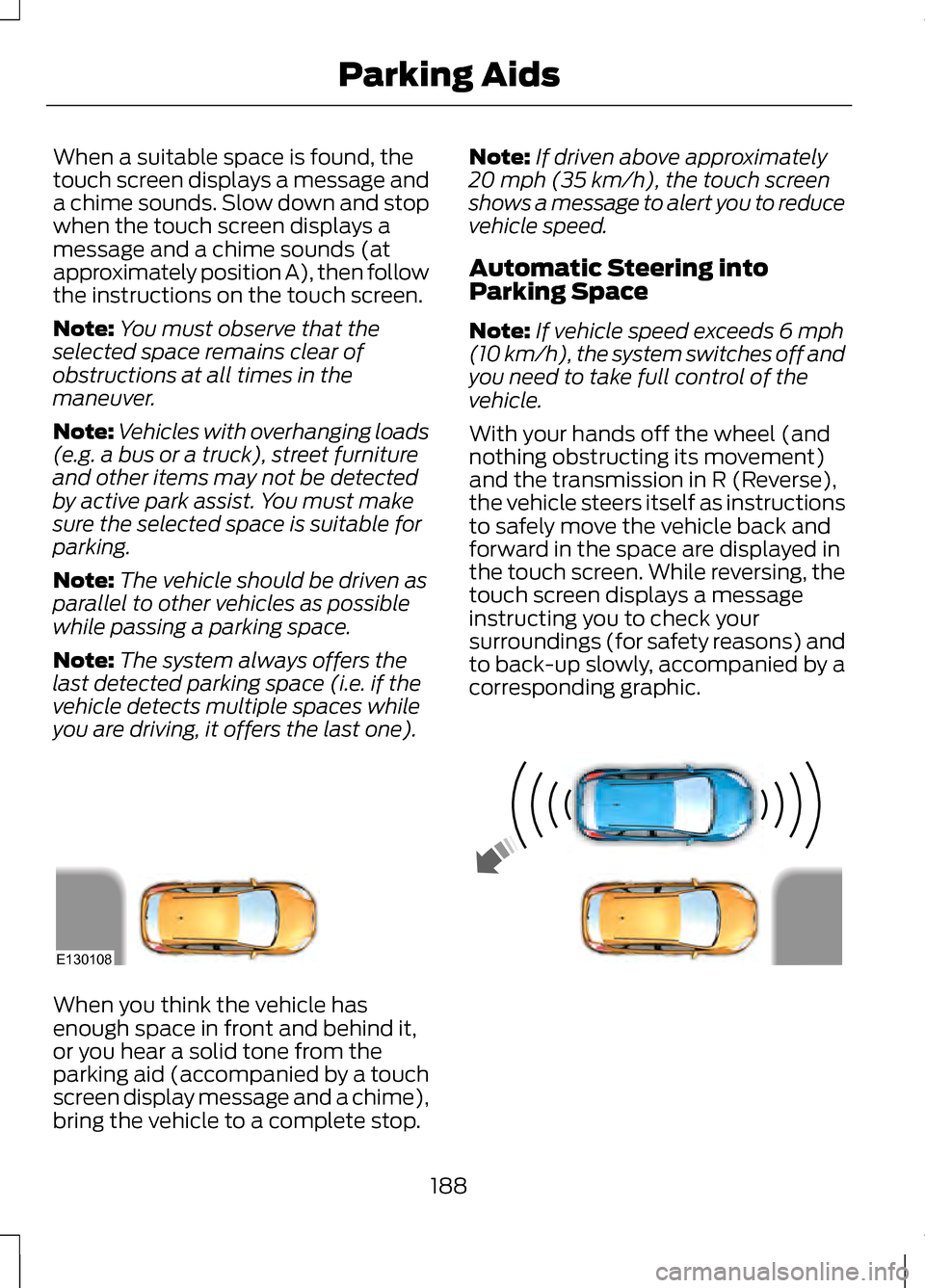
When a suitable space is found, the
touch screen displays a message and
a chime sounds. Slow down and stop
when the touch screen displays a
message and a chime sounds (at
approximately position A), then follow
the instructions on the touch screen.
Note:
You must observe that the
selected space remains clear of
obstructions at all times in the
maneuver.
Note: Vehicles with overhanging loads
(e.g. a bus or a truck), street furniture
and other items may not be detected
by active park assist. You must make
sure the selected space is suitable for
parking.
Note: The vehicle should be driven as
parallel to other vehicles as possible
while passing a parking space.
Note: The system always offers the
last detected parking space (i.e. if the
vehicle detects multiple spaces while
you are driving, it offers the last one). Note:
If driven above approximately
20 mph (35 km/h), the touch screen
shows a message to alert you to reduce
vehicle speed.
Automatic Steering into
Parking Space
Note: If vehicle speed exceeds 6 mph
(10 km/h), the system switches off and
you need to take full control of the
vehicle.
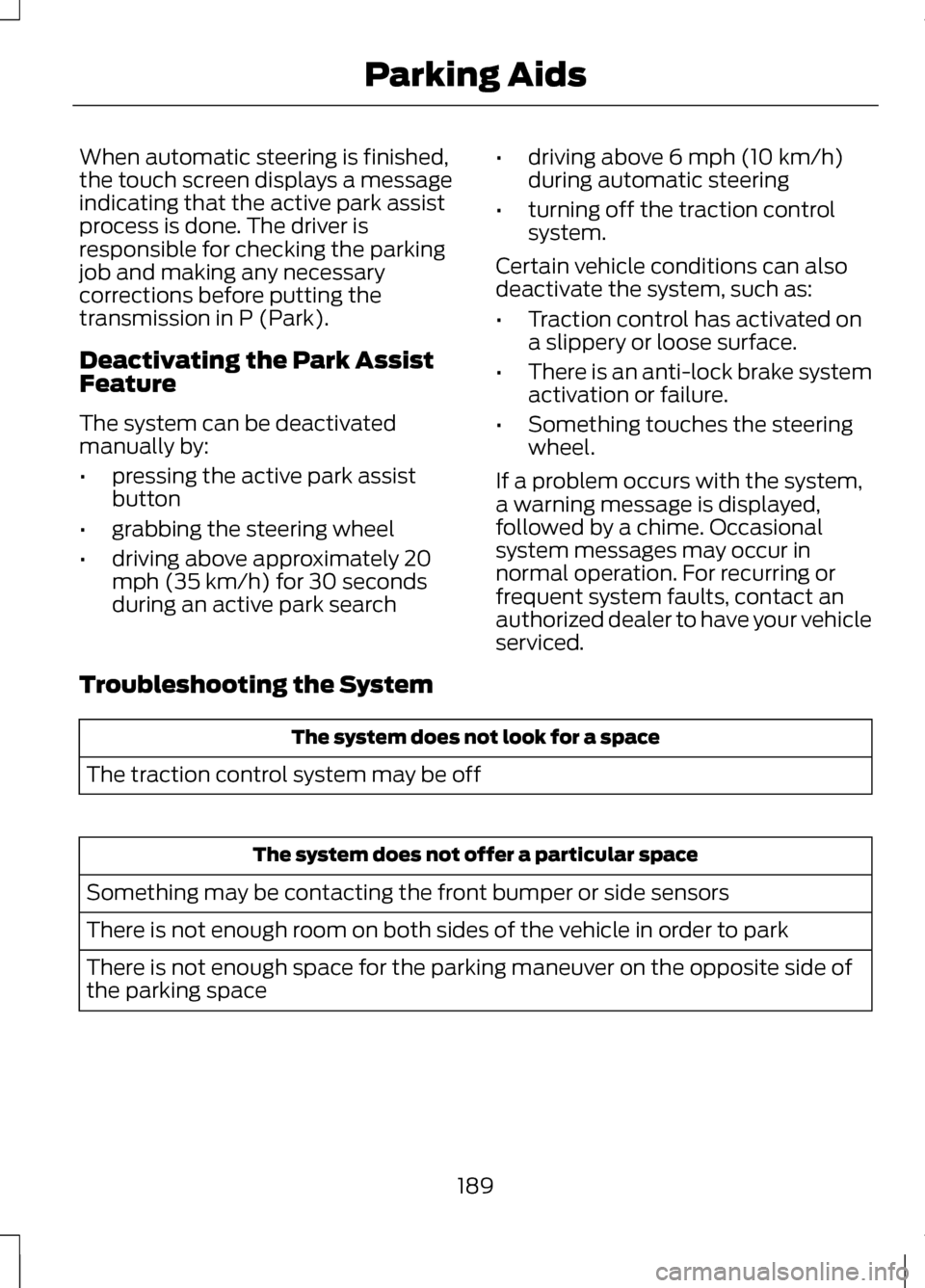
With your hands off the wheel (and
nothing obstructing its movement)
and the transmission in R (Reverse),
the vehicle steers itself as instructions
to safely move the vehicle back and
forward in the space are displayed in
the touch screen. While reversing, the
touch screen displays a message
instructing you to check your
surroundings (for safety reasons) and
to back-up slowly, accompanied by a
corresponding graphic. When you think the vehicle has
enough space in front and behind it,
or you hear a solid tone from the
parking aid (accompanied by a touch
screen display message and a chime),
bring the vehicle to a complete stop.
188
Parking AidsE130108
Page 192 of 474
When automatic steering is finished,
the touch screen displays a message
indicating that the active park assist
process is done. The driver is
responsible for checking the parking
job and making any necessary
corrections before putting the
transmission in P (Park).
Deactivating the Park Assist
Feature
The system can be deactivated
manually by:
•
pressing the active park assist
button
• grabbing the steering wheel
• driving above approximately 20
mph (35 km/h) for 30 seconds
during an active park search •
driving above 6 mph (10 km/h)
during automatic steering
• turning off the traction control
system.
Certain vehicle conditions can also
deactivate the system, such as:
• Traction control has activated on
a slippery or loose surface.
• There is an anti-lock brake system
activation or failure.
• Something touches the steering
wheel.
If a problem occurs with the system,
a warning message is displayed,
followed by a chime. Occasional
system messages may occur in
normal operation. For recurring or
frequent system faults, contact an
authorized dealer to have your vehicle
serviced.
Troubleshooting the System The system does not look for a space
The traction control system may be off The system does not offer a particular space
Something may be contacting the front bumper or side sensors
There is not enough room on both sides of the vehicle in order to park
There is not enough space for the parking maneuver on the opposite side of
the parking space
189
Parking Aids
Page 196 of 474
Active guidelines are only shown with
fixed guidelines. To use active
guidelines, turn the steering wheel to
point the guidelines toward an
intended path. If the steering wheel
position is changed while reversing,
the vehicle might deviate from the
original intended path.
The fixed and active guidelines fade
in and out depending on the steering
wheel position. The active guidelines
are not shown when the steering
wheel position is straight.
Always use caution while reversing.
Objects in the red zone are closest to
your vehicle and objects in the green
zone are farther away. Objects are
getting closer to your vehicle as they
move from the green zone to the
yellow or red zones. Use the side view
mirrors and rear view mirror to get
better coverage on both sides and rear
of the vehicle.
Selectable settings for this feature are
ACTIVE + FIXED, FIXED and OFF.
Visual Park Aid Alert
Note:
Visual park alert is only available
when the transmission is in R
(Reverse).
Note: The reverse sensing system is
not effective at speeds above 3 mph
(5 km/h) and may not detect certain
angular or moving objects. The system uses red, yellow and green
highlights which appear on top of the
video image when an object is
detected by the reverse sensing
system. The alert highlights the
closest object detected. The reverse
sensing alert can be disabled and if
visual park aid alert is enabled,
highlighted areas are still displayed.
Selectable settings for this feature are
ON and OFF.
Manual Zoom
WARNING
When manual zoom is on, the
full area behind the vehicle is not
shown. Be aware of your surroundings
when using the manual zoom feature. Note:
Manual zoom is only available
when the transmission is in R
(Reverse).
Note: When manual zoom is enabled,
only the centerline is shown.
This allows you to get a closer view of
an object behind the vehicle. The
zoomed image keeps the bumper in
the image to provide a reference. The
zoom is only active while the
transmission is in R (Reverse). When
the transmission is shifted out of R
(Reverse), the feature automatically
turns off and must be reset when it is
used again.
193
Parking Aids
Page 233 of 474
The braking system of the tow
vehicle is rated for operation at the
GVWR not GCWR.
Separate functioning brake
systems are required for safe
control of towed vehicles and
trailers weighing more than 1500
pounds (680 kilograms) when
loaded.
Trailer Lamps
Trailer lamps are required on most
towed vehicles. Make sure all running
lights, brake lights, turn signals and
hazard lights are working. Contact
your authorized dealer or trailer rental
agency for proper instructions and
equipment for hooking up the lamps.
Before Towing a Trailer
Practice turning, stopping and
backing-up to get the feel of the
vehicle-trailer combination before
starting on a trip. When turning, make
wider turns so the trailer wheels clear
curbs and other obstacles.
When Towing a Trailer
•
Do not drive faster than 70 mph
(113 km/h) during the first 500
miles (800 kilometers).
• Do not make full-throttle starts.
• Check your hitch, electrical
connections and trailer wheel lug
nuts thoroughly after you have
traveled 50 miles (80 kilometers). •
When stopped in congested or
heavy traffic during hot weather,
place the gearshift in position P to
aid engine and transmission
cooling and to help A/C
performance.
• Turn off the speed control with
heavy loads or in hilly terrain. The
speed control may turn off
automatically when you are towing
on long, steep grades.
• Shift to a lower gear when driving
down a long or steep hill. Do not
apply the brakes continuously, as
they may overheat and become
less effective.
• If your transmission is equipped
with a grade assist or Tow/Haul
feature, use this feature when
towing. This provides engine
braking and helps eliminate
excessive transmission shifting for
optimum fuel economy and
transmission cooling.
• Allow more distance for stopping
with a trailer attached. Anticipate
stops and brake gradually.
230
Towing
Page 234 of 474
•
Avoid parking on a grade.
• However, if you must park on a
grade:
•Turn the steering wheel to point
the vehicle tires away from
traffic flow.
• Set the vehicle parking brake.
• Place automatic transmission
in position P.
• Place wheel chocks in front and
back of the trailer wheels.
(Chocks not equipped with
vehicle.)
Launching or Retrieving a Boat
or Personal Watercraft (PWC)
Note: Disconnect the wiring to the
trailer
before backing the trailer into
the water.
Note: Reconnect the wiring to the
trailer after you remove the trailer from
the water.
When backing down a ramp during
boat launching or retrieval:
• Do not allow the static water level
to rise above the bottom edge of
the rear bumper.
• Do not allow waves to break higher
than 6 inches (15 centimeters)
above the bottom edge of the rear
bumper.
Exceeding these limits may allow
water to enter vehicle components:
• Causing internal damage to the
components.
• Affecting drivability, emissions, and
reliability. Any time the rear axle submerges in
water, replace the rear axle lubricant.
Water may contaminate the rear axle
lubricant, which is not a normal
maintenance inspection item unless
there is a possibility of a leak or other
axle repair is required.
TRANSPORTING THE
VEHICLE
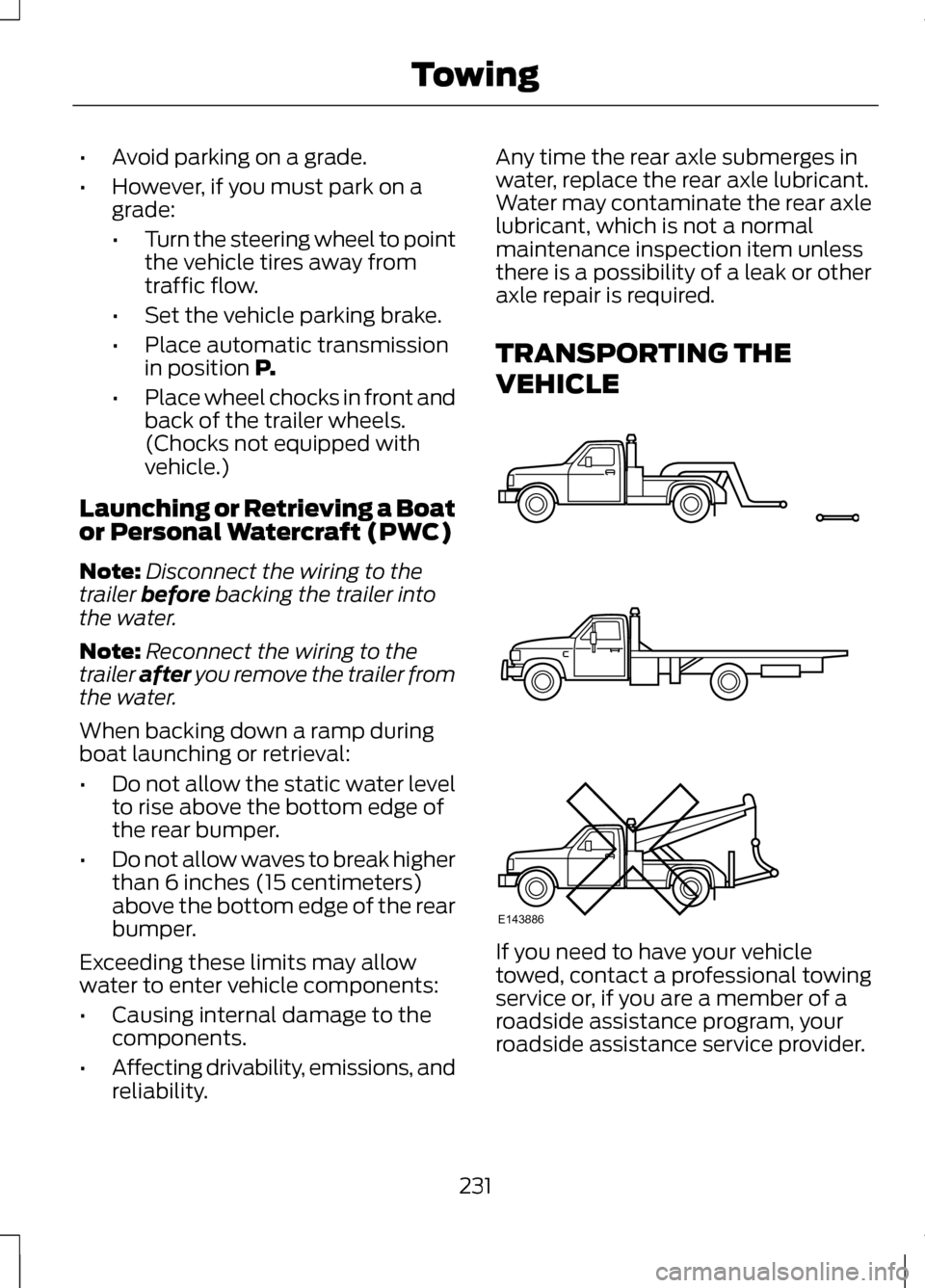
If you need to have your vehicle
towed, contact a professional towing
service or, if you are a member of a
roadside assistance program, your
roadside assistance service provider.
231
TowingE143886
Page 275 of 474
3. If this is not possible, wait a short
period for the engine to cool.
4. Check the coolant level and replenish if low.
5. Re-start the engine and take your vehicle to an authorized dealer.
Note: Driving the vehicle without
repairing the engine problem increases
the chance of engine damage. Take
your vehicle to an authorized dealer as
soon as possible.
AUTOMATIC
TRANSMISSION FLUID
CHECK
Note: Transmission fluid should be
checked by an authorized dealer. If
required, fluid should be added by an
authorized dealer.
The automatic transmission does not
have a transmission fluid dipstick.
Have an authorized dealer check and
change the transmission fluid and
filter at the correct service interval.
See Scheduled Maintenance (page
440). Your transmission does not
consume fluid. However, the fluid level
should be checked if the transmission
is not working properly, or if you notice
some sign of fluid leakage.
Do not use supplemental transmission
fluid additives, treatments or cleaning
agents. The use of these materials
may affect transmission operation
and result in damage to internal
transmission components. 6F35/HF35 transmission
(If
Equipped)
Note: Transmission fluid should be
checked by an authorized dealer. If
required, fluid should be added by an
authorized dealer.
The automatic transmission does not
have a transmission fluid dipstick.
Refer to your scheduled maintenance
information for scheduled intervals
for fluid checks and changes. Your
transmission does not consume fluid.
However, the fluid level should be
checked if the transmission is not
working properly, (For example: if the
transmission slips or shifts slowly) or
if you notice some sign of fluid
leakage. See
Scheduled
Maintenance (page 440).
Do not use supplemental transmission
fluid additives, treatments or cleaning
agents. The use of these materials
may affect transmission operation
and result in damage to internal
transmission components.
6F50/6F55 Transmission
(If
Equipped) WARNINGS
The dipstick cap and surrounding
components may be hot; gloves
are recommended. Use gloves when moving the air
filter assembly. Components will
be hot. 272
Maintenance
Page 276 of 474
![LINCOLN MKZ 2013 Owners Manual Note:
Automatic transmission fluid
expands when warmed. To obtain an
accurate fluid check, drive the vehicle
until it is warmed up (approximately
20 miles [30 kilometers]). If your
vehicle has been op](/img/15/6980/w960_6980-275.png "LINCOLN MKZ 2013 Owners Manual Note:
Automatic transmission fluid
expands when warmed. To obtain an
accurate fluid check, drive the vehicle
until it is warmed up (approximately
20 miles [30 kilometers]). If your
vehicle has been op")
Note:
Automatic transmission fluid
expands when warmed. To obtain an
accurate fluid check, drive the vehicle
until it is warmed up (approximately
20 miles [30 kilometers]). If your
vehicle has been operated for an
extended period at high speeds, in city
traffic during hot weather or pulling a
trailer, the vehicle should be turned off
until normal operating temperatures
are reached to allow the fluid to cool
before checking. Depending on vehicle
use, cooling times could take up to 30
minutes or longer.
Refer to your scheduled maintenance
information for scheduled intervals
for fluid checks and changes. Your
transmission does not consume fluid.
However, the fluid level should be
checked if the transmission is not
working properly. For example, if the
transmission slips or shifts slowly or
if you notice some sign of fluid
leakage.
1. Drive the vehicle 20 miles (30 kilometers) or until it reaches
normal operating temperature
2. Park the vehicle on a level surface and engage the parking brake.
3. With the parking brake engaged and your foot on the brake pedal,
start the engine and move the
gearshift lever through all of the
gear ranges. Allow a minimum of
10 seconds for each gear to
engage.
4. Put the gearshift lever in P (Park)
and leave the engine running. Note:
You will need to move the air
filter assembly to access the
transmission dipstick.
5. Remove the dipstick, wiping it clean with a clean, dry lint free rag.
If necessary, refer to Under hood
overview in this chapter for the
location of the dipstick.
6. Install the dipstick making sure it
is fully seated in the filler tube by
turning it to the locked position.
7. Remove the dipstick and inspect the fluid level. The fluid should be
in the designated areas for normal
operating temperature.
Moving the Air Filter Assembly
(Accessing the Dipstick) WARNING
Do not run engine with the air
filter disconnected.
273
Maintenance
Page 278 of 474
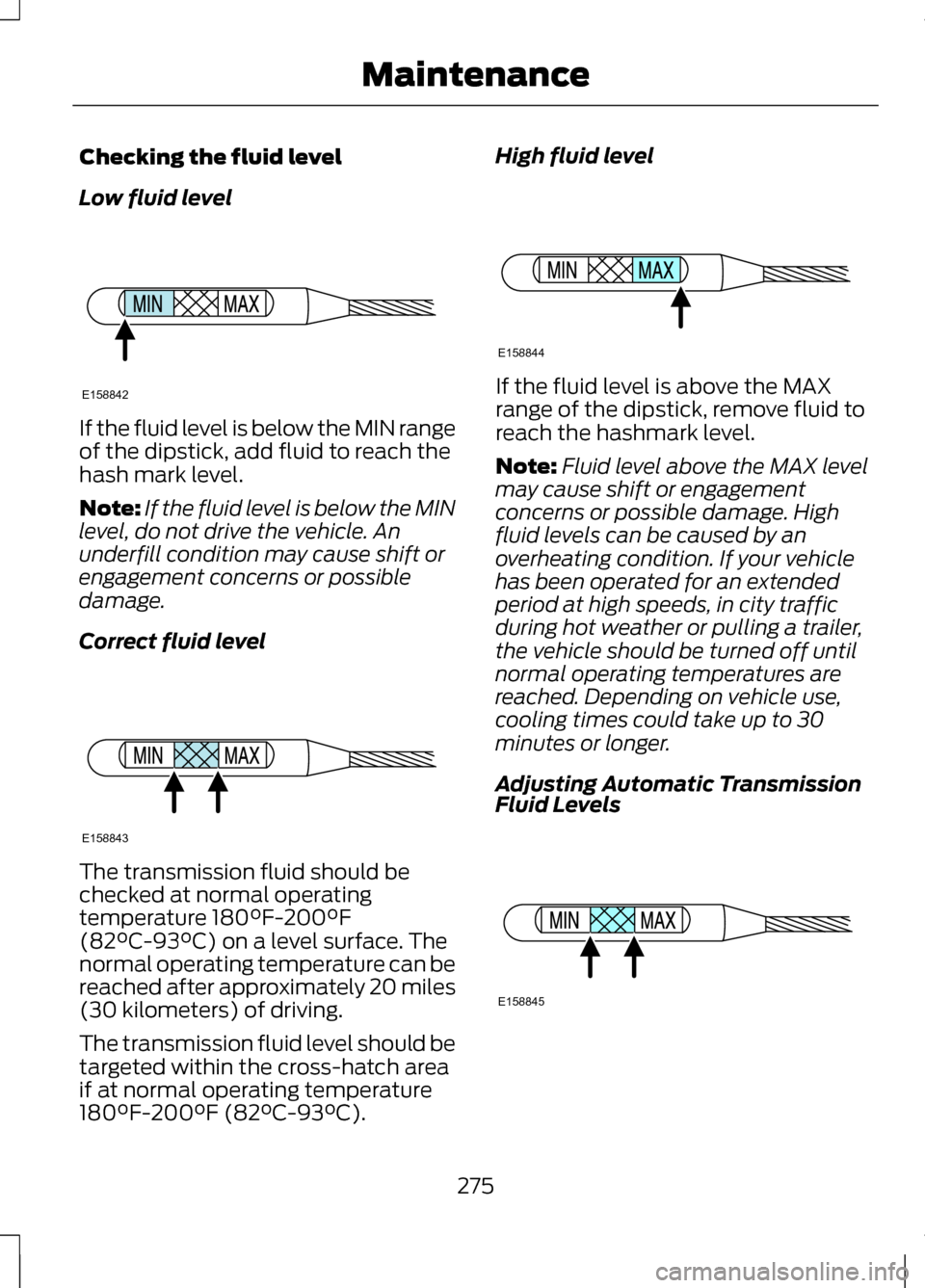
Checking the fluid level
Low fluid level
If the fluid level is below the MIN range
of the dipstick, add fluid to reach the
hash mark level.
Note:
If the fluid level is below the MIN
level, do not drive the vehicle. An
underfill condition may cause shift or
engagement concerns or possible
damage.
Correct fluid level The transmission fluid should be
checked at normal operating
temperature 180°F-200°F
(82°C-93°C) on a level surface. The
normal operating temperature can be
reached after approximately 20 miles
(30 kilometers) of driving.
The transmission fluid level should be
targeted within the cross-hatch area
if at normal operating temperature
180°F-200°F (82°C-93°C). High fluid level
If the fluid level is above the MAX
range of the dipstick, remove fluid to
reach the hashmark level.
Note:
Fluid level above the MAX level
may cause shift or engagement
concerns or possible damage. High
fluid levels can be caused by an
overheating condition. If your vehicle
has been operated for an extended
period at high speeds, in city traffic
during hot weather or pulling a trailer,
the vehicle should be turned off until
normal operating temperatures are
reached. Depending on vehicle use,
cooling times could take up to 30
minutes or longer.
Adjusting Automatic Transmission
Fluid Levels 275
MaintenanceE158842 E158843 E158844 E158845
Page 281 of 474
Your vehicle is equipped with a
Motorcraft® maintenance-free
battery which normally does not
require additional water during its life
of service.
Note:
If your battery has a
cover/shield, make sure it is reinstalled
after the battery has been cleaned or
replaced.
For longer, trouble-free operation,
keep the top of the battery clean and
dry. Also, make certain the battery
cables are always tightly fastened to
the battery terminals.
If you see any corrosion on the battery
or terminals, remove the cables from
the terminals and clean with a wire
brush. You can neutralize the acid with
a solution of baking soda and water.
It is recommended that the negative
battery cable terminal be
disconnected from the battery if you
plan to store your vehicle for an
extended period of time.
To ensure proper operation of the
battery management system (BMS),
any electrical devices that are added
to the vehicle should not have their
ground connection made directly at
the negative battery post. A
connection at the negative battery
post can cause inaccurate
measurements of the battery
condition and potential incorrect
system operation. Note:
Electrical or electronic
accessories or components added to
the vehicle by the dealer or the owner
may adversely affect battery
performance and durability and may
also affect the performance of other
electrical systems in the vehicle.
When a battery replacement is
required, the battery should only be
replaced with a Ford recommended
replacement battery that matches
the electrical requirements of the
vehicle.
When the battery is disconnected or
a new battery installed, the automatic
transmission must relearn its adaptive
strategy. As a result of this, the
transmission may shift firmly when
first driven. This operation is
considered normal and will fully
update transmission operation to its
optimum shift feel.
If the battery has been disconnected
or a new battery has been installed,
the clock and the preset radio stations
must be reset once the battery is
reconnected.
Note: Always dispose of automotive
batteries in a responsible manner.
Follow your local authorized standards
for disposal. Call your local authorized
recycling center to find out more about
recycling automotive batteries.
278
Maintenance
Page 331 of 474
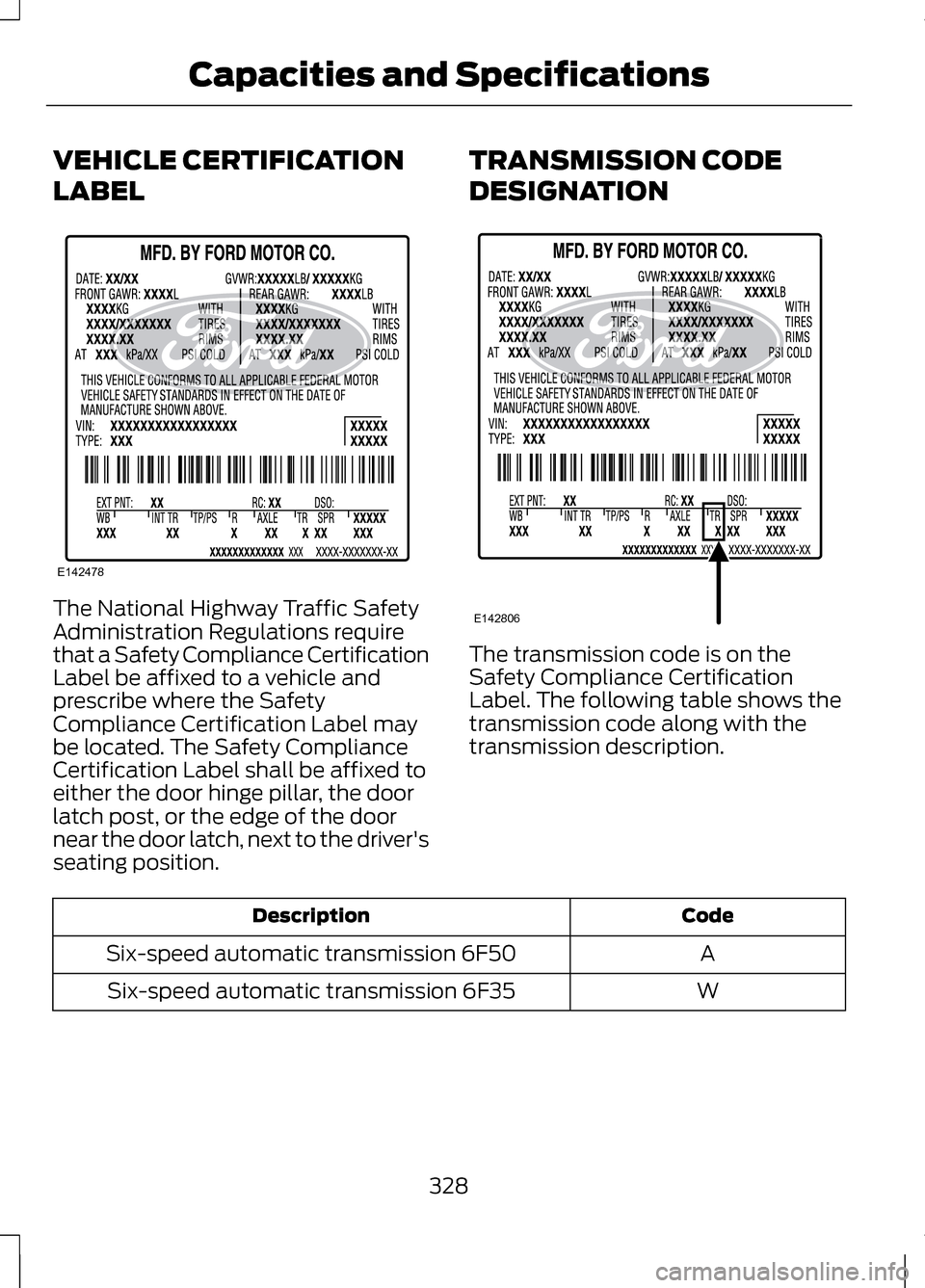
VEHICLE CERTIFICATION
LABEL
The National Highway Traffic Safety
Administration Regulations require
that a Safety Compliance Certification
Label be affixed to a vehicle and
prescribe where the Safety
Compliance Certification Label may
be located. The Safety Compliance
Certification Label shall be affixed to
either the door hinge pillar, the door
latch post, or the edge of the door
near the door latch, next to the driver's
seating position. TRANSMISSION CODE
DESIGNATION
The transmission code is on the
Safety Compliance Certification
Label. The following table shows the
transmission code along with the
transmission description.
Code
Description
A
Six-speed automatic transmission 6F50
W
Six-speed automatic transmission 6F35
328
Capacities and SpecificationsE142478 E142806