transmission LINCOLN MKZ 2014 Service Manual
[x] Cancel search | Manufacturer: LINCOLN, Model Year: 2014, Model line: MKZ, Model: LINCOLN MKZ 2014Pages: 468, PDF Size: 4.49 MB
Page 231 of 468
E142524
WARNING
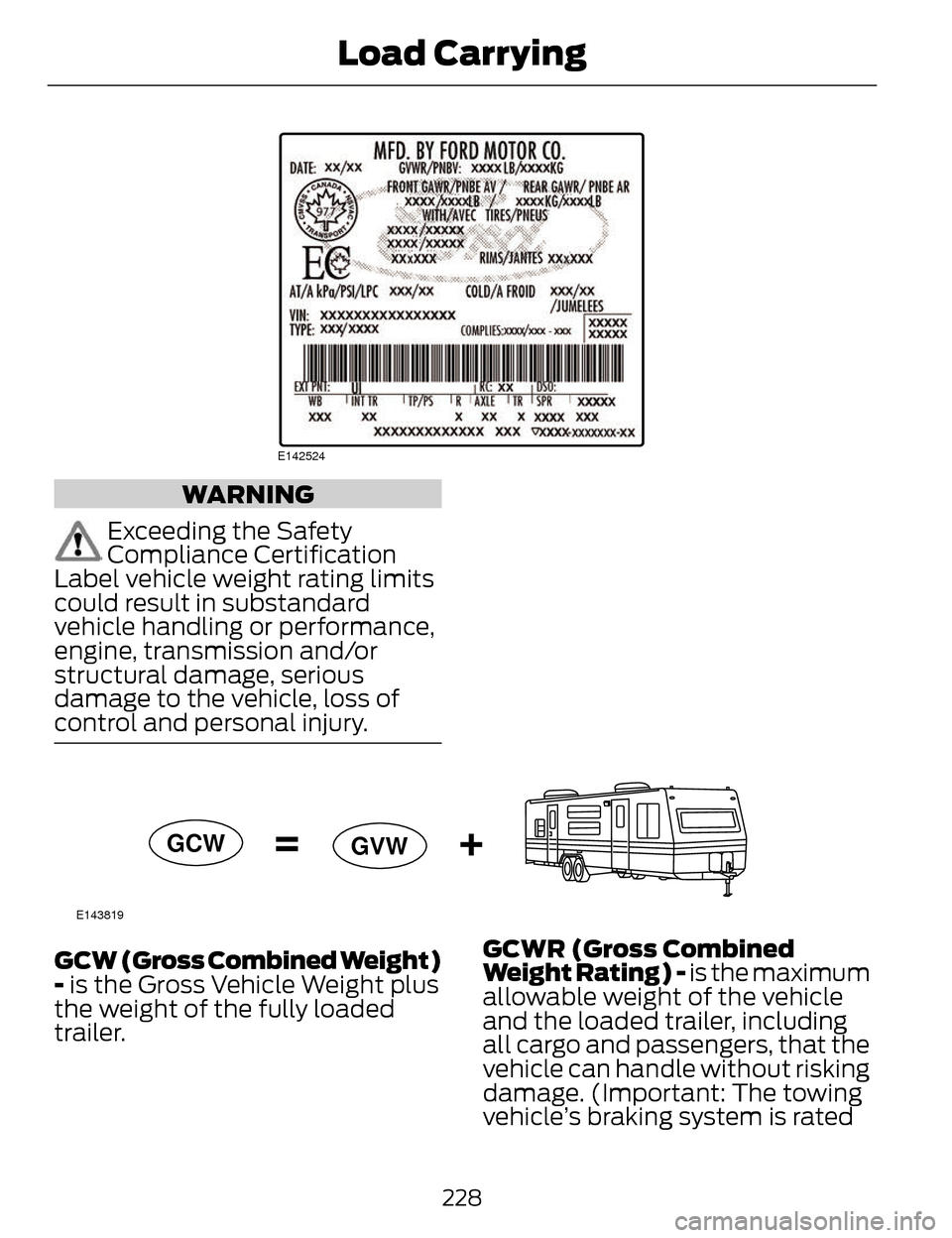
Exceeding the Safety
Compliance Certification
Label vehicle weight rating limits
could result in substandard
vehicle handling or performance,
engine, transmission and/or
structural damage, serious
damage to the vehicle, loss of
control and personal injury.
E143819
GCW GVW
GCW (Gross Combined Weight)
- is the Gross Vehicle Weight plus
the weight of the fully loaded
trailer. GCWR (Gross Combined
Weight Rating) - is the maximum
allowable weight of the vehicle
and the loaded trailer, including
all cargo and passengers, that the
vehicle can handle without risking
damage. (Important: The towing
vehicle’s braking system is rated
228
Load Carrying
Page 235 of 468
TOWING A TRAILER
WARNINGS
Do not exceed the GVWR or
the GAWR specified on the
certification label.
Towing trailers beyond the
maximum recommended
gross trailer weight exceeds the
limit of your vehicle and could
result in engine damage,
transmission damage, structural
damage, loss of vehicle control,
vehicle rollover and personal
injury.
Note: There may be electrical
items such as fuses or relays that
can affect trailer towing operation.
See Fuses (page 255).
Weight, not volume designates
your vehicle's load capacity. You
cannot necessarily use all
available space when loading a
vehicle.
Towing a trailer places an
additional load on your vehicle's
engine, transmission, axle, brakes,
tires and suspension. Inspect
these components periodically
during, and after, any towing
operation. Load Placement
To help minimize how trailer
movement affects the vehicle
when driving:
• Load the heaviest items closest
to the trailer floor.
• Load the heaviest items in the center of the left and right side
trailer tires.
• Load the heaviest items above the trailer axles or just slightly
forward toward the trailer
tongue. Do not allow the final
trailer tongue weight to go
above or below 10-15% of the
loaded trailer weight.
• Select a tow bar with the correct rise or drop. When both
the loaded vehicle and trailer
are connected, the trailer frame
should be level, or slightly
angled down toward the
vehicle, when viewed from the
side.
When driving with a trailer or
payload, a slight takeoff vibration
or shudder may be present due to
the increased payload weight.
Additional information regarding
proper trailer loading and setting
your vehicle up for towing is
located in the Load Carrying
chapter. See Load Limit (page
224). You can also find the
information in the RV & Trailer
Towing Guide, available at an
authorized dealer.
232
Towing
Page 238 of 468
Trailer Lamps
WARNING
Never connect any trailer lamp
wiring to the vehicle's tail lamp
wiring; this may damage the electrical
system resulting in fire. Contact your
authorized dealer as soon as possible
for assistance in proper trailer tow
wiring installation. Additional
electrical equipment may be required.
Trailer lamps are required on most
towed vehicles. Make sure all running
lights, brake lights, turn signals and
hazard lights are working.
Before Towing a Trailer
Practice turning, stopping and backing
up to get the feel of your
vehicle-trailer combination before
starting on a trip. When turning, make
wider turns so the trailer wheels clear
curbs and other obstacles.
When Towing a Trailer
• Do not drive faster than 70 mph (113 km/h) during the first 500
miles (800 kilometers).
• Do not make full-throttle starts.
• Check your hitch, electrical connections and trailer wheel lug
nuts thoroughly after you have
traveled 50 miles (80 kilometers).
• When stopped in congested or heavy traffic during hot weather,
place the gearshift in position P to
aid engine and transmission
cooling and to help A/C
performance. • Turn off the speed control with
heavy loads or in hilly terrain. The
speed control may turn off
automatically when you are towing
on long, steep grades.
• Shift to a lower gear when driving down a long or steep hill. Do not
apply the brakes continuously, as
they may overheat and become
less effective.
• If your transmission is equipped with a Grade Assist or Tow/Haul
feature, use this feature when
towing. This provides engine
braking and helps eliminate
excessive transmission shifting for
optimum fuel economy and
transmission cooling.
• Allow more distance for stopping with a trailer attached. Anticipate
stops and brake gradually.
• Avoid parking on a grade. However, if you must park on a grade:
• Turn the steering wheel to pointyour vehicle tires away from
traffic flow.
• Set your vehicle parking brake.
• Place the automatic transmission in position P.
• Place wheel chocks in front and back of the trailer wheels.
(Chocks not included with
vehicle.)
Launching or Retrieving a Boat
or Personal Watercraft (PWC)
Note: Disconnect the wiring to the
trailer before backing the trailer into
the water.
235
Towing
Page 240 of 468
Ford Motor Company produces a
towing manual for all authorized tow
truck operators. Have your tow truck
operator refer to this manual for
proper hook-up and towing
procedures for your vehicle.
It is acceptable to have your
front-wheel drive vehicle towed from
the front if using proper wheel lift
equipment to raise the front wheels
off the ground. When towing in this
manner, the rear wheels can remain
on the ground.
Front-wheel drive vehicles must have
the front wheels placed on a tow dolly
when towing your vehicle from the
rear using wheel lift equipment. This
prevents damage to the transmission.
Towing an all-wheel drive vehicle
requires that all wheels be off the
ground, such as using a wheel lift and
dollies or flatbed equipment. This
prevents damage to the transmission,
all-wheel drive system and vehicle.TOWING THE VEHICLE ON
FOUR WHEELS
Emergency Towing
You can flat-tow (all wheels on the
ground, regardless of the
powertrain/transmission
configuration) your disabled vehicle
(without access to wheel dollies,
car-hauling trailer, or flatbed transport
vehicle) under the following
conditions:
• Your vehicle is facing forward soyou tow it in a forward direction.
• You place the transmission in position N. If you cannot place the
transmission in position N, you
may need to override it. See
Transmission (page 167).
• Maximum speed is 35 mph (56 km/h).
• Maximum distance is 50 miles (80 kilometers).
Recreational Towing
Note: Put your climate control system
in recirculated air mode to prevent
exhaust fumes from entering the
vehicle. See Climate Control (page
128).
Follow these guidelines if you have a
need for recreational (RV) towing. An
example of recreational towing would
be towing your vehicle behind a
motorhome. These guidelines are to
make sure you do not damage the
transmission during towing.
237
Towing
Page 241 of 468
Vehicles Equipped with a 2.0L
Engine
Front-wheel drive (FWD) vehicles
CANNOT be flat-towed (all wheels
on the ground) as vehicle or
transmission damage may occur. You
must place the front wheels on a
two-wheel tow dolly. If you are using
a tow dolly, follow the instructions
specified by the equipment provider.
All-wheel drive (AWD) vehicles
CANNOT be flat-towed (all wheels
on the ground), as vehicle or
transmission damage may occur. It is
recommended to tow your vehicle
with all four (4) wheels off the ground
such as when using a car-hauling
trailer. Otherwise, you cannot tow your
vehicle.
Vehicles Equipped with a 3.7L
Engine
You can tow your vehicle with all four
wheels on the ground using the
Neutral Tow feature, or with all four
wheels off the ground using a vehicle
transport trailer. If you are using a
vehicle transport trailer, follow the
instruction specified by the equipment
provider.
If you tow your vehicle with all four
wheels on the ground:
• Tow only in the forward direction.
• Release the parking brake.
Neutral Tow
Enter Neutral Tow mode by doing the
following:1. Put the ignition in accessory mode
by pressing the engine START
button without pressing the brake
pedal.
2. Select Neutral Tow under the Vehicle Settings menu in the
information display. See General
Information (page 101).
3. Press and hold the OK button to start the neutral tow process.
4. Press the brake pedal and select N on the push-button
transmission.
5. Turn the ignition off by pressing the engine START button without
pressing the brake pedal.
If the process is completes
successfully:
• the N on the push-button transmission blinks slowly
• Neutral Tow Engaged turn
ignition off for towing appears
in the information display.
Note: If the parking brake is applied,
Neutral Tow remove park brake for
towing appears in the information
display.
Note: Do not exceed 65 mph (105
km/h).
Note: Start the engine and allow it to
run for five minutes at the beginning of
each day and every six hours (or fewer).
Shut the engine off and verify that
Neutral tow engaged appears in the
display before continuing to tow.
238
Towing
Page 242 of 468
Exit Neutral Tow mode, make sure the
ignition is on (engine can be on or off),
press the brake pedal and select P on
the push-button transmission.
If the process is completed
successfully, Neutral Tow
disengaged appears in the
information display and both the
instrument cluster and push-button
transmission display P.
239
Towing
Page 248 of 468
1. Turn the ignition off.
2. Turn the ignition to crank.
3. Turn the ignition off.
4. Turn the ignition on again tore-enable the fuel pump.
For vehicles equipped with a push
button start system:
1. Press the START/STOP button to turn the ignition off.
2. Press the brake pedal and press the START/STOP button (crank
attempt).
3. Remove your foot from the brake pedal and press the
START/STOP button (ignition
off).
4. Press the START/STOP button again to re-enable the fuel system.
JUMP-STARTING THE
VEHICLE
WARNINGS
The gases around the battery
can explode if exposed to
flames, sparks, or lit cigarettes. An
explosion could result in injury or
vehicle damage.
Batteries contain sulfuric acid
which can burn skin, eyes and
clothing, if contacted.
Use only an adequate-sized
cable with insulated clamps.
Preparing Your Vehicle
Note: Do not attempt to push-start
your automatic transmission vehicle.
Automatic transmissions do not have
push-start capability. Attempting to
push-start a vehicle with an automatic
transmission may cause transmission
damage.
Note: Use only a 12-volt supply to start
your vehicle.
Note: Do not disconnect the battery
of the disabled vehicle as this could
damage the vehicle's electrical system.
Park the booster vehicle close to the
hood of the disabled vehicle, making
sure the two vehicles do not touch.
Turn all accessories off.
Connecting the Jumper Cables
WARNING
Do not attach the cables to fuel
lines, engine rocker covers, the
intake manifold or electrical
components as grounding points. Stay
clear of moving parts. To avoid reverse
polarity connections, make sure that
you correctly identify the positive (+)
and negative (-) terminals on both the
disabled and booster vehicles before
connecting the cables.
Note: In the illustration, the bottom
vehicle represents the booster vehicle.
245
Roadside Emergencies
Page 261 of 468
Protected components
Fuse amp rating
Fuse or relay
number
Run/start electronic power assist
steering
10A119
Run/start lighting
10A
120
Run/start transmission control,
Transmission oil pump start/stop
15A
121
Air conditioner clutch solenoid
10A
122
Run/start: Blind spot information
system, Rear view camera, Adaptive
cruise control, Heads-up display,
Shifter
15A
123
Not used
-
24
Run/start anti-lock brake system
10A
225
Run/start powertrain control module
10A
226
Not used
-
27
Not used
-
28
Not used
-
29
Not used
-
30
Not used
-
31
Electronic fan #1 relay
-
32
Air conditioner clutch relay
-
33
Not used
-
34
Not used
-
35
Not used
-
36
Not used
-
37
Electronic fan #2 relay
-
38
258
Fuses
Page 265 of 468
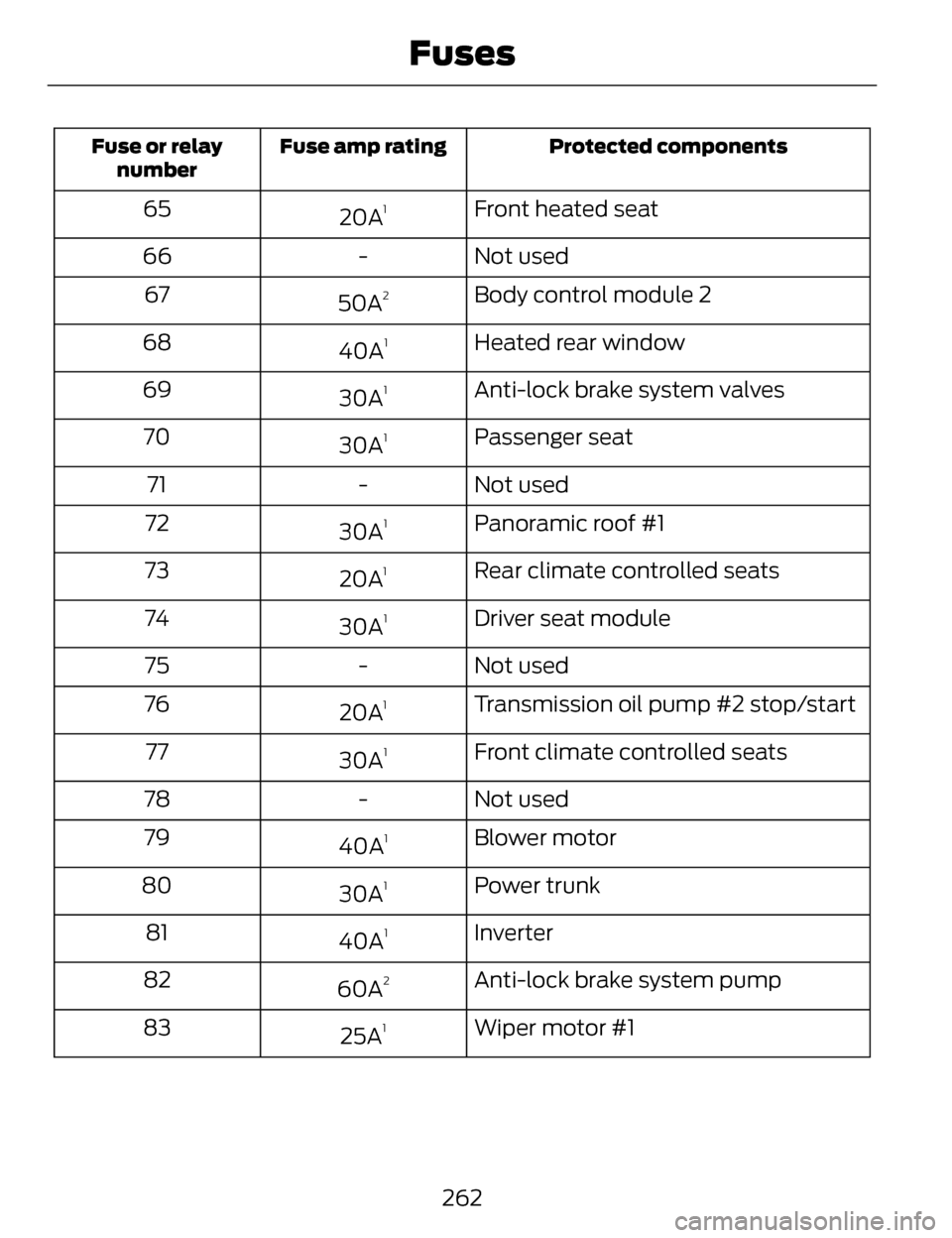
Protected components
Fuse amp rating
Fuse or relay
number
Front heated seat
20A165
Not used
-
66
Body control module 2
50A
267
Heated rear window
40A
168
Anti-lock brake system valves
30A
169
Passenger seat
30A
170
Not used
-
71
Panoramic roof #1
30A
172
Rear climate controlled seats
20A
173
Driver seat module
30A
174
Not used
-
75
Transmission oil pump #2 stop/start
20A
176
Front climate controlled seats
30A
177
Not used
-
78
Blower motor
40A
179
Power trunk
30A
180
Inverter
40A
181
Anti-lock brake system pump
60A
282
Wiper motor #1
25A
183
262
Fuses
Page 268 of 468
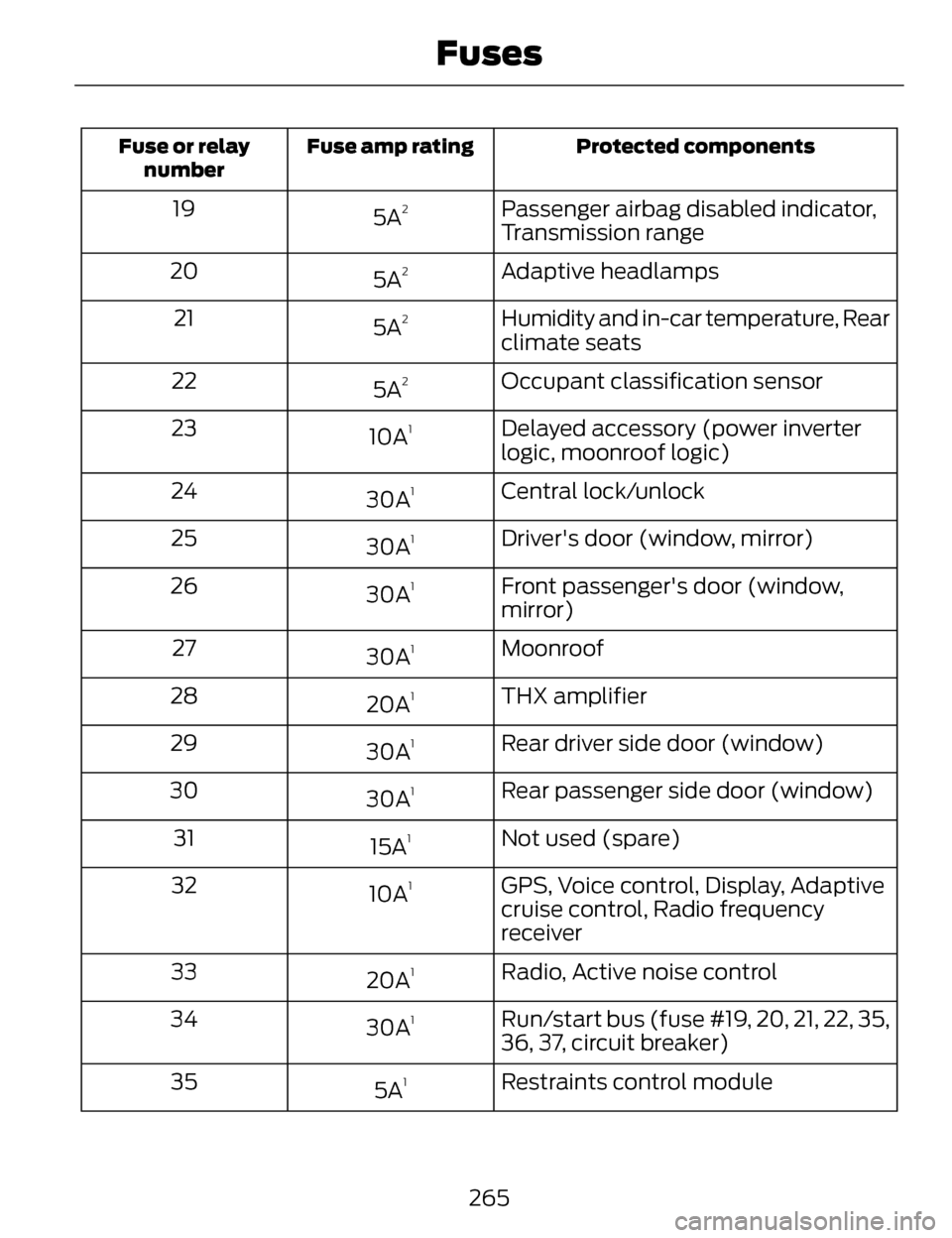
Protected components
Fuse amp rating
Fuse or relay
number
Passenger airbag disabled indicator,
Transmission range
5A219
Adaptive headlamps
5A
220
Humidity and in-car temperature, Rear
climate seats
5A
221
Occupant classification sensor
5A
222
Delayed accessory (power inverter
logic, moonroof logic)
10A
123
Central lock/unlock
30A
124
Driver's door (window, mirror)
30A
125
Front passenger's door (window,
mirror)
30A
126
Moonroof
30A
127
THX amplifier
20A
128
Rear driver side door (window)
30A
129
Rear passenger side door (window)
30A
130
Not used (spare)
15A
131
GPS, Voice control, Display, Adaptive
cruise control, Radio frequency
receiver
10A
132
Radio, Active noise control
20A
133
Run/start bus (fuse #19, 20, 21, 22, 35,
36, 37, circuit breaker)
30A
134
Restraints control module
5A
135
265
Fuses