brake LINCOLN MKZ 2014 Repair Manual
[x] Cancel search | Manufacturer: LINCOLN, Model Year: 2014, Model line: MKZ, Model: LINCOLN MKZ 2014Pages: 468, PDF Size: 4.49 MB
Page 261 of 468
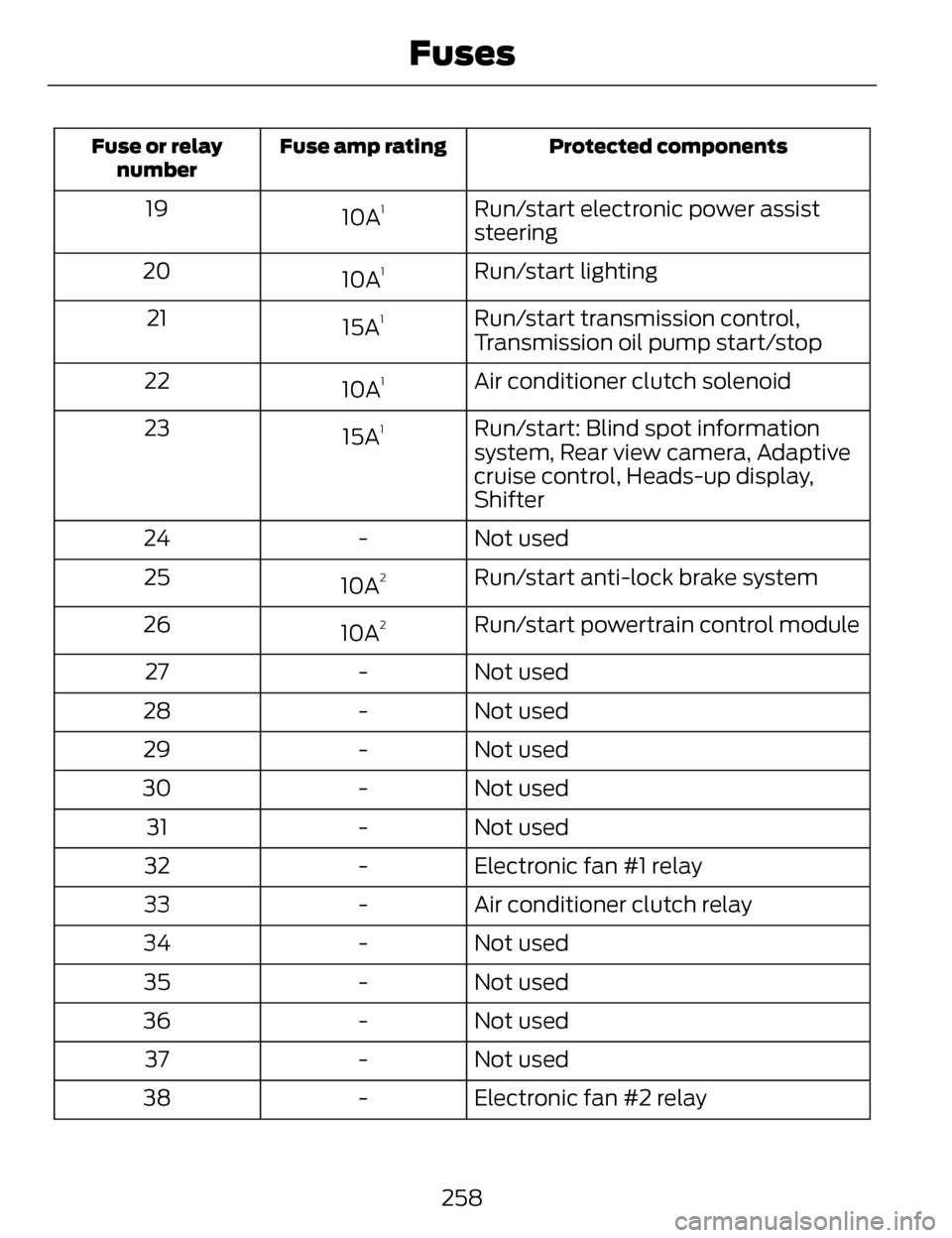
Protected components
Fuse amp rating
Fuse or relay
number
Run/start electronic power assist
steering
10A119
Run/start lighting
10A
120
Run/start transmission control,
Transmission oil pump start/stop
15A
121
Air conditioner clutch solenoid
10A
122
Run/start: Blind spot information
system, Rear view camera, Adaptive
cruise control, Heads-up display,
Shifter
15A
123
Not used
-
24
Run/start anti-lock brake system
10A
225
Run/start powertrain control module
10A
226
Not used
-
27
Not used
-
28
Not used
-
29
Not used
-
30
Not used
-
31
Electronic fan #1 relay
-
32
Air conditioner clutch relay
-
33
Not used
-
34
Not used
-
35
Not used
-
36
Not used
-
37
Electronic fan #2 relay
-
38
258
Fuses
Page 262 of 468
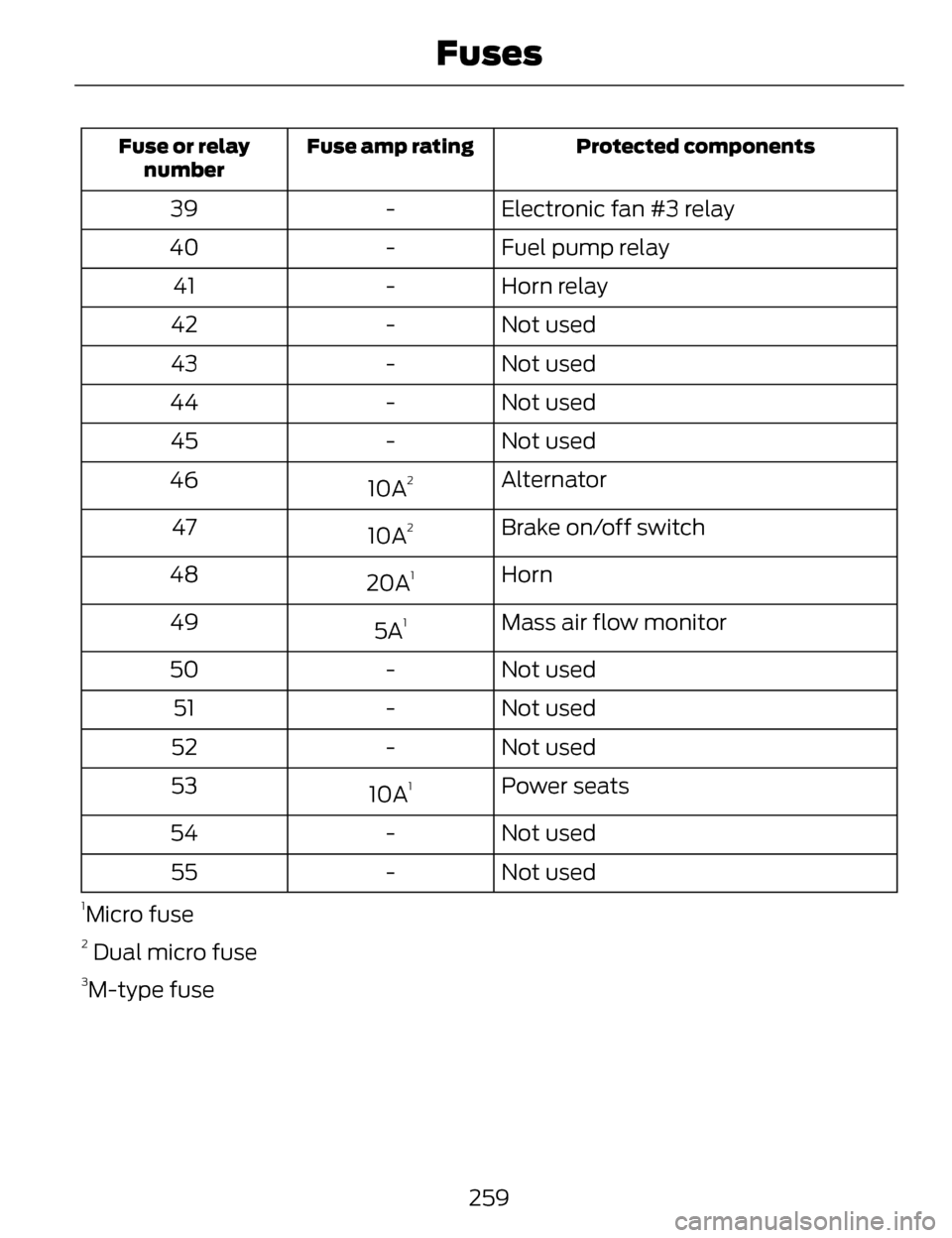
Protected components
Fuse amp rating
Fuse or relay
number
Electronic fan #3 relay
-
39
Fuel pump relay
-
40
Horn relay
-
41
Not used
-
42
Not used
-
43
Not used
-
44
Not used
-
45
Alternator
10A
246
Brake on/off switch
10A
247
Horn
20A
148
Mass air flow monitor
5A
149
Not used
-
50
Not used
-
51
Not used
-
52
Power seats
10A
153
Not used
-
54
Not used
-
55
1Micro fuse
2 Dual micro fuse
3M-type fuse
259
Fuses
Page 265 of 468
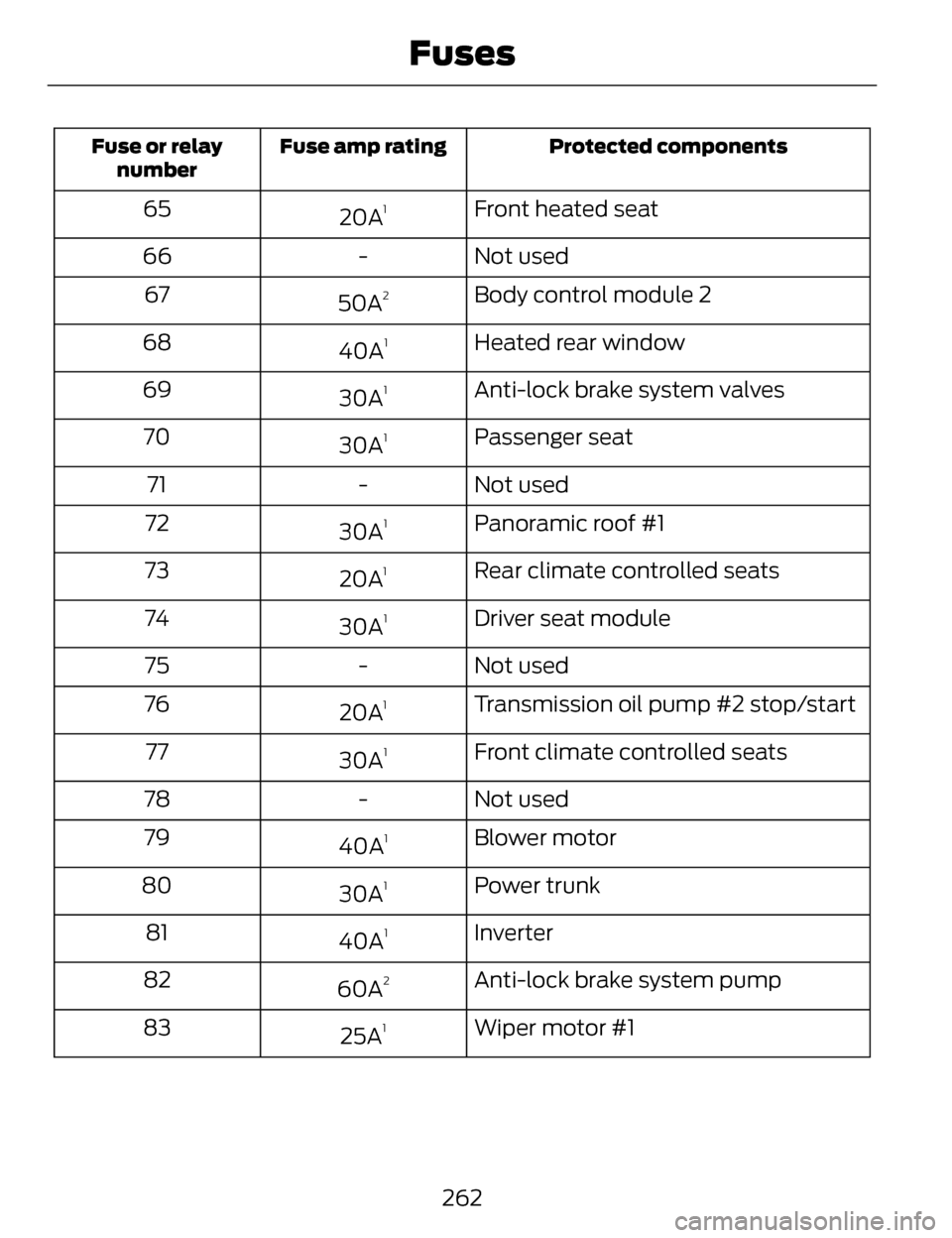
Protected components
Fuse amp rating
Fuse or relay
number
Front heated seat
20A165
Not used
-
66
Body control module 2
50A
267
Heated rear window
40A
168
Anti-lock brake system valves
30A
169
Passenger seat
30A
170
Not used
-
71
Panoramic roof #1
30A
172
Rear climate controlled seats
20A
173
Driver seat module
30A
174
Not used
-
75
Transmission oil pump #2 stop/start
20A
176
Front climate controlled seats
30A
177
Not used
-
78
Blower motor
40A
179
Power trunk
30A
180
Inverter
40A
181
Anti-lock brake system pump
60A
282
Wiper motor #1
25A
183
262
Fuses
Page 270 of 468
GENERAL INFORMATION
Have your vehicle serviced regularly
to help maintain its roadworthiness
and resale value. There is a large
network of Ford authorized dealers
that are there to help you with their
professional servicing expertise. We
believe that their specially trained
technicians are best qualified to
service your vehicle properly and
expertly. They are supported by a wide
range of highly specialized tools
developed specifically for servicing
your vehicle.
To help you service your vehicle, we
provide scheduled maintenance
information which makes tracking
routine service easy. See Scheduled
Maintenance (page 436).
If your vehicle requires professional
service, your authorized dealer can
provide the necessary parts and
service. Check your warranty
information to find out which parts
and services are covered.
Use only recommended fuels,
lubricants, fluids and service parts
conforming to specifications.
Motorcraft® parts are designed and
built to provide the best performance
in your vehicle.
Precautions
• Do not work on a hot engine.
• Make sure that nothing gets caught in moving parts. • Do not work on a vehicle with the
engine running in an enclosed
space, unless you are sure you
have enough ventilation.
• Keep all open flames and other burning material (such as
cigarettes) away from the battery
and all fuel related parts.
Working with the Engine Off
1. Set the parking brake and shift toP (Park).
2. Turn off the engine and remove the key (if equipped).
3. Block the wheels.
Working with the Engine On
WARNING
To reduce the risk of vehicle
damage and/or personal burn
injuries, do not start your engine with
the air cleaner removed and do not
remove it while the engine is running.
1. Set the parking brake and shift to P (Park).
2. Block the wheels
267
Maintenance
Page 272 of 468
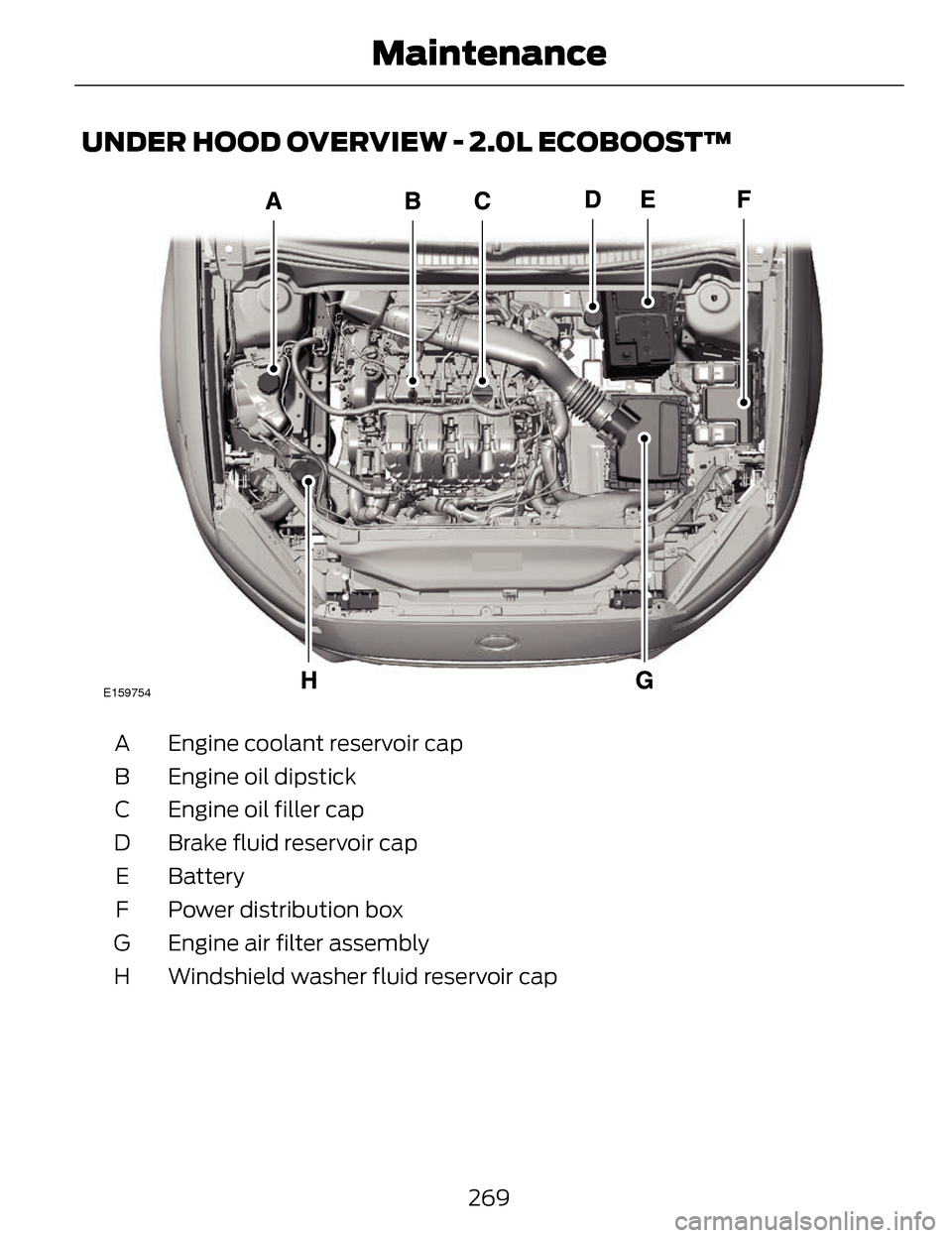
UNDER HOOD OVERVIEW - 2.0L ECOBOOST™
E159754
Engine coolant reservoir cap
A
Engine oil dipstick
B
Engine oil filler cap
C
Brake fluid reservoir cap
D
Battery
E
Power distribution box
F
Engine air filter assembly
G
Windshield washer fluid reservoir cap
H
269
Maintenance
Page 273 of 468
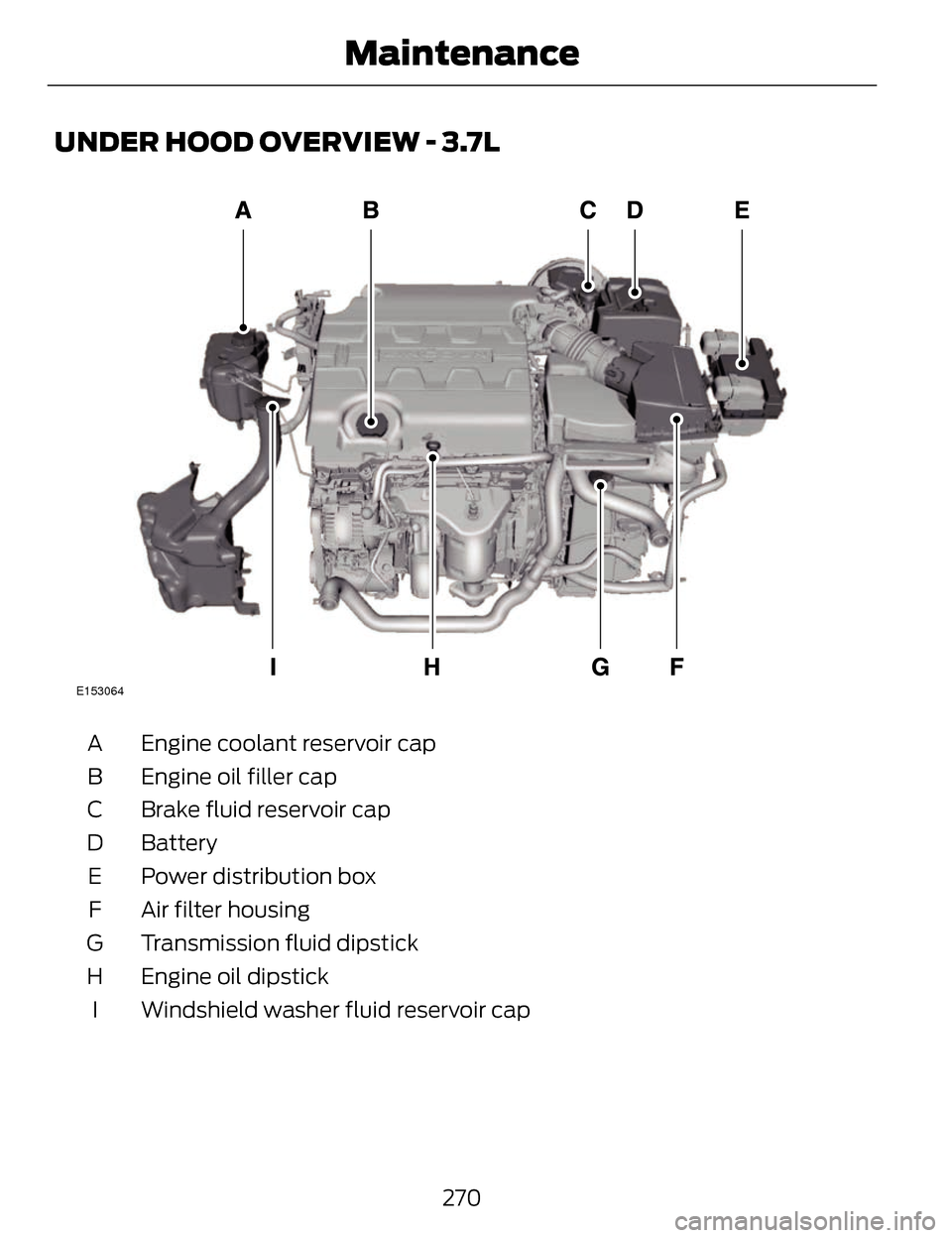
UNDER HOOD OVERVIEW - 3.7L
E153064
Engine coolant reservoir cap
A
Engine oil filler cap
B
Brake fluid reservoir cap
C
Battery
D
Power distribution box
E
Air filter housing
F
Transmission fluid dipstick
G
Engine oil dipstick
H
Windshield washer fluid reservoir cap
I
270
Maintenance
Page 278 of 468
If the engine reaches a preset
over-temperature condition, the
engine will automatically switch to
alternating cylinder operation. Each
disabled cylinder acts as an air pump
and cools the engine.
When this occurs, the vehicle will still
operate. However:
• The engine power will be limited.
• The air conditioning system will bedisabled.
Continued operation will increase the
engine temperature and the engine
will completely shut down, causing
steering and braking effort to increase.
Once the engine temperature cools,
the engine can be re-started. Take
your vehicle to an authorized dealer
as soon as possible to minimize
engine damage.
When Fail-Safe Mode Is Activated
WARNINGS
Fail-safe mode is for use during
emergencies only. Operate the
vehicle in fail-safe mode only as long
as necessary to bring the vehicle to
rest in a safe location and seek
immediate repairs. When in fail-safe
mode, the vehicle will have limited
power, will not be able to maintain
high-speed operation, and may
completely shut down without
warning, potentially losing engine
power, power steering assist, and
power brake assist, which may
increase the possibility of a crash
resulting in serious injury.
WARNINGS
Never remove the coolant
reservoir cap while the engine is
running or hot.
You have limited engine power when
in the fail-safe mode, so drive the
vehicle with caution. The vehicle will
not be able to maintain high-speed
operation and the engine will run
rough. Remember that the engine is
capable of completely shutting down
automatically to prevent engine
damage, therefore:
1. Pull off the road as soon as safely possible and turn off the engine.
2. Arrange for the vehicle to be taken to an authorized dealer.
3. If this is not possible, wait a short period for the engine to cool.
4. Check the coolant level and replenish if low.
5. Re-start the engine and take your vehicle to an authorized dealer.
Note: Driving the vehicle without
repairing the engine problem increases
the chance of engine damage. Take
your vehicle to an authorized dealer as
soon as possible.
275
Maintenance
Page 279 of 468
AUTOMATIC
TRANSMISSION FLUID
CHECK
6F35/HF35 transmission (If
Equipped)
Note: Transmission fluid should be
checked by an authorized dealer. If
required, fluid should be added by an
authorized dealer.
The automatic transmission does not
have a transmission fluid dipstick.
Refer to your scheduled maintenance
information for scheduled intervals
for fluid checks and changes. Your
transmission does not consume fluid.
However, the fluid level should be
checked if the transmission is not
working properly, (For example: if the
transmission slips or shifts slowly) or
if you notice some sign of fluid
leakage. See Scheduled
Maintenance (page 436).
Do not use supplemental transmission
fluid additives, treatments or cleaning
agents. The use of these materials
may affect transmission operation
and result in damage to internal
transmission components.
6F50/6F55 Transmission (If
Equipped)
WARNINGS
The dipstick cap and surrounding
components may be hot; gloves
are recommended.
WARNINGS
Use gloves when moving the air
filter assembly. Components will
be hot.
Note: Automatic transmission fluid
expands when warmed. To obtain an
accurate fluid check, drive the vehicle
until it is warmed up (approximately
20 miles [30 kilometers]). If your
vehicle has been operated for an
extended period at high speeds, in city
traffic during hot weather or pulling a
trailer, the vehicle should be turned off
until normal operating temperatures
are reached to allow the fluid to cool
before checking. Depending on vehicle
use, cooling times could take up to 30
minutes or longer.
Refer to your scheduled maintenance
information for scheduled intervals
for fluid checks and changes. Your
transmission does not consume fluid.
However, the fluid level should be
checked if the transmission is not
working properly. For example, if the
transmission slips or shifts slowly or
if you notice some sign of fluid
leakage.
1. Drive the vehicle 20 miles (30 kilometers) or until it reaches
normal operating temperature
2. Park the vehicle on a level surface and engage the parking brake.
276
Maintenance
Page 280 of 468
3. With the parking brake engagedand your foot on the brake pedal,
start the engine and move the
gearshift lever through all of the
gear ranges. Allow a minimum of
10 seconds for each gear to
engage.
4. Put the gearshift lever in P (Park) and leave the engine running.
Note: You will need to move the air
filter assembly to access the
transmission dipstick.
5. Remove the dipstick, wiping it clean with a clean, dry lint free rag.
If necessary, refer to Under hood
overview in this chapter for the
location of the dipstick.
6. Install the dipstick making sure it is fully seated in the filler tube by
turning it to the locked position.
7. Remove the dipstick and inspect the fluid level. The fluid should be
in the designated areas for normal
operating temperature.
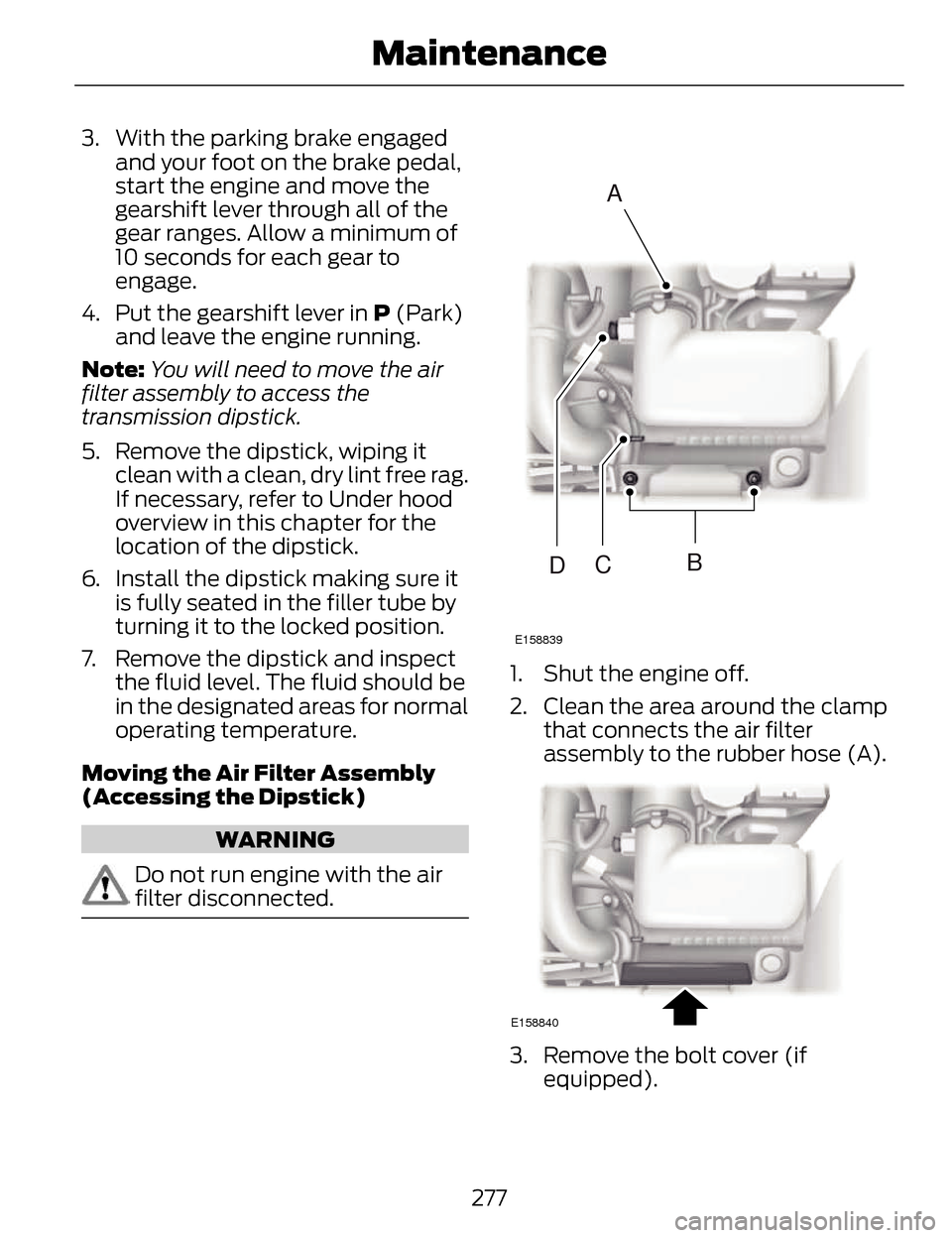
Moving the Air Filter Assembly
(Accessing the Dipstick)
WARNING
Do not run engine with the air
filter disconnected.
E158839
A
BCD
1. Shut the engine off.
2. Clean the area around the clamp that connects the air filter
assembly to the rubber hose (A).
E158840
3. Remove the bolt cover (ifequipped).
277
Maintenance
Page 283 of 468
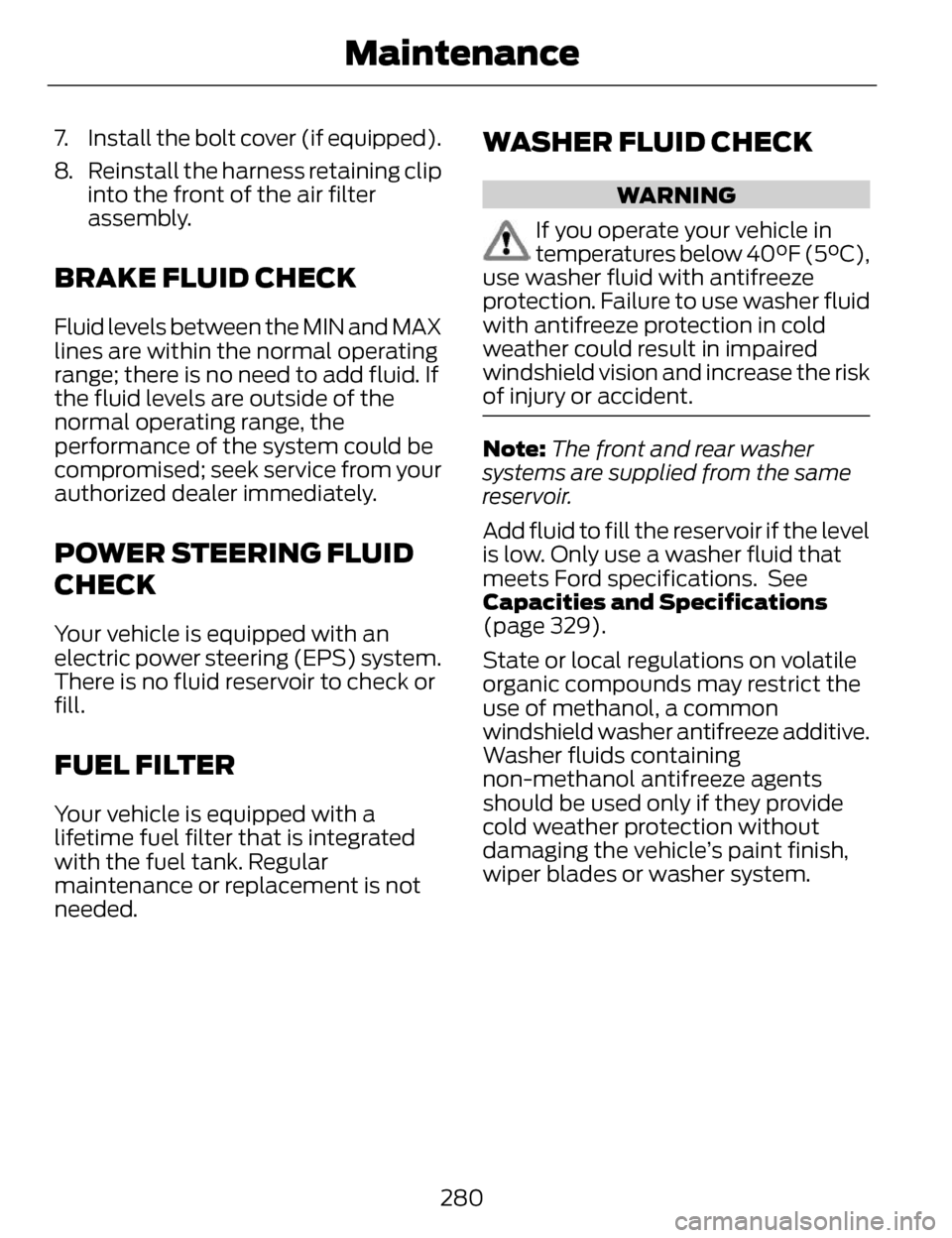
7. Install the bolt cover (if equipped).
8. Reinstall the harness retaining clip into the front of the air filter
assembly.
BRAKE FLUID CHECK
Fluid levels between the MIN and MAX
lines are within the normal operating
range; there is no need to add fluid. If
the fluid levels are outside of the
normal operating range, the
performance of the system could be
compromised; seek service from your
authorized dealer immediately.
POWER STEERING FLUID
CHECK
Your vehicle is equipped with an
electric power steering (EPS) system.
There is no fluid reservoir to check or
fill.
FUEL FILTER
Your vehicle is equipped with a
lifetime fuel filter that is integrated
with the fuel tank. Regular
maintenance or replacement is not
needed.
WASHER FLUID CHECK
WARNING
If you operate your vehicle in
temperatures below 40°F (5°C),
use washer fluid with antifreeze
protection. Failure to use washer fluid
with antifreeze protection in cold
weather could result in impaired
windshield vision and increase the risk
of injury or accident.
Note: The front and rear washer
systems are supplied from the same
reservoir.
Add fluid to fill the reservoir if the level
is low. Only use a washer fluid that
meets Ford specifications. See
Capacities and Specifications
(page 329).
State or local regulations on volatile
organic compounds may restrict the
use of methanol, a common
windshield washer antifreeze additive.
Washer fluids containing
non-methanol antifreeze agents
should be used only if they provide
cold weather protection without
damaging the vehicle’s paint finish,
wiper blades or washer system.
280
Maintenance