Seat LINCOLN MKZ 2016 Repair Manual
[x] Cancel search | Manufacturer: LINCOLN, Model Year: 2016, Model line: MKZ, Model: LINCOLN MKZ 2016Pages: 544, PDF Size: 5.77 MB
Page 154 of 544
E152622
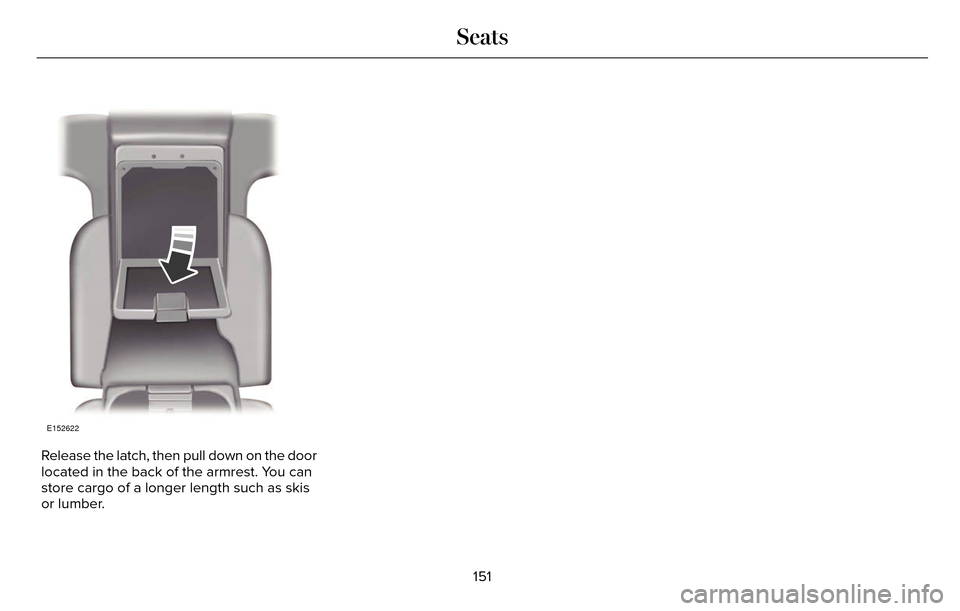
Release the latch, then pull down on the door
located in the back of the armrest. You can
store cargo of a longer length such as skis
or lumber.151
Seats
Page 172 of 544
E162864
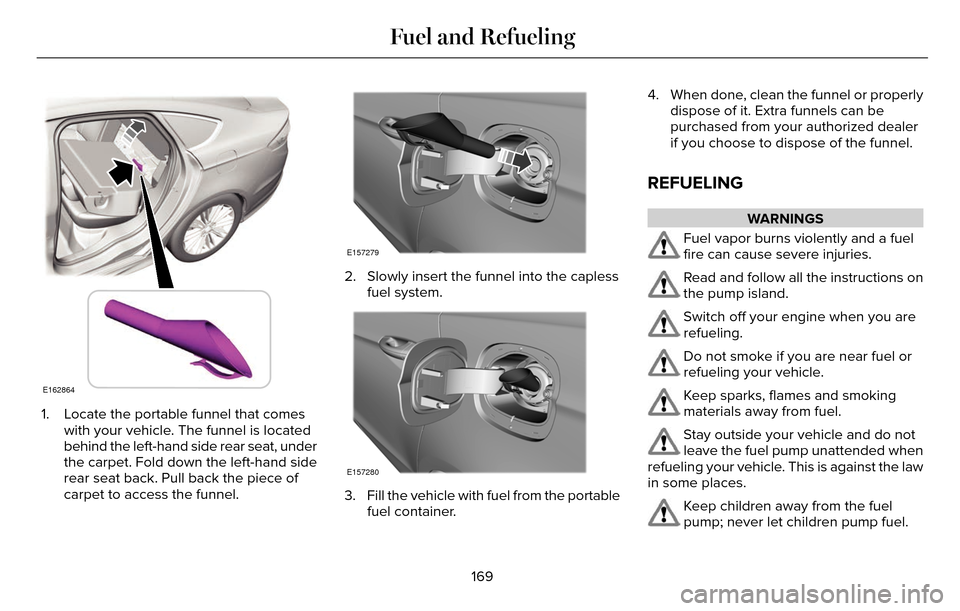
1. Locate the portable funnel that comeswith your vehicle. The funnel is located
behind the left-hand side rear seat, under
the carpet. Fold down the left-hand side
rear seat back. Pull back the piece of
carpet to access the funnel.
E157279
2. Slowly insert the funnel into the caplessfuel system.
E157280
3. Fill the vehicle with fuel from the portablefuel container. 4. When done, clean the funnel or properly
dispose of it. Extra funnels can be
purchased from your authorized dealer
if you choose to dispose of the funnel.
REFUELING
WARNINGS
Fuel vapor burns violently and a fuel
fire can cause severe injuries.
Read and follow all the instructions on
the pump island.
Switch off your engine when you are
refueling.
Do not smoke if you are near fuel or
refueling your vehicle.
Keep sparks, flames and smoking
materials away from fuel.
Stay outside your vehicle and do not
leave the fuel pump unattended when
refueling your vehicle. This is against the law
in some places.
Keep children away from the fuel
pump; never let children pump fuel.
169
Fuel and Refueling
Page 197 of 544
PRINCIPLE OF OPERATION
WARNINGS
Vehicle modifications involving braking
system, aftermarket roof racks,
suspension, steering system, tire
construction and wheel and tire size may
change the handling characteristics of the
vehicle and may adversely affect the
performance of the AdvanceTrac system. In
addition, installing any stereo loudspeakers
may interfere with and adversely affect the
AdvanceTrac system. Install any aftermarket
stereo loudspeaker as far as possible from
the front center console, the tunnel, and the
front seats in order to minimize the risk of
interfering with the AdvanceTrac sensors.
Reducing the effectiveness of the
AdvanceTrac system could lead to an
increased risk of loss of vehicle control,
vehicle rollover, personal injury and death.
Remember that even advanced
technology cannot defy the laws of
physics. It’s always possible to lose control
of a vehicle due to inappropriate driver input
for the conditions. Aggressive driving on any
road condition can cause you to lose control
WARNINGS
of your vehicle increasing the risk of personal
injury or property damage. Activation of the
AdvanceTrac system is an indication that at
least some of the tires have exceeded their
ability to grip the road; this could reduce the
operator’s ability to control the vehicle
potentially resulting in a loss of vehicle
control, vehicle rollover, personal injury and
death. If your AdvanceTrac system activates,
SLOW DOWN.
The AdvanceTrac Control system helps you
keep control of your vehicle when on a
slippery surface. The electronic stability
control portion of the system helps avoid
skids and lateral slides. The traction control
system helps avoid drive wheel spin and loss
of traction. See Using Traction Control
(page 192).
E72903
A AA
B
BB
B
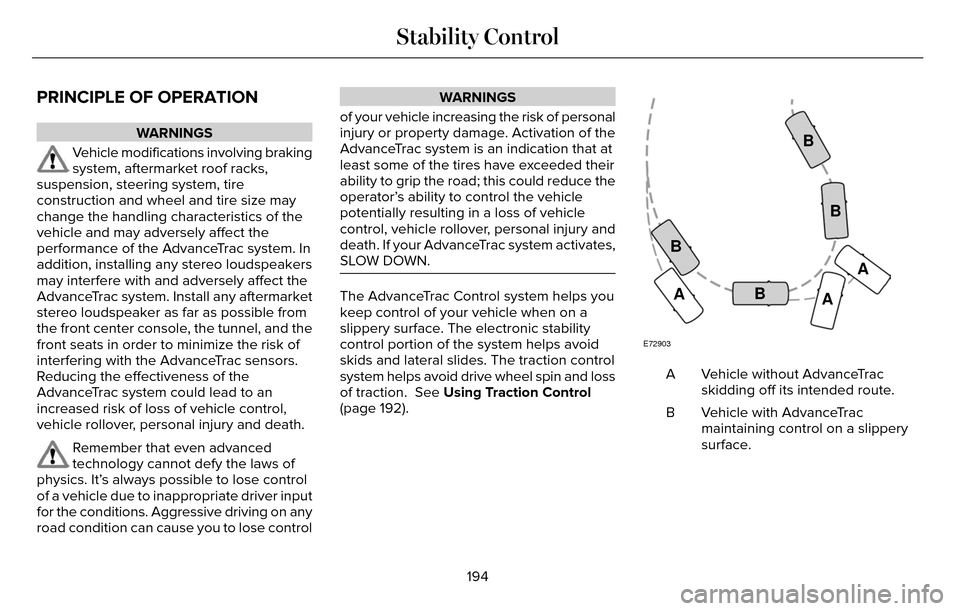
Vehicle without AdvanceTrac
skidding off its intended route.
A
Vehicle with AdvanceTrac
maintaining control on a slippery
surface.
B
194
Stability Control
Page 237 of 544
Cargo Weight - includes all weight
added to the Base Curb Weight,
including cargo and optional equipment.
When towing, trailer tongue load or king
pin weight is also part of cargo weight.
GAW (Gross Axle Weight) - is the total
weight placed on each axle (front and
rear) including vehicle curb weight and
all payload.GAWR (Gross Axle Weight Rating) - is
the maximum allowable weight that can
be carried by a single axle (front or rear).
These numbers are shown on the Safety
Compliance Certification Label. The
label shall be affixed to either the door
hinge pillar, door-latch post, or the door
edge that meets the door-latch post,
next to the driver's seating position. The
total load on each axle must never
exceed its Gross Axle Weight Rating.Note:
For trailer towing information
refer to the RV and Trailer Towing Guide
available at an authorized dealer.
E143818
GVW
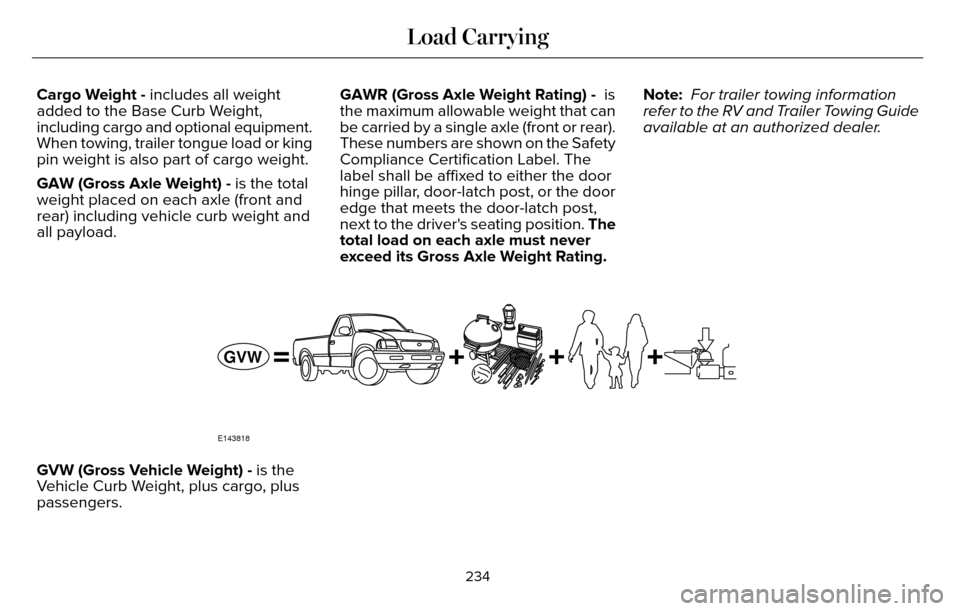
GVW (Gross Vehicle Weight) - is the
Vehicle Curb Weight, plus cargo, plus
passengers.
234
Load Carrying
Page 238 of 544
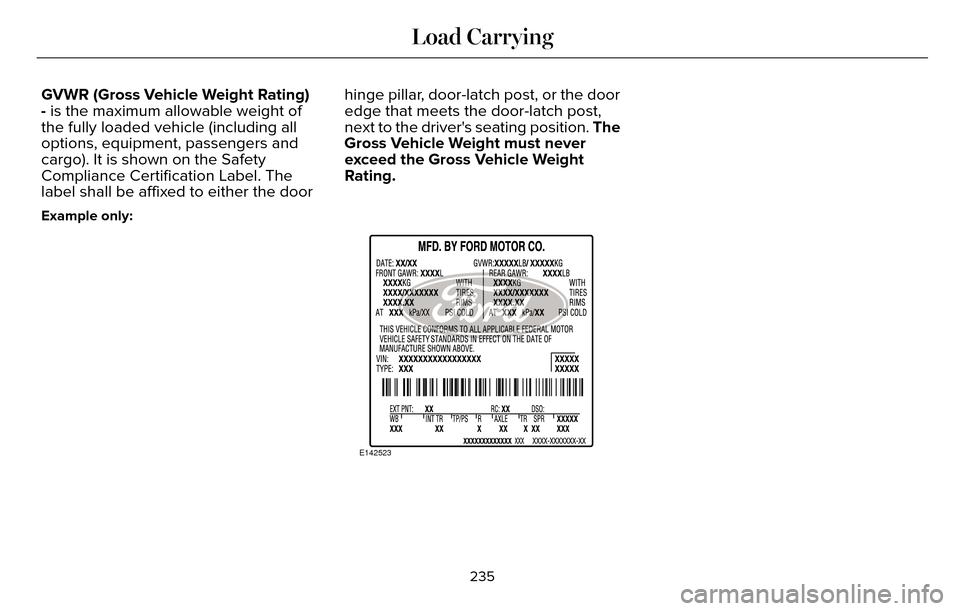
GVWR (Gross Vehicle Weight Rating)
- is the maximum allowable weight of
the fully loaded vehicle (including all
options, equipment, passengers and
cargo). It is shown on the Safety
Compliance Certification Label. The
label shall be affixed to either the doorhinge pillar, door-latch post, or the door
edge that meets the door-latch post,
next to the driver's seating position. The
Gross Vehicle Weight must never
exceed the Gross Vehicle Weight
Rating.
Example only:
E142523
235
Load Carrying
Page 242 of 544
*Suppose your vehicle has a 1400-pound
(635-kilogram) cargo and luggage
capacity. You and one of your friends
decide to pick up cement from the local
home improvement store to finish that
patio you have been planning for the
past two years. Measuring the inside of
the vehicle with the rear seat folded
down, you have room for twelve
100-pound (45-kilogram) bags of
cement. Do you have enough load
capacity to transport the cement to your
home? If you and your friend each weigh
220 pounds (99 kilograms), the
calculation would be: 1400 - (2 x 220) -
(12 x 100) = 1400 - 440 - 1200 = - 240
pounds. No, you do not have enough
cargo capacity to carry that much
weight. In metric units, the calculation
would be: 635 kilograms - (2 x 99
kilograms) - (12 x 45 kilograms) = 635 -
198 - 540 = -103 kilograms. You will need
to reduce the load weight by at least
240 pounds (104 kilograms). If you
remove three 100-pound (45-kilogram)
cement bags, then the load calculation
would be: 1400 - (2 x 220) - (9 x 100) =
1400 - 440 - 900 = 60 pounds. Now youhave the load capacity to transport the
cement and your friend home. In metric
units, the calculation would be: 635
kilograms - (2 x 99 kilograms) - (9 x 45
kilograms) = 635 - 198 - 405 = 32
kilograms.
The above calculations also assume that
the loads are positioned in your vehicle
in a manner that does not overload the
Front or the Rear Gross Axle Weight
Rating specified for your vehicle on the
Safety Compliance Certification Label.
The label shall be affixed to either the
door hinge pillar, door-latch post, or the
door edge that meets the door-latch
post, next to the driver's seating
position.
239
Load Carrying
Page 271 of 544
Protected components
Fuse amp rating
Fuse or relay number
Horn relay.
-
40
Not used.
-
41
Fuel pump relay coil.
-
42
Not used.
-
43
Not used.
-
44
Not used.
-
45
Not used.
–
46
Not used.
–
47
Not used.
–
48
Keep-alive power.
10A
149
Horn.
20A
150
Not used.
-
51
Not used.
-
52
Power seats.
10A
153
268
Fuses
Page 275 of 544
Protected components
Fuse amp rating
Fuse or relay number
Not used.
–
56
Diesel vaporizer or E100.
20A
157
Fuel pump feed.
30A
158
Electronic fan 3.
30A
259
Electronic fan 1.
30A
260
Not used.
-
61
Body control module 1.
50A
262
Electronic fan 2.
25A
163
Not used.
-
64
Front heated seat.
20A
165
Not used.
-
66
Body control module 2.
50A
267
272
Fuses
Page 276 of 544
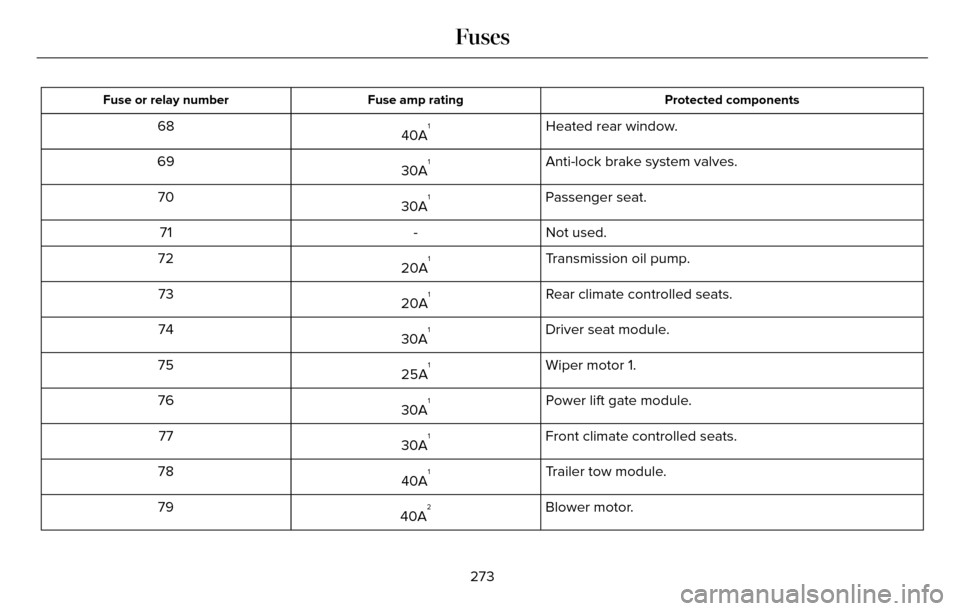
Protected components
Fuse amp rating
Fuse or relay number
Heated rear window.
40A168
Anti-lock brake system valves.
30A
169
Passenger seat.
30A
170
Not used.
-
71
Transmission oil pump.
20A
172
Rear climate controlled seats.
20A
173
Driver seat module.
30A
174
Wiper motor 1.
25A
175
Power lift gate module.
30A
176
Front climate controlled seats.
30A
177
Trailer tow module.
40A
178
Blower motor.
40A
279
273
Fuses
Page 279 of 544
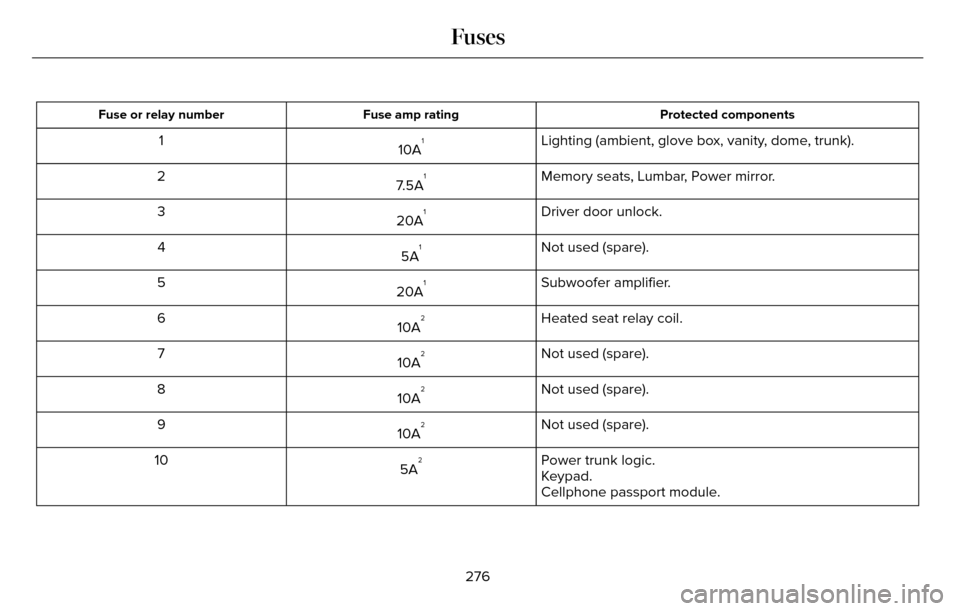
Protected components
Fuse amp rating
Fuse or relay number
Lighting (ambient, glove box, vanity, dome, trunk).
10A11
Memory seats, Lumbar, Power mirror.
7.5A
12
Driver door unlock.
20A
13
Not used (spare).
5A
14
Subwoofer amplifier.
20A
15
Heated seat relay coil.
10A
26
Not used (spare).
10A
27
Not used (spare).
10A
28
Not used (spare).
10A
29
Power trunk logic.
5A
210
Keypad.
Cellphone passport module.
276
Fuses